REVIEW 3 major objections 5 minor 32 references
Non-Identical Diffusion Models in MIMO-OFDM Channel Generation
T0 review · 3 major / 5 minor · reviewed 2026-08-05 · deepseek-v4-flash
Pith's one-line read The paper proves that diffusion generation can stay correct when every input element has its own noise schedule, and applies this to wireless channel recovery.
desk verdict Elementwise-time diffusion is a real engineering idea and the experiments are thorough, but Theorem 2 is not proven as written and Algorithm 2's initialization violates the theorem's hypothesis, so the theory needs major revision. read the letter →
The pith
A machine-rendered reading of the paper's core claim, the machinery that carries it, and where it could break.
The reading
What carries the argument
The central object is the element-wise time indicator: a matrix of noise levels alpha_t, one per input element, which generalizes the scalar time of standard diffusion. Each entry controls how much of the original signal remains in that element at time t, with matching beta_t = sqrt(1−alpha_t^2). The forward SDE dH_t = [log alpha_t]' ∘ H_t dt + sqrt(−2[log alpha_t]') ∘ dW_t yields the closed-form transition H_t = alpha_t ∘ H_0 + beta_t ∘ ξ, and the non-identical DDIM ODE defines a probability flow. Theorem 2, proved via a Fokker–Planck argument and Grönwall's inequality following the proof template of the cited sampling work, is the mechanism that guarantees generation correctness for arbitr
What would settle it
On a synthetic dataset with a known Gaussian mixture, run non-identical DDIM from the Eq. (14) initialization and compare the output distribution to the true mixture via a two-sample test; then run the same algorithm initialized from a point that exactly satisfies G_t0 ~ phi^{alpha}_{T−t0}. If the first output fails the test while the second passes, the initialization mismatch is the deciding factor. Alternatively, measure the empirical variance of the initial estimate and compare it with beta^2 at alpha = M/(M+1) to check whether the schedule is consistent.
Extended reading notes
Core claim
On its own terms, the paper's central claim is that the non-identical diffusion process — defined by a vector-valued noise schedule alpha_t in (0,1]^d replacing the scalar time index — admits a correct DDIM inverse process. Specifically, Theorem 2 states that under the ODE dG_t/dt = [log alpha_{T-t}]' ∘ (G_t − D^{alpha}_{T−t}(G_t)), if the starting point has the marginal law phi^{alpha}_{T−t0}, then for every t the law of G_t equals phi^{alpha}_{T−t}, and at t=T it equals the true data distribution. This holds for any schedule satisfying Definition 1 and any starting point with the required marginal law, provided the data distribution has compact support and the denoiser is the exact conditi
Load-bearing premise
The main guarantee assumes an error-free denoiser and a bounded data distribution, and the algorithm's starting point in Eq. (14) does not exactly match the marginal noise level that Theorem 2 requires.
Editorial extensions
If this is right
- MIMO-OFDM channel recovery can start from a rough channel estimate whose reliability varies strongly across antennas and subcarriers, and the non-identical DDIM output still follows the training channel distribution.
- Training and generation no longer need to share the same noise path: the theory permits arbitrary paths, so training can mix several noise patterns while generation uses a more targeted stepping scheme such as water-filling.
- Water-filling stepping, which first brings the least reliable elements up to the reliability of the better ones, consistently achieved the best final NMSE in the paper's experiments compared with linear or hybrid stepping.
- The numerical advantage over identical diffusion grows as the initial noise map becomes more non-uniform, which the paper demonstrates with Pilot-Car and Salt-Rec patterns outperforming White and Salt patterns.
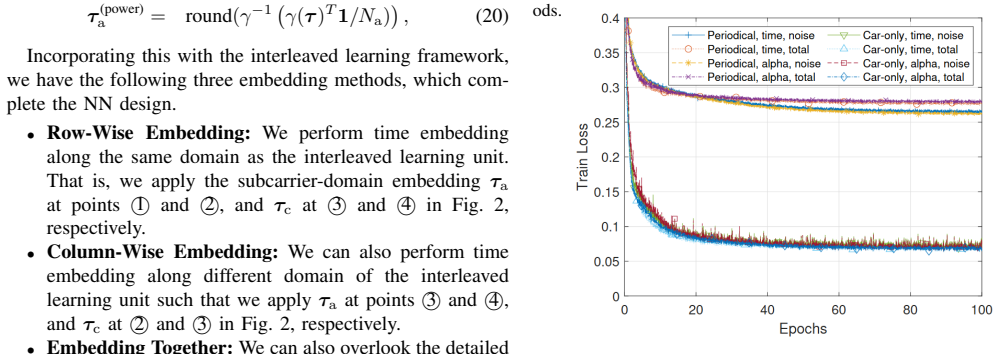
- The training noise pattern strongly affects generation: a model trained on a mix of patterns ('All') generalizes best, while training on one specific pattern can overfit and degrade recovery under other initializations.
Reading between the lines
- A direct corollary of the paper's framework, not explored there, is that the same element-wise reliability-map initialization should apply beyond wireless channels to any inverse problem with a known per-element confidence mask, such as image inpainting, radio map reconstruction, or accelerated MRI-style partial observations.
- The observed advantage of water-filling stepping suggests that the stepping path is a free design parameter; a testable extension is to optimize the path by minimizing an estimate of the per-element denoising error of the learned network rather than fixing water-filling a priori.
- The theorem guarantees distribution preservation relative to a matching starting marginal, but the algorithm's initialization in Eq. (14) does not generally satisfy that condition; quantifying this gap by comparing empirical noise variance at initialization with beta^2 at the scheduled alpha would clarify how much of the practical performance rests on the theorem versus the network's robustness.
- The paper leaves the row/column embedding puzzle open; one plausible explanation worth testing is that column-wise embedding provides a more consistent reliability context per operational dimension, which could be probed with ablations on synthetic noise maps.
Editorial analysis
A structured set of objections, weighed in public.
Referee Report
Summary. The paper proposes 'non-identical diffusion,' a diffusion model in which the noise level is described by an element-wise time matrix rather than a scalar. It defines a forward SDE with elementwise decay factors α_t, states Theorem 1 giving the marginal law as α_t∘H0+β_t∘ξ, and states Theorem 2 claiming that the DDIM-like ODE with the conditional-expectation denoiser maps the marginal φ_{T−t0} to the data distribution μ. The paper then introduces training and generation algorithms for this framework, a dimension-wise time-embedding scheme for MIMO-OFDM channel matrices, and numerical experiments comparing identical and non-identical diffusion under several pilot-like noise patterns.
Significance. If the theoretical claim is repaired, the paper proposes a natural and potentially useful extension of DDIM to settings where different elements of an observation have different reliabilities; MIMO-OFDM channel recovery with pilot-based nonuniform error is a reasonable application. The paper is also commendably broad empirically: it reports 48 training experiments, several training noise patterns, multiple generation schedulers, and an anonymous code link. However, as written, the central theorem is not proven and the proposed initialization does not satisfy the theorem's hypothesis. These issues are load-bearing and must be corrected before the theoretical or algorithmic claims can be accepted.
major comments (3)
- [Appendix A, Eqs. (24)-(26)] The proof of Theorem 2 is invalid as written. After Eq. (23), the expectation of the integral should contain ψ_s, not ψ_t0; the continuity equation for the density under the ODE flow is ψ_t = ψ_t0 − ∫_{t0}^t div(b_s ψ_s) ds. Eq. (25) instead places ψ_t0 inside the s-integral, and Eq. (26) repeats the same freezing for φ. Consequently the Gronwall estimate in Eq. (28) controls a quantity that is not the true φ_t, and the conclusion φ_t=0 does not follow. The result may be repairable via a standard probability-flow/Fokker-Planck argument, but this appendix does not provide that proof.
- [Section IV-A and Algorithm 2, Eqs. (14)-(16)] The initialization used in generation does not satisfy Theorem 2's hypothesis. From Eq. (14), eH(0) = Hbar/(M+1) = [M/(M+1)]∘H + [1/(M+1)]∘z with z∼CN(0,I), so its per-element noise variance is 1/(M+1)^2. At the assigned time τ0=γ^{-1}(M/(M+1)), the forward marginal has β^2=1−(M/(M+1))^2=(2M+1)/(M+1)^2. These differ, so G_t0 is not distributed as φ_{T−t0}. A consistent elementwise choice would be to divide by sqrt(M^2+1) and set τ0=γ^{-1}(M/sqrt(M^2+1)), but the manuscript does not make this choice.
- [Section V-C, Fig. 7, Tables II-III] The empirical comparison is partly circular. The non-identical configuration used in Fig. 7 is described as 'chosen based on prior experiments,' but no validation/test split is specified, so it is unclear whether the same test initializations were used for model selection. Similarly, Table III evaluates the 'All' training pattern on all test patterns and reports the best final numbers; without an explicit validation procedure, this is close to selecting the model on the test set. The claim that non-identical diffusion 'remarkably outperforms' identical diffusion is therefore not established at the reported level of rigor.
minor comments (5)
- [Section II-A, Theorem 1] The proof of Theorem 1 is only outlined. The result is elementary, but since it is foundational for Theorem 2, a full Fokker-Planck verification should be included for self-containedness.
- [Section IV-B] The notation around τ_c and τ_a is confusing: τ_c is called 'subcarrier-domain mapping' but is obtained by averaging over subcarriers. Please clarify the terminology and check the placement of the embeddings in the Row-Wise, Column-Wise, and Embedding Together bullets.
- [Algorithm 2] The relation between the velocity parameterization and the denoiser, D_α(g)=α∘g−β∘f(g,τ;θ), appears only as a comment in the algorithm. It should be stated and justified in the main text, since the algorithm's correctness depends on it.
- [Tables II and III] Please state explicitly that the reported values are NMSE and describe how they are averaged over the test set and over random realizations of the noise initialization.
- [Throughout] Minor typos and inconsistencies: Appendix A writes 't ∈ [to, T]' where t0 is meant; Section V-C2 says 'four kinds of noise initialization' while the settings list six patterns; the proof of Theorem 2 assumes an exact denoiser D and compact support, which the paper acknowledges in Section II, but a sentence explicitly stating that Theorem 2 applies to the ideal D_α and not to the trained network would prevent overclaiming.
Circularity Check
No circularity in the core derivation; Theorem 2 is a self-contained extension of the DDIM probability-flow argument and does not reduce to its assumptions. Minor self-citations and test-set-based configuration choices are present but are not load-bearing circularity.
full rationale
The central theoretical claim, Theorem 2, is a marginal-preservation statement for the ODE (5) given that the process starts at the forward marginal. The proof derives the conclusion from the Fokker-Planck/continuity equation and an external uniqueness lemma [31]; it does not define the conclusion into the premises. The non-identical construction in Definition 1 is a componentwise generalization of standard DDIM, and Theorem 1 explicitly gives the forward marginal law, so the hypothesis G_t0 ~ phi^alpha_{T-t0} is not the same as the conclusion G_t ~ phi^alpha_{T-t}. The application initialization (15)-(16) uses the reliability map M to set the starting time; this is side information, not a fitted parameter, so the measured NMSE against held-out H is not forced by construction. The empirical comparison does select the non-identical configuration "based on prior experiments" (Sec. V-C2) and evaluates on the same test initializations, which is a test-set-selection concern, but it is not an equation-level reduction and does not make the reported improvement circular in the sense of this analysis. Self-citations [25], [29] are used for the backbone architecture and experimental protocol, not to establish the central correctness claim. Two non-circular correctness caveats are worth explicit flagging: (i) Appendix A's integral equation (25) freezes the density at psi_t0 in the s-integral, which appears to invalidate the Gronwall argument as written; (ii) Algorithm 2's starting point has noise variance (M+1)^{-2}, while the forward process at alpha=M/(M+1) has variance 1-(M/(M+1))^2, so the initialization does not in general satisfy the theorem's marginal hypothesis. These are proof/implementation gaps, not circularity.
Assumptions & free parameters
free parameters (5)
- stochasticity coefficient epsilon =
0.4
- hybrid stepping mixing coefficient epsilon_hybrid =
0.3, 0.5, 0.7; water-filling (0) performs best
- training noise-pattern distributions =
period ranges 4-20 subcarriers, 4-10 antennas; car-only pattern
- default SNR per initialization pattern =
-10, -5, 0, 0, 10, 10 dB for White, Exp, Salt, Salt-Rec, Pilot, Pilot-Car
- number of generation steps NG =
50
assumptions (5)
- standard math Itô SDE and Fokker-Planck theory, including existence and uniqueness of ODE solutions under Lipschitz and linear growth conditions
- domain assumption The data distribution mu is bounded with compact support
- domain assumption The initial channel estimate satisfies Hbar - M circle H ~ CN(0, I) with M known exactly
- domain assumption The trained neural network f approximates the conditional expectation D^alpha_t through velocity parameterization
- domain assumption alpha_t is componentwise non-increasing, differentiable, alpha_0 = 1, and lim_{t -> T} alpha_t = 0
invented entities (2)
-
element-wise time matrix tau
-
non-identical diffusion process
Cite this review
Pith. "Pith review of Non-Identical Diffusion Models in MIMO-OFDM Channel Generation." pith.science (2026). https://pith.science/paper/ARFX2LQZ
@misc{pith2026250901641,
  author       = {Pith},
  title        = {Pith review of: Non-Identical Diffusion Models in MIMO-OFDM Channel Generation},
  year         = {2026},
  howpublished = {\url{https://pith.science/paper/ARFX2LQZ}},
  note         = {Machine review of arXiv:2509.01641}
}
read the original abstract
We propose a novel diffusion model, termed the non-identical diffusion model, and investigate its application to wireless orthogonal frequency division multiplexing (OFDM) channel generation. Unlike the standard diffusion model that uses a scalar-valued time index to represent the global noise level, we extend this notion to an element-wise time indicator to capture local error variations more accurately. Non-identical diffusion enables us to characterize the reliability of each element (e.g., subcarriers in OFDM) within the noisy input, leading to improved generation results when the initialization is biased. Specifically, we focus on the recovery of wireless multi-input multi-output (MIMO) OFDM channel matrices, where the initial channel estimates exhibit highly uneven reliability across elements due to the pilot scheme. Conventional time embeddings, which assume uniform noise progression, fail to capture such variability across pilot schemes and noise levels. We introduce a matrix that matches the input size to control element-wise noise progression. Following a similar diffusion procedure to existing methods, we show the correctness and effectiveness of the proposed non-identical diffusion scheme both theoretically and numerically. For MIMO-OFDM channel generation, we propose a dimension-wise time embedding strategy. We also develop and evaluate multiple training and generation methods and compare them through numerical experiments.
Figures


Figures from the paper (4 more)


Reference graph
Works this paper leans on
-
[1]
Denoising diffusion probabilis- tic models,
J. Ho, A. Jain, and P. Abbeel, “Denoising diffusion probabilis- tic models,” in Proc. 34th Int. Conf. Neural Inform. Process. Syst. (NeurIPS) , Red Hook, NY , USA, 2020, pp. 1–12
work page 2020
-
[2]
Denoising diffusion implicit models,
J. Song, C. Meng, and S. Ermon, “Denoising diffusion implicit models,” arXiv preprint arXiv:2010.02502 , 2020
arXiv 2010
-
[3]
Versatile diffusion: Text, images and variations all in one diffusion model,
X. Xu, Z. Wang, G. Zhang, et al. , “Versatile diffusion: Text, images and variations all in one diffusion model,” in Proc. IEEE/CVF Int. Conf. Comput. Vis. (ICCV) , 2023, pp. 7754– 7765
work page 2023
-
[4]
IRDM: A generative diffusion model for indoor radio map interpolation,
K. Qiu, S. Bakirtzis, I. Wassell, et al. , “IRDM: A generative diffusion model for indoor radio map interpolation,” in IEEE Global Commun. Conf. (Globecom) , IEEE, 2023, pp. 01–06
work page 2023
-
[5]
RF-Diffusion: Radio signal generation via time-frequency diffusion,
G. Chi, Z. Yang, C. Wu, et al. , “RF-Diffusion: Radio signal generation via time-frequency diffusion,” in Proc. 30th Annu. Int. Conf. Mobile Comput. Netw. (MobiCom) , 2024, pp. 77–92
work page 2024
-
[6]
Diffusion-based gen- erative prior for low-complexity MIMO channel estimation,
B. Fesl, M. Baur, F. Strasser, et al. , “Diffusion-based gen- erative prior for low-complexity MIMO channel estimation,” IEEE Wireless Commun. Lett. , vol. 13, no. 12, pp. 3493–3497, Dec. 2024, ISSN : 2162-2345. DOI: 10.1109/LWC.2024.34745 70
-
[7]
MIMO channel estimation using score-based generative models,
M. Arvinte and J. I. Tamir, “MIMO channel estimation using score-based generative models,” IEEE Trans. Wireless Com- mun., vol. 22, no. 6, pp. 3698–3713, Jun. 2023, ISSN : 1558-
work page 2023
-
[8]
Diffusion models: A comprehensive survey of methods and applications,
L. Yang, Z. Zhang, Y . Song, et al. , “Diffusion models: A comprehensive survey of methods and applications,” ACM Comput. Surv., vol. 56, no. 4, pp. 1–39, 2023
work page 2023
Show all 32 references
-
[9]
An overview of diffusion models: Applications, guided generation, statistical rates and optimization,
M. Chen, S. Mei, J. Fan, et al. , “An overview of diffusion models: Applications, guided generation, statistical rates and optimization,” arXiv preprint arXiv:2404.07771 , 2024
2024 arXiv
-
[10]
Repaint: Inpainting using denoising diffusion probabilistic models,
A. Lugmayr, M. Danelljan, A. Romero, et al. , “Repaint: Inpainting using denoising diffusion probabilistic models,” in Proc. IEEE/CVF Conf. Comput. Vis. Pattern Recognit. (CVPR), 2022, pp. 11 461–11 471
2022
-
[11]
Latentpaint: Image inpainting in latent space with diffusion models,
C. Corneanu, R. Gadde, and A. M. Martinez, “Latentpaint: Image inpainting in latent space with diffusion models,” in Proc. IEEE/CVF Winter Conf. Appl. Comput. Vis. (WACV) , 2024, pp. 4334–4343
2024
-
[12]
Image inpainting via tractable steering of diffusion models,
A. Liu, M. Niepert, and G. V . d. Broeck, “Image inpainting via tractable steering of diffusion models,” arXiv preprint arXiv:2401.03349, 2023
2023 arXiv
-
[13]
Imagic: Text-based real image editing with diffusion models,
B. Kawar, S. Zada, O. Lang, et al. , “Imagic: Text-based real image editing with diffusion models,” in Proc. IEEE/CVF Conf. Comput. Vis. Pattern Recognit. (CVPR), 2023, pp. 6007– 6017
2023
-
[14]
Diffusion model-based image editing: A survey,
Y . Huang, J. Huang, Y . Liu, et al. , “Diffusion model-based image editing: A survey,” IEEE Trans. Pattern Anal. Mach. Intell., 2025
2025
-
[15]
Inversion-based style transfer with diffusion models,
Y . Zhang, N. Huang, F. Tang, et al. , “Inversion-based style transfer with diffusion models,” in Proc. IEEE/CVF Conf. Comput. Vis. Pattern Recognit. (CVPR) , 2023, pp. 10 146– 10 156
2023
-
[16]
RADiff: Controllable diffusion models for radio astronomical maps generation,
R. Sortino, T. Cecconello, A. DeMarco, et al. , “RADiff: Controllable diffusion models for radio astronomical maps generation,” IEEE Trans. Artif. Intell. , 2024
2024
-
[17]
RM-Gen: Conditional diffusion model-based radio map generation for wireless net- works,
X. Luo, L. Zhizhen, Z. Peng, et al. , “RM-Gen: Conditional diffusion model-based radio map generation for wireless net- works,” in IFIP Networking Conference (IFIP Networking) , IEEE, 2024, pp. 543–548
2024
-
[18]
RadioDiff: An effective generative diffusion model for sampling-free dynamic radio map construction,
X. Wang, K. Tao, N. Cheng, et al. , “RadioDiff: An effective generative diffusion model for sampling-free dynamic radio map construction,” IEEE Trans. Cogn. Commun. Netw. , 2024
2024
-
[19]
An introduction to deep learning for the physical layer,
T. O’Shea and J. Hoydis, “An introduction to deep learning for the physical layer,” IEEE Trans. Cogn. Commun. Netw., vol. 3, no. 4, pp. 563–575, 2017. DOI: 10.1109/TCCN.2017.2758370
2017
-
[20]
A comprehensive survey of knowledge-driven deep learning for intelligent wireless network optimization in 6G,
R. Sun, N. Cheng, C. Li, et al. , “A comprehensive survey of knowledge-driven deep learning for intelligent wireless network optimization in 6G,” IEEE Commun. Surv. Tutor . , pp. 1–1, 2025. DOI: 10.1109/COMST.2025.3574765
2025
-
[21]
F. Zhu, X. Wang, X. Li, et al. , Wireless large AI model: Shaping the AI-native future of 6G and beyond , 2025. arXiv: 2504.14653. [Online]. Available: https://arxiv.org/abs/2504.1 4653
2025 arXiv
-
[22]
High dimensional channel estimation using deep generative networks,
E. Balevi, A. Doshi, A. Jalal, et al., “High dimensional channel estimation using deep generative networks,” IEEE J. Sel. Areas Commun., vol. 39, no. 1, pp. 18–30, 2020
2020
-
[23]
Diffusion model based channel estimation,
X. Ma, Y . Xin, Y . Ren, et al., “Diffusion model based channel estimation,” in IEEE Int. Conf. Commun. (ICC Workshops) , Jun. 2024, pp. 1159–1164. DOI: 10.1109/ICCWorkshops5955 1.2024.10615282
2024
-
[24]
Joint channel estimation and data detection in massive MIMO systems based on diffusion models,
N. Zilberstein, A. Swami, and S. Segarra, “Joint channel estimation and data detection in massive MIMO systems based on diffusion models,” in IEEE Int. Conf. Acoust., Speech, Signal Process. (ICASSP), Apr. 2024, pp. 13 291–13 295. DOI: 10.1109/ICASSP48485.2024.10446413
2024
-
[25]
Generative diffusion receivers: Achieving pilot-efficient MIMO-OFDM communi- cations,
Y . Yang, O. Alhussein, A. Arani, et al. , “Generative diffusion receivers: Achieving pilot-efficient MIMO-OFDM communi- cations,” arXiv preprint arXiv:2506.18419 , 2025
2025
-
[26]
Channel mapping based on interleaved learning with complex-domain MLP-Mixer,
Z. Chen, Z. Zhang, Z. Yang, et al., “Channel mapping based on interleaved learning with complex-domain MLP-Mixer,” IEEE Wireless Commun. Lett. , vol. 13, no. 5, pp. 1369–1373, 2024
2024
-
[27]
Improved denoising diffu- sion probabilistic models,
A. Q. Nichol and P. Dhariwal, “Improved denoising diffu- sion probabilistic models,” in Proc. Int. Conf. Mach. Learn. (ICML), PMLR, 2021, pp. 8162–8171
2021
-
[28]
Progressive distillation for fast sam- pling of diffusion models,
T. Salimans and J. Ho, “Progressive distillation for fast sam- pling of diffusion models,” in Proc. Int. Conf. Neural Inform. Process. Syst. (NeurIPS) , vol. 35, Curran Associates, Inc., 2022, pp. 17 870–17 881
2022
-
[29]
A hybrid inference archi- tecture incorporating neural network with belief propagation for AI receivers,
Y . Yang, Z. Zhang, Z. Chen, et al., “A hybrid inference archi- tecture incorporating neural network with belief propagation for AI receivers,” IEEE Trans. Wireless Commun., 2025, Early Access. DOI: 10.1109/TWC.2025.3552818
2025
-
[30]
DeepMIMO: A generic deep learning dataset for millimeter wave and massive MIMO applications,
A. Alkhateeb, “DeepMIMO: A generic deep learning dataset for millimeter wave and massive MIMO applications,” arXiv preprint arXiv:1902.06435, 2019
1902 arXiv
-
[31]
New algorithms for sampling and diffusion mod- els,
X. Zhang, “New algorithms for sampling and diffusion mod- els,” arXiv preprint arXiv:2406.09665 , 2024
2024 arXiv
-
[2248]
DOI: 10.1109/TWC.2022.3220784
2022
Reviewed August 5, 2026 · model on record in the stance chip above.
Discussion (0). Sign in to comment.