REVIEW 4 major objections 4 minor 41 references
BM-CL: Bias Mitigation through the lens of Continual Learning
T0 review · 4 major / 4 minor · reviewed 2026-08-05 · deepseek-v4-flash
Pith's one-line read Framing bias mitigation as a continual-learning problem lets a model improve its worst-off groups without the usual drop in performance for the already-best groups.
desk verdict A simple, modular two-stage recipe—LwF/EWC on top of GroupDRO/ReSample—delivers a consistent reduction in leveling-down on three benchmarks; the main gaps are reporting and the single-group LDE metric, not the core result. read the letter →
The pith
A machine-rendered reading of the paper's core claim, the machinery that carries it, and where it could break.
The reading
What carries the argument
Two-stage fine-tuning with a protected split. Stage 1: ERM is trained for a fraction rho of epochs, then each group is labeled best or worst by comparing its accuracy to the balanced-accuracy threshold tau (Eqs. 2–3). Stage 2: the model is fine-tuned with the objective L_BM(theta) + lambda * L_CL(theta) (Eq. 4), where L_BM is a standard bias-mitigation loss and L_CL is either LwF's KL distillation between old and current softmax predictions on best-group samples (Eqs. 5–6) or EWC's Fisher-weighted quadratic penalty on deviations from the stage-1 weights (Eq. 7). The machinery's job is to let the gradient from the mitigation loss improve worst groups while the regularizer prevents the same gr
What would settle it
Take a dataset where the group that is worst at the rho checkpoint later becomes best under full ERM training; if BM-CL still anchors on the early split and protects the group that is no longer advantaged, its leveling-down advantage should shrink or invert compared to a version that re-computes the split at the end of fine-tuning.
Extended reading notes
Core claim
The central claim is that the leveling-down effect in bias mitigation is a manifestation of catastrophic forgetting. The paper operationalizes this by defining best and worst groups from a partially trained ERM (pretraining ratio rho, group accuracies compared with the balanced-accuracy threshold tau), then fine-tuning with L = L_BM + lambda * L_CL. L_BM (GroupDRO or ReSample) pushes worst-group performance up; L_CL (KL distillation on best-group samples for LwF, or Fisher-weighted parameter anchoring for EWC) keeps best-group knowledge in place. On all three datasets, at least one BM-CL variant achieves the smallest leveling-down effect relative to ERM, with worst-group improvements compara
Load-bearing premise
The whole procedure depends on the Gbest/Gworst split computed from a partially trained model being the right split to protect; if that split is wrong or shifts during fine-tuning, the method preserves the wrong knowledge and its reported advantage could be an artifact of the split.
Editorial extensions
If this is right
- With the right CL regularizer, bias mitigation can improve worst-group accuracy without the usual best-group penalty: the paper's LwF variants keep best-group accuracy within about 0.2–2.8 points of ERM across datasets.
- The two-stage scheme turns any bias-mitigation loss into a continual-learning objective, so the fairness toolkit expands by the whole CL toolbox.
- Because LwF only needs stored outputs from stage 1, it gives most of the protection at lower computational cost than EWC's Fisher information estimate.
- The leveling-down effect is not an unavoidable law of fairness intervention; it behaves like a forgetting problem that can be regularized away.
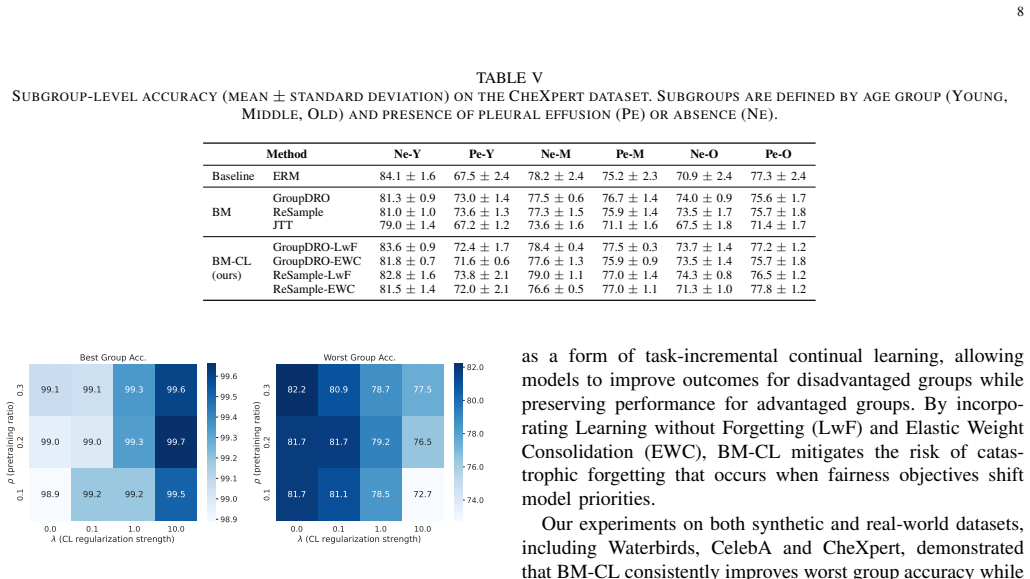
- In medical imaging (CheXpert), where harming any patient group is ethically fraught, BM-CL improves the worst age group while keeping the best age group close to baseline.
Reading between the lines
- Extension: the same recipe should work when L_BM is swapped for other mitigation losses (adversarial debiasing, logit adjustment, post-hoc methods), since the regularizer is agnostic to L_BM; the paper only tests GroupDRO and ReSample.
- The fixed Gbest/Gworst split invites a stress test: on datasets where group ranking changes during fine-tuning, protecting the original best groups could freeze a stale advantage; re-estimating the partition periodically would reveal whether BM-CL's edge survives.
- If leveling-down is truly forgetting, then rehearsal-based CL (storing and replaying Gbest samples) should behave similarly to LwF/EWC; comparing them would separate the forgetting explanation from a pure distillation effect.
- The pretraining ratio rho matters mainly when regularization is strong, which suggests an interaction that could be tuned per dataset; the paper does not propose an automatic way to set rho.
Editorial analysis
A structured set of objections, weighed in public.
Referee Report
Summary. The paper proposes BM-CL, a two-stage framework that treats bias mitigation as a continual learning problem. In stage 1, an ERM model is trained for a fraction rho of the total epochs, and validation accuracies are used to partition groups into Gbest and Gworst. In stage 2, the model is fine-tuned with a bias-mitigation objective (GroupDRO or ReSample) plus a continual-learning regularizer (LwF distillation on Gbest samples, or EWC with Fisher importance computed on Gbest). Experiments on Waterbirds, CelebA, and CheXpert compare BM-CL variants against ERM, GroupDRO, ReSample, and JTT. The central empirical claim is that BM-CL consistently yields the smallest leveling-down effect on the best group while retaining worst-group gains comparable to state-of-the-art mitigation methods, interpreted as positive-sum fairness.
Significance. The paper addresses a relevant fairness problem, and the analogy between catastrophic forgetting and leveling down is intuitive and potentially useful. Strengths include released code, 5-seed runs, subgroup-level accuracy tables, and coverage of three datasets with different bias mechanisms. If the empirical claim holds, BM-CL would be a simple plug-in regularizer for existing bias-mitigation losses, with practical value. However, the headline result depends on several under-reported choices (pretraining ratio, group partition stability, and the metric used to measure leveling down), so the significance is conditional on the revisions below.
major comments (4)
- [Section II-B.1 and Table II] The pretraining ratio rho used for the main experiments is not reported anywhere. The stage-1 partially trained model defines Gbest/Gworst and the anchor for LwF/EWC, so the reported LDE is relative to a converged ERM but protects the groups and weights of an early model. The ablation in Section IV-B varies rho only on Waterbirds, with 3 runs, and never checks whether the group partition is stable across rho or matches the converged ERM partition. Please report rho for every dataset and add a stability analysis (e.g., group-rank correlation or Gbest overlap across epochs/rho). Without this, the small LDE could be an artifact of protecting a transient group set.
- [Section II-B.1 vs Table II] The LDE metric is defined for only the single highest-accuracy group ('Best Group'), whereas LwF/EWC and the stated goal apply to all groups in Gbest. On CelebA, ERM places Nh-F, Bh-F, and Nh-M in Gbest; Table IV shows GroupDRO-LwF drops Nh-F by 3.4 points (95.7 to 92.3), while Table II's LDE reports only 2.8 for the top group Nh-M. Thus the 'smallest degradation in best-group accuracy' claim overstates preservation of the full advantaged set. Report accuracy and LDE averaged over all Gbest groups, or list each member, and adjust the claim accordingly.
- [Section IV-A/Table II] The LDE and IW columns are point estimates computed from the means without propagated uncertainty. Several comparisons are close (e.g., Waterbirds LDE 0.5 vs 0.2; CheXpert LDE 0.5 vs 1.3) and the reported standard deviations overlap. Please propagate errors or provide paired differences across seeds so that the ordering of methods is statistically supported. This is load-bearing for the central claim that BM-CL has the smallest leveling-down effect.
- [Section IV-B and Implementation details] No values are given for the hyperparameters actually used in Table II (rho, lambda, T; and the lambda scaling for EWC). The validation-based selection is described, but the selected values are absent, preventing reproduction of the central results. Please include a full hyperparameter table per dataset and method, and extend the ablation to at least one more dataset or to the EWC variant, rather than only GroupDRO-LwF on Waterbirds.
minor comments (4)
- [Abstract and Section III] The abstract and introduction mention 'synthetic and real-world datasets,' but Section III contains no synthetic dataset. Either add such an experiment or remove the word 'synthetic.'
- [Abstract and Section V] Terminology is inconsistent: the abstract says 'domain-incremental continual learning,' while the conclusion says 'task-incremental continual learning.' Clarify which scenario is intended.
- [Section IV-B and Fig. 4] Typos: 'pretaining' should be 'pretraining' in the section heading; Fig. 4 labels the y-axis 'wort-performing,' which should be 'worst-performing.'
- [Table II] The arrow convention is unclear: 'LDE' is better with a down arrow (lower is better) and 'IW' with an up arrow. Also clarify in the caption that blue highlighting marks the smallest degradation, not the best absolute value.
Circularity Check
No significant circularity: BM-CL is an empirical combination of standard CL regularizers and bias-mitigation losses, evaluated against external baselines.
full rationale
The paper is an empirical methods paper. It proposes a two-stage objective (Eq. 4) that combines an existing bias-mitigation loss (GroupDRO or ReSample) with a standard continual-learning regularizer (LwF or EWC, Eqs. 5-7). The downstream evaluation compares BM-CL against ERM, GroupDRO, ReSample, and JTT on three datasets with fixed group identities determined by the ERM baseline. No theoretical prediction is derived from the method; the claims are supported by measured accuracies. The fact that the LwF/EWC regularizers are designed to preserve the best-performing groups and that the leveling-down metric measures exactly that preservation is a design alignment, not a circular reduction: the losses optimize logit/parameter stability, not the accuracy-difference metric directly, and the empirical contribution lies in showing that the preservation can be achieved without sacrificing worst-group gains relative to existing methods. The self-citations (refs. 4, 19, 20) are background on fairness in medical imaging and are not load-bearing for any uniqueness or derivation claim. The unreported pretraining ratio rho and the reliance on a partially trained ERM to define Gbest/Gworst are potential robustness concerns but not circularity: the split is used as an evaluation scaffold, not as a fitted quantity being relabeled as a prediction. Overall score 0.
Assumptions & free parameters
free parameters (3)
- lambda (CL regularization strength) =
Not reported per dataset; grid 0.0, 0.1, 1.0, 10.0 (x1000 for EWC) on Waterbirds
- rho (pretraining ratio) =
Not reported per dataset; evaluated at 0.1, 0.2, 0.3 on Waterbirds
- T (LwF temperature) =
Not reported
assumptions (4)
- domain assumption ERM fits advantaged groups faster than disadvantaged groups, so early stopping at rho gives an informative Gbest/Gworst split.
- domain assumption The balanced-accuracy threshold tau (Eq. 3) separates groups into stable, disjoint best/worst sets.
- domain assumption KL distillation (LwF) and Fisher-based quadratic penalty (EWC), applied only to Gbest samples, preserve best-group knowledge during fine-tuning.
- standard math Fisher information computed on best-group samples estimates parameter importance for those groups.
Cite this review
Pith. "Pith review of BM-CL: Bias Mitigation through the lens of Continual Learning." pith.science (2026). https://pith.science/paper/OFQZPGI4
@misc{pith2026250901730,
  author       = {Pith},
  title        = {Pith review of: BM-CL: Bias Mitigation through the lens of Continual Learning},
  year         = {2026},
  howpublished = {\url{https://pith.science/paper/OFQZPGI4}},
  note         = {Machine review of arXiv:2509.01730}
}
read the original abstract
Biases in machine learning pose significant challenges, particularly when models amplify disparities that affect disadvantaged groups. Traditional bias mitigation techniques often lead to a {\itshape leveling-down effect}, whereby improving outcomes of disadvantaged groups comes at the expense of reduced performance for advantaged groups. This study introduces Bias Mitigation through Continual Learning (BM-CL), a novel framework that leverages the principles of continual learning to address this trade-off. We postulate that mitigating bias is conceptually similar to domain-incremental continual learning, where the model must adjust to changing fairness conditions, improving outcomes for disadvantaged groups without forgetting the knowledge that benefits advantaged groups. Drawing inspiration from techniques such as Learning without Forgetting and Elastic Weight Consolidation, we reinterpret bias mitigation as a continual learning problem. This perspective allows models to incrementally balance fairness objectives, enhancing outcomes for disadvantaged groups while preserving performance for advantaged groups. Experiments on synthetic and real-world image datasets, characterized by diverse sources of bias, demonstrate that the proposed framework mitigates biases while minimizing the loss of original knowledge. Our approach bridges the fields of fairness and continual learning, offering a promising pathway for developing machine learning systems that are both equitable and effective.
Figures


Figures from the paper (1 more)
Reference graph
Works this paper leans on
-
[24]
N. Churamani, O. Kara, and H. Gunes, “Domain-incremental contin- ual learning for mitigating bias in facial expression and action unit recognition,” IEEE Transactions on Affective Computing , vol. 14, no. 4, pp. 3191–3206, 2022
work page 2022
-
[25]
Bi- aspruner: Debiased continual learning for medical image classifica- tion,
N. Bayasi, J. Fayyad, A. Bissoto, G. Hamarneh, and R. Garbi, “Bi- aspruner: Debiased continual learning for medical image classifica- tion,” in International Conference on Medical Image Computing and Computer-Assisted Intervention, pp. 90–101, Springer, 2024
work page 2024
-
[1]
Gender shades: Intersectional accuracy disparities in commercial gender classification,
J. Buolamwini and T. Gebru, “Gender shades: Intersectional accuracy disparities in commercial gender classification,” in Conference on fair- ness, accountability and transparency , pp. 77–91, PMLR, 2018
work page 2018
-
[2]
A survey on bias and fairness in machine learning,
N. Mehrabi, F. Morstatter, N. Saxena, K. Lerman, and A. Galstyan, “A survey on bias and fairness in machine learning,” ACM computing surveys (CSUR), vol. 54, no. 6, pp. 1–35, 2021
work page 2021
-
[3]
MEDFAIR: Benchmarking Fairness for Medical Imaging
Y . Zong, Y . Yang, and T. Hospedales, “Medfair: Benchmarking fairness for medical imaging,” arXiv preprint arXiv:2210.01725 , 2022
work page Pith review arXiv 2022
-
[4]
A. J. Larrazabal, N. Nieto, V . Peterson, D. H. Milone, and E. Fer- rante, “Gender imbalance in medical imaging datasets produces biased classifiers for computer-aided diagnosis,” Proceedings of the National Academy of Sciences , vol. 117, no. 23, pp. 12592–12594, 2020
work page 2020
-
[5]
On feature learning in the presence of spurious correlations,
P. Izmailov, P. Kirichenko, N. Gruver, and A. G. Wilson, “On feature learning in the presence of spurious correlations,” Advances in Neural Information Processing Systems , vol. 35, pp. 38516–38532, 2022
work page 2022
-
[6]
Spurious correlations in machine learning: A survey,
W. Ye, G. Zheng, X. Cao, Y . Ma, and A. Zhang, “Spurious correlations in machine learning: A survey,” arXiv preprint arXiv:2402.12715, 2024. 9
arXiv 2024
Show all 41 references
-
[7]
Leveling down in computer vision: Pareto inefficiencies in fair deep classifiers,
D. Zietlow, M. Lohaus, G. Balakrishnan, M. Kleindessner, F. Locatello, B. Sch¨olkopf, and C. Russell, “Leveling down in computer vision: Pareto inefficiencies in fair deep classifiers,” in Proceedings of the IEEE/CVF Conference on Computer Vision and Pattern Recognition , pp. ...
2022
-
[8]
The unfairness of fair machine learning: Levelling down and strict egalitarianism by default,
B. Mittelstadt, S. Wachter, and C. Russell, “The unfairness of fair machine learning: Levelling down and strict egalitarianism by default,” arXiv preprint arXiv:2302.02404 , 2023
2023 arXiv
-
[9]
Chen and B
Z. Chen and B. Liu, Lifelong machine learning . Morgan & Claypool Publishers, 2018
2018
-
[10]
Catastrophic forgetting in connectionist networks,
R. M. French, “Catastrophic forgetting in connectionist networks,” Trends in cognitive sciences , vol. 3, no. 4, pp. 128–135, 1999
1999
-
[11]
Overcoming catastrophic forgetting in neural networks,
J. Kirkpatrick, R. Pascanu, N. Rabinowitz, J. Veness, G. Desjardins, A. A. Rusu, K. Milan, J. Quan, T. Ramalho, A. Grabska-Barwinska, et al. , “Overcoming catastrophic forgetting in neural networks,” Pro- ceedings of the national academy of sciences, vol. 114, no. 13, pp. 3521...
2017
-
[12]
Learning without forgetting,
Z. Li and D. Hoiem, “Learning without forgetting,” IEEE transactions on pattern analysis and machine intelligence , vol. 40, no. 12, pp. 2935– 2947, 2017
2017
-
[13]
Machine bias,
J. Angwin, J. Larson, S. Mattu, and L. Kirchner, “Machine bias,” in Ethics of data and analytics, pp. 254–264, Auerbach Publications, 2022
2022
-
[14]
Underdiagnosis bias of artificial intelligence algorithms applied to chest radiographs in under-served patient populations,
L. Seyyed-Kalantari, H. Zhang, M. B. McDermott, I. Y . Chen, and M. Ghassemi, “Underdiagnosis bias of artificial intelligence algorithms applied to chest radiographs in under-served patient populations,” Nature medicine, vol. 27, no. 12, pp. 2176–2182, 2021
2021
-
[15]
Fairness through awareness,
C. Dwork, M. Hardt, T. Pitassi, O. Reingold, and R. Zemel, “Fairness through awareness,” in Proceedings of the 3rd innovations in theoretical computer science conference , pp. 214–226, 2012
2012
-
[16]
Why fairness cannot be automated: Bridging the gap between eu non-discrimination law and ai,
S. Wachter, B. Mittelstadt, and C. Russell, “Why fairness cannot be automated: Bridging the gap between eu non-discrimination law and ai,” Computer Law & Security Review , vol. 41, p. 105567, 2021
2021
-
[17]
Equality of opportunity in supervised learning,
M. Hardt, E. Price, and N. Srebro, “Equality of opportunity in supervised learning,” Advances in neural information processing systems , vol. 29, 2016
2016
-
[18]
Minimax group fairness: Algorithms and experiments,
E. Diana, W. Gill, M. Kearns, K. Kenthapadi, and A. Roth, “Minimax group fairness: Algorithms and experiments,” in Proceedings of the 2021 AAAI/ACM Conference on AI, Ethics, and Society , pp. 66–76, 2021
2021
-
[19]
Open challenges on fairness of artificial intelligence in medical imaging applications,
E. Ferrante and R. Echeveste, “Open challenges on fairness of artificial intelligence in medical imaging applications,” in Trustworthy AI in Medical Imaging, pp. 265–276, Elsevier, 2025
2025
-
[20]
Addressing fairness in artificial intelligence for medical imaging,
M. A. Ricci Lara, R. Echeveste, and E. Ferrante, “Addressing fairness in artificial intelligence for medical imaging,” nature communications, vol. 13, no. 1, p. 4581, 2022
2022
-
[21]
Ethical use of artificial intelligence in medical diagnostics demands a focus on accuracy, not fairness,
M. R. Sabuncu, A. Q. Wang, and M. Nguyen, “Ethical use of artificial intelligence in medical diagnostics demands a focus on accuracy, not fairness,” 2025
2025
-
[22]
Positive-sum fairness: Leveraging demographic attributes to achieve fair ai outcomes without sacrificing group gains,
S. Belhadj, S. Park, A. Seth, H. Dar, and T. Kooi, “Positive-sum fairness: Leveraging demographic attributes to achieve fair ai outcomes without sacrificing group gains,” in MICCAI Workshop on Fairness of AI in Medical Imaging, pp. 56–66, Springer, 2024
2024
-
[23]
A continual learning survey: Defying forgetting in classification tasks,
M. De Lange, R. Aljundi, M. Masana, S. Parisot, X. Jia, A. Leonardis, G. Slabaugh, and T. Tuytelaars, “A continual learning survey: Defying forgetting in classification tasks,” IEEE transactions on pattern analysis and machine intelligence , vol. 44, no. 7, pp. 3366–3385, 2021
2021
-
[26]
An overview of statistical learning theory,
V . N. Vapnik, “An overview of statistical learning theory,” IEEE trans- actions on neural networks , vol. 10, no. 5, pp. 988–999, 1999
1999
-
[27]
Distributionally robust neural networks for group shifts: On the importance of regular- ization for worst-case generalization,
S. Sagawa, P. W. Koh, T. B. Hashimoto, and P. Liang, “Distributionally robust neural networks for group shifts: On the importance of regular- ization for worst-case generalization,” arXiv preprint arXiv:1911.08731, 2019
1911 arXiv
-
[28]
Simple data balancing achieves competitive worst-group-accuracy,
B. Y . Idrissi, M. Arjovsky, M. Pezeshki, and D. Lopez-Paz, “Simple data balancing achieves competitive worst-group-accuracy,” inConference on Causal Learning and Reasoning , pp. 336–351, PMLR, 2022
2022
-
[29]
Just train twice: Improving group robustness without training group information,
E. Z. Liu, B. Haghgoo, A. S. Chen, A. Raghunathan, P. W. Koh, S. Sagawa, P. Liang, and C. Finn, “Just train twice: Improving group robustness without training group information,” in International Confer- ence on Machine Learning , pp. 6781–6792, PMLR, 2021
2021
-
[30]
Learning from failure: De- biasing classifier from biased classifier,
J. Nam, H. Cha, S. Ahn, J. Lee, and J. Shin, “Learning from failure: De- biasing classifier from biased classifier,”Advances in Neural Information Processing Systems, vol. 33, pp. 20673–20684, 2020
2020
-
[31]
Distilling the knowledge in a neural network,
G. Hinton, “Distilling the knowledge in a neural network,” arXiv preprint arXiv:1503.02531, 2015
2015 arXiv
-
[32]
D. J. MacKay, Information theory, inference and learning algorithms . Cambridge university press, 2003
2003
-
[33]
E. T. Jaynes, Probability theory: The logic of science . Cambridge university press, 2003
2003
-
[34]
Three scenarios for continual learning,
G. M. Van de Ven and A. S. Tolias, “Three scenarios for continual learning,” arXiv preprint arXiv:1904.07734 , 2019
1904 arXiv
-
[35]
A comprehensive survey of continual learning: theory, method and application,
L. Wang, X. Zhang, H. Su, and J. Zhu, “A comprehensive survey of continual learning: theory, method and application,” IEEE Transactions on Pattern Analysis and Machine Intelligence , 2024
2024
-
[36]
The caltech-ucsd birds-200-2011 dataset,
C. Wah, S. Branson, P. Welinder, P. Perona, and S. Belongie, “The caltech-ucsd birds-200-2011 dataset,” 2011
2011
-
[37]
Deep learning face attributes in the wild,
Z. Liu, P. Luo, X. Wang, and X. Tang, “Deep learning face attributes in the wild,” in Proceedings of the IEEE international conference on computer vision, pp. 3730–3738, 2015
2015
-
[38]
Chexpert: A large chest radiograph dataset with uncertainty labels and expert comparison,
J. Irvin, P. Rajpurkar, M. Ko, Y . Yu, S. Ciurea-Ilcus, C. Chute, H. Mark- lund, B. Haghgoo, R. Ball, K. Shpanskaya, et al. , “Chexpert: A large chest radiograph dataset with uncertainty labels and expert comparison,” in Proceedings of the AAAI conference on artificial intelli...
2019
-
[39]
Deep residual learning for image recognition,
K. He, X. Zhang, S. Ren, and J. Sun, “Deep residual learning for image recognition,” in Proceedings of the IEEE conference on computer vision and pattern recognition , pp. 770–778, 2016
2016
-
[40]
Imagenet large scale visual recognition challenge,
O. Russakovsky, J. Deng, H. Su, J. Krause, S. Satheesh, S. Ma, Z. Huang, A. Karpathy, A. Khosla, M. Bernstein, et al., “Imagenet large scale visual recognition challenge,” International journal of computer vision, vol. 115, pp. 211–252, 2015
2015
-
[41]
Automatic differentiation in pytorch,
A. Paszke, S. Gross, S. Chintala, G. Chanan, E. Yang, Z. DeVito, Z. Lin, A. Desmaison, L. Antiga, and A. Lerer, “Automatic differentiation in pytorch,” 2017
2017
Reviewed August 5, 2026 · model on record in the stance chip above.
Discussion (0). Continue with ORCID to comment.