REVIEW 4 major objections 6 minor 13 references
A communication-aware federated distillation scheme can fine-tune LLMs over wireless links with about half the traffic and higher accuracy.
Reviewed by Pith at T0; open to challenge. T0 means a machine referee read the full paper against a public rubric. the ladder, T0–T4 →
A federated distillation scheme combining channel-aware Top-k logit sparsification, sparsity-aware aggregation, and LoRA projection alignment cuts communication by about 50% while improving fine-tuning accuracy in a GPT-2 experiment.
T0 review reviewed 2026-08-05 challenge →
load-bearing objection Useful engineering combination of known distillation ingredients, but the headline accuracy-plus-~50%-communication claim isn't yet backed by a single paired experiment; worth a referee with a request for code, more datasets, and a corrected cost analysis. the 4 major comments →
Communication-Aware Knowledge Distillation for Federated LLM Fine-Tuning over Wireless Networks
The pith
A machine-rendered reading of the paper's core claim, the machinery that carries it, and where it could break.
The reading
Core claim
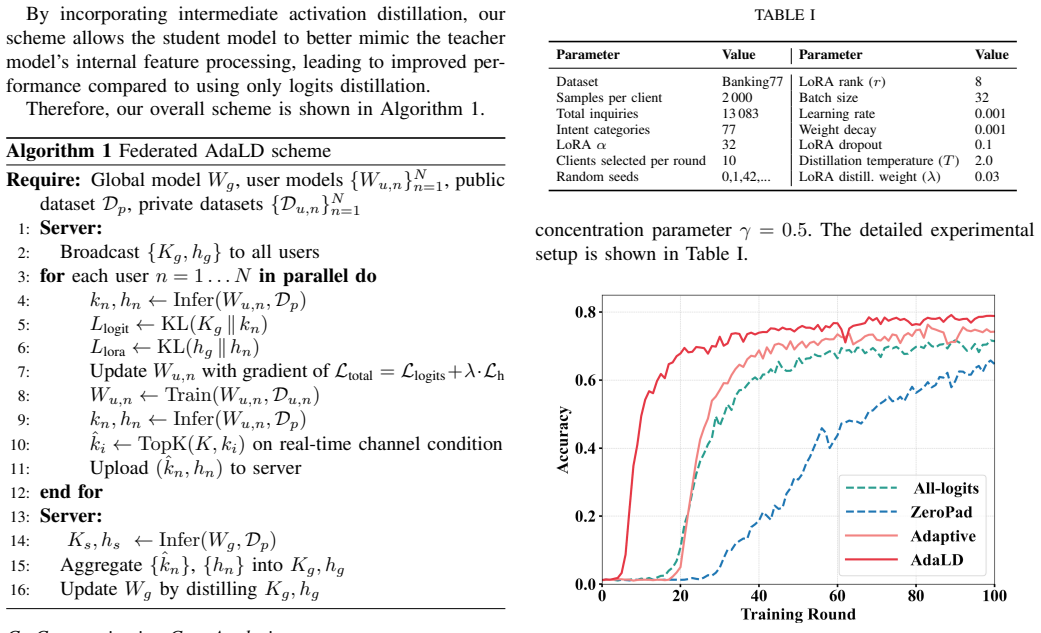
The paper claims that federated distillation between a server-side LLM and client-side small language models can be made communication-efficient and more accurate at the same time. It replaces full logit uploads with channel-adaptive Top-k sparsification, where each client keeps only its k most confident logit entries based on its current wireless capacity; it replaces zero-padding with a dimension-wise normalized aggregation that weights only the clients that actually transmitted a value for each dimension; and it adds a KL loss on the low-rank LoRA projection h=Ax to the standard logit KL loss. On Banking77 with 50 non-IID clients, GPT2-small clients, and a GPT2-large server, the combined
What carries the argument
The mechanism is a three-part distillation loop. Client-side, logits are sparsified by retaining the Top-k entries with k = floor(η·C·T/d), where η is the client's channel share, C is AWGN channel capacity, T is the per-round time budget, and d is bits per logit-index pair. Server-side, sparse logits are aggregated dimension-wise as K_{g,c} = Σ_n w_{n,c} K̃_{n,c} with w_{n,c} = |K̃_{n,c}| / S[c], so a dimension's global value comes only from clients that actually transmitted it, normalized by the total magnitude they uploaded. Separately, the LoRA adapter factors (A,B) produce a rank-r activation h=Ax per public sample; the paper feeds softmaxed h through the same temperature-scaled KL objec
Load-bearing premise
A rank-8 projection of a small client model and a large server model, taken from different backbones, is semantically comparable enough that a KL divergence between their softmaxed projections transfers useful knowledge; the paper offers no alignment test for this premise.
What would settle it
Train the same federation with the LoRA projection loss term removed (λ=0) and compare final accuracy. If the 0.85 result persists, the projection alignment is not responsible for the reported gain. Also, permute the dimensions of the server's h before computing KL; if accuracy does not drop, the loss is not using any true correspondence between the two projection spaces.
If this is right
- On the authors' experiments, AdaLD reaches the 0.79-accuracy target with 49.1 MB of total communication, versus 67.0 MB for adaptive aggregation alone and 99.5 MB for zero-padding; full-logit transmission needs over 2049.6 MB.
- Because the Top-k value is computed from each client's real-time Shannon capacity, the same method directly converts better channel conditions into deeper logit information without retraining.
- The dimension-wise normalization in Eq. (7) means that under non-IID data, clients with high confidence in a given class dominate that dimension's global soft label, which is why zero-padding's uniform averaging loses accuracy.
- Adding a LoRA projection loss gives per-sample messages of rank r (8) instead of vocabulary-sized logits, so the bottleneck moves from output dimension to a user-chosen rank.
- The scheme reaches its best accuracy earlier in training than any of the three baselines, so fewer communication rounds are needed to converge.
Where Pith is reading between the lines
- The paper evaluates L_logits and L_h jointly, so the pure contribution of the LoRA projection term is not isolated; a two-way ablation (with and without L_h, with and without adaptive aggregation) would separate the 0.85-versus-0.8 gain.
- The KL term on h assumes the rank-8 projections of differently sized models occupy comparable spaces; an affine or learned alignment head on h before the KL is a natural extension that could strengthen or falsify that assumption.
- Since Top-k selection transmits indices plus values, index compression or group sparsity is a testable follow-up that could push the communication saving below 50%.
- The same dimension-wise weighting could in principle be implemented as over-the-air aggregation, where sparse uploads combine in the wireless channel itself, reducing the protocol to almost no explicit uplink traffic in favorable conditions.
Editorial analysis
A structured set of objections, weighed in public.
Referee Report
Summary. The paper proposes AdaLD, a federated distillation framework for LLM fine-tuning over wireless networks. Clients fine-tune small language models with LoRA, sparsify their output logits via a channel-aware Top-k selection, and upload sparse logits along with low-rank LoRA projections h=Ax. The server aggregates the sparse logits using a sparsity-aware weighted scheme and distills both the aggregated logits and the LoRA projections into a server-side LLM. Experiments on Banking77 with GPT2-small clients and a GPT2-large server compare AdaLD with Adaptive aggregation, ZeroPad aggregation, and All-logits transmission, reporting higher final accuracy (0.85 vs. 0.8) and lower communication cost (49.1 MB vs. 67.0 MB at the 0.79 accuracy threshold).
Significance. If the results hold, AdaLD is a potentially useful contribution to communication-efficient federated LLM distillation. The proposed adaptive aggregation is a sensible alternative to zero-padding, and the channel-aware Top-k formulation ties sparsification to wireless link conditions. The paper provides a complete algorithmic description, a parameter table, and a comparison against three baselines, which are strengths. However, the evidence is not yet sufficient: the accuracy and communication results are obtained under different data distributions, the communication-cost model contains a dimensionally inconsistent formula, the LoRA-projection distillation relies on an unexamined representational-alignment assumption, and the empirical study lacks error bars, ablations, and reproducibility artifacts. These issues are fixable, but they currently block acceptance.
major comments (4)
- [Section IV, Figs. 2 and 3] The combined headline claim of 'higher accuracy + ~50% less communication' is not supported by a single paired experiment. Fig. 2 reports accuracy 'under a Non-IID data distribution,' while Fig. 3 states: 'Due to the large variance in communication under Non-IID settings, we report the results under the IID scenario for a fair comparison.' Thus, the 0.85-vs-0.8 accuracy advantage is measured in Non-IID, and the 49.1-MB-vs-67.0-MB communication advantage is measured in IID. Under Non-IID, the per-round Top-k sizes and the number of rounds to each threshold may differ, potentially changing the cost ranking; under IID, the accuracy ranking may differ. Please provide paired accuracy-versus-communication curves in the same setting (e.g., both IID and Non-IID), or explicitly present the two results as independent claims without the combined superiority statement.
- [Section III-C, communication cost analysis] The formula for the LoRA projection communication size is dimensionally inconsistent. The text states that each sample is associated with a low-dimensional vector of rank r, and then concludes that 'the total output size is (number of samples + r) * output dimension.' If h = Ax and h ∈ R^r per sample, the total size for |D_p| samples should be |D_p| × r, not (|D_p| + r) × output_dimension. As written, the formula mixes counts of samples and ranks and multiplies by a dimension that is not involved. Additionally, the analysis omits the cost of transmitting the dimension indices for the Top-k logits (only mentioned implicitly in Section II as k×d, where d includes one logit and its index) and does not count the cost of h in the total communication budget. Please derive the per-round byte count rigorously, including indices and both logits and projections, and use that corrected model in the
- [Section III-B, Eqs. (8)-(10); Section II; Table I] The LoRA-projection distillation assumes that the rank-r subspaces of different models are semantically aligned. Eq. (8) defines h = A x for the client, and Eq. (10) adds λ·L_h where L_h is a KL divergence between softmaxed h vectors. However, the teacher is GPT2-large and the student is GPT2-small, which have different hidden dimensions and layer counts; their LoRA factors are also initialized and trained independently. There is no evidence that the rank-8 projections live in a comparable semantic space, and applying softmax to h (which is an unbounded linear projection, not a logits vector) is an arbitrary construction. Please provide an alignment analysis or an ablation that replaces L_h with a random projection baseline, a fixed non-LoRA projection, or a Procrustes-aligned variant. Without such evidence, the claimed distinct contribution of the LoRA-projection term is not supported.
- [Table I and Fig. 2] The empirical evaluation is too limited to support the generality of the main claim. Only one dataset (Banking77) and one model family (GPT-2) are used, and the loss weight λ and temperature T are selected empirically, with λ reported in a range [0.03, 0.5] without sensitivity analysis. Although the paper states that results are averaged over three random seeds, Fig. 2 shows no error bars or confidence intervals. Consequently, it is unclear whether the reported 0.85-vs-0.8 accuracy gain is robust or an artifact of hyperparameter choices. Please add sensitivity curves for λ and T, error bars on the accuracy plots, and ideally a second dataset or model pair to support the claims of general effectiveness.
minor comments (6)
- [Abstract] The phrase 'parameter-sharing methods in traditional FL models solves number of technical challenges' has a subject-verb agreement error: 'solves' should be 'solve,' and 'number' should be 'a number.'
- [Section III-C] The sentence 'Notably, the total number of introduced LoRA projection is significantly smaller than the number of logits per sample' is grammatically unclear. Do you mean the total number of values, or the total communication size? Please rephrase.
- [Section II, system model] The text states that clients and the server use 'the same architectures,' but the experiments use GPT2-small clients and a GPT2-large server. These are not the same architecture in terms of hidden size or layer count. Please clarify the assumption or modify the system model to explicitly allow heterogeneous architectures.
- [Algorithm 1, lines 7-8] The algorithm updates the client model with the distillation loss L_total and then immediately trains on the private dataset (line 8). The order and interaction between these two updates are unclear. Please specify whether line 8 is a separate fine-tuning step and how many local epochs are performed.
- [Section III-A, Eq. (4)-(6)] There are inconsistent notations for the sparse logit vector: Eq. (4) defines \(\tilde K_{n,c}(x)\), but the aggregation part refers to \(\bar K_n(x)\) and later \(\tilde K_{n,c}\). Also, the text says 'for each client k' where the index is n. Please unify the notation.
- [Introduction, contributions] The third contribution states 'injecting LoRA-induced activation residuals into the loss,' but Section III-B defines h = A x, which is a projected activation, not a residual relative to a base activation. Please clarify whether 'residual' is intended or whether this wording should be corrected.
Circularity Check
No significant circularity found: the scheme's accuracy and communication results are empirical comparisons, not derivations that reduce to their own inputs.
full rationale
The paper's central claims are empirical: AdaLD reaches 0.85 accuracy in a Non-IID setting and achieves lower total communication cost to target thresholds in an IID setting. The channel-capacity formula k = floor(eta*C*T/d) sets the per-round Top-k size, but this same mechanism is applied to the Adaptive and ZeroPad baselines; the reported communication savings come from measured rounds-to-accuracy, not from the formula alone. The LoRA projection h = A x and the KL loss on softmaxed projections are introduced as a modeling choice, not as a fitted quantity whose value guarantees the result. The loss weight lambda is explicitly reported as empirically chosen (0.03-0.5), but it is a tuned hyperparameter and no output is presented as a prediction derived from that tuning. Self-citations to the authors' prior work appear only for background on LoRA and federated LLM distillation, and none is load-bearing for the reported accuracy or communication numbers. The Non-IID accuracy plot and IID communication plot are measured under different distributions, which is a legitimate evidential limitation, but it is not a circularity. Overall, the derivation chain is self-contained: methods are defined, experiments are run, and results are reported without redefining the outcome as the input.
Axiom & Free-Parameter Ledger
free parameters (4)
- LoRA distillation weight λ =
0.03 (optimal in [0.03, 0.5])
- LoRA rank r =
8
- Channel and transmission parameters (η, B, SNR, T, d) =
Not reported
- Distillation temperature T =
2.0
axioms (4)
- domain assumption AWGN channel with Shannon capacity C = B log2(1 + SNR)
- ad hoc to paper KL divergence on softmaxed LoRA projection h is a valid distillation objective
- ad hoc to paper Teacher and student low-rank subspaces share semantic meaning
- domain assumption Clients share a frozen backbone and add LoRA adapters
Cite this review
Pith. "Pith review of Communication-Aware Knowledge Distillation for Federated LLM Fine-Tuning over Wireless Networks." pith.science (2026). https://pith.science/paper/AHFIDTP5
@misc{pith2026250901750,
  author       = {Pith},
  title        = {Pith review of: Communication-Aware Knowledge Distillation for Federated LLM Fine-Tuning over Wireless Networks},
  year         = {2026},
  howpublished = {\url{https://pith.science/paper/AHFIDTP5}},
  note         = {Machine review of arXiv:2509.01750}
}
read the original abstract
Federated learning (FL) for large language models (LLMs) offers a privacy-preserving scheme, enabling clients to collaboratively fine-tune locally deployed LLMs or smaller language models (SLMs) without exchanging raw data. While parameter-sharing methods in traditional FL models solves number of technical challenges, they still incur high communication overhead and struggle with adapting to heterogeneous model architectures. Federated distillation, a framework for mutual knowledge transfer via shared logits, typically offers lower communication overhead than parameter-sharing methods. However, transmitting logits from LLMs remains challenging for bandwidth-limited clients due to their high dimensionality. In this work, we focus on a federated LLM distillation with efficient communication overhead. To achieve this, we first propose an adaptive Top-k logit selection mechanism, dynamically sparsifying logits according to real-time communication conditions. Then to tackle the dimensional inconsistency introduced by the adaptive sparsification, we design an adaptive logits aggregation scheme, effectively alleviating the artificial and uninformative inputs introduced by conventional zero-padding methods. Finally, to enhance the distillation effect, we incorporate LoRA-adapted hidden-layer projection from LLM into the distillation loss, reducing the communication overhead further while providing richer representation. Experimental results demonstrate that our scheme achieves superior performance compared to baseline methods while effectively reducing communication overhead by approximately 50%.
Figures


Reference graph
Works this paper leans on
-
[1]
A survey of large language models,
W. X. Zhao, K. Zhou, J. Li, T. Tang, X. Wang, Y . Hou, Y . Min, B. Zhang, J. Zhang, Z. Donget al., “A survey of large language models,”arXiv preprint arXiv:2303.18223, vol. 1, no. 2, 2023
Pith/arXiv arXiv 2023
-
[2]
Joint model pruning and resource allocation for wireless time-triggered federated learning,
X. Zhang, Y . Deng, and T. Mahmoodi, “Joint model pruning and resource allocation for wireless time-triggered federated learning,” in GLOBECOM 2024-2024 IEEE Global Communications Conference. IEEE, 2024, pp. 950–955
work page 2024
-
[3]
Towards building the federatedgpt: Federated instruction tuning,
J. Zhang, S. Vahidian, M. Kuo, C. Li, R. Zhang, T. Yu, G. Wang, and Y . Chen, “Towards building the federatedgpt: Federated instruction tuning,” inICASSP 2024-2024 IEEE International Conference on Acoustics, Speech and Signal Processing (ICASSP). IEEE, 2024, pp. 6915–6919
work page 2024
-
[4]
Federated llms fine-tuned with adaptive importance-aware lora,
Y . Su, N. Yan, and Y . Deng, “Federated llms fine-tuned with adaptive importance-aware lora,”arXiv preprint arXiv:2411.06581, 2024
Pith/arXiv arXiv 2024
-
[5]
Federated fine-tuning of llms: Framework comparison and research directions,
N. Yan, Y . Su, Y . Deng, and R. Schober, “Federated fine-tuning of llms: Framework comparison and research directions,”arXiv preprint arXiv:2501.04436, 2025
Pith/arXiv arXiv 2025
-
[6]
Fedmd: Heterogenous federated learning via model distillation,
D. Li and J. Wang, “Fedmd: Heterogenous federated learning via model distillation,”arXiv preprint arXiv:1910.03581, 2019
Pith/arXiv arXiv 1910
-
[7]
Ensemble distillation for robust model fusion in federated learning,
T. Lin, L. Kong, S. U. Stich, and M. Jaggi, “Ensemble distillation for robust model fusion in federated learning,”Advances in neural information processing systems, vol. 33, pp. 2351–2363, 2020
2020
-
[8]
Data-free knowledge distillation for het- erogeneous federated learning,
Z. Zhu, J. Hong, and J. Zhou, “Data-free knowledge distillation for het- erogeneous federated learning,” inInternational conference on machine learning. PMLR, 2021, pp. 12 878–12 889
work page 2021
-
[9]
Communication-efficient federated learning via knowledge distillation,
C. Wu, F. Wu, L. Lyu, Y . Huang, and X. Xie, “Communication-efficient federated learning via knowledge distillation,”Nature communications, vol. 13, no. 1, p. 2032, 2022
2032
-
[10]
Fedmkt: Federated mutual knowledge transfer for large and small language models,
T. Fan, G. Ma, Y . Kang, H. Gu, Y . Song, L. Fan, K. Chen, and Q. Yang, “Fedmkt: Federated mutual knowledge transfer for large and small language models,”arXiv preprint arXiv:2406.02224, 2024
Pith/arXiv arXiv 2024
-
[11]
Distilling the knowledge in a neural network,
G. Hinton, O. Vinyals, and J. Dean, “Distilling the knowledge in a neural network,”arXiv preprint arXiv:1503.02531, 2015
Pith/arXiv arXiv 2015
-
[12]
Language models are unsupervised multitask learners,
A. Radford, J. Wu, R. Child, D. Luan, D. Amodei, I. Sutskeveret al., “Language models are unsupervised multitask learners,”OpenAI blog, vol. 1, no. 8, p. 9, 2019
2019
-
[13]
Efficient intent detection with dual sentence encoders,
I. Casanueva, T. Tem ˇcinas, D. Gerz, M. Henderson, and I. Vuli ´c, “Efficient intent detection with dual sentence encoders,”arXiv preprint arXiv:2003.04807, 2020
Pith/arXiv arXiv 2003
This paper was first reviewed by deepseek-v4-flash on August 5, 2026.
discussion (0)
Sign in with ORCID, Apple, or X to comment. Anyone can read and Pith papers without signing in.