Wave-number lock-in in buckled elastic structures: an analogue to parametric instabilities
Pith reviewed 2026-05-22 13:39 UTC · model grok-4.3
The pith
Buckling patterns in elastic beams on modulated foundations lock into periodic modes at specific wave numbers, just as driven dynamic systems do.
A machine-rendered reading of the paper's core claim, the machinery that carries it, and where it could break.
Core claim
The buckling patterns of an elastic beam resting on a modulated Winkler foundation display the same kind of frequency lock-in observed in dynamic systems; through simulations and experiments, compressed elastic strips with modulated height alternate between predictable quasi-periodic and periodic buckling modes.
What carries the argument
The spatially modulated Winkler foundation, whose periodic variation in stiffness selects and locks the buckling wave number.
Load-bearing premise
The observed alternation between quasi-periodic and periodic buckling modes is caused by the foundation modulation itself rather than by unaccounted experimental artifacts, simulation discretization effects, or boundary conditions.
What would settle it
Performing the same compression experiments and simulations on a uniform (unmodulated) foundation and observing the same alternation between periodic and quasi-periodic modes would falsify the claim that modulation drives the lock-in.
Figures


read the original abstract
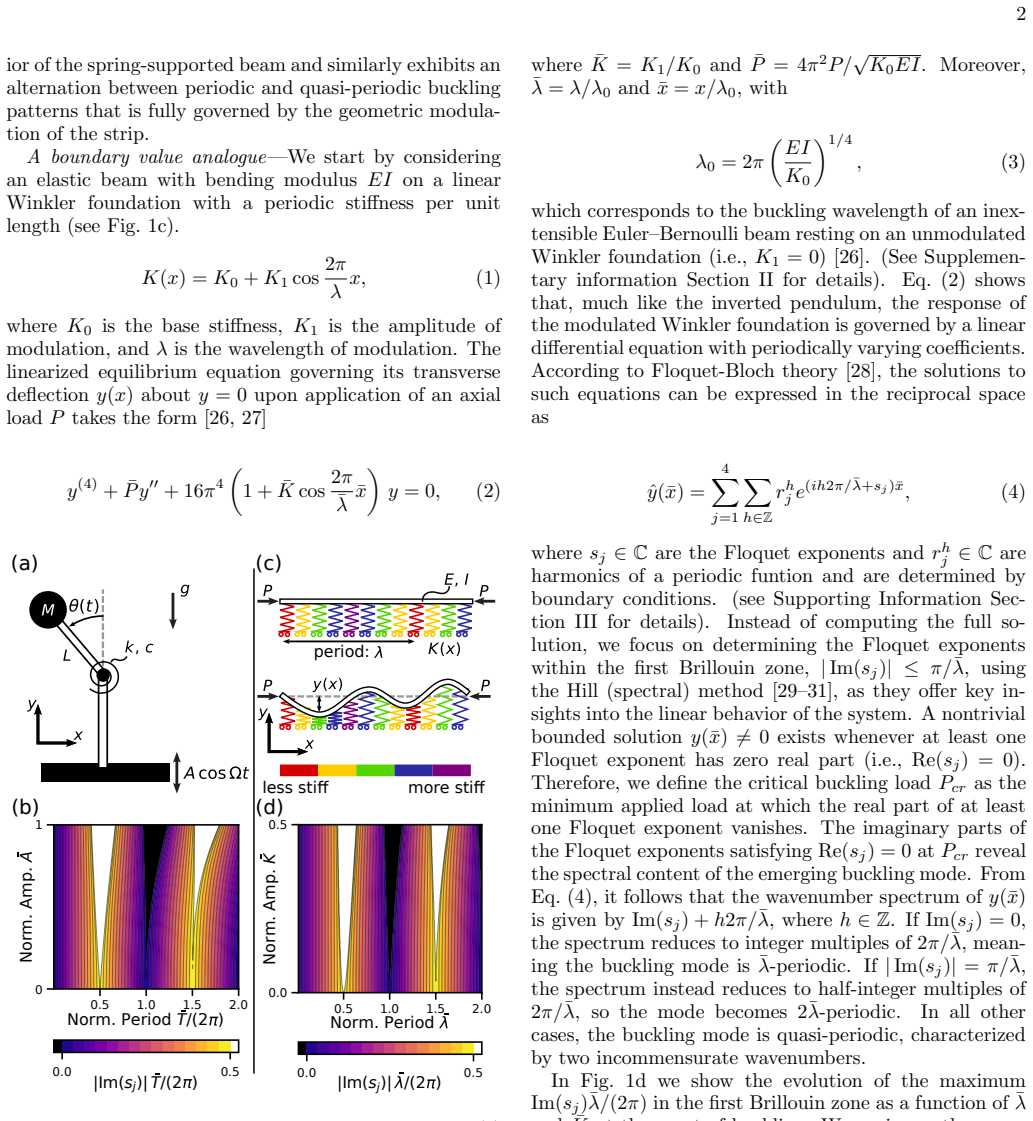
Parametric instabilities are a known feature of periodically driven dynamic systems; at particular frequencies and amplitudes of the driving modulation, the system's quasi-periodic response undergoes a frequency lock-in, leading to a periodically unstable response. Here, we demonstrate an analogous phenomenon in a purely static context. We show that the buckling patterns of an elastic beam resting on a modulated Winkler foundation display the same kind of frequency lock-in observed in dynamic systems. Through simulations and experiments, we reveal that compressed elastic strips with modulated height alternate between predictable quasi-periodic and periodic buckling modes. Our findings uncover previously unexplored analogies between structural and dynamic instabilities, highlighting how even simple elastic structures can give rise to rich and intriguing behaviors.
Editorial analysis
A structured set of objections, weighed in public.
Referee Report
Summary. The manuscript claims that buckling patterns of an elastic beam on a modulated Winkler foundation exhibit a static analogue of parametric frequency lock-in, with the system alternating between quasi-periodic and periodic buckling modes at specific modulation parameters, as demonstrated through finite-element simulations and physical experiments.
Significance. If the central claim is substantiated with controls that isolate the modulation effect, the work would establish a novel connection between dynamic parametric instabilities and static structural buckling, offering a framework for predicting and tuning wave-number selection in modulated elastic systems. This could inform design of adaptive structures or metamaterials, though the current presentation provides only qualitative observations without quantitative benchmarks.
major comments (2)
- [Simulation section] Simulation section: no mesh-convergence study, element-type variation, or boundary-condition sensitivity tests are reported. This directly bears on the central claim because the observed alternation between quasi-periodic and periodic modes could arise from discretization artifacts or clamping effects rather than modulation-induced lock-in, as noted in the stress-test concern.
- [Experimental results] Experimental results: the manuscript provides no quantitative data (measured wave-numbers, transition thresholds, error bars, or statistical measures) and no control experiments with uniform foundations. Without these, it is not possible to confirm that the mode alternation is caused by the foundation modulation itself rather than fabrication imperfections or generic selection mechanisms.
minor comments (2)
- [Abstract] The abstract states that the modes are 'predictable' but does not specify the prediction criterion or how it is derived from the modulation parameters.
- [Introduction] Notation for the modulation amplitude and wave-number is introduced without an explicit equation reference in the early sections, making it harder to follow the lock-in condition.
Simulated Author's Rebuttal
We thank the referee for the constructive feedback on our manuscript. We have carefully reviewed the comments regarding the simulation and experimental sections and provide detailed responses below. We believe these points can be addressed through targeted revisions that strengthen the evidence for the wave-number lock-in phenomenon without altering the core claims.
read point-by-point responses
-
Referee: [Simulation section] Simulation section: no mesh-convergence study, element-type variation, or boundary-condition sensitivity tests are reported. This directly bears on the central claim because the observed alternation between quasi-periodic and periodic modes could arise from discretization artifacts or clamping effects rather than modulation-induced lock-in, as noted in the stress-test concern.
Authors: We agree that explicit verification of numerical robustness is necessary to support the central claim. In the revised manuscript we will add a dedicated subsection reporting mesh-convergence studies (with at least three successively refined discretizations), results for both linear and quadratic elements, and boundary-condition sensitivity tests (including variations in clamping stiffness and domain length). These additional simulations confirm that the alternation between quasi-periodic and periodic buckling modes remains unchanged, indicating that the lock-in is not an artifact of discretization or boundary conditions. revision: yes
-
Referee: [Experimental results] Experimental results: the manuscript provides no quantitative data (measured wave-numbers, transition thresholds, error bars, or statistical measures) and no control experiments with uniform foundations. Without these, it is not possible to confirm that the mode alternation is caused by the foundation modulation itself rather than fabrication imperfections or generic selection mechanisms.
Authors: We acknowledge that the original presentation emphasized qualitative visualization of the mode alternation. To address this directly, the revised manuscript will incorporate quantitative measurements: wave-numbers extracted from digital image correlation of the buckled configurations, transition thresholds as functions of modulation amplitude, and error bars derived from at least five independent experimental realizations. We will also add control experiments performed on uniform (non-modulated) foundations under identical compression protocols, demonstrating that the periodic lock-in does not occur in the absence of modulation and thereby isolating the effect of the height variation. revision: yes
Circularity Check
No circularity: claims rest on independent simulations and experiments
full rationale
The paper demonstrates wave-number lock-in via new finite-element simulations and physical experiments on beams with modulated Winkler foundations. No equations, fitted parameters, or self-citations are shown that reduce the reported alternation between quasi-periodic and periodic modes to a prior definition or input by construction. The central analogy is presented as an observed phenomenon rather than a derived result that presupposes itself. The derivation chain is self-contained against external benchmarks.
Axiom & Free-Parameter Ledger
axioms (1)
- domain assumption The Winkler foundation model accurately captures the restoring force from the modulated base.
Lean theorems connected to this paper
-
IndisputableMonolith/Cost/FunctionalEquation.leanwashburn_uniqueness_aczel unclear?
unclearRelation between the paper passage and the cited Recognition theorem.
K(x) = K0 + K1 cos(2π x / λ) … y^{(4)} + P̄ y'' + 16π⁴(1 + K̄ cos(2π x̄/λ̄)) y = 0 … Floquet exponents … lock-in tongues
-
IndisputableMonolith/Foundation/ArithmeticFromLogic.leanLogicNat.induction unclear?
unclearRelation between the paper passage and the cited Recognition theorem.
alternation between periodic and quasi-periodic buckling modes … instability tongues
What do these tags mean?
- matches
- The paper's claim is directly supported by a theorem in the formal canon.
- supports
- The theorem supports part of the paper's argument, but the paper may add assumptions or extra steps.
- extends
- The paper goes beyond the formal theorem; the theorem is a base layer rather than the whole result.
- uses
- The paper appears to rely on the theorem as machinery.
- contradicts
- The paper's claim conflicts with a theorem or certificate in the canon.
- unclear
- Pith found a possible connection, but the passage is too broad, indirect, or ambiguous to say the theorem truly supports the claim.
Reference graph
Works this paper leans on
-
[1]
J. R. Sanmart´ ın Losada, American Journal of Physics52, 937 (1984)
work page 1984
-
[2]
A. A. Grandi, S. Proti` ere, and A. Lazarus, Extreme Me- chanics Letters , 101195 (2021)
work page 2021
-
[3]
Faraday, Philosophical transactions of the Royal Soci- ety of London , 299 (1831)
M. Faraday, Philosophical transactions of the Royal Soci- ety of London , 299 (1831)
-
[4]
T. B. Benjamin and F. J. Ursell, Proceedings of the Royal Society of London. Series A. Mathematical and Physical Sciences 225, 505 (1954)
work page 1954
-
[5]
T. L. Heugel, M. Oscity, A. Eichler, O. Zilberberg, and R. Chitra, Physical review letters 123, 124301 (2019)
work page 2019
- [6]
- [7]
- [8]
-
[9]
A. A. Grandi, S. Proti` ere, and A. Lazarus, Nonlinear Dy- namics 111, 12339 (2023)
work page 2023
-
[10]
B. Audoly and Y. Pomeau, Elasticity and geometry: From hair curls to the nonlinear response of shells (Oxford press, 2010)
work page 2010
-
[11]
Z. P. Bazant and L. Cedolin, Stability of structures: elas- tic, inelastic, fracture and damage theories (World Scien- tific, 2010)
work page 2010
- [12]
-
[13]
P. M. Reis, Journal of Applied Mechanics 82, 111001 (2015)
work page 2015
-
[14]
J. Shim, C. Perdigou, E. R. Chen, K. Bertoldi, and P. M. Reis, Proceedings of the National Academy of Sciences 109, 5978 (2012)
work page 2012
-
[15]
A. Lazarus and P. M. Reis, Advanced Engineering Mate- rials 17, 815 (2015)
work page 2015
- [16]
-
[17]
Y. Yang, H. Read, M. Sbai, A. Zareei, A. E. Forte, D. Melancon, and K. Bertoldi, Advanced Materials 36, 2406611 (2024)
work page 2024
-
[18]
E. Lee, M. Zhang, Y. Cho, Y. Cui, J. Van der Spiegel, N. Engheta, and S. Yang, Advanced Materials 26, 4127 (2014)
work page 2014
-
[19]
O. Doar´ e and S. Michelin, Journal of Fluids and Struc- tures 27, 1357 (2011)
work page 2011
-
[20]
S. Michelin and O. Doar´ e, Journal of Fluid Mechanics 714, 489 (2013)
work page 2013
-
[21]
S. H. Kang, S. Shan, W. L. Noorduin, M. Khan, J. Aizen- berg, and K. Bertoldi, Advanced materials (2013)
work page 2013
-
[22]
B. Deng, S. Yu, A. E. Forte, V. Tournat, and K. Bertoldi, Proceedings of the National Academy of Sciences 117, 31002 (2020). 6
work page 2020
-
[23]
L. Jin, R. Khajehtourian, J. Mueller, A. Rafsanjani, V. Tournat, K. Bertoldi, and D. M. Kochmann, Pro- ceedings of the National Academy of Sciences 117, 2319 (2020)
work page 2020
-
[24]
N. Nadkarni, A. F. Arrieta, C. Chong, D. M. Kochmann, and C. Daraio, Physical review letters116, 244501 (2016)
work page 2016
-
[25]
F. Brau, H. Vandeparre, A. Sabbah, C. Poulard, A. Boudaoud, and P. Damman, Nature Physics 7, 56 (2011)
work page 2011
-
[26]
F. Brau, P. Damman, H. Diamant, and T. A. Witten, Soft Matter 9, 8177 (2013)
work page 2013
-
[27]
R. Lagrange and D. Averbuch, International Journal of Mechanical Sciences 63, 48 (2012)
work page 2012
-
[28]
J. A. Richards, Analysis of periodically time-varying sys- tems (Springer Science & Business Media, 2012)
work page 2012
-
[29]
G. W. Hill, Acta Mathematica 8, 3 (1886)
-
[30]
B. Deconinck, F. Kiyak, J. D. Carter, and J. N. Kutz, Mathematics and Computers in Simulation 74, 370 (2007)
work page 2007
- [31]
- [32]
-
[33]
E. Si´ efert, N. Cattaud, E. Reyssat, B. Roman, and J. Bico, Physical review letters 127, 168002 (2021)
work page 2021
-
[34]
Brillouin, Wave propagation in periodic structures, 1st ed
L. Brillouin, Wave propagation in periodic structures, 1st ed. (McGraw-Hill New York, 1946)
work page 1946
-
[35]
X. Chen and J. W. Hutchinson, Journal of Applied Me- chanics 71, 597 (2004)
work page 2004
-
[36]
H. Lee, J. G. Bae, W. B. Lee, and H. Yoon, Soft matter 13, 8357 (2017)
work page 2017
-
[37]
D. Wu, Y. Huang, Q. Zhang, P. Wang, Y. Pei, Z. Zhao, and D. Fang, Journal of the Mechanics and Physics of Solids 162, 104838 (2022)
work page 2022
- [38]
-
[39]
B. Florijn, C. Coulais, and M. van Hecke, Programmable mechanical metamaterials, Vol. 113 (APS, 2014)
work page 2014
- [40]
-
[41]
Optimal dynamical stabilization
A. Lazarus and E. Tr´ elat, arXiv preprint arXiv:2508.00006 (2025)
work page internal anchor Pith review Pith/arXiv arXiv 2025
-
[42]
A. Lazarus and E. Tr´ elat, arXiv preprint arXiv:2507.13125 (2025)
-
[43]
A. Lazarus, C. Maurini, and S. Neukirch, in Extremely Deformable Structures (Springer, 2015) Chap. 1, pp. 1– 53
work page 2015
-
[44]
R. A. Calico and W. E. Wiesel, Journal of Guidance, Con- trol, and Dynamics 7, 671 (1984)
work page 1984
-
[45]
J. Zhou, T. Hagiwara, and M. Araki, Systems & control letters 53, 141 (2004)
work page 2004
- [46]
-
[47]
M. ˚Aberg and P. Gudmundson, The Journal of the Acous- tical Society of America 102, 2007 (1997). 7 Appendix A: Parametric Pendulum We begin by considering the inverted pendulum shown in Fig. 1 of the main text, or Fig. 4 here. Fig. 4. Schematic of an inverted pendulum with a shaking base. We study the stability and spectral response of θ(t) as a function...
work page 2007
-
[48]
Floquet theory for the Inverted Pendulum Here, we apply Floquet theory to the inverted pendulum considered in Section A. It follows from Eq. (A13) that the J matrix for this system is given by J(τ) = 0 1 −1 − ¯A cos ¯Ωτ − ¯C . (C17) Following the procedure described in the above section, we rewrite J(τ) as a Fourier expansion to obtain 0 1 −1 ...
-
[49]
Floquet theory for the Periodic Winkler Foundation Here, we apply Floquet theory to the periodic Winkler foundation considered in Section. A. It follows from Eq. (B14) that the J matrix for this system is given by 15 J(¯x) = 0 1 0 0 0 0 1 0 0 0 0 1 −16π4 − 16π4 ¯K cos ¯Ω¯x 0 − ¯P 0 . (C20) Following the procedure described in the above s...
work page 2019
-
[50]
Finite size simulations We simulate finite size samples over a variety of lengths, ranging from L = 200 mm (matching the experimental samples) to L = 1200 mm. Since the period of modulation, λmod will not always divide evenly into the total length, some simulations have a non-integer number of periods; this did not affect our results. To impose uniform co...
-
[51]
Bloch wave simulations We also investigate the behavior of infinite periodic strips using simulations of a single unit cell [46]; in the modulated case, this unit cell has length λmod, while in the unmodulated case, its length is arbitrary; we denote the length of our unit cell as L∗. To study the buckling of our structure, we first compress our unit cell...
work page 2021
-
[52]
Mold Preparation for the modulated strip on a thin block: We laser-cut four acrylic parts with 6.35 mm thickness to form the mold for the modulated strip on a thin block, as illustrated in Fig. 13a. The black part (part #2) has the desired wavy pattern engraved (highlighted in Fig. 14). The depth of the mold can be tailored by adjusting the laser power du...
-
[53]
Casting the modulated strip on a thin block: Parts #1 and #2 are stacked and aligned using four pins (Fig. 13b). The assembly is then filled with uncured PVS elastomer (Fig. 13c)
-
[54]
Closure and Curing: Parts #3 and #4 (Fig. 13d) are placed on top of the assembly, and pressure clamps are used to ensure uniform thickness (Fig. 13e). The elastomer is cured at room temperature (25 ◦C) for 30 minutes before demolding. At this point, the modulated strip on a thin block is ready
-
[55]
Additionally, two top and bottom acrylic plates are laser-cut to enclose the box
Mold Preparation for thickening the block: A box with two open faces is 3D printed using a BambuLab X1 Carbon printer. Additionally, two top and bottom acrylic plates are laser-cut to enclose the box
-
[56]
Final casting and curing: The cured modulated strip on a thin block is placed at the center of the bottom plate (Fig. 13f). The curing box is assembled, and the uncured PVS elastomer mixture is poured inside (Fig. 13g). The assembly is cured at room temperature (25 ◦C) for 30 minutes
-
[57]
Finishing T ouches: The edges of the wavy pattern are manually colored black using a Sharpie. 25 Fig. 13. Snapshots of the main steps required to fabricate our structures. Fig. 14. Laser cut mold with engraved waving pattern on its edge. 26 Appendix F: Testing Our samples are compressed using a universal testing machine (Instron 5969, outfitted with a 253...
-
[58]
We define these locations to be ( x, z0(x))
Post-process the undeformed sample to calculate the location of the top edge in the reference configuration. We define these locations to be ( x, z0(x))
-
[59]
We define this to be ( xfinal, z0(xfinal))
Post-process the deformed edge to calculate the location of the top edge in the current configuration. We define this to be ( xfinal, z0(xfinal))
-
[60]
Using the known global deformation, ux, project the deformed coordinates ( xfinal, zdeformed(xfinal)) back into the reference frame to calculate ( x, zdeformed(x))
-
[61]
Calculate z(x) = zdeformed(x)) − z0(xfinal)) 27
-
[62]
Calculate the DFT of z(x) with nfft = 214 All our experimental results can be seen in Fig. 16. We find strong agreement for λmod = 8.2 mm and 12.2 mm, and moderate agreement for all other samples. Fig. 16. All experimental samples (green) compared with post-buckling simulations (blue) for λmod = 8.2, 9.4, 9.8, 10.2, and 12.2 mm. DATA AVAILABILITY STATEMEN...
discussion (0)
Sign in with ORCID, Apple, or X to comment. Anyone can read and Pith papers without signing in.