Quantum Tomography of Suspended Carbon Nanotubes
Pith reviewed 2026-05-18 20:31 UTC · model grok-4.3
The pith
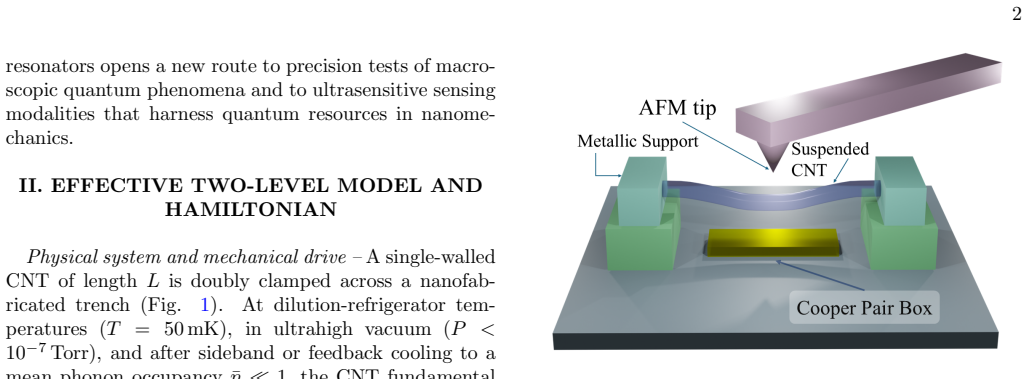
An atomic force microscope actuator on an anharmonic carbon nanotube enables both coherent control and Wigner function tomography using only mechanical forces.
A machine-rendered reading of the paper's core claim, the machinery that carries it, and where it could break.
Core claim
A single localized AFM actuator exploits the mechanical anharmonicity of the CNT to implement spectrally selective driving of the lowest flexural transition, thereby realizing effective two-level coherent control and the phase-space displacements required for Wigner tomography via displaced-parity sampling, all without optical heating or additional microwave drive lines.
What carries the argument
Spectrally selective mechanical driving of the lowest vibrational transition by the AFM actuator, which simultaneously supplies the calibrated displacements for displaced-parity sampling of the Wigner function.
If this is right
- Explicit pulse sequences connect directly measurable AFM signals to energy relaxation and phase coherence times.
- Parity-based signatures, including negative areas of the Wigner function, become experimentally accessible.
- The scheme supports multiple readout methods including direct AFM detection and dispersive coupling to a Cooper-pair box or microwave cavity.
- Complete characterization of populations, coherences, and parity is achieved within a single device architecture.
Where Pith is reading between the lines
- The minimal hardware requirement may lower the barrier for quantum experiments on other anharmonic mesoscopic resonators.
- Integration of control and tomography in one actuator could simplify studies of decoherence sources in mechanical systems.
- Similar all-mechanical protocols might be tested on different suspended nanostructures that exhibit Duffing nonlinearity.
Load-bearing premise
The mechanical anharmonicity of the nanotube allows the AFM actuator to drive the lowest vibrational transition selectively while keeping crosstalk and added decoherence negligible.
What would settle it
Failure to observe Rabi oscillations or negative regions in a reconstructed Wigner function after applying the proposed AFM pulse sequences, or the appearance of strong crosstalk signals between vibrational levels, would indicate that the selective-driving assumption does not hold.
Figures


read the original abstract
We propose and analyze an all-mechanical route to coherent control and quantum-state reconstruction of the fundamental flexural mode of a suspended carbon nanotube (CNT) operated in the anharmonic (Duffing/Kerr). A nearby atomic force microscope (AFM) provides a single, localized actuator that applies calibrated, time-dependent forces to the CNT. In the presence of mechanical anharmonicity this enables spectrally selective control of the lowest vibrational transition and thus supports effective two-level protocols such as Rabi oscillations and Ramsey interferometry. The same actuator also implements phase-space displacements required for Wigner function tomography via displaced-parity sampling, thereby unifying control and tomography without optical heating and without dedicated on-chip microwave drive lines at the CNT resonator. We develop explicit pulse sequences and a master equation framework that connect experimentally accessible signals to energy relaxation and phase coherence times and to parity-based quantum signatures, including negative regions of the Wigner function. The approach is compatible with multiple readout modalities, including direct AFM-based detection and dispersive coupling to superconducting circuitry such as Cooper-pair box, and/or a microwave cavity. Together, these techniques provide complete access to populations, coherence, and parity within a single device architecture. This minimal scheme provides a practical route to all-mechanical quantum control and state-resolved characterization of decoherence in mesoscopic mechanical systems.
Editorial analysis
A structured set of objections, weighed in public.
Referee Report
Summary. The paper proposes an all-mechanical scheme for coherent control and quantum tomography of the fundamental flexural mode of a suspended carbon nanotube in the anharmonic (Duffing/Kerr) regime. A single nearby AFM actuator applies time-dependent forces to enable spectrally selective Rabi driving and Ramsey interferometry on the lowest vibrational transition, while the same actuator implements phase-space displacements for displaced-parity sampling to reconstruct the Wigner function. A master-equation framework and explicit pulse sequences are developed to relate measurable signals to relaxation times, coherence times, and parity signatures (including Wigner negativity), with compatibility to AFM readout or dispersive coupling to superconducting circuits.
Significance. If the central assumptions hold, the work offers a practical, minimal architecture for all-mechanical quantum control and state characterization in mesoscopic resonators that avoids optical heating and dedicated on-chip microwave lines. Strengths include the explicit pulse sequences, the master-equation treatment linking signals to energy relaxation, phase coherence, and parity, and the unification of control and tomography in a single actuator.
major comments (2)
- [Master-equation framework (around the treatment of the time-dependent force and open-system terms)] The master-equation framework assumes the AFM force remains effectively classical and state-independent with negligible quantum back-action and actuator-induced fluctuating forces, but no quantitative bounds or scaling analysis is given on the additional decoherence channel that would grow with drive amplitude; if this rate approaches the intrinsic relaxation rate, the parity signatures and Wigner negativity become unobservable even if the formal pulse sequences are correct.
- [Pulse sequences and anharmonicity discussion] The claim of spectrally selective driving with negligible crosstalk relies on the mechanical anharmonicity permitting isolation of the lowest transition, yet the manuscript provides no numerical estimates or parameter regimes demonstrating that crosstalk and added decoherence remain small compared to intrinsic rates across the proposed pulse sequences.
minor comments (1)
- [Introduction and model section] Notation for the Duffing/Kerr term and the precise form of the anharmonic potential should be stated explicitly with the corresponding Hamiltonian term to aid reproducibility.
Simulated Author's Rebuttal
We thank the referee for the careful reading and constructive comments on our manuscript. We address the two major comments point by point below. Both comments correctly identify areas where additional quantitative support would strengthen the presentation, and we have revised the manuscript to incorporate the requested analysis and estimates.
read point-by-point responses
-
Referee: [Master-equation framework (around the treatment of the time-dependent force and open-system terms)] The master-equation framework assumes the AFM force remains effectively classical and state-independent with negligible quantum back-action and actuator-induced fluctuating forces, but no quantitative bounds or scaling analysis is given on the additional decoherence channel that would grow with drive amplitude; if this rate approaches the intrinsic relaxation rate, the parity signatures and Wigner negativity become unobservable even if the formal pulse sequences are correct.
Authors: We agree that quantitative bounds on actuator-induced decoherence are necessary to confirm observability of Wigner negativity. In the revised manuscript we add a new subsection that derives the scaling of the additional decoherence rate with AFM force amplitude, using realistic suspended-CNT parameters (force constants, quality factors, and Duffing coefficients). The analysis shows the drive-strength window in which this rate remains well below the intrinsic relaxation rate, thereby preserving the parity signatures. revision: yes
-
Referee: [Pulse sequences and anharmonicity discussion] The claim of spectrally selective driving with negligible crosstalk relies on the mechanical anharmonicity permitting isolation of the lowest transition, yet the manuscript provides no numerical estimates or parameter regimes demonstrating that crosstalk and added decoherence remain small compared to intrinsic rates across the proposed pulse sequences.
Authors: We acknowledge the absence of explicit numerical estimates for crosstalk. The revised manuscript includes an appendix with numerical estimates for representative CNT parameters (anharmonicity strength ~ few percent of the fundamental frequency, pulse durations, and detunings). These calculations demonstrate that leakage to higher transitions and the associated decoherence remain at least an order of magnitude below the intrinsic rates for the Rabi and Ramsey sequences we propose. revision: yes
Circularity Check
No significant circularity; standard techniques applied to new system
full rationale
The paper proposes an all-mechanical control and tomography scheme for the CNT flexural mode by applying established quantum-control protocols (Rabi, Ramsey, displaced-parity sampling) and a standard master-equation treatment to the anharmonic mechanical oscillator. No equations reduce by construction to fitted parameters defined by the target result, no load-bearing uniqueness theorems are imported via self-citation, and the pulse sequences and parity signatures are derived from textbook open-system dynamics rather than being renamed or smuggled in from prior author work. The derivation chain remains self-contained against external benchmarks of quantum optics and nanomechanics.
Axiom & Free-Parameter Ledger
axioms (2)
- domain assumption The suspended CNT flexural mode operates in the anharmonic Duffing/Kerr regime that permits spectrally selective addressing of the lowest transition.
- domain assumption The AFM tip delivers calibrated time-dependent forces without introducing significant heating or decoherence beyond the modeled dissipation.
Lean theorems connected to this paper
-
IndisputableMonolith/Cost/FunctionalEquation.leanwashburn_uniqueness_aczel unclear?
unclearRelation between the paper passage and the cited Recognition theorem.
We derive explicit control pulse sequences and a master-equation description that map measured signals onto ... T1 and T2 ... and onto parity-based quantum signatures, including negative regions of the Wigner function.
-
IndisputableMonolith/Foundation/RealityFromDistinction.leanreality_from_one_distinction unclear?
unclearRelation between the paper passage and the cited Recognition theorem.
the same actuator also implements phase-space displacements required for Wigner function tomography via displaced-parity sampling
What do these tags mean?
- matches
- The paper's claim is directly supported by a theorem in the formal canon.
- supports
- The theorem supports part of the paper's argument, but the paper may add assumptions or extra steps.
- extends
- The paper goes beyond the formal theorem; the theorem is a base layer rather than the whole result.
- uses
- The paper appears to rely on the theorem as machinery.
- contradicts
- The paper's claim conflicts with a theorem or certificate in the canon.
- unclear
- Pith found a possible connection, but the passage is too broad, indirect, or ambiguous to say the theorem truly supports the claim.
Reference graph
Works this paper leans on
-
[1]
We choose the phase of the first resonantπ/2 pulse such that the Bloch vector becomes: (1,0,0). During the subse- quent delay intervalτthe Bloch vector precesses at the detuning frequency ∆, and the system acquires a relative phase ∆τinduced by the unitary evolution. Since dur- ing this free interval the drive is off, Ω R(t) = 0, and the Bloch equations (...
-
[2]
A. D. Armour, M. P. Blencowe, and K. C. Schwab, En- tanglement and Decoherence of a Micromechanical Res- onator via Coupling to a Cooper-Pair Box, Physical Re- view Letters88, 148301 (2002)
work page 2002
-
[3]
N. R. Lee, Y. Guo, A. Y. Cleland, E. A. Wollack, R. G. Gruenke, T. Makihara, Z. Wang, T. Rajabzadeh, W. Jiang, F. M. Mayor, P. Arrangoiz-Arriola, C. J. Sara- balis, and A. H. Safavi-Naeini, Strong Dispersive Cou- pling Between a Mechanical Resonator and a Fluxo- nium Superconducting Qubit, PRX Quantum4, 040342 (2023)
work page 2023
-
[4]
K. C. Schwab and M. L. Roukes, Putting Mechanics into Quantum Mechanics, Physics Today58, 36 (2005)
work page 2005
-
[5]
Blencowe, Quantum electromechanical systems, Physics Reports395, 159 (2004)
M. Blencowe, Quantum electromechanical systems, Physics Reports395, 159 (2004)
work page 2004
-
[6]
C. Samanta, S. L. De Bonis, C. B. Møller, R. Tormo- Queralt, W. Yang, C. Urgell, B. Stamenic, B. Thibeault, Y. Jin, D. A. Czaplewski, F. Pistolesi, and A. Bachtold, Nonlinear nanomechanical resonators approaching the quantum ground state, Nature Physics19, 1340 (2023)
work page 2023
-
[7]
M. D. LaHaye, O. Buu, B. Camarota, and K. C. Schwab, Approaching the quantum limit of a nanomechanical res- onator, Science304, 74 (2004)
work page 2004
-
[8]
L. G. Remus, M. P. Blencowe, and Y. Tanaka, Damping and decoherence of a nanomechanical resonator due to a few two-level systems, Physical Review B80, 174103 (2009)
work page 2009
-
[9]
E. A. Wollack, A. Y. Cleland, R. G. Gruenke, Z. Wang, P. Arrangoiz-Arriola, and A. H. Safavi-Naeini, Quantum state preparation and tomography of entangled mechan- ical resonators, Nature604, 463 (2022)
work page 2022
-
[10]
M. Schlosshauer,Decoherence and the Quantum-To- Classical Transition, Frontiers Collection (Springer Berlin Heidelberg, Berlin, Heidelberg, 2007)
work page 2007
-
[11]
J. D. Teufel, T. Donner, D. Li, J. H. Harlow, M. S. All- man, K. Cicak, A. J. Sirois, J. D. Whittaker, K. W. Lehn- ert, and R. W. Simmonds, Sideband cooling of microme- chanical motion to the quantum ground state, Nature 475, 359 (2011)
work page 2011
-
[12]
A. D. O’Connell, M. Hofheinz, M. Ansmann, R. C. Bial- czak, M. Lenander, E. Lucero, M. Neeley, D. Sank, H. Wang, M. Weides, J. Wenner, J. M. Martinis, and A. N. Cleland, Quantum ground state and single-phonon control of a mechanical resonator, Nature464, 697 (2010)
work page 2010
-
[13]
G. S. MacCabe, H. Ren, J. Luo, J. D. Cohen, H. Zhou, A. Sipahigil, M. Mirhosseini, and O. Painter, Nano- acoustic resonator with ultralong phonon lifetime, Sci- ence370, 840 (2020)
work page 2020
- [14]
-
[15]
V. Sazonova, Y. Yaish, H. Ust¨ unel, D. Roundy, T. A. Arias, and P. L. McEuen, A tunable carbon nanotube 11 electromechanical oscillator, Nature431, 284 (2004)
work page 2004
-
[16]
D. Garcia-Sanchez, A. San Paulo, M. J. Esplandiu, F. Perez-Murano, L. Forr´ o, A. Aguasca, and A. Bachtold, Mechanical Detection of Carbon Nanotube Resonator Vi- brations, Physical Review Letters99, 085501 (2007)
work page 2007
-
[17]
A. K. H¨ uttel, M. Poot, B. Witkamp, and H. S. J. van der Zant, Nanoelectromechanics of suspended carbon nan- otubes, New Journal of Physics10, 095003 (2008)
work page 2008
-
[18]
A. Tavernarakis, A. Stavrinadis, A. Nowak, I. Tsioutsios, A. Bachtold, and P. Verlot, Optomechanics with a hybrid carbon nanotube resonator, Nature Communications9, 662 (2018)
work page 2018
-
[19]
B. H. Schneider, V. Singh, W. J. Venstra, H. B. Meer- waldt, and G. A. Steele, Observation of decoherence in a carbon nanotube mechanical resonator, Nature Commu- nications5, 5819 (2014)
work page 2014
-
[20]
A. P´ alyi, P. R. Struck, M. Rudner, K. Flensberg, and G. Burkard, Spin-Orbit-Induced Strong Coupling of a Single Spin to a Nanomechanical Resonator, Physical Re- view Letters108, 206811 (2012)
work page 2012
-
[21]
X. Wang, A. Miranowicz, H.-R. Li, and F. Nori, Hybrid quantum device with a carbon nanotube and a flux qubit for dissipative quantum engineering, Physical Review B 95, 205415 (2017)
work page 2017
-
[22]
H. Wang and G. Burkard, Creating arbitrary quantum vibrational states in a carbon nanotube, Physical Review B94, 205413 (2016)
work page 2016
-
[23]
I. Wilson-Rae, N. Nooshi, W. Zwerger, and T. J. Kip- penberg, Theory of ground state cooling of a mechanical oscillator using dynamical backaction, Phys. Rev. Lett. 99, 093901 (2007)
work page 2007
- [24]
-
[25]
H.-P. Breuer and F. Petruccione,The Theory of Open Quantum Systems, 1st ed. (Clarendon Press, Oxford, 2009)
work page 2009
-
[26]
J. Weinbub and D. K. Ferry, Recent advances in Wigner function approaches, Applied Physics Reviews5, 041104 (2018)
work page 2018
-
[27]
W. B. Case, Wigner functions and Weyl transforms for pedestrians, American Journal of Physics76, 937 (2008)
work page 2008
-
[28]
P. Lougovski, E. Solano, Z. M. Zhang, H. Walther, H. Mack, and W. P. Schleich, Fresnel Representation of the Wigner Function: An Operational Approach, Physi- cal Review Letters91, 010401 (2003)
work page 2003
- [29]
-
[30]
D. Leibfried, D. M. Meekhof, B. E. King, C. Monroe, W. M. Itano, and D. J. Wineland, Experimental Deter- mination of the Motional Quantum State of a Trapped Atom, Physical Review Letters77, 4281 (1996)
work page 1996
-
[31]
D. V. Karlovets and V. G. Serbo, Possibility to Probe Negative Values of a Wigner Function in Scattering of a Coherent Superposition of Electronic Wave Packets by Atoms, Physical Review Letters119, 173601 (2017)
work page 2017
-
[32]
A. Blais, R.-S. Huang, A. Wallraff, S. M. Girvin, and R. J. Schoelkopf, Cavity quantum electrodynamics for superconducting electrical circuits: An architecture for quantum computation, Physical Review A69, 062320 (2004)
work page 2004
- [33]
-
[34]
M. Boissonneault, J. M. Gambetta, and A. Blais, Dis- persive regime of circuit QED: Photon-dependent qubit dephasing and relaxation rates, Physical Review A79, 013819 (2009)
work page 2009
- [35]
-
[36]
M. D. LaHaye, J. Suh, P. M. Echternach, K. C. Schwab, and M. L. Roukes, Nanomechanical measurements of a superconducting qubit, Nature459, 960 (2009)
work page 2009
-
[37]
J.-M. Pirkkalainen, S. U. Cho, F. Massel, J. Tuorila, T. T. Heikkil¨ a, P. J. Hakonen, and M. A. Sillanp¨ a¨ a, Cav- ity optomechanics mediated by a quantum two-level sys- tem, Nature Communications6, 6981 (2015)
work page 2015
-
[38]
A. Eichler, J. Moser, J. Chaste, M. Zdrojek, I. Wilson- Rae, and A. Bachtold, Nonlinear damping in mechanical resonators made from carbon nanotubes and graphene, Nature Nanotechnology6, 339 (2011)
work page 2011
-
[39]
W. Cui, Z. Zhang, and K. Mølmer, Feedback control of rabi oscillations in circuit qed, Physical Review A88, 063823 (2013)
work page 2013
-
[40]
D. Rist` e, J. G. van Leeuwen, H.-S. Ku, K. W. Lehnert, and L. DiCarlo, Initialization by measurement of a super- conducting quantum bit circuit, Physical Review Letters 109, 050507 (2012)
work page 2012
-
[41]
M. Aspelmeyer, T. J. Kippenberg, and F. Marquardt, Cavity optomechanics, Reviews of Modern Physics86, 1391 (2014)
work page 2014
-
[42]
G. A. Steele, A. K. H¨ uttel, B. Witkamp, M. Poot, H. B. Meerwaldt, L. P. Kouwenhoven, and H. S. J. van der Zant, Strong coupling between single-electron tunneling and nanomechanical motion, Science325, 1103 (2009)
work page 2009
- [43]
discussion (0)
Sign in with ORCID, Apple, or X to comment. Anyone can read and Pith papers without signing in.