REVIEW 4 major objections 6 minor 76 references
Enabling Federated Object Detection for Connected Autonomous Vehicles: A Deployment-Oriented Evaluation
T0 review · 4 major / 6 minor · reviewed 2026-08-05 · deepseek-v4-flash
Pith's one-line read This paper claims that synchronously federated object detection can match or beat centralized training accuracy on three driving datasets, and that the decisive question for deployment is system cost: GPU memory, power, and training time.
desk verdict Useful resource profiling for FL object detection, but the 'FL beats centralized' headline rests on an unequal compute comparison and needs a fair baseline before it can be trusted. read the letter →
The pith
A machine-rendered reading of the paper's core claim, the machinery that carries it, and where it could break.
The reading
What carries the argument
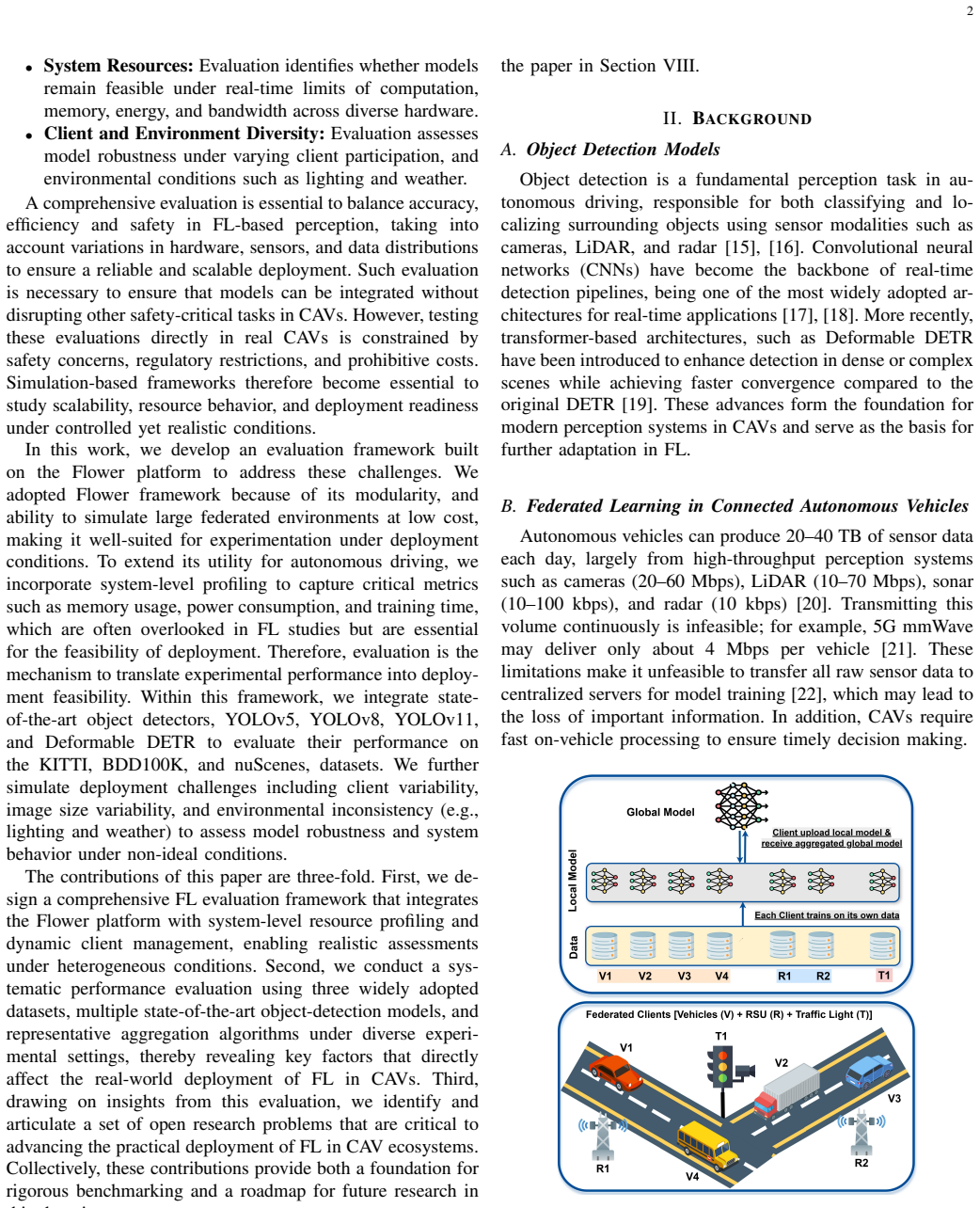
The carrying mechanism is the deployment-oriented evaluation harness: a federated simulation that orchestrates many client vehicles, partitions KITTI, BDD100K, and nuScenes into non-IID client subsets, and interleaves local training epochs with server-side aggregation using FedAvg, FedProx, or FedAsync. The harness's distinctive part is its resource-profiling layer, which attributes GPU memory, utilization, power, and time to each active client during its training window, together with controlled conditions such as a single shared checkpoint, a clean CUDA state, and sequential client execution. That combination is what lets the paper translate detection accuracy into feasibility statements a
What would settle it
Run the same detectors centrally for 30 epochs, the amount of local update federated learning receives, on KITTI, BDD100K, and nuScenes. If centralized mAP rises to or above the federated numbers, the paper's headline claim that FL achieves comparable or higher accuracy fails.
Extended reading notes
Core claim
On its own terms, the paper's central discovery is that federated object detection can be deployment-ready on accuracy while the real constraint is system cost. On KITTI, BDD100K, and nuScenes, synchronous FedAvg/FedProx with three YOLO variants reaches 82.9–87.9%, 59.3–60.7%, and 57.3–60.8% mAP, above the 10-epoch centralized baselines of 78.4–81.6%, 58.9–61.4%, and 53.2–56.3%, whereas asynchronous FedAsync collapses on complex datasets. Profiling shows GPU memory rising from roughly 7.7 GiB at 320px to 50–67 GiB at 960px and power from 250–280W to over 350W; YOLOv8x leads accuracy while YOLOv11x uses the least memory and power. Client dropout hurts most when data-rich clients leave (C1–C2
Load-bearing premise
The comparison treats 10 centralized epochs as an equivalent baseline to 10 federated rounds of 3 local epochs each, so the claim that federated learning matches or beats centralized accuracy depends on not giving centralized training the same total compute.
Editorial extensions
If this is right
- Synchronous aggregation with FedAvg or FedProx is the default choice for federated detection in connected vehicles; asynchronous aggregation should not be used on complex driving datasets without contribution-balancing.
- Model selection for onboard federated learning should be driven by measured memory and power envelopes, not parameter counts: YOLOv8x gives the best mAP, YOLOv11x the lowest resource draw.
- Higher image resolution is a reliable accuracy lever, up to 90.6% mAP at 960px on KITTI, but each step roughly doubles GPU memory and pushes power above 350W, so deployment must pick a resolution that fits the vehicle's GPU.
- Client dropout is tolerable only when the missing clients hold little data; losing the data-rich clients in BDD100K can drop global mAP by about 12 points.
- A single global model trained on mixed weather will underperform a model trained and tested in the same condition; snow is the hardest domain shift, with 63.6% in-domain versus 57.9% cross-domain mAP.
Reading between the lines
- Extension: Because the centralized baseline used 10 epochs while federated learning received up to 30 local updates, the accuracy advantage may be an artifact of unequal compute; equalizing updates is a direct way to test it.
- Extension: The dropout results suggest aggregation should weight clients by data volume or by expected gradient diversity rather than treating all clients equally; a weighted-aggregation ablation would quantify this.
- Extension: The day/night and weather gaps imply that condition-aware or clustered aggregation, grouping vehicles by operating environment before averaging, should outperform one global model; this is a concrete design the paper does not test.
- Extension: The reported over-72-hour training time and roughly 87–95 GiB memory for Deformable DETR imply it is not deployable on current onboard GPUs, so only low-resolution YOLO variants are realistically in reach; this predicts a ceiling on real-world federated detection accuracy.
Editorial analysis
A structured set of objections, weighed in public.
Referee Report
Summary. The paper presents a deployment-oriented evaluation framework for federated object detection in connected autonomous vehicles (CAVs). It integrates the Flower FL platform with system-level resource profiling (GPU memory, utilization, power, training/inference time) and evaluates YOLOv5/YOLOv8/YOLOv11 and Deformable DETR on KITTI, BDD100K, and nuScenes under non-IID partitions, varying resolutions, batch sizes, client dropout/heterogeneity, and weather/lighting conditions. The central empirical claim is that synchronous FL (FedAvg/FedProx) can achieve accuracy comparable to or higher than centralized training. The paper also proposes open research problems in datasets, models, and aggregation strategies for FL-based CAV perception.
Significance. If validated, the paper would provide a useful benchmark and profiling methodology for FL-based object detection in CAVs, where system-level constraints are often neglected. Its strengths include the breadth of the evaluation (three datasets, four detectors, multiple FL algorithms, and resource metrics), the use of a recognized FL platform (Flower), and the explicit identification of open challenges. The authors are also candid in Section VII about limitations such as single-run experiments and lack of communication modeling. However, the headline accuracy claim is currently confounded by unequal training compute between centralized and federated settings, and the scalability experiment conflates data volume with client count. These issues affect the central contribution and require correction before the paper's main conclusions can be accepted.
major comments (4)
- [§VI.A, Table V] The claim that 'synchronous FL can achieve accuracy comparable to or higher than centralized training' is not supported by the reported comparison because the training budgets are unequal. Centralized training uses 10 epochs, while FL uses 10 rounds × 3 local epochs, i.e., up to 30 local parameter updates per client. Thus the higher FL mAP (e.g., KITTI YOLOv8: 87.5 vs. 81.6; nuScenes YOLOv8: 60.6 vs. 56.3) may simply reflect a 3× larger local update budget. The same issue appears in Table IX for Deformable DETR, where centralized uses 50 epochs but FL uses 30 rounds × 3 local epochs = 90 local updates. To establish the headline claim, the authors need either a compute-matched centralized baseline (e.g., 30 epochs) or a federated configuration with the same total number of local updates (e.g., 10 rounds × 1 local epoch). Without this, the central comparison is confounded.
- [§VII (Limitations)] The paper states in Section VII that 'due to significant time and resource constraints, we were unable to perform additional experiments or multiple trial runs.' Since every quantitative claim in the paper rests on single runs, there are no error bars or significance measures. This is particularly problematic for statements such as 'FedProx introduces a proximal term... marginal gains over FedAvg' when the reported differences are often 0.0–0.5 mAP (e.g., BDD100K YOLOv8: 61.5 vs. 61.5; nuScenes YOLOv8: 60.6 vs. 60.8). Without repeated runs, these differences cannot be distinguished from noise. For an evaluation paper whose purpose is to guide deployment choices, single-run comparisons are a load-bearing limitation, not merely a presentation issue.
- [§VI.B.8 (Testing Scalability)] The 'Testing Scalability' experiment does not isolate client count as the variable of interest. In the even-partition condition, 60 clients each receive 1/60 of the data; in the overlapping condition, each client receives five consecutive partitions, increasing local data volume fivefold (with repetition). The mAP improves from 69.7% to 88.1%, but this change is attributable to increased per-client data volume, not to the number of clients or FL scalability. The text even acknowledges that the improvement is due to 'increased local data volume, independent of the number of clients.' To make a scalability claim, the authors should vary the number of clients while keeping per-client data volume constant (or explicitly control for total data per client), or present a separate experiment that does so.
- [§VI.A, last paragraph] The sentence 'To ensure a fair comparison, this study was limited to ten updates' is misleading and appears to understate the asymmetry. If 'updates' means epochs, then centralized training had 10 updates while federated clients had 30 local epochs (10 rounds × 3 local epochs); if 'updates' means communication rounds, then FL had 10 rounds but each round involved 3 local epochs. Either way, the comparison is not equalized. The authors should clarify the intended meaning and, more importantly, provide a comparison that controls for total local gradient steps or total compute. This is not a minor wording issue; it directly affects the interpretation of Table V and the paper's main conclusion.
minor comments (6)
- [§VI.B.3, Fig. 5] The order in the sentence 'with 67379, 58675, and 50892 MiB ... for YOLOv11, YOLOv5 and YOLOv8, respectively' does not match the figure/caption order or the apparent model ordering (YOLOv5 largest architecture, per Table VII). Please correct the mapping between values and model names.
- [§VI.A, Table V] The identical values for FedAvg and FedProx on BDD100K YOLOv8 (61.5) and nuScenes YOLOv8 (60.8 vs. 60.6 in the text) should be discussed in light of the single-run limitation. Reporting the same value to one decimal place suggests either a typo or a need for precision/error bars.
- [§VI.B.2, Table VII] YOLOv5x6u is listed as having 155.45M parameters, which is much larger than YOLOv8x and YOLOv11x. The text in Section VI.B.3 says 'YOLOv11, YOLOv5 and YOLOv8' for memory values, but Figure 5 appears to show YOLOv5 using the most memory. Please check that all model-specific statements are consistent with the actual model configurations used.
- [§VII.C.3] Typo: 'the braoder scope of vehicle computing' should be 'the broader scope.' Also, throughout the paper, 'CA Vs' and 'CAV' are used inconsistently; standardizing to one form would improve readability.
- [§IV.E] The paper states 'fixed random seeds' but does not report the seed values or the complete hyperparameter set (e.g., learning rate, FedProx proximal coefficient, batch sizes for each dataset/model). Providing these in an appendix or reproducibility table would strengthen the deployment-oriented evaluation.
- [§VI.A, FedAsync description] The description 'FedAsync used 10 rounds but followed an asynchronous protocol' is unclear. Asynchronous FL typically does not use synchronous rounds in the same way; please specify how FedAsync was configured within the Flower framework and how '10 rounds' is defined for an asynchronous method.
Circularity Check
No significant circularity: the paper is an empirical evaluation, and its self-citations are contextual rather than load-bearing.
full rationale
This paper is an empirical deployment-oriented evaluation, not a derivation. The central results—mAP comparisons across centralized and federated settings, resource profiling, dropout sensitivity, and weather/lighting robustness—are produced by running YOLOv5/v8/v11 and Deformable DETR on KITTI, BDD100K, and nuScenes under controlled FL configurations. No parameter is fitted to a target accuracy, and no claimed prediction is equivalent by construction to an input. The paper cites the authors' prior work [74] only to note that small-object challenges were previously identified, which is contextual background, not a load-bearing justification. Reference [25] is likewise a general edge-computing citation. There is no invocation of a self-authored uniqueness theorem, no ansatz smuggled in via citation, and no renaming of a known result as a new contribution. The most substantive concern—that the FL-vs-centralized comparison uses 10 centralized epochs versus 10 FL rounds with 3 local epochs each—is a question of experimental fairness and compute budget, not circularity: the FL result is not defined in terms of the centralized baseline, nor is the comparison forced by construction. Accordingly, the circularity score is low.
Assumptions & free parameters
free parameters (5)
- Centralized training epochs =
10
- FL rounds and local epochs =
10 rounds, 3 local epochs
- Client partition ratios =
KITTI 4 clients, BDD100K 8 clients, nuScenes 50/25/12.5/12.5, environment test client C3 at 20%
- FedProx proximal coefficient
- YOLO weight reinitialization
assumptions (4)
- domain assumption Simulated FL on a single Nvidia H100 NVL GPU with sequential clients is a valid proxy for real CAV deployment.
- domain assumption BDD100K weather and lighting annotations are accurate and complete.
- ad hoc to paper Centralized and FL accuracy can be compared without equalizing total training compute.
- domain assumption mAP at IoU=0.5 is a sufficient accuracy metric.
Cite this review
Pith. "Pith review of Enabling Federated Object Detection for Connected Autonomous Vehicles: A Deployment-Oriented Evaluation." pith.science (2026). https://pith.science/paper/GDYGXQD6
@misc{pith2026250901868,
  author       = {Pith},
  title        = {Pith review of: Enabling Federated Object Detection for Connected Autonomous Vehicles: A Deployment-Oriented Evaluation},
  year         = {2026},
  howpublished = {\url{https://pith.science/paper/GDYGXQD6}},
  note         = {Machine review of arXiv:2509.01868}
}
read the original abstract
Object detection is crucial for Connected Autonomous Vehicles (CAVs) to perceive their surroundings and make safe driving decisions. Centralized training of object detection models often achieves promising accuracy, fast convergence, and simplified training process, but it falls short in scalability, adaptability, and privacy-preservation. Federated learning (FL), by contrast, enables collaborative, privacy-preserving, and continuous training across naturally distributed CAV fleets. However, deploying FL in real-world CAVs remains challenging due to the substantial computational demands of training and inference, coupled with highly diverse operating conditions. Practical deployment must address three critical factors: (i) heterogeneity from non-IID data distributions, (ii) constrained onboard computing hardware, and (iii) environmental variability such as lighting and weather, alongside systematic evaluation to ensure reliable performance. This work introduces the first holistic deployment-oriented evaluation of FL-based object detection in CAVs, integrating model performance, system-level resource profiling, and environmental robustness. Using state-of-the-art detectors, YOLOv5, YOLOv8, YOLOv11, and Deformable DETR, evaluated on the KITTI, BDD100K, and nuScenes datasets, we analyze trade-offs between detection accuracy, computational cost, and resource usage under diverse resolutions, batch sizes, weather and lighting conditions, and dynamic client participation, paving the way for robust FL deployment in CAVs.
Figures


Figures from the paper (6 more)


Reference graph
Works this paper leans on
-
[1]
A survey of autonomous driving: Common practices and emerging technologies,
E. Yurtsever, J. Lambert, A. Carballo, and K. Takeda, “A survey of autonomous driving: Common practices and emerging technologies,” IEEE access , vol. 8, pp. 58 443–58 469, 2020
work page 2020
-
[2]
A survey of autonomous driving from a deep learning perspective,
J. Zhao, Y . Wu, R. Deng, S. Xu, J. Gao, and A. Burke, “A survey of autonomous driving from a deep learning perspective,” ACM Computing Surveys, vol. 57, no. 10, pp. 1–60, 2025
work page 2025
-
[3]
C. Sun, R. Zhang, Y . Lu, Y . Cui, Z. Deng, D. Cao, and A. Kha- jepour, “Toward ensuring safety for autonomous driving perception: Standardization progress, research advances, and perspectives,” IEEE Transactions on Intelligent Transportation Systems , vol. 25, no. 5, pp. 3286–3304, 2023
work page 2023
-
[4]
Autonomous vehicles perception (avp) using deep learning: Modeling, assessment, and challenges,
H.-H. Jebamikyous and R. Kashef, “Autonomous vehicles perception (avp) using deep learning: Modeling, assessment, and challenges,” IEEE Access, vol. 10, pp. 10 523–10 535, 2022
work page 2022
-
[5]
Federated learning for internet of things: A comprehensive survey,
D. C. Nguyen, M. Ding, P. N. Pathirana, A. Seneviratne, J. Li, and H. V . Poor, “Federated learning for internet of things: A comprehensive survey,” IEEE Communications Surveys & Tutorials , vol. 23, no. 3, pp. 1622–1658, 2021
work page 2021
-
[6]
A secure personalized federated learning algorithm for autonomous driving,
Y . Fu, X. Tang, C. Li, F. R. Yu, and N. Cheng, “A secure personalized federated learning algorithm for autonomous driving,” IEEE Transac- tions on Intelligent Transportation Systems , 2024
work page 2024
-
[7]
V . P. Chellapandi, L. Yuan, C. G. Brinton, S. H. ˙Zak, and Z. Wang, “Federated learning for connected and automated vehicles: A survey of existing approaches and challenges,” IEEE Transactions on Intelligent V ehicles, vol. 9, no. 1, pp. 119–137, 2023
work page 2023
-
[8]
A survey on federated learning in intelligent transportation systems,
R. Zhang, J. Mao, H. Wang, B. Li, X. Cheng, and L. Yang, “A survey on federated learning in intelligent transportation systems,” IEEE Transactions on Intelligent V ehicles, 2024
work page 2024
Show all 76 references
-
[9]
A survey on federated learning for resource-constrained iot devices,
A. Imteaj, U. Thakker, S. Wang, J. Li, and M. H. Amini, “A survey on federated learning for resource-constrained iot devices,” IEEE Internet of Things Journal , vol. 9, no. 1, pp. 1–24, 2021
2021
-
[10]
Federated learning in vehicular networks,
A. M. Elbir, B. Soner, S. C ¸¨oleri, D. G ¨und¨uz, and M. Bennis, “Federated learning in vehicular networks,” in 2022 IEEE International Mediter- ranean Conference on Communications and Networking (MeditCom) . IEEE, 2022, pp. 72–77. 15
2022
-
[11]
Client selection for federated learning in vehicular edge computing: A deep reinforcement learning approach,
S. Moon and Y . Lim, “Client selection for federated learning in vehicular edge computing: A deep reinforcement learning approach,”IEEE Access, 2024
2024
-
[12]
Federated learning with non-iid data: A survey,
Z. Lu, H. Pan, Y . Dai, X. Si, and Y . Zhang, “Federated learning with non-iid data: A survey,”IEEE Internet of Things Journal , vol. 11, no. 11, pp. 19 188–19 209, 2024
2024
-
[13]
Real-time traffic object detection for autonomous driving,
A. H. Khan, S. T. R. Rizvi, and A. Dengel, “Real-time traffic object detection for autonomous driving,” arXiv preprint arXiv:2402.00128 , 2024
2024 arXiv
-
[14]
Squeezedet: Unified, small, low power fully convolutional neural networks for real-time object detection for autonomous driving,
B. Wu, F. Iandola, P. H. Jin, and K. Keutzer, “Squeezedet: Unified, small, low power fully convolutional neural networks for real-time object detection for autonomous driving,” in Proceedings of the IEEE conference on computer vision and pattern recognition workshops , 2017, p...
2017
-
[15]
A review and comparative study on probabilistic object detection in autonomous driv- ing,
D. Feng, A. Harakeh, S. L. Waslander, and K. Dietmayer, “A review and comparative study on probabilistic object detection in autonomous driv- ing,” IEEE Transactions on Intelligent Transportation Systems , vol. 23, no. 8, pp. 9961–9980, 2021
2021
-
[16]
A deep learning-based hybrid framework for object detection and recognition in autonomous driving,
Y . Li, H. Wang, L. M. Dang, T. N. Nguyen, D. Han, A. Lee, I. Jang, and H. Moon, “A deep learning-based hybrid framework for object detection and recognition in autonomous driving,” IEEE Access , vol. 8, pp. 194 228–194 239, 2020
2020
-
[17]
Toward performing image classification and object detection with convolutional neural networks in autonomous driving systems: A survey,
T. Turay and T. Vladimirova, “Toward performing image classification and object detection with convolutional neural networks in autonomous driving systems: A survey,” IEEE access , vol. 10, pp. 14 076–14 119, 2022
2022
-
[18]
Navigating the yolo landscape: A comparative study of object detection models for emotion recognition,
M. M. A. Parambil, L. Ali, M. Swavaf, S. Bouktif, M. Gochoo, H. Al- jassmi, and F. Alnajjar, “Navigating the yolo landscape: A comparative study of object detection models for emotion recognition,” IEEE Access, 2024
2024
-
[19]
Deformable detr: Deformable transformers for end-to-end object detection,
X. Zhu, W. Su, L. Lu, B. Li, X. Wang, and J. Dai, “Deformable detr: Deformable transformers for end-to-end object detection,” arXiv preprint arXiv:2010.04159, 2020
2010 arXiv
-
[20]
Hydraspace: computational data storage for autonomous vehicles,
R. Wang, L. Liu, and W. Shi, “Hydraspace: computational data storage for autonomous vehicles,” in 2020 IEEE 6th International Conference on Collaboration and Internet Computing (CIC) . IEEE, 2020, pp. 70–77
2020
-
[21]
Feasibility of 5g mm-wave communication for connected autonomous vehicles,
S. M. Khan, M. Chowdhury, M. Rahman, and M. Islam, “Feasibility of 5g mm-wave communication for connected autonomous vehicles,” arXiv preprint arXiv:1808.04517, 2018
2018 arXiv
-
[22]
Data storage system requirement for autonomous vehicle,
I. Kim, G. Lee, S. Lee, and W. Choi, “Data storage system requirement for autonomous vehicle,” in 2022 22nd International Conference on Control, Automation and Systems (ICCAS) . IEEE, 2022, pp. 45–49
2022
-
[23]
Per- sonalized federated learning of driver prediction models for autonomous driving,
M. Nakanoya, J. Im, H. Qiu, S. Katti, M. Pavone, and S. Chinchali, “Per- sonalized federated learning of driver prediction models for autonomous driving,” arXiv preprint arXiv:2112.00956 , 2021
2021 arXiv
-
[24]
Privacy-preserved federated learning for autonomous driving,
Y . Li, X. Tao, X. Zhang, J. Liu, and J. Xu, “Privacy-preserved federated learning for autonomous driving,” IEEE Transactions on Intelligent Transportation Systems, vol. 23, no. 7, pp. 8423–8434, 2021
2021
-
[25]
Privacy and bias in edge computing,
K. Sha, K. S. Cherukuri, and H. Chen, “Privacy and bias in edge computing,” 2025
2025
-
[26]
An incentive mechanism of incorporating supervision game for federated learning in autonomous driving,
Y . Fu, C. Li, F. R. Yu, T. H. Luan, and P. Zhao, “An incentive mechanism of incorporating supervision game for federated learning in autonomous driving,” IEEE Transactions on Intelligent Transportation Systems, vol. 24, no. 12, pp. 14 800–14 812, 2023
2023
-
[27]
Adaptive segmentation enhanced asynchronous federated learning for sustainable intelligent transportation systems,
X. Zhou, W. Liang, A. Kawai, K. Fueda, J. She, and K. I.-K. Wang, “Adaptive segmentation enhanced asynchronous federated learning for sustainable intelligent transportation systems,” IEEE Transactions on Intelligent Transportation Systems, vol. 25, no. 7, pp. 6658–6666, 2024
2024
-
[28]
Federated and asynchronized learning for autonomous and intelligent things,
L. You, S. Liu, B. Zuo, C. Yuen, D. Niyato, and H. V . Poor, “Federated and asynchronized learning for autonomous and intelligent things,” IEEE Network, vol. 38, no. 2, pp. 286–293, 2023
2023
-
[29]
Large model- assisted federated learning for object detection of autonomous vehicles in edge,
S. Behera, M. Adhikari, V . G. Menon, and M. A. Khan, “Large model- assisted federated learning for object detection of autonomous vehicles in edge,” IEEE Transactions on V ehicular Technology, 2024
2024
-
[30]
Parameter-efficient federated cooperative learning for 3d object detection in autonomous driving,
F. Chi, Y . Wang, P. Nasiopoulos, and V . C. Leung, “Parameter-efficient federated cooperative learning for 3d object detection in autonomous driving,” IEEE Internet of Things Journal , 2025
2025
-
[31]
Toward efficient and secure object detection with sparse federated training over internet of vehicles,
Y . Qian, L. Rao, C. Ma, K. Wei, M. Ding, and L. Shi, “Toward efficient and secure object detection with sparse federated training over internet of vehicles,” IEEE Transactions on Intelligent Transportation Systems , 2024
2024
-
[32]
Vehicular federated learning for pedestrian detection under adverse image conditions,
G. P. Fittipaldi, V . O. Avena, R. S. Couto, and L. H. M. Costa, “Vehicular federated learning for pedestrian detection under adverse image conditions,” in 2024 IEEE 13th International Conference on Cloud Networking (CloudNet) . IEEE, 2024, pp. 1–9
2024
-
[33]
Federated semi-supervised learning for object detection in autonomous driving,
F. Chi, Y . Wang, P. Nasiopoulos, V . C. Leung, and M. T. Pourazad, “Federated semi-supervised learning for object detection in autonomous driving,” in ICASSP 2023-2023 IEEE International Conference on Acoustics, Speech and Signal Processing (ICASSP) . IEEE, 2023, pp. 1–5
2023
-
[34]
Federated learning with heterogeneous data handling for robust vehic- ular object detection,
A. Khalil, T. Dege, P. Golchin, R. Olshevskyi, A. F. Anta, and T. Meuser, “Federated learning with heterogeneous data handling for robust vehic- ular object detection,” arXiv preprint arXiv:2405.01108 , 2024
2024 arXiv
-
[35]
Fedpylot: Navigating federated learn- ing for real-time object detection in internet of vehicles,
C. Qu ´em´eneur and S. Cherkaoui, “Fedpylot: Navigating federated learn- ing for real-time object detection in internet of vehicles,” arXiv preprint arXiv:2406.03611, 2024
2024 arXiv
-
[36]
Towards continual federated learning of monocular depth for autonomous vehicles,
E. F. d. S. Soares and C. A. V . Campos, “Towards continual federated learning of monocular depth for autonomous vehicles,” in 2024 IEEE 100th V ehicular Technology Conference (VTC2024-Fall). IEEE, 2024, pp. 1–5
2024
-
[37]
Federated learning for object detection in autonomous vehi- cles,
D. Jallepalli, N. C. Ravikumar, P. V . Badarinath, S. Uchil, and M. A. Suresh, “Federated learning for object detection in autonomous vehi- cles,” in 2021 IEEE Seventh International Conference on Big Data Computing Service and Applications (BigDataService) . IEEE, 2021, pp. 107–114
2021
-
[38]
Explainable federated learning based secure and transparent object detection model for autonomous vehicles,
G. G. Devarajan, M. Thirunavukkarasan, M. Mahalinghum, D. Arock- iam, M.-E. Wu, and R. P. Mahapatra, “Explainable federated learning based secure and transparent object detection model for autonomous vehicles,” IEEE Transactions on Consumer Electronics , 2025
2025
-
[39]
Autofed: Heterogeneity- aware federated multimodal learning for robust autonomous driving,
T. Zheng, A. Li, Z. Chen, H. Wang, and J. Luo, “Autofed: Heterogeneity- aware federated multimodal learning for robust autonomous driving,” in Proceedings of the 29th annual international conference on mobile computing and networking , 2023, pp. 1–15
2023
-
[40]
Federated coopera- tive 3d object detection for autonomous driving,
F. Chi, Y . Wang, P. Nasiopoulos, and V . C. Leung, “Federated coopera- tive 3d object detection for autonomous driving,” in 2023 IEEE 33rd International Workshop on Machine Learning for Signal Processing (MLSP). IEEE, 2023, pp. 1–6
2023
-
[41]
Fedbevt: Federated learning bird’s eye view perception transformer in road traffic systems,
R. Song, R. Xu, A. Festag, J. Ma, and A. Knoll, “Fedbevt: Federated learning bird’s eye view perception transformer in road traffic systems,” IEEE Transactions on Intelligent V ehicles , vol. 9, no. 1, pp. 958–969, 2023
2023
-
[42]
On the federated learning framework for cooperative perception,
Z. Zhang, J. Liu, X. Zhou, T. Huang, Q.-L. Han, J. Liu, and H. Liu, “On the federated learning framework for cooperative perception,” IEEE Robotics and Automation Letters , 2024
2024
-
[43]
Federated deep learning meets autonomous vehicle perception: Design and verification,
S. Wang, C. Li, D. W. K. Ng, Y . C. Eldar, H. V . Poor, Q. Hao, and C. Xu, “Federated deep learning meets autonomous vehicle perception: Design and verification,” IEEE network, vol. 37, no. 3, pp. 16–25, 2022
2022
-
[44]
A secure object detection technique for intelligent transportation systems,
M. J. Mia and M. H. Amini, “A secure object detection technique for intelligent transportation systems,” IEEE Open Journal of Intelligent Transportation Systems, 2024
2024
-
[45]
Cooperative driving of connected autonomous vehicles in heterogeneous mixed traffic: A game theoretic approach,
S. Fang, P. Hang, C. Wei, Y . Xing, and J. Sun, “Cooperative driving of connected autonomous vehicles in heterogeneous mixed traffic: A game theoretic approach,” IEEE Transactions on Intelligent V ehicles , 2024
2024
-
[46]
Nipd: A federated learning person detection benchmark based on real- world non-iid data,
K. Yin, Z. Ding, Z. Dong, D. Chen, J. Fu, X. Ji, G. Yin, and Z. Wang, “Nipd: A federated learning person detection benchmark based on real- world non-iid data,” arXiv preprint arXiv:2306.15932 , 2023
2023 arXiv
-
[47]
Enhancing federated learning in heterogeneous internet of vehicles: A collaborative training approach,
C. Wu, H. Fan, K. Wang, and P. Zhang, “Enhancing federated learning in heterogeneous internet of vehicles: A collaborative training approach,” Electronics, vol. 13, no. 20, p. 3999, 2024
2024
-
[48]
On addressing heterogeneity in federated learning for autonomous vehicles connected to a drone orchestrator,
I. Donevski, J. J. Nielsen, and P. Popovski, “On addressing heterogeneity in federated learning for autonomous vehicles connected to a drone orchestrator,” Frontiers in Communications and Networks , vol. 2, p. 709946, 2021
2021
-
[49]
Hierarchical cooperative control of connected vehicles: From hetero- geneous parameters to heterogeneous structures,
M. Hu, L. Bu, Y . Bian, H. Qin, N. Sun, D. Cao, and Z. Zhong, “Hierarchical cooperative control of connected vehicles: From hetero- geneous parameters to heterogeneous structures,” IEEE/CAA Journal of Automatica Sinica , vol. 9, no. 9, pp. 1590–1602, 2022
2022
-
[50]
Reliable and efficient autonomous driving: the need for heterogeneous vehicular networks,
K. Zheng, Q. Zheng, H. Yang, L. Zhao, L. Hou, and P. Chatzimisios, “Reliable and efficient autonomous driving: the need for heterogeneous vehicular networks,” IEEE Communications Magazine , vol. 53, no. 12, pp. 72–79, 2015
2015
-
[51]
Heterofl: Computation and commu- nication efficient federated learning for heterogeneous clients,
E. Diao, J. Ding, and V . Tarokh, “Heterofl: Computation and commu- nication efficient federated learning for heterogeneous clients,” arXiv preprint arXiv:2010.01264, 2020
2010 arXiv
-
[52]
Fedadapt: Adaptive offloading for iot devices in federated learning,
D. Wu, R. Ullah, P. Harvey, P. Kilpatrick, I. Spence, and B. Varghese, “Fedadapt: Adaptive offloading for iot devices in federated learning,” IEEE Internet of Things Journal , vol. 9, no. 21, pp. 20 889–20 901, 2022
2022
-
[53]
Deep multi-modal object detection and semantic segmentation for autonomous driving: Datasets, methods, and challenges,
D. Feng, C. Haase-Sch ¨utz, L. Rosenbaum, H. Hertlein, C. Glaeser, F. Timm, W. Wiesbeck, and K. Dietmayer, “Deep multi-modal object detection and semantic segmentation for autonomous driving: Datasets, methods, and challenges,” IEEE Transactions on Intelligent Transporta- tion...
2020
-
[54]
Communication and computing resource optimization for connected au- tonomous driving,
K. Xiong, S. Leng, X. Chen, C. Huang, C. Yuen, and Y . L. Guan, “Communication and computing resource optimization for connected au- tonomous driving,” IEEE Transactions on V ehicular Technology, vol. 69, no. 11, pp. 12 652–12 663, 2020
2020
-
[55]
Performance evaluation of image processing algorithms on the gpu,
D. Casta ˜no-D´ıez, D. Moser, A. Schoenegger, S. Pruggnaller, and A. S. Frangakis, “Performance evaluation of image processing algorithms on the gpu,” Journal of structural biology , vol. 164, no. 1, pp. 153–160, 2008
2008
-
[56]
Advanced op- timization techniques for federated learning on non-iid data,
F. Efthymiadis, A. Karras, C. Karras, and S. Sioutas, “Advanced op- timization techniques for federated learning on non-iid data,” Future Internet, vol. 16, no. 10, p. 370, 2024
2024
-
[57]
A deep learning framework performance evaluation to use yolo in nvidia jetson platform,
D.-J. Shin and J.-J. Kim, “A deep learning framework performance evaluation to use yolo in nvidia jetson platform,” Applied Sciences , vol. 12, no. 8, p. 3734, 2022
2022
-
[58]
Deep learning with gpus,
W. Jeon, G. Ko, J. Lee, H. Lee, D. Ha, and W. W. Ro, “Deep learning with gpus,” in Advances in computers . Elsevier, 2021, vol. 122, pp. 167–215
2021
-
[59]
Lopecs: A low-power edge computing system for real-time autonomous driving services,
J. Tang, S. Liu, L. Liu, B. Yu, and W. Shi, “Lopecs: A low-power edge computing system for real-time autonomous driving services,” IEEE Access, vol. 8, pp. 30 467–30 479, 2020
2020
-
[60]
The architectural implications of autonomous driving: Constraints and acceleration,
S.-C. Lin, Y . Zhang, C.-H. Hsu, M. Skach, M. E. Haque, L. Tang, and J. Mars, “The architectural implications of autonomous driving: Constraints and acceleration,” in Proceedings of the twenty-third interna- tional conference on architectural support for programming languages ...
2018
-
[61]
Deep learning based approaches to enhance energy efficiency in autonomous driving systems,
J. Kwak, Y . Lee, M. Choi, and S. Lee, “Deep learning based approaches to enhance energy efficiency in autonomous driving systems,” Energy, vol. 307, p. 132625, 2024
2024
-
[62]
Reducing power consumption and latency of autonomous vehicles with efficient task and path assignment in the v2x-mec based on nash equilibrium,
R. Xiong, J. Cheng, Q. Yuan, K. Ma, L. Li, C. Zhang, and H. Zeng, “Reducing power consumption and latency of autonomous vehicles with efficient task and path assignment in the v2x-mec based on nash equilibrium,” IEEE Transactions on Intelligent Transportation Systems , 2024
2024
-
[63]
Object detection in autonomous vehicles under adverse weather: A review of traditional and deep learning approaches,
N. U. A. Tahir, Z. Zhang, M. Asim, J. Chen, and M. ELAffendi, “Object detection in autonomous vehicles under adverse weather: A review of traditional and deep learning approaches,” Algorithms, vol. 17, no. 3, p. 103, 2024
2024
-
[64]
Watch tesla autopilot go through a snowstorm,
F. Lambert, “Watch tesla autopilot go through a snowstorm,” Jan 2019. [Online]. Available: https://electrek.co/2019/01/28/ tesla-autopilot-snow-storm/
2019
-
[65]
Super Cruise: Hands-Free Driving, Cutting Edge Technology,
Cadillac, “Super Cruise: Hands-Free Driving, Cutting Edge Technology,” https://www.cadillac.com/ownership/vehicle-technology/ super-cruise, 2018, accessed: 2025-05-30. [Online]. Available: https://www.cadillac.com/ownership/vehicle-technology/super-cruise
2018
-
[66]
On the roles of circulation and aerosols in the decline of mist and dense fog in europe over the last 30 years,
G. J. van Oldenborgh, P. Yiou, and R. Vautard, “On the roles of circulation and aerosols in the decline of mist and dense fog in europe over the last 30 years,” Atmospheric Chemistry and Physics , vol. 10, no. 10, pp. 4597–4609, 2010
2010
-
[67]
Seeing through fog without seeing fog: Deep multi- modal sensor fusion in unseen adverse weather,
M. Bijelic, T. Gruber, F. Mannan, F. Kraus, W. Ritter, K. Dietmayer, and F. Heide, “Seeing through fog without seeing fog: Deep multi- modal sensor fusion in unseen adverse weather,” in Proceedings of the IEEE/CVF Conference on Computer Vision and Pattern Recognition , 2020, p...
2020
-
[68]
Perception and sensing for autonomous vehicles under adverse weather conditions: A survey,
Y . Zhang, A. Carballo, H. Yang, and K. Takeda, “Perception and sensing for autonomous vehicles under adverse weather conditions: A survey,” ISPRS Journal of Photogrammetry and Remote Sensing , vol. 196, pp. 146–177, 2023
2023
-
[69]
Vision meets robotics: The kitti dataset,
A. Geiger, P. Lenz, C. Stiller, and R. Urtasun, “Vision meets robotics: The kitti dataset,” The international journal of robotics research , vol. 32, no. 11, pp. 1231–1237, 2013
2013
-
[70]
Bdd100k: A diverse driving dataset for heterogeneous multitask learning,
F. Yu, H. Chen, X. Wang, W. Xian, Y . Chen, F. Liu, V . Madhavan, and T. Darrell, “Bdd100k: A diverse driving dataset for heterogeneous multitask learning,” in Proceedings of the IEEE/CVF conference on computer vision and pattern recognition , 2020, pp. 2636–2645
2020
-
[71]
nuscenes: A multimodal dataset for autonomous driving,
H. Caesar, V . Bankiti, A. H. Lang, S. V ora, V . E. Liong, Q. Xu, A. Krishnan, Y . Pan, G. Baldan, and O. Beijbom, “nuscenes: A multimodal dataset for autonomous driving,” in Proceedings of the IEEE/CVF conference on computer vision and pattern recognition , 2020, pp. 11 621–11 631
2020
-
[72]
Flower: A friendly federated learning research framework,
D. J. Beutel, T. Topal, A. Mathur, X. Qiu, J. Fernandez-Marques, Y . Gao, L. Sani, K. H. Li, T. Parcollet, P. P. B. de Gusm ˜ao, et al. , “Flower: A friendly federated learning research framework,” arXiv preprint arXiv:2007.14390, 2020
2007 arXiv
-
[73]
Ars-detr: Aspect ratio- sensitive detection transformer for aerial oriented object detection,
Y . Zeng, Y . Chen, X. Yang, Q. Li, and J. Yan, “Ars-detr: Aspect ratio- sensitive detection transformer for aerial oriented object detection,”IEEE transactions on geoscience and remote sensing , vol. 62, pp. 1–15, 2024
2024
-
[74]
Enabling federated learning for object detection in connected autonomous driving using yolo with the flower framework,
K. S. Cherukuri, K. Sha, and J. Ding, “Enabling federated learning for object detection in connected autonomous driving using yolo with the flower framework,” in 2025 34th International Conference on Computer Communications and Networks (ICCCN) , 2025, pp. 1–6
2025
-
[75]
Vehicle computing: Vision and challenges,
S. Lu and W. Shi, “Vehicle computing: Vision and challenges,” Journal of Information and Intelligence , vol. 1, no. 1, pp. 23–35, 2023
2023
-
[76]
A survey on federated unlearning: Challenges, methods, and future directions,
Z. Liu, Y . Jiang, J. Shen, M. Peng, K.-Y . Lam, X. Yuan, and X. Liu, “A survey on federated unlearning: Challenges, methods, and future directions,” ACM Computing Surveys , vol. 57, no. 1, pp. 1–38, 2024. Komala Subramanyam Cherukuri (Student Mem- ber, IEEE) received the B.E....
2024
Reviewed August 5, 2026 · model on record in the stance chip above.
Discussion (0). Sign in to comment.