REVIEW 3 major objections 4 minor 69 references
An ensemble Langevin sampler augmented with birth-death dynamics recovers the GW150914 posterior modes in about 15 minutes on a GPU, though it systematically overconstrains the parameters.
Reviewed by Pith at T0; open to challenge. T0 means a machine referee read the full paper against a public rubric. the ladder, T0–T4 →
T0 review · deepseek-v4-flash
2026-08-05 12:03 UTC pith:WIZPZPVB
load-bearing objection A promising GW mode finder with a real stationarity problem: the kernel-smoothed birth-death rate in Eq. (12) is not zero at ρ=p, so the target is not the stationary distribution, and the paper's own overconstraint observation is the expected signature. the 3 major comments →
Efficient Bayesian Sampling with Langevin Birth-Death Dynamics
The pith
A machine-rendered reading of the paper's core claim, the machinery that carries it, and where it could break.
Core claim
Using an ensemble of 500 particles and 20,000 iterations with Fisher preconditioning, a linear annealing schedule, and the kernel-smoothed birth-death rate, the method reproduces the main modes of the GW150914 posterior, matching a nested-sampling reference computed with a marginalized likelihood. The execution time is about 15 minutes on a GPU, with model and gradient evaluations embarrassingly parallel; the reference took about 1.5 hours on a CPU cluster. The authors state that the dynamics recovers the modes of the posterior well but systematically overconstrains the parameters, and attribute this to the absence of Metropolis-Hastings corrections in the diffusion and to sensitivity of the
What carries the argument
The machinery is an ensemble Langevin diffusion whose drift and noise are preconditioned by the inverse of the ensemble Fisher covariance matrix (Eq. 7), combined with a birth-death jump process (Algorithm 1) with rate Λ(x;ρ)=ln((k∗ρ)/p)(x)−E_ρ[ln((k∗ρ)/p)], where k is a Gaussian kernel with bandwidth set by the median heuristic. Reparameterization Theorem 2.3 transfers the dynamics from R^d to a hypercube or hypertorus by composing an affine map with the quantile function of a continuous random variable, adding the log-density of that variable as a confining potential. The Fisher preconditioner accelerates convergence on ill-conditioned targets, the birth-death rate pushes particles out of
Load-bearing premise
The sampler's unbiasedness depends on the kernel-smoothed birth-death rate being identically zero at the target and on the unadjusted Langevin step being a faithful discretization; the rate is not exactly zero for a Gaussian kernel, and the discretization has no Metropolis correction, so the stationary target is only approximate.
What would settle it
On a known multimodal target, run the full birth-death sampler with several kernel bandwidths and compare recovered mixture weights and the energy two-sample statistic against exact i.i.d. draws; if the discrepancy persists across all bandwidths and annealing schedules, the stationary distribution differs from p.
If this is right
- If the approach holds up, gravitational-wave parameter estimation can move from hours on large CPU clusters to tens of minutes on a single GPU for aligned-spin models.
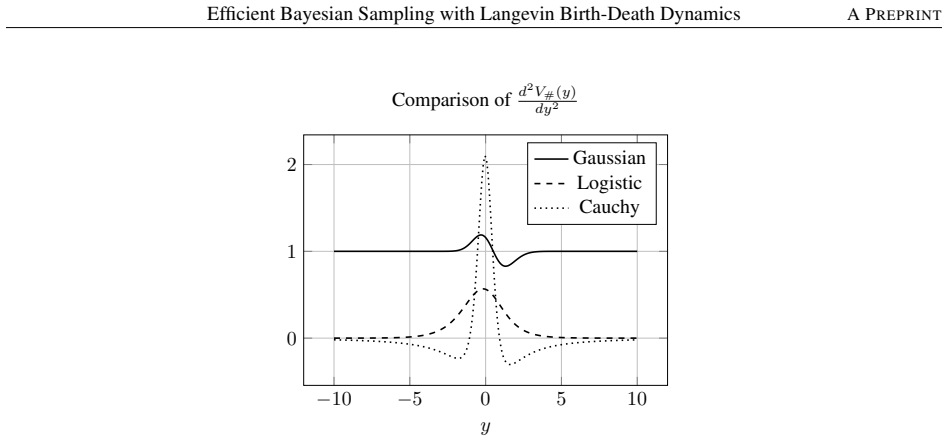
- The reparameterization theorem provides a general recipe for Langevin-type samplers on constrained and periodic domains, with the Gaussian choice acting as an L2-style confining potential.
- Birth-death augmentation plus annealing recovers multimodal weights in test cases where plain Langevin dynamics remains trapped, suggesting wider use for multimodal posteriors.
- Because the method is only first-order and parallelizes over particles, it is a natural fit for algorithmic differentiation and hardware accelerators.
- The reported systematic overconstraint implies the current sampler is a fast mode-finder, not yet an unbiased posterior sampler, and needs a Metropolis filter or exact jump rule for credible intervals.
Where Pith is reading between the lines
- The overconstraint is consistent with the stationary distribution of the birth-death process differing from p when the kernel rate Λ does not vanish at ρ=p; this should be checked by tuning the kernel bandwidth on a known target.
- The same dynamics should transfer to other differentiable waveform models and to neutron-star parameter estimation, because only the log-likelihood gradient and product-space structure are needed.
- A stepwise ablation—switching off birth-death, then adding an exact jump scheme—would quantitatively separate the contribution of the unadjusted Langevin bias from that of the kernel-smoothed rate.
- The quantile-map framework suggests designing custom reparameterizations that adapt the confining potential to prior shapes with boundary mass, going beyond the Gaussian, logistic, and Cauchy examples.
Editorial analysis
A structured set of objections, weighed in public.
Referee Report
Summary. The paper introduces an ensemble Langevin sampler augmented with a birth-death process, together with ensemble-based Fisher preconditioning, reparameterizations for hypercube/torus supports, and an annealing schedule. The method is first-order and parallelized across particles, and it is demonstrated on toy problems and on the GW150914 parameter-estimation problem. The authors report that the sampler recovers the modes of the GW150914 posterior in about 15 minutes on a GPU, compared with about 1.5 hours for a nested-sampling run, but they also acknowledge in Section 4 that the recovered distribution 'systematically overconstrains the parameters.'
Significance. If the stationarity issue identified below is repaired, the paper would be a useful contribution: it combines several practical ingredients (ensemble preconditioning, reparameterization, birth-death jumps, topological support) into a GPU-friendly first-order sampler, and the reparameterization analysis in Theorem 2.3 and Appendix B is mathematically clean. The code is available, and the experiments are reproducible in principle. However, the paper's central claim of 'recovering the posterior' is not supported by the current algorithm because the birth-death rate used in the implementation does not leave the target invariant.
major comments (3)
- [Eq. (12) and Section 2.4] The paper states that the kernel-smoothed rate Λ(x;ρ)=ln((k*ρ)/p)(x) - E_{x'∼ρ}[ln((k*ρ)/p)(x')] is 'identically zero when ρ=p'. This is false for any non-delta kernel. For the Gaussian kernel of Eq. (13), take p=N(0,1) and k=N(0,h²); then k*p=N(0,1+h²), so ln((k*p)/p)(x)=const + [h²/(2(1+h²))]x², and centering gives Λ(x;p)=[h²/(2(1+h²))](x²-1), which is not zero. Consequently p is not a stationary point of the birth-death term used in Algorithm 1. The mean-field equilibrium of the pure birth-death dynamics instead satisfies k*ρ∝p, whose Gaussian solution has variance σ_p²-h², i.e. a narrower distribution. This provides a concrete mechanism for the 'systematically overconstrains' behavior reported in Section 4, and it cannot be removed by adding a Metropolis filter to the diffusion alone. The unsmoothed rate in Eq. (11) does have the claimed property, but the implemented smoothed rate do
- [Section 4 and Abstract] The abstract claims the method is 'successfully applied to recover the parameters of GW150914', but Section 4 states that the dynamics 'recovers the modes of the posterior well, but systematically overconstrains the parameters.' These statements are in tension. The supported claim is fast mode discovery, not posterior recovery. The comparison with parallel Bilby is also not apples-to-apples: the Bilby run uses a likelihood marginalized over dL, tc, and Φc, whereas the Langevin birth-death run uses the full likelihood over all parameters, so the two runs target different posterior distributions. The reported speedup should be qualified accordingly, or the comparison should be rerun on identical targets.
- [Section 3.4 / Fig. 4] The two-ring Gaussian mixture experiment is presented as evidence that birth-death 'balances' mode weights. However, if the stationarity error from Eq. (12) is present, the balance achieved may be a balance with respect to the biased equilibrium k*ρ∝p rather than the true posterior. The experiment should be repeated with a corrected rate or with a diagnostic that isolates the birth-death bias (e.g. running the pure birth-death dynamics without diffusion and comparing the stationary variance to p). Without this, the mode-weight recovery claim is not established.
minor comments (4)
- [Eq. (12) / Remark 2.4] Remark 2.4 lists desirable properties of the unsmoothed rate, but the smoothing in Eq. (12) is stated to break diffeomorphic invariance. It would help to also state explicitly that smoothing breaks the exact stationarity property, since this is not merely a technicality.
- [Section 4, hyperparameters] The hyperparameters γ=0.01ϵ, σ=0.01 appear without definition of ϵ and σ in the main text; later τ and f are defined. Please define all tunables in one place and clarify the relationship between γ, τ, and the jump rate.
- [Throughout] There are several typographical errors (e.g. 'embarassingly', 'reparamaterization', 'Guassian', 'correponding', 'retrainment'). These do not affect the science but should be corrected.
- [Fig. 5 caption] The caption says the results are 'in reasonable agreement', while the text says the parameters are systematically overconstrained. Please make the caption consistent with the quantitative assessment, and report numerical discrepancy measures (e.g. marginal means/credible intervals) rather than relying only on the corner plot.
Circularity Check
No circularity found: adaptive ensemble preconditioning and kernel rates are self-referential only in the standard sense; the GW benchmark is external and the supported claim is fast mode recovery with acknowledged bias.
full rationale
Score 0: no step in the paper reduces by construction to its inputs. The Langevin update (Eq. 3) and preconditioned update (Eq. 4) are standard; the Fisher preconditioner (Eq. 7) is a Monte-Carlo estimator of the target-gradient covariance (Eq. 6), and using the evolving ensemble for that estimate is adaptive preconditioning, not a fitted parameter renamed as a prediction. The reparameterization theorem (Theorem 2.3, Eqs. 8-9) is proved in-text by a change of variables, and its three variants (logistic/Gaussian/Cauchy) are compared rather than assumed. The birth-death rate (Eq. 12) adapts the external construction of [37,46]; no uniqueness or optimality claim from the present authors' prior work is used to force the choice of kernel, which is explicitly a modeling choice (Eq. 13). The GW150914 validation is against an independent Dynesty/Bilby run using the same data, waveform, and priors, with no posterior summary from Bilby fed into the sampler; the paper's own Section 4 states the dynamics 'recover the modes ... but systematically overconstrain the parameters,' so the supported claim is mode recovery, and the acknowledged bias is a correctness limitation, not a circularity. The only in-scope caveat is the assertion in Section 2.4 that the smoothed rate Lambda in Eq. (12) is 'identically zero when rho = p'; for the Gaussian kernel of Eq. (13), k*p != p, so this stationarity claim is false and the birth-death term has an intrinsic bias. This is a mathematical error that should be weighed in correctness, but it does not make any predicted output equivalent to an input. The self-citations [27,31,32] refer to software and code repositories, not to load-bearing theoretical results.
Axiom & Free-Parameter Ledger
free parameters (5)
- Fisher damping lambda =
0.001
- Langevin timestep tau =
0.001 (identity), 2 (Fisher) in toy; 0.5 in GW150914
- Annealing schedule beta_min =
10^-5, linear to 1
- Maximum teleportation fraction f =
0.05 in GW run
- Kernel bandwidth h =
median heuristic of pairwise distances
axioms (6)
- standard math Langevin diffusion converges to the Gibbs density e^{-V} under the Fokker-Planck equation
- standard math Pushforward density formula: p#(y) = p(T^{-1}(y)) |det grad T^{-1}(y)|
- domain assumption Continuous birth-death PDE (Eq. 10) converges to p with potential-independent rate, as shown in [37]
- ad hoc to paper The kernel-smoothed rate Lambda in Eq. (12) with Gaussian kernel (Eq. 13) preserves the stationary distribution p
- domain assumption ULA without Metropolis correction has negligible bias for these targets at chosen timestep
- domain assumption Cylindrical approximation of S^2 with pole distortion is acceptable for orientation parameters
Cite this review
Pith. "Pith review of Efficient Bayesian Sampling with Langevin Birth-Death Dynamics." pith.science (2026). https://pith.science/paper/WIZPZPVB
@misc{pith2026250901942,
  author       = {Pith},
  title        = {Pith review of: Efficient Bayesian Sampling with Langevin Birth-Death Dynamics},
  year         = {2026},
  howpublished = {\url{https://pith.science/paper/WIZPZPVB}},
  note         = {Machine review of arXiv:2509.01942}
}
read the original abstract
Bayesian inference plays a central role in scientific and engineering applications by enabling principled reasoning under uncertainty. However, sampling from generic probability distributions remains a computationally demanding task. This difficulty is compounded when the distributions are ill-conditioned, multi-modal, or supported on topologically non-Euclidean spaces. Motivated by challenges in gravitational wave parameter estimation, we propose simulating a Langevin diffusion augmented with a birth-death process. The dynamics are rescaled with a simple preconditioner, and generalized to apply to the product spaces of a hypercube and hypertorus. Our method is first-order and embarrassingly parallel with respect to model evaluations, making it well-suited for algorithmic differentiation and modern hardware accelerators. We validate the algorithm on a suite of toy problems and successfully apply it to recover the parameters of GW150914 -- the first observed binary black hole merger. This approach addresses key limitations of traditional sampling methods, and introduces a template that can be used to design robust samplers in the future.
Figures


Reference graph
Works this paper leans on
-
[1]
Junaid Aasi et al. “Advanced ligo”. In: Classical and quantum gravity 32.7 (2015), p. 074001
work page 2015
-
[2]
Observation of Gravitational Waves from a Binary Black Hole Merger
B. P. Abbott et al. “Observation of Gravitational Waves from a Binary Black Hole Merger”. In: Physical Review Letters 116.6 (Feb. 2016). ISSN : 1079-7114. DOI: 10.1103/physrevlett.116.061102 . URL: http://dx. doi.org/10.1103/PhysRevLett.116.061102
-
[3]
Properties of the Binary Black Hole Merger GW150914
B. P. Abbott et al. “Properties of the Binary Black Hole Merger GW150914”. In: Phys. Rev. Lett. 116 (24 June 2016), p. 241102. DOI: 10.1103/PhysRevLett.116.241102 . URL: https://link.aps.org/doi/10. 1103/PhysRevLett.116.241102. 12 Efficient Bayesian Sampling with Langevin Birth-Death Dynamics A PREPRINT 30.82+0.73 −0.79 0.6 0.9 q 0.87+0.08 −0.08 0.3 0.6 d...
-
[4]
Open data from the first and second observing runs of Advanced LIGO and Advanced Virgo
Rich Abbott et al. “Open data from the first and second observing runs of Advanced LIGO and Advanced Virgo”. In: SoftwareX 13 (2021), p. 100658
work page 2021
-
[5]
Population of merging compact binaries inferred using gravitational waves through GWTC-3
Richard Abbott et al. “Population of merging compact binaries inferred using gravitational waves through GWTC-3”. In: Physical Review X 13.1 (2023), p. 011048
work page 2023
-
[6]
Advanced Virgo: a second-generation interferometric gravitational wave detector
Fausto Acernese et al. “Advanced Virgo: a second-generation interferometric gravitational wave detector”. In: Classical and Quantum Gravity 32.2 (2014), p. 024001
work page 2014
-
[7]
Estimating parameters in physical models through Bayesian inversion: A complete example
Moritz Allmaras et al. “Estimating parameters in physical models through Bayesian inversion: A complete example”. In: siam REVIEW 55.1 (2013), pp. 149–167
work page 2013
-
[8]
Gravitational-wave constraints on the neutron-star-matter Equation of State
Eemeli Annala et al. “Gravitational-wave constraints on the neutron-star-matter Equation of State”. In: Physical review letters 120.17 (2018), p. 172703
work page 2018
-
[9]
Bilby: A User-friendly Bayesian Inference Library for Gravitational-wave Astronomy
Gregory Ashton et al. “Bilby: A User-friendly Bayesian Inference Library for Gravitational-wave Astronomy”. In: The Astrophysical Journal Supplement Series 241.2 (Apr. 2019), p. 27. ISSN : 1538-4365. DOI: 10.3847/ 1538-4365/ab06fc. URL: http://dx.doi.org/10.3847/1538-4365/ab06fc
-
[10]
Gravitational-wave physics and astronomy in the 2020s and 2030s
Matthew Bailes et al. “Gravitational-wave physics and astronomy in the 2020s and 2030s”. In: Nature Reviews Physics 3.5 (2021), pp. 344–366
work page 2021
-
[11]
Christopher Michael Biwer et al. “PyCBC Inference: A Python-based parameter estimation toolkit for com- pact binary coalescence signals”. In: Publications of the Astronomical Society of the Pacific 131.996 (2019), p. 024503
work page 2019
-
[12]
James Bradbury et al. “Jax: Autograd and xla”. In: Astrophysics Source Code Library (2021), ascl–2111
work page 2021
-
[13]
T. A. Callister. A Thesaurus for Common Priors in Gravitational-Wave Astronomy. 2021. arXiv: 2104.09508 [gr-qc]. URL: https://arxiv.org/abs/2104.09508
Pith/arXiv arXiv 2021
-
[14]
Stan: A Probabilistic Programming Language
Bob Carpenter et al. “Stan: A Probabilistic Programming Language”. In: Journal of Statistical Software 76.1 (2017), pp. 1–32. DOI: 10.18637/jss.v076.i01
-
[15]
Sinho Chewi. Log-Concave Sampling. Unfinished draft. Available at https://chewisinho.github.io/ main.pdf. CIRM / MIT, 2025
work page 2025
-
[16]
Parameter estimation with gravitational waves
Nelson Christensen and Renate Meyer. “Parameter estimation with gravitational waves”. In: Reviews of Modern Physics 94.2 (Apr. 2022). ISSN : 1539-0756. DOI: 10.1103/revmodphys.94.025001 . URL: http://dx. doi.org/10.1103/RevModPhys.94.025001
-
[17]
CPNest: A Nested Sampling Implementation for Parameter Estimation
Walter Del Pozzo and John Veitch. CPNest: A Nested Sampling Implementation for Parameter Estimation . https://zenodo.org/records/6460935. 2022
-
[18]
Parallel tempering: Theory, applications, and new perspectives
David J Earl and Michael W Deem. “Parallel tempering: Theory, applications, and new perspectives”. In: Phys- ical Chemistry Chemical Physics 7.23 (2005), pp. 3910–3916
work page 2005
-
[19]
Thomas D. P. Edwards et al. ripple: Differentiable and Hardware-Accelerated Waveforms for Gravitational Wave Data Analysis. 2023. arXiv: 2302.05329 [astro-ph.IM]. URL: https://arxiv.org/abs/2302. 05329
Pith/arXiv arXiv 2023
-
[20]
F. Feroz and M. P. Hobson. “Multimodal nested sampling: an efficient and robust alternative to Markov Chain Monte Carlo methods for astronomical data analyses: Multimodal nested sampling”. In: Monthly Notices of the Royal Astronomical Society 384.2 (Jan. 2008), pp. 449–463. ISSN : 1365-2966. DOI: 10.1111/j.1365- 2966.2007.12353.x. URL: http://dx.doi.org/1...
arXiv 2008
-
[21]
MultiNest: an efficient and robust Bayesian inference tool for cosmology and particle physics
Farhan Feroz, MP Hobson, and Michael Bridges. “MultiNest: an efficient and robust Bayesian inference tool for cosmology and particle physics”. In: Monthly Notices of the Royal Astronomical Society 398.4 (2009), pp. 1601–1614
work page 2009
-
[22]
Langevin diffusions on the torus: estimation and applications
Eduardo Garc ´ıa-Portugu´es et al. “Langevin diffusions on the torus: estimation and applications”. In: Statistics and Computing 29.1 (Nov. 2017), pp. 1–22. ISSN : 1573-1375. DOI: 10.1007/s11222- 017- 9790- 2. URL: http://dx.doi.org/10.1007/s11222-017-9790-2
doi:10.1007/s11222- 2017
-
[23]
Large sample analysis of the median heuris- tic
Damien Garreau, Wittawat Jitkrittum, and Motonobu Kanagawa. “Large sample analysis of the median heuris- tic”. In: arXiv preprint arXiv:1707.07269 (2017)
Pith/arXiv arXiv 2017
-
[24]
Ensemble samplers with affine invariance
Jonathan Goodman and Jonathan Weare. “Ensemble samplers with affine invariance”. In: Communications in applied mathematics and computational science 5.1 (2010), pp. 65–80
work page 2010
-
[25]
Ya-Ping Hsieh et al. Mirrored Langevin Dynamics . 2020. arXiv: 1802 . 10174 [cs.LG]. URL: https : / / arxiv.org/abs/1802.10174
Pith/arXiv arXiv 2020
-
[26]
Sascha Husa et al. “Frequency-domain gravitational waves from nonprecessing black-hole binaries. I. New numerical waveforms and anatomy of the signal”. In:Phys. Rev. D93 (4 Feb. 2016), p. 044006.DOI: 10.1103/ PhysRevD.93.044006. URL: https://link.aps.org/doi/10.1103/PhysRevD.93.044006. 14 Efficient Bayesian Sampling with Langevin Birth-Death Dynamics A PREPRINT
-
[27]
GWFAST: A Fisher Information Matrix Python Code for Third-generation Gravitational-wave Detectors
Francesco Iacovelli et al. “GWFAST: A Fisher Information Matrix Python Code for Third-generation Gravitational-wave Detectors”. In: The Astrophysical Journal Supplement Series 263.1 (Oct. 2022), p. 2. ISSN : 1538-4365. DOI: 10 . 3847 / 1538 - 4365 / ac9129. URL: http : / / dx . doi . org / 10 . 3847 / 1538 - 4365 / ac9129
work page 2022
-
[28]
Sebastian Khan et al. “Frequency-domain gravitational waves from nonprecessing black-hole binaries. II. A phenomenological model for the advanced detector era”. In: Phys. Rev. D 93 (4 Feb. 2016), p. 044007. DOI: 10.1103/PhysRevD.93.044007. URL: https://link.aps.org/doi/10.1103/PhysRevD.93.044007
-
[29]
Recent observations of gravitational waves by LIGO and Virgo detectors
Andrzej Kr ´olak and Paritosh Verma. “Recent observations of gravitational waves by LIGO and Virgo detectors”. In: Universe 7.5 (2021), p. 137
work page 2021
-
[30]
Ensemble preconditioning for Markov chain Monte Carlo simulation
Benedict Leimkuhler, Charles Matthews, and Jonathan Weare. “Ensemble preconditioning for Markov chain Monte Carlo simulation”. In: Statistics and Computing 28 (2018), pp. 277–290
work page 2018
-
[31]
Leviyev. Langevin Birth-death. https://github.com/leviyevalex/langevin_birth_death. 2025
work page 2025
-
[32]
hybrid rosenbrock: An implementation of the n-dimensional Rosenbrock distribution for MCMC testing
Alex Leviyev. hybrid rosenbrock: An implementation of the n-dimensional Rosenbrock distribution for MCMC testing. GitHub repository. 2025. URL: https://github.com/leviyevalex/hybrid_rosenbrock
work page 2025
-
[33]
The Mirror Langevin Algorithm Converges with Vanishing Bias
Ruilin Li et al. The Mirror Langevin Algorithm Converges with Vanishing Bias . 2021. arXiv: 2109 . 12077 [cs.DS]. URL: https://arxiv.org/abs/2109.12077
work page internal anchor Pith review Pith/arXiv arXiv 2021
-
[34]
Ensemble Markov chain Monte Carlo with teleporting walkers
Michael Lindsey, Jonathan Weare, and Anna Zhang. “Ensemble Markov chain Monte Carlo with teleporting walkers”. In: SIAM/ASA Journal on Uncertainty Quantification 10.3 (2022), pp. 860–885
work page 2022
-
[35]
The mathematical engineering of deep learning
Benoit Liquet, Sarat Moka, and Yoni Nazarathy. The mathematical engineering of deep learning. 2024
work page 2024
-
[36]
Stein variational gradient descent: A general purpose bayesian inference algo- rithm
Qiang Liu and Dilin Wang. “Stein variational gradient descent: A general purpose bayesian inference algo- rithm”. In: Advances in neural information processing systems 29 (2016)
work page 2016
-
[37]
Accelerating langevin sampling with birth-death
Yulong Lu, Jianfeng Lu, and James Nolen. “Accelerating langevin sampling with birth-death”. In:arXiv preprint arXiv:1905.09863 (2019)
Pith/arXiv arXiv 1905
-
[38]
Yi-An Ma, Tianqi Chen, and Emily B. Fox. A Complete Recipe for Stochastic Gradient MCMC . 2015. arXiv: 1506.04696 [math.ST]. URL: https://arxiv.org/abs/1506.04696
Pith/arXiv arXiv 2015
-
[39]
GWpy: A Python package for gravitational-wave astrophysics
D. M. Macleod et al. “GWpy: A Python package for gravitational-wave astrophysics”. In: SoftwareX 13 (2021), p. 100657. ISSN : 2352-7110. DOI: 10.1016/j.softx.2021.100657. URL: https://www.sciencedirect. com/science/article/pii/S2352711021000029
-
[40]
Michele Maggiore. Gravitational Waves. Vol. 1: Theory and Experiments. Oxford University Press, 2007.ISBN : 978-0-19-171766-6, 978-0-19-852074-0. DOI: 10.1093/acprof:oso/9780198570745.001.0001
arXiv 2007
-
[41]
Kanti V Mardia and Peter E Jupp. Directional statistics. John Wiley & Sons, 2009
work page 2009
-
[42]
James Martin et al. “A stochastic Newton MCMC method for large-scale statistical inverse problems with application to seismic inversion”. In: SIAM Journal on Scientific Computing 34.3 (2012), A1460–A1487
work page 2012
-
[43]
Sampling from multimodal distributions using tempered transitions
Radford M Neal. “Sampling from multimodal distributions using tempered transitions”. In: Statistics and com- puting 6 (1996), pp. 353–366
work page 1996
-
[44]
Numerical optimization
Jorge Nocedal and Stephen J Wright. Numerical optimization. Springer, 1999
1999
-
[45]
An n-dimensional Rosenbrock distribution for Markov chain Monte Carlo testing
Filippo Pagani, Martin Wiegand, and Saralees Nadarajah. “An n-dimensional Rosenbrock distribution for Markov chain Monte Carlo testing”. In: Scandinavian Journal of Statistics 49.2 (2022), pp. 657–680
work page 2022
-
[46]
Sampling rare event energy landscapes via birth-death augmented dynamics
Benjamin Pampel et al. “Sampling rare event energy landscapes via birth-death augmented dynamics”. In: Phys. Rev. E 107 (2 Feb. 2023), p. 024141. DOI: 10.1103/PhysRevE.107.024141 . URL: https://link.aps. org/doi/10.1103/PhysRevE.107.024141
-
[47]
hyppo: A Comprehensive Multivariate Hypothesis Testing Python Package
Sambit Panda et al. hyppo: A Comprehensive Multivariate Hypothesis Testing Python Package . 2020. arXiv: 1907.02088 [stat.CO]
Pith/arXiv arXiv 2020
-
[48]
Stochastic processes and applications
Grigorios A Pavliotis. “Stochastic processes and applications”. In: Texts in applied mathematics 60 (2014)
work page 2014
-
[49]
A Hamiltonian Monte–Carlo method for Bayesian inference of supermas- sive black hole binaries
Edward K Porter and J ´erˆome Carr´e. “A Hamiltonian Monte–Carlo method for Bayesian inference of supermas- sive black hole binaries”. In: Classical and Quantum Gravity 31.14 (2014), p. 145004
work page 2014
-
[50]
The metropolis—hastings algorithm
Christian P Robert et al. “The metropolis—hastings algorithm”. In: Monte Carlo statistical methods (2004), pp. 267–320
work page 2004
-
[51]
Removing degeneracy and multimodality in gravitational wave source parameters
Javier Roulet et al. “Removing degeneracy and multimodality in gravitational wave source parameters”. In: Physical Review D 106.12 (2022), p. 123015
work page 2022
-
[52]
Sampling with Mirrored Stein Operators
Jiaxin Shi, Chang Liu, and Lester Mackey. “Sampling with mirrored stein operators”. In: arXiv preprint arXiv:2106.12506 (2021)
work page internal anchor Pith review Pith/arXiv arXiv 2021
-
[53]
Nested sampling for general Bayesian computation
John Skilling. “Nested sampling for general Bayesian computation”. In: (2006). 15 Efficient Bayesian Sampling with Langevin Birth-Death Dynamics A PREPRINT
work page 2006
-
[54]
Massively parallel Bayesian inference for transient gravitational-wave astronomy
Rory J E Smith et al. “Massively parallel Bayesian inference for transient gravitational-wave astronomy”. In: Monthly Notices of the Royal Astronomical Society 498.3 (Aug. 2020), pp. 4492–4502. ISSN : 1365-2966. DOI: 10.1093/mnras/staa2483. URL: http://dx.doi.org/10.1093/mnras/staa2483
-
[55]
dynesty: a dynamic nested sampling package for estimating Bayesian posteriors and ev- idences
Joshua S Speagle. “dynesty: a dynamic nested sampling package for estimating Bayesian posteriors and ev- idences”. In: Monthly Notices of the Royal Astronomical Society 493.3 (Feb. 2020), pp. 3132–3158. ISSN : 1365-2966. DOI: 10.1093/mnras/staa278. URL: http://dx.doi.org/10.1093/mnras/staa278
-
[56]
Non-Reversible Parallel Tempering: A Scalable Highly Parallel MCMC Scheme
Saifuddin Syed et al. “Non-Reversible Parallel Tempering: A Scalable Highly Parallel MCMC Scheme”. In: Journal of the Royal Statistical Society Series B: Statistical Methodology84.2 (Dec. 2021), pp. 321–350. ISSN : 1467-9868. DOI: 10.1111/rssb.12464. URL: http://dx.doi.org/10.1111/rssb.12464
-
[57]
Energy statistics: A class of statistics based on distances
G ´abor J Sz´ekely and Maria L Rizzo. “Energy statistics: A class of statistics based on distances”. In: Journal of statistical planning and inference 143.8 (2013), pp. 1249–1272
work page 2013
-
[58]
Eric Thrane and Colm Talbot. “An introduction to Bayesian inference in gravitational-wave astronomy: Pa- rameter estimation, model selection, and hierarchical models”. In: Publications of the Astronomical Society of Australia 36 (2019). ISSN : 1448-6083. DOI: 10.1017/pasa.2019.2. URL: http://dx.doi.org/10.1017/ pasa.2019.2
-
[59]
Optimal Preconditioning and Fisher Adaptive Langevin Sampling
Michalis Titsias. “Optimal Preconditioning and Fisher Adaptive Langevin Sampling”. In: Advances in Neural Information Processing Systems 36 (2024)
work page 2024
-
[60]
Michele Vallisneri. “Use and abuse of the Fisher information matrix in the assessment of gravitational-wave parameter-estimation prospects”. In: Physical Review D—Particles, Fields, Gravitation, and Cosmology 77.4 (2008), p. 042001
work page 2008
-
[61]
John Veitch et al. “Parameter estimation for compact binaries with ground-based gravitational-wave observa- tions using the LALInference software library”. In: Physical Review D 91.4 (2015), p. 042003
work page 2015
-
[62]
Rapid convergence of the unadjusted langevin algorithm: Isoperimetry suffices
Santosh Vempala and Andre Wibisono. “Rapid convergence of the unadjusted langevin algorithm: Isoperimetry suffices”. In: Advances in neural information processing systems 32 (2019)
work page 2019
-
[63]
SciPy 1.0: fundamental algorithms for scientific computing in Python
Pauli Virtanen et al. “SciPy 1.0: fundamental algorithms for scientific computing in Python”. In: Nature methods 17.3 (2020), pp. 261–272
work page 2020
-
[64]
Udo V on Toussaint. “Bayesian inference in physics”. In: Reviews of Modern Physics 83.3 (2011), pp. 943–999
work page 2011
-
[65]
Stein Variational Gradient Descent With Matrix-Valued Kernels
Dilin Wang et al. Stein Variational Gradient Descent With Matrix-Valued Kernels. 2019. arXiv: 1910.12794 [stat.ML]. URL: https://arxiv.org/abs/1910.12794
work page internal anchor Pith review Pith/arXiv arXiv 2019
-
[66]
Tikhonov or lasso regularization: Which is better and when
Fei Wang, Sanjay Chawla, and Wei Liu. “Tikhonov or lasso regularization: Which is better and when”. In: 2013 IEEE 25th International Conference on Tools with Artificial Intelligence. IEEE. 2013, pp. 795–802
work page 2013
-
[67]
E Weinan, Tiejun Li, and Eric Vanden-Eijnden. Applied stochastic analysis. V ol. 199. American Mathematical Soc., 2021
work page 2021
-
[68]
Kaze W. K. Wong, Maximiliano Isi, and Thomas D. P. Edwards. Fast gravitational wave parameter estimation without compromises. 2023. arXiv: 2302.05333 [astro-ph.IM]. URL: https://arxiv.org/abs/2302. 05333
Pith/arXiv arXiv 2023
-
[69]
Gravitational-wave tests of general relativity with ground-based detectors and pulsar-timing arrays
Nicol ´as Yunes and Xavier Siemens. “Gravitational-wave tests of general relativity with ground-based detectors and pulsar-timing arrays”. In: Living Reviews in Relativity 16.1 (2013), pp. 1–124. A Efficient Birth-Death Implementation The birth-death process described in Algorithm 1 utilizes an abstract data structure (DS) with three methods: lookup, choi...
work page 2013
discussion (0)
Sign in with ORCID, Apple, or X to comment. Anyone can read and Pith papers without signing in.