REVIEW 4 major objections 5 minor 5 cited by
Planck clusters calibrated with DES shear put S8 at 0.791, in 1.6-sigma tension with CMB and 2.9-sigma with eROSITA.
Reviewed by Pith at T0; open to challenge. T0 means a machine referee read the full paper against a public rubric. the ladder, T0–T4 →
Planck cluster counts with DES weak-lensing and Chandra mass calibration yield S8=0.791, matching late-time probes and disagreeing with eROSITA clusters by 2.9 sigma.
T0 review reviewed 2026-08-05 challenge →
load-bearing objection Careful PSZ2+DES shear S8=0.79 measurement, but the scatter-free hydrostatic-bias assumption is untested and the AIC-preferred free-bias model shifts Omega_m by 0.04. the 4 major comments →
Cosmological constraints from the Planck cluster catalogue with DES shear profiles and Chandra observations
The pith
A machine-rendered reading of the paper's core claim, the machinery that carries it, and where it could break.
The reading
Core claim
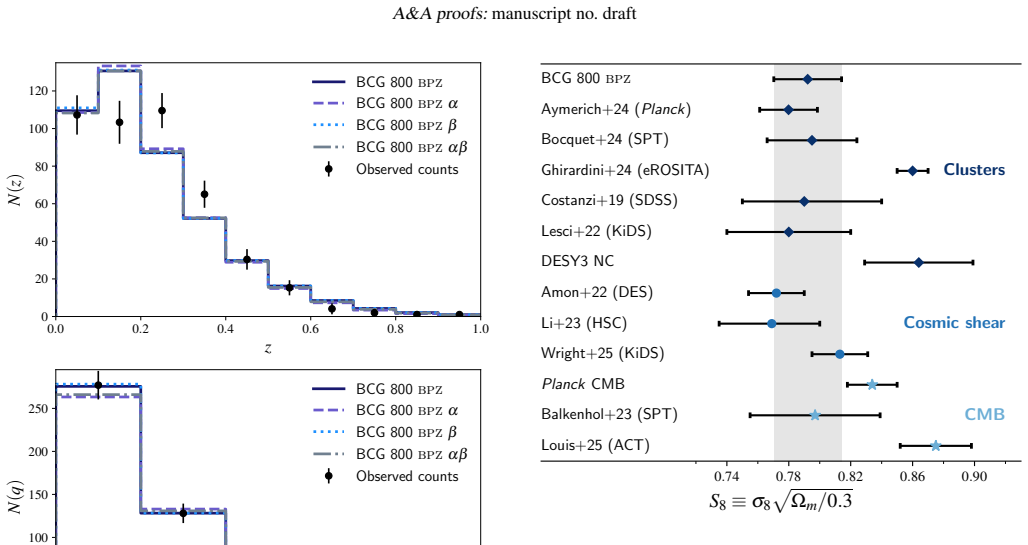
One joint likelihood — cluster number counts, DES shear-calibrated hydrostatic mass bias, and BAO data — turns the Planck PSZ2 catalogue into a competitive late-time cosmological probe. Baseline: Omega_m=0.312(+0.018,-0.024), sigma8=0.777(+/-0.024), S8=0.791(+0.023,-0.021), (1-b)=0.844(+0.055,-0.062). Letting the bias evolve with mass moves the preferred values to Omega_m=0.353, sigma8=0.751, S8=0.814, with alpha=0.272±0.094 preferred by the AIC. Results stay coherent across centre definitions, source-redshift estimators, and inner-bin choices. Planck and eROSITA masses agree, so the 2.9-sigma tension with eROSITA is placed in population modelling, not mass calibration.
What carries the argument
The load-bearing object is the hydrostatic mass bias (1-b), the factor that converts Chandra-derived hydrostatic masses to true halo masses through the scatter-free relation P(M_H|M,z)=delta(M_H-(1-b)M). The same bias enters both halves of the analysis: it rescales the masses that the DES shear-profile likelihood compares with a weak-lensing mass MWL, and it sets the expected SZ signal in the number-counts prediction. The argument is carried by the joint likelihood lnL = lnL_WL + lnL_NC + lnL_BAO, sampled with MCMC; the WL mass-to-halo-mass relation and its scatter are calibrated from synthetic shear profiles drawn from hydrodynamic simulations so that an imperfect extraction model does not
Load-bearing premise
The load-bearing premise is that a cluster's hydrostatic mass is the true halo mass times one smooth factor (1-b) with no scatter, so a single number or a single mass/redshift trend fully corrects the mass scale; the paper's own test that frees the mass trend shifts Omega_m from 0.312 to 0.353 and S8 from 0.791 to 0.814, showing this assumption's scope is the most fragile point.
What would settle it
Compare Chandra hydrostatic masses with unbiased lensing masses for the same PSZ2 clusters in narrow mass and redshift bins, with mis-centring controlled by X-ray centres. If the residuals show scatter clearly above zero around the (1-b) relation, or a mass trend steeper than alpha=0.27±0.09 outside the fitted uncertainty, then the delta-function mass-bias model in Eq. 9 is wrong and the quoted S8=0.791 is not the unbiased value. A cheaper check: rerun the joint fit with (1-b) given an intrinsic mass-scatter parameter and see whether the posterior on Omega_m moves by more than the reported err
If this is right
- Planck PSZ2 number counts mass-calibrated with DES shear prefer S8=0.791, consistent with SPT SZ clusters and most late-time probes, and only 1.6-sigma below Planck CMB.
- The mean hydrostatic mass bias (1-b)=0.844 agrees with simulation-based and gas-fraction-based estimates, supporting wide-field WL as a cluster mass calibrator.
- Because Planck+DES and eRASS1 masses agree for matched clusters, the 2.9-sigma eROSITA tension is placed in selection-function/population modelling rather than in the shared mass calibration.
- Letting the bias evolve with mass yields Omega_m=0.353 and S8=0.814, with the AIC preferring the evolving model; the fixed-bias baseline therefore carries a modelling choice that visibly moves the result along the Omega_m-sigma8 degeneracy.
- Forecast with Stage IV lensing-like shear mocks shows the PSZ2 sample becomes nearly statistics-limited, with further gains requiring the WL bias uncertainty to drop from 2-4% toward 1%.
Where Pith is reading between the lines
- Editorial extension: the same joint-calibration machinery, applied without modification to eROSITA and SPT catalogues, would directly test whether their differing S8 values are fully explained by catalogue population models.
- Editorial extension: if the mass-dependent bias (alpha~0.27) is a real astrophysical feature rather than a degeneracy with the PSZ2 mass-redshift correlation, fixed-bias cluster analyses systematically underestimate Omega_m; an independent, scatter-free measurement of (1-b) in fine mass bins would arbitrate.
- Editorial extension: the method transfers to X-ray-selected cluster samples — replacing the SZ selection function with an X-ray one while keeping the DES shear bias likelihood would place eROSITA and Planck on exactly the same calibration footing, a testable route to isolate selection effects.
Editorial analysis
A structured set of objections, weighed in public.
Referee Report
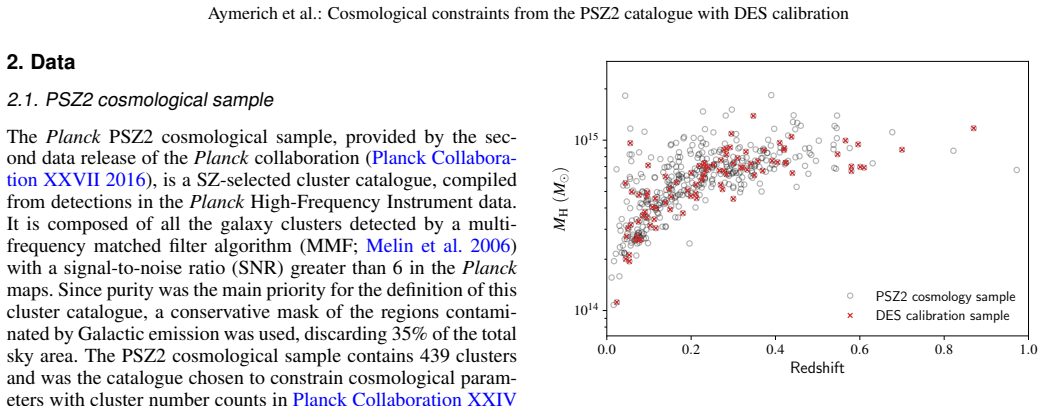
Summary. The paper presents cosmological constraints from the Planck PSZ2 cluster catalogue by simultaneously fitting (i) the cluster number counts, (ii) a weak-lensing calibration of the hydrostatic mass bias using DES Y3 shear profiles around 93 PSZ2 clusters, and (iii) BAO data. Hydrostatic masses for the full PSZ2 sample are derived from a YSZ–MH scaling relation calibrated on Chandra X-ray observations. The baseline analysis, using BCG centres, bpz photo-zs, and a fixed hydrostatic mass bias, yields Ωm=0.312+0.018/−0.024, σ8=0.777±0.024, S8=0.791+0.023/−0.021, and (1−b)=0.844+0.055/−0.062, in mild tension with Planck CMB and in 2.9σ tension with eRASS1. Robustness to centre definition, photo-z choice, inner-bin inclusion, and bias evolution is explored, and a forecast for Stage-IV WL surveys is given.
Significance. If the baseline result is correct, it adds a well-characterized late-time cluster probe to the low-S8 consensus and locates the eROSITA discrepancy in population modelling rather than mass calibration. The paper's method—simultaneous WL-based bias calibration and cosmological sampling—is a useful template for cluster cosmology with Stage-IV surveys. The analysis also provides a careful comparison of mass estimates with eRASS1 and makes chains publicly available. However, the central result depends on several modelling choices whose impact is not fully stress-tested, and the data themselves prefer an alternative parametrization, so the headline numbers should be treated with caution until those tests are performed.
major comments (4)
- [Eq. (9) and Sec. 4.1] Equation (9) assumes a scatter-free, deterministic hydrostatic mass bias, P(MH|M,z)=δ(MH−(1−b)M). This is what reduces Eq. (8) to Eq. (10) and allows the WL likelihood to be evaluated at M=MH/(1−b). If the hydrostatic mass has intrinsic scatter around (1−b)M (simulations and X-ray studies suggest several to ~15%), Eq. (10) is not the correct marginal likelihood; the integral over M must be retained, and the calibration of (1−b) and the number-counts likelihood will be modified. The robustness tests in Table 4 vary only the mean of the bias (α, β) and keep the delta-function form, so they do not probe this assumption. Given that freeing α already shifts Ωm from 0.312 to 0.353 and S8 from 0.791 to 0.814 (Table 4) and is AIC-preferred (Table 6), the no-scatter assumption is load-bearing and needs an explicit test, e.g., a rerun with a log-normal scatter in MH at fixed M.
- [Table 6 and Sec. 7.2] The paper reports ΔAIC=7.36 for the α-free model relative to the baseline fixed-bias model, which by the paper's own criterion is a significant improvement, yet the abstract, conclusions, and headline comparisons quote only the fixed-bias results. Since the data prefer the evolving-bias model, the fixed-bias model should not be presented as the sole baseline without a physical justification or a clear statement that the headline constraints are conditional on a prior that the data disfavour. The shifts between the two models are at the ~1σ level in S8 but larger in Ωm, so the choice affects the paper's central comparison with eRASS1 and Planck.
- [Sec. 7.2, Table 5] The number-counts C-statistic is 46.4 against an expected 34.5±7.9 from the best-fit model, i.e., about 1.5σ high. The paper attributes this to a known PSZ2 redshift-distribution problem and leaves it unmodelled. Because the number-counts likelihood is one of only two main likelihood terms, a systematic misfit of this size can bias the recovered Ωm and σ8. The paper should quantify the impact, for example by removing or down-weighting the discrepant redshift bins, or by adding a nuisance parameter for the redshift distribution, and show that the cosmological conclusions are stable.
- [Sec. 7.2, Fig. 6 and Table 5] The stacked shear profiles are visibly flatter than the model predictions (residuals in bins 2 and 3), and the baseline χ2=26.0+2.1/−2.7 for 17 dof is high. The paper argues this is absorbed by the WL mass bias bWL, but this is only guaranteed if the mismatch is scale-independent or if the simulation-based calibration covers the same radial trend. A mass-dependent residual trend could bias bM in Eq. (25) and hence the mass calibration. At minimum, the authors should test the sensitivity to the fixed concentration c500c=3 and show that the recovered masses are unchanged when the radial weighting is varied.
minor comments (5)
- [Abstract and Table 4] The abstract quotes the fixed-bias baseline without noting that the AIC-favoured model yields different Ωm and S8; consider making the baseline choice explicit in the abstract.
- [Sec. 3.3, Eq. (5)] The YSZ–MH scaling relation parameters are quoted with asymmetric notation (10−0.29±0.01 in Eq. 5 vs Y∗ in Eq. 3); clarify the relation between Y∗ and the normalization in Eq. (5).
- [Table 2 and Sec. 6.2] The notation 'BCG 800 bpzαβ' is compact but somewhat opaque; a short glossary or explicit definition in the table caption would improve readability.
- [Sec. 7.3, Fig. 10] The mass comparison with eRASS1 is a useful consistency check, but the vertical error bars appear to omit scatter in the eRASS1 mass estimates; please state the error budget explicitly.
- [Appendix C] The no-BAO results are reported for the baseline only; reporting them for the α-free model as well would be helpful for comparison with eRASS1, which uses a tighter H0 prior.
Circularity Check
Central S8 derivation is a genuine joint fit; only a minor shared-calibration cross-check is partially built in.
specific steps
-
other
[Section 7.3 (Comparison with other cosmological analyses), Eq. (39), Fig. 10]
"We confirm that our mass calibration is consistent with the eROSITA analysis by comparing masses for clusters present in both Planck and eROSITA samples, eliminating it as a potential cause of tension. ... This might be expected, as both experiments use the same WL data, and treat it in very similar ways."
The comparison mass MPlanck+DES is defined as MH/(1-b) (Eq. 39), with (1-b) calibrated from DES WL shear profiles; the eRASS1 masses are taken from Ghirardini+24, whose mass calibration uses the same DES WL data and the same Grandis+24 WL mass-to-halo-mass calibration. The agreement between the two mass scales is therefore partly guaranteed by the common WL calibration, so the 'confirmation' of mass-calibration consistency is not an independent validation. It does still test consistency between the SZ+X-ray and X-ray count-rate proxies, so this is a minor, non-load-bearing circularity; the central S8 constraint does not reduce to this comparison.
full rationale
The paper's headline result, S8 = 0.791, comes from a simultaneous fit of the PSZ2 number-count likelihood (Eqs. 26-29) and the DES shear-profile likelihood (Eqs. 8-11), with the hydrostatic-mass bias (1-b) and cosmology sampled together. The YSZ-MH scaling relation (Eq. 5) and its priors are imported from Aymerich+24, and the WL mass-to-halo-mass calibration (Eqs. 24-25, Appendix B) is imported from the Grandis+24 simulation framework. These are external inputs calibrated on X-ray, SZ, and simulation data, not on the target S8; they are load-bearing but not circular in the sense of being defined in terms of the result. The delta-function no-scatter assumption in Eq. (9) is an explicit modelling choice (justified by external references), not a hidden reduction. The paper's own AIC analysis shows that freeing the mass trend alpha is preferred, but this is a robustness concern rather than a circularity. The only partially circular element is the eRASS1 mass comparison, where both mass scales share the same DES WL calibration; the paper acknowledges this, and the comparison is a consistency check rather than part of the cosmological derivation. Overall, the central S8 value is not fixed by construction or by a self-citation chain, so the circularity score is low.
Axiom & Free-Parameter Ledger
free parameters (7)
- Hydrostatic mass bias (1-b) =
0.844+0.055-0.062 (baseline)
- Bias mass trend alpha and redshift trend beta =
alpha=0.272+/-0.094, beta=0.12+0.22-0.19 when free
- YSZ-MH scaling relation parameters Y*, alpha_SZ, sigma_int =
Y*=-0.29+/-0.01, alpha_SZ=1.70+/-0.1, sigma_int=0.086+/-0.01
- WL systematic parameters A_WL, B_WL, C_WL, D_WL =
Standard Gaussian priors
- Mis-centring parameters sigma1, sigma2, f =
SZ sigma1=54.9+/-5.4 arcsec; BCG sigma1=21+/-2 kpc, sigma2=207+/-39 kpc, f=0.54+/-0.19
- NFW concentration c500c =
3 (fixed)
- WL mass bias, mass trend, and scatter (b(z), b_M, sigma_WL) =
mu_b approx -0.01 to -0.03, b_M approx 1.0, sigma_WL approx 0.2 (Tables B.1-B.5)
axioms (8)
- domain assumption Hydrostatic equilibrium for X-ray mass computation
- domain assumption Scatter-free hydrostatic mass-halo mass relation (eq. 9)
- domain assumption Tinker et al. (2008) halo mass function
- domain assumption Gaussian-noise analytical selection function
- domain assumption Mis-centring shapes: single and double Rayleigh distributions
- domain assumption Log-normal WL mass-halo mass relation with TNG300-calibrated mean and scatter
- domain assumption DES calibration sample represents the full PSZ2 sample
- domain assumption Self-similar redshift scaling of the YSZ-MH relation
Cite this review
Pith. "Pith review of Cosmological constraints from the Planck cluster catalogue with DES shear profiles and Chandra observations." pith.science (2026). https://pith.science/paper/GRBTRE7W
@misc{pith2026250902068,
  author       = {Pith},
  title        = {Pith review of: Cosmological constraints from the Planck cluster catalogue with DES shear profiles and Chandra observations},
  year         = {2026},
  howpublished = {\url{https://pith.science/paper/GRBTRE7W}},
  note         = {Machine review of arXiv:2509.02068}
}
abstract
We present cosmological constraints from the Planck PSZ2 cosmological cluster sample, using weak-lensing shear profiles from Dark Energy Survey (DES) data and X-ray observations from the Chandra telescope for the mass calibration. We compute hydrostatic mass estimates for all clusters in the PSZ2 sample with a scaling relation between their Sunyaev-Zeldovich signal and X-ray derived hydrostatic mass, calibrated with the Chandra data. We introduce a method to correct these masses with a hydrostatic mass bias using shear profiles from wide-field galaxy surveys. We simultaneously fit the number counts of the PSZ2 sample and the mass calibration with the DES data, finding $\Omega_\text{m}=0.312^{+0.018}_{-0.024}$, $\sigma_8=0.777\pm 0.024$, $S_8\equiv \sigma_8 \sqrt{\Omega_\text{m} / 0.3}=0.791^{+0.023}_{-0.021}$, and $(1-b)=0.844^{+0.055}_{-0.062}$ for our baseline analysis when combined with BAO data. When considering a hydrostatic mass bias evolving with mass, we find $\Omega_\text{m}=0.353^{+0.025}_{-0.031}$, $\sigma_8=0.751\pm 0.023$, and $S_8=0.814^{+0.019}_{-0.020}$. We verify the robustness of our results by exploring a variety of analysis settings, with a particular focus on the definition of the halo centre used for the extraction of shear profiles. We compare our results with a number of other analyses, in particular two recent analyses of cluster samples obtained from SPT and eROSITA data that share the same mass calibration data set. We find that our results are in overall agreement with most late-time probes, in very mild tension with CMB results (1.6$\sigma$), and in significant tension with results from eROSITA clusters (2.9$\sigma$). We confirm that our mass calibration is consistent with the eROSITA analysis by comparing masses for clusters present in both Planck and eROSITA samples, eliminating it as a potential cause of tension.
Figures




Forward citations
Cited by 5 Pith papers
-
Simulation-Based Inference for Cluster Cosmology with Set-Based Neural Network Architectures
SBI framework with GNN-on-sets and masked autoregressive flow recovers input cosmologies from eRASS1 mocks at 11.5% precision on Ω_m and 4.4% on σ_8 using 3259 clusters.
-
CHEX-MATE: AMALGAM weak-lensing analysis of 41 Planck Sunyaev-Zel'dovich-selected galaxy clusters
Weak-lensing analysis of 41 SZ clusters yields c200=3.53±0.71 at 10^15 Msun z=0.25 and MSZ/M500=0.83±0.09 with 8% systematic uncertainty and intrinsic scatters.
-
Weak-lensing mass calibration of \emph{Planck} Sunyaev--Zel'dovich clusters with HSC-SSP Year~3
Weak-lensing calibration of 19 Planck SZ clusters with HSC Year 3 yields 1-b = 0.73^{+0.10}_{-0.11} at z_eff ~0.24 after forward-modeling selection, Eddington bias, and miscentering.
-
On the cosmology dependence of the cluster weak-lensing mass bias
Cosmology-dependent concentration models remove most cosmology dependence of the cluster weak-lensing mass bias; residual trends track baryon fraction and require explicit baryonic modeling.
-
PSZ: The meta-catalogue of Planck Sunyaev-Zeldovich sources
PSZ is a new meta-catalogue of 1500 confirmed Planck SZ clusters incorporating 281 new confirmations, 262 invalidations, updated redshifts for 552 clusters, and homogeneously derived masses corrected for selection effects.
Reference graph
Works this paper leans on
-
[1]
, " * write output.state after.block = add.period write newline
ENTRY address archiveprefix author booktitle chapter edition editor howpublished institution eprint journal key month note number organization pages publisher school series title type volume year label extra.label sort.label short.list INTEGERS output.state before.all mid.sentence after.sentence after.block FUNCTION init.state.consts #0 'before.all := #1 ...
-
[2]
write newline
" write newline "" before.all 'output.state := FUNCTION n.dashify 't := "" t empty not t #1 #1 substring "-" = t #1 #2 substring "--" = not "--" * t #2 global.max substring 't := t #1 #1 substring "-" = "-" * t #2 global.max substring 't := while if t #1 #1 substring * t #2 global.max substring 't := if while FUNCTION word.in bbl.in " " * FUNCTION format....
-
[3]
2017, Mon
Alam, S., Ata, M., Bailey, S., et al. 2017, Mon. Not. Roy. Astron. Soc., 470, 2617
2017
-
[4]
A., et al
Amon, A., Gruen, D., Troxel, M. A., et al. 2022, Phys. Rev. D, 105, 023514
2022
-
[5]
W., Melin, J.-B., et al
Andrade-Santos , F., Pratt, G. W., Melin, J.-B., et al. 2021, ApJ, 914, 58
2021
-
[6]
W., Piffaretti, R., et al
Arnaud, M., Pratt, G. W., Piffaretti, R., et al. 2010, Astron. Astrophys., 517, A92
2010
-
[7]
W., et al
Aymerich, G., Douspis, M., Pratt, G. W., et al. 2024, A&A, 690, A238
2024
-
[8]
S., et al
Balkenhol, L., Dutcher, D., Mancini, A. S., et al. 2023, Phys. Rev. D, 108, 023510
2023
-
[9]
2000, ApJ, 536, 571
Ben \'i tez, N. 2000, ApJ, 536, 571
2000
-
[10]
E., Bocquet, S., Stalder, B., et al
Bleem, L. E., Bocquet, S., Stalder, B., et al. 2020, ApJS, 247, 25
2020
-
[11]
Bleem, L. E., Klein, M., Abbott, T. M. C., et al. 2024, Open J. Astrophys., 7, astro.2311.07512
Pith/arXiv arXiv 2024
-
[12]
E., Stalder, B., de Haan , T., et al
Bleem, L. E., Stalder, B., de Haan , T., et al. 2015, Astrophys. J. Suppl., 216, 27
work page 2015
- [13]
- [14]
-
[15]
2020, Journal of Applied Statistics, 47, 2044
Bonamente, M. 2020, Journal of Applied Statistics, 47, 2044
work page 2020
-
[16]
2024, A&A, 685, A106
Bulbul, E., Liu, A., Kluge, M., et al. 2024, A&A, 685, A106
2024
- [17]
-
[18]
2024, The Open Journal of Astrophysics, 7
Chiu, I.-N., Chen, K.-F., Oguri, M., et al. 2024, The Open Journal of Astrophysics, 7
work page 2024
-
[19]
N., Ghirardini, V., Liu, A., et al
Chiu, I. N., Ghirardini, V., Liu, A., et al. 2022, A&A, 661, A11
work page 2022
- [20]
-
[21]
2021, Phys
Costanzi, M., Saro, A., Bocquet, S., et al. 2021, Phys. Rev. D, 103, 043522
2021
-
[22]
2023, Phys
Dalal, R., Li, X., Nicola, A., et al. 2023, Phys. Rev. D, 108, 123519
2023
-
[23]
De Vicente, J., S \'a nchez, E., & Sevilla-Noarbe , I. 2016, MNRAS, 459, 3078
work page 2016
-
[24]
2025, submitted, arXiv:2503.13632
DES Collaboration . 2025, submitted, arXiv:2503.13632
Pith/arXiv arXiv 2025
-
[25]
T., Honscheid, K., et al
Flaugher, B., Diehl, H. T., Honscheid, K., et al. 2015, AJ, 150, 150
2015
-
[26]
Foreman-Mackey , D., Hogg, D. W., Lang, D., & Goodman, J. 2013, Publications of the Astronomical Society of the Pacific, 125, 306
work page 2013
-
[27]
Gallo, S., Douspis, M., Soubri \'e , E., & Salvati, L. 2024, A&A, 686, A15
work page 2024
-
[28]
2021, MNRAS, 504, 4312
Gatti, M., Sheldon, E., Amon, A., et al. 2021, MNRAS, 504, 4312
2021
-
[29]
Ghirardini, V., Bulbul, E., Artis, E., et al. 2024, A&A, 689, A298
work page 2024
-
[30]
2021, Monthly Notices of the Royal Astronomical Society, 502, 5115
Gianfagna, G., De Petris, M., Yepes, G., et al. 2021, Monthly Notices of the Royal Astronomical Society, 502, 5115
work page 2021
-
[31]
J., Klein, M., & Dolag, K
Grandis, S., Bocquet, S., Mohr, J. J., Klein, M., & Dolag, K. 2021, MNRAS, 507, 5671
2021
-
[32]
Grandis, S., Ghirardini, V., Bocquet, S., et al. 2024, A&A, 687, A178
work page 2024
-
[33]
Grandis, S., Mohr, J. J., Dietrich, J. P., et al. 2019, MNRAS, 488, 2041
work page 2019
-
[34]
Gruen, D., Seitz, S., Brimioulle, F., et al. 2014, MNRAS, 442, 1507
work page 2014
- [35]
-
[36]
Herranz, D., Sanz, J. L., Barreiro, R. B., & Martinez-Gonzalez, E. 2002, Astrophys. J., 580, 610
work page 2002
-
[37]
Heymans, C., Tr \"o ster, T., Asgari, M., et al. 2021, A&A, 646, A140
work page 2021
-
[38]
Hilton, M., Sif \'o n, C., Naess, S., et al. 2021, Astrophys. J. Suppl., 253, 3
work page 2021
- [39]
-
[40]
Huff, E. & Mandelbaum, R. 2017, arXiv e-prints, arXiv:1702.02600
Pith/arXiv arXiv 2017
-
[41]
Jarvis, M., Bernstein, G. M., Amon, A., et al. 2021, MNRAS, 501, 1282
work page 2021
-
[42]
T., Braspenning, J., Chluba, J., et al
Kay, S. T., Braspenning, J., Chluba, J., et al. 2024, Mon. Not. Roy. Astron. Soc., 534, 251
work page 2024
-
[43]
Klein, M., Mohr, J. J., Bocquet, S., et al. 2024, Monthly Notices of the Royal Astronomical Society, 531, 3973
work page 2024
-
[44]
2025, A&A, 695, A216
Kleinebreil, F., Grandis, S., Schrabback, T., et al. 2025, A&A, 695, A216
2025
-
[45]
Kravtsov, A. V., Vikhlinin, A., & Nagai, D. 2006, Astrophys. J., 650, 128
work page 2006
-
[46]
G., Aghanim, N., Hern \'a ndez-Mart \'i nez , E., & Dolag, K
Lebeau, T., Sorce, J. G., Aghanim, N., Hern \'a ndez-Mart \'i nez , E., & Dolag, K. 2024, Astron. Astrophys., 682, A157
work page 2024
-
[47]
F., Marulli, F., Moscardini, L., et al
Lesci, G. F., Marulli, F., Moscardini, L., et al. 2022, A&A, 659, A88
2022
-
[48]
2023, Phys
Li, X., Zhang, T., Sugiyama, S., et al. 2023, Phys. Rev. D, 108, 123518
2023
- [49]
-
[50]
Louis, T., Posta, A. L., Atkins, Z., et al. 2025, The Atacama Cosmology Telescope : DR6 Power Spectra , Likelihoods and CDM Parameters
work page 2025
-
[51]
MacCrann, N., Becker, M. R., McCullough, J., et al. 2022, MNRAS, 509, 3371
work page 2022
-
[52]
Mantz, A. B., Allen, S. W., Morris, R. G., et al. 2015, Mon. Not. Roy. Astron. Soc., 449, 199
work page 2015
-
[53]
2019, Monthly Notices of the Royal Astronomical Society, 485, 498
Maturi, M., Bellagamba, F., Radovich, M., et al. 2019, Monthly Notices of the Royal Astronomical Society, 485, 498
work page 2019
-
[54]
McClintock, T., Varga, T. N., Gruen, D., et al. 2019, Monthly Notices of the Royal Astronomical Society, 482, 1352
work page 2019
-
[55]
Melin, J.-B., Bartlett, J. G., & Delabrouille, J. 2006, Astron. Astrophys., 459, 341
work page 2006
-
[56]
2023, Phys
Miyatake, H., Sugiyama, S., Takada, M., et al. 2023, Phys. Rev. D, 108, 123517
2023
-
[57]
2021, MNRAS, 505, 4249
Myles, J., Alarcon, A., Amon, A., et al. 2021, MNRAS, 505, 4249
2021
-
[58]
Navarro, J. F., Frenk, C. S., & White, S. D. M. 1997, Astrophys. J., 490, 493
work page 1997
-
[59]
Pacaud, F., Pierre, M., Melin, J.-B., et al. 2018, Astron. Astrophys., 620, A10
work page 2018
-
[60]
2018, MNRAS, 473, 4077
Pillepich, A., Springel, V., Nelson, D., et al. 2018, MNRAS, 473, 4077
2018
- [61]
- [62]
- [63]
- [64]
- [65]
- [66]
-
[67]
Potter, C., T \"u mer, A., Wang, Q. H. S., et al. 2023, ApJ, 958, 112
work page 2023
-
[68]
W., Arnaud, M., Biviano, A., et al
Pratt, G. W., Arnaud, M., Biviano, A., et al. 2019, Space Sci. Rev., 215, 25
2019
-
[69]
Rozo, E., Rykoff, E. S., Becker, M., Reddick, R. M., & Wechsler, R. H. 2015, Monthly Notices of the Royal Astronomical Society, 453, 38
work page 2015
-
[70]
Salvati, L., Douspis, M., Ritz, A., Aghanim, N., & Babul, A. 2019, A&A, 626, A27
work page 2019
-
[71]
Saxena, H., Sayers, J., Gavidia, A., et al. 2025, CHEX-MATE : The Impact of Triaxiality and Orientation on Planck SZ Cluster Selection and Weak Lensing Mass Measurements
work page 2025
-
[72]
H., Lovisari, L., Nevalainen, J., & David, L
Schellenberger, G., Reiprich, T. H., Lovisari, L., Nevalainen, J., & David, L. 2015, A&A, 575, A30
2015
-
[73]
F., Samuroff , S., Krause , E., et al
Secco , L. F., Samuroff , S., Krause , E., et al. 2022, , 105, 023515
2022
-
[74]
Sereno, M., Maurogordato, S., Cappi, A., et al. 2025, A&A, 693, A2
work page 2025
-
[75]
Sevilla-Noarbe , I., Bechtol, K., Carrasco Kind, M., et al. 2021, ApJS, 254, 24
work page 2021
-
[76]
Sheldon, E. S. & Huff, E. M. 2017, ApJ, 841, 24
2017
- [77]
-
[78]
W., Schrabback, T., Ragagnin, A., & Rockenfeller, R
Sommer, M. W., Schrabback, T., Ragagnin, A., & Rockenfeller, R. 2024, Monthly Notices of the Royal Astronomical Society, 532, 3359
work page 2024
- [79]
-
[80]
2008, Neutrinos and BBN (and the CMB )
Steigman, G. 2008, Neutrinos and BBN (and the CMB )
work page 2008
This paper was first reviewed by deepseek-v4-flash on August 5, 2026.
discussion (0)
Sign in with ORCID, Apple, or X to comment. Anyone can read and Pith papers without signing in.