Fermion Discretization Effects in the Two-Flavor Lattice Schwinger Model: A Study with Matrix Product States
Pith reviewed 2026-05-18 19:49 UTC · model grok-4.3
The pith
Twisted mass fermions with mass renormalization show O(a) improvement persisting into the interacting two-flavor Schwinger model.
A machine-rendered reading of the paper's core claim, the machinery that carries it, and where it could break.
Core claim
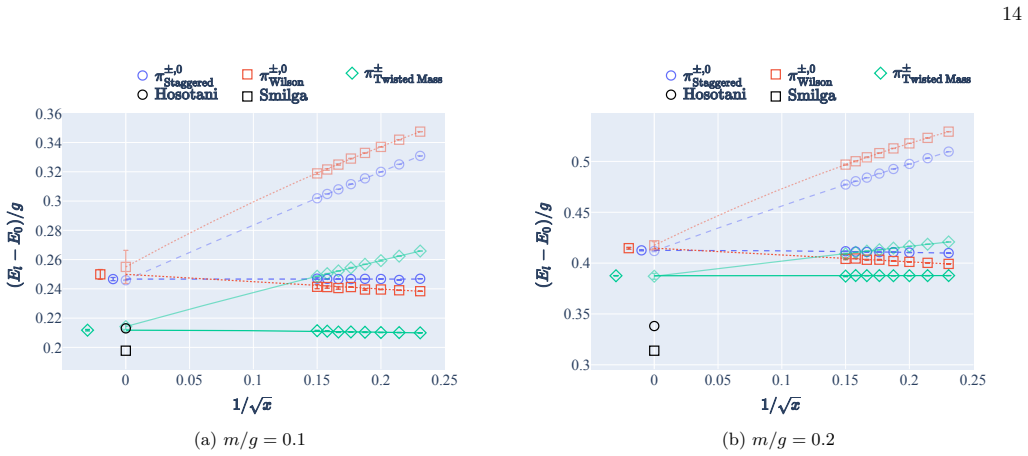
In the Hamiltonian formulation of the massive two-flavor Schwinger model the O(a) improvement of twisted mass fermions carries over from the free theory to the interacting theory when the system is tuned to maximal twist by an electric-field-based mass renormalization. This tuning produces rapid convergence of the pion mass to its continuum limit and a milder volume dependence than staggered or Wilson discretizations, while clear isospin-breaking effects appear that parallel those in lattice QCD.
What carries the argument
twisted mass fermion discretization tuned to maximal twist by electric-field-based mass renormalization
If this is right
- The pion mass converges rapidly to the continuum limit once the renormalization is included.
- Finite-volume effects are milder for twisted mass fermions than for staggered or Wilson formulations.
- Clear isospin-breaking effects emerge that parallel those observed in lattice QCD.
- The same renormalization method can be used to establish applicability in the two-flavor model.
Where Pith is reading between the lines
- The milder volume dependence could reduce computational cost when extending tensor-network methods to higher-dimensional gauge theories.
- The observed isospin breaking offers a controllable testbed for studying symmetry-breaking patterns before moving to four-dimensional models.
- Dispersion-relation and finite-volume scaling fits provide two independent ways to control systematics that could be combined in future studies.
Load-bearing premise
The electric-field-based mass renormalization reliably tunes the two-flavor interacting theory to maximal twist without introducing uncontrolled systematic errors.
What would settle it
A direct calculation in which the pion mass still exhibits large O(a) errors or strong volume dependence after the renormalization procedure is applied would falsify the claimed improvement and milder scaling.
Figures




read the original abstract
We present a comprehensive tensor network study of staggered, Wilson, and twisted mass fermions in the Hamiltonian formulation, using the massive two-flavor Schwinger model as a benchmark. Particular emphasis is placed on twisted mass fermions, whose properties in this context have not been systematically explored before. We confirm the expected O(a) improvement in the free theory and observe that this improvement persists in the interacting case. By leveraging an electric-field-based method for mass renormalization, we reliably tune to maximal twist and establish the method's applicability in the two-flavor model. Once mass renormalization is included, the pion mass exhibits rapid convergence to the continuum limit. Finite-volume effects are addressed using two complementary approaches: dispersion relation fits and finite-volume scaling. Our results show excellent agreement with semiclassical predictions and reveal a milder volume dependence for twisted mass fermions compared to staggered and Wilson discretizations. In addition, we observe clear isospin-breaking effects, suggesting intriguing parallels with lattice QCD. These findings highlight the advantages of twisted mass fermions for Hamiltonian simulations and motivate their further exploration, particularly in view of future applications to higher-dimensional lattice gauge theories.
Editorial analysis
A structured set of objections, weighed in public.
Referee Report
Summary. The manuscript presents a matrix product state (MPS) study of the two-flavor Schwinger model in the Hamiltonian formulation, comparing staggered, Wilson, and twisted-mass fermion discretizations. It confirms the expected O(a) improvement for twisted-mass fermions in the free theory, claims this improvement persists in the interacting theory after electric-field-based mass renormalization to maximal twist, reports rapid continuum convergence of the pion mass once renormalization is included, finds milder finite-volume effects for twisted mass relative to the other discretizations, and observes isospin-breaking effects with parallels to lattice QCD.
Significance. If the central claims hold, the work supplies useful numerical benchmarks for fermion discretizations in Hamiltonian lattice gauge theory simulations. The demonstration that O(a) improvement survives the interacting two-flavor regime, together with the reported agreement with semiclassical predictions and the use of complementary dispersion-relation and finite-volume scaling analyses, would support twisted-mass fermions as a practical choice for reducing discretization artifacts in tensor-network studies of gauge theories and motivate their application in higher-dimensional models.
major comments (1)
- The central claim of O(a) improvement and rapid continuum convergence for twisted-mass fermions rests on the assertion that the electric-field-based renormalization reliably achieves maximal twist in the interacting two-flavor theory. The manuscript does not report an explicit cross-check of the tuned bare mass against the PCAC mass (or an equivalent Ward-identity condition) in the interacting regime; without this, residual O(a) artifacts cannot be excluded and the observed scaling cannot be unambiguously attributed to the twisted-mass mechanism.
minor comments (2)
- The description of the MPS truncation and bond-dimension convergence criteria (mentioned in the methods) would benefit from a dedicated table or plot showing the dependence of the pion mass on bond dimension for each discretization at the largest volumes studied.
- Notation for the electric-field operator and the precise definition of the renormalization condition should be made uniform between the free-theory and interacting-theory sections to avoid ambiguity when comparing the two cases.
Simulated Author's Rebuttal
We thank the referee for the careful reading and constructive feedback on our manuscript. We address the major comment below and indicate the revisions we will make.
read point-by-point responses
-
Referee: The central claim of O(a) improvement and rapid continuum convergence for twisted-mass fermions rests on the assertion that the electric-field-based renormalization reliably achieves maximal twist in the interacting two-flavor theory. The manuscript does not report an explicit cross-check of the tuned bare mass against the PCAC mass (or an equivalent Ward-identity condition) in the interacting regime; without this, residual O(a) artifacts cannot be excluded and the observed scaling cannot be unambiguously attributed to the twisted-mass mechanism.
Authors: We appreciate the referee highlighting this point. The electric-field-based renormalization is motivated by the structure of the Schwinger model, where the expectation value of the electric field provides a direct proxy for tuning the renormalized mass to achieve maximal twist (twist angle of π/2). This procedure is first validated in the free theory, where O(a) improvement is analytically expected, and then applied in the interacting case, yielding the observed rapid continuum convergence of the pion mass and consistency with semiclassical predictions. We agree, however, that an explicit cross-check against a PCAC mass or equivalent Ward identity in the interacting regime would provide additional confirmation and help rule out residual O(a) effects. We will add a dedicated discussion of the relation between the electric-field tuning and maximal-twist conditions, together with a numerical comparison where feasible with the available MPS data, in the revised manuscript. revision: yes
Circularity Check
No circularity in numerical benchmark of fermion discretizations
full rationale
This is a numerical tensor-network study that measures discretization effects, volume dependence, and continuum convergence directly from MPS simulations of the two-flavor Schwinger model. All reported improvements (O(a) persistence, rapid pion-mass convergence after renormalization, milder finite-volume effects for twisted-mass fermions) are extracted quantities from the computed spectra and correlation functions, not quantities derived from the paper's own equations or fitted parameters by construction. The electric-field-based renormalization is presented as an applied procedure whose reliability is asserted via the observed outcomes and agreement with semiclassical predictions; no load-bearing step reduces to a self-definition or self-citation chain. The work is therefore self-contained against external benchmarks.
Axiom & Free-Parameter Ledger
free parameters (1)
- mass renormalization parameter
axioms (1)
- domain assumption The two-flavor Schwinger model in Hamiltonian formulation is an appropriate benchmark for comparing lattice fermion discretizations
Forward citations
Cited by 2 Pith papers
-
Tightening energy-based boson truncation bound using Monte Carlo-assisted methods
Monte Carlo-assisted tightening of the energy-based boson truncation bound substantially reduces volume dependence in (1+1)D scalar field theory and (2+1)D U(1) gauge theory.
-
Tightening energy-based boson truncation bound using Monte Carlo-assisted methods
A Monte Carlo-assisted analytic method tightens energy-based bounds on boson truncation errors, substantially reducing the volume dependence of the required cutoff in scalar and gauge theories.
Reference graph
Works this paper leans on
-
[1]
Hamiltonian and Conventions The Dirac Hamiltonian for two flavors of free Wilson (twisted mass) fermions with periodic boundary condi- tions is given by HD = N −1X n=0 1X f=0 a ψ† n,f γ0 m + (−1)f iµγ5 + r a ψn,f − 1 2 N −1X n=0 1X f=0 ψ† n,f γ0(iγ1 + r)ψn+1,f + h.c. , (A1) where f = 0 , 1 indexes the two fermion flavors, and the twisted mass term introdu...
-
[2]
Fourier Transform and Momentum-Space Hamiltonian We apply the discrete Fourier transform: ϕk,f,α = 1√ N N −1X n=0 e−i2πkn/N ϕn,f,α ϕn,f,α = 1√ N N −1X k=0 ei2πkn/N ϕk,f,α . (A5) Using the identity N −1X n=0 ei2π(k−k′)n/N = N δkk′, (A6) we find N −1X n=0 ϕ† n,f,αϕn,f ′,α′ = N −1X k=0 ϕ† k,f,α ϕk,f ′,α′, (A7) and similarly, N −1X n=0 ϕ† n,f,αϕn+1,f ′,α′ = N...
-
[3]
(A10) In the case of standard Wilson fermions ( µ = 0), the diagonal entries vanish
Matrix Form and Spectrum We express the Hamiltonian in matrix form: HD = N −1X k=0 1X f=0 Hk,f , Hk,f = ϕ† k,f,1 ϕ† k,f,2 !T −(−1)f µ ∆k ∆∗ k (−1)f µ ϕk,f,1 ϕk,f,2 , ∆k = m + 1 a 1 − ei2πk/N . (A10) In the case of standard Wilson fermions ( µ = 0), the diagonal entries vanish. The eigenvalues are given by: λ± = ± p A2 + |B|2, with A = (−1)f µ, B = ∆k. (A1...
-
[4]
Continuum Expansion Expanding in the lattice spacing a and defining the physical momentum k′ = 2πk/L, we obtain: λ+ = √ C + mk′2 2 √ C a − 3m2k′4 + Ck ′4 12 C3/2 a2 + O(a3), (A14) where C = µ2 + m2 + k′2. We observe that the O(a) term vanishes for m = 0, in line with the expected automatic O(a) improvement of twisted mass fermions at maximal twist
-
[5]
C. Gattringer and C. B. Lang, Quantum chromodynamics on the lattice , Vol. 788 (Springer, Berlin, 2010)
work page 2010
-
[6]
H. J. Rothe, Lattice Gauge Theories: An Introduction (Fourth Edition) (World Scientific Publishing Company, 2012)
work page 2012
-
[7]
Y. Aoki and T. Blum and S. Collins and L. Del˙Debbio and M. Della Morte and P. Dimopoulos and X. Feng and M. Golterman and Steven Gottlieb and R. Gupta and G. Herdoiza and P. Hernandez and A. J¨ uttner and T. Kaneko and E. Lunghi and S. Meinel and C. Mona- han and A. Nicholson and T. Onogi and P. Petreczky and A. Portelli and A. Ramos and S.R. Sharpe and ...
work page internal anchor Pith review Pith/arXiv arXiv 2024
-
[8]
E. Y. Loh, J. E. Gubernatis, R. T. Scalettar, S. R. White, D. J. Scalapino, and R. L. Sugar, Sign problem in the nu- merical simulation of many-electron systems, Phys. Rev. B 41, 9301 (1990)
work page 1990
-
[9]
J. Kogut and L. Susskind, Hamiltonian formulation of Wilson’s lattice gauge theories, Phys. Rev. D 11, 395 (1975)
work page 1975
-
[10]
M. C. Ba˜ nuls, K. Cichy, J. I. Cirac, K. Jansen, and S. K¨ uhn, Tensor Networks and their use for Lattice Gauge Theories, PoS(LATTICE2018) LATTICE2018, 022 (2019)
work page 2019
-
[11]
M. C. Ba˜ nuls and K. Cichy, Review on novel methods for lattice gauge theories, Rep. Prog. Phys. 83, 024401 (2020)
work page 2020
-
[12]
M. C. Ba˜ nuls, R. Blatt, J. Catani, A. Celi, J. I. Cirac, M. Dalmonte, L. Fallani, K. Jansen, M. Lewenstein, S. Montangero, C. A. Muschik, B. Reznik, E. Rico, L. Tagliacozzo, K. V. Acoleyen, F. Verstraete, U.-J. Wiese, M. Wingate, J. Zakrzewski, and P. Zoller, Sim- ulating lattice gauge theories within quantum technolo- gies, The European Physical Journa...
work page 2020
-
[13]
M. Rigobello, S. Notarnicola, G. Magnifico, and S. Mon- tangero, Entanglement generation in 1+1d QED scatter- ing processes, Phys. Rev. D 104, 114501 (2021)
work page 2021
-
[14]
M. Rigobello, G. Magnifico, P. Silvi, and S. Montangero, Hadrons in (1+1)d hamiltonian hardcore lattice qcd, arXiv:2308.04488 , (2023)
-
[15]
I. Papaefstathiou, J. Knolle, and M. C. Ba˜ nuls, Real-time scattering in the lattice schwinger model, Phys. Rev. D 111, 014504 (2025)
work page 2025
-
[16]
T. Angelides, Y. Guo, K. Jansen, S. K¨ uhn, and G. Mag- nifico, Meson thermalization with a hot medium in the open schwinger model, J. High Energy Phys. 2025 (4), 195
work page 2025
- [17]
- [18]
-
[19]
G. Magnifico, T. Felser, P. Silvi, and S. Montangero, Lat- tice quantum electrodynamics in (3+1)-dimensions at fi- nite density with tensor networks, Nat. Commun. 12, 3600 (2021)
work page 2021
-
[20]
G. Cataldi, G. Magnifico, P. Silvi, and S. Montangero, Simulating (2+1)d su(2) yang-mills lattice gauge theory at finite density with tensor networks, Physical Review Research 6, 033057 (2024)
work page 2024
-
[21]
G. Magnifico, G. Cataldi, M. Rigobello, P. Majcen, D. Jaschke, P. Silvi, and S. Montangero, Tensor networks for lattice gauge theories beyond one dimension (2025)
work page 2025
-
[22]
P. H. Ginsparg and K. G. Wilson, A remnant of chiral symmetry on the lattice, Phys. Rev. D 25, 2649 (1982)
work page 1982
-
[24]
L¨ uscher, Exact chiral symmetry on the lattice and the ginsparg-wilson relation, Phys
M. L¨ uscher, Exact chiral symmetry on the lattice and the ginsparg-wilson relation, Phys. Lett. B 428, 342 (1998)
work page 1998
-
[25]
R. Frezzotti, P. A. Grassi, S. Sint, and P. Weisz, Lattice qcd with a chirally twisted mass term, J. High Energy Phys. 2001 (08), 058
work page 2001
-
[26]
L. H. Karsten, Lattice fermions in euclidean space-time, Phys. Lett. B 104, 315 (1981)
work page 1981
-
[27]
Wilczek, Lattice fermions, Phys
F. Wilczek, Lattice fermions, Phys. Rev. Lett. 59, 2397 (1987)
work page 1987
-
[28]
Bori¸ ci, Creutz fermions on an orthogonal lattice, Phys
A. Bori¸ ci, Creutz fermions on an orthogonal lattice, Phys. Rev. D 78, 074504 (2008). 22
work page 2008
-
[29]
H. R. Quinn and M. Weinstein, New formulation for the lattice-fermion derivative: Locality and chirality without spectrum doubling, Phys. Rev. Lett. 57, 2617 (1986)
work page 1986
-
[30]
J. H. Weber, Properties of minimally doubled fermions , Ph.D. thesis, Johannes Gutenberg-Universit¨ at in Mainz (2015)
work page 2015
-
[32]
A. Shindler, Twisted mass lattice QCD, Physics Reports 461, 37 (2008), arXiv:0707.4093 [hep-lat]
work page internal anchor Pith review Pith/arXiv arXiv 2008
-
[33]
D. Albandea and P. Hern´ andez, Chiral and isospin break- ing in the two-flavor Schwinger model, Phys. Rev. D111, 074503 (2025)
work page 2025
-
[34]
K. G. Wilson, Confinement of quarks, Phys. Rev. D 10, 2445 (1974)
work page 1974
-
[35]
M. C. Ba˜ nuls, K. Cichy, K. Jansen, and H. Saito, Chi- ral condensate in the Schwinger model with Matrix Product Operators, Phys. Rev. D 93, 10.1103/Phys- RevD.93.094512 (2016), arXiv:1603.05002 [hep-lat]
work page internal anchor Pith review Pith/arXiv arXiv doi:10.1103/phys- 2016
- [36]
-
[37]
T. V. Zache, M. Van Damme, J. C. Halimeh, P. Hauke, and D. Banerjee, Toward the continuum limit of a (1+1)D quantum link schwinger model, Phys. Rev. D 106, L091502 (2022)
work page 2022
-
[38]
M. C. Ba˜ nuls, K. Cichy, J. I. Cirac, K. Jansen, and S. K¨ uhn, Density Induced Phase Transitions in the Schwinger Model: A Study with Matrix Product States, Phys. Rev. Lett. 118, 071601 (2017), arXiv:1611.00705 [hep-lat]
work page internal anchor Pith review Pith/arXiv arXiv 2017
- [39]
- [40]
- [41]
-
[42]
R. Dempsey, I. R. Klebanov, S. S. Pufu, B. T. Søgaard, and B. Zan, Phase Diagram of the Two-Flavor Schwinger Model at Zero Temperature, Phys. Rev. Lett. 132, 031603 (2024), arXiv:2305.04437 [hep-th]
- [43]
-
[44]
R. C. Farrell, M. Illa, A. N. Ciavarella, and M. J. Savage, Scalable Circuits for Preparing Ground States on Digital Quantum Computers: The Schwinger Model Vacuum on 100 Qubits, PRX Quantum 5, 020315 (2024)
work page 2024
-
[45]
J. Bringewatt, J. Kunjummen, and N. Mueller, Solving lattice gauge theories using the quantum Krylov algo- rithm and qubitization (2024), arXiv:2403.08859 [quant- ph]
-
[46]
T. Angelides, P. Naredi, A. Crippa, K. Jansen, S. K¨ uhn, I. Tavernelli, and D. S. Wang, First-order phase transi- tion of the Schwinger model with a quantum computer, npj Quantum Inf. 11, 1 (2025)
work page 2025
-
[47]
S. Schuster, S. K¨ uhn, L. Funcke, T. Hartung, M.-O. Pleinert, J. v. Zanthier, and K. Jansen, Studying the phase diagram of the three-flavor Schwinger model in the presence of a chemical potential with measurement- and gate-based quantum computing, Phys. Rev. D 109, 114508 (2024), arXiv:2311.14825 [hep-lat]
- [48]
-
[49]
Scaling test of fermion actions in the Schwinger model
N. Christian, K. Jansen, K. Nagai, and B. Pollakowski, Scaling test of fermion actions in the Schwinger model, Nucl. Phys. B 739, 60 (2006), arXiv:hep-lat/0510047
work page internal anchor Pith review Pith/arXiv arXiv 2006
-
[50]
R. Dempsey, I. R. Klebanov, S. S. Pufu, and B. Zan, Discrete chiral symmetry and mass shift in the lattice Hamiltonian approach to the Schwinger model, Physical Review Research 4, 043133 (2022)
work page 2022
-
[51]
M. C. Ba˜ nuls, K. Cichy, K. Jansen, and J. I. Cirac, The mass spectrum of the Schwinger model with Ma- trix Product States, J. High Energy Phys. 2013 (11), arXiv:1305.3765 [hep-lat]
work page internal anchor Pith review Pith/arXiv arXiv 2013
-
[52]
A. V. Smilga, Critical amplitudes in two-dimensional the- ories, Phys. Rev. D 55, R443 (1997)
work page 1997
-
[53]
Bosonized Massive N-flavor Schwinger Model
Y. Hosotani and R. Rodriguez, Bosonized Massive N- flavor Schwinger Model, Journal of Physics A: Mathemat- ical and General 31, 9925 (1998), arXiv:hep-th/9804205
work page internal anchor Pith review Pith/arXiv arXiv 1998
-
[54]
Schwinger, Gauge Invariance and Mass
J. Schwinger, Gauge Invariance and Mass. II, Physical Review 128, 2425 (1962)
work page 1962
-
[55]
Adam, Massive Schwinger model within mass pertur- bation theory, Annals of Phys
C. Adam, Massive Schwinger model within mass pertur- bation theory, Annals of Phys. 259, 1 (1997), arXiv:hep- th/9704064
-
[56]
Gepner, Non-abelian bosonization and multiflavor QED and QCD in two dimensions, Nucl
D. Gepner, Non-abelian bosonization and multiflavor QED and QCD in two dimensions, Nucl. Phys. B 252, 481 (1985)
work page 1985
-
[57]
Affleck, On the realization of chiral symmetry in (1+1) dimensions, Nucl
I. Affleck, On the realization of chiral symmetry in (1+1) dimensions, Nucl. Phys. B 265, 448 (1986)
work page 1986
-
[58]
Coleman, More about the massive Schwinger model, Annals of Phys
S. Coleman, More about the massive Schwinger model, Annals of Phys. 101, 239 (1976)
work page 1976
- [59]
-
[60]
T. V. Zache, F. Hebenstreit, F. Jendrzejewski, M. K. Oberthaler, J. Berges, and P. Hauke, Quantum simu- lation of lattice gauge theories using Wilson fermions, Quantum Science and Technology 3, 034010 (2018), arXiv:1802.06704 [cond-mat]
work page internal anchor Pith review Pith/arXiv arXiv 2018
-
[61]
G. Mazzola, S. V. Mathis, G. Mazzola, and I. Tav- ernelli, Gauge-invariant quantum circuits for u(1) and yang-mills lattice gauge theories, Physical Review Re- search 3, 10.1103/physrevresearch.3.043209 (2021)
-
[62]
Chirally improving Wilson fermions - I. O(a) improvement
R. Frezzotti and G. C. Rossi, Chirally improving Wilson fermions - I. O(a) improvement, J. High Energy Phys. 2004 (08), 007, arXiv:hep-lat/0306014
work page internal anchor Pith review Pith/arXiv arXiv 2004
-
[63]
S. Aoki and O. B¨ ar, Twisted mass QCD, O(a) improve- ment, and Wilson chiral perturbation theory, Phys. Rev. D 70, 116011 (2004)
work page 2004
-
[64]
S. Aoki and O. B¨ ar, Automatic o(a) improvement for twisted mass qcd in the presence of spontaneous symme- try breaking, Phys. Rev. D 74, 034511 (2006)
work page 2006
-
[65]
U. Schollw¨ ock, The density-matrix renormalization group in the age of matrix product states, Annals of Physics 326, 96–192 (2011). 23
work page 2011
-
[66]
M. Fishman, S. R. White, and E. M. Stoudenmire, The ITensor Software Library for Tensor Network Cal- culations, SciPost Physics Codebases 10.21468/SciPost- PhysCodeb.4 (2022), arXiv:2007.14822 [cs]
-
[67]
Haegeman, Variational renormalization group meth- ods for extended quantum systems , Ph.D
J. Haegeman, Variational renormalization group meth- ods for extended quantum systems , Ph.D. thesis, Ghent University. Faculty of Sciences (2011)
work page 2011
- [68]
-
[69]
C. V. Kraus, N. Schuch, F. Verstraete, and J. I. Cirac, Fermionic projected entangled pair states, Phys. Rev. A 81, 052338 (2010), publisher: American Physical Society
work page 2010
- [70]
-
[71]
Efron, The Jackknife, the Bootstrap, and Other Re- sampling Plans (SIAM, 1982)
B. Efron, The Jackknife, the Bootstrap, and Other Re- sampling Plans (SIAM, 1982)
work page 1982
-
[72]
Luscher, Volume Dependence of the Energy Spectrum in Massive Quantum Field Theories
M. Luscher, Volume Dependence of the Energy Spectrum in Massive Quantum Field Theories. 1. Stable Particle States, Commun. Math. Phys. 104, 177 (1986)
work page 1986
discussion (0)
Sign in with ORCID, Apple, or X to comment. Anyone can read and Pith papers without signing in.