REVIEW 3 major objections 4 minor 9 cited by
Current multimodal large language models are constrained less by spatial training data volume than by how positional encoding is handled in the visual encoder, and data scaling alone will not close the spatial reasoning gap.
Reviewed by Pith at T0; open to challenge. T0 means a machine referee read the full paper against a public rubric. the ladder, T0–T4 →
Spatial understanding in multimodal LLMs plateaus quickly as training data grows, and position encoding in the visual encoder is the more influential factor.
T0 review reviewed 2026-08-05 challenge →
load-bearing objection Good benchmark and data scaling study, but the VE-over-LLM conclusion depends on a confounded ablation that needs re-running. the 3 major comments →
Why Do MLLMs Struggle with Spatial Understanding? A Systematic Analysis from Data to Architecture
The pith
A machine-rendered reading of the paper's core claim, the machinery that carries it, and where it could break.
The reading
Core claim
The central claim is that current MLLMs' poor spatial understanding is not primarily a data-scaling problem: fine-tuning on 1k to 90k spatial samples produces gains that plateau quickly, and the ceiling is lowest precisely for tasks that require spatial imagination, such as azimuth transfer. On the architecture side, the paper argues that the visual encoder's positional encoding is the main carrier of spatial ability. In Qwen2.5-VL, LLaVA-OneVision, and Mono-InternVL, shuffling or masking the vision encoder's 2D-RoPE height and width dimensions sharply degrades spatial tasks, while perturbing the LLM's position tokens does much less; direction-specific ablations show the width dimension cont
What carries the argument
The central object is positional encoding, specifically the vision encoder's 2D rotary position embedding (2D-RoPE) with separate height and width dimensions, contrasted with the language model's M-RoPE or 1D-RoPE. The argument is carried by controlled ablations—mask, shuffle, and constant-value strategies—applied to one modality and one PE dimension at a time. This machinery shows that spatial performance tracks the integrity of the vision encoder's height and width components, while LLM positional perturbations matter much less, establishing the visual encoder's positional signal as the structural bottleneck.
Load-bearing premise
The load-bearing premise is that the PE ablations measure spatial information specifically; in fact the harshest ablations also destroy every non-spatial ordering cue, so the reported collapses are not clean evidence of a spatial-only bottleneck, and the 'low upper bound' on imagination tasks is partly set by items humans themselves answer at chance.
What would settle it
Run the same PE ablations on a non-spatial control task and check whether the strongest text-position perturbation also collapses non-spatial accuracy; if it does, the bottleneck is not specifically spatial. Separately, re-score Azimuth Transfer with items where humans are evaluated on wider angular separations; if human accuracy rises well above 51%, the low model ceiling is partly a benchmark artifact.
If this is right
- Fine-tuning on synthetic multi-view data or video spatial data yields fast-saturating returns, so adding more spatial data alone will not close the gap on spatial reasoning.
- The performance ceiling depends on task type: semantic-matching tasks like occlusion restoration respond to data, while tasks requiring spatial imagination, such as azimuth transfer and route planning, stay low.
- Architectural changes that preserve or strengthen visual-encoder positional signals should matter more than larger datasets or larger models.
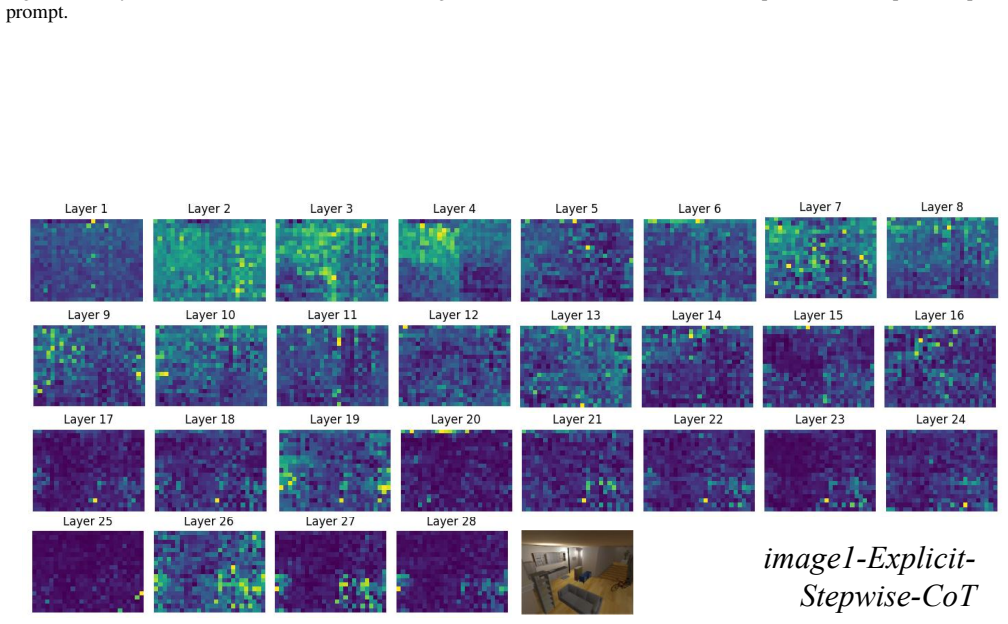
- Reasoning injection helps mainly on harder logical spatial tasks, and a multi-view consistency prompt outperforms generic stepwise prompting; explicit chain-of-thought can harm performance by diffusing attention.
- Model size gives diminishing fine-tuning gains for specialized spatial tasks, as seen across the 3B, 7B, 32B, and 72B Qwen2.5-VL family.
Where Pith is reading between the lines
- If the visual encoder's positional encoding is the true bottleneck, then MLLMs that feed the LLM only patch tokens without explicit 2D or 3D position information should continue to fail at spatial integration; this is testable by comparing vision encoders with and without strong 2D-RoPE while holding data and model size constant.
- The paper's strongest positional ablation also collapses non-spatial VG-Attribution (from 90.79 to 1.63), so the reported catastrophic drops likely reflect destruction of all ordering information rather than spatial-specific encoding; a cleaner experiment would perturb only the spatial dimensions while preserving token order.
- The low human accuracy on azimuth transfer (51.25%) suggests the benchmark's imagination tasks may be ambiguous even for people; a cleaned subset with larger angular separations would give a fairer estimate of the true model ceiling.
- The reasoning-injection results point to a potentially data-free gain: implicit step-by-step prompting with multi-view consistency may improve spatial tasks without fine-tuning, and explicit CoT should be evaluated against attention-ground-truth tasks where distraction can be measured directly.
Editorial analysis
A structured set of objections, weighed in public.
Referee Report
Summary. The paper presents a systematic analysis of why MLLMs struggle with spatial understanding, across single-view, multi-view, and video settings. It introduces MulSeT, a synthetic multi-view benchmark with three tasks (occlusion restoration, distance comparison, azimuth transfer), and uses it to study how fine-tuning data scale affects spatial performance. The paper also ablates positional encodings in the vision encoder (VE) and language model (LLM) of several MLLMs (Qwen2.5-VL-7B, LLaVA-OneVision-7B, Mono-InternVL-2B), concluding that VE positional encoding is substantially more critical than LLM positional encoding for spatial understanding. Finally, it evaluates reasoning-injection prompts and proposes a multi-view consistency prompt that outperforms stepwise and explicit-CoT variants.
Significance. If the architectural conclusion holds, it would be an important and actionable finding: current MLLMs have a structural bottleneck in visual position representation, not merely a data-hunger problem. The paper is commendable for releasing MulSeT and code, for using controlled synthetic scenes, for evaluating on external benchmarks (What'sUp, COCO-QA, VSI-Bench), and for including a non-spatial control task (VG-Attribution). The data-scaling analysis across multiple model sizes and tasks is also a useful empirical contribution. However, the PE ablation protocol does not isolate spatial information, and the data-scaling claims lack statistical support. The core conclusions are plausible but not established by the evidence as presented.
major comments (3)
- [Sec. 4.2 / Table 2] The central architectural claim that VE positional encoding is more critical than LLM positional encoding rests on an asymmetric and confounded ablation. Shuffle-LLM-txy(*) modifies both text and vision tokens across all PE dimensions, and it collapses even the non-spatial VG-Attribution task from 90.79 to 1.63 (Table 2; same in Table 6). This shows the manipulation destroys all token-order information needed for any language task, not selectively spatial cues. By contrast, Shuffle-VE-hw only perturbs two spatial dimensions in the image modality. The observed 'VE more critical' difference could therefore reflect ablation breadth and task-agnostic order destruction rather than a spatial-specific bottleneck. The paper's own text-only LLM ablations (Shuffle-LLM-txy) produce small or even positive changes on MulSeT Azimuth (+6.53), so the conclusion cannot be read off the data as presented.
- [Sec. 3.1 / Figures 4 and 5] The data-scaling conclusion is supported by single runs with no error bars or significance tests, and the protocol explicitly records the best result across epochs ('We save and evaluate the model for every epoch, and the best results are recorded'). This post-hoc selection inflates scores and obscures trends. Small differences such as −0.4, +0.4, and +1.8 in Figure 4 are interpreted as saturation or non-improvement. Please report at least 3 seeds with standard deviations, and either justify best-epoch selection with a validation-based stopping rule or report the final-epoch results for the main trend. Also, Table 5 shows non-monotonic fluctuations in Route Plan and other tasks; a formal trend analysis or curve-fit with confidence intervals would strengthen the 'diminishing returns' claim.
- [Table 1 / Sec. 2.1] The human evaluation on MulSeT reports only 51.25% accuracy for Azimuth Transfer. This low human ceiling suggests that the task may contain ambiguous or under-specified items, so the 'low upper bound for spatial imagination' may reflect benchmark properties rather than a fixed model ceiling. Please provide per-item human agreement (e.g., majority-vote consistency or inter-annotator agreement), and report model accuracy on the subset of items with high human consensus. If the model still performs poorly on unambiguous items, the architectural conclusion is strengthened; if not, the benchmark's difficulty should be reinterpreted.
minor comments (4)
- [Throughout] Minor naming inconsistencies: 'LLaV A-OV-7B' and 'LLaV A-OneVision' are used interchangeably; please standardize. Also, some abbreviations in table captions (e.g., 'txy', 'hw') are explained only in the main text; adding a compact legend to each table would improve readability.
- [Sec. 3.2] The 'Model size matters' paragraph is under-specified: it mentions SpaceR-151k and a consistent subset of 10,000 samples but does not give LoRA hyperparameters or training epochs for the 3B/32B/72B runs. Please add these details to the appendix.
- [Fig. 7 / Sec. 5.1] The attention visualization analysis is qualitative. Consider adding a quantitative metric, such as attention concentration or overlap with the relevant objects, to support the claim that explicit CoT diffuses attention.
- [Sec. 3.1] The phrase 'performance converges quickly' would benefit from a formal saturation criterion (e.g., slope below a threshold over a window) rather than a visual inspection of the curves.
Circularity Check
No significant circularity: the paper's central claims are empirical results from held-out and external benchmarks, not consequences of the benchmark construction or of fitted parameters.
full rationale
The paper's two main conclusions (data scaling gives diminishing returns; visual-encoder positional encoding matters more than language-model positional encoding) are derived from controlled experiments rather than by construction. Data scaling is measured on a held-out split of the newly introduced MulSeT benchmark and on the external VSI-Bench, with fine-tuning starting from an untuned baseline; no free parameter is fitted to the test set, and the conclusion is not baked into the benchmark definition. The architectural claim is supported by interventions on model weights (masking/shuffling positional-encoding dimensions) evaluated on external single-view benchmarks and the MulSeT held-out set, with the non-spatial VG-Attribution task serving as a control; the comparison between VE and LLM ablations is an empirical contrast, even if the ablation protocol has interpretation caveats. The directional ablation in Appendix A.3 is a sanity check rather than a derivation of the main result. The paper contains no load-bearing self-citation: the cited attention-visualization methodology is not by the present authors, and no uniqueness theorem or ansatz is smuggled in via prior work. The reader's concern that the PE ablations may not perfectly isolate spatial information is a validity and interpretation issue, not a circularity in the sense of the target result being equivalent to the input by definition. Therefore, no circular step can be exhibited with a specific reduction, and the honest finding is no significant circularity.
Axiom & Free-Parameter Ledger
free parameters (5)
- LoRA rank and alpha =
rank 8, alpha 32 for multi-view; rank 256, alpha 512 for video
- Learning rate and epochs =
1e-5, 10 epochs for multi-view; 5e-6, 1 epoch for video
- Best-epoch selection =
per-run chosen epoch
- MulSeT azimuth angle threshold =
15 degrees
- MulSeT min area ratio =
not reported
axioms (3)
- domain assumption Multiple-choice QA on synthetic rendered images measures spatial understanding.
- ad hoc to paper Perturbing positional indices in a dimension removes only that position-information channel.
- domain assumption LoRA fine-tuning with best-epoch selection isolates the effect of data quantity on spatial ability.
Cite this review
Pith. "Pith review of Why Do MLLMs Struggle with Spatial Understanding? A Systematic Analysis from Data to Architecture." pith.science (2026). https://pith.science/paper/7LNV4V7U
@misc{pith2026250902359,
  author       = {Pith},
  title        = {Pith review of: Why Do MLLMs Struggle with Spatial Understanding? A Systematic Analysis from Data to Architecture},
  year         = {2026},
  howpublished = {\url{https://pith.science/paper/7LNV4V7U}},
  note         = {Machine review of arXiv:2509.02359}
}
read the original abstract
Spatial understanding is essential for Multimodal Large Language Models (MLLMs) to support perception, reasoning, and planning in embodied environments. Despite recent progress, existing studies reveal that MLLMs still struggle with spatial understanding. However, existing research lacks a comprehensive and systematic evaluation of these limitations, often restricted to isolated scenarios, such as single-view or video. In this work, we present a systematic analysis of spatial understanding from both data and architectural perspectives across three representative scenarios: single-view, multi-view, and video. We propose a benchmark named MulSeT (Multi-view Spatial Understanding Tasks), and design a series of experiments to analyze the spatial reasoning capabilities of MLLMs. From the data perspective, the performance of spatial understanding converges quickly as the training data increases, and the upper bound is relatively low, especially for tasks that require spatial imagination. This indicates that merely expanding training data is insufficient to achieve satisfactory performance. From the architectural perspective, we find that spatial understanding relies more heavily on the positional encoding within the visual encoder than within the language model, in both cascaded and native MLLMs. Moreover, we explore reasoning injection and envision future improvements through architectural design to optimize spatial understanding. These insights shed light on the limitations of current MLLMs and suggest new directions for improving spatial reasoning capabilities through data scaling and architectural tuning.
Figures






Forward citations
Cited by 9 Pith papers
-
SSMNBench: Diagnosing Image-based Cross-View Human-Object Understanding via Single-View Sufficiency and Multi-View Necessity
SSMNBench shows that MLLMs suffer distraction degradation on single-view-sufficient tasks and fail to integrate geometric evidence across views, instead relying on semantic averaging and view preference.
-
Why Far Looks Up: Probing Spatial Representation in Vision-Language Models
VLMs exhibit consistent vertical-distance entanglement in embeddings from perspective bias in natural images, producing accuracy gaps that a new synthetic benchmark SpatialTunnel exposes as model-intrinsic.
-
MPDocBench-Parse: Benchmarking Practical Multi-page Document Parsing
MPDocBench-Parse provides a 3,246-page benchmark and evaluation protocol for multi-page document parsing that tests text/table/formula extraction, merging, figure handling, reading order, and heading hierarchy.
-
Why MLLMs Struggle to Determine Object Orientations
Orientation information is recoverable from MLLM visual encoder embeddings via linear regression, contradicting the hypothesis that failures originate in the encoders.
-
SCP: Spatial Causal Prediction in Video
SCP defines a new benchmark task for predicting spatial causal outcomes beyond direct observation and shows that 23 leading models lag far behind humans on it.
-
Self in Space: Benchmarking Self-Awareness and Spatial Cognition in UAV Embodied Intelligence
SIS-Bench shows MLLMs lag on UAV self-awareness versus spatial tasks, and motion-aware optical-flow fusion improves perception and memory.
-
Self in Space: Benchmarking Self-Awareness and Spatial Cognition in UAV Embodied Intelligence
SIS-Bench, a 4,856-question UAV benchmark, shows video MLLMs are weaker at self-awareness than spatial cognition, and optical-flow fusion improves perception and memory.
-
SVoT: State-aware Visualization-of-Thought for Spatial Reasoning via Reinforcement Learning
SVoT uses RL with GRPO to train MLLMs on interleaved textual and visual reasoning chains for multi-hop spatial tasks, achieving up to 65% accuracy gains on new domains with quantitative state verification.
-
MPDocBench-Parse: Benchmarking Practical Multi-page Document Parsing
MPDocBench-Parse provides 433 annotated multi-page documents and an evaluation protocol covering text/table/formula extraction, merging, figure extraction, reading order, and heading hierarchy for realistic document parsing.
Reference graph
Works this paper leans on
-
[1]
L.; Almeida, D.; Altenschmidt, J.; Altman, S.; Anadkat, S.; et al
Achiam, J.; Adler, S.; Agarwal, S.; Ahmad, L.; Akkaya, I.; Aleman, F. L.; Almeida, D.; Altenschmidt, J.; Altman, S.; Anadkat, S.; et al. 2023. Gpt-4 technical report. arXiv preprint arXiv:2303.08774
Pith/arXiv arXiv 2023
-
[2]
Alayrac, J.-B.; Donahue, J.; Luc, P.; Miech, A.; Barr, I.; Hasson, Y.; Lenc, K.; Mensch, A.; Millican, K.; Reynolds, M.; et al. 2022. Flamingo: a visual language model for few-shot learning. Neural Information Processing Systems
work page 2022
-
[3]
Bai, S.; Chen, K.; Liu, X.; Wang, J.; Ge, W.; Song, S.; Dang, K.; Wang, P.; Wang, S.; Tang, J.; Zhong, H.; Zhu, Y.; Yang, M.; Li, Z.; Wan, J.; Wang, P.; Ding, W.; Fu, Z.; Xu, Y.; Ye, J.; Zhang, X.; Xie, T.; Cheng, Z.; Zhang, H.; Yang, Z.; Xu, H.; and Lin, J. 2025. Qwen2.5-VL Technical Report. arXiv:2502.13923
Pith/arXiv arXiv 2025
-
[4]
C.; Geva, M.; He, J.; Wu, J.; and Li, M
Chen, S.; Zhu, T.; Zhou, R.; Zhang, J.; Gao, S.; Niebles, J. C.; Geva, M.; He, J.; Wu, J.; and Li, M. 2025. Why Is Spatial Reasoning Hard for VLMs? An Attention Mechanism Perspective on Focus Areas. In Proceedings of the International Conference on Machine Learning
work page 2025
-
[5]
Chen, X.; Ma, Z.; Zhang, X.; Xu, S.; Qian, S.; Yang, J.; Fouhey, D. F.; and Chai, J. 2024. Multi-Object Hallucination in Vision-Language Models. arXiv:2407.06192
Pith/arXiv arXiv 2024
-
[6]
Cheng, Z.; Tu, Y.; Li, R.; Dai, S.; Hu, J.; Hu, S.; Li, J.; Shi, Y.; Yu, T.; Chen, W.; Shi, L.; and Sun, M. 2025. EmbodiedEval: Evaluate Multimodal LLMs as Embodied Agents. In The Annual Meeting of the Association for Computational Linguistics
work page 2025
-
[7]
Colan, J.; Davila, A.; and Hasegawa, Y. 2025. Assessing the Value of Visual Input: A Benchmark of Multimodal Large Language Models for Robotic Path Planning. arXiv:2507.12391
work page internal anchor Pith review Pith/arXiv arXiv 2025
-
[8]
Dai, W.; Li, J.; Li, D.; Tiong, A. M. H.; Zhao, J.; Wang, W.; Li, B.; Fung, P.; and Hoi, S. 2023. InstructBLIP: Towards General-purpose Vision-Language Models with Instruction Tuning. arXiv:2305.06500
Pith/arXiv arXiv 2023
-
[9]
Diao, H.; Li, X.; Cui, Y.; Wang, Y.; Deng, H.; Pan, T.; Wang, W.; Lu, H.; and Wang, X. 2025. EVEv2: Improved Baselines for Encoder-Free Vision-Language Models. arXiv preprint arXiv:2502.06788
Pith/arXiv arXiv 2025
-
[10]
Dosovitskiy, A.; Beyer, L.; Kolesnikov, A.; Weissenborn, D.; Zhai, X.; Unterthiner, T.; Dehghani, M.; Minderer, M.; Heigold, G.; Gelly, S.; Uszkoreit, J.; and Houlsby, N. 2021. An Image is Worth 16x16 Words: Transformers for Image Recognition at Scale. arXiv:2010.11929
Pith/arXiv arXiv 2021
-
[11]
Du, M.; Wu, B.; Li, Z.; Huang, X.; and Wei, Z. 2024. E mb S patial-Bench: Benchmarking Spatial Understanding for Embodied Tasks with Large Vision-Language Models. In Ku, L.-W.; Martins, A.; and Srikumar, V., eds., Proceedings of the 62nd Annual Meeting of the Association for Computational Linguistics (Volume 2: Short Papers), 346--355. Bangkok, Thailand: ...
work page 2024
-
[12]
Fei, H.; Wu, S.; Ji, W.; Zhang, H.; Zhang, M.; Lee, M.-L.; and Hsu, W. 2024. Video-of-Thought: Step-by-Step Video Reasoning from Perception to Cognition. In Proceedings of the International Conference on Machine Learning
work page 2024
-
[13]
Feng, K.; Gong, K.; Li, B.; Guo, Z.; Wang, Y.; Peng, T.; Wu, J.; Zhang, X.; Wang, B.; and Yue, X. 2025. Video-R1: Reinforcing Video Reasoning in MLLMs. arXiv:2503.21776
Pith/arXiv arXiv 2025
-
[14]
Heo, B.; Park, S.; Han, D.; and Yun, S. 2024. Rotary position embedding for vision transformer. In European Conference on Computer Vision, 289--305. Springer
work page 2024
-
[15]
J.; Shen, Y.; Wallis, P.; Allen-Zhu, Z.; Li, Y.; Wang, S.; Wang, L.; Chen, W.; et al
Hu, E. J.; Shen, Y.; Wallis, P.; Allen-Zhu, Z.; Li, Y.; Wang, S.; Wang, L.; Chen, W.; et al. 2022. Lora: Low-rank adaptation of large language models. International Conference on Learning Representations, 1(2): 3
work page 2022
-
[16]
P.; Perelman, A.; Ramesh, A.; Clark, A.; Ostrow, A.; Welihinda, A.; Hayes, A.; Radford, A.; et al
Hurst, A.; Lerer, A.; Goucher, A. P.; Perelman, A.; Ramesh, A.; Clark, A.; Ostrow, A.; Welihinda, A.; Hayes, A.; Radford, A.; et al. 2024. GPT-4o System Card. arXiv preprint arXiv:2410.21276
Pith/arXiv arXiv 2024
-
[17]
Jia, M.; Qi, Z.; Zhang, S.; Zhang, W.; Yu, X.; He, J.; Wang, H.; and Yi, L. 2025. OmniSpatial: Towards Comprehensive Spatial Reasoning Benchmark for Vision Language Models. arXiv:2506.03135
arXiv 2025
-
[18]
Jin, H.; Yeom, J. W.; Bae, S.; and Kim, T. 2025. "Well, Keep Thinking": Enhancing LLM Reasoning with Adaptive Injection Decoding. arXiv:2503.10167
Pith/arXiv arXiv 2025
-
[19]
Kamath, A.; Hessel, J.; and Chang, K.-W. 2023. What ' s ``up'' with vision-language models? Investigating their struggle with spatial reasoning. In Bouamor, H.; Pino, J.; and Bali, K., eds., Proceedings of the 2023 Conference on Empirical Methods in Natural Language Processing, 9161--9175. Singapore: Association for Computational Linguistics
work page 2023
-
[20]
Kolve, E.; Mottaghi, R.; Han, W.; VanderBilt, E.; Weihs, L.; Herrasti, A.; Deitke, M.; Ehsani, K.; Gordon, D.; Zhu, Y.; et al. 2017. Ai2-thor: An interactive 3d environment for visual ai. arXiv preprint arXiv:1712.05474
Pith/arXiv arXiv 2017
-
[21]
Krishna, R.; Zhu, Y.; Groth, O.; Johnson, J.; Hata, K.; Kravitz, J.; Chen, S.; Kalantidis, Y.; Li, L.-J.; Shamma, D. A.; et al. 2017. Visual genome: Connecting language and vision using crowdsourced dense image annotations. International journal of computer vision, 123(1): 32--73
work page 2017
-
[22]
Li, B.; Zhang, Y.; Guo, D.; Zhang, R.; Li, F.; Zhang, H.; Zhang, K.; Li, Y.; Liu, Z.; and Li, C. 2024. Llava-onevision: Easy visual task transfer. arXiv preprint arXiv:2408.03326
Pith/arXiv arXiv 2024
-
[23]
Li, C.; Wu, W.; Zhang, H.; Xia, Y.; Mao, S.; Dong, L.; Vulić, I.; and Wei, F. 2025. Imagine while Reasoning in Space: Multimodal Visualization-of-Thought. In Proceedings of the International Conference on Machine Learning
work page 2025
-
[24]
Li, X.; Zhang, M.; Geng, Y.; Geng, H.; Long, Y.; Shen, Y.; Zhang, R.; Liu, J.; and Dong, H. 2023. ManipLLM: Embodied Multimodal Large Language Model for Object-Centric Robotic Manipulation. arXiv:2312.16217
Pith/arXiv arXiv 2023
-
[25]
Liao, Z.; Xie, Q.; Zhang, Y.; Kong, Z.; Lu, H.; Yang, Z.; and Deng, Z. 2025. Improved Visual-Spatial Reasoning via R1-Zero-Like Training. arXiv:2504.00883
Pith/arXiv arXiv 2025
-
[26]
Lin, T.; Li, G.; Zhong, Y.; Zou, Y.; and Zhao, B. 2025. Evo-0: Vision-Language-Action Model with Implicit Spatial Understanding. arXiv preprint arXiv:2507.00416
arXiv 2025
-
[27]
Lin, T.-Y.; Maire, M.; Belongie, S.; Hays, J.; Perona, P.; Ramanan, D.; Doll \'a r, P.; and Zitnick, C. L. 2014. Microsoft coco: Common objects in context. In European conference on computer vision, 740--755. Springer
2014
-
[28]
Liu, H.; Li, C.; Wu, Q.; and Lee, Y. J. 2023. Visual instruction tuning. Advances in neural information processing systems, 36: 34892--34916
2023
-
[29]
Liu, H.; Yan, W.; Zaharia, M.; and Abbeel, P. 2024. World model on million-length video and language with ringattention. arXiv preprint arXiv:2402.08268
Pith/arXiv arXiv 2024
-
[30]
Liu, Y.; Chi, D.; Wu, S.; Zhang, Z.; Hu, Y.; Zhang, L.; Zhang, Y.; Wu, S.; Cao, T.; Huang, G.; Huang, H.; Tian, G.; Qiu, W.; Quan, X.; Hao, J.; and Zhuang, Y. 2025. SpatialCoT: Advancing Spatial Reasoning through Coordinate Alignment and Chain-of-Thought for Embodied Task Planning. arXiv:2501.10074
Pith/arXiv arXiv 2025
-
[31]
Luo, G.; Yang, X.; Dou, W.; Wang, Z.; Liu, J.; Dai, J.; Qiao, Y.; and Zhu, X. 2025. Mono-internvl: Pushing the boundaries of monolithic multimodal large language models with endogenous visual pre-training. In Proceedings of the Computer Vision and Pattern Recognition Conference, 24960--24971
work page 2025
-
[32]
Ouyang, K.; Liu, Y.; Wu, H.; Liu, Y.; Zhou, H.; Zhou, J.; Meng, F.; and Sun, X. 2025. SpaceR: Reinforcing MLLMs in Video Spatial Reasoning. arXiv:2504.01805
Pith/arXiv arXiv 2025
-
[33]
Radford, A.; Kim, J. W.; Hallacy, C.; Ramesh, A.; Goh, G.; Agarwal, S.; Sastry, G.; Askell, A.; Mishkin, P.; Clark, J.; Krueger, G.; and Sutskever, I. 2021. Learning Transferable Visual Models From Natural Language Supervision. arXiv:2103.00020
Pith/arXiv arXiv 2021
-
[34]
Su, J.; Ahmed, M.; Lu, Y.; Pan, S.; Bo, W.; and Liu, Y. 2024. Roformer: Enhanced transformer with rotary position embedding. Neurocomputing, 568: 127063
work page 2024
-
[35]
Tong, S.; Liu, Z.; Zhai, Y.; Ma, Y.; LeCun, Y.; and Xie, S. 2024. Eyes wide shut? exploring the visual shortcomings of multimodal llms. In Proceedings of the IEEE/CVF Conference on Computer Vision and Pattern Recognition, 9568--9578
work page 2024
-
[36]
V.; Zhou, D.; et al
Wei, J.; Wang, X.; Schuurmans, D.; Bosma, M.; Xia, F.; Chi, E.; Le, Q. V.; Zhou, D.; et al. 2022. Chain-of-thought prompting elicits reasoning in large language models. Advances in neural information processing systems, 35: 24824--24837
2022
-
[37]
Wei, X.; Liu, X.; Zang, Y.; Dong, X.; Zhang, P.; Cao, Y.; Tong, J.; Duan, H.; Guo, Q.; Wang, J.; Qiu, X.; and Lin, D. 2025. VideoRoPE: What Makes for Good Video Rotary Position Embedding? arXiv:2502.05173
Pith/arXiv arXiv 2025
-
[38]
Wu, D.; Liu, F.; Hung, Y.-H.; and Duan, Y. 2025 a . Spatial-MLLM: Boosting MLLM Capabilities in Visual-based Spatial Intelligence. arXiv:2505.23747
Pith/arXiv arXiv 2025
-
[39]
Wu, Q.; Yang, X.; Zhou, Y.; Fang, C.; Song, B.; Sun, X.; and Ji, R. 2025 b . Grounded Chain-of-Thought for Multimodal Large Language Models. arXiv:2503.12799
Pith/arXiv arXiv 2025
-
[40]
Xiong, C.; Shen, C.; Li, X.; Zhou, K.; Liu, J.; Wang, R.; and Dong, H. 2024. AIC MLLM: Autonomous Interactive Correction MLLM for Robust Robotic Manipulation. In The Conference on Robot Learning
work page 2024
-
[41]
Xu, L.; Xie, H.; Qin, S.-Z. J.; Tao, X.; and Wang, F. L. 2023. Parameter-efficient fine-tuning methods for pretrained language models: A critical review and assessment. arXiv preprint arXiv:2312.12148
Pith/arXiv arXiv 2023
-
[42]
W.; Han, R.; Fei-Fei, L.; and Xie, S
Yang, J.; Yang, S.; Gupta, A. W.; Han, R.; Fei-Fei, L.; and Xie, S. 2025. Thinking in Space: How Multimodal Large Language Models See, Remember, and Recall Spaces. arXiv:2412.14171
Pith/arXiv arXiv 2025
-
[43]
Yeh, C.-H.; Wang, C.; Tong, S.; Cheng, T.-Y.; Wang, R.; Chu, T.; Zhai, Y.; Chen, Y.; Gao, S.; and Ma, Y. 2025. Seeing from Another Perspective: Evaluating Multi-View Understanding in MLLMs. In Neural Information Processing Systems
work page 2025
-
[44]
Zhang, J.; Khayatkhoei, M.; Chhikara, P.; and Ilievski, F. 2025. MLLM s Know Where to Look: Training-free Perception of Small Visual Details with Multimodal LLM s. In The Thirteenth International Conference on Learning Representations
work page 2025
-
[45]
Zheng, D.; Huang, S.; and Wang, L. 2025. Video-3D LLM: Learning Position-Aware Video Representation for 3D Scene Understanding. arXiv:2412.00493
Pith/arXiv arXiv 2025
-
[46]
Zhou, X.; He, J.; Ke, Y.; Zhu, G.; Gutierrez Basulto, V.; and Pan, J. 2024. An Empirical Study on Parameter-Efficient Fine-Tuning for M ulti M odal Large Language Models. In Ku, L.-W.; Martins, A.; and Srikumar, V., eds., Findings of the Association for Computational Linguistics, 10057--10084. Bangkok, Thailand: Association for Computational Linguistics
work page 2024
-
[47]
Zhu, J.; Wang, W.; Chen, Z.; Liu, Z.; Ye, S.; Gu, L.; Tian, H.; Duan, Y.; Su, W.; Shao, J.; Gao, Z.; Cui, E.; Wang, X.; Cao, Y.; Liu, Y.; Wei, X.; Zhang, H.; Wang, H.; Xu, W.; Li, H.; Wang, J.; Deng, N.; Li, S.; He, Y.; Jiang, T.; Luo, J.; Wang, Y.; He, C.; Shi, B.; Zhang, X.; Shao, W.; He, J.; Xiong, Y.; Qu, W.; Sun, P.; Jiao, P.; Lv, H.; Wu, L.; Zhang, ...
Pith/arXiv arXiv 2025
-
[48]
, " * write output.state after.block = add.period write newline
ENTRY address archivePrefix author booktitle chapter edition editor eid eprint howpublished institution isbn journal key month note number organization pages publisher school series title type volume year label extra.label sort.label short.list INTEGERS output.state before.all mid.sentence after.sentence after.block FUNCTION init.state.consts #0 'before.a...
-
[49]
write newline
" write newline "" before.all 'output.state := FUNCTION n.dashify 't := "" t empty not t #1 #1 substring "-" = t #1 #2 substring "--" = not "--" * t #2 global.max substring 't := t #1 #1 substring "-" = "-" * t #2 global.max substring 't := while if t #1 #1 substring * t #2 global.max substring 't := if while FUNCTION word.in bbl.in capitalize " " * FUNCT...
This paper was first reviewed by deepseek-v4-flash on August 5, 2026.
discussion (0)
Sign in with ORCID, Apple, or X to comment. Anyone can read and Pith papers without signing in.