REVIEW 4 major objections 4 minor 25 references
Implicit Actor Critic Coupling via a Supervised Learning Framework for RLVR
T0 review · 4 major / 4 minor · reviewed 2026-08-15 · deepseek-v4-flash
Pith's one-line read A supervised cross-entropy loss recovers the policy gradient for RLVR
desk verdict Clear writing and correct algebra, but the actual update is underspecified, the key hyperparameters are missing, and the abstract mislabels a benchmark; the empirical results are interesting enough to take through review. read the letter →
The pith
A machine-rendered reading of the paper's core claim, the machinery that carries it, and where it could break.
The reading
What carries the argument
The load-bearing object is the RLOO-style advantage score $\psi$ defined in Eq. 7, with a policy log-probability-ratio proxy $\hat r = \beta\log(\pi_\theta/\pi_{\rm ref})$ from Eq. 8. The load-bearing identity is the gradient decomposition of the cross-entropy loss into an actor term $l\nabla_\theta\log\pi_\theta$ and a critic term $(R-\sigma(\psi))\nabla_\theta\psi$. This identity is what turns a supervised classifier into an implicit actor-critic method. Stability relies on two supporting mechanisms: periodically hard-resetting $\pi_{\rm ref}$ to a recent snapshot of $\pi_\theta$ so the log-ratio proxy does not drift, and class-imbalance weights that rebalance correct versus incorrect samples.
What would settle it
Train PACS without the periodic reset of the reference policy, or monitor the sigmoid-transformed score against true reward on a held-out set: if gradients diverge or the score stops tracking actual correctness, the claimed actor-critic coupling is not the source of stability.
Extended reading notes
Core claim
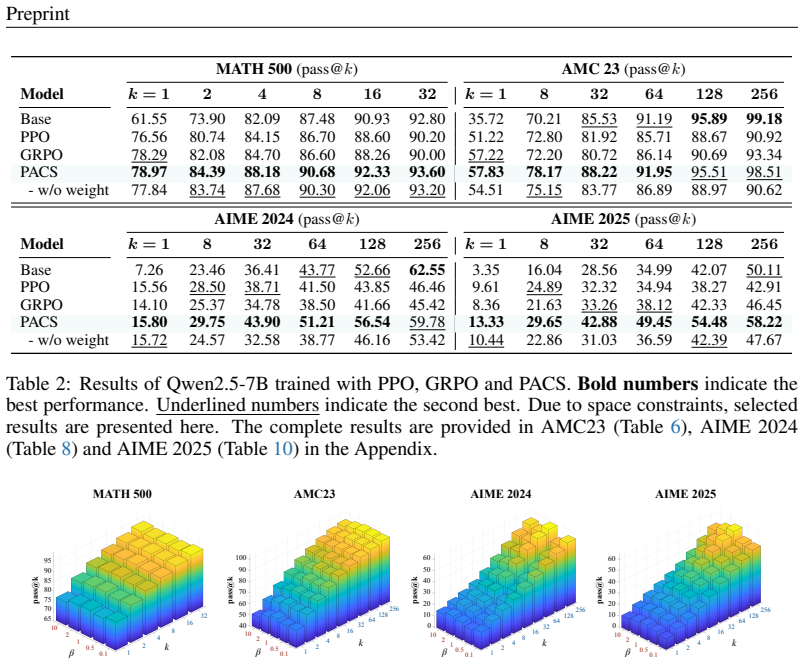
The discovery is that a binary cross-entropy loss, whose labels are the verifiable outcome rewards and whose logits come from a policy-parameterized advantage-like score, carries the same gradient as classic policy-gradient RLVR while adding an implicit critic term. With score function $\psi(q,o_i;\pi_\theta) = \hat r(q,o_i;\pi_\theta) - \frac{1}{G-1}\sum_{j\ne i}\hat r(q,o_j;\pi_\theta)$ and reward proxy $\hat r = \beta\log(\pi_\theta/\pi_{\rm ref})$, the loss gradient is $$-\mathbb E\left[\, l(q,o;\pi_\$\theta$)\nabla_\$\theta$\log\pi_\$\theta$(o|q) + \big(R(q,o)-\$\sigma$(\psi)\big)\nabla_\$\theta$\psi(q,o;\pi_\$\theta$)\right],$$ where $l$ is the per-sample cross-entropy. The first bracket is the actor: a policy-gradient update weighted by how well the current score predicts the reward. The second bracket is the critic: a prediction-error residual that adjusts the score toward the true reward. Because both use the same parameters, the paper argues the actor and critic are coupled implicitly, eliminating the temporal mismatch of separate value networks. The paper further reports that the resulting method consistently outperforms PPO and GRPO on MATH 500, AMC23, AIME 2024, and AIME 2025 with Qwen2.5-3B and Qwen2.5-7B.
Load-bearing premise
The method's stability and performance rest on the assumption that the log-probability-ratio score keeps meaningfully measuring response quality throughout training, which the paper handles by periodically resetting the reference policy rather than proving it will hold.
Editorial extensions
If this is right
- RLVR training can be implemented as a supervised classification loop over the policy's own rollouts, with no separate value network, no generalized advantage estimation, and no clipping ratio.
- The same gradient structure means PACS retains the credit-assignment behavior of a policy gradient while replacing Monte Carlo advantage noise with a prediction-error signal.
- Training dynamics reported in the paper show higher sustained gradient norms and non-collapsing entropy, so the method keeps exploring longer than PPO or GRPO.
- On AIME 2024 and AIME 2025, the reported pass@256 gains of roughly 11 to 15 points over PPO and GRPO on a 7B model would make PACS a stronger drop-in trainer for math reasoning at moderate scale.
Reading between the lines
- If the supervised formulation is the right lens, the supervised-learning toolbox (class-imbalance weighting, curriculum ordering, label smoothing, and early stopping on validation accuracy) should transfer directly to RLVR without altering the policy-gradient structure.
- The paper treats the reset schedule of $\pi_{\rm ref}$ as a practical choice; a testable extension is to trigger the reset adaptively from the drift of $\log(\pi_\theta/\pi_{\rm ref})$, removing the schedule hyperparameter while preserving the claimed stability.
- The ablation results suggest the advantage estimator matters most on hard tasks: on AIME, the RLOO variant beats Dr. GRPO by several points, while on MATH 500 they nearly tie; a sparser-reward domain such as program synthesis should show a larger RLOO-versus-Dr.-GRPO gap if that pattern is real.
Signed reviews
Editorial analysis
A structured set of objections, weighed in public.
Referee Report
Summary. The paper proposes PACS, a method for RLVR that defines a policy-parameterized score function ψ(q,o;πθ) as an RLOO advantage over log-probability-ratio reward proxies and optimizes a binary cross-entropy loss against the verifiable binary reward. The authors derive a gradient decomposition (Eq. 6) into a policy-gradient term and a reward-estimation term and claim that this constitutes an implicit actor-critic coupling that inherently recovers the classical policy gradient update. Experiments on Qwen2.5-3B and Qwen2.5-7B across MATH-500, AMC23, AIME 2024, and AIME 2025 compare PACS with PPO and GRPO, reporting consistent improvements, particularly on AIME at high pass@k. An ablation of a weighting mechanism and a β sensitivity analysis are included, and code is released.
Significance. If the claims hold, PACS would be a simple and effective RLVR trainer with meaningful gains over PPO and GRPO on mathematical reasoning benchmarks, and the open-source release is a practical strength. However, the conceptual significance is limited: the gradient decomposition in Eq. (6) is a chain-rule identity for any on-policy differentiable objective, and the 'critic' is not an independent value estimate but a reparameterization of the same policy. The empirical results are interesting, but the theoretical interpretation, the unspecified class-imbalance weighting, and the unspecified reference-policy reset schedule currently prevent the method from being fully evaluated or reproduced.
major comments (4)
- [Section 3.3, Eq. (6); Section 3.4.1] Equations (3) and (6) are correct for the full expectation gradient, but they include the score-function term l(q,o;πθ)∇θ log πθ(o|q). The implementation discussion in Section 3.4.1 instead analyzes only the direct derivative through ψ: it says that minimizing the loss for a correct sample maximizes ψ and hence increases πθ(oi|q), which corresponds to the −(R−σ)∇θψ term alone. The manuscript never states whether the implementation backpropagates through ψ for fixed rollouts or computes the full expectation gradient. If the former, the implemented loss is a reward-weighted classification loss, and the central claim that PACS 'inherently recovers the classical policy gradient update' is unsupported; if the latter, the intuitive description in Section 3.4.1 is incomplete because the l∇θ log πθ term can oppose the direct term, e.g., for a correct sample with small σ the score-function term has a negative weight. This distinction is load-bearing for the paper's main claim and must be resolved explicitly.
- [Section 3.4.2] The class-imbalance weighting mechanism is load-bearing: the ablation in Table 2 shows large drops without it (e.g., AIME 2024 pass@32 falls from 43.90 to 32.58 for Qwen2.5-7B), yet Section 3.4.2 gives no formula for the weights, no statement of how they enter Equation (9), and no hyperparameter values. Citing King and Zeng (2001) is not sufficient to specify the method. Please provide the exact weighted loss and the weight-setting rule.
- [Section 3.4, Eqs. (7)–(8)] The score function depends on the log-probability ratio β log(πθ/πref), and the paper states that this ratio may grow over time and that πref is periodically hard-reset to a recent snapshot with optimizer-state reinitialization. No reset frequency, snapshot-selection rule, or optimizer-state reset procedure is given, and β is chosen empirically (β=1) via the sweep in Figure 3 rather than derived. Because ψ is the entire learning signal, the stability and behavior of PACS hinge on these unspecified choices, so the method is not yet fully defined.
- [Section 3.2, Eq. (1); Abstract] Calling Equation (1) a supervised learning task is misleading: the expectation is over o∼πθ(·|q), so the objective is an on-policy RL objective whose gradient decomposition in Equation (6) is a chain-rule identity for any differentiable on-policy loss. The 'critic' role is not an independent value estimate but a reparameterization of the same policy's log-probabilities, so the 'implicit actor-critic coupling' claim amounts to a naming choice rather than a new algorithmic mechanism. The abstract and Section 3.3 should be revised to avoid overclaiming.
minor comments (4)
- [Table 2] At pass@256, the base model outperforms PACS on AMC23 (Base 99.18 vs PACS 98.51) and AIME 2024 (Base 62.55 vs PACS 59.78); this is acknowledged in Section C.2 but should be addressed in the main results to qualify the claim of superior performance at large sampling budgets.
- [References] The DeepScaleR reference (Luo et al., 2025) is listed as a Notion blog without a URL or access date; please provide a complete citation.
- [Figure 3] The 3D heatmaps are difficult to read for the exact β and k values; a tabular version or clearer axis labels would improve interpretability.
- [General] There are typographical artifacts such as 'im Plicit' and 'aSupervised' in the abstract and Section 3.2; please proofread the manuscript.
Circularity Check
Core derivation is a chain-rule identity; experiments are external, so no circularity found.
full rationale
The central claim is that optimizing the supervised cross-entropy loss in Eq. (1) inherently recovers a policy-gradient update through the actor/critic decomposition in Eq. (6). This derivation is a standard REINFORCE identity: because the loss is an expectation over outputs sampled from pi_theta, its gradient must contain the score-function term l * grad_log pi_theta, plus the direct derivative of the loss with respect to theta. The chain-rule steps in Eqs. (3)-(5) are mathematically correct for any differentiable score function psi, and the conclusion follows from the definition of the expectation rather than from assuming the target result. The score function psi in Eqs. (7)-(8) is an RLOO advantage built from beta log(pi_theta / pi_ref), with beta treated as a hyperparameter; the gradient identity does not depend on fitting psi to force the policy-gradient term. Calling the two terms in Eq. (6) 'actor' and 'critic' is a labeling choice, and the critic is not an independently fitted value function, but that is a framing issue rather than a circular prediction. The experimental claims are grounded in external benchmarks (MATH 500, AMC23, AIME 2024, AIME 2025) against PPO and GRPO baselines, with reported pass@k numbers, so the performance results are not a renamed version of the training objective. One internal inconsistency exists: Section 3.4.1 describes the loss dynamics as if only the direct derivative through psi is used, while Eq. (6) includes the additional score-function gradient term; the paper does not state which update is implemented. This is a correctness and implementation ambiguity, not a circularity, and it does not make the derivation self-fulfilling. No load-bearing self-citations were found; the cited prior work on RLOO, DPO, GRPO, and Dr. GRPO is external, and no uniqueness theorem from the present authors is invoked to force the choice of objective.
Assumptions & free parameters
free parameters (3)
- β (reward proxy scaling) =
1.0
- Class-imbalance weights =
not reported
- Reference policy reset schedule =
not reported
assumptions (4)
- standard math REINFORCE gradient identity: for f(θ,o), ∇θ E_{o∼πθ}[f] = E[f ∇θ log πθ + ∇θ f].
- domain assumption The verifiable reward R(q,o) is a predictable function of (q,o), so a score function can be trained to predict it.
- standard math RLOO leave-one-out baseline provides an unbiased relative advantage for i.i.d. samples within a group.
- ad hoc to paper Periodically resetting πref to a snapshot of πθ keeps the log-ratio reward proxy bounded and meaningful.
Cite this review
Pith. "Pith review of Implicit Actor Critic Coupling via a Supervised Learning Framework for RLVR." pith.science (2026). https://pith.science/paper/3MQXZU63
@misc{pith2026250902522,
  author       = {Pith},
  title        = {Pith review of: Implicit Actor Critic Coupling via a Supervised Learning Framework for RLVR},
  year         = {2026},
  howpublished = {\url{https://pith.science/paper/3MQXZU63}},
  note         = {Machine review of arXiv:2509.02522}
}
read the original abstract
Recent advances in Reinforcement Learning with Verifiable Rewards (RLVR) have empowered large language models (LLMs) to tackle challenging reasoning tasks such as mathematics and programming, however existing RLVR methods often suffer from sparse reward signals and unstable policy gradient updates inherent to RL-based approaches. To address the challenges, we propose PACS, a novel RLVR framework that achieves imPlicit Actor Critic coupling via a Supervised learning framework. By treating the outcome reward as a predictable label, we reformulate the RLVR problem into a supervised learning task over a score function parameterized by the policy model and optimized using cross-entropy loss. A detailed gradient analysis shows that this supervised formulation inherently recovers the classical policy gradient update while providing more stable and efficient training. Extensive experiments demonstrate that PACS significantly outperforms strong open-source models and RLVR baselines, yielding substantial average gains of +8.26% (4B) and +9.57% (8B) over base models offering a promising avenue for LLMs post-training with verifiable rewards. Our code and data are available as open source at https://github.com/ritzz-ai/PACS.
Figures


Figures from the paper (1 more)

Reference graph
Works this paper leans on
-
[1]
Back to basics: Revisiting reinforce style optimization for learn- ing from human feedback in llms
Arash Ahmadian, Chris Cremer, Matthias Gall ´e, Marzieh Fadaee, Julia Kreutzer, Olivier Pietquin, Ahmet ¨Ust¨un, and Sara Hooker. Back to basics: Revisiting reinforce style optimization for learn- ing from human feedback in llms. arXiv preprint arXiv:2402.14740,
-
[4]
Process reinforcement through implicit rewards
Ganqu Cui, Lifan Yuan, Zefan Wang, Hanbin Wang, Wendi Li, Bingxiang He, Yuchen Fan, Tianyu Yu, Qixin Xu, Weize Chen, et al. Process reinforcement through implicit rewards. arXiv preprint arXiv:2502.01456,
-
[5]
Deepseek-r1: Incentivizing reasoning capability in llms via reinforcement learning
Daya Guo, Dejian Yang, Haowei Zhang, Junxiao Song, Ruoyu Zhang, Runxin Xu, Qihao Zhu, Shirong Ma, Peiyi Wang, Xiao Bi, et al. Deepseek-r1: Incentivizing reasoning capability in llms via reinforcement learning. arXiv preprint arXiv:2501.12948,
-
[6]
Reinforce++: An efficient rlhf algorithm with robustness to both prompt and reward models
Jian Hu, Jason Klein Liu, and Wei Shen. Reinforce++: An efficient rlhf algorithm with robustness to both prompt and reward models. arXiv preprint arXiv:2501.03262,
-
[7]
Aaron Jaech, Adam Kalai, Adam Lerer, Adam Richardson, Ahmed El-Kishky, Aiden Low, Alec Helyar, Aleksander Madry, Alex Beutel, Alex Carney, et al. Openai o1 system card. arXiv preprint arXiv:2412.16720,
-
[11]
Prorl: Prolonged reinforcement learning expands reasoning boundaries in large language models
Mingjie Liu, Shizhe Diao, Ximing Lu, Jian Hu, Xin Dong, Yejin Choi, Jan Kautz, and Yi Dong. Prorl: Prolonged reinforcement learning expands reasoning boundaries in large language models. arXiv preprint arXiv:2505.24864, 2025a. 10 Preprint Zichen Liu, Changyu Chen, Wenjun Li, Penghui Qi, Tianyu Pang, Chao Du, Wee Sun Lee, and Min Lin. Understanding r1-zero...
-
[12]
Notion Blog. Ruotian Ma, Peisong Wang, Cheng Liu, Xingyan Liu, Jiaqi Chen, Bang Zhang, Xin Zhou, Nan Du, and Jia Li. S 2r: Teaching llms to self-verify and self-correct via reinforcement learning. arXiv preprint arXiv:2502.12853,
- [13]
Show all 25 references
-
[14]
Proximal policy optimization algorithms
John Schulman, Filip Wolski, Prafulla Dhariwal, Alec Radford, and Oleg Klimov. Proximal policy optimization algorithms. arXiv preprint arXiv:1707.06347,
-
[16]
Hybridflow: A flexible and efficient rlhf framework
Guangming Sheng, Chi Zhang, Zilingfeng Ye, Xibin Wu, Wang Zhang, Ru Zhang, Yanghua Peng, Haibin Lin, and Chuan Wu. Hybridflow: A flexible and efficient rlhf framework. arXiv preprint arXiv: 2409.19256,
- [17]
-
[18]
Dapo: An open-source llm reinforcement learning system at scale
Qiying Yu, Zheng Zhang, Ruofei Zhu, Yufeng Yuan, Xiaochen Zuo, Yu Yue, Weinan Dai, Tiantian Fan, Gaohong Liu, Lingjun Liu, et al. Dapo: An open-source llm reinforcement learning system at scale. arXiv preprint arXiv:2503.14476,
-
[19]
Vapo: Efficient and reliable reinforcement learning for advanced reasoning tasks
Yu Yue, Yufeng Yuan, Qiying Yu, Xiaochen Zuo, Ruofei Zhu, Wenyuan Xu, Jiaze Chen, Chengyi Wang, TianTian Fan, Zhengyin Du, et al. Vapo: Efficient and reliable reinforcement learning for advanced reasoning tasks. arXiv preprint arXiv:2504.05118,
-
[20]
Learning to reason without external rewards
Xuandong Zhao, Zhewei Kang, Aosong Feng, Sergey Levine, and Dawn Song. Learning to reason without external rewards. arXiv preprint arXiv:2505.19590,
-
[21]
Ttrl: Test-time reinforcement learning
Yuxin Zuo, Kaiyan Zhang, Li Sheng, Shang Qu, Ganqu Cui, Xuekai Zhu, Haozhan Li, Yuchen Zhang, Xinwei Long, Ermo Hua, et al. Ttrl: Test-time reinforcement learning. arXiv preprint arXiv:2504.16084,
-
[22]
enumerate
is employed. Through vllm, high-throughout and low-latency text generation is achieved. Consistent inference configurations are adopted across all experiments to ensure fairness and comparability of evaluation results. Hyperparameters Configuration Enable prefix caching True G...
2024
-
[24]
Underlined numbers indicate the second best
Bold numbers indicate the best performance. Underlined numbers indicate the second best. AIME 2025(pass@k) Model k = 1 2 4 8 16 32 64 128 256 PACS 13.33 18.19 23.73 29.65 36.00 42.88 49.45 54.48 58.22 - GRPO 8.39 13.01 17.69 21.78 25.77 29.86 34.34 39.26 43.73 - Dr. GRPO 13.93...
2025
-
[25]
Underlined numbers indicate the second best
Bold numbers indicate the best performance. Underlined numbers indicate the second best. The superiority of RLOO is most pronounced on the AIME 24 and AIME 25 (Tables 13 and 14). Here, the nuanced algorithmic difference between RLOO and Dr. GRPO is amplified into a clear perfo...
2025
-
[500]
Underlined numbers indicate the second best
Bold numbers indicate the best performance. Underlined numbers indicate the second best. AMC23(pass@k) Model k = 1 2 4 8 16 32 64 128 256 PACS 57.83 65.57 71.94 78.17 83.83 88.22 91.95 95.51 98.51 - GRPO 48.66 57.43 63.96 69.68 75.71 81.63 86.94 90.95 94.06 - Dr. GRPO 58.29 66...
2024
-
[2001]
Wouter Kool, Herke van Hoof, and Max Welling
doi: 10.1093/oxfordjournals.pan.a004868. Wouter Kool, Herke van Hoof, and Max Welling. Buy 4 reinforce samples, get a baseline for free! drlStructPred@ICLR,
-
[2017]
Deepseekmath: Pushing the limits of mathemati- cal reasoning in open language models
Zhihong Shao, Peiyi Wang, Qihao Zhu, Runxin Xu, Junxiao Song, Xiao Bi, Haowei Zhang, Mingchuan Zhang, YK Li, Yang Wu, et al. Deepseekmath: Pushing the limits of mathemati- cal reasoning in open language models. arXiv preprint arXiv:2402.03300,
-
[2021]
Xiangxiang Chu, Hailang Huang, Xiao Zhang, Fei Wei, and Yong Wang
URL https://arxiv.org/abs/2107.03374. Xiangxiang Chu, Hailang Huang, Xiao Zhang, Fei Wei, and Yong Wang. Gpg: A simple and strong reinforcement learning baseline for model reasoning. arXiv preprint arXiv:2504.02546,
-
[2023]
Tulu 3: Pushing frontiers in open language model post-training
Nathan Lambert, Jacob Morrison, Valentina Pyatkin, Shengyi Huang, Hamish Ivison, Faeze Brah- man, Lester James V Miranda, Alisa Liu, Nouha Dziri, Shane Lyu, et al. Tulu 3: Pushing frontiers in open language model post-training. arXiv preprint arXiv:2411.15124,
-
[2024]
Vineppo: Refining credit assignment in rl training of llms
Amirhossein Kazemnejad, Milad Aghajohari, Eva Portelance, Alessandro Sordoni, Siva Reddy, Aaron Courville, and Nicolas Le Roux. Vineppo: Refining credit assignment in rl training of llms. arXiv preprint arXiv:2410.01679,
-
[2025]
Gemini 2.5: Pushing the frontier with advanced reasoning, multimodality, long context, and next generation agentic capa- bilities
Gheorghe Comanici, Eric Bieber, Mike Schaekermann, Ice Pasupat, Noveen Sachdeva, Inderjit Dhillon, Marcel Blistein, Ori Ram, Dan Zhang, Evan Rosen, et al. Gemini 2.5: Pushing the frontier with advanced reasoning, multimodality, long context, and next generation agentic capa- b...
Reviewed August 15, 2026 · model on record in the stance chip above.
Discussion (0). Continue with ORCID to comment.