REVIEW 4 major objections 5 minor 45 references
Molecular dynamics simulations of Al-Cu alloys show that gravity and copper content jointly decide solidification pathway and hardness, with the ranking between compositions inverting between Earth gravity and microgravity.
Reviewed by Pith at T0; open to challenge. T0 means a machine referee read the full paper against a public rubric. the ladder, T0–T4 →
Gravity and copper content jointly shift Al-Cu solidification and hardness, with the composition trends inverting between Earth and microgravity in the simulations.
T0 review reviewed 2026-08-05 challenge →
load-bearing objection A promising and systematic MD study undermined by an undisclosed gravity scaling that makes its central claim untestable. the 4 major comments →
Gravity and Composition Modulated Solidification and Mechanical Properties of Al-Cu Nanostructures
The pith
A machine-rendered reading of the paper's core claim, the machinery that carries it, and where it could break.
The reading
Core claim
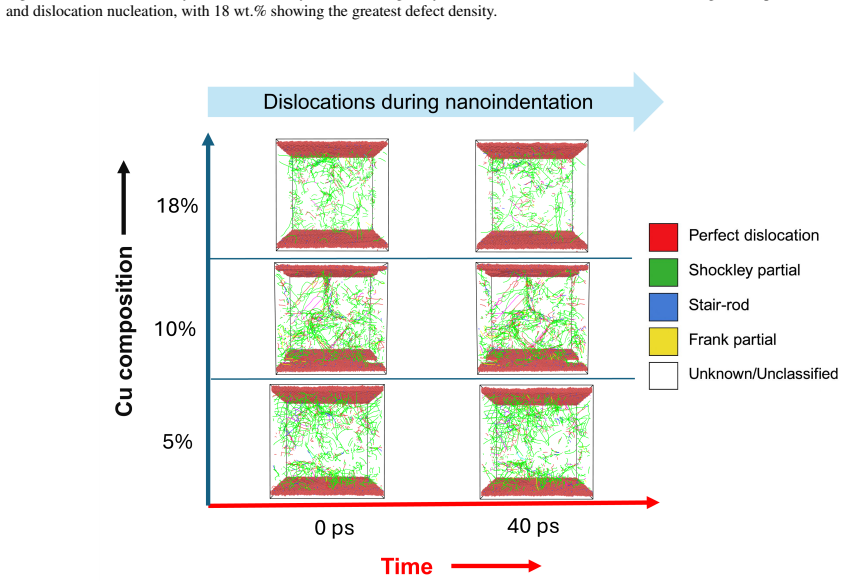
The paper reports the first systematic all-atom molecular dynamics study of Al–Cu solidification under Earth, Martian, Lunar, and microgravity, followed by nanoindentation on the as-solidified cells. The core discovery is a composition–gravity crossover: at low Cu content, increasing gravity accelerates solidification, raises dislocation density, and increases hardness; at 18 wt.% Cu the ranking inverts, and microgravity produces the most FCC phase, the most dislocations at indentation, and the highest hardness. The proposed mechanism is that under strong gravity the heavier Cu atoms segregate to the advancing solid–liquid interface, causing constitutional undercooling, stacking irregulariti
What carries the argument
The central object is the composition–gravity crossover in an Al–Cu binary alloy: the reversal in solidification rate, dislocation density, and hardness ranking as gravity is reduced. The machinery that produces it is a molecular dynamics setup — an Embedded Atom Method (EAM) interatomic potential for Al–Cu, a uniform body force along the Z axis scaled to each gravity level, a directional solidification temperature gradient with Langevin-thermostatted boundaries, common-neighbor-analysis phase counting for solid fraction, and spherical-indenter nanoindentation with dislocation extraction on the solidified cells. The body force plus Cu concentration is what couples solute transport to front s
Load-bearing premise
The load-bearing premise is that the uniform body force, scaled into the simulation's metal units, faithfully represents gravity's effect on nanoscale solidification — a premise that matters because the gravitational potential difference across the 21.87 nm cell at real 1g is orders of magnitude below thermal energy, so the observed separation between gravity levels must come from the scaling factor.
What would settle it
The gravitational potential-energy drop across the 21.87 nm simulation cell at Earth gravity is roughly 10^-13 eV per atom, while thermal energy at 1400 K is about 0.1 eV; if the reported 1g-versus-microgravity differences persist after replacing the scaled body force with its true physical magnitude (or after removing the undisclosed scaling factor), the claim survives, but if they vanish, the central result is an artifact of the scaling.
If this is right
- Materials for space manufacturing can be selected by composition: Cu-rich Al–Cu is the better choice when solidifying in microgravity, and dilute alloys when building under Earth or Mars gravity.
- Hardness predictions must include solidification history; the same alloy can be soft or hard depending on the gravity it solidified under, because the inherited dislocation population is what resists indentation.
- The reversal is a testable physical signature: Earth and Mars gravity should produce columnar, defect-rich microstructures, while microgravity should yield equiaxed, more uniform grains — matching the experimental benchmarks the paper cites.
- The same solidification-plus-indentation pipeline can be extended to other alloy families and gravity levels to map composition–gravity design charts for off-Earth fabrication.
Where Pith is reading between the lines
- Because the paper applies gravity as a scaled body force without reporting the scaling factor, the quantitative hardness and solid-fraction numbers should be read as statements about the model's artificial force, not about real 1g nanoscale physics; at real 1g, the gravitational potential-energy drop across a 22 nm cell is orders of magnitude below kT. The qualitative segregation mechanism may sti
- The authors' own limitations section notes that no dedicated microgravity solidification or nanoindentation experiments were run on the exact simulated alloys, that the EAM potential does not stabilize the tetragonal θ-Al2Cu phase, and that the accessible nanometer/nanosecond scales restrict extrapolation; these caveats make the predicted inversion a mechanistic hypothesis until confirmed by drop-
- If the mechanism is gravity-driven segregation of a dense solute, the same crossover should appear in other alloys whose solute is significantly heavier than the matrix (e.g., Al–Zn, Al–Fe) and should be absent for mass-matched solutes — a test the paper did not perform.
- The crossover composition between 10 and 18 wt.% Cu is a natural target for a dedicated parametric scan; mapping it as a function of gravity level and cell size would turn the current reversal into a quantitative design chart for in-space alloy selection.
Editorial analysis
A structured set of objections, weighed in public.
Referee Report
Summary. The manuscript reports molecular dynamics simulations of directional solidification of Al–Cu alloys (5, 10, and 18 wt.% Cu) under four body-force conditions labeled Earth, Martian, Lunar, and microgravity, followed by nanoindentation to extract hardness. The central claims are that gravitational forces significantly alter solidification pathways; that alloy composition can modulate, and in some cases reverse, the gravity effect; and that as-solidified hardness depends jointly on composition and gravity. The paper validates the model by comparing the melting range and lattice constant of Al–5 wt.% Cu with literature, and then interprets solid-fraction curves, microstructural snapshots, dislocation densities, and force–depth indentation responses for the twelve composition–gravity combinations.
Significance. If the central claim were established, the work would be of clear interest to in-space manufacturing and to computational design of alloys for extraterrestrial environments. The manuscript has some genuine strengths: it uses a standard EAM potential with external validation of melting range and lattice constant; it employs standard structural analysis (CNA, centrosymmetry, dislocation extraction); and it connects solidification microstructure to a mechanical property through nanoindentation. However, the central claim depends on an undisclosed gravity scaling factor, and the reported physical interpretation is not supported by the simulations as described. The single-run design and the acknowledged absence of the θ-Al2Cu phase in the potential further weaken the mechanistic conclusions. The result may be reproducible as a study of an arbitrary body force, but not as a study of physical gravity at the simulated length scale.
major comments (4)
- [Section 2.1] The gravity implementation is not reproducible. The text states that Earth/Mars/Moon/microgravity accelerations are 'converted into the metal unit system of LAMMPS, then scaled appropriately,' but the scaling factor is never reported. This is load-bearing: every gravity comparison in Figures 3–15 depends on that factor. At the stated box size of 21.87 nm, the gravitational potential-energy difference across the cell for an Al atom is mgh ≈ 1e-32 J, whereas kT at 1400 K is ≈ 2e-20 J, i.e., a ratio of about 5e-13. A literal 1g body force is therefore negligible; the reported separation between 'Earth gravity' and 'microgravity' must arise from a large, unreported amplification. Without disclosing and justifying that amplification, the central claim that gravity significantly affects solidification pathways is unfalsifiable.
- [Section 2.1 / Figures 3–4] Each of the twelve cases is a single simulation trajectory, with no repeat runs, no ensemble averaging, and no error bars. Solidification at the nanoscale is stochastic (nucleation times and front morphologies fluctuate from run to run). The claimed ordering of solid-fraction curves and the composition–gravity reversal could in principle be run-to-run noise. The paper provides no statistical support for the systematic trends it reports. This is a load-bearing issue for all quantitative comparisons, not a minor omission.
- [Section 3.1 and 3.3 vs Section 4] The interpretation repeatedly invokes 'θ-Al2Cu' phase competition and θ-phase stabilization/destabilization as the mechanism behind the composition-dependent trends (e.g., 'the thermodynamic preference for intermetallic formation,' 'promotes the precipitation of the θ-Al2Cu phase,' and 'formation of θ (Al2Cu) intermetallics'). However, Section 4 explicitly acknowledges that the employed EAM potential 'does not explicitly stabilize the tetragonal θ (Al2Cu) phase' and that 'phase competition between FCC–Al and θ (Al2Cu) cannot be fully represented.' The mechanistic story is therefore not supported by the model used. This discrepancy undermines the physical explanation of the central result, not merely a secondary detail.
- [Section 3.4.2] Hardness values are reported with reference to experimental literature, but the calculation is underspecified. The text says hardness is 'the ratio of the peak indentation force to the projected contact area, following the standard procedure adapted to atomistic scales,' but neither the projected contact area convention nor its numerical values are given. With a 20 Å diameter indenter and ~20 Å maximum depth, the contact area is ambiguous and strongly affects the final hardness numbers. Without this information, the comparison in Figure 15 and the quantitative claims about '0.7316 GPa at plateau' cannot be reproduced or assessed.
minor comments (5)
- [Throughout] There are numerous typographical errors, including 'evidenue,' 'molelar,' 'bianry,' 'di fferent,' and 'by the by the.' The manuscript would benefit from a careful proofreading pass.
- [Title page] PACS and MSC entries are placeholders ('0000, 1111'). These should be replaced with appropriate codes or removed.
- [Figure 15] The axis is labeled 'Hardness (GPa)' but the figure appears to lack a numerical scale and error bars. Please clarify what is plotted, including units and uncertainty.
- [Section 2.3] Validation of the melting range and lattice constant is performed only for Al–5 wt.% Cu, whereas the study includes 10 and 18 wt.% Cu. The text should justify why validation of the dilute composition transfers to the higher-composition cases, especially since the EAM potential is stated to be less reliable for θ-phase behavior.
- [Section 3.2] The microstructural snapshots (Figures 5–7) are visually descriptive but do not include quantitative metrics such as grain size, HCP fraction, or interface roughness. Adding such metrics would strengthen the claimed monotonic trends.
Circularity Check
No significant circularity: simulation outputs are not fitted inputs, and the central claims rest on MD evolution, not on self-citation or definitional reduction.
full rationale
The paper's derivation chain is self-contained in the sense required for circularity analysis. The inputs are an EAM interatomic potential, a 21.87 nm liquid Al–Cu cell at 1400 K, a directional temperature gradient, and a body force whose magnitude is scaled to represent Earth, Martian, Lunar, and microgravity levels. The outputs—solid fraction evolution, microstructural snapshots, dislocation densities, and nanoindentation hardness—are obtained by time integration of the MD equations, not by fitting or renaming the inputs. The melting range (816–967 K) and lattice constant (4.038 Å) are checked against external experimental/continuum values, and the hardness values are compared to independent experimental reports. No equation in the paper defines a reported result in terms of the same reported result, and no fitted parameter is relabeled as a prediction. The self-citations [20,21] appear only as introductory examples of prior MD work on other materials and are not load-bearing. The paper explicitly acknowledges its limitations: results are simulation-only without one-to-one experimental validation, the EAM potential does not stabilize the θ-Al₂Cu phase, and nanoscale/nanosecond timescales restrict direct extrapolation. The undisclosed gravity scaling factor is a legitimate reproducibility and physical-fidelity concern—at this box size, literal 1g is negligible—but it is not circularity: the paper does not state that the scaling was chosen to produce the observed reversal, and the trends are not derived from that scaling by definition. Accordingly, no circular step can be exhibited with a quote-based reduction, so the circularity score is 0.
Axiom & Free-Parameter Ledger
free parameters (3)
- Gravity acceleration scaling factor =
Not disclosed; 'scaled appropriately'
- Projected contact area convention for hardness =
Not reported
- CNA cutoff / neighbor parameters for solid fraction =
Not reported
axioms (5)
- domain assumption The Cai-Ye EAM potential accurately describes Al-Cu thermodynamics and phase stability for 5-18 wt.% Cu.
- domain assumption A uniform downward body force on each atom is an adequate model of gravity's effect on nanoscale solidification.
- domain assumption The 1.5 ns directional solidification run produces a representative as-solidified structure.
- domain assumption MD nanoindentation at 0.1 Å/ps yields hardness comparable to experimental values.
- standard math CNA and centrosymmetry labels are sufficient to define solid fraction and crystal structure.
Cite this review
Pith. "Pith review of Gravity and Composition Modulated Solidification and Mechanical Properties of Al-Cu Nanostructures." pith.science (2026). https://pith.science/paper/UXFDQWFX
@misc{pith2026250902798,
  author       = {Pith},
  title        = {Pith review of: Gravity and Composition Modulated Solidification and Mechanical Properties of Al-Cu Nanostructures},
  year         = {2026},
  howpublished = {\url{https://pith.science/paper/UXFDQWFX}},
  note         = {Machine review of arXiv:2509.02798}
}
read the original abstract
The future of space exploration and human settlement beyond Earth hinges on a deeper understanding of in space manufacturing processes. The unique physical conditions and scarcity of experimental data demand robust computational models to investigate the atomic scale physics of solidification. This work presents a molecular dynamics (MD) model to examine the solidification behavior of the Al Cu binary alloy, focusing on the influence of varying compositions and gravity levels (Earth, Lunar, Martian, and microgravity) on atomistic solidification mechanisms and the resulting mechanical properties specifically, hardness of as solidified nanostructures. Hardness is evaluated via nanoindentation simulations. The study confirms that gravitational forces significantly affect the solidification pathways of Al Cu alloys. Notably, by tuning alloy composition, the influence of gravity can be modulated and in some cases, even reversed. Moreover, hardness exhibits a coupled dependence on both composition and gravity, offering a promising avenue for bottom-up design of components tailored for extraterrestrial environments. The article delves into the nanoscale physical mechanisms underlying these phenomena and outlines future directions for extending this modeling framework to broader applications.
Figures



Reference graph
Works this paper leans on
-
[1]
Sowards, Welding in space: Past, present, and future, in: 2023 AWS Professional Program, 2023
J. Sowards, Welding in space: Past, present, and future, in: 2023 AWS Professional Program, 2023
work page 2023
-
[2]
C. McCoy, Beyond earth: Surveying public opinion on space exploration and space settlement in the united states (2021), in: AIAA SCITECH 2024 Forum, 2024, p. 2171
work page 2021
-
[3]
A. J. Subin, J. Jackson, J. Foster, T. Silva, E. Markham, P. L. Menezes, In-space manufacturing: Technologies, challenges, and future horizons, Journal of Manufacturing and Materials Processing 9 (2025) 84
work page 2025
-
[4]
S. Bourgeois, Convection e ffects on Skylab experiments M551, M552, and M553, phase C report, Technical Report, 1973
work page 1973
-
[5]
M. Peebles, Review of electron beam welding technology for aerospace and space manufacturing, Journal of Manufacturing Processes 45 (2019) 255–268
work page 2019
-
[6]
B. Reitz, C. Lotz, N. Gerdes, S. Linke, E. Olsen, K. Pflieger, S. Sohrt, M. Ernst, P. Taschner, J. Neumann, E. Stoll, L. Overmeyer, Additive Manufacturing Under Lunar Gravity and Microgravity, Microgravity Science and Technology 33 (2021) 25. doi:10.1007/s12217-021-09878- 4
-
[7]
A. Zocca, J. Wilbig, A. Waske, J. G ¨unster, M. P. Widjaja, C. Neumann, M. Clozel, A. Meyer, J. Ding, Z. Zhou, X. Tian, Challenges in the Technology Development for Additive Manufacturing in Space, Chinese Journal of Mechanical Engineering: Additive Manufacturing Frontiers 1 (2022) 100018. doi:10.1016/j.cjmeam.2022.100018
-
[8]
A. O’Connor, J. M. Bonebrake, T. C. Bryan, Z. S. Courtright, C. T. Cowen, E. R. Crabtree, W. C. Evans, E. K. Jaynes, J. C. Ivester, L. S. Littles, et al., Establishing an in-space joining ecosystem at nasa marshall space flight center via laser beam welding, in: AIAA SCITECH 2025 Forum, 2025, p. 1784
work page 2025
-
[9]
M. Snyder, J. Dunn, E. Gonzalez, The E ffects of Microgravity on Extrusion Based Additive Manufacturing, in: AIAA SPACE 2013 Conference and Exposition, American Institute of Aeronautics and Astronautics, San Diego, CA, 2013. doi:10.2514/6.2013-5439
-
[10]
K. Ishfaq, M. Asad, M. A. Mahmood, M. Abdullah, C. Pruncu, Opportunities and challenges in additive manufacturing used in space sector: a comprehensive review, Rapid Prototyping Journal 28 (2022) 2027–2042. doi:10.1108/RPJ-05-2022-0166
-
[11]
E. Sacco, S. K. Moon, Additive manufacturing for space: status and promises, The International Journal of Advanced Manufacturing Technology 105 (2019) 4123–4146. doi:10.1007/s00170-019-03786-z
-
[12]
J. C. Steuben, A. P. Iliopoulos, J. G. Michopoulos, Discrete element modeling of particle-based additive manufacturing processes, Computer Methods in Applied Mechanics and Engineering 305 (2016) 537–561. doi:10.1016/j.cma.2016.02.023
-
[13]
C. K ¨orner, A. Bauereiß, E. Attar, Fundamental consolidation mechanisms during selective beam melting of powders, Modelling and Simulation in Materials Science and Engineering 21 (2013) 085011. doi:10.1088/0965-0393/21/8/085011
-
[14]
P. Ninpetch, P. Kowitwarangkul, S. Mahathanabodee, R. Tongsri, P. Ratanadecho, Thermal and Melting track Simulations of Laser Powder Bed Fusion (L-PBF), IOP Conference Series: Materials Science and Engineering 526 (2019) 012030. doi:10.1088/1757-899X/526/1/012030
-
[15]
P. Kumar, O. Prakash, U. Ramamurty, Micro-and meso-structures and their influence on mechanical properties of selectively laser melted Ti-6Al-4V, Acta Materialia 154 (2018) 246–260. doi:10.1016/j.actamat.2018.05.044
-
[16]
R.-t. Tong, Z.-f. Quan, B. Han, G. Liu, Coarse-grained molecular dynamics simulation on friction behaviors of textured ag-coating under vacuum and microgravity environments, Surface and Coatings Technology 359 (2019) 265–271. doi:10.1016/j.surfcoat.2018.12.085
- [17]
-
[18]
X. Guo, X. Gan, H. Niu, B. Huang, W. Hu, Unraveling the mechanisms of aluminum solidification under hyper-gravity condition from molecular dynamics simulations, Journal of Applied Physics 132 (2022) 025101. doi:10.1063/5.0090633
-
[19]
R. Tong, B. Han, X. Zhang, T. Zhang, Q. Zeng, G. Liu, Molecular Dynamics Simulation on Collision Frictional Properties of a Molybdenum Disulfide (MoS2) Film in Microgravity Environment, Microgravity Science and Technology 33 (2021) 47. doi:10.1007/s12217-021-09896-2
- [20]
- [21]
-
[22]
A. Mahata, M. A. Zaeem, M. I. Baskes, Understanding homogeneous nucleation in solidification of aluminum by molecular dynamics simulations, Modelling and Simulation in Materials Science and Engineering 26 (2018) 025007. doi:10.1088/1361-651X/aa9f36
-
[23]
T. Fujinaga, Y . Shibuta, Molecular dynamics simulation of athermal heterogeneous nucleation of solidification, Computational Materials Science 164 (2019) 74–81. doi:10.1016/j.commatsci.2019.03.061
-
[24]
M. Haapalehto, T. Pinomaa, L. Wang, A. Laukkanen, An atomistic simulation study of rapid solidification kinetics and crystal defects in dilute Al–Cu alloys, Computational Materials Science 209 (2022) 111356. doi:10.1016/j.commatsci.2022.111356
-
[25]
K. Li, D. Li, J. Liang, Y . Ye, Y . Liao, R. Liu, Y . Mo, Performance analysis of parallel algorithms in physics simulation for molecular dynamics simulation liquid metals solidification processes, Computers & Fluids 110 (2015) 19–26. doi:10.1016/j.compfluid.2014.12.016
-
[26]
S. Plimpton, Fast parallel algorithms for short-range molecular dynamics, Journal of Computational Physics 117 (1995) 1–19. doi:10.1006/jcph.1995.1039
arXiv 1995
-
[27]
J. Cai, Y .-Y . Ye, Simple analytical embedded-atom-method model including a long-range force for face-centered cubic metals and their alloys, Physical Review B 54 (1996) 8398–8410. doi:10.1103/PhysRevB.54.8398
-
[28]
T. J. Williams, C. Beckermann, Benchmark Al–Cu solidification experiments in microgravity and on earth, Metallurgical and Materials Transactions A 54 (2023) 405–422. doi:10.1007/s11661-022-06909-6
-
[29]
C. L. Kelchner, S. J. Plimpton, J. C. Hamilton, Dislocation nucleation and defect structure during surface indentation, Phys. Rev. B 58 (1998) 11085–11088. doi:10.1103/PhysRevB.58.11085
-
[30]
A Generic and Automated Methodology to Simulate Melting Point
F.-Z. Dai, S.-H. Yuan, Y .-B. Hao, X.-F. Gu, S. Zhu, J. Hu, Y . Xu, A generic and automated methodology to simulate melting point (2024). arXiv:2408.17270
work page internal anchor Pith review Pith/arXiv arXiv 2024
-
[31]
F. Rahmani, J. Jeon, S. Jiang, S. Nouranian, Melting and solidification behavior of cu /al and ti/al bimetallic core/shell nanoparticles during additive manufacturing by molecular dynamics simulation, Journal of Nanoparticle Research 20 (2018) 133. doi:10.1007/s11051-018-4237-z. 19
-
[32]
P. Puri, V . Yang, Effect of particle size on melting of aluminum at nano scales, The Journal of Physical Chemistry C 111 (2007) 11776–11783. doi:10.1021/jp0724774
-
[33]
R. Huang, G.-F. Shao, X.-M. Zeng, Y .-H. Wen, Diverse melting modes and structural collapse of hollow bimetallic core–shell nanoparticles: A perspective from molecular dynamics simulations, Scientific Reports 4 (2014) 7051. doi:10.1038/srep07051
-
[34]
L. Zhang, X. Gao, Z. Zhang, M. Zhang, Y . Cheng, J. Su, A doping lattice of aluminum and copper with accelerated electron transfer process and enhanced reductive degradation performance, Scientific Reports 6 (2016) 31797. doi:10.1038/srep31797
-
[35]
J. D. Honeycutt, H. C. Andersen, Molecular dynamics study of melting and freezing of small lennard-jones clusters, The Journal of Physical Chemistry 91 (1987) 4950–4963. doi:10.1021/j100303a014
-
[36]
H. Okamoto, T. Massalski, et al., Binary alloy phase diagrams, ASM International, Materials Park, OH, USA 12 (1990) 3528–3531
work page 1990
-
[37]
T. B. Massalski, H. Okamoto, P. R. Subramanian, L. Kacprzak (Eds.), Binary Alloy Phase Diagrams, 2nd ed., ASM International, Materials Park, OH, 1990. Comprehensive compilation of experimentally evaluated binary alloy phase diagrams
work page 1990
-
[38]
H. Gu, L. Li, Computational fluid dynamic simulation of gravity and pressure e ffects in laser metal deposition for potential additive manu- facturing in space, International Journal of Heat and Mass Transfer 140 (2019) 51–65. doi:10.1016/j.ijheatmasstransfer.2019.05.081
-
[39]
G. Zhang, X. Luo, Y . Li, S. Liu, Comparative study of gravity e ffects in directional solidification of Al–3.5 wt.% Si and Al–10 wt.% Cu alloys, npj Microgravity 10 (2024) 114. doi:10.1038/s41526-024-00454-9
-
[40]
L. L. Regel, W. R. Wilcox, Improved Crystal Quality by Detached Solidification in Microgravity, Contractor or Grantee Report; presented at NASA Microgravity Materials Science Conference, NASA, 1999. NASA Document ID 19990040332; Microgravity Materials Science Conference
work page 1999
-
[41]
P. M. Anderson, J. P. Hirth, J. Lothe, Theory of dislocations, Cambridge University Press, 2017
2017
-
[42]
P. Gong, T. Kwok, Y . Wang, H. Dawson, R. Goodall, D. Dye, W. M. Rainforth, A multi-scale microstructure to address the strength-ductility trade off in high strength steel for fusion reactors, Nature Communications 16 (2025) 2746
work page 2025
-
[43]
A. Sadeghi, E. Kozeschnik, Modeling the evolution of the dislocation density and yield stress of al over a wide range of temperatures and strain rates, Metallurgical and Materials Transactions A 55 (2024) 1643–1653. doi:10.1007/s11661-024-07358-z
-
[44]
N. P. Bansal, R. H. Doremus, Hardness and elastic modulus of al–cu nanocrystals by nanoindentation, Journal of Materials Research 26 (2011) 499–505. doi:10.1557/jmr.2011.45
- [45]
This paper was first reviewed by deepseek-v4-flash on August 5, 2026.
discussion (0)
Sign in with ORCID, Apple, or X to comment. Anyone can read and Pith papers without signing in.