REVIEW 4 major objections 6 minor 2 cited by
This paper claims that KV-cache compression can pick its own per-request budget by sampling synthetic future queries from the Gaussian distribution of hidden states, cutting memory roughly in half without manual tuning.
Reviewed by Pith at T0; open to challenge. T0 means a machine referee read the full paper against a public rubric. the ladder, T0–T4 →
GVote removes hand-set KV-cache budgets by synthesizing future queries from the hidden state distribution and keeping the union of keys they vote for, yielding around 2x memory savings at comparable accuracy.
T0 review reviewed 2026-08-05 challenge →
load-bearing objection GVote has a genuinely new adaptive-budget idea, but the Gaussian-sampling premise and missing artifacts make the evidence too thin to support the claims yet. the 4 major comments →
Adaptive KV-Cache Compression without Manually Setting Budget
The pith
A machine-rendered reading of the paper's core claim, the machinery that carries it, and where it could break.
The reading
Core claim
GVote's central claim is that the optimal KV-cache budget is not a number to set in advance but an outcome of 'what will future queries need?'. Because future queries are unknown at prefill, GVote synthesizes them: it fits a diagonal Gaussian to the hidden states of the current prefix, samples S query vectors, projects them through the model's query projection, applies rotary embeddings at an averaged future position, and computes their attention against all cached keys. Each synthetic query keeps its top-k positions (with k fixed by the current query's nucleus-truncated attention), and the union of these selections is the compressed cache; its size, automatically, is the budget. The paper a
What carries the argument
The Monte-Carlo voting mechanism: S synthetic queries drawn from the fitted Gaussian N(μ, diag(σ²)) of hidden states are converted into real attention queries and scored against every cached key; each voter contributes its top-k key set, and the final cache is the union of all votes, with the union's cardinality serving as the per-head budget. The Gaussian fit is the load-bearing object: it turns the unknowable future-query distribution into a samplable one, and the union operation is what makes the budget adaptive rather than prescribed. A secondary design choice—top-k for synthetic voters instead of top-p—dampens noise from imperfectly estimated queries.
Load-bearing premise
The load-bearing premise is that hidden states along the sequence are close enough to Gaussian that queries sampled from the fitted distribution will attend to roughly the same key positions as the model's real future queries; the paper supports this with a single illustrative head (r = 0.7759, overlap 0.929) rather than a distribution test.
What would settle it
Run GVote on a held-out set of long contexts, record its keep-set, then decode fully and compute the keep-set of the actual future queries. If the mean overlap between the two—across all heads, layers, and several models—falls well below the 0.929 reported for the single illustrative head, the Gaussian sampling proxy is not carrying the argument. A second, cheaper test: apply a standard normality test (e.g., Shapiro-Wilk) to per-channel hidden states along the sequence axis; if most channels reject Gaussianity on the evaluation datasets, the fitted distribution is misspecified.
If this is right
- Operators no longer need to tune a compression ratio per task; the same algorithm self-adjusts from short math prompts to 50K-token documents.
- The resulting cache is non-uniform across heads and layers, with per-head budgets that track where attention actually concentrates, and this format is compatible with variable-length attention kernels like FlashAttention.
- Because the budget is a statistic computed from hidden states, it inherits the distribution of the input: workload shifts that change attention also change the budget, avoiding both accuracy collapse and memory waste.
- Roughly 2x memory reduction at equal or better accuracy compared with fixed-budget baselines, across four model families and eight benchmarks.
Where Pith is reading between the lines
- The Gaussian proxy could be replaced or validated against a nonparametric alternative (e.g., sampling from the empirical history of hidden states); if the nonparametric version performs as well, Gaussianity is not load-bearing, and if it fails, the method's reliability is tied to the Gaussian claim.
- The pattern of 'sample the distribution of future inputs to set a resource knob' may generalize beyond KV-caches—for example, to adaptive batch sizes, speculative-decoding window lengths, or sparse-attention block selection, wherever a downstream choice depends on unseen future states.
- A natural stress test: generate long outputs and measure whether the union of synthetic-query key sets converges to the union over the real future queries as S grows; the reported single-head overlap (0.929) leaves head-wise and layer-wise variance unquantified.
- The budget estimate from the current query's top-p set (|C0|) couples the two hyperparameters; deriving k directly from the Gaussian or from a separate statistic might yield a more fully parameter-free version.
Editorial analysis
A structured set of objections, weighed in public.
Referee Report
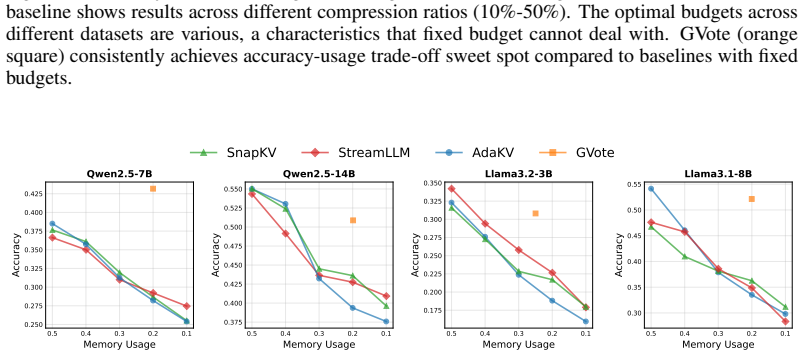
Summary. The paper proposes GVote, an adaptive KV-cache compression method that aims to eliminate the manual budget setting of fixed-ratio compressors such as SnapKV and AdaKV. The method first computes the current query's top-p attention set to obtain a per-request budget Bstep, then fits a diagonal Gaussian to the prompt hidden states, samples S synthetic queries, and retains the union of the top-k key sets selected by those synthetic queries. The authors argue that this union approximates the keys that future queries will need. Experiments are presented as accuracy-versus-memory plots on eight benchmarks and four models, and the paper claims a 2x memory reduction with comparable or better accuracy.
Significance. The underlying idea is timely and potentially useful: per-request, content-aware KV-cache budgets could indeed be preferable to fixed compression ratios across heterogeneous workloads. The paper is also honest in Section 3.3 about some limitations of synthetic-query quality. However, the central claims are currently supported almost entirely by qualitative accuracy-usage plots, with no numerical tables, error bars, code, or data release. The load-bearing Gaussian and synthetic-query approximation is validated on a single illustrative head/figure, and the method's 'automatic' budget depends on the manually chosen nucleus threshold pnuc. If properly validated, GVote could be a meaningful step toward adaptive KV-cache compression, but in its present form the evidence does not establish the mechanism or the quantitative advantages claimed.
major comments (4)
- [Section 3.2, Algorithm 1, line 2; Section 3.5] The claimed elimination of manual budget setting is not supported by the algorithm. Bstep is set to |C0|, where C0 = TopP(A0, pnuc). Every synthetic query then selects exactly k=|C0| keys, and the final cache size is the union of S such top-k sets. Thus pnuc acts as a manual budget hyperparameter: it directly controls the per-query selection size and hence, together with S, the final memory footprint. The recommendation pnuc=0.95 in Section 3.5 is a manual setting. The paper should either reposition pnuc as a quality/reliability threshold and show that the final cache size is insensitive to it, or acknowledge that GVote still requires a budget-related hyperparameter. As written, the central claim in the title and abstract is overstated.
- [Section 3.1, Section 3.3, Figure 3] The Gaussian assumption and the synthetic-query proxy are load-bearing but under-validated. The only direct evidence is Figure 3, which reports attention overlap 0.929 (below the paper's own 0.95 threshold) and a Pearson correlation r=0.7759 for a single attention head. No distributional test is provided for the claimed Gaussianity, and the validation is not carried over multiple heads, layers, datasets, or models. Moreover, the actual mechanism in Algorithm 1 uses the union of S top-k sets, not the single synthetic query tested in Figure 3. The paper never measures whether this union improves recall over the single-query overlap of 0.929, nor whether the union approximates the optimal keep-set for real future queries. Without such experiments, the claimed memory--accuracy advantage is not explained by the proposed mechanism.
- [Section 3.2, Algorithm 1, line 6] All synthetic queries share a single averaged RoPE position P = AverageCosSin(nf). Real future queries have distinct positions, and attention patterns can be strongly position-dependent. The paper provides no evidence that one averaged position is sufficient to generate synthetic queries whose top-k key sets cover the keys needed by future positions. This is a nontrivial component of the approximation and should be justified or tested, e.g., by comparing the union of synthetic top-k sets with the keep-set produced by actual future queries at their true positions.
- [Section 4, Figures 4 and 5] The central quantitative claim of '2x memory reduction with higher or comparable accuracy' is not supported by the evidence presented. The results are shown only as accuracy-usage plots, with no numerical values, no error bars, no standard deviations, and no specification of the number of runs or seeds. It is also unclear how the 2x figure is computed: GVote appears as a single point per dataset, while baselines are swept from 10% to 50%, so the comparison is not defined in a reproducible way. The paper should include a table with exact accuracy and cache-usage numbers, standard errors, and ideally release code/data so the claimed advantage can be verified independently.
minor comments (6)
- [Section 3.2, Algorithm 1; Section 3.5] The parameter ns (number of initial tokens ignored due to attention sinks) is mentioned in Step 2 but is not defined in the algorithm input list or in the parameters section. Similarly, nf is used but its role is not explained beyond 'average cos/sin for nf future positions'. Please define all free parameters explicitly and report their default values.
- [Section 2.1, Eq. (3)] The symbol S is used for both the score tensor (Eq. 3) and the number of synthetic samples (Algorithm 1). This is confusing. Consider using a different symbol, e.g., N or M, for the number of samples.
- [Section 3.5] Two unresolved placeholders appear: 'Detailed sensitivity analysis is presented in [ref]' and 'Further empirical results are discussed in the experiments section [ref]'. These must be fixed or the missing sensitivity analysis must be included in a revision.
- [Section 4.1] The abstract and introduction mention GSM8K, RULER and Longbench, while Figure 4 reports datasets such as 'Code Repo Understanding', 'Long-ICL', etc. Please clarify which Longbench subsets are used and how the eight benchmarks correspond to the three named datasets.
- [Section 1, Figure 1; Figures 6 and 7] Figure 1's legend appears not to include GVote (the text says it should), and Figures 6 and 7 are rendered as very small thumbnails without legible axes labels. Please ensure all figures are readable and consistent.
- [Throughout] There are typos, e.g., 'INTRODUCION' in the section heading, and some notation inconsistencies such as A0 ∈ R^{Shead×L} in Section 3.2 Step 1 despite A0 being defined for a single query. A careful proofread is recommended.
Circularity Check
No significant circularity: GVote's budget is an empirical proxy, not a constructional identity with the claimed target.
full rationale
The derivation chain is not circular. GVote computes its budget from the current query's top-p candidate set and from synthetic queries sampled from a Gaussian fit to the prompt's hidden states (Algorithm 1, lines 1-10). The claimed target is the union of keys required by future queries, defined as ∪_{u>t} argTop-p(A_u). These are not the same object by definition: the algorithm outputs K = ∪_s TopK(eQ_s K^⊤, |C0|), while the ideal target is an unknown future-query union. The gap is an empirical approximation, and the paper attempts to validate it directly in Section 3.3 by comparing synthetic queries against a real future query (overlap 0.929, r=0.7759). No parameter is fitted to the future-query target, so the prediction is not statistically forced. There are no load-bearing self-citations: the only external citation for the Gaussian observation (NVIDIA 2025) is independently corroborated by the authors' Figure 2. The admitted limitations—overlap falling below the 0.95 threshold, single-head/single-input validation, and pnuc remaining a manual threshold—weaken the strength of the prediction claim but do not make it circular. The memory-accuracy comparison is grounded in external benchmarks (GSM8K, RULER, LongBench) and fixed-budget baselines, providing independent evidence for the empirical claim. Therefore the paper is self-contained against external benchmarks and exhibits no significant circularity.
Axiom & Free-Parameter Ledger
free parameters (4)
- pnuc =
0.95 (recommended)
- S =
>= 8 (recommended)
- nf =
not specified
- ns =
not specified
axioms (5)
- domain assumption Hidden states along the sequence axis are approximately Gaussian per channel
- domain assumption Synthetic queries sampled from the fitted Gaussian have attention patterns close to real future queries
- domain assumption The current query's top-p candidate set size |C0| is a reliable proxy for a single future query's token budget
- ad hoc to paper Preserving the minimal set of keys with cumulative top-p attention probability is the right optimality criterion
- domain assumption Layer normalization drives hidden states toward Gaussianity
Cite this review
Pith. "Pith review of Adaptive KV-Cache Compression without Manually Setting Budget." pith.science (2026). https://pith.science/paper/6XXT4URY
@misc{pith2026250903136,
  author       = {Pith},
  title        = {Pith review of: Adaptive KV-Cache Compression without Manually Setting Budget},
  year         = {2026},
  howpublished = {\url{https://pith.science/paper/6XXT4URY}},
  note         = {Machine review of arXiv:2509.03136}
}
read the original abstract
Large language models (LLMs) inference relies heavily on KV-caches to accelerate autoregressive decoding, but the resulting memory footprint grows rapidly with sequence length, posing significant efficiency challenges. Current KV-cache compression methods suffer from a Procrustes' bed problem: they force diverse workloads into fixed compression ratios, leading to suboptimal resource allocation and inference performance. To this end, we present GVote, an adaptive KV-cache compression scheme that eliminates manual budget specification while achieving superior accuracy-efficiency trade-offs. GVote operates on the principle that the important keys are the aggregation of keys required by future queries. The method predicts future query attention demands by Monte-Carlo style sampling potential queries and aggregating selected keys to determine the optimal cache budget without manual specification. Experimental evaluation demonstrates GVote's effectiveness across multiple benchmarks, including GSM8K, RULER and Longbench. Compared to baselines, GVote exhibits 2$\times$ memory reduction while the accuracy maintains higher or comparable.
Figures



Forward citations
Cited by 2 Pith papers
-
CompilerKV: Risk-Adaptive KV Compression via Offline Experience Compilation
CompilerKV uses offline-compiled retention tables as portable priors to achieve SOTA prefill-only KV compression performance across backbones at low token budgets.
-
CompilerKV: Risk-Adaptive KV Compression via Offline Experience Compilation
Offline-learned head-reliability and risk-threshold tables make prefill-only KV compression recover about 97.7% of uncompressed LongBench accuracy at a 512-token-per-layer memory budget.
Reference graph
Works this paper leans on
-
[1]
Gqa: Training generalized multi-query transformer models from multi-head check- points
Joshua Ainslie, James Lee-Thorp, Michiel De Jong, Yury Zemlyanskiy, Federico Lebr´on, and Sumit Sanghai. Gqa: Training generalized multi-query transformer models from multi-head check- points. arXiv preprint arXiv:2305.13245,
-
[5]
Training verifiers to solve math word problems
Karl Cobbe, Vineet Kosaraju, Mohammad Bavarian, Mark Chen, Heewoo Jun, Lukasz Kaiser, Matthias Plappert, Jerry Tworek, Jacob Hilton, Reiichiro Nakano, Christopher Hesse, and John Schulman. Training verifiers to solve math word problems. arXiv preprint arXiv:2110.14168 ,
-
[7]
Ada-kv: Optimizing kv cache evic- tion by adaptive budget allocation for efficient llm inference
Yuan Feng, Junlin Lv, Yukun Cao, Xike Xie, and S Kevin Zhou. Ada-kv: Optimizing kv cache evic- tion by adaptive budget allocation for efficient llm inference. arXiv preprint arXiv:2407.11550,
-
[8]
Cheng-Ping Hsieh, Simeng Sun, Samuel Kriman, Shantanu Acharya, Dima Rekesh, Fei Jia, Yang Zhang, and Boris Ginsburg. Ruler: What’s the real context size of your long-context language models? arXiv preprint arXiv:2404.06654,
-
[10]
Keep the cost down: A review on methods to optimize llm’s kv-cache consumption
Luohe Shi, Hongyi Zhang, Yao Yao, Zuchao Li, and Hai Zhao. Keep the cost down: A review on methods to optimize llm’s kv-cache consumption. arXiv preprint arXiv:2407.18003,
-
[11]
Qwen Team. Qwen2 technical report. arXiv preprint arXiv:2407.10671,
-
[13]
Big bird: Transformers for longer sequences
10 Published as a conference paper at ICLR 2026 Manzil Zaheer, Guru Guruganesh, Kumar Avinava Dubey, Joshua Ainslie, Chris Alberti, Santiago Ontanon, Philip Pham, Anirudh Ravula, Qifan Wang, Li Yang, et al. Big bird: Transformers for longer sequences. Advances in neural information processing systems, 33:17283–17297,
work page 2026
-
[2017]
Efficient streaming language models with attention sinks
Guangxuan Xiao, Yuandong Tian, Beidi Chen, Song Han, and Mike Lewis. Efficient streaming language models with attention sinks. arXiv preprint arXiv:2309.17453,
-
[2020]
Pyramidkv: Dynamic kv cache compression based on pyra- midal information funneling
Zefan Cai, Yichi Zhang, Bofei Gao, Yuliang Liu, Yucheng Li, Tianyu Liu, Keming Lu, Wayne Xiong, Yue Dong, Junjie Hu, et al. Pyramidkv: Dynamic kv cache compression based on pyra- midal information funneling. arXiv preprint arXiv:2406.02069,
-
[2021]
Flashattention-2: Faster attention with better parallelism and work partitioning
Tri Dao. Flashattention-2: Faster attention with better parallelism and work partitioning. arXiv preprint arXiv:2307.08691,
-
[2023]
Longbench v2: Towards deeper understanding and reasoning on realistic long-context multitasks
Yushi Bai, Shangqing Tu, Jiajie Zhang, Hao Peng, Xiaozhi Wang, Xin Lv, Shulin Cao, Jiazheng Xu, Lei Hou, Yuxiao Dong, Jie Tang, and Juanzi Li. Longbench v2: Towards deeper understanding and reasoning on realistic long-context multitasks. arXiv preprint arXiv:2412.15204,
-
[2024]
Longformer: The long-document transformer
Iz Beltagy, Matthew E Peters, and Arman Cohan. Longformer: The long-document transformer. arXiv preprint arXiv:2004.05150,
Pith/arXiv arXiv 2004
-
[2025]
Ziran Qin, Yuchen Cao, Mingbao Lin, Wen Hu, Shixuan Fan, Ke Cheng, Weiyao Lin, and Jianguo Li
Accessed: 2025-07-20. Ziran Qin, Yuchen Cao, Mingbao Lin, Wen Hu, Shixuan Fan, Ke Cheng, Weiyao Lin, and Jianguo Li. Cake: Cascading and adaptive kv cache eviction with layer preferences. arXiv preprint arXiv:2503.12491,
arXiv 2025
This paper was first reviewed by deepseek-v4-flash on August 5, 2026.
discussion (0)
Sign in with ORCID, Apple, or X to comment. Anyone can read and Pith papers without signing in.