Comparison of Halo Model and Simulation Predictions for Projected-Field Kinematic Sunyaev-Zel'dovich Cross-Correlations
Pith reviewed 2026-05-21 22:28 UTC · model grok-4.3
The pith
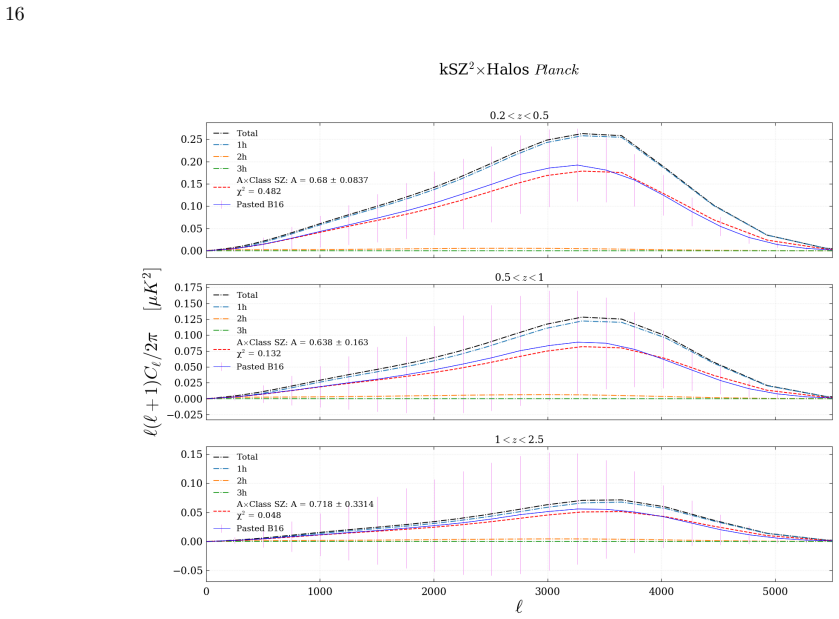
Halo model predictions for projected kSZ cross-correlations match simulations at Planck sensitivity but differ by 20 percent for Simons Observatory.
A machine-rendered reading of the paper's core claim, the machinery that carries it, and where it could break.
Core claim
The halo model, restricted to the dominant term in the projected-field kSZ signal, reproduces the Websky simulation measurements to high accuracy when Planck-matched filters are used. With Simons Observatory filters the same model shows an approximately 20 percent offset that exceeds the forecasted uncertainties. This offset size matches prior theoretical estimates for the subdominant terms that arise from additional contractions and are omitted from the current halo-model calculation.
What carries the argument
The projected-field kSZ estimator, which squares a filtered CMB temperature map and cross-correlates the result with a large-scale structure tracer density field without requiring individual redshifts.
If this is right
- The halo model can be used with confidence for current Planck-level projected kSZ measurements.
- Upcoming Simons Observatory data will require the full set of theoretical terms to avoid systematic bias in gas and structure inferences.
- The size of the missing contributions is expected to be around 20 percent at Simons Observatory sensitivity.
- The tSZ and tau validations confirm that the underlying halo profiles and map construction are reliable.
- Results remain consistent when the comparison is repeated in separate halo redshift bins.
Where Pith is reading between the lines
- Adding the higher-order terms would allow the halo model to serve as a fast, accurate forward model for parameter inference from next-generation kSZ surveys.
- The same validation approach could be applied to other CMB secondaries to identify similar gaps between analytic models and simulations.
- If the offset persists after theory updates, it would point to the need for higher-resolution simulations or refined filter designs.
Load-bearing premise
The 20 percent offset seen at Simons Observatory sensitivity is caused by the omission of higher-order theoretical terms rather than by inaccuracies in the halo model, simulation resolution, or filter construction.
What would settle it
Recalculate the projected-field kSZ cross-correlation in the simulations after explicitly adding the predicted higher-order contraction terms and check whether the 20 percent offset with the halo model disappears.
Figures




read the original abstract
The kinematic Sunyaev-Zel'dovich (kSZ) effect in the cosmic microwave background (CMB) is a powerful probe of gas physics and large-scale structure (LSS) in our universe. We consider the "projected-field" kSZ estimator, which involves cross-correlating a foreground-cleaned, filtered, squared CMB temperature map with an LSS tracer, and requires no individual tracer redshifts. We compare $\verb|class_sz|$ halo model calculations of projected-field kSZ cross-correlations with measurements of these signals from the Websky numerical simulations. We cross-correlate halo density maps from Websky with various CMB secondary signals. We first validate our halo model by comparing its predictions for thermal SZ (tSZ) and patchy screening ($\tau$) cross-correlations to measurements of these signals from Websky. We consider three different halo redshift ranges in our comparisons. We also construct our own kSZ, tSZ, and $\tau$ maps to validate the form of the relevant profiles. Following the tSZ and $\tau$ validation, we compare projected-field kSZ calculations between the halo model and the simulations. We use filters constructed for $\textit{Planck}$ and the Simons Observatory (SO) to assess the accuracy of the halo-model kSZ predictions for experiments of differing sensitivity. Overall, we find good agreement, particularly at $\textit{Planck}$ sensitivity. However, we find an $\approx$ 20$\%$ difference between our halo model and the simulations for SO, which significantly exceeds the predicted error bars. We note that our halo model includes only the dominant expected term in the projected-field kSZ signal; the magnitude of the difference between our model and the simulations is consistent with previous predictions for terms arising from other contractions in the theory calculation. These terms will need to be included to obtain unbiased inference from upcoming projected-field kSZ measurements.
Editorial analysis
A structured set of objections, weighed in public.
Referee Report
Summary. The manuscript compares class_sz halo model predictions for projected-field kSZ cross-correlations against measurements from Websky simulations. It first validates the halo model on tSZ and τ signals across three halo redshift ranges, constructs independent kSZ/tSZ/τ maps to check profiles, and then applies Planck and SO filters to the kSZ comparison. The central result is good agreement at Planck sensitivity but an ≈20% offset at SO sensitivity that exceeds the reported error bars; this offset is interpreted as consistent with prior predictions for sub-dominant contractions omitted from the halo model.
Significance. If the attribution of the offset holds, the work is significant for next-generation CMB analyses with SO and similar experiments, because it shows that the dominant-term halo model alone is insufficient for unbiased projected-field kSZ inference. Benchmarking against independent Websky simulations and performing explicit tSZ/τ validation steps before the kSZ comparison are clear strengths that increase the reliability of the reported discrepancy.
major comments (2)
- [Abstract and kSZ comparison section] Abstract and kSZ comparison section: the interpretation that the ≈20% SO offset arises specifically from unmodeled higher-order contractions is load-bearing for the final claim that these terms “will need to be included” for unbiased inference. The manuscript does not isolate or recompute those sub-dominant contractions inside the same halo-model framework used for the dominant term, nor does it quantify their expected size under the exact filter and redshift binning choices applied here. This leaves open the possibility that residual differences in map resolution, filter normalization, or halo redshift binning contribute to the offset.
- [Validation section (tSZ and τ comparisons)] Validation section (tSZ and τ comparisons): while the tSZ and τ tests are presented as establishing the reliability of the halo profiles and filters before the kSZ step, the manuscript does not show that the same level of agreement persists when the identical filter construction and map-making pipeline is applied to the kSZ velocity field. A direct side-by-side residual map or power-spectrum comparison at the filter scale would strengthen the claim that the profiles themselves are accurate.
minor comments (2)
- [Abstract] Abstract: the three halo redshift ranges are mentioned but not numerically specified; adding the exact bin edges would improve reproducibility.
- [Figure captions and methods] Figure captions and methods: clarify whether the error bars on the simulation measurements include cosmic variance, shot noise, or only the diagonal covariance from the estimator; this affects whether the 20% offset truly exceeds the predicted uncertainties.
Simulated Author's Rebuttal
We thank the referee for their careful and constructive review of our manuscript. We address each major comment below, indicating where we agree and will revise the text or add material, and where we maintain our original interpretation while providing additional clarification.
read point-by-point responses
-
Referee: [Abstract and kSZ comparison section] Abstract and kSZ comparison section: the interpretation that the ≈20% SO offset arises specifically from unmodeled higher-order contractions is load-bearing for the final claim that these terms “will need to be included” for unbiased inference. The manuscript does not isolate or recompute those sub-dominant contractions inside the same halo-model framework used for the dominant term, nor does it quantify their expected size under the exact filter and redshift binning choices applied here. This leaves open the possibility that residual differences in map resolution, filter normalization, or halo redshift binning contribute to the offset.
Authors: We agree that a direct recomputation of the higher-order contractions within the identical halo-model setup would strengthen the attribution. Our current analysis relies on the observed offset magnitude being consistent with prior theoretical estimates of those terms in the literature. Because the same Websky maps, halo catalogs, and filter constructions are used for both the halo-model prediction and the simulation measurement, differences in resolution, normalization, or binning are controlled at the level of the map-making pipeline. We will revise the abstract and kSZ comparison section to explicitly state the reliance on literature predictions, to quantify why the listed systematics are sub-dominant to the observed 20% offset, and to clarify that a full multi-term halo-model calculation is left for future work. revision: partial
-
Referee: [Validation section (tSZ and τ comparisons)] Validation section (tSZ and τ comparisons): while the tSZ and τ tests are presented as establishing the reliability of the halo profiles and filters before the kSZ step, the manuscript does not show that the same level of agreement persists when the identical filter construction and map-making pipeline is applied to the kSZ velocity field. A direct side-by-side residual map or power-spectrum comparison at the filter scale would strengthen the claim that the profiles themselves are accurate.
Authors: The referee correctly identifies that our profile validation for kSZ was performed via direct map construction but did not include an explicit filtered comparison at the same level of detail shown for tSZ and τ. We will add a new panel or supplementary figure that applies the identical Planck and SO filter constructions to the kSZ velocity field and presents the resulting cross-power spectra or residuals against the halo-model prediction. This addition will directly demonstrate that the profile agreement holds at the filtered scales relevant to the main kSZ comparison. revision: yes
Circularity Check
No significant circularity; central comparisons benchmarked against independent Websky simulations
full rationale
The paper derives its conclusions by computing halo-model predictions for projected-field kSZ (and validating tSZ/τ) using class_sz and then directly comparing those predictions to cross-correlations measured on the independent Websky simulation suite. Filters for Planck and SO are applied to both the model and the simulated maps; the ~20% SO offset is noted as consistent with prior theory but is not itself fitted or redefined within the present work. No equation reduces to a fitted parameter renamed as a prediction, no self-citation supplies a load-bearing uniqueness theorem, and the profiles are validated by constructing the relevant maps from the same simulations rather than by internal redefinition. The derivation chain therefore remains externally anchored.
Axiom & Free-Parameter Ledger
axioms (1)
- domain assumption The projected-field kSZ signal is dominated by a single term whose form can be computed from halo profiles.
Lean theorems connected to this paper
-
IndisputableMonolith/Cost/FunctionalEquation.leanwashburn_uniqueness_aczel unclear?
unclearRelation between the paper passage and the cited Recognition theorem.
We note that our halo model includes only the dominant expected term in the projected-field kSZ signal; the magnitude of the difference between our model and the simulations is consistent with previous predictions for terms arising from other contractions in the theory calculation.
-
IndisputableMonolith/Foundation/RealityFromDistinction.leanreality_from_one_distinction unclear?
unclearRelation between the paper passage and the cited Recognition theorem.
Bδeδeh = B1hδeδeh + B2hδeδeh + B3hδeδeh (Eq. 37)
What do these tags mean?
- matches
- The paper's claim is directly supported by a theorem in the formal canon.
- supports
- The theorem supports part of the paper's argument, but the paper may add assumptions or extra steps.
- extends
- The paper goes beyond the formal theorem; the theorem is a base layer rather than the whole result.
- uses
- The paper appears to rely on the theorem as machinery.
- contradicts
- The paper's claim conflicts with a theorem or certificate in the canon.
- unclear
- Pith found a possible connection, but the passage is too broad, indirect, or ambiguous to say the theorem truly supports the claim.
Reference graph
Works this paper leans on
-
[1]
Halo Occupation Distribution In our work, we use halos as our LSS tracer. We model them in the halo occupation distribution (HOD) framework [27], assuming central galaxies only. A halo of a given mass can have at most one central galaxy. The expectation value of the number of central galaxies is dependent on the mass of the halo: Ncent(M) = 1 2 1 + erf lo...
-
[2]
Thermal SZ Effect The tSZ effect is the temperature shift of the CMB due to the inverse-Compton scattering of CMB photons off of the hot electron gas present in galaxies and clusters. At frequency ν, the shift in the CMB temperature due to the tSZ effect at angular separation ⃗θ on the sky from the center of a halo is given by ∆T tSZ ν (⃗θ, M, z) TCMB = g...
-
[3]
Optical Depth The optical depth τ projected along the LOS is defined by τ = σT ˆ LOS ne dl , (21) where ne is the electron number density. Like Pth, we adopt a GNFW profile for ne, which takes the following form: ne(r) = ρgas,free(r) muµe , (22) where mu is the atomic mass unit, µe ≃ 1.14 is the mean molecular weight per electron, and ρgas,free(r) = fbffr...
work page 2010
-
[4]
R. A. Sunyaev and I. B. Zeldovich, ARA&A 18, 537 (1980)
work page 1980
-
[5]
R. A. Sunyaev and Y. B. Zeldovich, Nature 223, 721 (1969)
work page 1969
-
[6]
Probing Feedback in Galaxy Formation with Millimeter-wave Observations
N. Battaglia, J. C. Hill, S. Amodeo, J. G. Bartlett, K. Basu, J. Erler, S. Ferraro, L. Hernquist, M. Madhavacheril, M. McQuinn, et al., BAAS 51, 297 (2019), 1903.04647
work page internal anchor Pith review Pith/arXiv arXiv 2019
-
[7]
S. Ho, S. Dedeo, and D. Spergel, Finding the missing baryons using cmb as a backlight (2009), 0903.2845, URL https: //arxiv.org/abs/0903.2845
work page internal anchor Pith review Pith/arXiv arXiv 2009
-
[8]
P. G. Ferreira, M. Davis, H. A. Feldman, A. H. Jaffe, and R. Juszkiewicz,Measuring omega with galaxy streaming velocities (1999), astro-ph/9904074, URL https://arxiv.org/abs/astro-ph/9904074. 19 Figure 9: kSZ 2× halos with non-B16 electron density profile. We compare the theory and simulation results for SO (left) and show the theory to simulation ratio (...
work page internal anchor Pith review Pith/arXiv arXiv 1999
-
[9]
K. M. Smith, M. S. Madhavacheril, M. M¨ unchmeyer, S. Ferraro, U. Giri, and M. C. Johnson, arXiv e-prints arXiv:1810.13423 (2018), 1810.13423
work page internal anchor Pith review Pith/arXiv arXiv 2018
-
[10]
Beyond the Damping Tail: Cross-Correlating the Kinetic Sunyaev-Zel'dovich Effect with Cosmic Shear
O. Dor´ e, J. F. Hennawi, and D. N. Spergel, ApJ 606, 46 (2004), astro-ph/0309337, URL https://arxiv.org/abs/ astro-ph/0309337
work page internal anchor Pith review Pith/arXiv arXiv 2004
-
[11]
The kinetic Sunyaev-Zel'dovitch effect as a dark energy probe
S. DeDeo, D. N. Spergel, and H. Trac, arXiv e-prints astro-ph/0511060 (2005), astro-ph/0511060, URL https://arxiv. org/abs/astro-ph/0511060
work page internal anchor Pith review Pith/arXiv arXiv 2005
-
[12]
J. C. Hill, S. Ferraro, N. Battaglia, J. Liu, and D. N. Spergel, Phys. Rev. Lett. 117, 051301 (2016), 1603.01608, URL https://arxiv.org/abs/1603.01608. 20
work page internal anchor Pith review Pith/arXiv arXiv 2016
-
[13]
S. Ferraro, J. C. Hill, N. Battaglia, J. Liu, and D. N. Spergel, Phys. Rev. D 94, 123526 (2016), 1605.02722
work page internal anchor Pith review Pith/arXiv arXiv 2016
-
[14]
A. Krolewski, S. Ferraro, E. F. Schlafly, and M. White, Journal of Cosmology and Astroparticle Physics 2020, 047–047 (2020), ISSN 1475-7516, URL http://dx.doi.org/10.1088/1475-7516/2020/05/047
-
[15]
A. Kusiak, B. Bolliet, S. Ferraro, J. C. Hill, and A. Krolewski, Phys. Rev. D 104, 043518 (2021), 2102.01068, URL http://dx.doi.org/10.1103/PhysRevD.104.043518
-
[16]
H. Gil-Mar´ ın, C. Wagner, F. Fragkoudi, R. Jimenez, and L. Verde, Journal of Cosmology and Astroparticle Physics2012, 047–047 (2012), ISSN 1475-7516, URL http://dx.doi.org/10.1088/1475-7516/2012/02/047
-
[17]
Simulations of the Sunyaev-Zel'dovich Power Spectrum with AGN Feedback
N. Battaglia, J. R. Bond, C. Pfrommer, J. L. Sievers, and D. Sijacki, ApJ 725, 91 (2010), 1003.4256
work page internal anchor Pith review Pith/arXiv arXiv 2010
-
[18]
B. Bolliet, J. Colin Hill, S. Ferraro, A. Kusiak, and A. Krolewski, Journal of Cosmology and Astroparticle Physics 2023, 039 (2023), ISSN 1475-7516, URL http://dx.doi.org/10.1088/1475-7516/2023/03/039
-
[19]
B. Bolliet, A. Kusiak, F. McCarthy, A. Sabyr, K. Surrao, J. C. Hill, J. Chluba, S. Ferraro, B. Hadzhiyska, D. Han, et al., class sz i: Overview (2023), 2310.18482, URL https://arxiv.org/abs/2310.18482
-
[20]
B. Bolliet, A. Kusiak, F. McCarthy, A. Sabyr, K. Surrao, J. Chluba, C. E. Villagra, S. Ferraro, B. Hadzhiyska, D. Han, et al., Class sz ii: Notes and examples of fast and accurate calculations of halo model, large scale structure and cosmic microwave background observables (2025), 2507.07346, URL https://arxiv.org/abs/2507.07346
-
[21]
G. Stein, M. A. Alvarez, J. R. Bond, A. v. Engelen, and N. Battaglia, Journal of Cosmology and Astroparticle Physics 2020, 012–012 (2020), ISSN 1475-7516, URL http://dx.doi.org/10.1088/1475-7516/2020/10/012
- [22]
-
[23]
J. F. Navarro, C. S. Frenk, and S. D. M. White, The Astrophysical Journal 462, 563 (1996), ISSN 1538-4357, URL http://dx.doi.org/10.1086/177173
-
[24]
Analytical Models For Galactic Nuclei
H. Zhao, MNRAS 278, 488 (1996), astro-ph/9509122
work page internal anchor Pith review Pith/arXiv arXiv 1996
-
[25]
Analytic model for galaxy and dark matter clustering
U. Seljak, MNRAS 318, 203 (2000), astro-ph/0001493
work page internal anchor Pith review Pith/arXiv arXiv 2000
-
[26]
A. COORAY and R. SHETH, Physics Reports 372, 1–129 (2002), ISSN 0370-1573, URL http://dx.doi.org/10.1016/ S0370-1573(02)00276-4
work page 2002
-
[27]
Toward a halo mass function for precision cosmology: the limits of universality
J. Tinker, A. V. Kravtsov, A. Klypin, K. Abazajian, M. Warren, G. Yepes, S. Gottl¨ ober, and D. E. Holz, The Astrophysical Journal 688, 709–728 (2008), ISSN 1538-4357, URL http://dx.doi.org/10.1086/591439
work page internal anchor Pith review doi:10.1086/591439 2008
-
[28]
J. L. Tinker, B. E. Robertson, A. V. Kravtsov, A. Klypin, M. S. Warren, G. Yepes, and S. Gottl¨ ober, ApJ 724, 878 (2010), 1001.3162
work page internal anchor Pith review Pith/arXiv arXiv 2010
-
[29]
The Cosmic Linear Anisotropy Solving System (CLASS) I: Overview
J. Lesgourgues, The cosmic linear anisotropy solving system (class) i: Overview (2011), 1104.2932, URL https://arxiv. org/abs/1104.2932
work page internal anchor Pith review Pith/arXiv arXiv 2011
-
[30]
Z. Zheng, I. Zehavi, D. J. Eisenstein, D. H. Weinberg, and Y. P. Jing, The Astrophysical Journal 707, 554–572 (2009), ISSN 1538-4357, URL http://dx.doi.org/10.1088/0004-637X/707/1/554
-
[31]
N. Battaglia, J. R. Bond, C. Pfrommer, and J. L. Sievers, The Astrophysical Journal 758, 75 (2012), ISSN 1538-4357, URL http://dx.doi.org/10.1088/0004-637X/758/2/75
-
[32]
J. C. Hill and E. Pajer, Phys. Rev. D 88, 063526 (2013), 1303.4726
work page internal anchor Pith review Pith/arXiv arXiv 2013
-
[33]
N. Battaglia, Journal of Cosmology and Astroparticle Physics 2016, 058–058 (2016), ISSN 1475-7516, URL http://dx. doi.org/10.1088/1475-7516/2016/08/058
-
[34]
Joint Planck and WMAP CMB Map Reconstruction
J. Bobin, F. Sureau, J. L. Starck, A. Rassat, and P. Paykari, A&A 563, A105 (2014), 1401.6016
work page internal anchor Pith review Pith/arXiv arXiv 2014
-
[35]
P. Ade, J. Aguirre, Z. Ahmed, S. Aiola, A. Ali, D. Alonso, M. A. Alvarez, K. Arnold, P. Ashton, J. Austermann, et al., Journal of Cosmology and Astroparticle Physics 2019, 056–056 (2019), ISSN 1475-7516, URL http://dx.doi.org/10. 1088/1475-7516/2019/02/056
work page 2019
-
[36]
M. Abitbol, I. Abril-Cabezas, S. Adachi, P. Ade, A. E. Adler, P. Agrawal, J. Aguirre, Z. Ahmed, S. Aiola, T. Alford, et al., JCAP 2025, 034 (2025), 2503.00636
-
[37]
2001, MNRAS, 322, 231, doi: 10.1046/j.1365-8711.2001.04022.x
R. Scoccimarro and H. M. P. Couchman, Monthly Notices of the Royal Astronomical Society 325, 1312 (2001), ISSN 0035-8711, https://academic.oup.com/mnras/article-pdf/325/4/1312/3031416/325-4-1312.pdf, URL https://doi.org/ 10.1046/j.1365-8711.2001.04281.x
-
[38]
Dark Matter Halo Profiles of Massive Clusters: Theory vs. Observations
S. Bhattacharya, S. Habib, K. Heitmann, and A. Vikhlinin, ApJ 766, 32 (2013), 1112.5479
work page internal anchor Pith review Pith/arXiv arXiv 2013
-
[39]
H. Park, M. A. Alvarez, and J. R. Bond, ApJ 853, 121 (2018), 1710.02792
work page internal anchor Pith review Pith/arXiv arXiv 2018
- [40]
-
[41]
F. McCarthy, J. C. Hill, W. R. Coulton, and D. W. Hogg, Signal-preserving cmb component separation with machine learning (2024), 2404.03557, URL https://arxiv.org/abs/2404.03557
- [42]
-
[43]
K. M. G´ orski, E. Hivon, A. J. Banday, B. D. Wandelt, F. K. Hansen, M. Reinecke, and M. Bartelmann, ApJ 622, 759 (2005), astro-ph/0409513, URL https://arxiv.org/abs/astro-ph/0409513
work page internal anchor Pith review Pith/arXiv arXiv 2005
-
[44]
Singer and Daniel Lenz and Martin Reinecke and Cyrille Rosset and Eric Hivon and Krzysztof M
A. Zonca, L. Singer, D. Lenz, M. Reinecke, C. Rosset, E. Hivon, and K. Gorski, Journal of Open Source Software 4, 1298 (2019), URL https://doi.org/10.21105/joss.01298
-
[45]
C. R. Harris, K. J. Millman, S. J. van der Walt, R. Gommers, P. Virtanen, D. Cournapeau, E. Wieser, J. Taylor, S. Berg, N. J. Smith, et al., Nature 585, 357 (2020), URL https://arxiv.org/pdf/2006.10256.pdf
work page internal anchor Pith review Pith/arXiv arXiv 2020
-
[46]
SciPy 1.0--Fundamental Algorithms for Scientific Computing in Python
P. Virtanen, R. Gommers, T. E. Oliphant, M. Haberland, T. Reddy, D. Cournapeau, E. Burovski, P. Peterson, W. Weckesser, J. Bright, et al., Nature Methods 17, 261 (2020), URL https://arxiv.org/pdf/1907.10121.pdf
work page internal anchor Pith review Pith/arXiv arXiv 2020
- [47]
-
[48]
Astropy Collaboration, T. P. Robitaille, E. J. Tollerud, P. Greenfield, M. Droettboom, E. Bray, T. Aldcroft, M. Davis, A. Ginsburg, A. M. Price-Whelan, et al., A&A 558, A33 (2013), 1307.6212, URL https://arxiv.org/pdf/1307.6212. 21 pdf
work page internal anchor Pith review Pith/arXiv arXiv 2013
-
[49]
Astropy Collaboration, A. M. Price-Whelan, B. M. Sip˝ ocz, H. M. G¨ unther, P. L. Lim, S. M. Crawford, S. Conseil, D. L. Shupe, M. W. Craig, N. Dencheva, et al., AJ156, 123 (2018), 1801.02634, URL https://arxiv.org/pdf/1801.02634.pdf
work page internal anchor Pith review Pith/arXiv arXiv 2018
-
[50]
Astropy Collaboration, A. M. Price-Whelan, P. L. Lim, N. Earl, N. Starkman, L. Bradley, D. L. Shupe, A. A. Patil, L. Corrales, C. E. Brasseur, et al., apj 935, 167 (2022), 2206.14220, URL https://arxiv.org/pdf/2206.14220.pdf
work page internal anchor Pith review Pith/arXiv arXiv 2022
discussion (0)
Sign in with ORCID, Apple, or X to comment. Anyone can read and Pith papers without signing in.