REVIEW 4 major objections 4 minor 39 references
BiND: A Neural Discriminator-Decoder for Accurate Bimanual Trajectory Prediction in Brain-Computer Interfaces
T0 review · 4 major / 4 minor · reviewed 2026-08-15 · deepseek-v4-flash
Pith's one-line read A discriminator that routes neural signals to specialized decoders improves bimanual hand-velocity prediction over a single recurrent network.
desk verdict Sensible new architecture for bimanual decoding, but the paper never actually shows the discriminator routing is what delivers the 2% gain; worth a serious referee, not a desk reject. read the letter →
The pith
A machine-rendered reading of the paper's core claim, the machinery that carries it, and where it could break.
The reading
What carries the argument
The load-bearing mechanism is the routing architecture itself: an LSTM-based 'Discriminator' that classifies each neural window as right-hand, left-hand, or bimanual, and then selects one of three GRU-based decoders. The decoders share a 512-unit GRU layer and a dense output layer, but each is trained on a different subset of trials; the Bi-decoder is deliberately trained on all motion types because bimanual movements share components with unimanual ones. A second mechanism is the onset counter, a time index that tells the decoder where the current window falls within the trial, compensating for the temporal structure lost when raw signals are chopped into overlapping windows. The discriminator contains about 500,000 parameters, each decoder about 2 million, and GRUs are used in the decoders because they give similar accuracy to LSTMs at roughly 80% of the training cost.
What would settle it
Compare BiND against an oracle-routing version that receives the true motion type instead of the predicted one; if the oracle does not outperform BiND by a clearly larger margin than the reported 2%, the improvement cannot be attributed to the discriminator's routing decision. A complementary test: degrade the discriminator by assigning random motion-type labels; if BiND still beats GRU by roughly 2%, the gain comes from the multi-decoder architecture rather than from accurate classification.
Extended reading notes
Core claim
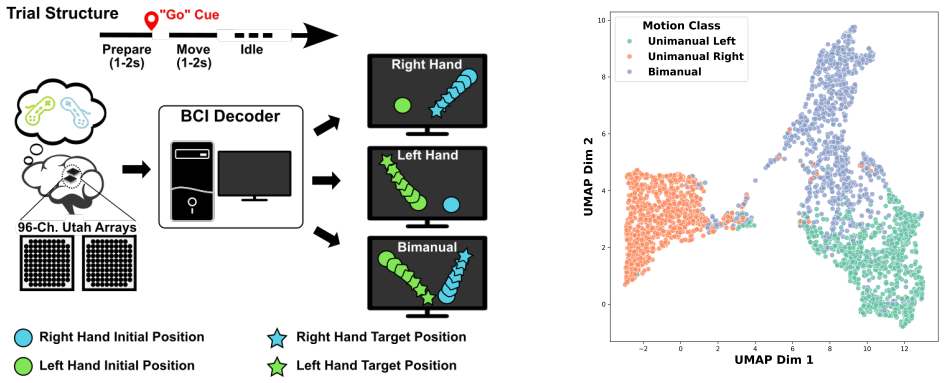
BiND's central claim is that a two-stage discriminator-decoder architecture outperforms end-to-end models for continuous prediction of two-hand velocities. The discriminator, an LSTM-based classifier, predicts the motion type, and the input is then fed to one of three decoders: one trained on left-hand movements, one on right-hand movements, and one trained on all movement types to capture inter-limb coordination. A trial-relative time index is added as an input feature to restore long-range temporal structure that the 600-ms windowing discards. The paper reports that BiND reaches a mean R² of 0.76 for unimanual and 0.69 for bimanual velocity prediction, surpassing the best baseline (a single GRU) by 2% in both tasks, and that the advantage grows to 2–4% in cross-session analyses. The paper attributes this improvement to learning several simpler mappings rather than a single highly complex one, i.e., specialization via routing.
Load-bearing premise
The 2% gain over a single GRU assumes the motion-type classifier is usually right, so that routing errors don't wipe out the benefit of specialized decoders.
Editorial extensions
If this is right
- Bimanual decoding, currently a known weak point of BCIs, can be improved without a new neural recording modality, just by restructuring how existing signals are decoded.
- Because the discriminator and decoders are causal (only past information is used) and the model is fine-tuned on 40% of a target session, BiND is directly applicable to real-time BCI loops.
- The 2% R² gain over GRU is consistent across both unimanual and bimanual tasks and widens to 4% in the most variable sessions, implying the routing benefit is most valuable exactly when session-to-session neural drift is large.
- Non-recurrent baselines (CNN, Transformer, FNN) underperform in this dataset, pointing to short- and mid-range temporal dependencies, not long-range attention, as the critical structure for hand-velocity decoding.
- Ablation shows both the discriminator routing and the time-index feature contribute comparably, so both mechanisms are needed for the reported gain.
Reading between the lines
- The paper never computes an oracle-routing upper bound; if that bound is much larger than 2%, then targeted discriminator improvements (e.g., online adaptation of the classifier within a session) could yield larger gains than the current architecture extracts.
- The discriminator could double as a practical mode switch for prosthetic hands, telling the device whether the user intends left-hand, right-hand, or two-handed motion, providing a useful control signal at no extra cost.
- The time-index feature is transportable: any windowed recurrent decoder that loses trial-phase information could adopt it, and the two-stage idea may transfer to other multi-limb or multi-effector decoding problems in BCIs.
- The 2% advantage is measured against a single GRU on the same data pipeline; a fairer stress test would compare against a GRU of equal total parameter count to the full BiND stack, since BiND also benefits from roughly four times the parameters across the discriminator and decoders.
Signed reviews
Editorial analysis
A structured set of objections, weighed in public.
Referee Report
Summary. The paper introduces BiND, a two-stage neural architecture for decoding bimanual hand velocities from intracortical recordings. The first stage is a motion-type discriminator that classifies each window as unimanual left, unimanual right, or bimanual; the second stage routes the window to one of three GRU-based decoders, with the addition of a trial-relative time index. The model is evaluated on a publicly available 13-session dataset from a single tetraplegic participant, using the same preprocessing and causal decoding for all models. The authors report mean R2 of 0.76 for unimanual and 0.69 for bimanual trajectory prediction, outperforming the next-best model (GRU) by about 2%, and claim greater robustness to session variability. The paper also reports that BiND's two introduced components contributed comparably in ablation studies, but no ablation results are shown.
Significance. If fully substantiated, the paper would provide a modest but practically relevant contribution to bimanual BCI decoding: a task-aware routing architecture with specialized decoders, evaluated causally on a public dataset. The use of a public single-participant dataset, a standard comparison set, and a causal evaluation protocol are strengths. However, the central empirical claim--that the discriminator-routing mechanism is responsible for the improvement over a plain GRU--is not yet convincingly supported. The missing significance tests, missing ablation tables, missing oracle-routing bound, and incomplete reproducibility details mean that the quantitative conclusions should not be regarded as established at their face value. The paper's contribution would be materially strengthened by adding these analyses.
major comments (4)
- [Section II-C and Section III-B] The central attribution of the performance gain to discriminator-based routing is unsupported. The text states that 'ablation studies revealed that both components introduced in this work contributed comparably,' but no ablation results are presented anywhere in the manuscript. In addition, the paper never reports a per-class confusion matrix for the discriminator, never analyzes the cost of misrouting a window to a decoder not trained for that movement type, and never provides an oracle-routing upper bound (routing with ground-truth labels). The claim in Fig. 2 that 'over 80% of bimanual data points are correctly classified' is made in the context of a UMAP latent-space visualization, which is an unsupervised embedding and not a classification accuracy measure. Without these analyses, the 2% improvement over GRU could be explained by the time-index feature or by the Bi-decoder's exposure to all movement types, while the routing component itself might degrade performance when the discriminator errs.
- [Section III-A and III-B] No statistical significance tests are provided for the claimed improvements. The reported difference between BiND and GRU is only about 2% in R2, which is small relative to the reported variability across folds (Abstract reports ±0.01 for unimanual and ±0.03 for bimanual). The Fig. 6 caption states that 'BiND significantly outperforms all baseline models,' but no test (e.g., paired test across cross-validation folds or sessions, bootstrap confidence intervals, or effect sizes) is given. The 'up to 4%' improvement in cross-session analyses also appears without error bars or per-session details. The authors should report whether the differences are statistically reliable and quantify uncertainty in a way that supports the headline comparison.
- [Section II-B and III-B] The evaluation protocol is not fully specified, which compromises the fairness of the comparison. The paper states that 40% of target-session trials are used for fine-tuning and the remaining 60% for evaluation, but it does not state whether all baseline models receive the same fine-tuning procedure and the same target-session adaptation. If only BiND is fine-tuned on target-session data, the comparison is unfair. It is also unclear how hyperparameters were selected for each model, whether the same cross-validation splits were used for all models, and whether any model selection was performed on the final evaluation portion of the target session. Please clarify these points.
- [Section II-B and II-C] The empirical claims are not reproducible without code and full training details. The paper does not give the optimizer, learning rate, batch size, number of epochs, early-stopping criteria, number of random seeds, or hardware used. The discriminator and decoder architectures are described in terms of layer sizes, but no full hyperparameter table or training schedule is included. Given that the paper's central message is an empirical comparison, these omissions are load-bearing; the authors should release code or provide a complete appendix with all implementation details and random seed information.
minor comments (4)
- [Affiliation] The affiliation line reads 'Institutes of Electrical and Micro Engineering and Neuro-X'; the singular 'Institute' appears to be intended.
- [Section III-B] The sentence 'the use of non-overlapping windows can hinder Transformer performance' appears to conflict with the earlier description in Section II-B of overlapping 600-ms windows with a 300-ms stride. Please clarify whether the Transformer used a different windowing scheme.
- [Section II-C] The text says the discriminator output layer uses a sigmoid activation 'that generates class probabilities.' With three mutually exclusive classes, a softmax would be the standard choice; sigmoid unit activations would not, by themselves, form a proper probability distribution over classes. Please clarify the exact output activation and loss function.
- [Figure 5 caption] The caption says panels (a) and (b) display average R2 scores while the figure shows box plots; please clarify what quantity is plotted and whether the dots represent folds, sessions, or individual windows.
Circularity Check
No circularity: BiND's reported R2 gains are held-out empirical comparisons, not derivations from fitted constants or self-cited premises.
full rationale
The paper's central claim is an empirical benchmark result: BiND is trained on preceding sessions plus 40% of the target session's trials and evaluated on the disjoint remaining 60%, with R2 computed on held-out neural windows. Nothing in the model definition—the LSTM discriminator, the three GRU decoders, or the trial-relative time index—is defined in terms of the reported R2 values or the benchmark outcomes, so the result is not equivalent to an input by construction. The preprocessing steps (threshold-crossing counts, per-session normalization, Gaussian smoothing, 600-ms windows) are standard and applied identically to all models, making the comparison fair rather than circular. The claimed 2% improvement over the next-best GRU is a measured outcome, not a parameter fitted to that gap. The paper's self-citations (e.g., Shaeri and Sodagar [6], Shaeri et al. [11,12,15,33]) support background, hardware, and general decoding claims and are not load-bearing for the bimanual trajectory prediction result; the main dataset and prior bimanual RNN result [21] are external. The absence of an oracle-routing upper bound, the lack of shown ablation tables, and the missing per-class misclassification-cost analysis are evidentiary gaps that weaken the attribution of the gain to the discriminator, but they are correctness/rigor issues, not circularity. No equation is shown to reduce a prediction to a fit, and no self-citation is invoked to forbid alternative architectures. Hence the derivation chain is self-contained against external benchmarks and receives a score of 0.
Assumptions & free parameters
free parameters (6)
- Window length =
600 ms
- Window stride =
300 ms
- Gaussian kernel width =
~40 ms
- Dropout rate =
0.3
- Decoder hidden size =
512 GRU units
- Discriminator hidden sizes =
128 LSTM, 64 dense
assumptions (4)
- domain assumption Threshold-crossing counts in 20 ms bins provide a sufficient representation of neural activity for hand velocity decoding.
- domain assumption Cursor velocity during open-loop control reflects the participant's intended hand movement.
- domain assumption The overlapping windowing scheme does not leak across the train/fine-tune/test split.
- standard math Standard deep learning training assumptions (data stationarity within a session, enough data for convergence) hold.
Cite this review
Pith. "Pith review of BiND: A Neural Discriminator-Decoder for Accurate Bimanual Trajectory Prediction in Brain-Computer Interfaces." pith.science (2026). https://pith.science/paper/YEAX6G44
@misc{pith2026250903521,
  author       = {Pith},
  title        = {Pith review of: BiND: A Neural Discriminator-Decoder for Accurate Bimanual Trajectory Prediction in Brain-Computer Interfaces},
  year         = {2026},
  howpublished = {\url{https://pith.science/paper/YEAX6G44}},
  note         = {Machine review of arXiv:2509.03521}
}
abstract
Decoding bimanual hand movements from intracortical recordings remains a critical challenge for brain-computer interfaces (BCIs), due to overlapping neural representations and nonlinear interlimb interactions. We introduce BiND (Bimanual Neural Discriminator-Decoder), a two-stage model that first classifies motion type (unimanual left, unimanual right, or bimanual) and then uses specialized GRU-based decoders, augmented with a trial-relative time index, to predict continuous 2D hand velocities. We benchmark BiND against six state-of-the-art models (SVR, XGBoost, FNN, CNN, Transformer, GRU) on a publicly available 13-session intracortical dataset from a tetraplegic patient. BiND achieves a mean $R^2$ of 0.76 ($\pm$0.01) for unimanual and 0.69 ($\pm$0.03) for bimanual trajectory prediction, surpassing the next-best model (GRU) by 2% in both tasks. It also demonstrates greater robustness to session variability than all other benchmarked models, with accuracy improvements of up to 4% compared to GRU in cross-session analyses. This highlights the effectiveness of task-aware discrimination and temporal modeling in enhancing bimanual decoding.
Figures


Reference graph
Works this paper leans on
-
[1]
J. D. Steinmetz, K. M. Seeher, N. Schiess, E. Nichols, B. Cao, C. Servili, et al., “Global, regional, and national burden of disorders affecting the nervous system, 1990–2021: a systematic analysis for the global burden of disease study 2021,” The Lancet Neurology, vol. 23, no. 4, pp. 344–381, 2024
work page 1990
- [2]
-
[3]
Who world report on disability: a review,
G. L. Krahn, “Who world report on disability: a review,” Disability and health journal , vol. 4, no. 3, pp. 141–142, 2011
work page 2011
-
[4]
W. H. Organization and W. Bank, World Report on Disability. Geneva, Switzerland: World Health Organization, 2011. Accessed: 2025-05-23
work page 2011
-
[5]
The state of clinical trials of implantable brain–computer interfaces,
K. M. Patrick-Krueger, I. Burkhart, and J. L. Contreras-Vidal, “The state of clinical trials of implantable brain–computer interfaces,” Nat. Rev. Bioeng., pp. 1–18, 2024
work page 2024
-
[6]
M. A. Shaeri and A. M. Sodagar, “Data transformation in the pro- cessing of neuronal signals: A powerful tool to illuminate informative contents,” IEEE IEEE Rev. Biomed. Eng., vol. 16, pp. 611–626, 2022
work page 2022
-
[7]
Walking naturally after spinal cord injury using a brain–spine interface,
H. Lorach, A. Galvez, V . Spagnolo, F. Martel, S. Karakas, N. Intering, M. Vat, O. Faivre, C. Harte, S. Komi, et al., “Walking naturally after spinal cord injury using a brain–spine interface,” Nature, vol. 618, no. 7963, pp. 126–133, 2023
work page 2023
-
[8]
A. B. Ajiboye, F. R. Willett, D. R. Young, W. D. Memberg, B. A. Mur- phy, J. P. Miller, B. L. Walter, J. A. Sweet, H. A. Hoyen, M. W. Keith, et al. , “Restoration of reaching and grasping movements through brain-controlled muscle stimulation in a person with tetraplegia,” The Lancet, vol. 389, no. 10081, pp. 1821–1830, 2017
work page 2017
Show all 39 references
-
[9]
Decoding motor imagery from the posterior parietal cortex of a tetraplegic human,
T. Aflalo, S. Kellis, C. Klaes, B. Lee, Y . Shi, K. Pejsa, K. Shanfield, S. Hayes-Jackson, M. Aisen, C. Heck, et al., “Decoding motor imagery from the posterior parietal cortex of a tetraplegic human,” Science, vol. 348, no. 6237, pp. 906–910, 2015
2015
-
[10]
A brain-computer interface that evokes tactile sensations improves robotic arm control,
S. N. Flesher, J. E. Downey, J. M. Weiss, C. L. Hughes, A. J. Herrera, E. C. Tyler-Kabara, M. L. Boninger, J. L. Collinger, and R. A. Gaunt, “A brain-computer interface that evokes tactile sensations improves robotic arm control,” Science, vol. 372, no. 6544, pp. 831–836, 2021
2021
-
[11]
A 2.46-mm 2 miniaturized brain-machine interface (MiBMI) enabling 31-class brain-to-text decoding,
M. A. Shaeri, U. Shin, A. Yadav, R. Caramellino, G. Rainer, and M. Shoaran, “A 2.46-mm 2 miniaturized brain-machine interface (MiBMI) enabling 31-class brain-to-text decoding,” IEEE J. Solid- State Circuits, vol. 59, no. 11, pp. 3566–3579, 2024
2024
-
[12]
33.3 MiBMI: A 192/512-channel 2.46mm 2 miniaturized brain-machine interface chipset enabling 31-class brain-to-text conver- sion through distinctive neural codes,
M. A. Shaeri, U. Shin, A. Yadav, R. Caramellino, G. Rainer, and M. Shoaran, “33.3 MiBMI: A 192/512-channel 2.46mm 2 miniaturized brain-machine interface chipset enabling 31-class brain-to-text conver- sion through distinctive neural codes,” in 2024 IEEE Int. Solid-State Circui...
2024
-
[13]
Machine learning for neural decoding,
J. I. Glaser, A. S. Benjamin, R. H. Chowdhury, M. G. Perich, L. E. Miller, and K. P. Kording, “Machine learning for neural decoding,” eNeuro, vol. 7, no. 4, 2020
2020
-
[14]
A power-efficient brain-machine interface system with a sub-mw feature extraction and decoding asic demonstrated in nonhuman primates,
H. An, S. R. Nason-Tomaszewski, J. Lim, K. Kwon, M. S. Willsey, P. G. Patil, H.-S. Kim, D. Sylvester, C. A. Chestek, and D. Blaauw, “A power-efficient brain-machine interface system with a sub-mw feature extraction and decoding asic demonstrated in nonhuman primates,” IEEE Tra...
2022
-
[15]
Challenges and opportunities of edge ai for next-generation implantable bmis,
M. A. Shaeri, A. Afzal, and M. Shoaran, “Challenges and opportunities of edge ai for next-generation implantable bmis,” in IEEE 4th Int. Conf. on AI Circuits and Systems (AICAS) , pp. 190–193, 2022
2022
-
[16]
Fast and accurate decoding of finger movements from ecog through riemannian features and modern machine learning techniques,
L. Yao, B. Zhu, and M. Shoaran, “Fast and accurate decoding of finger movements from ecog through riemannian features and modern machine learning techniques,” J Neural Eng., vol. 19, no. 1, p. 016037, 2022
2022
-
[17]
Neuraltree: A 256-channel 0.227- µj/class versatile neural activity classification and closed-loop neuromodulation soc,
U. Shin, C. Ding, B. Zhu, Y . Vyza, A. Trouillet, E. C. Revol, S. P. Lacour, and M. Shoaran, “Neuraltree: A 256-channel 0.227- µj/class versatile neural activity classification and closed-loop neuromodulation soc,” IEEE J. Solid-State Circuits , vol. 57, no. 11, pp. 3243–3257, 2022
2022
-
[18]
Intelligent neural interfaces: An emerging era in neurotechnology,
M. Shoaran, U. Shin, and M. A. Shaeri, “Intelligent neural interfaces: An emerging era in neurotechnology,” in 2024 IEEE Custom Integr. Circuits Conf. (CICC) , pp. 01–07, 2024
2024
-
[19]
Real-time brain-machine interface in non-human primates achieves high-velocity prosthetic finger move- ments using a shallow feedforward neural network decoder,
M. S. Willsey, S. R. Nason-Tomaszewski, S. R. Ensel, H. Temmar, M. J. Mender, J. T. Costello, et al., “Real-time brain-machine interface in non-human primates achieves high-velocity prosthetic finger move- ments using a shallow feedforward neural network decoder,” Nature Commu...
2022
-
[20]
High-performance brain-to-text communication via handwriting,
F. R. Willett, D. T. Avansino, L. R. Hochberg, J. M. Henderson, and K. V . Shenoy, “High-performance brain-to-text communication via handwriting,” Nature, vol. 593, p. 249–254, May 2021
2021
-
[21]
Brain control of bimanual movement enabled by recurrent neural networks,
D. R. Deo, F. R. Willett, D. T. Avansino, L. R. Hochberg, J. M. Henderson, and K. V . Shenoy, “Brain control of bimanual movement enabled by recurrent neural networks,” Scientific Reports , vol. 14, no. 1, p. 1598, 2024
2024
-
[22]
Deep learning for neural decoding in motor cortex,
F. Liu, S. Meamardoost, R. Gunawan, T. Komiyama, C. Mewes, Y . Zhang, E. Hwang, and L. Wang, “Deep learning for neural decoding in motor cortex,” J Neural Eng. , vol. 19, no. 5, p. 056021, 2022
2022
-
[23]
Deep learning approaches for neural decoding across architectures and recording modalities,
J. A. Livezey and J. I. Glaser, “Deep learning approaches for neural decoding across architectures and recording modalities,” Briefings in bioinformatics, vol. 22, no. 2, pp. 1577–1591, 2021
2021
-
[24]
A systematic review of bimanual motor coordination in brain-computer interface,
P. Tantawanich, C. Phunruangsakao, S.-I. Izumi, and M. Hayashibe, “A systematic review of bimanual motor coordination in brain-computer interface,” IEEE Transactions on Neural Systems and Rehabilitation Engineering, 2024
2024
-
[25]
Attention is all you need,
A. Vaswani, N. Shazeer, N. Parmar, J. Uszkoreit, L. Jones, A. N. Gomez, Ł. Kaiser, and I. Polosukhin, “Attention is all you need,” Advances in neural information processing systems , vol. 30, 2017
2017
-
[26]
Activities of daily living,
P. F. Edemekong, D. Bomgaars, S. Sukumaran, and S. B. Levy, “Activities of daily living,” 2019
2019
-
[27]
Signal processing in implantable neural recording microsystems,
S. Razmpour, M. A. Shaeri, H. Hosseini-Nejad, and A. M. Sodagar, “Signal processing in implantable neural recording microsystems,” in Telemedicine and Electronic Medicine , ch. 18, pp. 416–443, Boca Raton, FL, USA: CRC Press, 2015
2015
-
[28]
Real-time, neural signal processing for high-density brain-implantable devices,
A. M. Sodagar, Y . Khazaei, M. Nekoui, and M. A. Shaeri, “Real-time, neural signal processing for high-density brain-implantable devices,” Bioelectronic Medicine, vol. 11, no. 1, p. 17, 2025
2025
-
[29]
Maintained representations of the ipsilateral and contralateral limbs during biman- ual control in primary motor cortex,
K. P. Cross, E. A. Heming, D. J. Cook, and S. H. Scott, “Maintained representations of the ipsilateral and contralateral limbs during biman- ual control in primary motor cortex,” Journal of Neuroscience, vol. 40, no. 35, pp. 6732–6747, 2020
2020
-
[30]
A hardware-efficient EMG decoder with an attractor- based neural network for next-generation hand prostheses,
M. Kalbasi, M. A. Shaeri, V . A. Mendez, S. Shokur, S. Micera, and M. Shoaran, “A hardware-efficient EMG decoder with an attractor- based neural network for next-generation hand prostheses,” in IEEE 6th Int. Conf. on AI Circuits and Systems (AICAS), pp. 532–536, 2024
2024
-
[31]
Suppression of the non- dominant motor cortex during bimanual symmetric finger movement: a functional magnetic resonance imaging study,
Y . Aramaki, M. Honda, and N. Sadato, “Suppression of the non- dominant motor cortex during bimanual symmetric finger movement: a functional magnetic resonance imaging study,” Neuroscience, vol. 141, no. 4, pp. 2147–2153, 2006
2006
-
[32]
Between-hand difference in ipsilateral deactivation is associated with hand lateralization: fmri mapping of 284 volunteers balanced for handedness,
N. Tzourio-Mazoyer, L. Petit, L. Zago, F. Crivello, N. Vinuesa, et al., “Between-hand difference in ipsilateral deactivation is associated with hand lateralization: fmri mapping of 284 volunteers balanced for handedness,” Frontiers in Human Neuroscience , vol. 9, p. 5, 2015
2015
-
[33]
Integrating neural inter- faces with machine learning: Enabling self-sufficient and ubiquitous prosthetic and diagnostic devices,
M. A. Shaeri, J. Liu, and M. Shoaran, “Integrating neural inter- faces with machine learning: Enabling self-sufficient and ubiquitous prosthetic and diagnostic devices,” in 2025 23rd IEEE Interregional NEWCAS Conference (NEWCAS) , pp. 50–54, IEEE, 2025
2025
-
[34]
Motor control and neural plasticity through interhemispheric interactions,
N. Takeuchi, Y . Oouchida, and S.-I. Izumi, “Motor control and neural plasticity through interhemispheric interactions,” Neural plasticity , vol. 2012, no. 1, p. 823285, 2012
2012
-
[35]
Revisiting the prob- lem of learning long-term dependencies in recurrent neural networks,
L. Johnston, V . Patel, Y . Cui, and P. Balaprakash, “Revisiting the prob- lem of learning long-term dependencies in recurrent neural networks,” Neural Networks, vol. 183, p. 106887, 2025
2025
-
[36]
Non-local neural networks,
X. Wang, R. Girshick, A. Gupta, and K. He, “Non-local neural networks,” in Proceedings of the IEEE conference on computer vision and pattern recognition , pp. 7794–7803, 2018
2018
-
[37]
Transformers in time series: A survey,
Q. Wen, T. Zhou, C. Zhang, W. Chen, Z. Ma, J. Yan, and L. Sun, “Transformers in time series: A survey,” arXiv preprint arXiv:2202.07125, 2022
2022 arXiv
-
[38]
Feedforward sequential memory networks: A new structure to learn long-term dependency,
S. Zhang, C. Liu, H. Jiang, S. Wei, L. Dai, and Y . Hu, “Feedforward sequential memory networks: A new structure to learn long-term dependency,” arXiv preprint arXiv:1512.08301 , 2015
2015 arXiv
-
[39]
A critical review of multi-output support vector regression,
N. K. Tran, L. C. K ¨uhle, and G. W. Klau, “A critical review of multi-output support vector regression,” Pattern Recognition Letters , vol. 178, pp. 69–75, 2024
2024
Reviewed August 15, 2026 · model on record in the stance chip above.
Discussion (0). Continue with ORCID to comment.