REVIEW 3 major objections 6 minor 17 references
Low-Cost Open-Source Ambidextrous Robotic Hand with 23 Direct-Drive servos for American Sign Language Alphabet
T0 review · 3 major / 6 minor · reviewed 2026-08-05 · deepseek-v4-flash
Pith's one-line read VulcanV3, a low-cost 3D-printed hand driven by 23 direct-drive servos, claims to reproduce all 52 right- and left-hand ASL alphabet handshapes with 96.97% recognition accuracy in a 33-participant study.
desk verdict A useful, genuinely open hardware contribution, but the 'accurate reproduction of all 52 handshapes' claim is overstated and not supported by the paper's own per-letter recognition data. read the letter →
The pith
A machine-rendered reading of the paper's core claim, the machinery that carries it, and where it could break.
The reading
What carries the argument
The load-bearing mechanism is the 23-actuator direct-drive layout with per-letter servo-angle mappings. Each finger carries four small servos (two 2 g and two 3.7 g), the thumb five, and two MG996R servos drive palmar and wrist motions; every ASL letter is stored as a pose table that sets each servo's angle for both the right and the left hand. Direct drive means no tendons or gears between servo and joint, so the commanded angle is (in principle) the joint angle - the property the paper argues gives it precise handshape reproduction and simple reversibility.
What would settle it
Mount a motion-capture or goniometer rig on the hand and record the actual joint angles while it executes all 52 signs repeatedly. If any commanded servo angle differs from the measured joint angle by more than about 5 degrees on repeated trials, or if the pose-table output is not visually distinguishable from a randomly chosen pose to a blind ASL-naive observer, the 100% formation and the 96.97% recognition claims collapse. A second control: run the recognition study with participants who are shown only still photos of the hand's poses (no video, no prior exposure to ASL diagrams) and compare
Extended reading notes
Core claim
The paper's central discovery is that the full ASL alphabet can be reproduced in both hands by an entirely direct-drive, in-hand servo arrangement: 21 micro servos for the fingers plus two larger servos for palm and wrist, with every letter mapped to a specific set of servo angles for the right and left configurations. Empirical cycling through all 52 signs produced a 100% formation success rate on visual inspection, and a randomized recognition study (n=33) yielded 96.97% correct identification across configurations, improving to 98.78% after participants watched a demonstration. The system is released as open-source CAD and code under permissive licenses, making the claimed capability repl
Load-bearing premise
That the 3D-printed joints and low-cost servos drive the fingers to the commanded angles accurately enough to form each ASL handshape; if the plastic flexes, servos undershoot, or backlash accumulates, the hand will not actually make the intended sign, and the high recognition scores could reflect participants' familiarity with the letter diagrams or with the tester's setup rather than the hand's fidelity.
Editorial extensions
If this is right
- A low-cost ambidextrous hand can cover the entire ASL alphabet, setting a new capability baseline for fingerspelling robots (full 52 signs vs. partial or single-hand systems).
- Because the design is direct-drive and open-source, other groups can replicate or modify the hand without specialized fabrication, enabling broader accessibility research.
- The per-letter pose tables for both configurations make the hand a deterministic testbed for comparing ASL recognition algorithms and for teaching materials.
- The measured 96.97% baseline recognition gives a quantitative target and methodology for future low-cost signing hands to beat.
Reading between the lines
- The recognition result is not a direct measure of handshape fidelity: high accuracy after video demonstration may partly reflect participants learning the hand's idiosyncrasies rather than the hand matching a canonical ASL alphabet; a motion-capture check of joint angles would separate these.
- Direct drive at this price point trades durability and speed for simplicity; the claimed capability may not persist over thousands of cycles, and the hand's long-term repeatability is not tested here.
- The same 23-servo architecture could be extended beyond letters to numbers or a small set of continuous-sign transitions, since the pose-table approach is modular - though continuous signing would need temporal coordination the current controller does not provide.
Signed reviews
Editorial analysis
A structured set of objections, weighed in public.
Referee Report
Summary. The paper introduces VulcanV3, a low-cost, open-source, 3D-printed ambidextrous robotic hand actuated by 23 direct-drive servos and controlled by an Arduino Mega with two PCA9685 modules. The central claims are (i) that the hand accurately reproduces all 52 ASL alphabet handshapes (26 letters in both left- and right-hand configurations), based on the author's visual inspection against ASL diagrams, and (ii) that a user study with 33 participants achieved 96.97% recognition accuracy (1664/1716 correct), improving to 98.78% after a demonstration video. The design, servo mappings, CAD files, and code are released under open-source licenses. The paper compares favorably with prior single-hand, tendon-driven systems and positions VulcanV3 as a replicable platform for assistive robotics, education, and outreach.
Significance. If the central claims hold, VulcanV3 would be a meaningful contribution: it is one of the few ambidextrous, fully direct-drive robotic hands aimed at complete ASL fingerspelling, and the open-source release of CAD and code supports reproducibility. The user study, while modest in size, provides an independent behavioral check on the hand's communicative intelligibility rather than only kinematic measurements. The specific strengths are the explicit per-letter/per-configuration accuracy table, the randomized handshape generator, and the honest acknowledgment of mechanical and experiential limitations. However, the claim of '100% formation success' is not supported by the paper's own recognition data, and the study lacks objective joint-angle verification or inter-rater agreement. The contribution is promising but requires strengthening before the central claim can be accepted.
major comments (3)
- [3.1 vs. Table 3] The claim in Section 3.1 of '100% formation success rate for all letters' is contradicted by the recognition data in Table 3. For example, N-right is recognized by only 75.76% of participants (25/33), M-left by 87.88% (29/33), and S-left by 81.82% (27/33). If the hand truly formed canonical, accurate handshapes, ASL teachers and experienced signers (22 of 33 participants have >10 years or are teachers) should recognize these at near-ceiling. The paper's own data therefore undermine the assertion that all 52 handshapes are 'accurately reproduced.' At minimum, the empirical-test claim must be revised to acknowledge that some handshapes are approximate, and the recognition results should be reported as the primary evidence of communicative accuracy rather than as a secondary check.
- [3.2, Table 3] The attribution of confusions to 'users with little experience' is not supported by the data. The paper states that 'most confusions (for example, M / N) occurred among users with little experience,' but the sample contains only 5 participants with little ASL knowledge. For N-right, 8 participants misrecognized the letter; even if all 5 novices erred, at least 3 errors came from experienced signers or teachers. A per-group breakdown of the confusion matrix is necessary to substantiate this claim. Without it, the paper overstates the extent to which recognition failures are due to participant inexperience rather than mechanical or mapping inaccuracies.
- [3.1, 2.5] The 100% formation success is based solely on the author's visual inspection against ASL diagrams, with no objective measurement of joint angles, fingertip positions, or comparison against canonical handshape templates. Given that the direct-drive servos and 3D-printed joints may flex or undershoot under load, and given the recognition failures in Table 3, this self-assessment is insufficient to establish 'accurate reproduction.' The authors should provide quantitative kinematic verification (e.g., measured joint angles or photographs from standardized viewpoints with inter-rater agreement) or explicitly reframe the claim as 'visually judged by the author' and rely on the user study as the evidence of intelligibility.
minor comments (6)
- [Table 1] The heading 'Degrees of amplitude' is nonstandard; consider 'Range of Motion' or 'Degrees of rotation.' Also, the listed ranges (e.g., forearm 270°, wrist flexion 190°) are claimed but no measurement protocol is described.
- [3.2] The sentence 'achieving an overall recognition across all 52 signs and 33 participants was 96.97%' is grammatically awkward. Also, report confidence intervals or at least the standard error for the overall accuracy and for the per-letter rates, given that many cells are based on 33 responses.
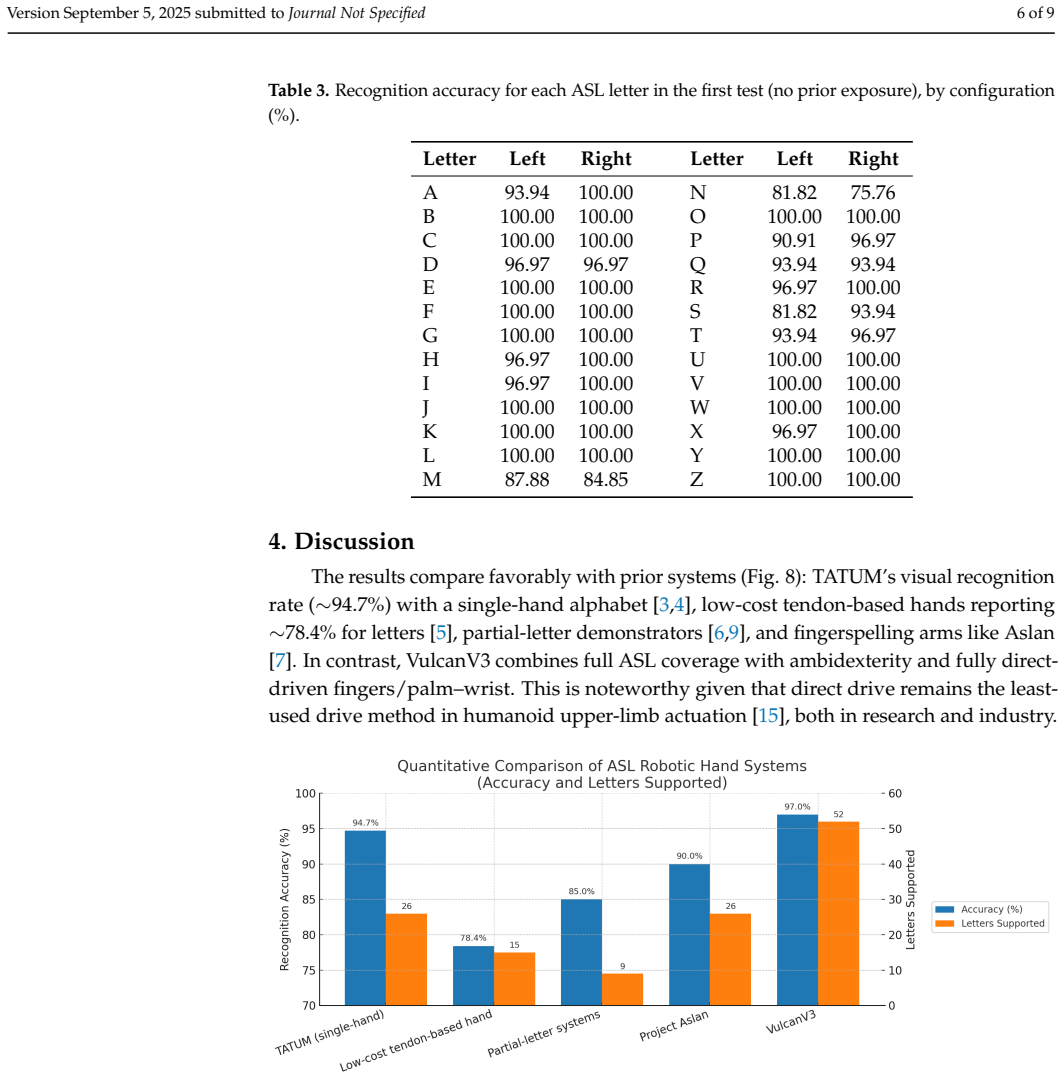
- [Figure 8] The comparison chart lacks error bars or any measure of uncertainty for the reported accuracies of prior systems and VulcanV3. A simple bar chart without variability may mislead readers about the significance of differences.
- [Data Availability] The data and code are linked to a Hackaday project page, not a persistent archival repository with a DOI. To support reproducibility, please deposit the CAD files, servo mappings, Arduino code, and the raw per-participant recognition data in a versioned archive such as Zenodo or Figshare.
- [References and text] Several reference entries are incomplete or informal (e.g., [7], [13], [17] lack full bibliographic details). The Acknowledgments contain a grammatical error: 'The author have reviewed' should be 'The author has reviewed.' The phrase 'Journal Not Specified' in the header and repeated template text should be cleaned up before submission.
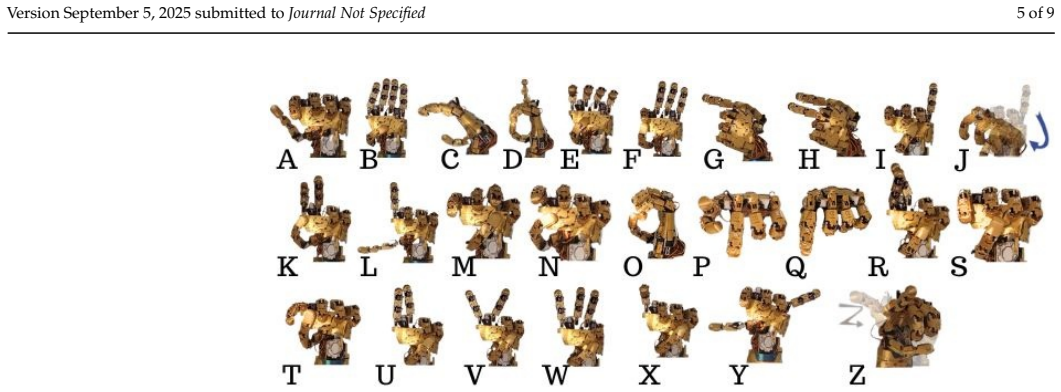
- [Figure 4] The caption says 'ASL alphabet Handshapes for both hand configurations,' but it is unclear whether the figure shows both left- and right-hand versions. Please clarify or split into subfigures.
Circularity Check
No significant circularity: the ASL servo mappings come from external diagrams and the central claim is validated by an independent participant recognition study, not by fitting or self-derived definitions.
full rationale
The paper's derivation chain is not circular. The servo-to-letter mappings in Section 2.5 are taken from an external ASL source (Handspeak, ref. [17]), not derived from the recognition outcomes or from the hand's own design constraints. The central validation is the user study in Section 3.2, where 33 participants, including ASL teachers and long-term signers, independently recognized the handshapes; this is external evidence that does not reduce to the inputs. The author's visual inspection in Section 3.1 is an implementation check against the same diagrams used to define the angles, but that does not make the user-study result circular: physical servo motion is not guaranteed by the commanded angles, and the recognition data are separate. The only self-citation (the author's Vulcan V2 video, ref. [13]) appears in a comparison table and is not load-bearing for any claimed derivation. The Discussion's stated limitations (servo wear, fingerspelling-only scope, confusions on visually similar letters) are correctness/robustness concerns, not evidence of circularity. The appendix statement about AI assistance is also not relevant to circularity. Therefore the paper's central claim has independent empirical content and the circularity score is 0.
Assumptions & free parameters
free parameters (1)
- Servo angle mapping for each of the 52 ASL signs =
Not given in text; embedded in Arduino code
assumptions (3)
- domain assumption The ASL handshape definitions from Handspeak [17] are standard and complete.
- domain assumption Direct-drive servos deliver commanded angles accurately enough, and the 3D-printed joints do not flex or slip significantly.
- domain assumption Human recognition rates reflect the hand's fidelity rather than participant guessing, contextual cues, or the hand's overall anthropomorphic appearance.
Cite this review
Pith. "Pith review of Low-Cost Open-Source Ambidextrous Robotic Hand with 23 Direct-Drive servos for American Sign Language Alphabet." pith.science (2026). https://pith.science/paper/SSFGVUZM
@misc{pith2026250903690,
  author       = {Pith},
  title        = {Pith review of: Low-Cost Open-Source Ambidextrous Robotic Hand with 23 Direct-Drive servos for American Sign Language Alphabet},
  year         = {2026},
  howpublished = {\url{https://pith.science/paper/SSFGVUZM}},
  note         = {Machine review of arXiv:2509.03690}
}
read the original abstract
Accessible communication through sign language is vital for deaf communities, 1 yet robotic solutions are often costly and limited. This study presents VulcanV3, a low- 2 cost, open-source, 3D-printed ambidextrous robotic hand capable of reproducing the full 3 American Sign Language (ASL) alphabet (52 signs for right- and left-hand configurations). 4 The system employs 23 direct-drive servo actuators for precise finger and wrist movements, 5 controlled by an Arduino Mega with dual PCA9685 modules. Unlike most humanoid upper- 6 limb systems, which rarely employ direct-drive actuation, VulcanV3 achieves complete ASL 7 coverage with a reversible design. All CAD files and code are released under permissive 8 open-source licenses to enable replication. Empirical tests confirmed accurate reproduction 9 of all 52 ASL handshapes, while a participant study (n = 33) achieved 96.97% recognition 10 accuracy, improving to 98.78% after video demonstration. VulcanV3 advances assistive 11 robotics by combining affordability, full ASL coverage, and ambidexterity in an openly 12 shared platform, contributing to accessible communication technologies and inclusive 13 innovation.
Figures


Figures from the paper (5 more)



Reference graph
Works this paper leans on
-
[1]
Towards Accessible Communication for the Deaf: Sign Language Recognition and Synthesis
Kushalnagar, R., Cavender, A.C., and Ladner, R.E. Towards Accessible Communication for the Deaf: Sign Language Recognition and Synthesis. 2017. In Proceedings of the 19th International ACM SIGACCESS Conference on Computers and Accessibility, pp. 350–351, ACM
work page 2017
-
[2]
Ten things you should know about sign languages.Curr
Emmorey, K. Ten things you should know about sign languages.Curr. Dir. Psychol. Sci. 2023, 32, 387–394
work page 2023
-
[3]
Johnson, S.; Gao, G.; Johnson, T.; Liarokapis, M.; Bellini, C. An Adaptive, Affordable, Open- Source Robotic Hand for Deaf and Deaf-Blind Communication Using Tactile ASL. In Proc. IEEE EMBC, 2021, pp. 4732–4737
work page 2021
-
[4]
Robotic Arm Signing Tactile Sign Language (t-SL) to Aid Deaf-Blind Communication
Johnson, S.T. Robotic Arm Signing Tactile Sign Language (t-SL) to Aid Deaf-Blind Communication. Master’s Thesis, Northeastern University, 2021
work page 2021
-
[5]
Adeyanju, I.A.; Alabi, S.O.; Esan, A.O.; Omodunbi, B.A.; Bello, O.O.; Fanijo, S. Design and prototyping of a robotic hand for sign language using locally-sourced materials.Scientific African 2023, 19, e01533
work page 2023
-
[6]
Artificial Intelligence Robotic Arm for Teaching American Sign Language
Piascik, J.; Kaya, T. Artificial Intelligence Robotic Arm for Teaching American Sign Language. DigitalCommons@SHU 2025
work page 2025
-
[7]
Project Aslan: 3D-printed robotic arm translating text into sign language. DesignBoom 2017
work page 2017
-
[8]
Sequence-to-Sequence Natural Language to Humanoid Robot Sign Language
Gago, J.J.; Vasco, V .; Łukawski, B.; Pattacini, U.; Tikhanoff, V .; Victores, J.G.; Balaguer, C. Sequence-to-Sequence Natural Language to Humanoid Robot Sign Language. arXiv preprint 2019, arXiv:1907.04198
arXiv 2019
Show all 17 references
-
[9]
SignBot, Sign-Language Performing Robot, Based on Sequential Motion of Servo Motor Arrays
Al-Khulaidi, R.A.; Abu Bakr, N.H.B.; Fauzi, N.M.; Akmeliawati, R. SignBot, Sign-Language Performing Robot, Based on Sequential Motion of Servo Motor Arrays. In: Kim J.-H. et al. (eds) Robot Intelligence Technology and Applications 5. AISC, vol 751. Springer, 2019
2019
-
[10]
RoboTalk: Prototyping a Humanoid Robot as a Speech-to-Sign Language Translator
Homburg, D.C.; Thieme, M.S.; Völker, J.; Stock, R.M. RoboTalk: Prototyping a Humanoid Robot as a Speech-to-Sign Language Translator. In Proc. 52nd HICSS, 2019
2019
-
[11]
Representing American Sign Language Letters and Numbers with Humanoid Robot Arm
Gül, M. Representing American Sign Language Letters and Numbers with Humanoid Robot Arm. Kocaeli Journal of Science and Engineering 2021, 4(2), 136–145. doi:10.34088/kojose.882323
2021 doi
-
[12]
DG-5F: High-performance humanoid robotic hand (product brief)
Tesollo Inc. DG-5F: High-performance humanoid robotic hand (product brief). 2025. Available online: https://tesollo.com/products/dg-5f (accessed 2025-09-01)
2025
-
[13]
Humanoid Robotic Arm Capable of Sign Language (Vulcan V2 Demo)
Gonzalez, K. Humanoid Robotic Arm Capable of Sign Language (Vulcan V2 Demo). YouTube, 2025. Available online: https://youtu.be/FE9hrGcHdUk (accessed 2025-09-01)
2025
-
[14]
Design and Development of Low Cost 3D Printed Ambidextrous Robotic Hand Driven by Pneumatic Muscles
Akyürek, E.; Kalganova, T.; Mukhtar, M.; Paramonov, L.; Steele, L.; Simko, M.; Kavanagh, L.; Nimmo, A.; Huynh, A.; Stelarc. Design and Development of Low Cost 3D Printed Ambidextrous Robotic Hand Driven by Pneumatic Muscles. Int. J. Eng. Tech. Res. 2014, 2(10), 179–187
2014
-
[15]
Survey on Main Drive Methods Used in Humanoid Robotic Upper Limbs
Wang, Y.; Li, W.; Togo, S.; Yokoi, H.; Jiang, Y. Survey on Main Drive Methods Used in Humanoid Robotic Upper Limbs . Cyborg and Bionic Systems, 2021, 2, 9817487. https://doi.org/10.34133/2021/9817487
2021 doi
-
[16]
Composite Control of Direct-Drive Robots
Taylor, D.G. Composite Control of Direct-Drive Robots . 1989. In Proceedings of the 28th IEEE Conference on Decision and Control, pp. 1670–1675, IEEE
1989
-
[17]
American Sign Language Alphabet
Handspeak. American Sign Language Alphabet. 2025. Handspeak. Accessed: 2025-09-01
2025
Reviewed August 5, 2026 · model on record in the stance chip above.
Discussion (0). Continue with ORCID to comment.