REVIEW 5 major objections 5 minor 41 references
What Fundamental Structure in Reward Functions Enables Efficient Sparse-Reward Learning?
T0 review · 5 major / 5 minor · reviewed 2026-08-05 · deepseek-v4-flash
Pith's one-line read This paper claims sparse-reward RL becomes tractable when reward functions have approximate low-rank plus sparse structure, and that a policy-aware matrix-completion estimator with confidence-gated abstention is how to exploit it.
desk verdict The paper's conceptual framing is new and worth a conversation, but the current manuscript's theoretical and empirical claims are not verifiable as written. read the letter →
The pith
A machine-rendered reading of the paper's core claim, the machinery that carries it, and where it could break.
The reading
What carries the argument
The central object is the reward matrix R ∈ R^{|S|×|A|}, decomposed as R = L* + S* + E. The mechanism is policy-aware weighted matrix completion: inverse-propensity weights W_{sa} = 1/max(p_{sa}, ε_p) correct for missing-not-at-random sampling; a weighted nuclear norm plus weighted ℓ1 objective jointly recovers the low-rank component and the sparse component; and a calibrated confidence map C(s,a) gates which completed rewards the policy is allowed to trust, triggering abstention and an exploration bonus when intervals are wide.
What would settle it
Run PAMC on a small tabular MDP whose reward matrix is exactly low-rank, but use a behavior policy that assigns zero probability to one state-action pair in the optimal policy's support (so κ = 0). The theorem predicts the inverse-propensity weights diverge and recovery error is uncontrolled; measuring whether the estimated rewards stay accurate or the confidence gate abstains would directly test the positivity assumption.
Extended reading notes
Core claim
The paper establishes that the sparse-reward problem is not uniformly hard: under a general reward model, any learner needs Ω(|S||A|/p) samples, but if the true reward matrix can be written as a low-rank component plus a sparse component plus noise, recovery becomes polynomial. Concretely, Theorem 2 claims that a weighted robust principal-component pursuit estimator recovers the low-rank reward with error scaling as σ sqrt(r(|S|+|A|)/m_eff) plus a sparse-noise term, where m_eff is an inverse-propensity-weighted effective sample size. Theorem 3 then converts completion error into a policy regret bound under a visitation-weighted norm. The paper further claims that when assumptions weaken—high
Load-bearing premise
The guarantees require that the behavior policy has positive probability of visiting every state-action pair that the optimal policy would use; if exploration is deterministic or near-deterministic, the inverse-propensity weights become unstable and the recovery bounds collapse.
Editorial extensions
If this is right
- If rewards are approximately low-rank plus sparse, reward recovery needs only polynomial samples in the effective sample size m_eff rather than Ω(|S||A|/p).
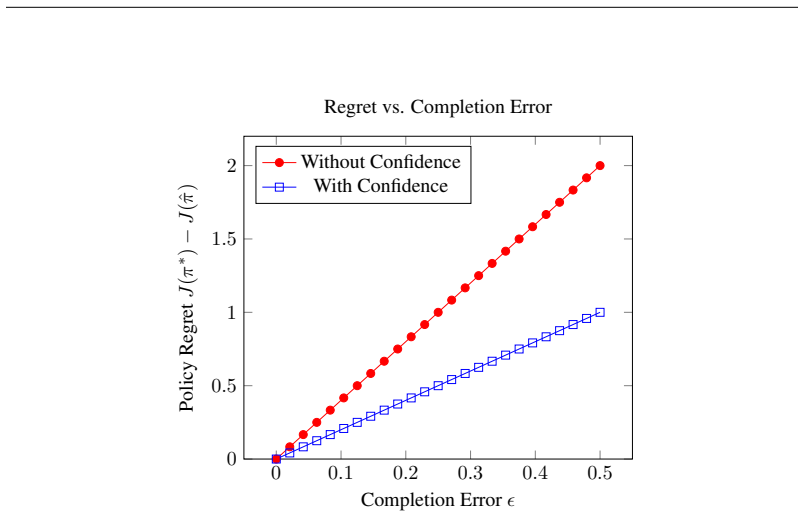
- Policy regret is bounded by a visitation-weighted completion error, so improving completion under the optimal policy's reachable state-action distribution directly improves control performance.
- When assumptions are violated, PAMC widens confidence intervals and abstains, degrading gracefully to exploration instead of catastrophically imposing wrong rewards.
- The framework extends beyond rewards: low-rank successor features can be completed in the same way, and non-stationary rewards with bounded drift are handled by the same adaptive abstention mechanism.
- On Atari-26, DM Control, MetaWorld, D4RL, and preference-based benchmarks, adding PAMC to strong baselines improves sample efficiency under compute-normalized comparisons.
Reading between the lines
- If the central claim is right, environment designers could deliberately shape rewards to keep the reward matrix low-rank, making sparse feedback dramatically easier to learn from.
- The confidence-gated abstention principle is not specific to matrix completion; attaching it to other learned predictors in the RL loop—dynamics models, value estimators, preference models—would be a natural test of the paper's general safety mechanism.
- The theory suggests a practical pre-deployment check: estimate the singular-value spectrum of the reward matrix from a small uniform sample; if the effective rank is high, PAMC's guarantees do not apply and exploration baselines should remain in charge.
- Because inverse-propensity weights become unstable when propensities are tiny, swapping them for a doubly robust estimator (which the paper mentions only in passing) could relax the positivity assumption and deserves a direct empirical comparison.
Editorial analysis
A structured set of objections, weighed in public.
Referee Report
Summary. The manuscript proposes Policy-Aware Matrix Completion (PAMC) for sparse-reward RL. The reward matrix is modeled as L*+S*+E (low-rank + sparse + noise), and a weighted robust principal component analysis estimator is used with inverse-propensity weights to correct for MNAR sampling. The paper claims an impossibility lower bound for general rewards (Theorem 1), a recovery guarantee (Theorem 2), a visitation-weighted error-to-regret bound (Theorem 3), a sample-complexity bound (Theorem 4), and an IPW consistency lemma (Lemma 1). It also reports empirical gains on Atari-26, DM Control, MetaWorld MT50, D4RL, and preference-based RL, with confidence-based abstention. The main theoretical results are stated with proofs deferred to an appendix that is not present; the algorithm's propensity estimates are not covered by the oracle recovery theorem; and the empirical tables do not support the abstract's breadth.
Significance. If the recovery and regret guarantees held as stated, the paper would provide a useful bridge between matrix completion theory and sparse-reward RL, and the idea of confidence-gated abstention is a sensible safety mechanism. The paper also includes a candid Limitations section and stress-test diagnostics. However, the results are not verifiable as submitted: core proofs are missing, the main theorem assumes known sampling propensities while the algorithm estimates them, Theorem 1's proof sketch appears inconsistent, and the empirical support is narrower than claimed. The contribution is therefore not yet established.
major comments (5)
- [§3.2, Theorems 2 and 4] The main recovery and sample-complexity bounds are stated without proof. Appendix A contains only implementation details and Algorithm 1, not the promised derivations. The statement of Theorem 2 also has unclear dependencies: m_eff is defined as a sum of inverse propensities, so the displayed error appears to shrink as sampling probabilities become small, which is opposite to the usual missing-data intuition; a precise derivation is needed. Without the missing proofs, the central polynomial-sample-complexity claim cannot be evaluated.
- [§3.2, Theorem 1] The proof sketch does not support the stated lower bound Ω(|S||A|/(pε²)). The coupon-collector argument gives a 1/p dependence for identifying the nonzero reward pair, with no ε² mechanism. Moreover, the reward family R^{(i,j)} sets the nonzero reward to ε/(1−γ), while the theorem refers to functions differing by ε in expected return; under discounting these differ by a factor that is not specified. The impossibility result, which motivates the structural assumption, is therefore not established.
- [§3.2 and Algorithm 1 (lines 6–8)] Theorem 2 assumes policy-aware sampling probabilities p_sa are known constants in [p,_p_], truncated below by ε_p. In the actual PAMC loop, Algorithm 1 line 7 estimates propensities from a replay buffer filled by an evolving behavior policy. No error bound relates these estimated IPW weights to the oracle weights, and IPW is known to be sensitive to propensity misspecification. Consequently, the recovery guarantee does not apply to the implemented algorithm, and the regret bound in Theorem 3 inherits this gap.
- [§3.4, Theorem 3] As stated, the bound J(π*)−J(π_PAMC) ≤ C∥R̂−R∥_W + Õ(√log(1/δ)/n) is an error-transport inequality: if the completion error under the optimal policy's visitation is small, the policy is good. The weighted norm ∥·∥_W is not defined, n is not specified, and no account is taken of the gating/abstention mechanism or of optimization/exploration error in the policy update. This does not constitute the 'novel sample complexity' result claimed in the introduction.
- [§4.2, Table 2 and abstract] The abstract claims improvements over DrQ-v2, DreamerV3, Agent57, T-REX/D-REX, and PrefPPO across five benchmark families, but Table 2 reports only DrQ-v2, DreamerV3, and PrefPPO. Agent57 and T-REX/D-REX are not tabulated, and no results are shown for MetaWorld MT50 or D4RL despite textual claims. The single Atari 'HNS' aggregate lacks per-game breakdowns or significance tests. The empirical evidence is not sufficient for the breadth asserted.
minor comments (5)
- [§3.2] The weighted objective writes ∥L∥,W with an odd comma; this should be ∥L∥_*,W or another explicitly defined weighted norm.
- [Figure 6] The left panel's x-axis label reads 'Overlap Inverse (1/)' but the text says the quantity is 1/√κ. Please make the label explicit and consistent.
- [Table 1] Several formatting issues: baseline rows use '—' for SVD time/overhead, and the 'A100 Hours' column is concatenated in places (e.g., '≈18PAMC'). Clarify the units and align the entries.
- [§4.1] The protocol says 'all methods are granted the same number of environment interactions,' but Table 2 reports 'compute-normalized' comparisons. Please clarify whether the comparison controls environment steps, optimizer steps, wall-clock time, or all of these.
- [Reproducibility] The paper says code will be released; if it is available, provide a link or anonymized artifact in the manuscript. Also the statement 'all experiments were run with 5 random seeds' is not reflected in the reported confidence intervals for all tables.
Circularity Check
No significant circularity: Theorem 2 is an oracle matrix-completion bound and Theorem 3 is a standard performance-difference inequality; neither reduces to its inputs. The main vulnerability is an unverified link between estimated and oracle propensities, which is a correctness gap, not a circular derivation.
full rationale
The paper's central derivation chain is not circular. Theorem 2 assumes known policy-aware sampling probabilities p_sa in [p,p], truncated by epsilon_p, and states a weighted robust PCP error bound in terms of effective sample size m_eff, incoherence, and noise; this is a standard matrix-completion-style guarantee and no parameter is fitted to the reward matrix being predicted. Theorem 3 converts completion error into regret via a visitation-weighted norm; it is an inequality of performance-difference type, not a definitional restatement: the norm ||Rhat-R||_W is a sufficient statistic for the value gap, and the bound requires a proof through Bellman/performance-difference arguments. Lemma 1's positivity assumption (kappa>0) is an explicit condition, acknowledged in the Limitations section ('If the behavior policy is deterministic, weights can be unstable'), and the paper does not hide it. The remaining weakness is that Algorithm 1 line 7 estimates propensities from a replay buffer filled by a non-stationary policy, while Theorem 2's guarantee is for known p_sa; no bound accounts for propensity-estimation error. This is a gap between theory and implementation and a correctness risk, but it is not circular: the theorem is not defined in terms of the algorithm's output, nor is a fitted parameter renamed as a prediction. There are no load-bearing self-citations, no imported uniqueness theorem, and no ansatz smuggled in via citation. Empirical plots (e.g., error scaling with 1/sqrt(kappa)) check the predicted functional form rather than constructing the prediction from the fit. Therefore the paper's theoretical claims are independent of their conclusions, and the circularity score is 0.
Assumptions & free parameters
free parameters (6)
- rank hint r =
not reported (illustrated range 1-120 in Fig. 7)
- weight clipping epsilon_p =
not reported
- confidence threshold tau =
not reported
- regularization weights lambda_L, lambda_S =
not reported
- embedding dimension d =
32 (saturation point, Fig. 3a)
- completion frequency K =
5,000-10,000 steps
assumptions (5)
- domain assumption Reward matrix R is |S|x|A| and admits the decomposition R = L* + S* + E with rank(L*) <= r, S* sparse, E sub-Gaussian.
- domain assumption Standard incoherence assumptions on L*.
- domain assumption Positivity/overlap: p_sa > 0 for all (s,a) in supp(pi*).
- domain assumption Propensity scores p_sa can be estimated from the behavior policy.
- domain assumption The policy pi used for the regret bound visits states approximately according to the stationary distribution of pi*.
Cite this review
Pith. "Pith review of What Fundamental Structure in Reward Functions Enables Efficient Sparse-Reward Learning?." pith.science (2026). https://pith.science/paper/G56WN5Q6
@misc{pith2026250903790,
  author       = {Pith},
  title        = {Pith review of: What Fundamental Structure in Reward Functions Enables Efficient Sparse-Reward Learning?},
  year         = {2026},
  howpublished = {\url{https://pith.science/paper/G56WN5Q6}},
  note         = {Machine review of arXiv:2509.03790}
}
abstract
Sparse-reward reinforcement learning (RL) remains fundamentally hard: without structure, any agent needs $\Omega(|\mathcal{S}||\mathcal{A}|/p)$ samples to recover rewards. We introduce Policy-Aware Matrix Completion (PAMC) as a first concrete step toward a structural reward learning framework. Our key idea is to exploit approximate low-rank + sparse structure in the reward matrix, under policy-biased (MNAR) sampling. We prove recovery guarantees with inverse-propensity weighting, and establish a visitation-weighted error-to-regret bound linking completion error to control performance. Importantly, when assumptions weaken, PAMC degrades gracefully: confidence intervals widen and the algorithm abstains, ensuring safe fallback to exploration. Empirically, PAMC improves sample efficiency across Atari-26 (10M steps), DM Control, MetaWorld MT50, D4RL offline RL, and preference-based RL benchmarks, outperforming DrQ-v2, DreamerV3, Agent57, T-REX/D-REX, and PrefPPO under compute-normalized comparisons. Our results highlight PAMC as a practical and principled tool when structural rewards exist, and as a concrete first instantiation of a broader structural reward learning perspective.
Figures


Figures from the paper (4 more)


Reference graph
Works this paper leans on
-
[1]
An optimistic perspective on offline reinforcement learning
Rishabh Agarwal, Dale Schuurmans, and Mohammad Norouzi. An optimistic perspective on offline reinforcement learning. In International Conference on Machine Learning, pp.\ 104--114. PMLR, 2020
work page 2020
-
[2]
Concrete problems in ai safety
Dario Amodei, Chris Olah, Jacob Steinhardt, Paul Christiano, John Schulman, and Dan Man \'e . Concrete problems in ai safety. 2016
work page 2016
-
[3]
Minimax regret bounds for reinforcement learning
Mohammad Gheshlaghi Azar, Ian Osband, and R \'e mi Munos. Minimax regret bounds for reinforcement learning. In International Conference on Machine Learning, pp.\ 263--272. PMLR, 2017
work page 2017
-
[4]
Never give up: Learning directed exploration strategies
Adri \`a Puigdom \`e nech Badia, Bilal Piot, Steven Kapturowski, Pablo Sprechmann, Alex Vitvitskyi, Daniel Guo, and Charles Blundell. Never give up: Learning directed exploration strategies. In International Conference on Learning Representations, 2020
work page 2020
-
[5]
Successor features for transfer learning in reinforcement learning
Andr \'e Barreto, Will Dabney, R \'e mi Munos, Jonathan J Hunt, Tom Schaul, Hado P van Hasselt, and David Silver. Successor features for transfer learning in reinforcement learning. In Advances in neural information processing systems, pp.\ 4055--4065, 2017
work page 2017
-
[6]
Recent advances in hierarchical reinforcement learning
Andrew G Barto and Sridhar Mahadevan. Recent advances in hierarchical reinforcement learning. Discrete event dynamic systems, 13 0 (1-2): 0 41--77, 2003
work page 2003
-
[7]
Unifying count-based exploration and hashing: A case study of model-based rl
Marc Bellemare, Sriram Srinivasan, Georg Ostrovski, Tom Schaul, David Saxton, and Remi Munos. Unifying count-based exploration and hashing: A case study of model-based rl. In Advances in neural information processing systems, pp.\ 2035--2043, 2016
-
[8]
Exploration by random network distillation
Yuri Burda, Harrison Edwards, Amos Storkey, and Oleg Klimov. Exploration by random network distillation. In International Conference on Learning Representations, 2018
work page 2018
Show all 41 references
-
[9]
Exact matrix completion via convex optimization
Emmanuel J Cand \`e s and Benjamin Recht. Exact matrix completion via convex optimization. Foundations of Computational mathematics, 9 0 (6): 0 717--772, 2009
2009
-
[10]
Deep reinforcement learning from human preferences
Paul F Christiano, Jan Leike, Tom Brown, Miljan Martic, Shane Legg, and Dario Amodei. Deep reinforcement learning from human preferences. In Advances in neural information processing systems, pp.\ 4299--4307, 2017
2017
-
[11]
Unifying pac and regret: Uniform pac bounds for episodic reinforcement learning
Christoph Dann, Tor Lattimore, and Emma Brunskill. Unifying pac and regret: Uniform pac bounds for episodic reinforcement learning. In Advances in Neural Information Processing Systems, pp.\ 5713--5723, 2017
2017
-
[12]
First return, then explore
Adrien Ecoffet, Joost Huizinga, Joel Lehman, Kenneth O Stanley, and Jeff Clune. First return, then explore. volume 590, pp.\ 580--586. Nature Publishing Group, 2021
2021
-
[13]
Model-agnostic meta-learning for fast adaptation of deep networks
Chelsea Finn, Pieter Abbeel, and Sergey Levine. Model-agnostic meta-learning for fast adaptation of deep networks. In International conference on machine learning, pp.\ 1126--1135. PMLR, 2017
2017
-
[14]
Noisy networks for exploration
Meire Fortunato, Mohammad Gheshlaghi Azar, Bilal Piot, Jacob Menick, Ian Osband, Alex Graves, Vlad Mnih, Remi Munos, Demis Hassabis, Olivier Pietquin, et al. Noisy networks for exploration. In International Conference on Learning Representations, 2018
2018
-
[15]
Dropout as a bayesian approximation: Representing model uncertainty in deep learning
Yarin Gal and Zoubin Ghahramani. Dropout as a bayesian approximation: Representing model uncertainty in deep learning. In International conference on machine learning, pp.\ 1050--1059. PMLR, 2016
2016
-
[16]
Selective classification for deep neural networks
Yonatan Geifman and Ran El-Yaniv. Selective classification for deep neural networks. In Advances in neural information processing systems, pp.\ 4878--4887, 2017
2017
-
[17]
On calibration of modern neural networks
Chuan Guo, Geoff Pleiss, Yu Sun, and Kilian Q Weinberger. On calibration of modern neural networks. In International conference on machine learning, pp.\ 1321--1330. PMLR, 2017
2017
-
[18]
Is q-learning provably efficient? In Advances in neural information processing systems, pp.\ 4863--4873, 2018
Chi Jin, Zeyuan Allen-Zhu, Sebastien Bubeck, and Michael I Jordan. Is q-learning provably efficient? In Advances in neural information processing systems, pp.\ 4863--4873, 2018
2018
-
[19]
Matrix factorization techniques for recommender systems
Yehuda Koren, Robert Bell, and Chris Volinsky. Matrix factorization techniques for recommender systems. In Computer, volume 42, pp.\ 30--37. IEEE, 2009
2009
-
[20]
Conservative q-learning for offline reinforcement learning
Aviral Kumar, Aurick Zhou, George Tucker, and Sergey Levine. Conservative q-learning for offline reinforcement learning. In Advances in Neural Information Processing Systems, pp.\ 1179--1191, 2020
2020
-
[21]
Simple and scalable predictive uncertainty estimation using deep ensembles
Balaji Lakshminarayanan, Alexander Pritzel, and Charles Blundell. Simple and scalable predictive uncertainty estimation using deep ensembles. In Advances in neural information processing systems, pp.\ 6402--6413, 2017
2017
-
[22]
Curl: Contrastive unsupervised representations for reinforcement learning
Michael Laskin, Aravind Srinivas, and Pieter Abbeel. Curl: Contrastive unsupervised representations for reinforcement learning. In International Conference on Machine Learning, pp.\ 5639--5650. PMLR, 2020
2020
-
[23]
Scalable agent alignment via reward modeling: A research direction
Jan Leike, David Krueger, Tom Everitt, Miljan Martic, Vishal Maini, and Shane Legg. Scalable agent alignment via reward modeling: A research direction. arXiv preprint arXiv:1811.07871, 2018
2018 arXiv
-
[24]
Neural matrix completion
Yao Ma, Tong He, Xiaorui Wang, Chao Zhou, and Jure Leskovec. Neural matrix completion. In International Conference on Machine Learning, pp.\ 4321--4331. PMLR, 2019
2019
-
[25]
Geometric deep learning on graphs and manifolds using mixture model cnns
Federico Monti, Davide Boscaini, Jonathan Masci, Emanuele Rodola, Jan Svoboda, and Michael M Bronstein. Geometric deep learning on graphs and manifolds using mixture model cnns. In Proceedings of the IEEE conference on computer vision and pattern recognition, pp.\ 5115--5124, 2017
2017
-
[26]
Deep exploration via bootstrapped dqn
Ian Osband, Charles Blundell, Alexander Pritzel, and Benjamin Van Roy. Deep exploration via bootstrapped dqn. In Advances in neural information processing systems, pp.\ 4026--4034, 2016
2016
-
[27]
Can you trust your model's uncertainty? evaluating predictive uncertainty under dataset shift
Yaniv Ovadia, Emily Fertig, Jie Ren, Zachary Nado, D Sculley, Sebastian Nowozin, Joshua Dillon, Balaji Lakshminarayanan, and Jasper Snoek. Can you trust your model's uncertainty? evaluating predictive uncertainty under dataset shift. In Advances in neural information processin...
2019
-
[28]
Curiosity-driven exploration by self-supervised prediction
Deepak Pathak, Pulkit Agrawal, Alexei A Efros, and Trevor Darrell. Curiosity-driven exploration by self-supervised prediction. In International conference on machine learning, pp.\ 2778--2787. PMLR, 2017
2017
-
[29]
Parameter space noise for exploration
Matthias Plappert, Rein Houthooft, Prafulla Dhariwal, Szymon Sidor, Richard Y Chen, Xi Chen, Tamim Asfour, Pieter Abbeel, and Marcin Andrychowicz. Parameter space noise for exploration. In International Conference on Learning Representations, 2018
2018
-
[30]
Masked autoencoder for distribution estimation
Sai Rajeswar, Brian Manela, Florian Step, Nan Rosemary Ke, Anirudh Goyal, Yoshua Bengio, Aaron Courville, and Simon Lacoste-Julien. Masked autoencoder for distribution estimation. In Advances in Neural Information Processing Systems, pp.\ 18114--18128, 2022
2022
-
[31]
Guaranteed minimum-rank solutions of linear matrix equations via nuclear norm minimization
Benjamin Recht, Maryam Fazel, and Pablo A Parrilo. Guaranteed minimum-rank solutions of linear matrix equations via nuclear norm minimization. SIAM review, 52 0 (3): 0 471--501, 2010
2010
-
[32]
Proximal policy optimization algorithms
John Schulman, Filip Wolski, Prafulla Dhariwal, Alec Radford, and Oleg Klimov. Proximal policy optimization algorithms. 2017
2017
-
[33]
Data-efficient reinforcement learning with self-predictive representations
Max Schwarzer, Ankesh Anand, Rishab Goel, R Devon Hjelm, Aaron Courville, and Philip Bachman. Data-efficient reinforcement learning with self-predictive representations. In International Conference on Learning Representations, 2021
2021
-
[34]
Reinforcement learning: An introduction
Richard S Sutton and Andrew G Barto. Reinforcement learning: An introduction. 2018
2018
-
[35]
Exploration: A study of count-based exploration for deep reinforcement learning
Haoran Tang, Rein Houthooft, Davis Foote, Adam Stooke, Xi Chen, Yan Duan, John Schulman, Filip DeTurck, and Pieter Abbeel. Exploration: A study of count-based exploration for deep reinforcement learning. In Advances in neural information processing systems, pp.\ 2753--2762, 2017
2017
-
[36]
Transfer learning for reinforcement learning domains: A survey
Matthew E Taylor and Peter Stone. Transfer learning for reinforcement learning domains: A survey. Journal of Machine Learning Research, 10 0 (7), 2009
2009
-
[37]
Meta-world: A benchmark and evaluation for multi-task and meta reinforcement learning
Tianhe Yu, Deirdre Quillen, Zhanpeng He, Ryan Julian, Karol Hausman, Chelsea Finn, and Sergey Levine. Meta-world: A benchmark and evaluation for multi-task and meta reinforcement learning. In Conference on robot learning, pp.\ 1094--1100. PMLR, 2020
2020
-
[38]
write newline
" write newline "" before.all 'output.state := FUNCTION n.dashify 't := "" t empty not t #1 #1 substring "-" = t #1 #2 substring "--" = not "--" * t #2 global.max substring 't := t #1 #1 substring "-" = "-" * t #2 global.max substring 't := while if t #1 #1 substring * t #2 gl...
-
[39]
@esa (Ref
\@ifxundefined[1] #1\@undefined \@firstoftwo \@secondoftwo \@ifnum[1] #1 \@firstoftwo \@secondoftwo \@ifx[1] #1 \@firstoftwo \@secondoftwo [2] @ #1 \@temptokena #2 #1 @ \@temptokena \@ifclassloaded agu2001 natbib The agu2001 class already includes natbib coding, so you should ...
-
[40]
\@lbibitem[] @bibitem@first@sw\@secondoftwo \@lbibitem[#1]#2 \@extra@b@citeb \@ifundefined br@#2\@extra@b@citeb \@namedef br@#2 \@nameuse br@#2\@extra@b@citeb \@ifundefined b@#2\@extra@b@citeb @num @parse #2 @tmp #1 NAT@b@open@#2 NAT@b@shut@#2 \@ifnum @merge>\@ne @bibitem@firs...
-
[41]
@open @close @open @close and [1] URL: #1 \@ifundefined chapter * \@mkboth \@ifxundefined @sectionbib * \@mkboth * \@mkboth\@gobbletwo \@ifclassloaded amsart * \@ifclassloaded amsbook * \@ifxundefined @heading @heading NAT@ctr thebibliography [1] @ \@biblabel @NAT@ctr \@bibset...
Reviewed August 5, 2026 · model on record in the stance chip above.
Discussion (0). Continue with ORCID to comment.