REVIEW 4 major objections 5 minor 3 cited by
LATTE, a two-tier FPGA-CPU decoding architecture for surface-code quantum error correction, reports over 90 percent syndrome-bandwidth reduction and constant-latency streaming decoding in arbitrarily long memory experiments.
Reviewed by Pith at T0; open to challenge. T0 means a machine referee read the full paper against a public rubric. the ladder, T0–T4 →
A hybrid FPGA-CPU streaming decoder cuts syndrome transmission by over 90% and keeps feedback latency roughly constant in long surface-code memory runs.
T0 review reviewed 2026-08-05 challenge →
load-bearing objection Solid architecture, but headline claims overreach: the 2-thread claim contradicts the paper's own Table V, and the cross-distance NLDU transfer lacks per-distance evidence. the 4 major comments →
LATTE: A Decoding Architecture for Quantum Computing with Temporal and Spatial Scalability
The pith
A machine-rendered reading of the paper's core claim, the machinery that carries it, and where it could break.
The reading
Core claim
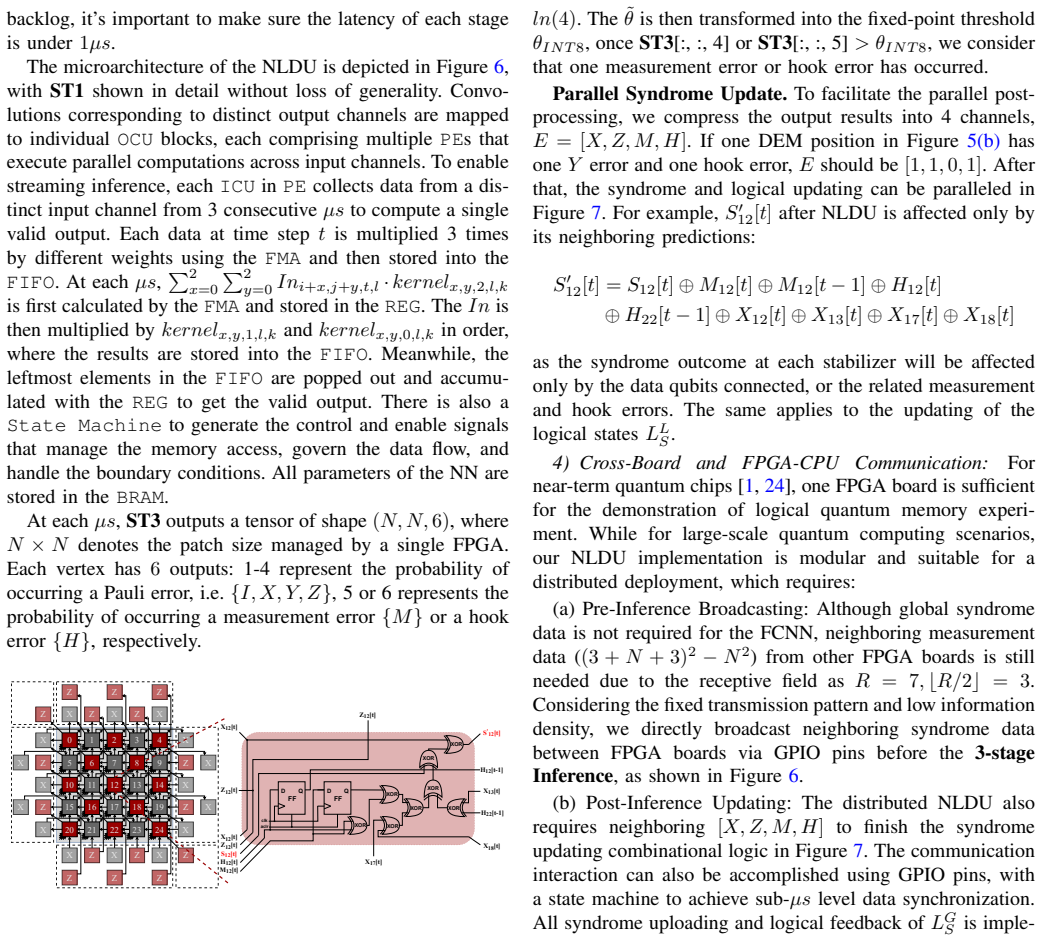
The central claim is that decoding can be made scalable by splitting the decoding graph into two hierarchical stages instead of decoding the full space-time graph globally. At the FPGA tier, syndrome detectors are embedded as a tensor and a roughly 3000-parameter fully convolutional network with a (7,7,7) receptive field predicts six error classes (I, X, Y, Z, M, H) at every detector-error-model position; because errors are local and sparse, this removes more than 90 percent of the syndrome at p=0.001. At the CPU tier, the global decoding graph is partitioned into d x d x d blocks with buffer regions, decoded asynchronously in decode and merge thread pools coordinated by semaphores, with mer
What carries the argument
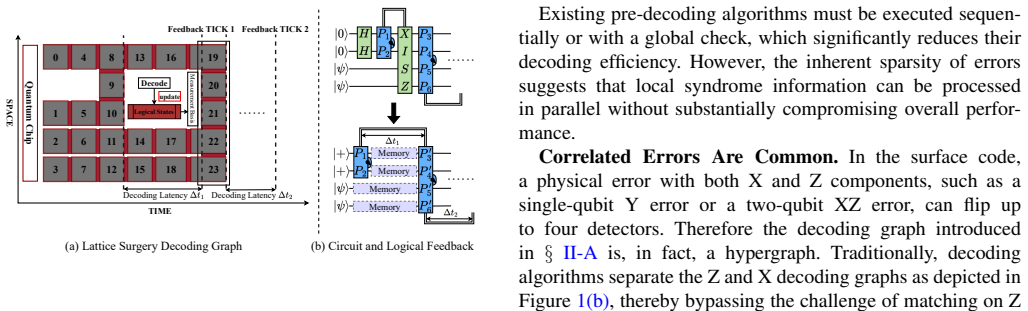
The load-bearing pieces are (1) the Neural Local Decoding Unit (NLDU), a streaming INT8-quantized fully convolutional network on the control FPGA whose (7,7,7) receptive field matches the typical error-chain length, and (2) the asynchronous block decoding system (BLDS) on CPU, which generalizes sliding-window decoding to full space-time blocks, decouples decode and merge via semaphores and shared memory, and is managed by a global dynamic scheduler that sends logical feedback at each tick. The syndrome tensor embedding maps arbitrary patches onto (alpha+1, beta+1, gamma, 2) tensors and errors onto six channels, turning local decoding from a subgraph matching problem into a per-vertex multi-c
Load-bearing premise
The neural local decoder is trained only on distance-13 data at three physical error rates and then applied without retraining to all code distances from 9 to 21 and error rates up to 0.005; if this transfer fails at unseen distances or boundary regions, the bandwidth-reduction and low-latency results rest on a model that has never been evaluated there.
What would settle it
Measure the remaining-syndrome ratio and logical error rate of LATTE at d=19 and d=21 at p=0.003 and p=0.005, using the shipped d=13-trained NLDU and identical simulated circuit-level noise, and compare against global minimum-weight perfect matching. If the remaining-syndrome ratio rises sharply above the roughly 22 percent seen at d=13, p=0.003, or the logical error rate deviates from MWPM beyond the buffer-convergence margin, the translation-invariance transfer claim is disproved.
If this is right
- Lattice-surgery circuits can stream syndromes continuously at the 1 microsecond round rate without memory overflow or exponentially growing backlog, even for arbitrarily long quantum memory experiments.
- The CPU resource budget for decoding stays near-optimal (2 threads at distance 17), freeing cores for compilation, simulation, and control tasks.
- Because the FPGA local unit is transparent to the block decoder, the same architecture can be paired with different base decoders such as minimum-weight perfect matching or union-find, and inherits the base decoder's accuracy.
- The 90 percent bandwidth cut applies at p=0.001, the regime of current superconducting hardware, making the integration point practical rather than asymptotic.
- Spatial scalability is modular: one NLDU covers patches up to distance 15, four cover distance 17 and 19, while each inference stage stays under 1 microsecond.
Where Pith is reading between the lines
- Editorial extension: the reported numbers assume the d=13-trained local model transfers to all distances by translation invariance; testing it directly at a held-out distance such as d=19 at p=0.005 with the same INT8 weights would separate architecture gains from model-generalization risk.
- Editorial extension: because the NLDU output is a per-vertex six-class prediction, the same FPGA unit could be adapted to other local error models or to decoding with defects and holes during lattice surgery by retraining only the final layers; the paper demonstrates only rotated surface-code patches.
- Editorial extension: in a full circuit with many overlapping logical patches and frequent feedback ticks, block scheduling contention and inter-FPGA communication could dominate the per-patch latency reported here; the multi-patch benchmark with 16 patches is a first step, not an upper bound on spatial scaling.
Editorial analysis
A structured set of objections, weighed in public.
Referee Report
Summary. The paper presents LATTE, a hierarchical FPGA-CPU decoding architecture for surface-code lattice surgery. The CPU-side block decoding system (BLDS) partitions streaming syndromes into temporal/spatial blocks, decodes them asynchronously in a thread pool, and merges seam corrections; the FPGA-side neural local decoding unit (NLDU) is a ~3k-parameter INT8 convolutional network with a 7x7x7 receptive field that predicts local DEM errors and updates syndromes before transmission to the CPU. The authors claim circuit-level-noise accuracy close to MWPM, >90% transmission-bandwidth reduction at p=0.001, a 6.4x average single-block decoding speedup, constant streaming latency with a 16x-20x speedup over Google/Fusion Blossom, and that 2 threads are sufficient for distances up to 17. The paper includes memory/stability experiments for d=9..21, multi-block buffer convergence studies, comparisons with hardware decoders, and FPGA resource/latency tables.
Significance. If the quantitative claims hold, LATTE is a useful systems contribution: it cleanly decouples decoding and merging in a producer-consumer pipeline, integrates a very small neural pre-decoder on the control FPGA, and demonstrates low resource use. The paper's strengths include the explicit streaming architecture, modularity with respect to the base decoder, the lightweight quantized model, the resource-model equations, and the breadth of comparison against existing hardware-implemented decoders. However, the headline numbers rest on an unvalidated generalization of the NLDU across code distances and physical error rates, and most plotted results lack statistical uncertainty or controlled baselines. The significance is therefore conditional on additional validation rather than unconditional.
major comments (4)
- [§VI-B, Table II, Figs. 8a/9/10] The NLDU is trained only on d=13 circuit-level data at p=0.001, 0.003, 0.005, but it is deployed at d=9..21 and p up to at least 0.006 in Fig. 8a, with p=0.002 appearing in Fig. 9. The paper justifies this by 'translation invariance of convolutional networks', which holds only in the bulk: the constant-2 virtual-vertex encoding, missing-edge locations, hook-error orientations, and the boundary/bulk fraction all depend on d. No per-distance FP/FN rates or validation curves are reported, so the claim that the >90% bandwidth reduction and the latency speedups hold at untested distances is not directly supported. Please provide FP/FN as a function of d and p, and report error-barred remaining-syndrome and LER curves at each distance.
- [§VII-D2, Fig. 10(b)] The 16x-20x streaming-latency speedup is stated against Google/Fusion Blossom numbers taken from published work, not against a baseline run on the same hardware. Since CPU model, core count, memory system, compiler, and decoder configuration all differ, this is not a controlled comparison and the speedup factor is not a property of LATTE alone. Please provide a same-machine baseline run, or clearly label the comparison as cross-paper and weaken the abstract claim accordingly.
- [§VII-E1, Table V and abstract] The abstract's claim that 'merely 2 threads are sufficient' is incomplete. The system also uses a fixed pool of 2 merging threads (stated in §VII-E1), and Table V reports only the minimum number of decode threads. The criterion for 'sufficient' (latency threshold, measurement-round duration, or backlog-free operation) is not defined. Please report the full thread accounting and the criterion used to determine the minimum.
- [§VII-A/B, Figs. 8-9] No error bars, shot counts, or independent repetitions are reported for any LER, bandwidth, or latency curve. For logical error rates around 1e-5, Poisson sampling requires many shots to distinguish curves; for latency, run-to-run variance matters. Without uncertainty information or sample sizes, claims such as 'accuracy on par with MWPM' and 'over 90% reduction' cannot be quantitatively assessed. Please add error bars and declare the number of samples/repetitions for each reported point.
minor comments (5)
- [Eq. (1c) vs. Table VII] The latency model in Eq. (1c) includes a fixed 3us pipeline delay plus a term that with Table VII parameters yields roughly 4.2us, while the stage latencies in Table VII sum to about 1.2us. Please clarify what each quantity measures and reconcile the definitions.
- [§VI-B, FP/FN report] The false-positive/false-negative rates reported in §VI-B are given without a definition of the validation set. State whether these are on d=13 held-out data, and provide the per-distance breakdown requested above.
- [Table III & Table IV comparison] Table III uses qualitative entries ('High', 'Low', 'Medium') without quantitative thresholds. Table IV should state whether the comparison numbers for Lazy, CLIQUE, and Promatch were obtained with the same Stim circuits, noise model, and d/p grid, or are quoted from the respective papers.
- [Fig. 7 caption and Algorithm 1] Fig. 7 caption contains a typo ('visulization'). In Algorithm 1, 'f ront' appears twice in the DECODE/MERGE procedures; this should be 'front'.
- [§VII-C, Fig. 10(c)] The multi-patch measurement experiment lacks details on patch layout, communication/synchronization overhead, and the definition of Npatch=16. Please specify these parameters and include error bars or repeated-run statistics.
Circularity Check
No significant circularity: LATTE's headline claims are benchmarked results, not derivations from their own inputs.
full rationale
The paper's central quantitative claims—over 90% bandwidth reduction, 6.4x single-block speedup, 16-20x streaming latency improvement, and 2-thread scalability—are empirical results obtained by running the implemented system and comparing it against external baselines (Sparse Blossom/MWPM, Google/Fusion Blossom, CC). The NLDU is a supervised convolutional classifier trained on circuit-level DEM labels from Stim; its output is used to thin the syndrome before MWPM, and the resulting remaining syndrome, logical error rates, and latencies are measured outcomes. None of these metrics is an identity forced by the training objective or by a parameter fitted to the same target. The buffer size b = ceil(d/2) is not assumed as a circular input; it is validated in Fig. 8(b) against global MWPM and cross-referenced to prior work [8,48,51]. Self-citations ([51], [62]) appear as related work or as a noise-model reference and are not load-bearing: the accuracy and latency comparisons are performed in-paper. The main weakness is a generalization assumption—the NLDU is trained only at d=13 (p=0.001/0.003/0.005) and applied at d=9..21 and p=0.002—but this is standard supervised transfer, and Fig. 8(a) provides per-distance LER evidence. Missing per-distance FP/FN rates and error bars are a validation gap, not a demonstration that the claims reduce to their inputs by construction. No equation or fitted parameter in the paper is renamed as a prediction.
Axiom & Free-Parameter Ledger
free parameters (3)
- Neural network weights (~3000 parameters) =
Trained on Stim circuit-level d=13 data at p=0.001, 0.003, 0.005; INT8 quantized
- Measurement/hook error threshold theta =
0.8 (pre-sigmoid threshold ln 4 in INT8)
- Receptive field R=7 =
7x7x7
axioms (4)
- domain assumption The circuit-level noise model with I, X, Y, Z, M, D, H error types and Stim-generated DEM labels is faithful to real hardware.
- domain assumption A fixed 1 microsecond syndrome round emulates the readout timing of superconducting quantum hardware.
- ad hoc to paper Translation invariance lets a d=13-trained convolutional network generalize to d=9..21 and to physical error rates outside the training set.
- domain assumption Seam merging by 2D decoding of the XOR of neighboring block seams is sufficient for circuit-level noise and arbitrary lattice surgery graphs.
Cite this review
Pith. "Pith review of LATTE: A Decoding Architecture for Quantum Computing with Temporal and Spatial Scalability." pith.science (2026). https://pith.science/paper/STWYEHOW
@misc{pith2026250903954,
  author       = {Pith},
  title        = {Pith review of: LATTE: A Decoding Architecture for Quantum Computing with Temporal and Spatial Scalability},
  year         = {2026},
  howpublished = {\url{https://pith.science/paper/STWYEHOW}},
  note         = {Machine review of arXiv:2509.03954}
}
abstract
Quantum error correction allows inherently noisy quantum devices to emulate an ideal quantum computer with reasonable resource overhead. As a crucial component, decoding architectures have received significant attention recently. In this paper, we introduce LATTE, a FPGA-CPU hybrid decoding architecture aiming to address the key requirements of scaling up in lattice surgery quantum computation -- Latency, Accuracy, Throughput and Transmission Bandwidth, in an Eclectic manner. LATTE follows a hierarchical design: (1) A fully streaming and asynchronous block decoding system on CPU to enable parallelization both temporally and spatially. (2) A super-light yet accurate neural local decoding unit integrated with quantum control hardware on FPGA, which remains \emph{transparent} to the block decoding system, effectively reducing transmission bandwidth and accelerating the decoding process. LATTE delivers accuracy on par with the base decoder while achieving real-time decoding throughput and significantly reducing both bandwidth requirements and computational resources, enabling a level of scalability far beyond previous approaches. Under circuit-level noise $p=0.001$, LATTE achieves over $\mathbf{90\%}$ reduction in transmission bandwidth and a $\mathbf{6.4\times}$ speedup on average in single-block decoding. In the \emph{streaming decoding} scenario: (1) LATTE achieves constant and low latency ($\mathbf{16\times}$-$\mathbf{20\times}$ speedup over existing streaming decoding implementations) in arbitrarily long quantum memory experiments, with near-optimal resources -- merely $\mathbf{2}$ threads are sufficient for decoding the surface code with distance up to $17$. (2) LATTE minimizes latency in multi-patch measurement experiments through highly parallelized decoding operations. These combined efforts ensure sufficient scalability for large-scale fault-tolerant quantum computing.
Figures





Forward citations
Cited by 3 Pith papers
-
Fast and accurate AI-based pre-decoders for surface codes
AI pre-decoders achieve O(1 μs) per round decoding runtimes on GPUs for surface codes while improving logical error rates over global decoding alone and enabling data-driven noise weight estimation.
-
Rethink the Role of Neural Decoders in Quantum Error Correction
Neural decoders for surface-code QEC achieve practical microsecond FPGA latency when trained on large datasets with appropriate inductive biases and INT4 quantization, rather than relying on architectural complexity.
-
Real-time Surface-Code Error Correction Using an FPGA-based Neural-Network Decoder
An FPGA-based neural-network decoder achieves 550 ns deterministic closed-loop latency for real-time distance-3 surface code error correction on a superconducting processor, matching offline decoding performance.
Reference graph
Works this paper leans on
-
[1]
Rajeev Acharya, Laleh Aghababaie-Beni, I. Aleiner, Trond I. Andersen, Markus Ansmann, Frank Arute, Ku- nal Arya, Abraham T. Asfaw, Nikita Astrakhantsev, Juan Atalaya, Ryan Babbush, Dave Bacon, Brian Ballard, Joseph C. Bardin, Johannes Bausch, Andreas Bengtsson, Alexander Bilmes, Sam Blackwell, Sergio Boixo, Gina Bortoli, Alexandre Bourassa, Jenna Bovaird,...
work page 2024
-
[2]
Aleiner, Richard Allen, Trond I
Rajeev Acharya, I. Aleiner, Richard Allen, Trond I. Andersen, Markus Ansmann, Frank Arute, Kunal Arya, Abraham T. Asfaw, Juan Atalaya, Ryan Babbush, Dave Bacon, Joseph C. Bardin, Jo ˜ao Marcos Vensi Basso, An- dreas Bengtsson, Sergio Boixo, Gina Bortoli, Alexandre Bourassa, Jenna Bovaird, Leon Brill, Mick Broughton, Bob B Buckley, David A. Buell, Tim Burg...
work page 2022
-
[3]
Fault-tolerant quantum computation with constant error
Dorit Aharonov and Michael Ben-Or. Fault-tolerant quantum computation with constant error. In Proceedings of the twenty-ninth annual ACM symposium on Theory of computing, pages 176–188, 1997
work page 1997
-
[4]
Promatch: Ex- tending the reach of real-time quantum error correction with adaptive predecoding
Narges Alavisamani, Suhas Vittal, Ramin Ayanzadeh, Poulami Das, and Moinuddin Qureshi. Promatch: Ex- tending the reach of real-time quantum error correction with adaptive predecoding. In Proceedings of the 29th ACM International Conference on Architectural Support for Programming Languages and Operating Systems, Volume 3, pages 818–833. ACM, 2024
work page 2024
-
[5]
U200 and u250 alveo data sheet
AMD. U200 and u250 alveo data sheet. https://docs.amd. com/r/en-US/ds962-u200-u250/Summary, 2024. Ac- cessed: 2024-10-17
work page 2024
-
[6]
Barnes, Tomasz Bialas, Okan Bugdayci, Earl T
Ben Barber, Kenton M. Barnes, Tomasz Bialas, Okan Bugdayci, Earl T. Campbell, Neil I. Gillespie, Kauser Johar, Ram Rajan, Adam W. Richardson, Luka Skoric, Canberk Topal, Mark L. Turner, and Abbas B. Ziad. A real-time, scalable, fast and resource-efficient decoder for a quantum computer. Nature Electronics, 8:84–91, 2023
work page 2023
-
[7]
Johannes Bausch, Andrew W Senior, Francisco J. H. Heras, Thomas Edlich, Alex Davies, Michael Newman, Cody Jones, Kevin Satzinger, Murphy Yuezhen Niu, Sam Blackwell, George Holland, Dvir Kafri, Juan Atalaya, Craig Gidney, Demis Hassabis, Sergio Boixo, Hartmut Neven, and Pushmeet Kohli. Learning high-accuracy error decoding for quantum processors. Nature, 6...
work page 2024
-
[8]
Mod- ular decoding: parallelizable real-time decoding for quan- tum computers
H ´ector Bomb ´ın, Chris Dawson, Ye-Hua Liu, Naomi Nickerson, Fernando Pastawski, and Sam Roberts. Mod- ular decoding: parallelizable real-time decoding for quan- tum computers. arXiv preprint arXiv:2303.04846 , 2023
Pith/arXiv arXiv 2023
-
[9]
Scalable neural network decoders for higher dimensional quantum codes
Nikolas P Breuckmann and Xiaotong Ni. Scalable neural network decoders for higher dimensional quantum codes. Quantum, 2:68, 2018
work page 2018
-
[10]
Belief propagation as a partial decoder
Laura Caune, Brendan Reid, Joan Camps, and Earl Campbell. Belief propagation as a partial decoder. arXiv preprint arXiv:2306.17142, 2023
Pith/arXiv arXiv 2023
-
[11]
Tech- niques for combining fast local decoders with global decoders under circuit-level noise
Christopher Chamberland, Luis Goncalves, Prasahnt Sivarajah, Eric Peterson, and Sebastian Grimberg. Tech- niques for combining fast local decoders with global decoders under circuit-level noise. Quantum Science and Technology, 8(4):045011, 2023
work page 2023
-
[12]
Multi-path summation for decoding 2d topological codes
Ben Criger and Imran Ashraf. Multi-path summation for decoding 2d topological codes. Quantum, 2:102, 2018
work page 2018
-
[13]
Lilliput: a lightweight low-latency lookup-table decoder for near- term quantum error correction
Poulami Das, Aditya Locharla, and Cody Jones. Lilliput: a lightweight low-latency lookup-table decoder for near- term quantum error correction. In Proceedings of the 27th ACM International Conference on Architectural Support for Programming Languages and Operating Systems , pages 541–553. ACM, 2022
work page 2022
-
[14]
Afs: Accurate, fast, and scalable error-decoding for fault-tolerant quantum computers
Poulami Das, Christopher A Pattison, Srilatha Manne, Douglas M Carmean, Krysta M Svore, Moinuddin Qureshi, and Nicolas Delfosse. Afs: Accurate, fast, and scalable error-decoding for fault-tolerant quantum computers. In 2022 IEEE International Symposium on High-Performance Computer Architecture (HPCA) , pages 259–273. IEEE, 2022
work page 2022
-
[15]
Hierarchical decoding to reduce hardware requirements for quantum computing
Nicolas Delfosse. Hierarchical decoding to reduce hardware requirements for quantum computing. arXiv preprint arXiv:2001.11427, 2020
Pith/arXiv arXiv 2001
-
[16]
Almost-linear time decoding algorithm for topological codes
Nicolas Delfosse and Naomi H Nickerson. Almost-linear time decoding algorithm for topological codes. Quantum, 5:595, 2021
2021
-
[17]
Topological quantum memory
Eric Dennis, Alexei Kitaev, Andrew Landahl, and John Preskill. Topological quantum memory. Journal of Mathematical Physics, 43(9):4452–4505, 2002
2002
-
[18]
Cooperating sequential processes
Edsger W Dijkstra. Cooperating sequential processes. In The origin of concurrent programming: from semaphores to remote procedure calls , pages 65–138. Springer, Berlin, Heidelberg, 2002
work page 2002
-
[19]
Matching, euler tours and the chinese postman
Jack Edmonds and Ellis L Johnson. Matching, euler tours and the chinese postman. Mathematical programming, 5:88–124, 1973
work page 1973
-
[20]
The end: An equivariant neural decoder for quantum error correction
Evgenii Egorov, Roberto Bondesan, and Max Welling. The end: An equivariant neural decoder for quantum error correction. arXiv preprint arXiv:2304.07362, 2023
Pith/arXiv arXiv 2023
-
[21]
Entangling logical qubits with lattice surgery
Alexander Erhard, Hendrik Poulsen Nautrup, Michael Meth, Lukas Postler, Roman Stricker, Martin Stadler, Vlad Negnevitsky, Martin Ringbauer, Philipp Schindler, Hans J Briegel, et al. Entangling logical qubits with lattice surgery. Nature, 589(7841):220–224, 2021
work page 2021
-
[22]
Optimal complexity correction of correlated errors in the surface code
Austin G Fowler. Optimal complexity correction of correlated errors in the surface code. arXiv preprint arXiv:1310.0863, 2013
Pith/arXiv arXiv 2013
-
[23]
Surface codes: Towards practical large-scale quantum computation
Austin G Fowler, Matteo Mariantoni, John M Marti- nis, and Andrew N Cleland. Surface codes: Towards practical large-scale quantum computation. Physical Review A—Atomic, Molecular, and Optical Physics , 86(3):032324, 2012
work page 2012
-
[24]
Dongxin Gao, Daojin Fan, Chen Zha, Jiahao Bei, Guo- qing Cai, Jianbin Cai, Sirui Cao, Fusheng Chen, Jiang 15 Chen, Kefu Chen, Xiawei Chen, Xiqing Chen, Zhe Chen, Zhiyuan Chen, Zi-Han Chen, Wenhao Chu, Hui Deng, Zhibin Deng, Pei Ding, Xun Ding, Zhuzhengqi Ding, Shuai Dong, Yupeng Dong, Bo Fan, Yu Fu, Song-Ming Gao, Lei Ge, Ming Gong, Jiacheng Gui, Cheng Gu...
work page 2025
-
[25]
Stim: a fast stabilizer circuit simulator
Craig Gidney. Stim: a fast stabilizer circuit simulator. Quantum, 5:497, 2021
2021
-
[26]
Stability experiments: The overlooked dual of memory experiments
Craig Gidney. Stability experiments: The overlooked dual of memory experiments. Quantum, 6:786, 2022
work page 2022
-
[27]
A fast quantum mechanical algorithm for database search
Lov K Grover. A fast quantum mechanical algorithm for database search. In Proceedings of the twenty-eighth annual ACM symposium on Theory of computing , pages 212–219, 1996
1996
-
[28]
Pymatching: A python package for decoding quantum codes with minimum-weight perfect matching
Oscar Higgott. Pymatching: A python package for decoding quantum codes with minimum-weight perfect matching. ACM Transactions on Quantum Computing , 3(3):1–16, 2022
work page 2022
-
[29]
Sparse blossom: cor- recting a million errors per core second with minimum- weight matching
Oscar Higgott and Craig Gidney. Sparse blossom: cor- recting a million errors per core second with minimum- weight matching. Quantum, 9:1600, 2025
work page 2025
-
[30]
Nisq+: Boosting quantum computing power by approx- imating quantum error correction
Adam Holmes, Mohammad Reza Jokar, Ghasem Pasandi, Yongshan Ding, Massoud Pedram, and Frederic T Chong. Nisq+: Boosting quantum computing power by approx- imating quantum error correction. In 2020 ACM/IEEE 47th annual international symposium on computer ar- chitecture (ISCA), pages 556–569. IEEE, 2020
work page 2020
-
[31]
Quantization and training of neural networks for efficient integer-arithmetic-only inference
Benoit Jacob, Skirmantas Kligys, Bo Chen, Menglong Zhu, Matthew Tang, Andrew Howard, Hartwig Adam, and Dmitry Kalenichenko. Quantization and training of neural networks for efficient integer-arithmetic-only inference. In Proceedings of the IEEE conference on computer vision and pattern recognition , pages 2704– 2713, 2018
work page 2018
-
[32]
Quantum error correction with imperfect gates
A Yu Kitaev. Quantum error correction with imperfect gates. In Quantum communication, computing, and measurement, pages 181–188. Springer, 1997
work page 1997
-
[33]
Emanuel Knill, Raymond Laflamme, and Wojciech H Zurek. Resilient quantum computation. Science, 279(5349):342–345, 1998
work page 1998
-
[34]
Blossom v: a new implementation of a minimum cost perfect matching algorithm
Vladimir Kolmogorov. Blossom v: a new implementation of a minimum cost perfect matching algorithm. Mathe- matical Programming Computation , 1:43–67, 2009
work page 2009
-
[35]
Norris, Christian Kraglund Andersen, M
Sebastian Krinner, Nathan Lacroix, Ants Remm, Agustin Di Paolo, ´Elie Genois, Catherine Leroux, Christoph Hellings, Stefania Laz ˘ar, Franc ¸ois Swiadek, Johannes Herrmann, Graham J. Norris, Christian Kraglund Andersen, M. Muller, Alexandre Blais, Christopher Eichler, and Andreas Wallraff. Realizing repeated quantum error correction in a distance-three su...
work page 2022
-
[36]
Spatially parallel decoding for multi-qubit lattice surgery
Sophia Fuhui Lin, Eric C Peterson, Krishanu Sankar, and Prasahnt Sivarajah. Spatially parallel decoding for multi- qubit lattice surgery. arXiv preprint arXiv:2403.01353 , 2024
work page internal anchor Pith review Pith/arXiv arXiv 2024
-
[37]
A game of surface codes: Large-scale quantum computing with lattice surgery
Daniel Litinski. A game of surface codes: Large-scale quantum computing with lattice surgery. Quantum, 3:128, 2019
work page 2019
-
[38]
A substrate scheduler for compiling arbitrary fault-tolerant graph states
Sitong Liu, Naphan Benchasattabuse, Darcy QC Mor- gan, Michal Hajdu ˇsek, Simon J Devitt, and Rodney Van Meter. A substrate scheduler for compiling arbitrary fault-tolerant graph states. In 2023 IEEE International Conference on Quantum Computing and Engineering (QCE), volume 1, pages 870–880. IEEE, 2023
work page 2023
-
[39]
Fpga-based distributed union-find decoder for surface codes
Namitha Liyanage, Yue Wu, Siona Tagare, and Lin Zhong. Fpga-based distributed union-find decoder for surface codes. IEEE Transactions on Quantum Engi- neering, 2024
work page 2024
-
[40]
Universal quantum simulators
Seth Lloyd. Universal quantum simulators. Science, 273(5278):1073–1078, 1996
1996
-
[41]
Scal- able neural decoder for topological surface codes
Kai Meinerz, Chae-Yeun Park, and Simon Trebst. Scal- able neural decoder for topological surface codes. Phys- ical Review Letters , 128(8):080505, 2022
work page 2022
-
[42]
Pytorch: An imperative style, high-performance deep learning library
Adam Paszke, Sam Gross, Francisco Massa, Adam Lerer, James Bradbury, Gregory Chanan, Trevor Killeen, Zem- ing Lin, Natalia Gimelshein, Luca Antiga, Alban Des- maison, Andreas Kopf, Edward Yang, Zachary DeVito, Martin Raison, Alykhan Tejani, Sasank Chilamkurthy, Benoit Steiner, Lu Fang, Junjie Bai, and Soumith Chin- 16 tala. Pytorch: An imperative style, h...
work page 2019
-
[43]
A variational eigenvalue solver on a photonic quantum processor
Alberto Peruzzo, Jarrod McClean, Peter Shadbolt, Man- Hong Yung, Xiao-Qi Zhou, Peter J Love, Al ´an Aspuru- Guzik, and Jeremy L O’brien. A variational eigenvalue solver on a photonic quantum processor. Nature commu- nications, 5(1):4213, 2014
work page 2014
-
[44]
Better than worst-case decoding for quantum error correction
Gokul Subramanian Ravi, Jonathan M Baker, Arash Fayyazi, Sophia Fuhui Lin, Ali Javadi-Abhari, Massoud Pedram, and Frederic T Chong. Better than worst-case decoding for quantum error correction. In Proceedings of the 28th ACM International Conference on Architectural Support for Programming Languages and Operating Systems, Volume 2, pages 88–102, 2023
work page 2023
-
[45]
Pauli frames for quantum computer architectures
Leon Riesebos, Xiang Fu, Savvas Varsamopoulos, Car- men G Almudever, and Koen Bertels. Pauli frames for quantum computer architectures. In Proceedings of the 54th Annual Design Automation Conference 2017 , pages 1–6, 2017
work page 2017
-
[46]
Ciar ´an Ryan-Anderson, Justin Gary Bohnet, K W Lee, Daniel N. Gresh, Aaron M. Hankin, John P. Gaebler, David Francois, Alexander Chernoguzov, Dario Luc- chetti, Natalie C. Brown, T. M. Gatterman, Si Khadir Halit, Kevin A. Gilmore, J. Gerber, Brian Neyenhuis, David Hayes, and Russell P. Stutz. Realization of real- time fault-tolerant quantum error correct...
work page 2021
-
[47]
Polynomial-time algorithms for prime factorization and discrete logarithms on a quantum com- puter
Peter W Shor. Polynomial-time algorithms for prime factorization and discrete logarithms on a quantum com- puter. SIAM review, 41(2):303–332, 1999
work page 1999
-
[48]
Parallel window decod- ing enables scalable fault tolerant quantum computation
Luka Skoric, Dan E Browne, Kenton M Barnes, Neil I Gillespie, and Earl T Campbell. Parallel window decod- ing enables scalable fault tolerant quantum computation. Nature Communications, 14(1):7040, 2023
work page 2023
-
[49]
Local predecoder to reduce the bandwidth and latency of quantum error correction
Samuel C Smith, Benjamin J Brown, and Stephen D Bartlett. Local predecoder to reduce the bandwidth and latency of quantum error correction. Physical Review Applied, 19(3):034050, 2023
work page 2023
-
[50]
Daniel Bochen Tan, Murphy Yuezhen Niu, and Craig Gidney. A sat scalpel for lattice surgery: Representa- tion and synthesis of subroutines for surface-code fault- tolerant quantum computing. In 2024 ACM/IEEE 51st Annual International Symposium on Computer Architec- ture (ISCA), pages 325–339. IEEE, 2024
work page 2024
-
[51]
Scalable surface-code decoders with par- allelization in time
Xinyu Tan, Fang Zhang, Rui Chao, Yaoyun Shi, and Jianxin Chen. Scalable surface-code decoders with par- allelization in time. PRX Quantum, 4(4):040344, 2023
work page 2023
-
[52]
Quantum error correction for quantum memories
Barbara M Terhal. Quantum error correction for quantum memories. Reviews of Modern Physics , 87(2):307–346, 2015
work page 2015
-
[53]
Neural network decoder for near-term surface-code experiments
Boris M Varbanov, Marc Serra-Peralta, David Byfield, and Barbara M Terhal. Neural network decoder for near-term surface-code experiments. arXiv preprint arXiv:2307.03280, 2023
Pith/arXiv arXiv 2023
-
[54]
Astrea: Accurate quantum error-decoding via practical minimum-weight perfect-matching
Suhas Vittal, Poulami Das, and Moinuddin Qureshi. Astrea: Accurate quantum error-decoding via practical minimum-weight perfect-matching. In Proceedings of the 50th Annual International Symposium on Computer Architecture, pages 1–16, 2023
work page 2023
-
[55]
Rapid high-fidelity single-shot dispersive readout of superconducting qubits
Theo Walter, Philipp Kurpiers, Simone Gasparinetti, Paul Magnard, Anton Poto ˇcnik, Yves Salath ´e, Marek Pechal, Mintu Mondal, Markus Oppliger, Christopher Eichler, and Andreas Wallraff. Rapid high-fidelity single-shot dispersive readout of superconducting qubits. Physical Review Applied, 7(5):054020, 2017
work page 2017
-
[56]
Transformer-qec: quantum error correction code decoding with transferable transformers
Hanrui Wang, Pengyu Liu, Kevin Shao, Dantong Li, Jiaqi Gu, David Z Pan, Yongshan Ding, and Song Han. Transformer-qec: quantum error correction code decoding with transferable transformers. arXiv preprint arXiv:2311.16082, 2023
Pith/arXiv arXiv 2023
-
[57]
A high performance compiler for very large scale surface code computations
George Watkins, Hoang Minh Nguyen, Keelan Watkins, Steven Pearce, Hoi-Kwan Lau, and Alexandru Paler. A high performance compiler for very large scale surface code computations. Quantum, 8:1354, 2024
work page 2024
-
[58]
Fusion blossom: Fast mwpm decoders for qec
Yue Wu and Lin Zhong. Fusion blossom: Fast mwpm decoders for qec. In 2023 IEEE International Confer- ence on Quantum Computing and Engineering (QCE) , volume 1, pages 928–938. IEEE, 2023
work page 2023
-
[59]
Hypergraph minimum-weight parity factor decoder for qec
Yue Wu, Lin Zhong, and Shruti Puri. Hypergraph minimum-weight parity factor decoder for qec. Bulletin of the American Physical Society , 2024
work page 2024
-
[60]
Yilun Xu, Gang Huang, Jan Balewski, Ravi Naik, Alexis Morvan, Bradley Mitchell, Kasra Nowrouzi, David I Santiago, and Irfan Siddiqi. Qubic: An open-source fpga- based control and measurement system for superconduct- ing quantum information processors. IEEE Transactions on Quantum Engineering , 2:1–11, 2021
work page 2021
-
[61]
Fpga-based electronic system for the control and readout of superconducting quantum processors
Yuchen Yang, Zhongtao Shen, Xing Zhu, Ziqi Wang, Gengyan Zhang, Jingwei Zhou, Xun Jiang, Chunqing Deng, and Shubin Liu. Fpga-based electronic system for the control and readout of superconducting quantum processors. Review of Scientific Instruments, 93(7), 2022
work page 2022
-
[62]
A classical architecture for dig- ital quantum computers
Fang Zhang, Xing Zhu, Rui Chao, Cupjin Huang, Ling- hang Kong, Guoyang Chen, Dawei Ding, Haishan Feng, Yihuai Gao, Xiaotong Ni, Liwei Qiu, Zhe Wei, Yueming Yang, Yang Zhao, Yaoyun Shi, Weifeng Zhang, Peng Zhou, and Jianxin Chen. A classical architecture for dig- ital quantum computers. ACM Transactions on Quantum Computing, 5(1):1–24, 2023
work page 2023
-
[63]
Realization of an error-correcting surface code with superconducting qubits
You-Wei Zhao, Yangsen Ye, Heliang Huang, Yiming Zhang, Dachao Wu, Hui-Rui Guan, Qingling Zhu, Zuolin Wei, Tan He, Sirui Cao, Fusheng Chen, Tung Hsun Chung, Hui Deng, Daojin Fan, Ming Gong, Cheng Guo, Shaojun Guo, Lianchen Han, Na Li, Shaowei Li, Yuan Li, Futian Liang, Jin Lin, Haoran Qian, Hao Rong, Hong Su, Lihua Sun, Shiyu Wang, Yulin Wu, Yu Xu, Chong Y...
work page 2022
This paper was first reviewed by deepseek-v4-flash on August 5, 2026.
discussion (0)
Sign in with ORCID, Apple, or X to comment. Anyone can read and Pith papers without signing in.