REVIEW 4 major objections 5 minor 3 cited by
ARFM turns offline RL post-training of VLA flow models into an adaptive per-batch weighting scheme that raises LIBERO average success from 88.1% to 92.1%.
Reviewed by Pith at T0; open to challenge. T0 means a machine referee read the full paper against a public rubric. the ladder, T0–T4 →
T0 review · deepseek-v4-flash
2026-08-05 10:24 UTC pith:WP7WP5Z7
load-bearing objection An empirically solid adaptive weighted-flow fine-tuning paper whose theoretical selling point is undermined by a mismatch between the loss it analyzes and the loss it runs. the 4 major comments →
Balancing Signal and Variance: Adaptive Offline RL Post-Training for VLA Flow Models
The pith
A machine-rendered reading of the paper's core claim, the machinery that carries it, and where it could break.
Core claim
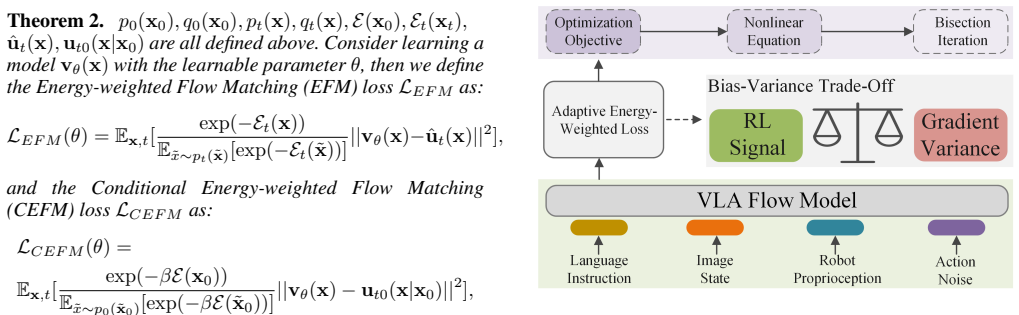
Correctly scaled advantage weighting is enough to make flow-based VLA policies learn from offline RL data. ARFM standardizes leave-one-out advantages R*, estimates per-sample flow-loss variance, and each batch picks alpha to minimize weighted-gradient variance minus lambda times expected advantage. Under Gaussian assumptions on R* and flow losses, the minimizer solves 4 sqrt(x) e^{2x} - 2 sqrt(x) e^x = lambda sigma_R / sigma_L^2 with alpha = sqrt(x)/sigma_R, found by bisection. The resulting weighted flow loss fine-tunes the π0 VLA flow policy to 92.1% average LIBERO success versus 88.1% unweighted, and gives the best perturbation, few-shot, and continual-learning numbers.
What carries the argument
The load-bearing object is the adaptive scaling factor alpha in the conditional energy-weighted flow matching loss. It tilts the training distribution toward high-advantage action chunks at a strength chosen each batch, and the argument works by rewriting the choice of alpha as a bias-variance trade-off: maximizing the average advantage pushed through the softmax weight against minimizing the variance of the resulting loss gradient. The accompanying machinery is the leave-one-out advantage estimator (unbiased, critic-free R*) and a bisection solve of the first-order condition for alpha, with two Gaussian assumptions turning the objective into a closed-form equation.
Load-bearing premise
The scheme's optimal-alpha formula assumes standardized RL advantages are Gaussian and roughly independent of the flow-loss gradient, which is doubtful for sparse rewards or heavy-tailed losses, so the derived alpha is not provably optimal though the adaptive procedure may still work.
What would settle it
Take a LIBERO task suite and split expert data into two clearly separated reward groups (for example, a third of trajectories with reward 1 and the rest with reward 0), then measure the empirical distribution of the standardized advantages and flow losses in a batch. If the advantage histogram is bimodal rather than bell-shaped, the Gaussian assumption behind Corollary 2 is violated. A direct behavioral test is to compare, on the same batches, the alpha from the bisection equation against a grid search over alpha: if a grid-searched alpha yields clearly better success than the closed-form one,
If this is right
- Any flow-based VLA policy that already has a return estimate can be post-trained offline by adding this one adaptive weight; no critic, no environment interaction, and no extra prediction head is required.
- Per-batch adaptation should make fine-tuning stable when data quality varies, since alpha shrinks when gradient variance spikes and grows when the advantage signal is weak.
- Because the weighted loss is still the standard conditional flow-matching loss, the method can be combined with other post-training techniques such as data augmentation and replay-based continual learning.
- The reported continual-learning gains imply that advantage reweighting can soften catastrophic forgetting: samples from newly learned tasks are amplified without letting their gradients dominate the shared policy.
- The same derivation applies to any regression-style policy loss whose per-sample gradients are available, so the method is not limited to action-chunk flow models.
Where Pith is reading between the lines
- A testable extension the authors do not pursue is to apply the same bisection rule to control weighting in plain behavior cloning or in diffusion-policy post-training; if the variance term is generic, ARFM's alpha is a ready-made schedule for any energy-weighted imitation loss.
- The Gaussian assumptions are doing real work. With sparse success/failure rewards, R* will be bimodal rather than normal, so the closed-form alpha will be approximate; the empirical gains suggest the bounded bisection heuristic is still useful, but an apples-to-apples grid-search comparison per batch would separate the theory from the heuristic.
- Since the leave-one-out baseline depends on batch composition, small batches will make R* noisier; the paper's few-shot results are encouraging, but ablating batch size would clarify how much the method relies on good advantage estimates versus on the adaptive alpha itself.
- If the objective were extended to online RL, the same per-batch alpha could be used as an automatic entropy/exploitation schedule, with the advantage estimator replaced by Monte Carlo returns from environment interaction; that is a natural next step the paper only names as future work.
Editorial analysis
A structured set of objections, weighed in public.
Referee Report
Summary. The paper proposes ARFM, an offline RL post-training method for vision-language-action (VLA) flow models such as π0. The method reweights the conditional flow-matching loss by an exponentiated RL advantage, with the scaling factor α adjusted per batch through a bisection procedure. The adjustment is claimed to minimize a bias-variance trade-off objective J(α)=Var(ĝ)−λS(α) that balances preserving RL advantage signal against controlling gradient variance. The authors provide two corollaries giving a closed-form optimality condition for α, and they evaluate ARFM on LIBERO multi-task, action-perturbation, few-shot, continual-learning, and real-world UR5 manipulation settings, reporting consistent improvements over π0, ReinboT, and RWR (e.g., 92.1% vs. 88.1% average LIBERO success rate).
Significance. If the theoretical derivation were sound, ARFM would be a practically valuable and simple contribution: it adapts the strength of an offline RL signal in a flow-based VLA policy in a per-batch, nearly parameter-light way, and the empirical evaluation is extensive across simulation and real-robot settings. The paper also includes useful implementation details (batch size, λ, bisection iterations, reward components) and compares against flow-matching versions of offline RL baselines. However, the central theoretical claim—that α is the minimizer of a principled variance-signal trade-off—is not supported by the derivation as written. The variance is computed for a different weighting scheme than the one implemented, and the proof invokes unstated independence and moment assumptions. The adaptive rule may still work as a heuristic, but the paper's main 'principled' contribution is currently not established.
major comments (4)
- [Methodology, Eq. (7) and Algorithm 2] The objective J(α) is analyzed for ĝ(α)=Σ_i \hat w_i ∇_θ L_i with \hat w_i=exp(αR_i^*) (unnormalized weights), and Corollary 1/2 solve for α under this unnormalized model. However, the practical loss L_1^τ(θ) implemented in Algorithm 2 (step 9) uses the normalized softmax weights w_i(α)=exp(αg_i)/Σ_j exp(αg_j). The gradient of the implemented loss is not the ĝ analyzed in the proof. Consequently, Eq. (7) is not the variance of the implemented gradient, and the α* obtained from Eq. (8) need not minimize J(α) for the actual training loss. The claim that α is chosen by a principled bias-variance trade-off is therefore unsupported without additional analysis of the normalized case.
- [Appendix, proof of Corollary 1] The variance computation treats the per-sample gradient ∇L_i as a scalar with variance σ_L^2 and uses Var((1/B)Σ exp(αR_i)∇L_i) = (m_2(α)−m_1(α)^2)σ_L^2. This identity requires, at minimum, an unstated independence assumption between R_i^* and ∇L_i and an assumption about the mean of ∇L_i; if E[∇L_i]≠0, an additional μ_L-dependent term appears and the expression is not correct. Even under Assumptions 1–2, the derived Eq. (7) does not follow from the stated definitions. The independence assumption is load-bearing and should be listed as an explicit assumption and empirically checked.
- [Algorithm 1] There is an inconsistency in the bisection search. Line 1 defines x_low=σ_A^2 α_min and x_high=σ_A^2 α_max, while Corollary 2 uses x=α^2 σ_R^2. If x is meant to be α^2 σ_R^2, the bounds should be σ_R^2 α_min^2 and σ_R^2 α_max^2. Also, σ_A is not defined in the text (presumably it is σ_R). As written, the bisection may not be solving Eq. (8), and the returned α* = sqrt(0.5(x_low+x_high))/σ_A does not match the derivation. This is a concrete algorithmic bug that must be fixed or explicitly clarified.
- [Methodology, Assumptions 1–2 and experiments] The Gaussian assumptions on R^* and on CFM losses are central to the closed-form α, but no empirical support is provided. The paper calls these assumptions 'mild and reasonable' without diagnostics. In offline RL with dense rewards and success/failure indicators, advantages are often skewed or multimodal, and flow-matching losses are typically non-Gaussian, especially at early training steps. Since Eq. (8) depends directly on these distributional assumptions, the optimality of α is not trustworthy until the assumptions are validated or a robustness analysis is given. A concrete test would be to report the empirical distributions of R_i^* and L_i^{CFM} during post-training and to compare the α from Eq. (8) with a direct grid minimization of J(α) computed on the actual normalized loss.
minor comments (5)
- [Abstract / Introduction] The phrase 'theoretically propose' overstates the current support; the adaptive rule should be described as a heuristic or as 'motivated by' the derived objective until the derivation is corrected.
- [Notation] The symbol \hat w_i is used both for exp(αR_i^*) (in J(α)) and, implicitly, for the normalized weights in L_1^τ. This ambiguity is a source of the mismatch between theory and algorithm and should be fixed by using different symbols for normalized and unnormalized weights.
- [Table 3] The '+4.1%', '+6.5%', and '+12.2%' values in the Avg. column are relative to π0, but the notation is inconsistent with the absolute percentages shown; please clarify whether these are absolute or relative improvements.
- [Section 4, real-world experiments] The real-world evaluation reports only bar-chart comparisons. Please report the number of trials per task, standard errors, and the exact success counts so the practical significance of the improvement can be assessed.
- [Appendix, proof of Theorem 2] The proof contains a likely typo: the expression for E[exp(−E_t(x))] writes 'exp(−βE_t(x0))' in one line where 'exp(−βE(x0))' is intended. This does not affect the theorem but should be corrected.
Circularity Check
No significant circularity: alpha is computed from per-batch statistics via an explicit trade-off objective, not fitted to test outcomes; self-citations are not load-bearing.
full rationale
The paper's central adaptive mechanism solves for alpha from current-batch statistics (sigma_R, sigma_L) through the explicit objective J(alpha)=Var−lambda S (Eq. 7, Corollary 1; Algorithm 1), and then uses that alpha in the weighted flow-matching loss. This is a per-step reweighting heuristic, not a prediction of held-out success: the alpha equation does not encode the LIBERO/UR5 success rates that are later reported, and it is evaluated against external benchmarks. The EWFM theorems (Theorems 1–2) are imported from prior work by one coauthor, but they are stated with assumptions and proven in the appendix, so they do not reduce the present claim to a self-citation. ReinboT is cited as a baseline rather than as evidence for ARFM. The main substantive weakness is a formal gap between the proof and the implemented loss: Corollary 1 computes the variance for unnormalized weights exp(alpha R) and substitutes scalar CFM-loss variance for gradient second moments, while Algorithm 2 uses normalized softmax weights and (in step 9) an extra exp(·) on R; this makes the claimed 'principled optimum' not a minimizer of the implemented objective under Assumptions 1–2. That is a correctness/validity concern, not a circular-input/output reduction, so under the hard rules it is reported here only as context and does not raise the circularity score.
Axiom & Free-Parameter Ledger
free parameters (3)
- lambda =
5e-4
- alpha bounds =
[0.01, 5]
- reward component weights =
13 hand-designed weights (e.g., 0.1/13, 0.01/13)
axioms (5)
- domain assumption Energy-weighted flow matching theorems (Theorems 1 and 2) from prior work
- ad hoc to paper Assumption 1: Standardized RL advantages R* are Gaussian N(0, sigma_R^2)
- ad hoc to paper Assumption 2: CFM loss values are Gaussian N(mu_L, sigma_L^2)
- standard math Assumption 3: Large batch size allows sample approximations of expectations and variances
- ad hoc to paper Implicit independence between R* and the per-sample flow loss gradient
Cite this review
Pith. "Pith review of Balancing Signal and Variance: Adaptive Offline RL Post-Training for VLA Flow Models." pith.science (2026). https://pith.science/paper/WP7WP5Z7
@misc{pith2026250904063,
  author       = {Pith},
  title        = {Pith review of: Balancing Signal and Variance: Adaptive Offline RL Post-Training for VLA Flow Models},
  year         = {2026},
  howpublished = {\url{https://pith.science/paper/WP7WP5Z7}},
  note         = {Machine review of arXiv:2509.04063}
}
read the original abstract
Vision-Language-Action (VLA) models based on flow matching have shown excellent performance in general-purpose robotic manipulation tasks. However, the action accuracy of these models on complex downstream tasks is unsatisfactory. One important reason is that these models rely solely on the post-training paradigm of imitation learning, which makes it difficult to have a deeper understanding of the distribution properties of data quality, which is exactly what Reinforcement Learning (RL) excels at. In this paper, we theoretically propose an offline RL post-training objective for VLA flow models and induce an efficient and feasible offline RL fine-tuning algorithm -- Adaptive Reinforced Flow Matching (ARFM). By introducing an adaptively adjusted scaling factor in the VLA flow model loss, we construct a principled bias-variance trade-off objective function to optimally control the impact of RL signal on flow loss. ARFM adaptively balances RL advantage preservation and flow loss gradient variance control, resulting in a more stable and efficient fine-tuning process. Extensive simulation and real-world experimental results show that ARFM exhibits excellent generalization, robustness, few-shot learning, and continuous learning performance.
Figures


Forward citations
Cited by 3 Pith papers
-
DyGRO-VLA: Cross-Task Scaling of Vision-Language-Action Models via Dynamic Grouped Residual Optimization
DyGRO-VLA is a two-stage optimization framework for cross-task scaling of Vision-Language-Action models via dynamic grouped residual optimization in RL.
-
HapticVLA: Contact-Rich Manipulation via Vision-Language-Action Model without Inference-Time Tactile Sensing
A vision-language-action robot policy that claims tactile-aware manipulation without tactile sensors at inference via reward-weighted flow matching and action distillation.
-
Reflection-Based Task Adaptation for Self-Improving VLA
Reflective Self-Adaptation combines failure-reflective reinforcement learning with success-guided imitation learning to enable faster and more reliable task adaptation for pre-trained Vision-Language-Action models.
Reference graph
Works this paper leans on
-
[1]
, " * write output.state after.block = add.period write newline
ENTRY address archivePrefix author booktitle chapter edition editor eid eprint howpublished institution isbn journal key month note number organization pages publisher school series title type volume year label extra.label sort.label short.list INTEGERS output.state before.all mid.sentence after.sentence after.block FUNCTION init.state.consts #0 'before.a...
-
[2]
write newline
" write newline "" before.all 'output.state := FUNCTION n.dashify 't := "" t empty not t #1 #1 substring "-" = t #1 #2 substring "--" = not "--" * t #2 global.max substring 't := t #1 #1 substring "-" = "-" * t #2 global.max substring 't := while if t #1 #1 substring * t #2 global.max substring 't := if while FUNCTION word.in bbl.in capitalize " " * FUNCT...
-
[3]
Ajay, A.; Du, Y.; Gupta, A.; Tenenbaum, J. B.; Jaakkola, T. S.; and Agrawal, P. 2022. Is Conditional Generative Modeling all you need for Decision Making? In The Eleventh International Conference on Learning Representations
work page 2022
-
[4]
Alayrac, J.-B.; Donahue, J.; Luc, P.; Miech, A.; Barr, I.; Hasson, Y.; Lenc, K.; Mensch, A.; Millican, K.; Reynolds, M.; et al. 2022. Flamingo: a visual language model for few-shot learning. Advances in neural information processing systems, 35: 23716--23736
2022
-
[5]
Black, K.; Brown, N.; Driess, D.; Esmail, A.; Equi, M.; Finn, C.; Fusai, N.; Groom, L.; Hausman, K.; Ichter, B.; et al. 2024. _0 : A Vision-Language-Action Flow Model for General Robot Control. arXiv preprint arXiv:2410.24164
Pith/arXiv arXiv 2024
-
[6]
Black, K.; Nakamoto, M.; Atreya, P.; Walke, H.; Finn, C.; Kumar, A.; and Levine, S. 2023. Zero-shot robotic manipulation with pretrained image-editing diffusion models. arXiv preprint arXiv:2310.10639
Pith/arXiv arXiv 2023
-
[7]
Brohan, A.; Brown, N.; Carbajal, J.; Chebotar, Y.; Chen, X.; Choromanski, K.; Ding, T.; Driess, D.; Dubey, A.; Finn, C.; et al. 2023. Rt-2: Vision-language-action models transfer web knowledge to robotic control. arXiv preprint arXiv:2307.15818
Pith/arXiv arXiv 2023
-
[8]
Brohan, A.; Brown, N.; Carbajal, J.; Chebotar, Y.; Dabis, J.; Finn, C.; Gopalakrishnan, K.; Hausman, K.; Herzog, A.; Hsu, J.; et al. 2022. Rt-1: Robotics transformer for real-world control at scale. arXiv preprint arXiv:2212.06817
Pith/arXiv arXiv 2022
-
[9]
Cadene, R.; Alibert, S.; Soare, A.; Gallouedec, Q.; Zouitine, A.; Palma, S.; Kooijmans, P.; Aractingi, M.; Shukor, M.; Aubakirova, D.; Russi, M.; Capuano, F.; Pascale, C.; Choghari, J.; Moss, J.; and Wolf, T. 2024. LeRobot: State-of-the-art Machine Learning for Real-World Robotics in Pytorch. https://github.com/huggingface/lerobot
work page 2024
-
[10]
Chen, H.; Lu, C.; Ying, C.; Su, H.; and Zhu, J. 2022. Offline Reinforcement Learning via High-Fidelity Generative Behavior Modeling. In The Eleventh International Conference on Learning Representations
work page 2022
-
[11]
Chen, L.; Lu, K.; Rajeswaran, A.; Lee, K.; Grover, A.; Laskin, M.; Abbeel, P.; Srinivas, A.; and Mordatch, I. 2021. Decision transformer: Reinforcement learning via sequence modeling. Advances in neural information processing systems, 34: 15084--15097
work page 2021
-
[12]
Chen, R. T. Q.; Rubanova, Y.; Bettencourt, J.; and Duvenaud, D. 2019. Neural Ordinary Differential Equations. arXiv:1806.07366
Pith/arXiv arXiv 2019
-
[13]
K.; Tomizuka, M.; and Romeres, D
Chen, Y.; Jha, D. K.; Tomizuka, M.; and Romeres, D. 2025. FDPP: Fine-tune Diffusion Policy with Human Preference. arXiv preprint arXiv:2501.08259
Pith/arXiv arXiv 2025
-
[14]
Chi, C.; Xu, Z.; Feng, S.; Cousineau, E.; Du, Y.; Burchfiel, B.; Tedrake, R.; and Song, S. 2023. Diffusion policy: Visuomotor policy learning via action diffusion. The International Journal of Robotics Research, 02783649241273668
work page 2023
-
[15]
S.; Lynch, C.; Chowdhery, A.; Wahid, A.; Tompson, J.; Vuong, Q.; Yu, T.; Huang, W.; et al
Driess, D.; Xia, F.; Sajjadi, M. S.; Lynch, C.; Chowdhery, A.; Wahid, A.; Tompson, J.; Vuong, Q.; Yu, T.; Huang, W.; et al. 2023. Palm-e: An embodied multimodal language model
work page 2023
-
[16]
Guo, Y.; Zhang, J.; Chen, X.; Ji, X.; Wang, Y.-J.; Hu, Y.; and Chen, J. 2025. Improving Vision-Language-Action Model with Online Reinforcement Learning. arXiv preprint arXiv:2501.16664
Pith/arXiv arXiv 2025
-
[17]
Ho, J.; Jain, A.; and Abbeel, P. 2020. Denoising Diffusion Probabilistic Models. CoRR, abs/2006.11239
Pith/arXiv arXiv 2020
-
[18]
Hou, Z.; Zhang, T.; Xiong, Y.; Duan, H.; Pu, H.; Tong, R.; Zhao, C.; Zhu, X.; Qiao, Y.; Dai, J.; et al. 2025. Dita: Scaling diffusion transformer for generalist vision-language-action policy. arXiv preprint arXiv:2503.19757
Pith/arXiv arXiv 2025
-
[19]
Janner, M.; Du, Y.; Tenenbaum, J.; and Levine, S. 2022. Planning with Diffusion for Flexible Behavior Synthesis. In International Conference on Machine Learning, 9902--9915. PMLR
work page 2022
-
[20]
Kim, M. J.; Pertsch, K.; Karamcheti, S.; Xiao, T.; Balakrishna, A.; Nair, S.; Rafailov, R.; Foster, E.; Lam, G.; Sanketi, P.; et al. 2024. Openvla: An open-source vision-language-action model. arXiv preprint arXiv:2406.09246
Pith/arXiv arXiv 2024
-
[21]
Kool, W.; van Hoof, H.; and Welling, M. 2019. Buy 4 reinforce samples, get a baseline for free!
work page 2019
-
[22]
R.; Fu, C.; Lunawat, I.; Sieh, I.; Kirmani, S.; et al
Li, X.; Hsu, K.; Gu, J.; Pertsch, K.; Mees, O.; Walke, H. R.; Fu, C.; Lunawat, I.; Sieh, I.; Kirmani, S.; et al. 2024. Evaluating real-world robot manipulation policies in simulation. arXiv preprint arXiv:2405.05941
Pith/arXiv arXiv 2024
-
[23]
Lipman, Y.; Chen, R. T. Q.; Ben-Hamu, H.; Nickel, M.; and Le, M. 2023. Flow Matching for Generative Modeling. arXiv:2210.02747
Pith/arXiv arXiv 2023
-
[24]
Liu, B.; Zhu, Y.; Gao, C.; Feng, Y.; Liu, Q.; Zhu, Y.; and Stone, P. 2023. LIBERO: Benchmarking Knowledge Transfer for Lifelong Robot Learning. arXiv preprint arXiv:2306.03310
Pith/arXiv arXiv 2023
-
[25]
Loshchilov, I.; and Hutter, F. 2017. Decoupled weight decay regularization. arXiv preprint arXiv:1711.05101
Pith/arXiv arXiv 2017
-
[26]
Lu, C.; Chen, H.; Chen, J.; Su, H.; Li, C.; and Zhu, J. 2023. Contrastive energy prediction for exact energy-guided diffusion sampling in offline reinforcement learning. In International Conference on Machine Learning, 22825--22855. PMLR
work page 2023
-
[27]
Lu, G.; Guo, W.; Zhang, C.; Zhou, Y.; Jiang, H.; Gao, Z.; Tang, Y.; and Wang, Z. 2025. Vla-rl: Towards masterful and general robotic manipulation with scalable reinforcement learning. arXiv preprint arXiv:2505.18719
Pith/arXiv arXiv 2025
-
[28]
Mark, M. S.; Gao, T.; Sampaio, G. G.; Srirama, M. K.; Sharma, A.; Finn, C.; and Kumar, A. 2024. Policy Agnostic RL: Offline RL and Online RL Fine-Tuning of Any Class and Backbone. arXiv preprint arXiv:2412.06685
Pith/arXiv arXiv 2024
-
[29]
Mete, A.; Xue, H.; Wilcox, A.; Chen, Y.; and Garg, A. 2024. Quest: Self-supervised skill abstractions for learning continuous control. Advances in Neural Information Processing Systems, 37: 4062--4089
work page 2024
-
[30]
Nakamoto, M.; Mees, O.; Kumar, A.; and Levine, S. 2024. Steering your generalists: Improving robotic foundation models via value guidance. arXiv preprint arXiv:2410.13816
Pith/arXiv arXiv 2024
-
[31]
Peters, J.; and Schaal, S. 2007. Reinforcement learning by reward-weighted regression for operational space control. In Proceedings of the 24th International Conference on Machine Learning, ICML '07, 745–750. New York, NY, USA: Association for Computing Machinery. ISBN 9781595937933
work page 2007
-
[32]
E.; Wenzel, F.; and Lioutikov, R
Reuss, M.; Ya g murlu, \"O . E.; Wenzel, F.; and Lioutikov, R. 2024. Multimodal diffusion transformer: Learning versatile behavior from multimodal goals. arXiv preprint arXiv:2407.05996
Pith/arXiv arXiv 2024
-
[33]
Schulman, J.; Wolski, F.; Dhariwal, P.; Radford, A.; and Klimov, O. 2017. Proximal policy optimization algorithms. arXiv preprint arXiv:1707.06347
Pith/arXiv arXiv 2017
-
[34]
Tan, S.; Dou, K.; Zhao, Y.; and Kr \"a henb \"u hl, P. 2025. Interactive Post-Training for Vision-Language-Action Models. arXiv preprint arXiv:2505.17016
Pith/arXiv arXiv 2025
-
[35]
Team, O. M.; Ghosh, D.; Walke, H.; Pertsch, K.; Black, K.; Mees, O.; Dasari, S.; Hejna, J.; Kreiman, T.; Xu, C.; et al. 2024. Octo: An open-source generalist robot policy. arXiv preprint arXiv:2405.12213
Pith/arXiv arXiv 2024
-
[36]
Wang, Z.; Hunt, J. J.; and Zhou, M. 2022. Diffusion Policies as an Expressive Policy Class for Offline Reinforcement Learning. In The Eleventh International Conference on Learning Representations
work page 2022
-
[37]
Zhai, S.; Bai, H.; Lin, Z.; Pan, J.; Tong, P.; Zhou, Y.; Suhr, A.; Xie, S.; LeCun, Y.; Ma, Y.; et al. 2024. Fine-tuning large vision-language models as decision-making agents via reinforcement learning. Advances in neural information processing systems, 37: 110935--110971
work page 2024
-
[38]
Zhang, H.; Zhuang, Z.; Zhao, H.; Ding, P.; Lu, H.; and Wang, D. 2025. ReinboT: Amplifying Robot Visual-Language Manipulation with Reinforcement Learning. arXiv preprint arXiv:2505.07395
Pith/arXiv arXiv 2025
-
[39]
Zhang, S.; Zhang, W.; and Gu, Q. 2025. Energy-Weighted Flow Matching for Offline Reinforcement Learning. arXiv:2503.04975
Pith/arXiv arXiv 2025
-
[40]
Zhang, Z.; Zheng, K.; Chen, Z.; Jang, J.; Li, Y.; Wang, C.; Ding, M.; Fox, D.; and Yao, H. 2024. Grape: Generalizing robot policy via preference alignment. arXiv preprint arXiv:2411.19309
Pith/arXiv arXiv 2024
-
[41]
Zhao, H.; Song, W.; Wang, D.; Tong, X.; Ding, P.; Cheng, X.; and Ge, Z. 2025. MoRE: Unlocking Scalability in Reinforcement Learning for Quadruped Vision-Language-Action Models. arXiv preprint arXiv:2503.08007
Pith/arXiv arXiv 2025
-
[42]
Zheng, Q.; Le, M.; Shaul, N.; Lipman, Y.; Grover, A.; and Chen, R. T. 2023. Guided flows for generative modeling and decision making. arXiv preprint arXiv:2311.13443
Pith/arXiv arXiv 2023
-
[43]
Zhuang, Z.; Peng, D.; Liu, J.; Zhang, Z.; and Wang, D. 2024. Reinformer: Max-return sequence modeling for offline rl. arXiv preprint arXiv:2405.08740
Pith/arXiv arXiv 2024
discussion (0)
Sign in with ORCID, Apple, or X to comment. Anyone can read and Pith papers without signing in.