REVIEW 4 major objections 4 minor 1 cited by
Cosmic-ray scattering cannot make the diffuse supernova neutrino background visible: the calculated flux is 20 orders of magnitude below anything current detectors can see.
Reviewed by Pith at T0; open to challenge. T0 means a machine referee read the full paper against a public rubric. the ladder, T0–T4 →
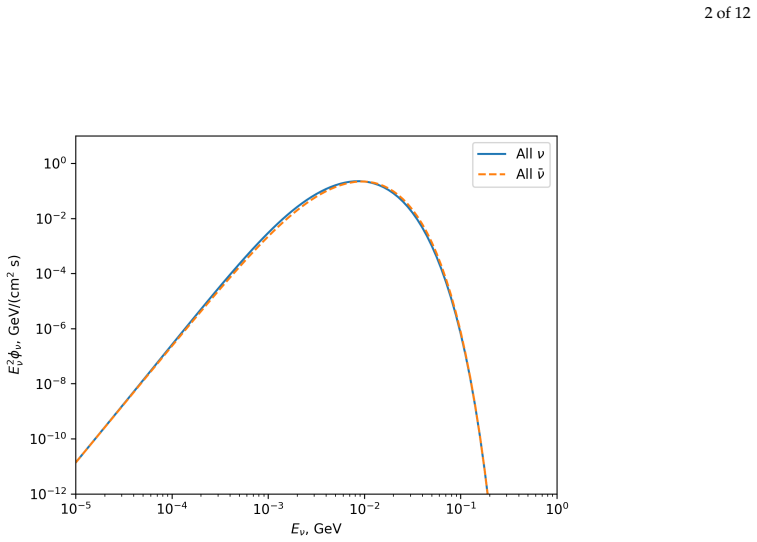
Cosmic-ray upscattering of the diffuse supernova neutrino background produces a flux about 20 orders below the galactic diffuse emission and about 18 orders below current limits, making the channel undetectable.
T0 review reviewed 2026-08-05 challenge →
load-bearing objection A careful, honest null result that closes the door on cosmic-ray-boosted DSNB neutrinos; the calculation is sound but the conclusion is a door closing rather than a window opening. the 4 major comments →
Cosmic-Ray Boosted Diffuse Supernova Neutrinos
The pith
A machine-rendered reading of the paper's core claim, the machinery that carries it, and where it could break.
The reading
Core claim
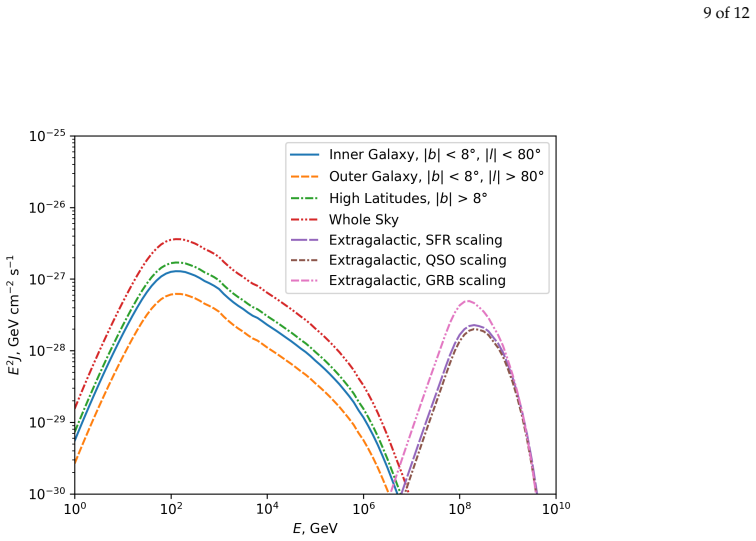
The paper's central claim is that the flux of diffuse supernova neutrinos boosted by cosmic-ray scattering is many orders of magnitude too small to be detected: about 20 orders of magnitude below modeled galactic diffuse neutrino emission for the galactic component, and about 18 orders below current experimental limits for the extragalactic component. The galactic component is brightest toward the galactic center and concentrated around the galactic plane, with a roughly E^-2.4 spectrum; the extragalactic component is isotropic and peaks near a few hundred PeV. Because the upscattered flux is so small, it does not compete with ordinary galactic diffuse neutrino emission, the measured high-en
What carries the argument
The calculation is built from a collision-rate integral: the diffuse supernova neutrino background acts as an isotropic low-energy target, cosmic-ray protons and nuclei act as projectiles, and the upscattered neutrino inherits the cosmic-ray direction in the head-on approximation. For the galactic component, the cosmic-ray spectrum is a multi-population rigidity-cutoff parametrization, and the intensity is obtained by integrating the local emission rate along the line of sight using a sech-shaped spatial distribution of galactic cosmic rays. For the extragalactic component, the cosmic-ray density at each redshift comes from a propagated ultra-high-energy cosmic-ray spectrum, with source dens
Load-bearing premise
The extragalactic part of the calculation assumes that ultra-high-energy cosmic-ray sources at very large distances became more or less numerous in one of three ways tied to star formation, quasars, or gamma-ray bursts; that distant behavior is not constrained by the cosmic-ray spectrum measured on Earth.
What would settle it
Look for galactic-plane-correlated neutrinos at TeV-PeV energies, or an isotropic neutrino flux peaking near a few hundred PeV, with sensitivity pushed far beyond current instruments: a detection matching either predicted spectral shape would refute the paper. Short of that, recomputing the extragalactic flux with a high-redshift source density much larger than the three adopted scalings—for example, growth as (1+z)^5—and showing that it approaches current upper limits would demonstrate that the 'unmeasurable' conclusion rests on the least-constrained assumption.
If this is right
- The galactic cosmic-ray-boosted component, though concentrated along the galactic plane and following roughly an E^-2.4 spectrum, is so far below modeled galactic diffuse neutrino emission that it will never be separated as a distinct signal.
- The isotropic extragalactic component, peaking near a few hundred PeV, lies about 18 orders of magnitude below current experimental upper limits, placing it beyond the reach of any approved or planned detector.
- Because both components are negligible, cosmic-ray-boosted diffuse supernova neutrinos can be ignored as a background in searches for cosmogenic neutrinos.
- For supernova neutrinos, inelastic scattering contributes significantly to the boosted flux, unlike the relic-neutrino case where elastic scattering dominates; future boosted-flux estimates should include both channels.
Where Pith is reading between the lines
- If a future experiment nevertheless sees a TeV-PeV galactic-plane-correlated neutrino flux or an isotropic few-hundred-PeV flux, this calculation says it should not be attributed to cosmic-ray-boosted supernova neutrinos; the interpretation would need astrophysical sources or new physics.
- The extragalactic result is only as solid as the assumed high-redshift source density. A source population that grows far more steeply with redshift than star formation, quasars, or gamma-ray bursts could raise the isotropic flux, so scanning such unconstrained evolutions would map the true upper bound of this channel.
- The same rate-integral machinery, including both elastic and inelastic channels, can be applied to any diffuse low-energy neutrino target, so the method carries over to relic-neutrino and other boosted-flux estimates.
Editorial analysis
A structured set of objections, weighed in public.
Referee Report
Summary. The paper calculates the neutrino flux generated when the diffuse supernova neutrino background (DSNB) is upscattered by cosmic rays, considering both Galactic cosmic rays (producing a flux concentrated near the Galactic plane) and extragalactic ultra-high-energy cosmic rays (producing an isotropic flux). The calculation combines a published parametrization of the DSNB, the Gaisser mixed-composition Galactic cosmic-ray model, PriNCe simulations of UHECR propagation under three assumed source-density evolutions (star-formation rate, quasar rate, gamma-ray-burst rate), and standard neutrino-nucleon, neutrino-nucleus, and DIS cross sections. The central claim is that the resulting CR-boosted DSNB flux is unmeasurably small: about 20 orders of magnitude below current models of the Galactic diffuse neutrino emission and about 18 orders of magnitude below present experimental limits, leading the author to conclude that neither component is detectable in the foreseeable future.
Significance. If the result holds, it constitutes a robust null result for a proposed indirect-detection channel of the DSNB. A strength of the paper is that the small flux is not achieved by tuned parameters: all ingredients are taken from published parametrizations and fits, and three different UHECR source-evolution scenarios are tested. The extremely large safety margin means that even order-of-magnitude variations in the least-constrained inputs, such as the high-redshift scaling of UHECR sources, would not affect the qualitative conclusion. The paper is therefore potentially citable as a definitive negative statement. However, the usefulness of the paper depends on the derivation being transparent and reproducible; in its current form several key equations are inconsistent or malformed, which undermines verification of the numerical result.
major comments (4)
- [Section 5.1, Eqs. (17)-(18)] The transition from Eq. (17) to Eq. (18) is not justified as written. Eq. (17) contains the factor 2ϵν and dσ/dQ², while Eq. (18) introduces an unexplained Q⁴ factor and a 1/(2ϵs³) prefactor. Using the stated relation Q² = 2ϵνϵs(1−cosψ), the angular integral dΩν = 2π d(cosψ) maps to dQ² with Jacobian −π/(ϵνϵs), yielding (2πc/ϵs)∫dϵν∫dΓCR nν nCR ∫dQ² dσ/dQ², not the expression in Eq. (18). Unless an additional kinematic relation between Q² and the final-state energy ϵs is being used without being stated, the two equations are inconsistent. This is a load-bearing part of the calculation, so the derivation must be corrected or clarified before the numerical results can be checked.
- [Section 5.2, Eqs. (21)-(22)] The presentation of the deep-inelastic scattering integral is badly garbled. Eq. (21) has an unshown lower limit on the ΓCR integration and the final double integral appears in the text as '∫ 2ϵνΓCR 0 dϵ∗ν ϵνΓCR 2mp(yϵ∗ν −mπ )−m2πZ 0 dQ2', which is unreadable. Eq. (22) similarly writes the upper limit of the Q² integral as '2mp(ϵ∗ν −ϵs/2ΓCR−mπ )−m2πZ 0 dQ2'. Since the paper states in Sec. 5.3 that the inelastic contribution dominates the emission rate, these integrals are central to the result. They must be typeset correctly with all integration limits and variables defined before the calculation can be reproduced.
- [Section 5.5, Eq. (26)] Eq. (26) introduces f(z) as 'the scaling of the cosmic-ray source density with redshift z, normalized to 1 at zmin = 2.37×10⁻⁶', but f(z) does not appear anywhere in the integrand. The reader is left unable to determine how the three source scalings of Eqs. (5)-(7) enter the extragalactic flux. In addition, the lower limit of the redshift integral is not shown, despite the stated normalization at zmin. Please define f(z) explicitly, state the integration limits, and explain the relation between f(z) and the source density used in the PriNCe simulation.
- [Table 1 and Eq. (8)] The spectral indices in Table 1 are listed with negative signs (γ = −0.8, −1.0, −0.8). Inserting these into Eq. (8), which contains (E/10^9 GeV)^{−γ}, gives an injection spectrum that rises with energy as E^{+0.8}, E^{+1.0}, or E^{+0.8} up to the rigidity cutoff. Such rising source spectra are not physically plausible and would not reproduce the Auger-measured UHECR spectrum shown in Fig. 3. This is very likely a sign typo (the values should presumably be +0.8, +1.0, +0.8), but the authors must correct the table or clarify the sign convention used in their fit.
minor comments (4)
- [Sec. 3.2, Table 1] The units of the normalizations f_A, given as GeV^{-1} cm^{-3} s^{-1}, are not explained. Please clarify whether these are comoving emissivities, and how the fit to the Auger spectrum fixes the overall source normalization.
- [Sec. 5.4, Eq. (25)] The line-of-sight integral L(Ω) is presented with units kpc/sr, but a line-of-sight integral of a dimensionless spatial function has units of length. The /sr presumably comes from the definition of the intensity per solid angle; this should be stated explicitly.
- [General] The manuscript would benefit from a list of input parameters and their references in one place; currently the cosmological parameters appear only in Sec. 3.2, while the DSNB parameters are in Sec. 2 and the cross-section parameters in Sec. 4 and Appendix A.
- [Eq. (21)] The variable y in the upper limit '2mp(yϵ∗ν −mπ)' should presumably be a function of εs, ΓCR, and ε*ν as defined in Eq. (20); the notation is confusing and should be made consistent.
Circularity Check
No significant circularity: the calculation is a convolution of independent external models and standard fits.
full rationale
The paper's central result is a direct convolution of externally published inputs: the DSNB parametrization of Ref. [10] based on Ref. [11], the galactic cosmic-ray parametrization of Ref. [12], and extragalactic UHECR spectra from the PriNCe simulation code [15]. The UHECR injection parameters in Table 1 are explicitly fitted to Pierre Auger data as standard calibration; they are not used as a prediction. The final boosted flux is obtained by evaluating the scattering integrals with these ingredients, and no parameter is adjusted to force the extremely small magnitude—the smallness follows from the tiny DSNB number density and the relevant cross-sections. The only author self-citation, Ref. [3], appears in the introduction merely to note recent interest in boosted relic neutrinos and is not load-bearing for any derivation. The paper also honestly discloses in Sec. 5.5 that the high-redshift source evolution is unconstrained by fitting the Earth-observed UHECR spectrum; this is a modeling uncertainty, not an instance of circularity, because the assumed scalings (SFR, QSO, GRB) are external functional forms and are not defined in terms of the target flux. No step in the derivation reduces to its own inputs by construction. The minor notation issue in Eq. (26) (undefined f(z)) is a presentation defect, not a circularity.
Axiom & Free-Parameter Ledger
free parameters (3)
- UHECR injection parameters under SFR source evolution =
Rmax=10^9.25 GV; gamma=-0.8; fH=1.0e-45; fHe=4.5e-46; fN=6.2e-47; fSi=4.1e-48; fFe=9.0e-50 GeV-1 cm-3 s-1
- UHECR injection parameters under QSO source evolution =
Rmax=10^9.20 GV; gamma=-1.0; fH=2.2e-45; fHe=7.7e-46; fN=6.1e-47; fSi=2.3e-48; fFe=6.6e-50 GeV-1 cm-3 s-1
- UHECR injection parameters under GRB source evolution =
Rmax=10^9.25 GV; gamma=-0.8; fH=1.7e-46; fHe=4.6e-47; fN=5.5e-47; fSi=3.9e-48; fFe=9.5e-50 GeV-1 cm-3 s-1
axioms (6)
- domain assumption The DSNB flux parametrization of [10] based on [11] gives the total neutrino plus antineutrino flux (Eq. 1, Section 2).
- domain assumption The galactic cosmic ray flux is described by the three-population parametrization of [12] (Eq. 4), with the third (extragalactic) component removed.
- domain assumption UHECR injection follows the form of [18] and propagation uses PriNCe [15] with TALYS photodisintegration [20] and Gilmore EBL [29].
- domain assumption The head-on approximation Omega_s = Omega_CR and beta = 1 is valid for the problem because Gamma_CR >> 1 (Section 5.1).
- domain assumption The galactic cosmic ray spectrum factorizes as n_CR(E,x) = n_sun(E) f(x), with f from [27] (Eq. 24, Section 5.4).
- standard math Standard-model elastic and inelastic neutrino-nucleon/nucleus cross sections from [21,23,24,25,26] (Section 4).
Cite this review
Pith. "Pith review of Cosmic-Ray Boosted Diffuse Supernova Neutrinos." pith.science (2026). https://pith.science/paper/CK3O4XXL
@misc{pith2026250904229,
  author       = {Pith},
  title        = {Pith review of: Cosmic-Ray Boosted Diffuse Supernova Neutrinos},
  year         = {2026},
  howpublished = {\url{https://pith.science/paper/CK3O4XXL}},
  note         = {Machine review of arXiv:2509.04229}
}
read the original abstract
The subject of boosted fluxes of dark matter or cosmic relic neutrinos via scattering on cosmic rays has received considerable attention recently. This article investigates the boosted neutrino flux from scattering of cosmic rays and the so-far undetected diffuse supernova neutrino background, taking into account both galactic and extragalactic cosmic rays. The calculated flux is many orders of magnitude smaller than either the galactic diffuse neutrino emission, the extragalactic astrophysical flux measured by IceCube, or the cosmogenic neutrino flux expected at the highest energies.
Figures


Forward citations
Cited by 1 Pith paper
-
Ultra-High-Energy Cosmic Ray Boosted Relic Neutrinos
Computes the diffuse UHECR-boosted CνB flux across elastic, coherent, incoherent, resonance, and deep-inelastic channels with mixed-composition UHECR models and derives upper limits on CνB overdensity from IceCube and...
Reference graph
Works this paper leans on
-
[1]
Diffuse supernova neutrino background search at Super-Kamiokande
Abe, K.; et al. Diffuse supernova neutrino background search at Super-Kamiokande. Phys. Rev. D 2021, 104, 122002
work page 2021
-
[2]
Prospects for detecting the diffuse supernova neutrino background with JUNO
Abusleme, A.; et al. Prospects for detecting the diffuse supernova neutrino background with JUNO. J. Cosmol. Astropart. Phys. 2022, 2022, 033
work page 2022
-
[3]
Impact of coherent scattering on relic neutrinos boosted by cosmic rays 2025
Zhang, J.; Sandrock, A.; Liao, J.; Yue, B. Impact of coherent scattering on relic neutrinos boosted by cosmic rays 2025. [2505.04791]
arXiv 2025
-
[4]
Relic neutrino background from cosmic-ray reservoirs
Marchi, A.G.D.; Granelli, A.; Nava, J.; Sala, F. Relic neutrino background from cosmic-ray reservoirs. Phys. Rev. D 2025, 111, 023023
work page 2025
-
[5]
Diffuse Emission of Galactic High-energy Neutrinos from a Global Fit of Cosmic Rays.Astrophys
Schwefer, G.; Mertsch, P .; Wiebusch, C. Diffuse Emission of Galactic High-energy Neutrinos from a Global Fit of Cosmic Rays.Astrophys. J. 2023, 949, 16
work page 2023
-
[6]
Floor of Cosmogenic Neutrino Fluxes above1017 eV .Astrophys
Bérat, C.; Condorelli, A.; Deligny, O.; Montanet, F.; Torrès, Z. Floor of Cosmogenic Neutrino Fluxes above1017 eV .Astrophys. J. 2024, 966, 186. 12 of 12
work page 2024
-
[7]
Abbasi, R.; et al. A Search for Extremely-High-Energy Neutrinos and First Constraints on the Ultra-High-Energy Cosmic-Ray Proton Fraction with IceCube 2025. [2502.01963]
arXiv 2025
-
[8]
Recent cosmogenic neutrino search results with IceCube and prospects with IceCube-Gen2
Meier, M. Recent cosmogenic neutrino search results with IceCube and prospects with IceCube-Gen2 2024. [2409.01740]. 58th Rencontres de Moriond, Very High Energy Phenomena in the Universe
work page internal anchor Pith review Pith/arXiv arXiv 2024
-
[9]
Aab, A.; et al. Probing the origin of ultra-high-energy cosmic rays with neutrinos in the EeV energy range using the Pierre Auger Observatory. J. Cosmol. Astropart. Phys. 2019, 10, 022
work page 2019
-
[10]
Neutrino nonradiative decay and the diffuse supernova neutrino background
Iváñez Ballesteros, P .; Volpe, M.C. Neutrino nonradiative decay and the diffuse supernova neutrino background. Phys. Rev. D 2023, 107, 023017
work page 2023
-
[11]
Monte Carlo Study of Supernova Neutrino Spectra Formation
Keil, M.T.; Raffelt, G.G.; Janka, H.T. Monte Carlo Study of Supernova Neutrino Spectra Formation. Astrophys. J. 2003, 590, 971
work page 2003
-
[12]
Spectrum of cosmic-ray nucleons and the atmospheric muon charge ratio
Gaisser, T.K. Spectrum of cosmic-ray nucleons and the atmospheric muon charge ratio. Astropart. Phys. 2012, 35, 801
work page 2012
-
[13]
A cosmic-ray database update: CRDB v4.1
Maurin, D.; Ahlers, M.; Dembinski, H.; Haungs, A.; Mangeard, P .S.; Melot, F.; Mertsch, P .; Wochele, D.; Wochele, J. A cosmic-ray database update: CRDB v4.1. Eur. Phys. J. C 2023, 83, 971, [arXiv:astro-ph.HE/2306.08901]. https://doi.org/10.1140/epjc/s10052-023-12092-8
Pith/arXiv arXiv 2023
-
[14]
The Cosmic-Ray Energy Spectrum, 2020
Evoli, C. The Cosmic-Ray Energy Spectrum, 2020. https://doi.org/10.5281/zenodo.4396125
-
[15]
Heinze, J.; Fedynitch, A.; Boncioli, D.; Winter, W. A New View on Auger Data and Cosmogenic Neutrinos in Light of Different Nuclear Disintegration and Air-shower Models. Ap. J. 2019, 873, 88
work page 2019
-
[16]
On the Normalization of the Cosmic Star Formation History
Hopkins, A.M.; Beacom, J.F. On the Normalization of the Cosmic Star Formation History. Ap. J. 2006, 651, 142
work page 2006
-
[17]
The Parkes quarter-Jansky flat-spectrum sample: III
Wall, J.V .; Jackson, C.A.; Shaver, P .A.; Hook, I.M.; Kellermann, K.I. The Parkes quarter-Jansky flat-spectrum sample: III. Space density and evolution of QSOs. Astron. & Astrophys. 2005, 434, 133
work page 2005
-
[18]
Combined fit of spectrum and composition data as measured by the Pierre Auger Observatory
Aab, A.; et al. Combined fit of spectrum and composition data as measured by the Pierre Auger Observatory. J. Cosmol. Astropart. Phys. 2017, 2017, 038, [arXiv:astro-ph.HE/1612.07155]. https://doi.org/10.1088/1475-7516/2017/04/038
Pith/arXiv arXiv 2017
-
[19]
Verzi, V . Measurement of the energy spectrum of ultra-high energy cosmic rays using the Pierre Auger Observatory.Proc. Sci. 2019, 358, 450. 36th International Cosmic Ray Conference (ICRC2019)
work page 2019
-
[20]
TALYS: Comprehensive Nuclear Reaction Modeling
Koning, A.J.; Hilaire, S.; Duijvestijn, M.C. TALYS: Comprehensive Nuclear Reaction Modeling. AIP Conf. Proc. 2005, 769, 1154. International Conference on Nuclear Data for Science and Technology
work page 2005
-
[21]
Measurement of neutrino-proton and antineutrino-proton elastic scattering
Ahrens, L.A.; et al. Measurement of neutrino-proton and antineutrino-proton elastic scattering. Phys. Rev. D 1987, 35, 785
work page 1987
-
[22]
Determination of the Pion-Nucleon Scattering Amplitude from Dispersion Relations and Unitarity
Mandelstam, S. Determination of the Pion-Nucleon Scattering Amplitude from Dispersion Relations and Unitarity. General Theory. Phys. Rev. 1958, 112, 1344–1360. https://doi.org/10.1103/PhysRev.112.1344
-
[23]
From eV to EeV: Neutrino cross sections across energy scales
Formaggio, J.A.; Zeller, G.P . From eV to EeV: Neutrino cross sections across energy scales. Rev. Mod. Phys. 2012, 84, 1307
work page 2012
-
[24]
Exclusive vector meson production in relativistic heavy ion collisions
Klein, S.R.; Nystrand, J. Exclusive vector meson production in relativistic heavy ion collisions. Phys. Rev. C 1999, 60, 014903
work page 1999
-
[25]
Block, M.M.; Durand, L.; Ha, P . Connection of the virtual γ∗ p cross section of ep deep inelastic scattering to real γp scattering, and the implications for νN and ep total cross sections. Phys. Rev. D 2014, 89, 094027
work page 2014
-
[26]
Measurements of R = σL/σT for 0.03 < x < 0.1 and fit to world data
Abe, K.; et al. Measurements of R = σL/σT for 0.03 < x < 0.1 and fit to world data. Phys. Lett. B 1999, 452, 194
work page 1999
-
[27]
Diffuse Galactic gamma ray flux at very high energy
Lipari, P .; Vernetto, S. Diffuse Galactic gamma ray flux at very high energy. Phys. Rev. D 2018, 98, 043003
work page 2018
-
[28]
Revisiting the luminosity and redshift distributions of long gamma-ray bursts
Lang, G.X.; Wei, J.J.; Zeng, H.D.; Li, Y.; Wu, X.F. Revisiting the luminosity and redshift distributions of long gamma-ray bursts. Mon. Not. Roy. Astron. Soc. 2021, 508, 52
work page 2021
-
[29]
Gilmore, R.C.; Somerville, R.S.; Primack, J.R.; Domínguez, A. Semi-analytic modelling of the extragalactic background light and consequences for extragalactic gamma-ray spectra. Mon. Not. Roy. Astron. Soc. 2012, 422, 3189. Disclaimer/Publisher’s Note: The statements, opinions and data contained in all publications are solely those of the individual author...
work page 2012
This paper was first reviewed by deepseek-v4-flash on August 5, 2026.
discussion (0)
Sign in with ORCID, Apple, or X to comment. Anyone can read and Pith papers without signing in.