Thermoelectric transport in graphene under strain fields modeled by Dirac oscillators
Pith reviewed 2026-05-21 22:01 UTC · model grok-4.3
The pith
Strain fields in graphene are modeled as independent 2D Dirac oscillators to derive analytical expressions for electrical conductivity, Seebeck coefficient, and thermal conductivity via Boltzmann transport.
A machine-rendered reading of the paper's core claim, the machinery that carries it, and where it could break.
Core claim
Representing strain-induced impurities in graphene as 2D Dirac oscillators and inserting the corresponding scattering rates into the semiclassical Boltzmann equation yields explicit analytical formulas for electrical conductivity, Seebeck coefficient, and thermal conductivity, together with an explicit temperature dependence for the density of these strain centers.
What carries the argument
The 2D Dirac oscillator potential, which encodes the coupling between pseudorelativistic carriers and localized lattice distortions and supplies the scattering matrix element for the relaxation-time calculation.
If this is right
- Electrical conductivity falls with rising strain-center density because the relaxation time shortens.
- Both Seebeck coefficient and thermal conductivity acquire explicit temperature dependence through the varying density of Dirac-oscillator scatterers.
- The analytic forms allow direct evaluation of the thermoelectric figure of merit as a function of applied strain without numerical integration.
- Strain engineering of graphene devices can be quantified by tuning the oscillator frequency parameter that sets the strength of each localized distortion.
Where Pith is reading between the lines
- The same Dirac-oscillator scattering kernel could be inserted into other transport formalisms, such as Kubo or Landauer approaches, to test consistency across regimes.
- Controlled substrate patterning that creates known densities of localized strains would provide a direct experimental test of the temperature-dependent density assumption.
- Extending the model to include a magnetic field or time-varying strain would map out additional control knobs for thermoelectric response.
Load-bearing premise
Randomly distributed localized strain fields can be treated as independent 2D Dirac oscillator potentials whose scattering rates enter the Boltzmann equation without significant overlap or many-body corrections.
What would settle it
A measured conductivity or Seebeck coefficient that deviates systematically from the predicted analytic dependence on strain-center density once the density exceeds a threshold where overlap becomes appreciable.
Figures


read the original abstract
Graphene has emerged as a paradigmatic material in condensed matter physics due to its exceptional electronic, mechanical, and thermal properties. A deep understanding of its thermoelectric transport behavior is crucial for the development of novel nanoelectronic and energy-harvesting devices. In this work, we investigate the thermoelectric transport properties of monolayer graphene subjected to randomly distributed localized strain fields, which locally induce impurity-like perturbations. These strain-induced impurities are modeled via 2D Dirac oscillators, capturing the coupling between pseudorelativistic charge carriers and localized distortions in the lattice. Employing the semiclassical Boltzmann transport formalism, we compute the relaxation time using a scattering approach tailored to the Dirac oscillator potential. From this framework, we derive analytical expressions for the electrical conductivity, Seebeck coefficient, and thermal conductivity. The temperature dependence of the scattering centers density is also investigated. Our results reveal how strain modulates transport coefficients, highlighting the interplay between mechanical deformations and thermoelectric performance in graphene. This study provides a theoretical foundation for strain engineering in thermoelectric graphene-based devices.
Editorial analysis
A structured set of objections, weighed in public.
Referee Report
Summary. The manuscript investigates thermoelectric transport in monolayer graphene with randomly distributed localized strain fields modeled as 2D Dirac oscillators. Employing the semiclassical Boltzmann transport formalism, the authors compute a relaxation time from scattering off these potentials and derive analytical expressions for electrical conductivity, Seebeck coefficient, and thermal conductivity; they also examine the temperature dependence of the scattering-center density.
Significance. If the independent-scatterer approximation holds, the work supplies closed-form expressions linking strain-induced scattering to thermoelectric coefficients, offering a useful analytical handle for strain engineering in graphene devices. The explicit mapping of strain to a Dirac-oscillator scattering potential is a distinctive modeling choice that, when justified, strengthens the predictive power of the Boltzmann framework.
major comments (2)
- [Abstract and modeling section] Abstract and implied modeling section: the central claim that randomly distributed strain fields act as independent 2D Dirac-oscillator scatterers whose rates enter the Boltzmann equation via Matthiessen’s rule is load-bearing, yet no quantitative criterion is supplied showing that the mean inter-center distance exceeds the spatial support of the oscillator wave function at the densities employed. Without this check, overlap or coherent multiple-scattering corrections could invalidate the relaxation-time derivation and the resulting expressions for σ, S, and κ.
- [Section on temperature dependence of scattering-center density] Section on temperature dependence of scattering-center density: it is unclear whether the reported T-dependence is an independent prediction derived from the strain model or is selected to reproduce expected transport trends; if the latter, the claim that the framework yields falsifiable predictions for thermoelectric coefficients is weakened.
minor comments (2)
- [Modeling section] Clarify the precise form of the Dirac-oscillator potential (including any cutoff or regularization) when it is first introduced, to allow readers to reproduce the scattering matrix elements.
- [Notation throughout] Ensure that all symbols for conductivity, relaxation time, and Fermi velocity are defined consistently in the text and equations.
Simulated Author's Rebuttal
We thank the referee for the careful reading and constructive comments on our manuscript. We address each major comment below and will revise the manuscript to incorporate clarifications and additional analysis where appropriate.
read point-by-point responses
-
Referee: [Abstract and modeling section] Abstract and implied modeling section: the central claim that randomly distributed strain fields act as independent 2D Dirac-oscillator scatterers whose rates enter the Boltzmann equation via Matthiessen’s rule is load-bearing, yet no quantitative criterion is supplied showing that the mean inter-center distance exceeds the spatial support of the oscillator wave function at the densities employed. Without this check, overlap or coherent multiple-scattering corrections could invalidate the relaxation-time derivation and the resulting expressions for σ, S, and κ.
Authors: We agree that an explicit quantitative check on the independent-scatterer approximation would strengthen the presentation. The manuscript implicitly relies on this regime for the relaxation-time derivation but does not provide the requested comparison. In the revised version we will add a paragraph to the modeling section that estimates the mean inter-center distance (∼ n_s^{-1/2}) and compares it to the characteristic length of the Dirac-oscillator wave function (set by the strain-induced frequency parameter). For the densities employed in the calculations this comparison confirms that overlap remains negligible, thereby justifying Matthiessen’s rule and the closed-form transport expressions. revision: yes
-
Referee: [Section on temperature dependence of scattering-center density] Section on temperature dependence of scattering-center density: it is unclear whether the reported T-dependence is an independent prediction derived from the strain model or is selected to reproduce expected transport trends; if the latter, the claim that the framework yields falsifiable predictions for thermoelectric coefficients is weakened.
Authors: The temperature dependence of the scattering-center density is introduced phenomenologically, motivated by physical expectations such as thermal relaxation of strain or defect annealing, rather than being derived directly from the Dirac-oscillator Hamiltonian. We will revise the relevant section to state this explicitly and to emphasize that the analytical expressions for σ, S, and κ are obtained for a given n_s(T). Once an independent determination of n_s(T) is supplied (experimentally or from a separate model), the thermoelectric coefficients become falsifiable predictions of the framework. This clarification preserves the utility of the closed-form results while acknowledging the input nature of n_s(T). revision: partial
Circularity Check
No significant circularity; derivation uses standard transport theory on an explicit modeling ansatz
full rationale
The paper models localized strain fields as independent 2D Dirac oscillator potentials and inserts the resulting scattering rates into the semiclassical Boltzmann equation to obtain closed-form expressions for σ, S, and κ. This is a conventional modeling choice followed by standard kinetic-theory algebra; the temperature dependence of scatterer density is reported as an output of the calculation rather than a parameter fitted to the transport coefficients themselves. No self-citation chain, uniqueness theorem, or self-definitional step is visible in the abstract or described framework that would reduce the final expressions to the inputs by construction. The derivation therefore remains self-contained against external benchmarks.
Axiom & Free-Parameter Ledger
axioms (2)
- domain assumption Localized strain fields induce impurity-like perturbations that are faithfully captured by 2D Dirac oscillator potentials.
- domain assumption Semiclassical Boltzmann transport with relaxation time from Dirac-oscillator scattering yields accurate thermoelectric coefficients.
Lean theorems connected to this paper
-
IndisputableMonolith/Cost/FunctionalEquation.leanwashburn_uniqueness_aczel unclear?
unclearRelation between the paper passage and the cited Recognition theorem.
strain-induced impurities are modeled via 2D Dirac oscillators... relaxation time using a scattering approach tailored to the Dirac oscillator potential... analytical expressions for the electrical conductivity, Seebeck coefficient, and thermal conductivity
-
IndisputableMonolith/Foundation/AlexanderDuality.leanalexander_duality_circle_linking unclear?
unclearRelation between the paper passage and the cited Recognition theorem.
randomly distributed localized strain fields... nanobubble density n_b ~ 8e10 cm^-2
What do these tags mean?
- matches
- The paper's claim is directly supported by a theorem in the formal canon.
- supports
- The theorem supports part of the paper's argument, but the paper may add assumptions or extra steps.
- extends
- The paper goes beyond the formal theorem; the theorem is a base layer rather than the whole result.
- uses
- The paper appears to rely on the theorem as machinery.
- contradicts
- The paper's claim conflicts with a theorem or certificate in the canon.
- unclear
- Pith found a possible connection, but the passage is too broad, indirect, or ambiguous to say the theorem truly supports the claim.
Reference graph
Works this paper leans on
-
[1]
or quantum dots with hybrid magnetic-Dirac oscillator couplings [41]) our work reveals a fundamental distinction: here, the oscillator dynamics emerge naturally from the strain- induced pseudogauge fieldA 5, without external potentials or magnetic fields. This intrinsic coupling directly links mechan- ical deformations to valley-polarized oscillatory stat...
-
[2]
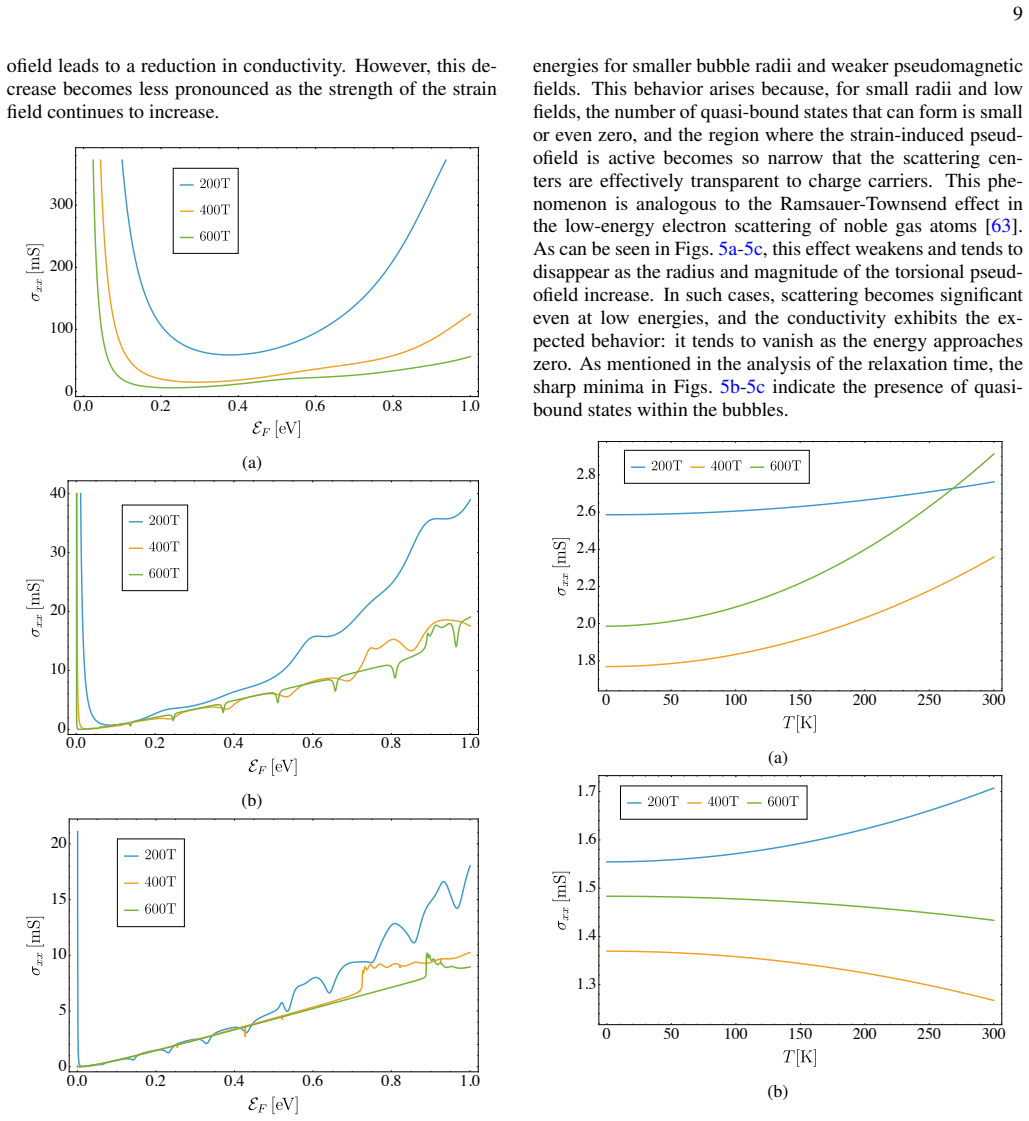
(48), the conductivity depends on the energy derivative of the re- laxation time
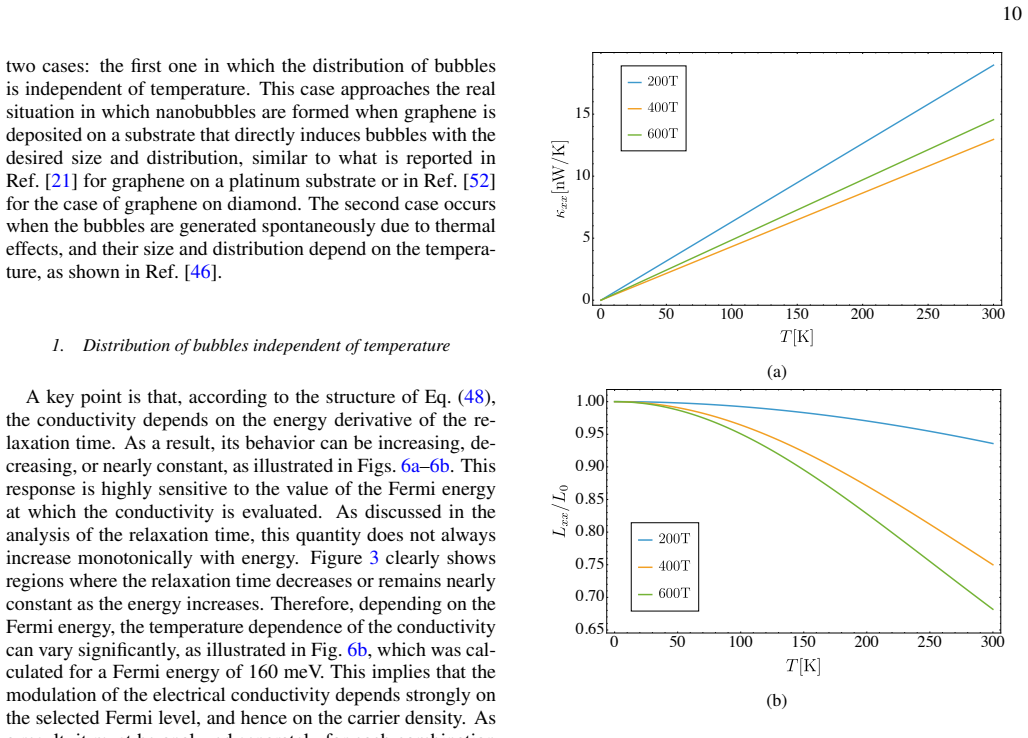
Distribution of bubbles independent of temperature A key point is that, according to the structure of Eq. (48), the conductivity depends on the energy derivative of the re- laxation time. As a result, its behavior can be increasing, de- creasing, or nearly constant, as illustrated in Figs. 6a–6b. This response is highly sensitive to the value of the Fermi...
-
[3]
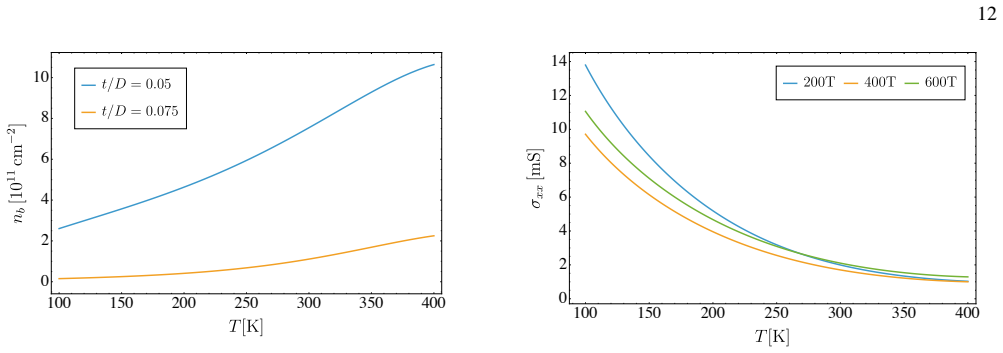
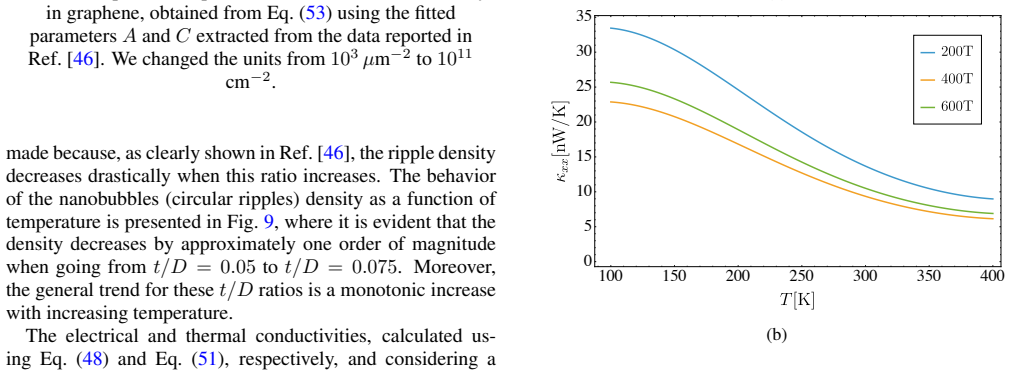
Temperature dependent distribution of bubbles As mentioned in Ref. [46], in graphene, thermal fluctua- tions at finite temperatureTdrive the formation of out-of- plane ripples. In the circular model, a ripple can be con- sidered as a nanobubble of heighttand an effective diame- terD. At room temperature most circular ripples lie around D∼5–12 ˚A. AsTincre...
work page 2025
-
[4]
K. S. Novoselov, A. K. Geim, S. V . Morozov, D. Jiang, Y . Zhang, S. V . Dubonos, I. V . Grigorieva, and A. A. Firsov. Electric field effect in atomically thin carbon films. Science, 306(5696):666–669, oct 2004
work page 2004
-
[5]
K.I. Bolotin, K.J. Sikes, Z. Jiang, M. Klima, G. Fudenberg, J. Hone, P. Kim, and H.L. Stormer. Ultrahigh electron mo- bility in suspended graphene. Solid State Communications, 146(9):351–355, 2008
work page 2008
-
[6]
Changgu Lee, Xiaoding Wei, Jeffrey W. Kysar, and James Hone. Measurement of the elastic properties and intrinsic strength of monolayer graphene. Science, 321(5887):385–388, 2008
work page 2008
-
[7]
Changgu Lee, Xiaoding Wei, Qunyang Li, Robert Carpick, Jef- frey W. Kysar, and James Hone. Elastic and frictional properties of graphene. physica status solidi (b), 246(11-12):2562–2567, 2009
work page 2009
-
[8]
Alexander A. Balandin, Suchismita Ghosh, Wenzhong Bao, Irene Calizo, Desalegne Teweldebrhan, Feng Miao, and Chun Ning Lau. Superior thermal conductivity of single- layer graphene. Nano Letters, 8(3):902–907, 2008. PMID: 18284217
work page 2008
- [9]
-
[10]
Sajedeh Manzeli, Dmitry Ovchinnikov, Diego Pasquier, Oleg V . Yazyev, and Andras Kis. 2d transition metal dichalcogenides. Nature Reviews Materials, 2(8):17033, Jun 2017
work page 2017
-
[11]
Puthirath, Ashokku- mar Meiyazhagan, Sohini Bhattacharyya, Muhammad M
Soumyabrata Roy, Xiang Zhang, Anand B. Puthirath, Ashokku- mar Meiyazhagan, Sohini Bhattacharyya, Muhammad M. Rah- man, Ganguli Babu, Sandhya Susarla, Sreehari K. Saju, Mai Kim Tran, Lucas M. Sassi, M. A. S. R. Saadi, Jiawei Lai, Onur Sahin, Seyed Mohammad Sajadi, Bhuvaneswari Dhar- marajan, Devashish Salpekar, Nithya Chakingal, Abhijit Babu- raj, Xinting...
work page 2021
-
[12]
Two- dimensional layered topological semimetals for advanced elec- tronics and optoelectronics
Huihui Yu, Haoran Zeng, Yanzhe Zhang, Yihe Liu, Wei Shang- Guan, Xiankun Zhang, Zheng Zhang, and Yue Zhang. Two- dimensional layered topological semimetals for advanced elec- tronics and optoelectronics. Advanced Functional Materials, 35(2):2412913, 2025
work page 2025
-
[13]
Graphene properties and applications in nanoelectronic
Tahereh Radsar, Hassan Khalesi, and Vahid Ghods. Graphene properties and applications in nanoelectronic. Optical and Quantum Electronics, 53(4):178, Apr 2021. 14
work page 2021
-
[14]
Jinlei Miao and Tingting Fan. Flexible and stretchable transpar- ent conductive graphene-based electrodes for emerging wear- able electronics. Carbon, 202(1):495–527, Jan 2023
work page 2023
-
[15]
Graphene-based thermoelectric mate- rials: toward sustainable energy-harvesting systems
Jewook Kim, Hwanseok Chang, Gwangmin Bae, Myungwoo Choi, and Seokwoo Jeon. Graphene-based thermoelectric mate- rials: toward sustainable energy-harvesting systems. Chemical Communications, 61(27):5050–5063, Mar 2025
work page 2025
-
[16]
Bonilla, Jorge David Casta˜no Yepes, A
Daniel A. Bonilla, Jorge David Casta˜no Yepes, A. Mart´ın-Ruiz, and Enrique Mu˜noz. Electromagnetic coupling and transport in a topological insulator–graphene heterostructure. Phys. Rev. B, 107:245103, Jun 2023
work page 2023
-
[17]
Electronic trans- port in torsional strained weyl semimetals
Rodrigo Soto-Garrido and Enrique Mu ˜noz. Electronic trans- port in torsional strained weyl semimetals. Journal of Physics: Condensed Matter, 30(19):195302, apr 2018
work page 2018
-
[18]
Thermoelectric transport in torsional strained weyl semimetals
Enrique Mu ˜noz and Rodrigo Soto-Garrido. Thermoelectric transport in torsional strained weyl semimetals. Journal of Applied Physics, 125(8):082507, 12 2018
work page 2018
-
[19]
Thermo-magneto-electric transport through a torsion disloca- tion in a type i weyl semimetal
Daniel Bonilla, Enrique Mu ˜noz, and Rodrigo Soto-Garrido. Thermo-magneto-electric transport through a torsion disloca- tion in a type i weyl semimetal. Nanomaterials, 11(11), 2021
work page 2021
-
[20]
Electronic transport in weyl semimetals with a uniform concentration of torsional dis- locations
Daniel Bonilla and Enrique Mu ˜noz. Electronic transport in weyl semimetals with a uniform concentration of torsional dis- locations. Nanomaterials, 12(20), 2022
work page 2022
-
[21]
Daniel A. Bonilla and Enrique Mu ˜noz. Thermoelectric trans- port in weyl semimetals under a uniform concentration of tor- sional dislocations. Nanoscale Adv., 6:2701–2712, 2024
work page 2024
- [22]
- [23]
-
[24]
N. Levy, S. A. Burke, K. L. Meaker, M. Panlasigui, A. Zettl, F. Guinea, A. H. Castro Neto, and M. F. Crommie. Strain- induced pseudo–magnetic fields greater than 300 tesla in graphene nanobubbles. Science, 329(5991):544–547, Jul 2010
work page 2010
-
[25]
M. Ramezani Masir, D. Moldovan, and F.M. Peeters. Pseudo magnetic field in strained graphene: Revisited. Solid State Communications, 175-176:76–82, Dec 2013
work page 2013
-
[26]
Fernando de Juan, Juan L. Ma ˜nes, and Mar´ıa A. H. V ozmedi- ano. Gauge fields from strain in graphene. Physical Review B, 87(16):165131, Apr 2013
work page 2013
-
[27]
Strain engineering of graphene: a review
Chen Si, Zhimei Sun, and Feng Liu. Strain engineering of graphene: a review. Nanoscale, 8(6):3207–3217, Jan 2016
work page 2016
-
[28]
Electronic and optical proper- ties of strained graphene and other strained 2d materials: a re- view
Gerardo G Naumis, Salvador Barraza-Lopez, Maurice Oliva- Leyva, and Humberto Terrones. Electronic and optical proper- ties of strained graphene and other strained 2d materials: a re- view. Reports on Progress in Physics, 80(9):096501, Sep 2017
work page 2017
-
[29]
Enrique Mu ˜noz and Rodrigo Soto-Garrido. Analytic approach to magneto-strain tuning of electronic transport through a graphene nanobubble: perspectives for a strain sensor. Journal of Physics: Condensed Matter, 29(44):445302, oct 2017
work page 2017
-
[30]
McRae, Guoqing Wei, Linxiang Huang, Serap Yi- gen, Vahid Tayari, and Alexandre R
Andrew C. McRae, Guoqing Wei, Linxiang Huang, Serap Yi- gen, Vahid Tayari, and Alexandre R. Champagne. Mechanical control of quantum transport in graphene. Advanced Materials, 36(23):2313629, 2024
work page 2024
-
[31]
M.A.H. V ozmediano, M.I. Katsnelson, and F. Guinea. Gauge fields in graphene. Physics Reports, 496(4):109–148, 2010
work page 2010
-
[32]
Power, Mads Brandbyge, and Antti- Pekka Jauho
Mikkel Settnes, Stephen R. Power, Mads Brandbyge, and Antti- Pekka Jauho. Graphene nanobubbles as valley filters and beam splitters. Physical Review Letters, 117(27), December 2016
work page 2016
-
[33]
Graphene nanoelectromechanical systems as valleytronic de- vices
Walter Ortiz, Nikodem Szpak, and Thomas Stegmann. Graphene nanoelectromechanical systems as valleytronic de- vices. Physical Review B, 106(3), July 2022
work page 2022
-
[34]
Valley filtering and valley- polarized collective modes in bulk graphene monolayers
Jian-Long Zheng and Feng Zhai. Valley filtering and valley- polarized collective modes in bulk graphene monolayers. Chinese Physics B, 33(1):017203, January 2024
work page 2024
- [35]
-
[36]
M Moshinsky and A Szczepaniak. The dirac oscillator. Journal of Physics A: Mathematical and General, 22(17):L817–L819, Sep 1989
work page 1989
-
[37]
J. M. Ziman. Principles of the Theory of Solids. Cambridge University Press, Cambridge, 2nd edition, 1972
work page 1972
-
[38]
A. H. Castro Neto, F. Guinea, N. M. R. Peres, K. S. Novoselov, and A. K. Geim. The electronic properties of graphene. Rev. Mod. Phys., 81:109–162, Jan 2009
work page 2009
-
[39]
Electronic Properties Of Dirac And Weyl Semimetals
Eduard V Gorbar, Vladimir A Miransky, Igor A Shovkovy, and Pavlo O Sukhachov. Electronic Properties Of Dirac And Weyl Semimetals. World Scientific, World Scientific, 01 2021
work page 2021
- [40]
-
[41]
Phonons and electron- phonon scattering in carbon nanotubes
Hidekatsu Suzuura and Tsuneya Ando. Phonons and electron- phonon scattering in carbon nanotubes. Physical Review B, 65(23):235412, May 2002
work page 2002
- [42]
-
[43]
C. Quimbay and P. Strange. Graphene physics via the dirac oscillator in (2+1) dimensions, 2013
work page 2013
-
[44]
Gate- tunable graphene quantum dot and dirac oscillator
Abdelhadi Belouad, Ahmed Jellal, and Youness Zahidi. Gate- tunable graphene quantum dot and dirac oscillator. Physics Letters A, 380(5):773–778, 2016
work page 2016
-
[45]
Luis E. F. Foa Torres, Stephan Roche, and Jean-Christophe Charlier. Introduction to Graphene-Based Nanomaterials: From Electronic Structure to Quantum Transport. Cambridge Univer- sity Press, 2 edition, 2020
work page 2020
-
[46]
M. O. Goerbig. Electronic properties of graphene in a strong magnetic field. Reviews of Modern Physics, 83(4):1193–1243, Nov 2011
work page 2011
-
[47]
J. M. Ziman. Electrons and Phonons: The Theory of Transport Phenomena. Oxford, Clanderon Press, London, 1960
work page 1960
-
[48]
G. D. Mahan. Many Particle Physics. Plenum, New York, 3rd edition, 2000
work page 2000
-
[49]
Katsnelson, Tianzhong Zhang, and Shengjun Yuan
Jin Yu, Mikhail I. Katsnelson, Tianzhong Zhang, and Shengjun Yuan. Distribution of ripples in graphene membranes. Phys. Rev. B, 106:045418, Jul 2022
work page 2022
-
[50]
Nouredine Zettili. Quantum Mechanics. John Wiley & Sons, John Wiley & Sons, 02 2009
work page 2009
-
[51]
Introducci´on a la mec´anica cu´antica
Luis de la Pe ˜na. Introducci´on a la mec´anica cu´antica. Fondo de Cultura Economica, Fondo de Cultura Economica, 06 2014
work page 2014
-
[52]
Dislocation defect as a bulk probe of monopole charge of multi- weyl semimetals
Rodrigo Soto-Garrido, Enrique Mu ˜noz, and Vladimir Juri ˇci´c. Dislocation defect as a bulk probe of monopole charge of multi- weyl semimetals. Phys. Rev. Res., 2:012043, Feb 2020
work page 2020
-
[53]
M. Ramezani Masir, A. Matulis, and F. M. Peeters. Scattering of dirac electrons by circular mass barriers: Valley filter and resonant scattering. Physical Review B, 84(24):245413, Dec 2011
work page 2011
-
[54]
M. Abramowitz and I.A. Stegun. Handbook of Mathematical Functions: With Formulas, Graphs, and Mathematical Tables. Applied mathematics series. Dover Publications, 1965
work page 1965
-
[55]
A hydrothermal anvil made of graphene nanobubbles on diamond
Candy Haley Yi Xuan Lim, Anastassia Sorkin, Qiaoliang Bao, Ang Li, Kai Zhang, Milos Nesladek, and Kian Ping Loh. A hydrothermal anvil made of graphene nanobubbles on diamond. Nature Communications, 4:1556, March 2013. 15
work page 2013
-
[56]
S. Das Sarma, Shaffique Adam, E. H. Hwang, and Enrico Rossi. Electronic transport in two-dimensional graphene. Reviews of Modern Physics, 83(2):407–470, May 2011
work page 2011
-
[57]
Y .-W. Tan, Y . Zhang, K. Bolotin, Y . Zhao, S. Adam, E. H. Hwang, S. Das Sarma, H. L. Stormer, and P. Kim. Measure- ment of scattering rate and minimum conductivity in graphene. Physical Review Letters, 99(24):246803, December 2007
work page 2007
-
[58]
Valley- symmetry-preserved transport in ballistic graphene with gate- defined carrier guiding
Minsoo Kim, Ji-Hae Choi, Sang-Hoon Lee, Kenji Watanabe, Takashi Taniguchi, Seung-Hoon Jhi, and Hu-Jong Lee. Valley- symmetry-preserved transport in ballistic graphene with gate- defined carrier guiding. Nature Physics, 12(11):1022–1026, November 2016
work page 2016
-
[59]
T. O. Wehling, S. Yuan, A. I. Lichtenstein, A. K. Geim, and M. I. Katsnelson. Resonant scattering by realistic impurities in graphene. Phys. Rev. Lett., 105:056802, Jul 2010
work page 2010
-
[60]
Aires Ferreira, J. Viana-Gomes, Johan Nilsson, E. R. Mucciolo, N. M. R. Peres, and A. H. Castro Neto. Unified description of the dc conductivity of monolayer and bilayer graphene at finite densities based on resonant scatterers.Phys. Rev.B, 83:165402, Apr 2011
work page 2011
-
[61]
C. A. Downing, A. R. Pearce, R. J. Churchill, and M. E. Portnoi. Optimal traps in graphene. Phys. Rev. B, 92:165401, Oct 2015
work page 2015
-
[62]
V . U. Nazarov, E. E. Krasovskii, and V . M. Silkin. Scatter- ing resonances in two-dimensional crystals with application to graphene. Phys. Rev. B, 87:041405, Jan 2013
work page 2013
-
[63]
Energy levels of graphene magnetic circu- lar quantum dot
Abdelhadi Belouad, Bouchaib Lemaalem, Ahmed Jellal, and Hocine Bahlouli. Energy levels of graphene magnetic circu- lar quantum dot. Materials Research Express, 7(1):015090, jan 2020
work page 2020
-
[64]
Elec- trons trapped in graphene magnetic quantum dots with mass term
Mohammed El Azar, Ahmed Bouhlal, and Ahmed Jellal. Elec- trons trapped in graphene magnetic quantum dots with mass term. Computational Materials Science, 231:112573, 2024
work page 2024
-
[65]
Boosting energy levels in graphene magnetic quantum dots through magnetic flux and inhomogeneous gap
Mohammed El Azar, Ahmed Bouhlal, and Ahmed Jellal. Boosting energy levels in graphene magnetic quantum dots through magnetic flux and inhomogeneous gap. Physica B: Condensed Matter, 685:416005, 2024
work page 2024
-
[66]
J. J. Sakurai. Modern Quantum Mechanics. Addison-Wesley, revised edition, 1994
work page 1994
-
[67]
Dario A. Bahamon, Zenan Qi, Harold S. Park, Vitor M. Pereira, and David K. Campbell. Conductance signatures of elec- tron confinement induced by strained nanobubbles in graphene. Nanoscale, 7:15300–15309, 2015
work page 2015
-
[68]
Alexander A. Balandin, Suchismita Ghosh, Wenzhong Bao, Irene Calizo, Desalegne Teweldebrhan, Feng Miao, and Chun Ning Lau. Superior thermal conductivity of single-layer graphene. Nano Letters, 8(3):902–907, 03 2008
work page 2008
-
[69]
Thermal conductivity of mono- layer graphene: Convergent and lower than diamond
Zherui Han and Xiulin Ruan. Thermal conductivity of mono- layer graphene: Convergent and lower than diamond. Phys. Rev. B, 108:L121412, Sep 2023
work page 2023
-
[70]
Controlling the thermal conductivity of monolayer graphene with kirigami structure
Yuan Gao, Shuaijie Lu, Weiqiang Chen, Jinyuan Zhang, Chundi Feng, and Yanming Liu. Controlling the thermal conductivity of monolayer graphene with kirigami structure. Membranes, 12(11), 2022
work page 2022
-
[71]
Large scale graphene thermoelectric device with high power factor using gradient doping profile
Hyeon Jun Hwang, So-Young Kim, Sang Kyung Lee, and By- oung Hun Lee. Large scale graphene thermoelectric device with high power factor using gradient doping profile. Carbon, 201:467–472, 2023
work page 2023
-
[72]
Hatef Sadeghi, Sara Sangtarash, and Colin J. Lambert. Enhanc- ing the thermoelectric figure of merit in engineered graphene nanoribbons. Beilstein Journal of Nanotechnology, 6:1176– 1182, 2015
work page 2015
-
[73]
A bottom-up route to enhance thermoelectric figures of merit in graphene nanoribbons
H ˆaldun Sevinc ¸li, Cem Sevik, Tahir C ¸ a˘gın, and Gianaurelio Cu- niberti. A bottom-up route to enhance thermoelectric figures of merit in graphene nanoribbons. Scientific Reports, 3(1):1228, 2013
work page 2013
discussion (0)
Sign in with ORCID, Apple, or X to comment. Anyone can read and Pith papers without signing in.