REVIEW 4 major objections 5 minor 17 references
Paper claims a scaling law linking training sample counts to predictive horizon in chaotic time series, with zero-shot gains on Bitcoin returns.
Reviewed by Pith at T0; open to challenge. T0 means a machine referee read the full paper against a public rubric. the ladder, T0–T4 →
Pre-training on resampled Lorenz chaotic series yields zero-shot Bitcoin return predictions, with the training-sample count needed for a fixed skill level growing roughly exponentially with predictive horizon.
T0 review reviewed 2026-08-05 challenge →
load-bearing objection The scaling law is extrapolated, not observed, and the financial edge leaks test-window information, but the resampled-Lorenz pretraining recipe is a genuinely useful construction worth a careful second look. the 4 major comments →
Scaling Law for Large-Scale Pre-Training Using Chaotic Time Series and Predictability in Financial Time Series
The pith
A machine-rendered reading of the paper's core claim, the machinery that carries it, and where it could break.
The reading
Core claim
The central claim is that a Transformer trained only on resampled Lorenz-model trajectories, never on real financial data, can predict one-step-ahead financial returns better than a statistical autocorrelation model, and that the horizon it can look ahead is governed by a scaling law. The mapping is x = order flow, y = price change rate, and z = volume, with Lorenz parameters sampled from sigma in [9,11], rho in [26,30], beta in [2.3,3.1] to simulate variation across assets. Trained with causal self-attention, a 512-token context, and a single epoch over 10 billion samples at resampling intervals 100 to 1000, the model maintains a correlation of about 0.1 between predicted and actual y; the
What carries the argument
The load-bearing object is the resampled Lorenz trajectory. The Lorenz equations dx/dt = sigma(y-x), dy/dt = x(rho-z)-y, dz/dt = xy-beta*z are integrated at Delta t = 0.01 and then sampled every R in {100,...,1000} integration steps; the resampling interval R is the predictive horizon in 'unit time', and each 513-step resampled sequence yields 512 one-step-ahead training examples through the model's causal mask. The paper assigns x to order flow, y to price change rate (the trading signal), and z to volume, citing a prior result that price-volume dynamics can take the Lorenz form. The scaling law is read from the training-sample count needed to reach correlation 0.1 against the target y at e
Load-bearing premise
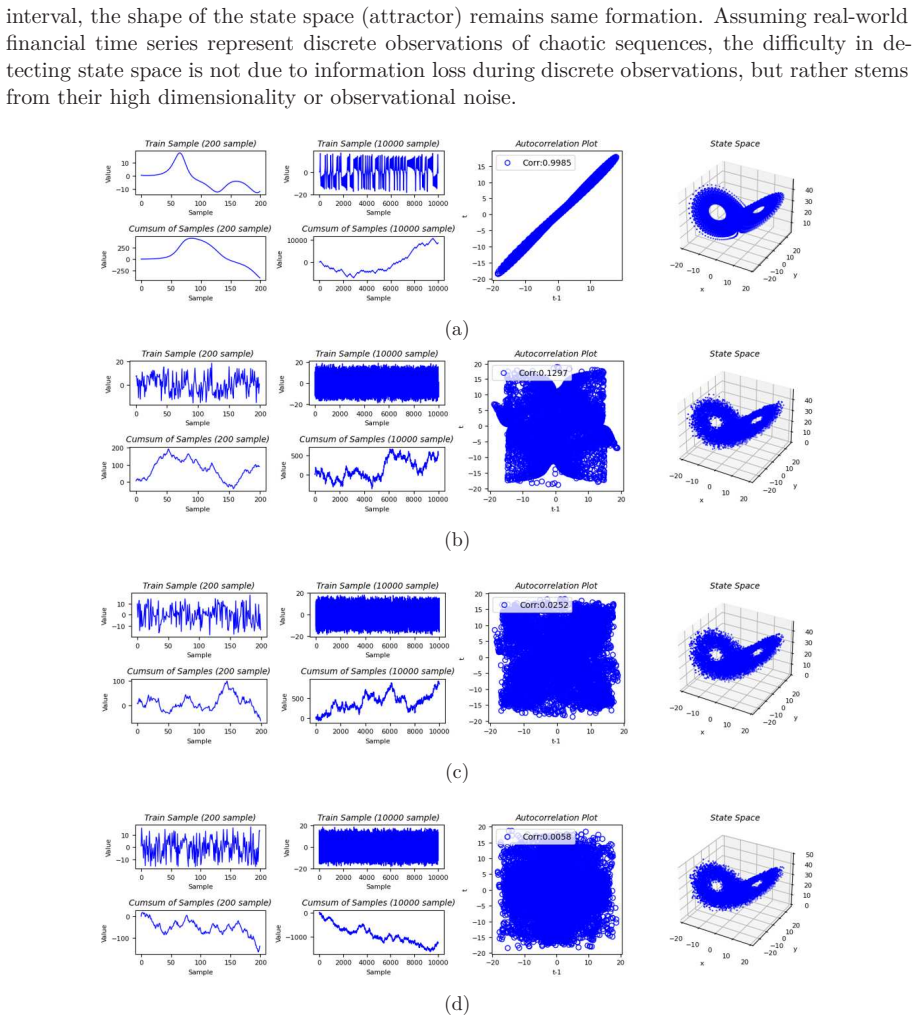
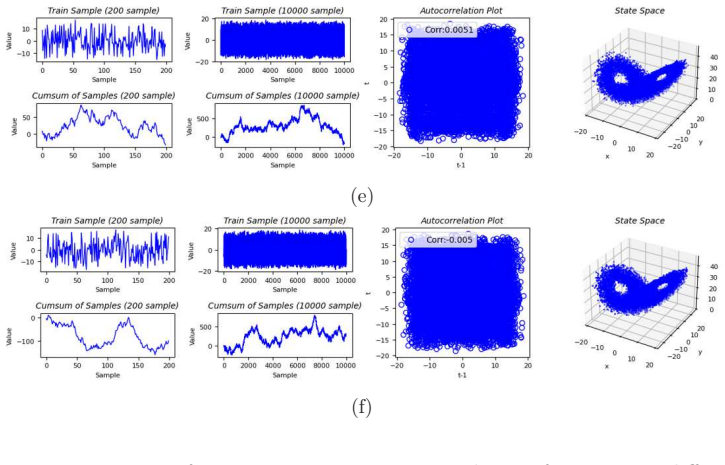
Bitcoin order flow, price change, and volume are discrete observations of a chaotic microstructure process whose state space can be approximated by resampled Lorenz trajectories with parameters in the chosen ranges; the paper gives a visual comparison but no quantitative test of this equivalence.
What would settle it
Compute the scaling-law curve for a horizon beyond 1000, say 2000, at 100 to 200 billion samples: if the correlation at 0.1 does not appear in the extrapolated sample budget, the law is an artifact of the chosen range. Alternatively, hold the resampled-Lorenz training fixed and test on a non-chaotic stochastic process with matched autocorrelation and volatility; if the model's excess return over autocorrelation disappears, the transfer is not specifically chaos.
If this is right
- If the scaling law holds, pushing from horizon 1000 to longer horizons requires 100-200 billion sample-class budgets, so the achievable look-ahead is bounded by compute and data generation cost.
- Long-horizon pretraining transfers better than horizon-matched training in the tested range; 1000-unit models dominate on Bitcoin at all timeframes, suggesting the relevant training distribution should be deliberately more 'chaotic-difficult'.
- Zero-shot transfer to real financial data, if real, makes synthetic chaotic pretraining a viable route for sub-minute trading signals without access to proprietary tick data.
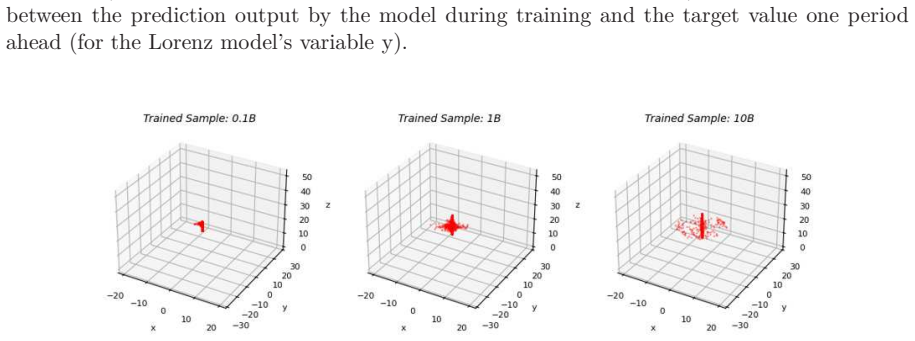
- The attractor formation during training, with the model gradually reconstructing the Lorenz state space in its predictions, provides a qualitative diagnostic for when scale is enough.
- The approach is data-inexpensive in one dimension: since chaotic trajectories are generated on the fly, 10 billion samples require no storage or curation, only simulation compute.
Where Pith is reading between the lines
- Inference: if the scaling law is a property of deterministic chaotic systems generally, the same resampling-plus-pretraining recipe should transfer to other chaotic equations such as Mackey-Glass, Rossler, or Henon; a positive result there would make the law a generic feature rather than a Lorenz quirk.
- Inference: the paper leaves open the baseline question; a stochastic process with the same autocorrelation structure as resampled Lorenz (for example, a matched AR(1)) would separate the model having learned chaos from the model having learned autocorrelation, since the current comparison uses only the autocorrelation model.
- Inference: the zero-shot profitability claim is measured pre-cost; a testable extension is to include realistic taker and maker fees at 5 to 30 second holding periods. The paper acknowledges that fees would erode profits, so the claim that matters is predictive skill, not tradable alpha.
- Inference: if the microstructure-chaos premise is right, the paper implies that very short-horizon prediction (seconds) is the regime where deterministic structure is visible, while daily returns are noise-dominated; that would help explain the conflicting evidence on financial chaos.
Editorial analysis
A structured set of objections, weighed in public.
Referee Report
Summary. The paper proposes to model financial time series by resampling chaotic Lorenz-system trajectories at various intervals, pretraining a decoder-only Transformer on 10 billion samples per horizon (100–1000 integration units), and then applying the pretrained models zero-shot to Bitcoin trade data aggregated at 5–60 second timeframes. The main claims are (i) a scaling-law-like phenomenon in which the training-sample count needed to reach an information coefficient of 0.1 grows exponentially with the predictive horizon, and (ii) that the pretrained models yield significant performance improvements over an autocorrelation baseline in a long/short trading evaluation.
Significance. If the scaling law were actually observed and transferable to financial data, this would be a notable result: it would connect chaotic dynamics pretraining with a concrete resource-accuracy trade-off and a forward-looking claim about near-future predictability. The paper is honest about several limitations (e.g., non-convergence at long horizons), reports a substantial amount of training, and gives enough architecture/training detail to be reproducible in principle. However, the central contribution is not supported by the evidence as presented: the longest-horizon scaling-law point is extrapolated from a run that never reached the stated threshold, the financial evaluation appears to contain look-ahead bias, and the transfer premise is only visually illustrated. These issues are load-bearing, so the scientific contribution as claimed is not established.
major comments (4)
- [§3.2, Fig. 9] The central scaling-law claim is not supported by the reported measurements. The text states that for horizon 1000 the correlation coefficient did not reach 0.1 even after 10B samples and that no convergence was observed; the Fig. 9 point for 1000 is therefore extrapolated from an assumed trend ('approximately 100-200 billion training samples'). An extrapolated point cannot be reported as an observed scaling law. Moreover, each horizon is represented by a single run with no error bars, the IC=0.1 threshold is arbitrary, and five points (one extrapolated) cannot distinguish exponential from power-law growth. Since the abstract and conclusions explicitly say 'observed', this is a load-bearing inconsistency.
- [§3.3, Fig. 10/11, Table 2] The trading evaluation likely contains look-ahead bias. The strategy 'longs the top 20th percentile (top 5%) and shorts the bottom 5%' is described without stating that the percentile thresholds are computed only from information available at each prediction time. If the thresholds are full-window quantiles of the prediction distribution, the backtest uses future information and the excess-return improvements are invalid. Furthermore, 'significant performance improvements' is unsupported: no significance tests are reported, Table 2 shows negative excess returns for 25s, 30s, and 60s timeframes, and the positive results are concentrated at selected horizons after inspecting all horizons. The conclusion that models with longer horizons 'consistently' outperform is contradicted by Table 2 (e.g., 5s horizon 1000 excess 0.045 vs horizon 700 excess 0.071; 60s all negative).
- [§2.1, §2.4] The transfer from Lorenz resampled data to Bitcoin is not established. The paper's mapping of x,y,z to order flow, price change, and volume is based on a reference model and a visual comparison (Fig. 4). The Introduction itself cites conflicting evidence on whether financial time series are chaotic ([6]-[10]). No quantitative test of the equivalence is provided, nor an ablation with a different chaotic system or with shuffled/randomized training data. The zero-shot excess returns could therefore be coincidental. A minimal test would be to compare the pretrained model against a model trained on resampled data with different Lorenz parameters or against ARIMA/random-signal baselines with the same evaluation protocol.
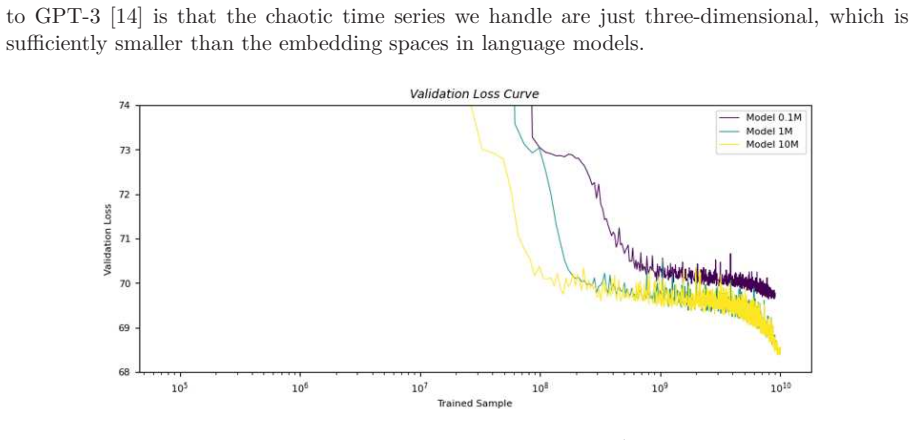
- [§3.1, §3.2] The scaling-law plot uses the crossing time of IC=0.1 from curves that, by the paper's own account, have not converged for the longest horizons. §3.1 states that for horizons 700 and 1000 'no convergence in loss reduction was observed' even at 10B samples. A crossing time read from a non-converged curve is not a stable estimator of the sample requirement; the plotted relationship may shift substantially with longer training. This is not a minor caveat but undermines the quantitative form of the claimed law.
minor comments (5)
- [Title/Abstract] Typo in title: 'Tim e' should be 'Time'.
- [Fig. 7 caption] The caption reads 'completion points of 100 million, 100 million, and 1 billion training samples'; the second value is likely a typo (e.g., 300M or 500M).
- [§3.3] 'top 20th percentile (top 5%)' is ambiguous. Clarify whether the threshold is the top 5% of predictions or the top 20th percentile (i.e., top 20%).
- [§2.4, Eq. (2.1)] Equation (2.1) appears twice with the same number; the second occurrence in §2.4 should be renumbered.
- [Table 2] No error bars or variance estimates are reported for the return/excess-return values. Given the short evaluation window, some indication of variability (e.g., bootstrap CIs) is needed.
Circularity Check
No significant circularity: the zero-shot transfer and loss scaling are empirical; the extrapolated horizon-1000 point is an overclaim, not a circular reduction.
full rationale
The paper's central derivation is not circular. The Lorenz-model training data is generated from resampled chaotic time series independently of the Bitcoin test set, and the model weights are never updated on Bitcoin data, so the zero-shot predictions are genuine out-of-sample evaluations. The scaling-law claim rests on an empirical plot of training-sample counts needed to reach IC=0.1 at each horizon (Fig. 9). The horizon-1000 point is admittedly not observed: Sec. 3.2 states the correlation coefficient 'did not reach 0.1 even at the end of the 10 billion training sample period' and the 'approximately 100-200 billion' sample estimate is an extrapolation. That is an overclaim or robustness limitation, not a definitional identity: the paper does not present a fitted equation whose evaluation is then relabeled as a prediction. Similarly, the trading strategy in Sec. 3.3 uses prediction-percentile thresholds; if those thresholds are computed on the test set, that is in-sample evaluation leakage, but the same procedure is applied to the autocorrelation baseline, and it does not make the model's output equivalent to its training target by construction. There are no load-bearing self-citations, no imported uniqueness theorems, and no ansatz smuggled in via the author's own prior work; references [4], [5], and [11] are external. The paper's honest reporting of non-convergence actually weakens the scaling-law evidence but does not create circularity. Therefore the appropriate circularity score is 0.
Axiom & Free-Parameter Ledger
free parameters (4)
- Lorenz parameter sampling ranges (sigma 9-11, rho 26-30, beta 2.3-3.1; initial x,y,z 0.18-0.22)
- Skill threshold for the scaling law (IC = 0.1) =
0.1
- Long/short quantile thresholds (top/bottom 5%) =
computed on the full test window
- Resampling intervals (predictive horizons) =
[100, 200, 300, 400, 500, 700, 1000]
axioms (4)
- domain assumption Financial time series possess chaotic properties at microstructure time scales and are discrete observations of a chaotic process
- domain assumption The Lorenz model with parameters in [9,11] x [26,30] x [2.3,3.1] is an adequate generator of financial microstructure dynamics
- domain assumption A transformer trained on resampled Lorenz sequences generalizes zero-shot to real financial returns
- domain assumption Loss is MSE over the three Lorenz channels and this objective is aligned with one-step return prediction
Cite this review
Pith. "Pith review of Scaling Law for Large-Scale Pre-Training Using Chaotic Time Series and Predictability in Financial Time Series." pith.science (2026). https://pith.science/paper/VQEJVCMM
@misc{pith2026250904921,
  author       = {Pith},
  title        = {Pith review of: Scaling Law for Large-Scale Pre-Training Using Chaotic Time Series and Predictability in Financial Time Series},
  year         = {2026},
  howpublished = {\url{https://pith.science/paper/VQEJVCMM}},
  note         = {Machine review of arXiv:2509.04921}
}
read the original abstract
Time series forecasting plays a critical role in decision-making processes across diverse fields including meteorology, traffic, electricity, economics, finance, and so on. Especially, predicting returns on financial instruments is a challenging problem. Some researchers have proposed time series foundation models applicable to various forecasting tasks. Simultaneously, based on the recognition that real-world time series exhibit chaotic properties, methods have been developed to artificially generate synthetic chaotic time series, construct diverse datasets and train models. In this study, we propose a methodology for modeling financial time series by generating artificial chaotic time series and applying resampling techniques to simulate financial time series data, which we then use as training samples. Increasing the resampling interval to extend predictive horizons, we conducted large-scale pre-training using 10 billion training samples for each case. We subsequently created test datasets for multiple timeframes using actual Bitcoin trade data and performed zero-shot prediction without re-training the pre-trained model. The results of evaluating the profitability of a simple trading strategy based on these predictions demonstrated significant performance improvements over autocorrelation models. During the large-scale pre-training process, we observed a scaling law-like phenomenon that we can achieve predictive performance at a certain level with extended predictive horizons for chaotic time series by increasing the number of training samples exponentially. If this scaling law proves robust and holds true across various chaotic models, it suggests the potential to predict near-future events by investing substantial computational resources. Future research should focus on further large-scale training and verifying the applicability of this scaling law to diverse chaotic models.
Figures






Reference graph
Works this paper leans on
-
[1]
Abdul Fatir Ansari, Lorenzo Stella, Caner Turkmen, Xiyu an Zhang, Pedro Mercado, Huibin Shen, Oleksandr Shchur, Syama Sundar Rangapuram, Sebastia n Pineda Arango, Shubham Kapoor, Jasper Zschiegner, Danielle C. Maddix, Michael W. M ahoney, Kari Torkkola, Andrew Gordon Wilson, Michael Bohlke-Schneider, and Yuyan g Wang. Chronos: Learning the Language of Tim...
work page 2024
-
[2]
Mamba4Cast: Efficient Zero-Shot Time Series Forecas ting with State Space Models
Sathya Kamesh Bhethanabhotla, Omar Swelam, Julien Siem s, David Salinas, and Frank Hutter. Mamba4Cast: Efficient Zero-Shot Time Series Forecas ting with State Space Models. CoRR (arXiv preprint) , abs/2410.09385, October 12, 2024
Pith/arXiv arXiv 2024
-
[3]
FinTSB: A Comprehensive and Prac tical Benchmark for Financial Time Series Forecasting
Yifan Hu, Yuante Li, Peiyuan Liu, Yuxia Zhu, Naiqi Li, Tao Dai, Shu-tao Xia, Dawei Cheng, and Changjun Jiang. FinTSB: A Comprehensive and Prac tical Benchmark for Financial Time Series Forecasting. CoRR (arXiv preprint) , abs/2502.18834, February 26, 2025
Pith/arXiv arXiv 2025
-
[4]
Panda: A Pre trained Forecast Model for Universal Representation of Chaotic Dynamics
Jeffrey Lai, Anthony Bao, and William Gilpin. Panda: A Pre trained Forecast Model for Universal Representation of Chaotic Dynamics. CoRR (arXiv preprint) , abs/2505.13755, May 19, 2025
arXiv 2025
-
[5]
True Zer o-Shot Inference of Dynamical Systems Preserving Long-Term Statistics
Christoph Jürgen Hemmer and Daniel Durstewitz. True Zer o-Shot Inference of Dynamical Systems Preserving Long-Term Statistics. CoRR (arXiv preprint) , abs/2505.13192, May 19, 2025
arXiv 2025
- [6]
-
[7]
David A. Hsieh. Chaos and Nonlinear Dynamics: Applicati on to Financial Markets. The Journal of Finance , vol. 46, no. 5, pp. 1839–1877, December 1991
work page 1991
-
[8]
José A. Scheinkman and Blake LeBaron. Nonlinear Dynamic s and Stock Returns. The Journal of Business , vol. 62, no. 3, pp. 311–337, July 1989
work page 1989
-
[9]
Julio E. Sandubete and Lorenzo Escot. Chaotic Signals In side Some Tick-by-Tick Financial Time Series. Chaos, Solitons & Fractals , vol. 137, Article 109852, 2020
work page 2020
-
[10]
Chaotic Analysis of the Foreign Exchange Rates
Atin Das and Pritha Das. Chaotic Analysis of the Foreign Exchange Rates. Applied Mathematics and Computation , vol. 179, no. 2, pp. 988–997, 2006
work page 2006
-
[11]
Expectations, Price Fluctuations and L orenz Attractor
Victor Olkhov. Expectations, Price Fluctuations and L orenz Attractor. MPRA Paper No. 89105, Munich Personal RePEc Archive (MPRA) , September 2018
work page 2018
-
[12]
Financial Time Series An alysis Using Total-CApEn and A vg-CApEn with Cumulative Histogram Matrix
Jinyang Li and Pengjian Shang. Financial Time Series An alysis Using Total-CApEn and A vg-CApEn with Cumulative Histogram Matrix. Communications in Nonlinear Science and Numerical Simulation , vol. 63, pp. 239–252, March 2018
work page 2018
-
[13]
Seasonal Mackey –Glass–GARCH Process and Short-Term Dynamics
Catherine Kyrtsou and Michel Terraza. Seasonal Mackey –Glass–GARCH Process and Short-Term Dynamics. Empirical Economics, vol. 38, no. 2, pp. 325–345, April 2010. 18
work page 2010
-
[14]
Gomez, Lukasz Kaiser, and Illia Polosukhin
Ashish Vaswani, Noam Shazeer, Niki Parmar, Jakob Uszko reit, Llion Jones, Aidan N. Gomez, Lukasz Kaiser, and Illia Polosukhin. Attention is Al l You Need. In Advances in Neural Information Processing Systems 30 (NeurIPS 2017) , pp. 5998–6008, December 2017
work page 2017
-
[15]
I nformer: Beyond Efficient Transformer for Long Sequence Time-Series Forecasting
Haixu Wu, Jiehui Xu, Jianmin Wang, and Mingsheng Long. I nformer: Beyond Efficient Transformer for Long Sequence Time-Series Forecasting. In Proceedings of the AAAI Con- ference on Artificial Intelligence (AAAI 2021) , vol. 35, no. 12, pp. 11106–11115, May 2021
work page 2021
-
[16]
Bryan Lim and Sercan Ö. Arik. Temporal Fusion Transformers for Interpretable Mu lti- Horizon Time Series Forecasting. In Proceedings of the 28th ACM SIGKDD Conference on Knowledge Discovery and Data Mining (KDD 2022) , pp. 1267–1275, August 2021
work page 2022
-
[17]
Tom B. Brown, Benjamin Mann, Nick Ryder, Melanie Subbia h, Jared Kaplan, Prafulla Dhariwal, Arvind Neelakantan, Pranav Shyam, Girish Sastry , Amanda Askell, Sandhini Agarwal, Ariel Herbert-Voss, Gretchen Krueger, Tom Henigh an, Rewon Child, Aditya Ramesh, Daniel M. Ziegler, Jeffrey Wu, Clemens Winter, Chris topher Hesse, Mark Chen, Eric Sigler, Mateusz Lit...
work page 2020
This paper was first reviewed by deepseek-v4-flash on August 5, 2026.
discussion (0)
Sign in with ORCID, Apple, or X to comment. Anyone can read and Pith papers without signing in.