REVIEW 3 major objections 5 minor 2 cited by
Dual-loop edge-terminal collaboration makes LLM agents plan better and run faster in 6G services.
Reviewed by Pith at T0; open to challenge. T0 means a machine referee read the full paper against a public rubric. the ladder, T0–T4 →
T0 review · deepseek-v4-flash
2026-08-05 05:41 UTC pith:7DQ5FEGR
load-bearing objection Plausible framework, clearly written, but the execution-efficiency half of the central claim rests on a simulated scheduler and a survivor-filtered comparison; worth a referee, not worth citing as a validated result. the 3 major comments →
LLM Enabled Multi-Agent System for 6G Networks: Framework and Method of Dual-Loop Edge-Terminal Collaboration
The pith
A machine-rendered reading of the paper's core claim, the machinery that carries it, and where it could break.
Core claim
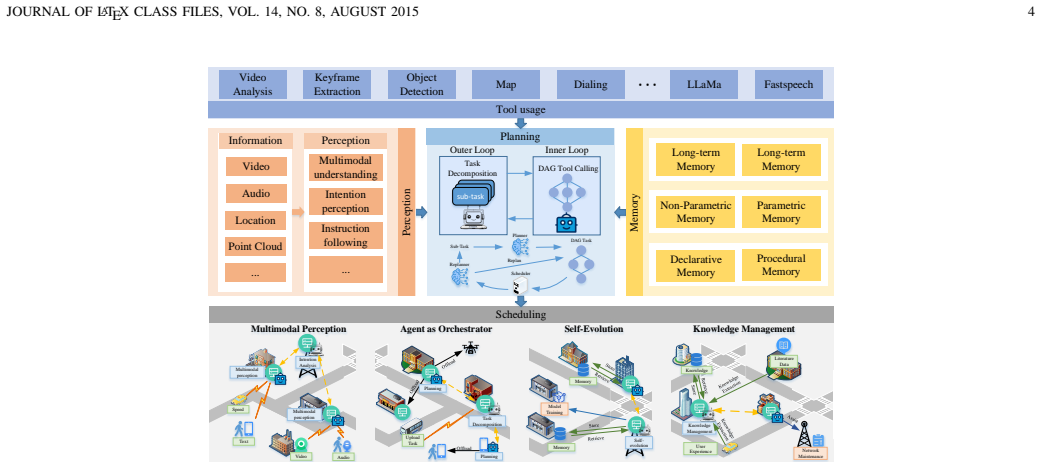
On its own terms, the paper establishes that combining hierarchical task decomposition with parallel tool-call planning is a workable design for LLM agents in resource-constrained 6G networks. The outer loop keeps each sub-agent's reasoning short by decomposing the user request into parallel subtasks; the inner loop builds on LLMCompiler so independent tool calls run in parallel as a directed acyclic graph instead of sequentially. In the case study, the dual-loop system achieves higher success rates than ReAct and plain LLMCompiler across easy, medium, and hard tasks, and, when tool executions are scheduled onto five edge servers and ten terminals, reduces latency compared with cloud-only or
What carries the argument
The central mechanism is the dual loop. In the outer loop, a global agent on the edge decomposes each user request into parallel subtasks and assigns them to role-specific sub-agents on terminals, then aggregates the results. In the inner loop, each sub-agent generates a directed acyclic graph (DAG) of tool calls, executes independent branches in parallel, reflects on feedback, and replans. A priority-based scheduler that sorts tools by critical-path length offloads executions to heterogeneous edge and terminal resources. The DAG-based parallel tool calling is what turns task decomposition into latency savings.
Load-bearing premise
The recorded latency gains assume a simulated scheduling model with deterministic tool runtimes and no real-world communication contention; real 6G networks would need to reproduce those conditions.
What would settle it
Measure end-to-end latency on a real or packet-level 6G testbed with background traffic, variable link quality, and failed or retried tasks included in the statistics; if the dual-loop system does not consistently beat sequential baselines under that contention, the latency claim fails.
If this is right
- Complex 6G service requests can be handled by smaller on-device models, because each subtask demands less reasoning than the full task.
- Service latency can scale with the width of the tool-dependency graph rather than the number of tools, so independent branches no longer wait in line.
- The same dual-loop pattern transfers to network slicing, digital twins, and satellite-ground communication by swapping role-specific sub-agents and toolkits.
- Memory and few-shot experience let the system reuse successful plans, moving toward the self-evolution that 6G envisions.
Where Pith is reading between the lines
- The success-rate result is reported only for simulated tasks; a stronger test would apply the dual-loop design to real network-planning benchmarks with noisy or unreliable tool outputs.
- The latency reduction depends on tool runtimes being predictable, so in real networks with variable communication delays the scheduler may need dynamic critical-path updates rather than a priority queue computed once.
- Because the latency statistic counts only successfully planned and executed tasks, the reported efficiency gain may not reflect end-to-end behavior when failures trigger replanning.
- The same hierarchical decomposition pattern could benefit non-6G edge-AI systems by separating a global planner from local, role-specialized executors.
Editorial analysis
A structured set of objections, weighed in public.
Referee Report
Summary. The paper proposes a dual-loop, LLM-enabled multi-agent framework for 6G networks. In the outer loop, a global agent decomposes complex requests into parallel subtasks and assigns them to role-specific sub-agents; in the inner loop, each sub-agent uses LLMCompiler-style parallel tool-call DAG generation and replanning, while a scheduling layer offloads tool executions to edge servers and terminals. The authors claim that this architecture improves task planning success rate and execution latency, and support the claim with a case study in urban safety governance where the proposed system is compared against ReAct and LLMCompiler. The paper also surveys 6G agent functions and discusses open challenges such as on-device deployment, context-window limits, communication overhead, and hallucination.
Significance. If the empirical claims were fully supported, the paper would make a useful systems contribution at the intersection of LLM agents and 6G edge/terminal computing. The architectural idea of combining hierarchical task decomposition, parallel tool calling, and device-level offloading is plausible and timely, and the open-challenges discussion provides helpful context. The paper's falsifiable performance comparisons (success rate and latency) are the right kind of evidence, and the stated use of specific models (MiniCPM-V 2.6, GLM-4-0520) gives some concreteness. However, the current validation is not strong enough to support the abstract's claim of improved task planning capability and task execution efficiency: success-rate comparisons lack statistical detail, and the latency results are produced by an idealized scheduling simulation rather than end-to-end measurements. The central claims are therefore defensible but require substantially stronger evidence.
major comments (3)
- [Section IV (Case Study), Fig. 5] The execution-latency claim is load-bearing for the 'task execution efficiency' half of the abstract, but the latency values are 'calculated based on the generated tool topology' with a priority-based scheduler, not measured on the deployed system. The simulation includes 5 edge servers and 10 terminals with 'heterogeneous computational resources,' yet no model of wireless/backhaul transmission delays, queueing, contention, or actual heterogeneous tool runtimes is provided. These are precisely the dominant factors in real 6G edge-terminal execution, and Section V-3 itself identifies communication overhead as an open challenge. As written, Fig. 5 demonstrates properties of an idealized scheduler, not of the proposed system in a 6G setting. Please provide end-to-end measurements on a real testbed, or at minimum a thoroughly specified network-aware simulation with transmission/contention pa
- [Section IV (Case Study), Fig. 4 and Fig. 5] The success-rate comparison reports no error bars, confidence intervals, sample sizes, or number of tasks per difficulty level, so the 'best performance' claim cannot be assessed statistically. For latency, the paper states that 'only tasks with successful planning and execution are considered.' This introduces survivor bias: ReAct, LLMCompiler, and the proposed system succeed on different subsets of tasks, so lower average latency on the successful subset may reflect task composition (e.g., succeeding mainly on easy tasks) rather than execution efficiency. This is a serious issue for the central comparison, since planning capability and execution efficiency are being conflated. Please report per-difficulty success counts, per-system successful-task sets, and latency distributions with variance, and consider analyzing all attempted tasks with a suitable penalty for failures.
- [Section III-C and Section IV] The proposed system integrates LLMCompiler as part of its inner loop, but LLMCompiler is also used as a baseline. The paper should specify the exact experimental protocol for the baseline: does it run without the outer-loop task decomposition and without the offloading/scheduling layer? What prompts, tool schemas, and device assignments are used? Without this information, and without an ablation study (e.g., the proposed system without decomposition, or without offloading), the improvement attributed to the dual-loop framework cannot be separated from the added components. This is essential for reproducing the reported gains and for interpreting them as support for the framework rather than for implementation choices.
minor comments (5)
- [Section III-C] The sentence 'the inner loop consists of LLMCompiler [4]' is imprecise: the inner loop is an agent architecture that adopts LLMCompiler-style parallel function calling, not the LLMCompiler method itself. Please rephrase to avoid confusion with the baseline.
- [Fig. 2] Figure 2 is extremely dense, with many small labels (e.g., 'LLaMa', 'Fastspeech', 'DAG', 'Scheduling') that are not explained in the text. Please enlarge, simplify, or provide a legend so the architecture can be read independently.
- [Section IV] Please report the units and dispersion of the latency values in Fig. 5, and specify the number of trials and random seeds. Zero temperature is stated for GLM-4-0520, but details for the MLLM and other stochastic components are missing.
- [General] The paper does not state whether code, prompts, or data will be released. Given the empirical nature of the central claims, releasing the task set and evaluation scripts would substantially improve reproducibility.
- [Section IV] The phrase '6G-supported urban safety governance' suggests a real 6G network, but the case study is a simulation. Please adjust the wording to 'simulated 6G scenario' to avoid overstatement.
Circularity Check
No significant circularity: the dual-loop system is evaluated against external baselines, and the load-bearing assumptions are explicit simulation choices rather than fitted or self-referential quantities.
full rationale
The paper's central claims are the improved task planning capability and task execution efficiency of a dual-loop MAS. The success rate (Fig. 4) is compared against ReAct [13] and LLMCompiler [4], both external published methods; no component of the proposed system is fitted to the test set, and no equation defines the reported advantage in terms of the system's own outputs. The execution latency (Fig. 5) is 'calculated based on the generated tool topology' using a priority-based scheduler with critical-path sorting, and only tasks with successful planning and execution are considered. These are explicit modeling and evaluation choices: they mean the latency result is a property of the stated simulation model (more devices, parallel DAGs, deterministic scheduling) rather than a measurement on a real 6G testbed. That is a validity/realism limitation, not circularity, because the comparison is still between independently specified methods under a common model, and the paper does not define the conclusion into the setup. No self-citation chain, imported uniqueness theorem, or renamed known result carries the argument. The framework explicitly incorporates LLMCompiler [4] and ReAct [13] as external baselines/components, so the contribution remains distinguishable from its inputs.
Axiom & Free-Parameter Ledger
axioms (4)
- domain assumption LLMs can reliably perform task decomposition and role-based sub-task planning when provided with few-shot examples.
- ad hoc to paper The priority-based scheduler with critical-path sorting is an adequate model of execution latency on heterogeneous edge/terminal devices.
- domain assumption MiniCPM-V and GLM-4-0520 provide sufficient multimodal perception and planning capabilities to represent the implemented system.
- domain assumption The emergency-response task set is a representative sample of complex 6G agent workloads.
Cite this review
Pith. "Pith review of LLM Enabled Multi-Agent System for 6G Networks: Framework and Method of Dual-Loop Edge-Terminal Collaboration." pith.science (2026). https://pith.science/paper/7DQ5FEGR
@misc{pith2026250904993,
  author       = {Pith},
  title        = {Pith review of: LLM Enabled Multi-Agent System for 6G Networks: Framework and Method of Dual-Loop Edge-Terminal Collaboration},
  year         = {2026},
  howpublished = {\url{https://pith.science/paper/7DQ5FEGR}},
  note         = {Machine review of arXiv:2509.04993}
}
read the original abstract
The ubiquitous computing resources in 6G networks provide ideal environments for the fusion of large language models (LLMs) and intelligent services through the agent framework. With auxiliary modules and planning cores, LLM-enabled agents can autonomously plan and take actions to deal with diverse environment semantics and user intentions. However, the limited resources of individual network devices significantly hinder the efficient operation of LLM-enabled agents with complex tool calls, highlighting the urgent need for efficient multi-level device collaborations. To this end, the framework and method of the LLM-enabled multi-agent system with dual-loop terminal-edge collaborations are proposed in 6G networks. Firstly, the outer loop consists of the iterative collaborations between the global agent and multiple sub-agents deployed on edge servers and terminals, where the planning capability is enhanced through task decomposition and parallel sub-task distribution. Secondly, the inner loop utilizes sub-agents with dedicated roles to circularly reason, execute, and replan the sub-task, and the parallel tool calling generation with offloading strategies is incorporated to improve efficiency. The improved task planning capability and task execution efficiency are validated through the conducted case study in 6G-supported urban safety governance. Finally, the open challenges and future directions are thoroughly analyzed in 6G networks, accelerating the advent of the 6G era.
Figures



Forward citations
Cited by 2 Pith papers
-
Cost and Accuracy of Long-Term Memory in Distributed Multi-Agent Systems Based on Large Language Models
A two-framework testbed comparison claims mem0 is Pareto-optimal over Graphiti for distributed LLM agents because its lower cost is paired with accuracy that is not significantly different.
-
Wireless Copilot: An AI-Powered Partner for Navigating Next-Generation Wireless Complexity
Introduces a human-in-the-loop 'Wireless Copilot' framework for 6G network management, with a LAWNets simulation showing higher intent satisfaction than LLM/RL baselines.
Reference graph
Works this paper leans on
-
[1]
A. Farajzadehet al., ”Self-Evolving Integrated Vertical Heterogeneous Networks,”IEEE Open Journal of the Communications Society, vol. 4, 2023, pp. 552-580
work page 2023
-
[2]
C. -X. Wanget al., ”On the Road to 6G: Visions, Requirements, Key Technologies, and Testbeds,”IEEE Communications Surveys & Tutorials, vol. 25, no. 2, 2023, pp. 905-974
work page 2023
-
[3]
C. Chaccouret al., ”Telecom’s Artificial General Intelli- gence (AGI) Vision: Beyond the GenAI Frontier,”IEEE Network, vol. 38, no. 5, 2024, pp. 21-28
work page 2024
-
[4]
S. Kimet al., ”An LLM compiler for parallel function calling,” arXiv preprint arXiv: 2312.04511, Jun 2024
Pith/arXiv arXiv 2024
-
[5]
Y . Zhaoet al., ”LaMoSC: Large Language Model-Driven Semantic Communication System for Visual Transmis- sion,”IEEE Transactions on Cognitive Communications and Networking, vol. 10, no. 6, 2024, pp. 2005-2018
work page 2024
-
[6]
I. Chatzistefanidiset al., ”Maestro: LLM-Driven Collab- orative Automation of Intent-Based 6G Networks,”IEEE Networking Letters, 2024
work page 2024
-
[7]
M. Xuet al., ”When Large Language Model Agents Meet 6G Networks: Perception, Grounding, and Alignment,” IEEE Wireless Communications, vol. 31, no. 6, 2024, pp. 63-71
work page 2024
-
[8]
A. M. Rahmani,et al., ”Optimizing task offloading with metaheuristic algorithms across cloud, fog, and edge com- puting networks: A comprehensive survey and state-of- the-art schemes,”Sustain. Comput. Informatics Syst., vol. 45, 2025, pp. 101080
work page 2025
-
[9]
Y . Xiaet al., ”LLM experiments with simulation: Large Language Model Multi-Agent System for Process Sim- ulation Parametrization in Digital Twins,” arXiv preprint arXiv: 2405.18092, Jul 2024
Pith/arXiv arXiv 2024
-
[10]
S. Luet al., ”MorphAgent: Empowering Agents through Self-Evolving Profiles and Decentralized Collaboration,” arXiv preprint arXiv: 2410.15048, Oct 2024
Pith/arXiv arXiv 2024
-
[11]
E. J. Huet al., ”LoRA: Low-Rank Adaptation of Large Language Models,” arXiv preprint arXiv: 2106.09685, Oct 2021
Pith/arXiv arXiv 2021
-
[12]
Y . Zhuet al., ”KnowAgent: Knowledge-Augmented Planning for LLM-Based Agents,” arXiv preprint arXiv: 2403.03101, Mar 2024
Pith/arXiv arXiv 2024
-
[13]
S. Yaoet al., ”ReAct: Synergizing Reasoning and Acting in Language Models,” arXiv preprint arXiv: 2210.03629, Mar 2023
Pith/arXiv arXiv 2023
-
[14]
Y . Yaoet al., ”MiniCPM-V: A GPT-4V Level MLLM on Your Phone,” arXiv preprint arXiv: 2408.01800, Aug 2024
Pith/arXiv arXiv 2024
-
[15]
A. Zenget al., ”ChatGLM: A Family of Large Language Models from GLM-130B to GLM-4 All Tools,” arXiv preprint arXiv: 2406.12793, Jul 2024. VIII. BIOGRAPHYSECTION ZHEYAN QU(zheyanqu@bupt.edu.cn) is currently pursuing the M.S. degree at Beijing University of Posts and Telecommunications, China. His research interests include edge intelligence, multi-agent sy...
Pith/arXiv arXiv 2024
discussion (0)
Sign in with ORCID, Apple, or X to comment. Anyone can read and Pith papers without signing in.