Quantum anomalous Hall phases in gated rhombohedral graphene
Pith reviewed 2026-05-18 18:11 UTC · model grok-4.3
The pith
A coupled Dirac operator model classifies all quantum anomalous Hall phases in gated rhombohedral graphene and links them to chiral edge states with quantized current.
A machine-rendered reading of the paper's core claim, the machinery that carries it, and where it could break.
Core claim
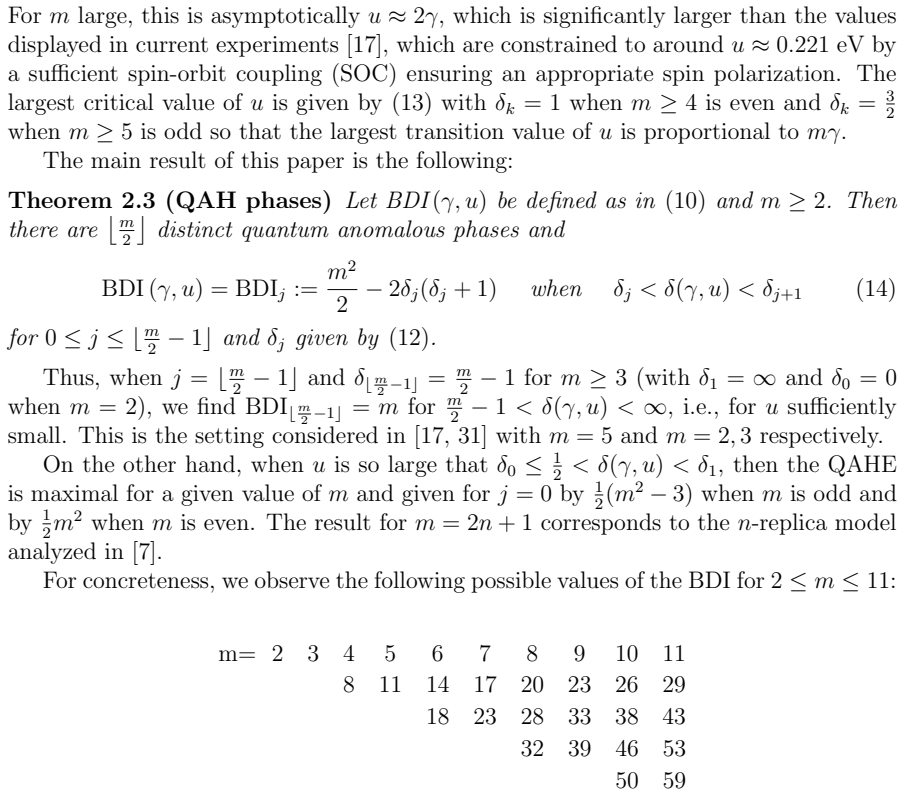
We consider a coupled system of Dirac operators that models spin- and valley-polarized gated rhombohedral graphene with an arbitrary number of layers. We classify all quantum anomalous Hall phases that are compatible with the model and show that a bulk-edge correspondence exists between bulk phases and chiral edge states carrying a quantized anomalous Hall current. When the displacement field is sufficiently small compared to the interlayer coupling in the RHG application, we retrieve the known phases where the charge is given by the number of graphene layers. When the displacement field increases, we identify all possible topological phase transitions and corresponding quantized chiral edge
What carries the argument
The coupled system of Dirac operators that encodes the rhombohedral multilayer stacking together with the gate-induced displacement field.
If this is right
- For small displacement fields the anomalous Hall charge equals the number of graphene layers.
- Increasing the displacement field triggers topological phase transitions that change the number of quantized chiral edge charges.
- The bulk-edge correspondence guarantees matching chiral edge states for every classified bulk phase.
- Numerical simulations confirm the complete set of phases and transitions allowed by the model.
Where Pith is reading between the lines
- Varying gate voltage in experiment could select among the predicted numbers of conducting edge channels.
- The classification supplies a concrete way to predict how many edge channels appear for given layer count and field strength.
- The same operator approach may classify phases in other multilayer 2D systems with similar stacking.
Load-bearing premise
The physical gated rhombohedral graphene system with spin and valley polarization is faithfully represented by the chosen coupled system of Dirac operators.
What would settle it
An experimental count of chiral edge modes or measured Hall conductivity in a sample with known layer number and displacement field that deviates from the quantized values predicted by the classification.
Figures


read the original abstract
We consider a coupled system of Dirac operators that models spin- and valley-polarized gated rhombohedral graphene (RHG) with an arbitrary number of layers. We classify all quantum anomalous Hall phases that are compatible with the model and show that a bulk-edge correspondence exists between bulk phases and chiral edge states carrying a quantized anomalous Hall current. When the displacement field is sufficiently small compared to the interlayer coupling in the RHG application, we retrieve the known phases where the charge is given by the number of graphene layers. When the displacement field increases, we identify all possible topological phase transitions and corresponding quantized chiral edge charges. Numerical simulations confirm the theoretical findings.
Editorial analysis
A structured set of objections, weighed in public.
Referee Report
Summary. The manuscript analyzes a coupled system of Dirac operators modeling spin- and valley-polarized gated rhombohedral graphene with an arbitrary number of layers. It classifies all quantum anomalous Hall phases compatible with the model, establishes a bulk-edge correspondence linking bulk topological invariants to chiral edge states carrying quantized anomalous Hall current, recovers the known layer-number-dependent phases at small displacement field D, and identifies additional topological transitions at larger D, with numerical simulations presented as confirmation.
Significance. If the effective Dirac model remains faithful in the large-D regime, the complete classification and bulk-edge correspondence would provide a predictive framework for locating new QAH states in multilayer rhombohedral graphene, extending existing results and offering concrete guidance for transport experiments targeting quantized chiral currents.
major comments (2)
- [Model description] Model description (opening paragraphs): the central claim that new QAH phases and transitions appear for D comparable to or larger than the interlayer coupling rests on the unverified assumption that the low-energy Dirac approximation continues to capture the correct gap structure and Chern numbers; no comparison is shown to a tight-binding Hamiltonian that includes trigonal warping or next-nearest-neighbor terms in this regime.
- [Numerical simulations] Numerical simulations section: the statement that simulations confirm the theoretical phase diagram lacks explicit details on how Chern numbers or edge-state spectra are extracted for the large-D cases, making it impossible to judge whether the numerics independently test the extrapolation beyond the Dirac-point regime.
minor comments (1)
- [Abstract] The abstract and introduction could clarify whether the bulk-edge correspondence is proved for the full family of coupled Dirac operators or only for the RHG parameter choices.
Simulated Author's Rebuttal
We thank the referee for the careful reading of our manuscript and for the constructive comments. We appreciate the positive assessment of the classification and bulk-edge correspondence. We address each major comment below and outline the revisions we will make.
read point-by-point responses
-
Referee: [Model description] Model description (opening paragraphs): the central claim that new QAH phases and transitions appear for D comparable to or larger than the interlayer coupling rests on the unverified assumption that the low-energy Dirac approximation continues to capture the correct gap structure and Chern numbers; no comparison is shown to a tight-binding Hamiltonian that includes trigonal warping or next-nearest-neighbor terms in this regime.
Authors: We agree that the range of validity of the effective Dirac model for large displacement fields is an important consideration. Our analysis is performed entirely within the coupled Dirac-operator model, which is the standard low-energy effective theory for gated rhombohedral graphene. Within this framework the topological classification, bulk invariants, and bulk-edge correspondence are exact. We will add a dedicated paragraph in the revised manuscript discussing the regime of applicability, noting that trigonal warping and next-nearest-neighbor terms become relevant only when D greatly exceeds the interlayer coupling scale; the topological transitions we identify occur at intermediate D where the Dirac approximation remains faithful. We will also reference existing tight-binding studies that support the persistence of the Dirac-like gap structure in this window. revision: partial
-
Referee: [Numerical simulations] Numerical simulations section: the statement that simulations confirm the theoretical phase diagram lacks explicit details on how Chern numbers or edge-state spectra are extracted for the large-D cases, making it impossible to judge whether the numerics independently test the extrapolation beyond the Dirac-point regime.
Authors: We apologize for the insufficient methodological detail. In the revised manuscript we will expand the numerical section to specify that Chern numbers are obtained by integrating the Berry curvature over a dense k-space mesh using the standard discretized formula, while edge-state spectra are computed for finite-width ribbons with open boundaries in the transverse direction. These calculations are performed with the identical effective Hamiltonian employed in the analytic part of the work, thereby providing an independent numerical confirmation of the phase diagram, including the large-D transitions. revision: yes
Circularity Check
No circularity: classification derived directly from Dirac-operator model analysis
full rationale
The paper defines a coupled system of Dirac operators as the model for spin- and valley-polarized gated rhombohedral graphene, then performs a mathematical classification of all quantum anomalous Hall phases compatible with that model and establishes bulk-edge correspondence via analysis of the operator spectrum and topological invariants. Known phases for small displacement field are recovered as special cases of the same classification, while new transitions at larger fields follow from the model's parameter dependence; numerical simulations serve as independent verification rather than input fitting. No step reduces a prediction to a fitted parameter by construction, invokes a self-citation as the sole justification for a uniqueness claim, or renames an external result. The derivation remains self-contained within the stated model assumptions.
Axiom & Free-Parameter Ledger
axioms (1)
- domain assumption Gated rhombohedral graphene with spin and valley polarization is modeled by a coupled system of Dirac operators.
Lean theorems connected to this paper
-
IndisputableMonolith/Foundation/AlexanderDuality.leanalexander_duality_circle_linking unclear?
unclearRelation between the paper passage and the cited Recognition theorem.
We consider a coupled system of Dirac operators that models spin- and valley-polarized gated rhombohedral graphene (RHG) with an arbitrary number of layers... classify all quantum anomalous Hall phases... bulk-difference invariant (BDI)
What do these tags mean?
- matches
- The paper's claim is directly supported by a theorem in the formal canon.
- supports
- The theorem supports part of the paper's argument, but the paper may add assumptions or extra steps.
- extends
- The paper goes beyond the formal theorem; the theorem is a base layer rather than the whole result.
- uses
- The paper appears to rely on the theorem as machinery.
- contradicts
- The paper's claim conflicts with a theorem or certificate in the canon.
- unclear
- Pith found a possible connection, but the passage is too broad, indirect, or ambiguous to say the theorem truly supports the claim.
Reference graph
Works this paper leans on
-
[1]
J. E. Avron, R. Seiler, and B. Simon , Charge deficiency, charge transport and comparison of dimensions , Comm. Math. Phys., 159 (1994), pp. 399--422
work page 1994
-
[2]
G. Bal , Continuous bulk and interface description of topological insulators , Journal of Mathematical Physics, 60 (2019)
work page 2019
-
[3]
height 2pt depth -1.6pt width 23pt, Topological invariants for interface modes , Communications in Partial Differential Equations, 47 (2022), pp. 1636--1679
work page 2022
-
[4]
height 2pt depth -1.6pt width 23pt, Topological charge conservation for continuous insulators , Journal of Mathematical Physics, 64 (2023), p. 031508
work page 2023
- [5]
-
[6]
G. Bal, P. Cazeaux, D. Massatt, and S. Quinn , Mathematical models of topologically protected transport in twisted bilayer graphene , Multiscale Modeling & Simulation, 21 (2023), pp. 1081--1121
work page 2023
- [7]
- [8]
-
[9]
B. A. Bernevig and T. L. Hughes , Topological insulators and topological superconductors , Princeton university press, 2013
work page 2013
-
[10]
P. Delplace, J. Marston, and A. Venaille , Topological origin of equatorial waves , Science, 358 (2017), pp. 1075--1077
work page 2017
-
[11]
A. Drouot , Microlocal analysis of the bulk-edge correspondence , Communications in Mathematical Physics, 383 (2021), p. 2069–2112
work page 2021
-
[12]
Topological edge states of continuous Hamiltonians
M. Frazier and G. Bal , Topological edge states of continuous hamiltonians , arXiv preprint arXiv:2503.11811, (2025)
work page internal anchor Pith review Pith/arXiv arXiv 2025
- [13]
- [14]
-
[15]
F. D. M. Haldane , Model for a Quantum Hall Effect without Landau Levels: Condensed-Matter Realization of the "Parity Anomaly" , Phys. Rev. Lett., 61 (1988), pp. 2015--2018
work page 1988
-
[16]
F. D. M. Haldane and S. Raghu , Possible realization of directional optical waveguides in photonic crystals with broken time-reversal symmetry , Phys. Rev. Lett., 100 (2008), p. 013904
work page 2008
-
[17]
T. Han, Z. Lu, Y. Yao, J. Yang, J. Seo, C. Yoon, K. Watanabe, T. Taniguchi, L. Fu, F. Zhang, and L. Ju , Large quantum anomalous Hall effect in spin-orbit proximitized rhombohedral graphene , Science, 384 (2024), pp. 647--651
work page 2024
-
[18]
G. W. Hanson, S. Gangaraj, and A. Nemilentsau , Notes on photonic topological insulators and scattering-protected edge states-a brief introduction , arXiv preprint arXiv:1602.02425, (2016)
work page internal anchor Pith review Pith/arXiv arXiv 2016
-
[19]
Kato , Perturbation theory for linear operators , vol
T. Kato , Perturbation theory for linear operators , vol. 132, Springer Science & Business Media, 2013
work page 2013
-
[20]
K. v. Klitzing, G. Dorda, and M. Pepper , New method for high-accuracy determination of the fine-structure constant based on quantized Hall resistance , Physical review letters, 45 (1980), p. 494
work page 1980
-
[21]
L. Lu, J. D. Joannopoulos, and M. Solja c i \'c , Topological photonics , Nature Photonics, 8 (2014), pp. 821--829
work page 2014
-
[22]
J. W. McIver, B. Schulte, F.-U. Stein, T. Matsuyama, G. Jotzu, G. Meier, and A. Cavalleri , Light-induced anomalous hall effect in graphene , Nature physics, 16 (2020), pp. 38--41
work page 2020
- [23]
-
[24]
P. M. Perez-Piskunow, L. E. F. Foa Torres, and G. Usaj , Hierarchy of Floquet gaps and edge states for driven honeycomb lattices , Phys. Rev. A, 91 (2015), p. 043625
work page 2015
-
[25]
E. Prodan and H. Schulz-Baldes , Bulk and boundary invariants for complex topological insulators: From K-Theory to Physics , Springer Verlag, Berlin, 2016
work page 2016
-
[26]
S. Quinn and G. Bal , Approximations of interface topological invariants , SIAM Journal on Mathematical Analysis, 56 (2024), pp. 5521--5582
work page 2024
-
[27]
S. Rossi and A. Tarantola , Topology of 2D Dirac operators with variable mass and an application to shallow-water waves , Journal of Physics A: Mathematical and Theoretical, 57 (2024), p. 065201
work page 2024
-
[28]
M. G. Silveirinha , Chern invariants for continuous media , Physical Review B, 92 (2015), p. 125153
work page 2015
-
[29]
height 2pt depth -1.6pt width 23pt, Bulk-edge correspondence for topological photonic continua , Physical Review B, 94 (2016), p. 205105
work page 2016
-
[30]
D. J. Thouless, M. Kohmoto, M. P. Nightingale, and M. den Nijs , Quantized Hall Conductance in a Two-Dimensional Periodic Potential , Phys. Rev. Lett., 49 (1982), pp. 405--408
work page 1982
- [31]
- [32]
discussion (0)
Sign in with ORCID, Apple, or X to comment. Anyone can read and Pith papers without signing in.