Handling Data Gaps for the Next Generation of Gravitational-Wave Observatories
Pith reviewed 2026-05-18 18:28 UTC · model grok-4.3
The pith
A time-frequency formulation makes Bayesian data augmentation practical for filling gaps in long-duration gravitational-wave signals.
A machine-rendered reading of the paper's core claim, the machinery that carries it, and where it could break.
Core claim
We present a new, computationally efficient approach to Bayesian data augmentation in the time-frequency domain that avoids repeated, costly matrix operations. We show that our approach efficiently solves the problem of data gaps in simulated LISA data, and can be smoothly integrated into the LISA Global Fit. The same approach can also be used for future 3G ground-based interferometers.
What carries the argument
Time-frequency domain Bayesian data augmentation that fills gaps to suppress spectral leakage from finite wavelet filters without repeated matrix operations.
If this is right
- Data gaps in LISA observations can be filled accurately enough to recover injected signals without visible spectral leakage.
- The procedure integrates directly into the existing LISA Global Fit pipeline.
- The same gap-handling technique extends to planned third-generation ground-based interferometers.
- Non-stationary noise and gap-induced artifacts are treated jointly within a single time-frequency framework.
Where Pith is reading between the lines
- Longer signal durations expected in future detectors make gap filling a routine rather than occasional step in the analysis chain.
- The computational savings could allow more frequent re-analysis of data segments as new calibration information arrives.
- Similar gap-handling logic may transfer to other long-duration time-series measurements that use wavelet bases.
Load-bearing premise
Reformulating the gap filling in the time-frequency domain lets the Bayesian calculations proceed without the slow repeated matrix math required before.
What would settle it
Apply the method to simulated LISA data sets that contain both known injected signals and realistic gaps, then compare the recovered signal parameters and residual noise spectrum against the same data analyzed without gap filling.
Figures




read the original abstract
In the coming decades, as the low frequency sensitivity of detectors improves, the time that gravitational-wave signals remain in the sensitive band will increase, leading to new challenges in analyzing data, namely non-stationary noise and data gaps. Time-frequency (wavelet) methods can efficiently handle non-stationary noise, but data gaps still lead to spectral leakage due to the finite length of the wavelet filters. It was previously shown that Bayesian data augmentation - "gap filling" - could mitigate spectral leakage in frequency domain analyses, but the computational cost associated with the matrix operations needed in that approach is prohibitive. Here we present a new, computationally efficient approach to Bayesian data augmentation in the time-frequency domain that avoids repeated, costly matrix operations. We show that our approach efficiently solves the problem of data gaps in simulated LISA data, and can be smoothly integrated into the LISA Global Fit. The same approach can also be used for future 3G ground-based interferometers.
Editorial analysis
A structured set of objections, weighed in public.
Referee Report
Summary. The manuscript presents a new Bayesian data augmentation method formulated in the time-frequency (wavelet) domain to address spectral leakage from data gaps in long-duration gravitational-wave signals. Building on earlier frequency-domain gap-filling techniques, the approach is claimed to avoid repeated costly matrix operations, to efficiently handle gaps in simulated LISA data, and to integrate smoothly into the LISA Global Fit while also being applicable to third-generation ground-based detectors.
Significance. If the scalability and integration claims are substantiated, the work would provide a practical tool for analyzing non-stationary data with gaps in next-generation observatories, where signals remain in band for extended periods. It could improve the fidelity of joint inferences without prohibitive computational overhead, complementing existing time-frequency methods for non-stationary noise.
major comments (2)
- [Abstract] Abstract: the claim that the method 'efficiently solves the problem of data gaps in simulated LISA data' and 'can be smoothly integrated into the LISA Global Fit' is unsupported by any quantitative metrics, error budgets, scaling tests, or baseline comparisons. This is load-bearing for the central performance assertion, especially given the skeptic concern that isolated short-segment runs do not secure tractability for year-long segments amid other Global Fit components.
- [Abstract] Abstract: the statement that the time-frequency formulation 'permits Bayesian augmentation while completely avoiding the repeated matrix operations that made the earlier frequency-domain version prohibitive' lacks concrete implementation details or scaling analysis for full LISA data lengths. Without this, the efficiency advantage relative to prior work remains unverified and central to the paper's contribution.
minor comments (2)
- The abstract notes potential use for 3G ground-based interferometers but offers no discussion, examples, or adaptation details for that context.
- Consider including a dedicated section or table with runtime benchmarks, gap-filling accuracy metrics, and comparisons to the frequency-domain baseline to improve clarity and verifiability.
Simulated Author's Rebuttal
We thank the referee for their thoughtful and constructive comments. We address the two major comments point by point below, providing clarifications based on the manuscript content while agreeing to strengthen the presentation of quantitative support and implementation details in a revised version.
read point-by-point responses
-
Referee: [Abstract] Abstract: the claim that the method 'efficiently solves the problem of data gaps in simulated LISA data' and 'can be smoothly integrated into the LISA Global Fit' is unsupported by any quantitative metrics, error budgets, scaling tests, or baseline comparisons. This is load-bearing for the central performance assertion, especially given the skeptic concern that isolated short-segment runs do not secure tractability for year-long segments amid other Global Fit components.
Authors: We agree that the abstract would benefit from explicit reference to supporting results. The body of the manuscript (Sections 3 and 4) demonstrates the method on simulated LISA data, including quantitative measures of spectral leakage reduction and signal recovery fidelity. The time-frequency formulation is constructed to operate segment-wise, which directly supports integration into the LISA Global Fit by avoiding global operations; this is shown through the algorithmic structure and pseudocode. To address concerns about year-long segments, we have added a discussion of linear scaling with segment count and revised the abstract to cite these demonstrations and the segment-wise design. revision: yes
-
Referee: [Abstract] Abstract: the statement that the time-frequency formulation 'permits Bayesian augmentation while completely avoiding the repeated matrix operations that made the earlier frequency-domain version prohibitive' lacks concrete implementation details or scaling analysis for full LISA data lengths. Without this, the efficiency advantage relative to prior work remains unverified and central to the paper's contribution.
Authors: Section 2 derives the wavelet-domain augmentation that localizes computations to individual wavelet coefficients, eliminating the dense matrix operations of the prior frequency-domain approach. Section 3 provides implementation specifics, including the use of sparse representations and iterative sampling that yield improved scaling. While the current manuscript focuses on demonstrations for representative LISA segment lengths rather than exhaustive benchmarks across all possible full-mission durations, the complexity is analyzed as scaling with the number of segments rather than the cube of total length. We have added a new subsection with explicit complexity statements and will include additional timing benchmarks for longer segments in the revision. revision: partial
Circularity Check
No circularity: derivation presents independent structural change in domain and augmentation method
full rationale
The paper describes a new time-frequency domain Bayesian data augmentation technique that avoids the matrix operations of a prior frequency-domain version. The abstract and available description frame this as a computational reformulation rather than a redefinition or fit of existing quantities. No load-bearing step reduces by construction to a self-citation, fitted parameter renamed as prediction, or ansatz smuggled via prior work by the same authors. The efficiency and integration claims rest on simulation results and architectural assertions that remain externally testable and do not collapse into the inputs by definition. This is the expected non-finding for a methods paper whose central contribution is a change of representation.
Axiom & Free-Parameter Ledger
Lean theorems connected to this paper
-
IndisputableMonolith/Cost/FunctionalEquation.leanwashburn_uniqueness_aczel unclear?
unclearRelation between the paper passage and the cited Recognition theorem.
new, computationally efficient approach to Bayesian data augmentation in the time-frequency domain that avoids repeated, costly matrix operations
-
IndisputableMonolith/Foundation/DimensionForcing.leanreality_from_one_distinction unclear?
unclearRelation between the paper passage and the cited Recognition theorem.
Wilson-Daubechies-Meyer wavelets ... 8-tick period ... three spatial dimensions
What do these tags mean?
- matches
- The paper's claim is directly supported by a theorem in the formal canon.
- supports
- The theorem supports part of the paper's argument, but the paper may add assumptions or extra steps.
- extends
- The paper goes beyond the formal theorem; the theorem is a base layer rather than the whole result.
- uses
- The paper appears to rely on the theorem as machinery.
- contradicts
- The paper's claim conflicts with a theorem or certificate in the canon.
- unclear
- Pith found a possible connection, but the passage is too broad, indirect, or ambiguous to say the theorem truly supports the claim.
Reference graph
Works this paper leans on
-
[1]
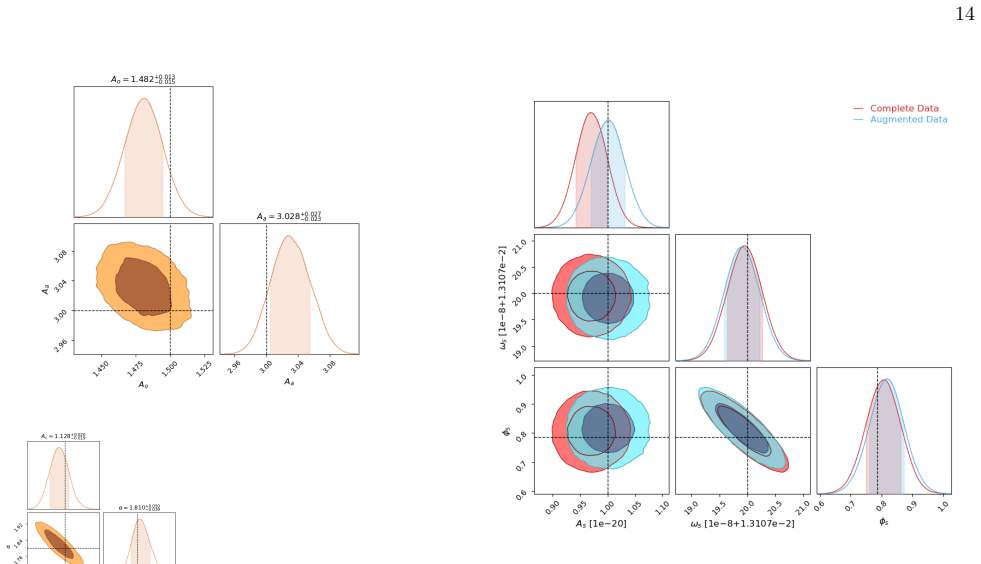
LISA-Like Noise Model For an effective noise model that approximates the LISA observatory, we used the LISA sensitivity curve, overlaid by a time-varying galactic background [8, 29], S(f, t;τ) =S n(f;τ n) +S c(f;τ c)r(t;τ m),(23) characterized by eleven parametersτ={τ n,τ c,τ m}= {Ao, Aa, A, α, f1, f2, fknee, A1, A2, ϕ1, ϕ2}. These param- eters characteri...
-
[2]
Signal Model As a rudimentary signal model, which effectively mim- ics the behavior of galactic binaries (with negligible fre- quency derivatives), we use a simple monochromatic si- nusoid described by three parameters,θ={A s, ωs, ϕs}, 12 h(t;θ) =A s sin (ωst+ϕ s) (31) For simplicity in this initial application, we only in- ject one binary (SNR∼35), embed...
work page internal anchor Pith review Pith/arXiv arXiv
-
[3]
Laser Interferometer Space Antenna,
P. Amaro-Seoane, H. Audley, S. Babak,et al., “Laser Interferometer Space Antenna,”arXiv e-prints(Feb.,
-
[4]
arXiv:1702.00786,arXiv:1702.00786 [astro-ph.IM]
work page internal anchor Pith review Pith/arXiv arXiv
-
[5]
2023, Living Reviews in Relativity, 26, 2, doi: 10.1007/s41114-022-00041-y
P. Amaro-Seoane, J. Andrews, M. Arca Sedda,et al., “Astrophysics with the laser interferometer space antenna,”Living Rev Relativ26no. 2, (Mar, 2023) . https://doi.org/10.1007/s41114-022-00041-y
-
[6]
Overview and progress on the Laser Interferometer Space Antenna mission,
J.-B. Bayle, B. Bonga, C. Caprini, D. Doneva, M. Muratore, A. Petiteau, E. Rossi, and L. Shao, “Overview and progress on the Laser Interferometer Space Antenna mission,”Nature Astronomy6(Dec.,
-
[7]
Primordial Gravitational Waves with LISA
A. Ricciardone, “Primordial Gravitational Waves with LISA,”J. Phys. Conf. Ser.840no. 1, (2017) 012030, arXiv:1612.06799 [astro-ph.CO]
work page internal anchor Pith review Pith/arXiv arXiv 2017
-
[8]
The Search for Massive Black Hole Binaries with LISA
N. J. Cornish and E. K. Porter, “The Search for supermassive black hole binaries with LISA,”Class. Quant. Grav.24(2007) 5729–5755, arXiv:gr-qc/0612091
work page internal anchor Pith review Pith/arXiv arXiv 2007
-
[9]
Gravitational-wave parameter estimation with gaps in LISA: A bayesian data augmentation method,
Q. Baghi, J. I. Thorpe, J. Slutsky, J. Baker, T. D. Canton, N. Korsakova, and N. Karnesis, “Gravitational-wave parameter estimation with gaps in LISA: A bayesian data augmentation method,”Physical Review D100no. 2, (Jul, 2019) . https://doi.org/10.1103%2Fphysrevd.100.022003
work page 2019
-
[10]
LISA Gravitational Wave Sources in a Time-varying Galactic Stochastic Background,
M. C. Digman and N. J. Cornish, “LISA Gravitational Wave Sources in a Time-varying Galactic Stochastic Background,”Astrophys. J.940no. 1, (2022) 10, arXiv:2206.14813 [astro-ph.IM]
-
[11]
K. Dey, N. Karnesis, A. Toubiana, E. Barausse, N. Korsakova, Q. Baghi, and S. Basak, “Effect of data gaps on the detectability and parameter estimation of massive black hole binaries with lisa,”Phys. Rev. D 104(Aug, 2021) 044035.https: //link.aps.org/doi/10.1103/PhysRevD.104.044035
-
[12]
Mind the gap: addressing data gaps and assessing noise mismodeling in LISA,
O. Burke, S. Marsat, J. R. Gair, and M. L. Katz, “Mind the gap: addressing data gaps and assessing noise mismodeling in LISA,”arXiv:2502.17426 [gr-qc]
-
[13]
Extracting gravitational wave signals from LISA data in the presence of artifacts,
E. Castelli, Q. Baghi, J. G. Baker, J. Slutsky, J. Bobin, N. Karnesis, A. Petiteau, O. Sauter, P. Wass, and W. J. Weber, “Extracting gravitational wave signals from LISA data in the presence of artifacts,”Class. Quant. Grav.42no. 6, (2025) 065018,arXiv:2411.13402 [gr-qc]
-
[14]
T. Venumadhav, B. Zackay, J. Roulet, L. Dai, and M. Zaldarriaga, “New search pipeline for compact binary mergers: Results for binary black holes in the first observing run of Advanced LIGO,”Phys. Rev. D 100no. 2, (2019) 023011,arXiv:1902.10341 [astro-ph.IM]
-
[15]
Detecting gravitational waves in data with non-stationary and non-gaussian noise,
B. Zackay, T. Venumadhav, J. Roulet, L. Dai, and M. Zaldarriaga, “Detecting gravitational waves in data with non-stationary and non-gaussian noise,”Phys. Rev. D104(Sep, 2021) 063034.https: //link.aps.org/doi/10.1103/PhysRevD.104.063034
-
[16]
Multimode Quasinormal Spectrum from a Perturbed Black Hole,
C. D. Capano, M. Cabero, J. Westerweck, J. Abedi, S. Kastha, A. H. Nitz, Y.-F. Wang, A. B. Nielsen, and B. Krishnan, “Multimode Quasinormal Spectrum from a Perturbed Black Hole,”Phys. Rev. Lett.131no. 22, (2023) 221402,arXiv:2105.05238 [gr-qc]
-
[17]
Analyzing black-hole ringdowns,
M. Isi and W. M. Farr, “Analyzing black-hole ringdowns,”arXiv e-prints(July, 2021) arXiv:2107.05609,arXiv:2107.05609 [gr-qc]
-
[18]
A. Blelly, J. Bobin, and H. Moutarde, “Sparse data inpainting for the recovery of galactic-binary gravitational wave signals from gapped data,”Monthly Notices of the Royal Astronomical Society509no. 4, (Nov, 2021) 5902–5917. https://doi.org/10.1093%2Fmnras%2Fstab3314
work page 2021
-
[19]
Window and inpainting: dealing with data gaps for TianQin,
L. Wang, H.-Y. Chen, X. Lyu, E.-K. Li, and Y.-M. Hu, “Window and inpainting: dealing with data gaps for TianQin,”arXiv e-prints(May, 2024) arXiv:2405.14274, arXiv:2405.14274 [gr-qc]
-
[20]
Novel stacked hybrid autoencoder for imputing LISA data gaps,
R. Mao, J. E. Lee, and M. C. Edwards, “Novel stacked hybrid autoencoder for imputing LISA data gaps,” Phys. Rev. D111no. 2, (2025) 024067, arXiv:2410.05571 [gr-qc]. [19]LISACollaboration, M. Colpiet al., “LISA Definition Study Report,”arXiv:2402.07571 [astro-ph.CO]
-
[21]
BayesWave: Bayesian Inference for Gravitational Wave Bursts and Instrument Glitches
N. J. Cornish and T. B. Littenberg, “BayesWave: Bayesian Inference for Gravitational Wave Bursts and Instrument Glitches,”Class. Quant. Grav.32no. 13, (2015) 135012,arXiv:1410.3835 [gr-qc]
work page internal anchor Pith review Pith/arXiv arXiv 2015
-
[22]
Beyond the required lisa free-fall performance: New lisa pathfinder results down to 20µHz,
M. Armano, H. Audley, J. Baird,et al., “Beyond the required lisa free-fall performance: New lisa pathfinder results down to 20µHz,”Phys. Rev. Lett.120(Feb,
-
[23]
061101.https://link.aps.org/doi/10.1103/ PhysRevLett.120.061101
-
[24]
Robust 18 Bayesian inference with gapped LISA data using all-in-one TDI-∞,
N. Houba, J.-B. Bayle, and M. Vallisneri, “Robust 18 Bayesian inference with gapped LISA data using all-in-one TDI-∞,”arXiv:2412.20793 [astro-ph.IM]
-
[25]
The Effect of Data Gaps on LISA Galactic Binary Parameter Estimation
J. Carre and E. K. Porter, “The Effect of Data Gaps on LISA Galactic Binary Parameter Estimation,” arXiv:1010.1641 [gr-qc]
work page internal anchor Pith review Pith/arXiv arXiv
-
[26]
Eaton,Multivariate Statistics: A Vector Space Approach
M. Eaton,Multivariate Statistics: A Vector Space Approach. Probability and Statistics Series. Wiley, 1983. https://books.google.com/books?id=1CvvAAAAMAAJ
work page 1983
-
[27]
H. Stark and J. Woods,Probability, Random Processes, and Estimation Theory for Engineers, vol. 90. 01, 1994
work page 1994
-
[28]
Time-frequency analysis of gravitational wave data,
N. J. Cornish, “Time-frequency analysis of gravitational wave data,”Physical Review D102no. 12, (Dec, 2020) .https://doi.org/10.1103%2Fphysrevd.102.124038
work page 2020
-
[29]
Transient analysis with fast Wilson-Daubechies time-frequency transform,
V. Necula, S. Klimenko, and G. Mitselmakher, “Transient analysis with fast Wilson-Daubechies time-frequency transform,”J. Phys. Conf. Ser.363 (2012) 012032
work page 2012
-
[30]
Adaptive covariance estimation of locally stationary processes,
S. Mallat, G. Papanicolaou, and Z. Zhang, “Adaptive covariance estimation of locally stationary processes,” The Annals of Statistics26no. 1, (1998) 1 – 47. https://doi.org/10.1214/aos/1030563977
-
[31]
The construction and use of LISA sensitivity curves
T. Robson, N. J. Cornish, and C. Liu, “The construction and use of LISA sensitivity curves,”Class. Quant. Grav.36no. 10, (2019) 105011, arXiv:1803.01944 [astro-ph.HE]
work page internal anchor Pith review Pith/arXiv arXiv 2019
-
[32]
N. Karnesis, S. Babak, M. Pieroni, N. Cornish, and T. Littenberg, “Characterization of the stochastic signal originating from compact binary populations as measured by LISA,”Phys. Rev. D104no. 4, (2021) 043019,arXiv:2103.14598 [astro-ph.IM]
-
[33]
Prototype global analysis of LISA data with multiple source types,
T. B. Littenberg and N. J. Cornish, “Prototype global analysis of LISA data with multiple source types,” Phys. Rev. D107no. 6, (2023) 063004, arXiv:2301.03673 [gr-qc]
-
[34]
LISA Data Challenge Sangria (LDC2a),
M. Le Jeune and S. Babak, “LISA Data Challenge Sangria (LDC2a),”.doi.org/10.5281/zenodo.7132178
discussion (0)
Sign in with ORCID, Apple, or X to comment. Anyone can read and Pith papers without signing in.