REVIEW 5 major objections 5 minor 23 references
Learning to Walk in Costume: Adversarial Motion Priors for Aesthetically Constrained Humanoids
T0 review · 5 major / 5 minor · reviewed 2026-08-15 · deepseek-v4-flash
Pith's one-line read A humanoid robot whose head carries 16 percent of its mass can still learn to stand and walk naturally, using adversarial motion priors plus randomized physics and safety rewards.
desk verdict A credible hardware demo of AMP-based walking on a deliberately unstable entertainment robot, but the quantitative evaluation is self-referential and the motion references are never checked for dynamic feasibility. read the letter →
The pith
A machine-rendered reading of the paper's core claim, the machinery that carries it, and where it could break.
The reading
What carries the argument
The central mechanism is the AMP discriminator, a network trained to classify states as coming from the reference set or from the policy, with the policy receiving $\log D_\phi(s)$ as a style reward. That single signal lets the robot imitate expressive human motion without hand-coded style rewards. Around it sit three reward groups—imitation/style, motion quality, and safety (foot stumble, foot orientation, foot height)—and a domain-randomization scheme covering friction, base mass, PD gains, actuator lag, sensor noise, and periodic pushes. The discriminator is what converts the hybrid reference library into a training signal; the safety rewards and randomization are what keep that signal from destroying the shells and actuators during deployment.
What would settle it
Simulate each reference clip open-loop on the Cosmo model and check whether the projected center of mass stays inside the foot support polygon and whether joint limits are respected; if a substantial fraction of clips violate either condition, the discriminator is rewarding infeasible motion and the policy's safety rests on the safety rewards rather than on the motion prior.
Extended reading notes
Core claim
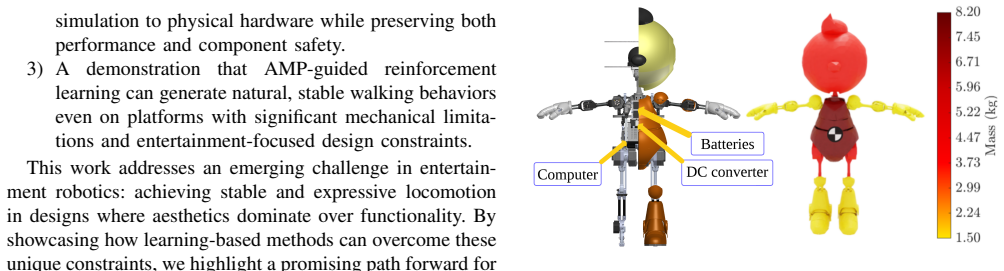
On Cosmo, an entertainment humanoid whose head carries 16% of its 25 kg mass, whose sensing is entirely proprioceptive, and whose shells restrict joint motion, the paper claims that AMP-trained policies produce stable standing and walking that transfer from simulation to hardware. The reference set is deliberately hybrid: human motion-capture clips retargeted to Cosmo's proportions supply expressive style, while model-based walking clips from a whole-body controller on the same robot supply dynamics-aware poses and continuous commanded velocities. The paper argues that neither source alone is enough; retargeted mocap lacks robot-specific dynamics and offers only fixed speeds, and reward-only training without explicit foot references produces dangerous high-frequency stepping. In experiments the walking policy reaches 0.5–0.7 m/s, reproduces shoulder swing and head oscillation from the mocap, and keeps joint torques within limits, with ablations showing that the safety rewards and both reference types are necessary.
Load-bearing premise
The load-bearing premise is that the hybrid reference set—retargeted human mocap plus model-based walking clips—is dynamically compatible with Cosmo's top-heavy body, because the AMP discriminator rewards apparent likeness to those references, not physical feasibility, and the paper provides no independent feasibility analysis of the clips.
Editorial extensions
If this is right
- Entertainment robots whose morphology is fixed by character design can still be given stable, human-like locomotion through learning, without redesigning the hardware.
- Because the policy uses only proprioception, the same recipe should transfer to vision-less robots or robots with obstructed sensors.
- The hybrid-reference design implies a practical recipe for unusual platforms: expressive mocap for style plus model-based clips for dynamics, with both needed for safe low-speed transitions.
- Ablations show specialized safety rewards and domain randomization are load-bearing: removing them produces impact spikes or high-frequency stepping that would damage shells.
- The demonstrated speed range, 0.5–0.7 m/s, is a deliberate trade-off favoring expressiveness and hardware preservation over agility, matching entertainment use cases.
Reading between the lines
- Editorial inference: the same AMP pipeline is likely to work for other top-heavy or shell-constrained characters, but the optimal balance between retargeted and model-based reference clips will probably be platform-specific; the paper's ablation only tests complete removal of one source.
- Editorial inference: one could use the simulated push-recovery policy to filter the reference set, keeping only clips whose center of mass stays inside the support polygon; this would directly address the dynamic-feasibility assumption that the paper leaves unexamined.
- Editorial inference: the non-monotonic dependence of balancing performance on head mass (optimum near 3.2 kg) hints that a moderate top-heaviness gives the policy a stronger proprioceptive signal; testing this on another platform would show whether it is a Cosmo-specific effect.
- Editorial inference: extending the method to uneven terrain or to gaits faster than 0.7 m/s would be a natural next test, since the current evaluation is restricted to flat ground and a deliberate stability-first speed range.
Signed reviews
Editorial analysis
A structured set of objections, weighed in public.
Referee Report
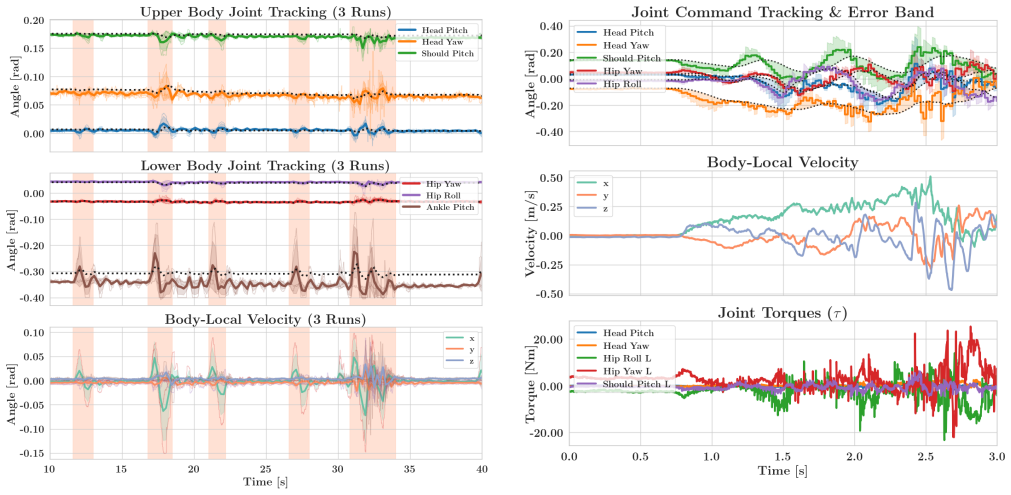
Summary. The paper presents a reinforcement learning (RL) system for Cosmo, a purpose-built entertainment humanoid with an unusually heavy head (16% of total mass), no vision, and protective shells that restrict joint motion. The authors combine Adversarial Motion Priors (AMP) with a hybrid reference set consisting of retargeted human motion-capture clips and model-based whole-body-control clips, along with domain randomization and specialized safety rewards, to train a proprioceptive policy in Isaac Gym that transfers to the real robot. The central claim is that AMP generates stable standing and walking behaviors despite the robot's extreme mass distribution and movement constraints. Evidence includes simulation-only tuning studies (Table IV), ablation studies of reference motions and reward components (Section V), and hardware time-series plots showing balancing, disturbance rejection, and walking with torque limits (Section IV.C).
Significance. If the central claim holds, the paper makes a useful engineering contribution: it demonstrates that AMP plus domain randomization can produce stable locomotion on a top-heavy, sensor-limited, aesthetically constrained humanoid, a morphology rarely treated in the humanoid-control literature. The hardware demonstration is a genuine achievement, and the ablation of reference-motion types (standing, model-based walking, stylized mocap) is valuable evidence that hybrid reference sets matter. The authors also give credit for reporting torque clamping within actuator limits and for using a proprioceptive-only observation space. However, the quantitative support for the paper's main claims is weakened by circular evaluation metrics, a mismatch between the simulated and real head mass, and the absence of any dynamic-feasibility screening for the reference motions. The conclusions about 'optimal' hyperparameters and the 0.5–0.7 m/s gait speed are not fully supported by the reported data.
major comments (5)
- [Section III.B and Table IV] The headline comparisons in Table IV are scored using the exact reward terms that are being tuned: Motion Quality, Task, and Safety rewards are both the training objectives and the reported performance metrics. The reward structure text explicitly says that these components 'will be used as metric to compare the performance of different experiments.' The optimal reward weights and AMP coefficient are selected by maximizing a weighted average of these same rewards, making the selection procedure self-referential. No independent metrics (e.g., success rate, fall rate, commanded-vs-actual velocity tracking error, or a held-out motion-quality score) are reported. Please add external evaluation metrics, or reframe the Table IV analysis as a reward-shaping study rather than a claim about which configuration is 'best.'
- [Section III.C and Table IV (Balancing)] The paper states that Cosmo's real head weighs 4 kg (Section III.C), yet the balancing study in Table IV finds the 'optimal head mass' to be 3.2 kg, and the training uses that value. The domain randomization table (Table III) only randomizes base mass by ±1.5 kg, which would put the simulated mass range at 1.7–4.7 kg if 3.2 kg is the nominal head mass, but this is not clearly explained. The paper should clarify whether the Table IV values are total head mass or added mass, why the simulator trains at 3.2 kg while the real hardware has 4 kg, and how the mismatch is covered by randomization. Without this explanation, the carefully constructed head-mass sweep does not translate to the physical platform.
- [Section III.A, III.D, and Table IV (AMP coefficient rows)] The AMP discriminator (Eq. 2) is trained on reference motions that are never screened for dynamic feasibility. Section III.A explicitly states that the retargeted CMU mocap clips do not account for Cosmo's wide shells and that the meshes clip into each other; Section III.D adds HQP-generated clips but provides no analysis of their dynamic feasibility. The Table IV AMP-coefficient rows show a direct consequence: raising the style coefficient improves discriminator loss (from −0.420 to −0.372) while the safety reward falls (0.720 to 0.679). The ablation in Section V.A shows that removing the model-based reference causes unstable, high-frequency stepping. These observations together undermine the claim that AMP's style signal promotes safe, feasible motion; the safety rewards may instead be overpowering an unsafe prior. Please provide a feasibility analysis of the reference set (e.g., checking foot penetration, shell collisions, and center-of-mass support-polygon constraints) or add a filter that excludes infeasible clips.
- [Section III.D and Section VI] The paper repeatedly claims gait speeds of 0.5–0.7 m/s (Section III.D 'typically 0.5-0.7 m/s'; Section VI 'achieving 0.5-0.7 m/s gaits'), but the hardware walking data in Figure 9 shows 'pronounced velocity fluctuations in the x-direction, reaching peaks of 0.4 m/s commanded.' This is an inconsistency: either the 0.5–0.7 m/s value is the commanded range in some experiments, or the figure is from a slower policy. Please reconcile the speed claim with the actual data and specify whether the value refers to commanded velocity, measured velocity, or an average over the gait cycle.
- [Section IV.B and Table IV] The statistical support for the 'optimal' settings is weak. All configurations in Table IV are reported as means over 5 random seeds with standard deviations, and many of the claimed differences are smaller than one standard deviation (e.g., balancing head mass 3.2 kg: 0.677±0.089 vs. 2.2 kg: 0.660±0.090; AMP coefficient 0.4: 0.733±0.113 vs. 0.5: 0.720±0.113). Without significance tests, effect sizes, or a clearer presentation of the seed distributions, the conclusions that 3.2 kg is optimal and that 0.4 is the best AMP coefficient are not statistically grounded. Please add appropriate statistical comparisons or temper the claims accordingly.
minor comments (5)
- [Introduction and Section IV.A] There are several typographical errors: 'challengs' in the Introduction, 'devitations' in Section IV.A, and a stray 'f' at the end of Section IV.A. These should be corrected.
- [Section III.B] The text says the AMP style reward is r_AMP(s_t) = log D(s_t), whereas Table II lists the AMP reward as −log D(s). These are different objectives; please align the notation and define the sign convention used in the implementation.
- [Section III.D] The 'hierarchical quadratic programming based inverse dynamics whole-body controller' used to generate model-based reference clips is mentioned without a citation. Please provide a reference or a brief description of this controller.
- [Figure 7] Figure 7 shows three policies ('balancing,' 'model-based walking,' and 'walking with swagger'), but the figure is not referenced in the text with an explanation of what is displayed. Please describe the panel contents in the body text.
- [Table III] The domain randomization table lists 'Base mass' randomization but no 'head mass' randomization. The text in Section IV.B refers to 'head randomization parameters'; please clarify the distinction or add the missing parameter to the table.
Circularity Check
No circular derivation chain found; the central hardware claim is independently evidenced, and the reward-based tuning metrics are not load-bearing predictions.
full rationale
The paper's central claim—that AMP-trained policies transfer to Cosmo hardware—is supported by external evidence rather than by a self-referential derivation: hardware joint-tracking and torque plots (Figures 8–9), disturbance-rejection data, and an independent comparison against ARTEMIS (Figure 6). The Table IV sweeps select reward-structure weights and AMP coefficients by training separate policies and ranking them with the same reward components, but that ranking is an empirical outcome of training dynamics, not an equality forced by construction; it is a hyperparameter search, not a prediction derived from the objective. The AMP discriminator loss is an internal style metric, yet a single baseline discriminator is used for cross-experiment comparison, and the hardware gait is separately inspected. No load-bearing self-citations or imported uniqueness theorems appear. The retargeting limitation in Section III.A (meshes clipping into the wide shells) and the reliance on the HQP model-based reference in Section V.A are feasibility and assumption weaknesses, but they do not make the argument circular. Therefore no circular step meets the quoted-evidence bar.
Assumptions & free parameters
free parameters (5)
- Reward group weights =
[0.35, 0.35, 0.4]
- AMP style coefficient =
0.4
- Simulated head mass (added mass) =
3.2 kg
- Reward kernel widths (sigma)
- Domain randomization ranges =
friction [0.2,1.1], mass +/-1.5 kg, PD gains [0.75,1.13], lag 4 steps, pushes 0.5 m/s / 0.2 rad/s
assumptions (5)
- domain assumption Human motion capture clips can be retargeted to a robot with different joint topology and used as a style prior without explicit dynamic feasibility.
- domain assumption Isaac Gym physics simulation with simplified convex hulls faithfully captures contact and self-collision behavior of Cosmo.
- domain assumption An invariant extended Kalman filter yields state estimates accurate enough from proprioception alone.
- ad hoc to paper The model-based walking clips from an HQP controller on Cosmo are valid and useful reference motions for imitation.
- standard math Standard adversarial training (Eq. 2) and PPO-style RL optimization converge to a policy that transfers.
Cite this review
Pith. "Pith review of Learning to Walk in Costume: Adversarial Motion Priors for Aesthetically Constrained Humanoids." pith.science (2026). https://pith.science/paper/E5AMLSHM
@misc{pith2026250905581,
  author       = {Pith},
  title        = {Pith review of: Learning to Walk in Costume: Adversarial Motion Priors for Aesthetically Constrained Humanoids},
  year         = {2026},
  howpublished = {\url{https://pith.science/paper/E5AMLSHM}},
  note         = {Machine review of arXiv:2509.05581}
}
read the original abstract
We present a Reinforcement Learning (RL)-based locomotion system for Cosmo, a custom-built humanoid robot designed for entertainment applications. Unlike traditional humanoids, entertainment robots present unique challenges due to aesthetic-driven design choices. Cosmo embodies these with a disproportionately large head (16% of total mass), limited sensing, and protective shells that considerably restrict movement. To address these challenges, we apply Adversarial Motion Priors (AMP) to enable the robot to learn natural-looking movements while maintaining physical stability. We develop tailored domain randomization techniques and specialized reward structures to ensure safe sim-to-real, protecting valuable hardware components during deployment. Our experiments demonstrate that AMP generates stable standing and walking behaviors despite Cosmo's extreme mass distribution and movement constraints. These results establish a promising direction for robots that balance aesthetic appeal with functional performance, suggesting that learning-based methods can effectively adapt to aesthetic-driven design constraints.
Figures


Figures from the paper (6 more)




Reference graph
Works this paper leans on
-
[1]
Z. Gu, J. Li, W. Shen, W. Yu, Z. Xie, S. McCrory, X. Cheng, A. Shamsah, R. Griffin, C. K. Liu, A. Kheddar, X. B. Peng, Y . Zhu, G. Shi, Q. Nguyen, G. Cheng, H. Gao, and Y . Zhao, “Humanoid locomotion and manipulation: Current progress and challenges in control, planning, and learning,” 2025. [Online]. Available: https://arxiv.org/abs/2501.02116
arXiv 2025
-
[2]
So lifelike! cutest toothless & hiccup interaction ever at the new epic universe theme park,
A. 360, “So lifelike! cutest toothless & hiccup interaction ever at the new epic universe theme park,” https://youtu.be/U6f3OrO-DlM, 2025, youTube video, published April, 2025
work page 2025
-
[3]
Design and control of a bipedal robotic character,
R. Grandia, E. Knoop, M. A. Hopkins, G. Wiedebach, J. Bishop, S. Pickles, D. M ¨uller, and M. B¨acher, “Design and control of a bipedal robotic character,”arXiv preprint arXiv:2501.05204, 2025
arXiv 2025
-
[4]
Amp: adversarial motion priors for stylized physics-based character control,
X. B. Peng, Z. Ma, P. Abbeel, S. Levine, and A. Kanazawa, “Amp: adversarial motion priors for stylized physics-based character control,”ACM Transactions on Graphics, vol. 40, no. 4, p. 1–20, Jul
-
[5]
Survey on model- based biped motion control for humanoid robots,
K. Yamamoto, T. Kamioka, and T. Sugihara, “Survey on model- based biped motion control for humanoid robots,”Advanced Robotics, vol. 34, no. 21-22, pp. 1353–1369, 2020
work page 2020
-
[6]
Optimization-based locomotion planning, estimation, and control design for the atlas humanoid robot,
S. Kuindersma, R. Deits, M. Fallon, A. Valenzuela, H. Dai, F. Per- menter, T. Koolen, P. Marion, and R. Tedrake, “Optimization-based locomotion planning, estimation, and control design for the atlas humanoid robot,”Autonomous Robots, vol. 40, no. 3, pp. 429–455, 2016
2016
-
[7]
Real-world humanoid lo- comotion with reinforcement learning,
I. Radosavovic, T. Xiao, B. Zhang, T. Darrell, J. Malik, and K. Sreenath, “Real-world humanoid lo- comotion with reinforcement learning,”Science Robotics, vol. 9, no. 89, p. eadi9579, 2024. [Online]. Available: https://www.science.org/doi/abs/10.1126/scirobotics.adi9579
-
[8]
Reinforcement learning for versatile, dynamic, and robust bipedal locomotion control,
Z. Li, X. B. Peng, P. Abbeel, S. Levine, G. Berseth, and K. Sreenath, “Reinforcement learning for versatile, dynamic, and robust bipedal locomotion control,”The International Journal of Robotics Research, vol. 0, no. 0, 2024
work page 2024
Show all 23 references
-
[9]
Expressive whole-body control for humanoid robots,
X. Cheng, Y . Ji, J. Chen, R. Yang, G. Yang, and X. Wang, “Expressive whole-body control for humanoid robots,” inRobotics: Science and Systems. Delft, Netherlands: RSS Foundation, 2024. [Online]. Available: https://www.roboticsproceedings.org/rss20/p107.html
2024
-
[10]
Reinforcement learning for robust parameterized locomotion control of bipedal robots,
Z. Li, X. Cheng, X. B. Peng, P. Abbeel, S. Levine, G. Berseth, and K. Sreenath, “Reinforcement learning for robust parameterized locomotion control of bipedal robots,” in2021 IEEE International Conference on Robotics and Automation (ICRA), 2021, pp. 2811– 2817
2021
-
[11]
Humanoid parkour learning,
Z. Zhuang, S. Yao, and H. Zhao, “Humanoid parkour learning,”arXiv preprint arXiv:2406.10759, 2024
2024 arXiv
-
[12]
Wococo: Learning whole-body humanoid control with sequential contacts,
C. Zhang, W. Xiao, T. He, and G. Shi, “Wococo: Learning whole-body humanoid control with sequential contacts,” in8th Annual Conference on Robot Learning, 2024. [Online]. Available: https://openreview.net/forum?id=Czs2xH9114
2024
-
[13]
Adversarial motion priors make good substitutes for complex reward functions,
A. Escontrela, X. B. Peng, W. Yu, T. Zhang, A. Iscen, K. Goldberg, and P. Abbeel, “Adversarial motion priors make good substitutes for complex reward functions,” in2022 IEEE/RSJ International Confer- ence on Intelligent Robots and Systems (IROS). Kyoto, Japan: IEEE, 2022, pp. 1–8
2022
-
[14]
Rokoko studio live plugin for blender,
Rokoko, “Rokoko studio live plugin for blender,” https://github.com/Rokoko/rokoko-studio-live-blender, 2025, version 1.4.1, accessed April 28, 2025
2025
-
[15]
Blender – a 3d modelling and rendering package,
Blender Online Community, “Blender – a 3d modelling and rendering package,” Blender Foundation, Amsterdam, The Netherlands, 2025, version 4.4. [Online]. Available: https://www.blender.org
2025
-
[16]
CMU Graphics Lab Motion Capture Database,
C. M. University, “CMU Graphics Lab Motion Capture Database,” http://mocap.cs.cmu.edu, 2003, accessed: 04/01/25
2003
-
[17]
Massive library of free 3d character animations,
R. Milk, “Massive library of free 3d character animations,”
-
[18]
Isaac sim on omniverse,
NVIDIA, “Isaac sim on omniverse,” 2023, https://developer.nvidia.com/isaac-sim
2023
-
[19]
Design of a highly dynamic humanoid robot
T. Zhu, “Design of a highly dynamic humanoid robot.” [Online]. Available: https://escholarship.org/uc/item/0qz3p57g
-
[20]
Isaac gym: High performance gpu-based physics simulation for robot learning,
V . Makoviychuk, L. Wawrzyniak, Y . Guo, M. Lu, K. Storey, M. Macklin, D. Hoeller, N. Rudin, A. Allshire, A. Handa, and G. State, “Isaac gym: High performance gpu-based physics simulation for robot learning,” 2021. [Online]. Available: https://arxiv.org/abs/2108.10470
2021 arXiv
-
[21]
Learning to walk in minutes using massively parallel deep reinforcement learning,
N. Rudin, D. Hoeller, P. Reist, and M. Hutter, “Learning to walk in minutes using massively parallel deep reinforcement learning,”CoRR, vol. abs/2109.11978, 2021. [Online]. Available: https://arxiv.org/abs/2109.11978
2021 arXiv
-
[2021]
Available: http://dx.doi.org/10.1145/3450626.3459670
[Online]. Available: http://dx.doi.org/10.1145/3450626.3459670
-
[2022]
Available: https://rancidmilk.itch.io/free-character- animations
[Online]. Available: https://rancidmilk.itch.io/free-character- animations
Reviewed August 15, 2026 · model on record in the stance chip above.
Discussion (0). Continue with ORCID to comment.