REVIEW 4 major objections 4 minor 14 references
Knowledge-Augmented Vision Language Models for Underwater Bioacoustic Spectrogram Analysis
T0 review · 4 major / 4 minor · reviewed 2026-08-05 · deepseek-v4-flash
Pith's one-line read The paper claims that progressively accumulating VLM-generated pattern descriptions in a text knowledge base improves marine mammal spectrogram classification by 92% over a vanilla VLM, without retraining.
desk verdict Honest feasibility study with a confounded headline: the 92% gain over vanilla VLMs mostly reflects labeled examples in the retrieval index, not progressive knowledge. read the letter →
The pith
A machine-rendered reading of the paper's core claim, the machinery that carries it, and where it could break.
The reading
What carries the argument
The load-bearing mechanism is the progressive knowledge base combined with TF-IDF similarity matching. Each species has a text library of pattern descriptions; a query spectrogram is described by the VLM, vectorized with TF-IDF (n-gram range 1–3), and compared to library entries by cosine similarity. Species scores combine the best match, mean match, and a diversity term, so a single strong pattern description can carry classification while the library's breadth prevents overfitting to one phrase. The knowledge base evolves via a quality-and-novelty filter (thresholds θ and δ) that admits only new, non-generic patterns, with the authors reporting that 23% of extracted patterns were too gener
What would settle it
If two acoustically distinct species whose VLM descriptions use the same phrases (e.g., 'burst sequences') are consistently confused even after many rounds of pattern accumulation, and removing generic phrases from the library does not change the confusion, then the text-similarity bottleneck is real and the central hypothesis fails in that setting.
Extended reading notes
Core claim
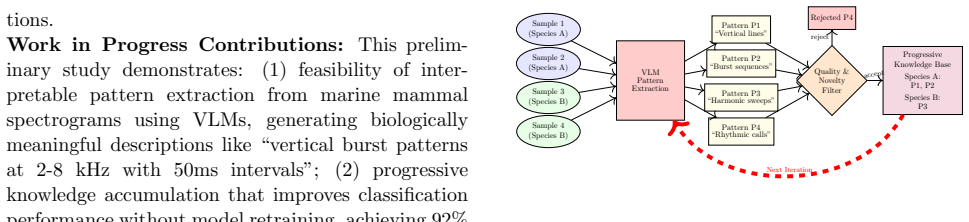
The central claim is that a two-stage knowledge-augmented classification reframing—separating pattern extraction from species identification—lets a general-purpose VLM adapt to bioacoustic spectrograms without fine-tuning. In Stage 1 the VLM converts each spectrogram into a natural language pattern description; in Stage 2 a TF-IDF cosine similarity matcher scores that description against each species' knowledge base, and the species with the highest aggregated score (0.6 max, 0.3 mean, 0.1 diversity) is the prediction. The knowledge base starts with synthetic expert patterns and grows iteratively: patterns extracted from training samples are added only if they pass quality and novelty thresh
Load-bearing premise
The pipeline assumes that VLM-written text descriptions of spectrograms are similar for sounds of the same species and different for sounds of different species; if the text clusters by wording rather than by biology, the similarity-matching stage cannot separate species regardless of how many patterns accumulate.
Editorial extensions
If this is right
- If the central claim holds, marine mammal monitoring can bootstrap species screening from unlabeled recordings: a VLM writes descriptions, the knowledge base grows, and classification improves without retraining or manual annotation.
- The natural-language output gives biologists a concrete validation workflow, e.g., checking a "20 Hz pulse pattern with 12-second intervals" prediction against known fin whale vocalization ranges before accepting it.
- The approach is positioned as a rapid screening tool or annotation accelerator, not a replacement for specialized CNNs, so its practical value is in triage and data labeling rather than final autonomous decisions.
- The engineering next steps the paper sketches—contrastive visual-linguistic alignment, hierarchical knowledge organization, uncertainty quantification, and RAG integration—are direct corollaries of the identified semantic-gap bottleneck.
Reading between the lines
- Because the paper's own UMAP analysis shows descriptions cluster by wording, a testable extension is to add a visual-anchor term to the similarity score (e.g., contrastive visual features) and measure whether cross-species linguistic confusions drop.
- The reported negative correlation between pattern quantity and accuracy suggests a cheap lever: adaptive quality thresholds that reject near-duplicate generic patterns. Measuring accuracy against threshold θ directly would verify whether curation, not library size, is the binding constraint.
- If the approach generalizes, the same two-stage text-knowledge design could be applied to other expert-visual domains (e.g., bird song spectrograms or medical imaging) where a VLM can describe patterns but not classify them directly.
Editorial analysis
A structured set of objections, weighed in public.
Referee Report
Summary. The paper proposes a two-stage, training-free pipeline for marine mammal classification from spectrograms. In Stage 1, a VLM generates natural-language descriptions of acoustic patterns in spectrograms; in Stage 2, these descriptions are matched against a knowledge base of per-species text patterns using TF-IDF cosine similarity. The knowledge base is initialized with synthetic expert patterns and grows via a progressive algorithm that filters VLM-generated patterns by undefined 'quality' and 'novelty' criteria. The authors report 25.4%±11.5% accuracy across 5-, 10-, and 24-species configurations, a 92% relative improvement over a vanilla VLM baseline (13.2%), and claim that the approach preserves interpretability and avoids retraining. The paper explicitly frames itself as preliminary and emphasizes expert-in-the-loop workflows over raw accuracy compared with specialized CNNs.
Significance. If the central claim were fully substantiated, the paper would make a modest but useful contribution: a no-retraining, interpretable route to bioacoustic classification that produces inspectable natural-language pattern descriptions. The authors are appropriately candid about limitations, include a UMAP-based semantic-gap analysis, and report performance on a public benchmark. The study also has a genuinely useful control condition, the Fixed Knowledge Base, even though it is not used to calibrate the headline claim. However, the reported '92% improvement' conflates the progressive knowledge mechanism with the trivial effect of giving the classifier access to labeled in-domain examples, and key components of Algorithm 1 are not specified. As it stands, the evidence supports a more modest claim: a retrieval index of labeled training descriptions improves zero-shot VLM accuracy, and adding a small, quality-filtered progressive set yields a further modest gain. The paper does not currently demonstrate that the natural-language knowledge representation is the load-bearing carrier of signal.
major comments (4)
- [§3.1, §4.2, Table 1] The headline '92% improvement over vanilla VLMs' conflates the progressive-knowledge mechanism with access to labeled training examples. The Vanilla VLM baseline (Section 3.1) has no access to any training sample, while the Progressive system stores VLM descriptions of labeled training spectrograms in its knowledge base (Algorithm 1). The correct control for the progressive component is the Fixed Knowledge Base condition reported in Table 1 (18.5%); on that comparison the incremental gain of the progressive system is only 6.9 points, or about 37% relative. The paper therefore overstates the contribution of progressive accumulation. In addition, no experiment replaces the VLM-generated text patterns with raw VLM or spectrogram embeddings of the same training samples. Without such a control, the results are equally consistent with 'any retrieval index of labeled examples improves classific
- [§2.3, §3.2, Algorithm 1] The progressive learning algorithm is not reproducible as specified. Algorithm 1 lines 7–8 require evaluating quality(p) > θ_q and novelty(p, KB(s)) > θ_n, but the functions Q(p) and N(p) are never defined, and the thresholds θ_q and θ_n are never reported. The species-level aggregation weights 0.6, 0.3, and 0.1 in Section 3.3, and the TF-IDF n-gram range (1,3), are also presented without justification. If these parameters were tuned to maximize the reported 92% improvement, the headline result could be a tuning artifact. Please specify the filters, report the thresholds, and provide a sensitivity analysis or ablation showing how accuracy varies with these choices.
- [§2.4, §4.2, Table 2] Section 2.4 formally defines H0 and H1 for the hypothesis that context improves accuracy, but no hypothesis test is reported anywhere in Section 4. The accuracy numbers in Table 2 include standard deviations (e.g., 31.8%±13.3% for 5 species), yet there is no statement of the number of independent runs, no paired comparison between conditions, and no confidence interval or p-value. Without this, the '92% improvement' could be within run-to-run variability. The paper should either report a proper statistical test over the 60 experiments or explicitly downgrade the claim to an exploratory observation.
- [§4.4, Figure 3] The UMAP analysis in Section 4.4 shows that VLM-generated pattern descriptions cluster by linguistic similarity rather than biological relationships. This is a direct challenge to the core premise of the two-stage design, namely that TF-IDF cosine similarity between text descriptions can separate species by preserving species-discriminative visual-acoustic information. The authors acknowledge this as a limitation, but the manuscript does not quantify how much discriminative information is retained. A quantitative analysis—for example, measuring the separability of per-species pattern sets, or showing that removing semantically ambiguous patterns changes accuracy—would help determine whether the semantic gap is a fixable engineering issue or a fundamental bottleneck. As written, the UMAP result is consistent with the possibility that the text bottleneck, not the progressive knowledge mech
minor comments (4)
- [Abstract / Title] The title and abstract describe 'knowledge-augmented Vision Language Models,' but the VLM itself is not modified; only the retrieval/classification stage is augmented. Consider rewording to 'knowledge-augmented VLM-based classification' to avoid implying model-level augmentation.
- [§1, 'T rilemma'] Typographical error: 'T rilemma' should be 'Trilemma.' Also, 'expert validation decisions are not capable' in Section 4.4 appears to be a missing-word or grammatical issue.
- [Table 1] The Vanilla VLM baseline is listed as 12.5% in Table 1 but as 13.2% in Section 4.2. Please reconcile the numbers and state which value is used in the 92% calculation.
- [Fig. 1] The middle panel labels the process 'FixedKnowledge Base' without a space, and the bottom panel's 'QualityFilter' does not clearly correspond to the two separate quality and novelty filters in Algorithm 1. Minor labeling issue.
Circularity Check
No significant circularity: the knowledge base is built from labeled training samples and evaluated on held-out data; the 92% headline is a confounded comparison but not a definitional or fitted-input circularity.
full rationale
The derivation chain is self-contained and not circular. The knowledge base is constructed in Algorithm 1 by sampling K labeled training spectrograms per species, extracting VLM text patterns, filtering by quality/novelty, and storing them in KB(s); test classification (Sec. 3.3) computes TF-IDF cosine similarity between the test sample's VLM pattern and each species' KB and selects the argmax. This is a supervised retrieval system evaluated on held-out data, so the reported accuracy is not defined in terms of the test labels or the headline number. The paper also includes a fixed-knowledge-base condition (18.5%, Table 1) as an internal control, so the progressive component is not the only comparison. The 92% improvement over the vanilla VLM (Sec. 4.2) compares a system with labeled-example access to a zero-shot baseline; this is a methodological confound, not a circular reduction, because no equation makes the improvement equal to the KB construction by definition and no fitted parameter is relabeled as a prediction. The paper's own UMAP and r=-0.44 analysis acknowledge the semantic gap and quality-quantity tradeoff. Missing significance testing for H0/H1 (Sec. 2.4) is a statistical-support gap, not circularity. No self-citation is load-bearing. Hence score 0.
Assumptions & free parameters
free parameters (4)
- quality threshold θ_q =
not reported
- novelty threshold θ_n =
not reported
- species-level aggregation weights (0.6, 0.3, 0.1) =
0.6, 0.3, 0.1
- TF-IDF n-gram range =
(1,3)
assumptions (3)
- domain assumption VLM-generated natural language descriptions of spectrograms preserve enough species-discriminative acoustic information for downstream text matching.
- domain assumption TF-IDF cosine similarity between pattern texts correlates with biological or acoustic similarity of the underlying calls.
- ad hoc to paper The quality and novelty functions Q(p) and N(p) exist and can be implemented with meaningful thresholds.
Cite this review
Pith. "Pith review of Knowledge-Augmented Vision Language Models for Underwater Bioacoustic Spectrogram Analysis." pith.science (2026). https://pith.science/paper/QDQVV7U3
@misc{pith2026250905703,
  author       = {Pith},
  title        = {Pith review of: Knowledge-Augmented Vision Language Models for Underwater Bioacoustic Spectrogram Analysis},
  year         = {2026},
  howpublished = {\url{https://pith.science/paper/QDQVV7U3}},
  note         = {Machine review of arXiv:2509.05703}
}
read the original abstract
Marine mammal vocalization analysis depends on interpreting bioacoustic spectrograms. Vision Language Models (VLMs) are not trained on these domain-specific visualizations. We investigate whether VLMs can extract meaningful patterns from spectrograms visually. Our framework integrates VLM interpretation with LLM-based validation to build domain knowledge. This enables adaptation to acoustic data without manual annotation or model retraining.
Figures


Reference graph
Works this paper leans on
- [1]
-
[2]
Y. Zheng et al. Mt-resformer: Multi-scale time-series feature learning for marine mammal sound classifi- cation.IEEE Transactions on Multimedia, 26:3421– 3433, 2024
work page 2024
-
[3]
E. Schall et al. Deep learning in marine bioacous- tics: a benchmark for baleen whale detection.Remote Sensing in Ecology and Conservation, 10(3):392–408, 2024
work page 2024
-
[4]
Y. Shiu et al. Deep neural networks for automated de- tection of marine mammal species.Scientific Reports, 10:607, 2020
work page 2020
-
[5]
J. Hagge et al. Naturelm-audio: an audio-language foundation model for bioacoustics.ArXiv preprint,
-
[6]
Learning transferable visual representations from natural language supervision
Alec Radford, Jong Wook Kim, Chris Hallacy, Aditya Ramesh, Gabriel Goh, Sandhini Agarwal, Girish Sas- try, Amanda Askell, Pamela Mishkin, Jack Clark, et al. Learning transferable visual representations from natural language supervision. InInternational conference on machine learning, pages 8748–8758. PMLR, 2021
work page 2021
-
[7]
Introducing medical vlm-24b: Our first medical vision language model, 2024
John Snow Labs. Introducing medical vlm-24b: Our first medical vision language model, 2024
work page 2024
-
[8]
Vision Language Models Are Few-Shot Audio Spectrogram Classifiers
J. Gardner et al. Vision language models are few-shot audio spectrogram classifiers.ArXiv preprint, 2024. arXiv:2411.12058
work page Pith review arXiv 2024
Show all 14 references
-
[9]
Retrieval-augmented generation for knowledge-intensive nlp tasks.Advances in Neural Information Processing Systems, 33:9459–9474, 2020
Patrick Lewis et al. Retrieval-augmented generation for knowledge-intensive nlp tasks.Advances in Neural Information Processing Systems, 33:9459–9474, 2020
2020
-
[10]
Yang et al
X. Yang et al. Crag - comprehensive rag benchmark. InProceedings of the 38th Conference on Neural In- formation Processing Systems, 2024
2024
-
[11]
Hu et al
Edward J. Hu et al. Lora: Low-rank adaptation of large language models.ArXiv preprint, 2021. arXiv:2106.09685
2021 arXiv
-
[12]
The watkins marine mammal sound database: an online, freely accessible resource
Laela Sayigh, Mary Ann Daher, Julie Allen, He- len Gordon, Katherine Joyce, Claire Stuhlmann, and Peter Tyack. The watkins marine mammal sound database: an online, freely accessible resource. In Proceedings of Meetings on Acoustics, volume 27. AIP Publishing, 2016
2016
-
[13]
William A. Watkins. Marine mam- mal sound database, 1993. Available at: https://whoicf2.whoi.edu/science/B/whalesounds/
1993
-
[14]
Umap: Uniform manifold approximation and pro- jection for dimension reduction.arXiv preprint arXiv:1802.03426, 2018
Leland McInnes, John Healy, and James Melville. Umap: Uniform manifold approximation and pro- jection for dimension reduction.arXiv preprint arXiv:1802.03426, 2018
2018 arXiv
Reviewed August 5, 2026 · model on record in the stance chip above.
Discussion (0). Continue with ORCID to comment.