REVIEW 4 major objections 5 minor 64 references
3DPillars: Pillar-based two-stage 3D object detection
T0 review · 4 major / 5 minor · reviewed 2026-08-05 · deepseek-v4-flash
Pith's one-line read This paper claims a two-stage pillar-based 3D detector that processes voxel features as stacks of pseudo images can match slower voxel-based detectors while running in real time.
desk verdict Solid, well-ablated two-stage pillar detector; the headline claims oversell it and SVFM's exact computation needs to be pinned down before the efficiency story is credible. read the letter →
The pith
A machine-rendered reading of the paper's core claim, the machinery that carries it, and where it could break.
The reading
What carries the argument
Two named modules carry the argument. SVFM (separable voxel feature module) treats the 4D voxel feature volume as a stack of pseudo images and decomposes a 3D convolution of size k×k×k into three 2D convolutions, 1×k×k over the X-Y plane, k×1×k over Y-Z, and k×k×1 over X-Z, so view-specific features are learned with 2D filters; sequential ordering of the three views outperforms parallel ordering in the paper's ablations. S2CFM (sparse scene context feature module) concatenates initial VFE features with trilinearly interpolated multi-scale backbone features at non-empty voxel positions to build a sparse scene feature, pools sub-RoI features via the voxel RoI pooling scheme, and uses a key-val
What would settle it
Run the same two-stage detector on KITTI with the SVFM backbone replaced by standard sparse 3D convolutions at matched channel counts, keeping the S2CFM RoI head and training schedule fixed. If the 3D-convolution version matches or exceeds the reported mAP while the separable version's claimed memory and latency advantage fails to appear under a profiler, the central claim that 2D axis-decomposed convolutions preserve needed 3D structure at lower cost is not supported. A second, quicker check: disable the side- and front-view pseudo-image stacks, keeping only the BEV stack; if accuracy hardly
Extended reading notes
Core claim
On the paper's own terms, the discovery is that a two-stage 3D object detector can be built entirely on pseudo image representations, something previously available only to voxel-based or point-based pipelines. The authors state this is the first two-stage framework exploiting pseudo images, and they attribute its success to two components: SVFM, which splits the sparse voxel feature volume along the X, Y, and Z axes and applies 2D convolutions (1×k×k, k×1×k, k×k×1) to each stack, preserving 3D structure without 3D convolutions; and S2CFM, which forms a sparse scene feature from the initial voxel features plus multi-scale backbone features, pools RoI features from it, and enriches them with
Load-bearing premise
The whole accuracy-versus-speed trade-off rests on the claim that splitting the 3D voxel feature grid into three stacks of pseudo images and applying 2D convolutions along each axis captures enough 3D structure to match 3D convolutions, yet the paper never specifies how empty voxels are treated, what exactly collapsing the height dimension does, or the actual FLOPs and memory compared with sparse 3D convolutions.
Editorial extensions
If this is right
- Two-stage refinement becomes available to any pillar-based or pseudo-image detector, not just sparse-3D-CNN pipelines.
- Small and distant objects, such as cyclists, pedestrians, and far vehicles, benefit most because multi-scale pooling and global context compensate for sparse point clouds.
- Real-time operation is preserved: 29.6 Hz on KITTI with 8.1M parameters, and the added RoI head costs about 6 ms and 115 MB over the single-stage backbone.
- The same architecture transfers across KITTI, Waymo Open, and nuScenes with competitive BEV-family results, indicating the gains are not dataset-specific.
- Sequential rather than parallel processing of the three pseudo-image views yields better accuracy, so how the views interact matters as much as their existence.
Reading between the lines
- The axis-decomposed 2D convolution idea is a general recipe: any 3D feature volume on a dense grid could be processed as three view stacks, which may transfer to other perception tasks such as 3D segmentation or occupancy prediction at lower cost than 3D convolutions.
- Because the paper leaves open how empty voxels are handled in SVFM, the reported efficiency depends on whether the volume is processed densely; a sparse-aware implementation of the same decomposition could be a natural next step and might close the remaining gap to fully sparse voxel transformers.
- The paper's arithmetic for parameter reduction (45% for k=3) does not match 3·k² versus k³, so the actual savings come from channel and depth structure rather than the kernel decomposition alone; a fair comparison would report FLOPs and memory, not just parameter counts.
- The shared key-value memory of scene prototypes suggests a learned prior over driving environments; one testable extension is to update or condition the memory on the current scene's layout, such as map or lane information, to reduce context ambiguity like the reported garden-car false positive.
Signed reviews
Editorial analysis
A structured set of objections, weighed in public.
Referee Report
Summary. The paper proposes 3DPillars, a two-stage LiDAR-based 3D object detector built on pseudo image representations. Its first stage (SVFM) treats the sparse voxel feature volume as stacks of pseudo images and applies 2D convolutions along the X, Y, and Z axes instead of 3D convolutions, in order to preserve 3D structure while retaining efficiency. The second stage (S2CFM) aggregates multi-scale voxel features into a sparse scene feature and refines RoI features with a key-value memory that provides global context. Experiments are reported on KITTI, Waymo Open, and nuScenes, with a runtime of 29.6 Hz on KITTI and substantial gains over PointPillars. The paper's central claim is that this is the first two-stage pseudo-image-based 3D detector that narrows the accuracy gap to voxel-based state-of-the-art methods while retaining real-time speed.
Significance. If the method and measurements hold up, the paper would offer a useful speed/accuracy trade-off for pillar-based 3D detection: a two-stage detector that avoids 3D convolutions and still reaches real-time on KITTI. The paper has genuine strengths: it evaluates on three datasets (KITTI, Waymo, nuScenes), provides component-wise ablations (Tables 6–9), reports a runtime breakdown (Table 11), and the design of the RoI head with a memory module is a plausible contribution. However, the central efficiency and novelty claims contain errors and ambiguities that must be resolved before the contribution can be assessed: the SVFM description is underspecified, the stated parameter reduction is arithmetically false, and the 'first' and 'best at real-time' claims are contradicted by the paper's own tables.
major comments (4)
- [§3.1.2, Fig. 3] The SVFM specification is ambiguous and load-bearing. The text says SVFM 'applies 2D convolutions to each slide' but then says it 'reshapes the 4D features ... by collapsing the height dimension' and applies 2D convolutions along X-Y. These are different operations: per-slice convolutions scale FLOPs with the number of slices, while collapsing height changes the filter's receptive field and contradicts the stated 1×k×k kernel shape. The paper also never states how empty voxels are handled, whether the convolutions are sparse, dense, or submanifold, or what the actual FLOPs/memory are. Without this specification, the reported 8.9 ms backbone time and the claim that SVFM avoids 3D convolutions cannot be verified.
- [§3.1.2, parameter count] The claimed '45% parameter reduction compared to the 3D case when k = 3' is arithmetically incorrect. Three 2D kernels with sizes 1×k×k, k×1×k, and k×k×1 contain 3·k^2 parameters; a single 3D kernel k×k×k contains k^3. For k=3 both are 27, so there is zero parameter reduction. A reduction only appears for k>3. This quantitative pillar of the efficiency story needs to be corrected or removed.
- [Abstract, §1, Table 1] The claim of being the 'first two-stage 3D detection framework exploiting pseudo image representations' is contradicted by Table 1, which lists LiDAR R-CNN as a BEV-based two-stage method (35.6 Hz). In the same table, the statement that 'ours achieves the best mAP across all classes at real-time speed' is falsified by Voxel R-CNN (25.2 Hz) with higher Car Easy/Moderate mAP, and by PVT-SSD (20.4 Hz) with higher Car Easy/Moderate/Hard mAP, both above the 20 Hz real-time threshold used in the paper. These claims should be narrowed or qualified.
- [§4.2.2, Table 3] On Waymo Open, the gap to recent fully sparse voxel methods is substantial (e.g., vehicle L2 mAP 70.42 vs 73.10 for ScatterFormer and 72.70 for SAFDNet; pedestrian L2 mAP 73.12 vs 77.00 and 77.30). The text acknowledges this, but the abstract's 'narrowing the performance gaps ... while retaining its efficiency' overstates the case without also reporting the corresponding efficiency comparison for those methods. The accuracy/efficiency trade-off should be presented more carefully.
minor comments (5)
- [§3.3, Eq. (10)] The confidence loss is denoted \mathcal{L}_{cfd} but the text says 'confidence (cfd)'; likely a typo for \mathcal{L}_{conf} or similar.
- [§4.3.6, Table 10] The paper says SVFM 'reduces the number of parameters significantly by replacing the expensive 3D operations with 2D convolutions,' but no comparison of SVFM's parameter count against a 3D-convolution baseline is actually reported. Table 10 compares whole detectors, not the SVFM vs a 3D-convolution backbone under matched design.
- [§4.2.2] Typos: 'perfomance' and 'PoinPillars' should be corrected.
- [Fig. 4] The four SVFM variants are described in the caption and text, but it would help to specify the exact tensor reshape/grouping used for each variant, especially for the sequential-parallel and parallel-sequential cases, to make the ablation reproducible.
- [§4.1.4] Key and value memory sizes are tuned on the validation split (K=10,V=50 on KITTI; K=20,V=200 on Waymo). This should be stated as validation-tuned hyperparameters, which the paper does, but the sensitivity analysis in Fig. 6 is only for V and only on KITTI. Reporting sensitivity to K would strengthen the memory module's robustness claim.
Circularity Check
No significant circularity: the paper's claims rest on held-out benchmark measurements, not on self-referential derivation.
full rationale
The paper (arXiv:2509.05780) is an empirical architecture paper. The headline claims—two-stage performance gains over PointPillars, real-time runtime, competitiveness on KITTI/Waymo/nuScenes—are supported by benchmark results on test/validation splits compared against external baselines. No equation derives a prediction from the same data used to fit it. Hyperparameters such as memory sizes K and V are explicitly tuned on the KITTI validation split (Sec. 4.1.4) and reported as such; this is standard model selection, not a fitted input disguised as a prediction. The SVFM and S2CFM modules are ablated in Sec. 4.3.1–4.3.5; those ablations compare measured mAP under different architectural choices, so there is no reduction-by-construction. Self-citations appear only as related work and baselines (e.g., HVPR in Tables 1 and 2), not as load-bearing justification. No uniqueness theorem or prior result by the same authors is invoked to force a choice. The limitations section (Sec. 5) candidly documents failure cases on distant sparse objects. Two non-circular concerns are worth noting outside the circularity score: (1) the claimed '45% parameter reduction' for k=3 (Sec. 3.1.2) is arithmetically inconsistent with the three stated 2D kernel sizes, which together contain 3*3*3 = 27 parameters, equal to the 3D kernel; (2) how SVFM handles empty voxels and 'collapsing the height dimension' is underspecified. These are correctness/reproducibility issues, not circular reasoning.
Assumptions & free parameters
free parameters (5)
- Key memory size K =
10 (KITTI), 20 (Waymo)
- Value memory size V =
50 (KITTI), 200 (Waymo)
- Memory loss weight lambda_mem =
0.5
- SVFM variant (sequential) =
sequential
- Voxel sizes =
KITTI (0.16, 0.16, 0.25); Waymo (0.16, 0.16, 0.3); nuScenes (0.2, 0.2, 0.4)
assumptions (4)
- domain assumption A sparse 3D voxel feature volume can be processed as a stack of dense pseudo images with axis-decomposed 2D convolutions without explicit sparsity handling
- domain assumption Outdoor scenes share prototypical global contexts that can be stored in a key-value memory shared across scenes
- domain assumption Voxel RoI pooling (Deng et al. 2021) transfers to features produced by a 2D-conv backbone
- standard math Trilinear interpolation, cross-attention, and smooth-L1 losses behave as standard
invented entities (2)
-
SVFM (separable voxel feature module)
-
S2CFM with key-value memory (sparse scene context feature module)
Cite this review
Pith. "Pith review of 3DPillars: Pillar-based two-stage 3D object detection." pith.science (2026). https://pith.science/paper/DKZVI2FZ
@misc{pith2026250905780,
  author       = {Pith},
  title        = {Pith review of: 3DPillars: Pillar-based two-stage 3D object detection},
  year         = {2026},
  howpublished = {\url{https://pith.science/paper/DKZVI2FZ}},
  note         = {Machine review of arXiv:2509.05780}
}
read the original abstract
PointPillars is the fastest 3D object detector that exploits pseudo image representations to encode features for 3D objects in a scene. Albeit efficient, PointPillars is typically outperformed by state-of-the-art 3D detection methods due to the following limitations: 1) The pseudo image representations fail to preserve precise 3D structures, and 2) they make it difficult to adopt a two-stage detection pipeline using 3D object proposals that typically shows better performance than a single-stage approach. We introduce in this paper the first two-stage 3D detection framework exploiting pseudo image representations, narrowing the performance gaps between PointPillars and state-of-the-art methods, while retaining its efficiency. Our framework consists of two novel components that overcome the aforementioned limitations of PointPillars: First, we introduce a new CNN architecture, dubbed 3DPillars, that enables learning 3D voxel-based features from the pseudo image representation efficiently using 2D convolutions. The basic idea behind 3DPillars is that 3D features from voxels can be viewed as a stack of pseudo images. To implement this idea, we propose a separable voxel feature module that extracts voxel-based features without using 3D convolutions. Second, we introduce an RoI head with a sparse scene context feature module that aggregates multi-scale features from 3DPillars to obtain a sparse scene feature. This enables adopting a two-stage pipeline effectively, and fully leveraging contextual information of a scene to refine 3D object proposals. Experimental results on the KITTI and Waymo Open datasets demonstrate the effectiveness and efficiency of our approach, achieving a good compromise in terms of speed and accuracy.
Figures


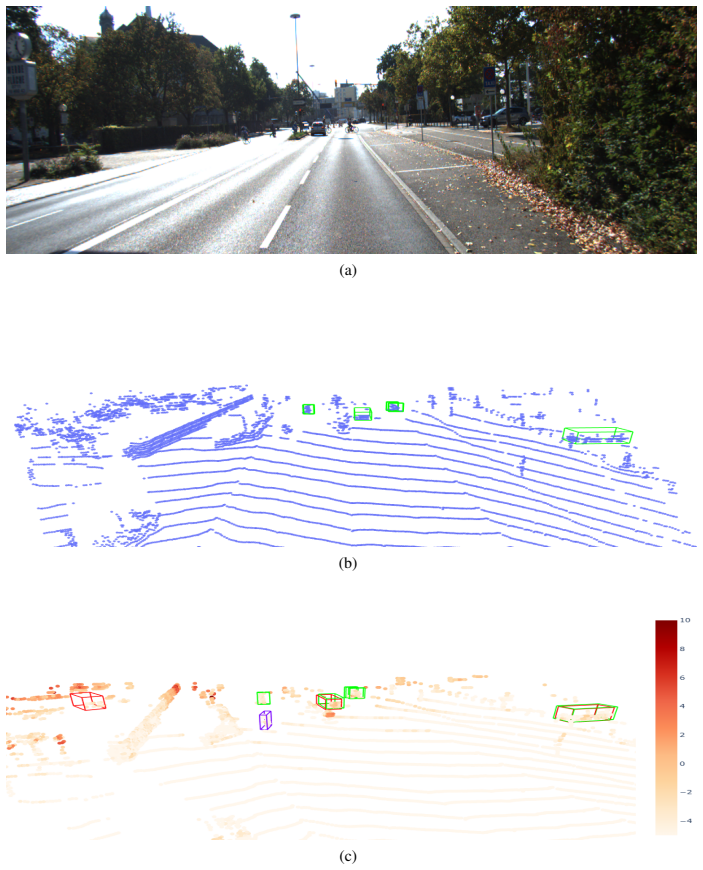
Figures from the paper (7 more)


Reference graph
Works this paper leans on
-
[1]
Caesar, H., Bankiti, V ., Lang, A. H., V ora, S., Liong, V . E., Xu, Q., Krishnan, A., Pan, Y ., Baldan, G., & Beijbom, O. (2020). nuScenes: A multimodal dataset for autonomous driving. In CVPR
work page 2020
-
[2]
Chen, Q., Sun, L., Wang, Z., Jia, K., & Yuille, A. (2020). Object as hotspots: An anchor-free 3D object detection approach via firing of hotspots. In ECCV
work page 2020
-
[3]
G., Ma, H., Fidler, S., & Urtasun, R
Chen, X., Kundu, K., Zhu, Y ., Berneshawi, A. G., Ma, H., Fidler, S., & Urtasun, R. (2015). 3D object proposals for accurate object class detection. In NeurIPS
work page 2015
-
[4]
Chen, Y ., Li, Y ., Zhang, X., Sun, J., & Jia, J. (2022). Focal sparse convolutional networks for 3D object detection. In CVPR
work page 2022
-
[5]
Chen, Y ., Liu, S., Shen, X., & Jia, J. (2019). Fast point R-CNN. InICCV
work page 2019
-
[6]
Deng, J., Shi, S., Li, P., Zhou, W., Zhang, Y ., & Li, H. (2021). V oxel R-CNN: Towards high performance voxel-based 3D object detection. In AAAI
work page 2021
-
[7]
Du, L., Ye, X., Tan, X., Feng, J., Xu, Z., Ding, E., & Wen, S. (2020). Associate-3Ddet: Perceptual-to-conceptual association for 3D point cloud object detection. In CVPR
work page 2020
-
[8]
Fan, L., Pang, Z., Zhang, T., Wang, Y .-X., Zhao, H., Wang, F., Wang, N., & Zhang, Z. (2022). Embracing single stride 3D object detector with sparse transformer. In CVPR
work page 2022
Show all 64 references
-
[9]
Geiger, A., Lenz, P., & Urtasun, R. (2012). Are we ready for autonomous driving? the KITTI vision benchmark suite. In CVPR
2012
-
[10]
R., Venkatesh, S., & Hengel, A
Gong, D., Liu, L., Le, V ., Saha, B., Mansour, M. R., Venkatesh, S., & Hengel, A. v. d. (2019). Memorizing normality to detect anomaly: Memory- augmented deep autoencoder for unsupervised anomaly detection. In ICCV
2019
-
[11]
Guang, J., Hu, Z., Wu, S., Zhang, Q., & Liu, J. (2024). Rpea: A residual path network with efficient attention for 3d pedestrian detection from lidar point clouds. Expert Systems with Applications, 249, 123497
2024
-
[12]
Guo, C., Fan, B., Zhang, Q., Xiang, S., & Pan, C. (2020). AugFPN: Improving multi-scale feature learning for object detection. In CVPR
2020
-
[13]
Guo, C., Pleiss, G., Sun, Y ., & Weinberger, K. Q. (2017). On calibration of modern neural networks
2017
-
[14]
He, C., Li, R., Li, S., & Zhang, L. (2022). V oxel set transformer: A set-to-set approach to 3D object detection from point clouds. In CVPR
2022
-
[15]
He, C., Li, R., Zhang, G., & Zhang, L. (2024). Scatterformer: Efficient voxel transformer with scattered linear attention. In ECCV: Springer
2024
-
[16]
He, C., Zeng, H., Huang, J., Hua, X.-S., & Zhang, L. (2020). Structure aware single-stage 3D object detection from point cloud. In CVPR
2020
-
[17]
Hu, J. S. K., Kuai, T., & Waslander, S. L. (2022). Point density-aware voxels for lidar 3D object detection. In CVPR
2022
-
[18]
& Szegedy, C
Ioffe, S. & Szegedy, C. (2015). Batch normalization: Accelerating deep network training by reducing internal covariate shift. In ICML
2015
-
[19]
Konushin, A. (2025). Unidet3d: Multi-dataset indoor 3d object detection. In AAAI
2025
-
[20]
Kong, T., Sun, F., Yao, A., Liu, H., Lu, M., & Chen, Y . (2017). Ron: Reverse connection with objectness prior networks for object detection. In CVPR
2017
-
[21]
Koo, I., Lee, I., Kim, S.-H., Kim, H.-S., Jeon, W.-j., & Kim, C. (2023). PG-RCNN: Semantic surface point generation for 3d object detection. In ICCV
2023
-
[22]
H., V ora, S., Caesar, H., Zhou, L., Yang, J., & Beijbom, O
Lang, A. H., V ora, S., Caesar, H., Zhou, L., Yang, J., & Beijbom, O. (2019). PointPillars: Fast encoders for object detection from point clouds. In CVPR
2019
-
[23]
Li, J., Luo, C., & Yang, X. (2023). PillarNeXt: Rethinking network designs for 3d object detection in lidar point clouds. In CVPR
2023
-
[24]
Li, X., Wang, C., & Zeng, Z. (2024). Ws-ssd: Achieving faster 3d object detection for autonomous driving via weighted point cloud sampling. Expert Systems with Applications, 249, 123805
2024
-
[25]
Li, Y ., Pang, Y ., Shen, J., Cao, J., & Shao, L. (2020). NETNet: Neighbor erasing and transferring network for better single shot object detection. In CVPR
2020
-
[26]
Li, Z., Wang, F., & Wang, N. (2021). LiDAR R-CNN: An efficient and universal 3D object detector. In CVPR
2021
-
[27]
Lin, T.-Y ., Goyal, P., Girshick, R., He, K., & Dollár, P. (2017). Focal loss for dense object detection. In ICCV
2017
-
[28]
Liu, Z., Zhao, X., Huang, T., Hu, R., Zhou, Y ., & Bai, X. (2020). TANet: Robust 3D object detection from point clouds with triple attention. In AAAI
2020
-
[29]
Zhan, X. (2021). PVGNet: A bottom-up one-stage 3D object detector with integrated multi-level features. In CVPR
2021
-
[30]
Miller, A., Fisch, A., Dodge, J., Karimi, A.-H., Bordes, A., & Weston, J. (2016). Key-value memory networks for directly reading documents. In EMNLP
2016
-
[31]
Noh, J., Lee, S., & Ham, B. (2021). HVPR: Hybrid voxel-point representation for single-stage 3D object detection. In CVPR
2021
-
[32]
E., & Huang, G
Pan, X., Xia, Z., Song, S., Li, L. E., & Huang, G. (2021). 3d object detection with pointformer. In CVPR. Noh et al.: Preprint submitted to Elsevier Page 18 of 19
2021
-
[33]
R., Liu, W., Wu, C., Su, H., & Guibas, L
Qi, C. R., Liu, W., Wu, C., Su, H., & Guibas, L. J. (2018). Frustum PointNets for 3D object detection from RGB-D data. In CVPR
2018
-
[34]
Qin, Z., Li, Z., Zhang, Z., Bao, Y ., Yu, G., Peng, Y ., & Sun, J. (2019). ThunderNet: Towards real-time generic object detection on mobile devices. In ICCV
2019
-
[35]
Sheng, H., Cai, S., Liu, Y ., Deng, B., Huang, J., Hua, X.-S., & Zhao, M.-J. (2021). Improving 3D object detection with channel-wise transformer. In ICCV
2021
-
[36]
Sheng, H., Cai, S., Zhao, N., Deng, B., Huang, J., Hua, X.-S., Zhao, M.-J., & Lee, G. H. (2022). Rethinking iou-based optimization for single-stage 3d object detection. In ECCV
2022
-
[37]
Shi, G., Li, R., & Ma, C. (2022). Pillarnet: Real-time and high-performance pillar-based 3D object detection. In ECCV: Springer
2022
-
[38]
Shi, S., Jiang, L., Deng, J., Wang, Z., Guo, C., Shi, J., Wang, X., & Li, H. (2023). PV-RCNN++: Point-voxel feature set abstraction with local vector representation for 3D object detection. IJCV, 131(2), 531–551
2023
-
[39]
Shi, S., Wang, X., & Li, H. (2019). PointRCNN: 3D object proposal generation and detection from point cloud. In CVPR
2019
-
[40]
& Rajkumar, R
Shi, W. & Rajkumar, R. (2020). Point-GNN: Graph neural network for 3D object detection in a point cloud. In CVPR
2020
-
[41]
Simon, M., Milzy, S., Amendey, K., & Gross, H.-M. (2018). Complex- YOLO: An euler-region-proposal for real-time 3D object detection on point clouds. In ECCVW
2018
-
[42]
Smith, L. N. & Topin, N. (2019). Super-convergence: Very fast training of neural networks using large learning rates. In Artificial intelligence and machine learning for multi-domain operations applications
2019
-
[43]
Sukhbaatar, S., Weston, J., Fergus, R., et al. (2015). End-to-end memory networks. In NeurIPS
2015
-
[44]
Sun, P., Kretzschmar, H., Dotiwalla, X., Chouard, A., Patnaik, V ., Tsui, P., Guo, J., Zhou, Y ., Chai, Y ., Caine, B., et al. (2020). Scalability in perception for autonomous driving: Waymo open dataset. In CVPR
2020
-
[45]
Sun, P., Tan, M., Wang, W., Liu, C., Xia, F., Leng, Z., & Anguelov, D. (2022). SWFormer: Sparse window transformer for 3D object detection in point clouds. In ECCV: Springer
2022
-
[46]
Wang, C., Yang, W., Liu, X., & Zhang, T. (2025). State space model meets transformer: A new paradigm for 3d object detection. In ICLR
2025
-
[47]
Wang, T., Hu, X., Liu, Z., & Fu, C.-W. (2022). Sparse2Dense: Learning to densify 3D features to boost 3D object detection. In NeurIPS
2022
-
[48]
Wang, W., Lu, Y ., Zheng, G., Zhan, S., Ye, X., Tan, Z., Wang, J., Wang, G., & Li, X. (2024). Bevspread: Spread voxel pooling for bird’s-eye-view representation in vision-based roadside 3d object detection. In CVPR
2024
-
[49]
A., Pantofaru, C., Funkhouser, T., & Solomon, J
Wang, Y ., Fathi, A., Kundu, A., Ross, D. A., Pantofaru, C., Funkhouser, T., & Solomon, J. (2020). Pillar-based object detection for autonomous driving. In ECCV
2020
-
[50]
& Jia, K
Wang, Z. & Jia, K. (2019). Frustum ConvNet: Sliding frustums to aggregate local point-wise features for amodal 3D object detection. In IROS
2019
-
[51]
Weston, J., Chopra, S., & Bordes, A. (2015). Memory networks. In ICLR
2015
-
[52]
Wu, X., Shi, G., Zhao, Z., Li, M., Gao, X., & Yan, X. (2024). Dccn: A dual-cross contrastive neural network for 3d point cloud representation learning. Expert Systems with Applications, 249, 123564
2024
-
[53]
Yan, Y ., Mao, Y ., & Li, B. (2018). SECOND: Sparsely embedded convolutional detection. Sensors, 18(10)
2018
-
[54]
Yang, B., Luo, W., & Urtasun, R. (2018). PIXOR: Real-time 3D object detection from point clouds. In CVPR
2018
-
[55]
Yang, H., Wang, W., Chen, M., Lin, B., He, T., Chen, H., He, X., & Ouyang, W. (2023). PVT-SSD: Single-stage 3d object detector with point-voxel transformer. In CVPR
2023
-
[56]
Yang, Z., Sun, Y ., Liu, S., & Jia, J. (2020). 3DSSD: Point-based 3D single stage object detector. In CVPR
2020
-
[57]
Yang, Z., Sun, Y ., Liu, S., Shen, X., & Jia, J. (2019). STD: Sparse-to-dense 3D object detector for point cloud. In ICCV
2019
-
[58]
Ye, M., Xu, S., & Cao, T. (2020). HVNet: Hybrid voxel network for lidar based 3D object detection. In CVPR
2020
-
[59]
Yin, T., Zhou, X., & Krahenbuhl, P. (2021). Center-based 3D object detection and tracking. In CVPR
2021
-
[60]
Zhang, G., Chen, J., Gao, G., Li, J., Liu, S., & Hu, X. (2024). SAFDNet: A simple and effective network for fully sparse 3d object detection. In CVPR
2024
-
[61]
Zhang, H., Zhang, H., Wang, C., & Xie, J. (2019). Co-occurrent features in semantic segmentation. In CVPR
2019
-
[62]
Zhao, H., Shi, J., Qi, X., Wang, X., & Jia, J. (2017). Pyramid scene parsing network. In CVPR
2017
-
[63]
& Tuzel, O
Zhou, Y . & Tuzel, O. (2018). V oxelNet: End-to-end learning for point cloud based 3D object detection. In CVPR
2018
-
[64]
Zhou, Z., Zhao, X., Wang, Y ., Wang, P., & Foroosh, H. (2022). Centerformer: Center-based transformer for 3D object detection. In ECCV: Springer. Noh et al.: Preprint submitted to Elsevier Page 19 of 19
2022
Reviewed August 5, 2026 · model on record in the stance chip above.
Discussion (0). Continue with ORCID to comment.