REVIEW 5 major objections 6 minor 71 references
A reward that scores how much a chain of thought raises the correct answer's likelihood lifts a 7B model's deductive accuracy from 13% to 60% in 400 training steps.
Reviewed by Pith at T0; open to challenge. T0 means a machine referee read the full paper against a public rubric. the ladder, T0–T4 →
DRER rewards CoT trajectories that increase the model's likelihood of the correct answer, plus a length penalty, and the new LogicTree benchmark reportedly lifts a 7B model's average accuracy from 0.13 to 0.60.
T0 review reviewed 2026-08-05 challenge →
load-bearing objection Interesting reward idea and a useful new benchmark, but the central mechanism is confounded by mismatched prompts and the evaluation lacks the ablations needed to trust the headline numbers. the 5 major comments →
Rethinking Reasoning Quality in Large Language Models through Enhanced Chain-of-Thought via RL
The pith
A machine-rendered reading of the paper's core claim, the machinery that carries it, and where it could break.
The reading
Core claim
The paper's central discovery is that the difference in log-likelihood of the ground-truth answer tokens with versus without a chain of thought — Δ(x) = ℓ_CoT − ℓ_NoCoT — is a usable learning signal for reasoning quality. When a CoT is genuinely useful, the model assigns higher probability to the correct answer conditional on it, so Δ is positive; when the chain is spurious, Δ is negative. DRER converts this margin into a bounded reward R_q = tanh(Δ), adds it to the task reward (answer correctness plus format), and multiplies the group-normalized advantage by a length attenuation factor g_i derived from validation-set length quantiles. Training with this composite reward on the LogicTree dat
What carries the argument
The load-bearing object is the log-likelihood margin Δ(x) = ℓ_CoT − ℓ_NoCoT, the per-token average log-probability the current policy assigns to the ground-truth answer tokens when the prompt includes the generated chain of thought versus when it does not. Squashed through tanh it becomes the Reasoning Quality Reward; multiplied into the group advantage it becomes the Dynamic Length Advantage via g_i = exp(−max{0, L_min − ℓ_i, ℓ_i − L_max}/τ) with bounds taken from the validation set. The margin is doing the work: it is the only part of the reward that links intermediate reasoning tokens to the answer, and it is what lets DRER prefer chains that "demonstrably raise the likelihood of the corr
Load-bearing premise
The load-bearing premise is that the margin Δ(x) — how much more likely the current model finds the correct answer when the chain of thought is present — actually measures whether the chain helped reasoning, and not merely whether the model became more confident or leaned on memorized surface cues; the model computing the margin is also the one being trained, so the signal is not stationary.
What would settle it
Generate LogicTree prompts where a filler chain that restates the answer without valid deduction is inserted between premises and answer; if R_q is positive for such filler chains and accuracy on held-out depth-8 trees still rises substantially, the margin is rewarding confidence rather than deductive utility. A cheaper check on the same logic: compute the WR-group margin (+2.46 nats on GSM8K, +1.81 on LogicTree) on adversarial CoTs that state the answer before deriving it — if the margin stays positive, Eq. (11)'s sign convention is not tracking logical validity.
If this is right
- If the margin is a faithful quality signal, any RL pipeline that can sample CoT and no-CoT rollouts can upgrade outcome-only rewards to reasoning-sensitive ones without human annotation or a process reward model.
- Training on formal deduction transfers: the same 400-step 7B model improves on AIME24, MMLU-redux, ZebraLogic, and ProntoQA, suggesting logical RL generalizes beyond the training domain.
- The length attenuation suppresses the length-inflation tendency of GRPO-style group advantages, so reasoning quality can improve while token consumption falls by about 75% relative to the DAPO/GRPO baselines.
- Consistency across paraphrases of the same logical structure rises from 0.01 to 0.41 on average, implying the model learns logical paradigms rather than surface patterns, though it still collapses at depth 7-8.
Where Pith is reading between the lines
- The margin Δ is computed with the current policy, which is itself being trained; the paper validates the sign convention post-hoc. A natural test the authors did not run: freeze the reference policy and compare credit assignment under frozen vs. live policy, since non-stationarity could mean early high-Δ chains are the ones the model already agrees with rather than the ones that teach new inferenc
- Because the reward needs only the correct answer tokens and two forward passes, it should extend to any verifiable domain beyond True/False deduction — multiple-choice QA or code with testable prefixes — with the length advantage recalibrated per bucket.
- The consistency metric (same logic, different words) could double as a reward-hacking detector: if accuracy rises while consistency stays flat, DRER is fitting the benchmark's wording distribution rather than the inference paradigm.
- The scalar margin collapses CoT utility into one number; a finer variant would decompose the margin per inference step to say which premise the chain exploited, connecting to process reward models without their annotation cost.
Editorial analysis
A structured set of objections, weighed in public.
Referee Report
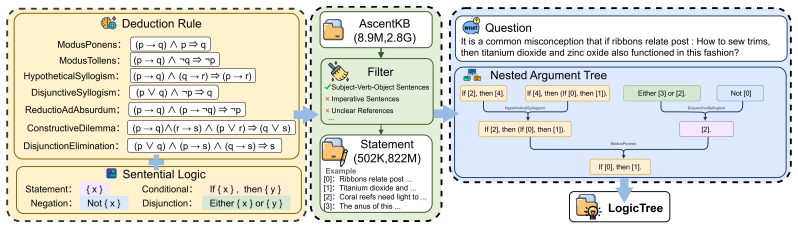
Summary. The paper proposes DRER, a reinforcement-learning reward shaping method for LLM chain-of-thought reasoning. It defines a reasoning-quality reward R_q = tanh(ℓ_CoT − ℓ_NoCoT), computed as the per-token log-likelihood margin of the ground-truth answer when conditioning on a generated CoT versus a No-CoT prompt, and combines it with a task-level correctness reward. A secondary component, the Dynamic Length Advantage, multiplies the group-normalized advantage by an exponential penalty for responses whose lengths fall outside validation-derived quantiles. The authors also release LogicTree, a dynamically generated deductive-reasoning dataset with controllable depth and width, and report experiments training Qwen2.5-7B-Instruct-1M with DAPO/GRPO for 400 steps, claiming LogicTree accuracy rises from 13% to 60%, confidence gains of 30–60%, and generalization to ZebraLogic, ProntoQA, AIME24, and MMLU-redux.
Significance. If the central mechanism is validated, DRER is a potentially valuable plug-and-play reward for reasoning-quality RL: it is rule-based, requires no learned reward model, and directly targets whether CoT tokens increase the likelihood of the correct answer. The LogicTree dataset is a genuinely useful contribution: it is synthetically generated, semantically decoupled from world knowledge, and offers controlled reasoning depth, consistency metrics, and exact prompt templates. The paper also releases code and data, which supports reproducibility. However, the empirical support for the reward mechanism is currently incomplete: the reported gains are not ablated against the length penalty, the CoT/No-CoT prompts are confounded by template differences, and all headline results come from a single training run without error bars or multiple seeds.
major comments (5)
- [Appendix D, Tables 4–5; §3.1, Eqs. (9)–(12)]
- [§4.2, §4.5; Eqs. (13)–(14)]
- [§4.4; §3.1, Eqs. (9)–(12)]
- [Abstract; Introduction; Table 1]
- [§4.1; Tables 1, 11, 12]
minor comments (6)
- [§5]
- [Eqs. (9), (14)]
- [Throughout]
- [Appendix D]
- [§2, Eqs. (3)–(4)]
- [Table 12]
Circularity Check
The reasoning-quality reward's increase is by construction; the central accuracy claim remains independently measured.
specific steps
-
self definitional
[Section 4.4, Figure 5; Eqs. (11)-(13)]
"We train the same base model with two popular base algorithms, GRPO and DAPO on DRER framework. Picture 5 shows that reasoning quality reward increases sharply ,which proves that the CoT tokens are becoming positive for model reasoning."
R_q is defined in Eq. (12) as tanh(Δ(x)) with Δ(x)=ℓ_CoT−ℓ_NoCoT (Eq. 11), and the training objective (Eq. 13) explicitly maximizes this R_q. Therefore a rising 'reasoning quality reward' curve is a monotone consequence of optimizing the very margin that defines the reward; it cannot independently 'prove that the CoT tokens are becoming positive.' The same Δ is also used in Section 4.4 (Tables 9–10) to validate the hypothesis in Eq. (10). Thus the evidence offered for the mechanism is the objective itself, making the reported increase partly by construction rather than an independent confirmation of reasoning-quality improvement.
full rationale
The central empirical claim—DRER raising LogicTree accuracy from 13% to 60% on a held-out test split (Table 1)—is measured independently of the reward function and is not circular. However, the paper's secondary claim that DRER improves 'reasoning quality' relies on the log-likelihood margin Δ(x), which is the exact quantity that R_q = tanh(Δ) is designed to maximize. Figure 5's increase in R_q is therefore a direct consequence of optimizing that objective, not an independent verification that CoT tokens are becoming more useful. Additionally, the CoT and No-CoT prompts (Tables 4–5) differ in system instructions and output-format requirements, so Δ may partly reflect template effects; this is a confound rather than a circularity but further weakens the interpretation of the reward curve. No load-bearing self-citation chains or imported uniqueness theorems are present. The accuracy improvements on LogicTree and generalization to other benchmarks provide independent content, so the paper is only partially circular.
Axiom & Free-Parameter Ledger
free parameters (4)
- lambda_q (reasoning reward weight) =
1
- tau (length attenuation temperature) =
8
- L_min^(d), L_max^(d) per difficulty bucket =
5th and 95th percentiles of validation-set response lengths
- Task reward constants S_format and S_answer =
1/-1 and 2/-1.5/-2
axioms (6)
- standard math Propositional logic inference rules (modus ponens, modus tollens, etc.) are valid and sufficient to determine truth values in LogicTree.
- ad hoc to paper The log-likelihood margin ell_CoT minus ell_NoCoT is a valid measure of whether CoT tokens are beneficial.
- domain assumption Ground-truth answers are available and correctly formatted for all LogicTree training questions.
- ad hoc to paper Validation-derived length quantiles L_min and L_max remain representative during training.
- standard math The policy gradient and GRPO/DAPO objectives are unbiased under the stated MDP with deterministic transitions.
- domain assumption Model confidence scores are comparable across prompts and models.
Cite this review
Pith. "Pith review of Rethinking Reasoning Quality in Large Language Models through Enhanced Chain-of-Thought via RL." pith.science (2026). https://pith.science/paper/JFXACJAK
@misc{pith2026250906024,
  author       = {Pith},
  title        = {Pith review of: Rethinking Reasoning Quality in Large Language Models through Enhanced Chain-of-Thought via RL},
  year         = {2026},
  howpublished = {\url{https://pith.science/paper/JFXACJAK}},
  note         = {Machine review of arXiv:2509.06024}
}
read the original abstract
Reinforcement learning (RL) has recently become the dominant paradigm for strengthening the reasoning abilities of large language models (LLMs). Yet the rule-based reward functions commonly used on mathematical or programming benchmarks assess only answer format and correctness, providing no signal as to whether the induced Chain-of-Thought (CoT) actually improves the answer. Furthermore, such task-specific training offers limited control over logical depth and therefore may fail to reveal a model's genuine reasoning capacity. We propose Dynamic Reasoning Efficiency Reward (DRER) -- a plug-and-play RL reward framework that reshapes both reward and advantage signals. (i) A Reasoning Quality Reward assigns fine-grained credit to those reasoning chains that demonstrably raise the likelihood of the correct answer, directly incentivising the trajectories with beneficial CoT tokens. (ii) A Dynamic Length Advantage decays the advantage of responses whose length deviates from a validation-derived threshold, stabilising training. To facilitate rigorous assessment, we also release Logictree, a dynamically constructed deductive reasoning dataset that functions both as RL training data and as a comprehensive benchmark. Experiments confirm the effectiveness of DRER: our 7B model attains GPT-o3-mini level performance on Logictree with 400 trianing steps, while the average confidence of CoT-augmented answers rises by 30%. The model further exhibits generalisation across diverse logical-reasoning datasets, and the mathematical benchmark AIME24. These results illuminate how RL shapes CoT behaviour and chart a practical path toward enhancing formal-reasoning skills in large language models. All code and data are available in repository https://github.com/Henryhe09/DRER.
Figures



Reference graph
Works this paper leans on
-
[1]
L1: Controlling how long a reasoning model thinks with reinforcement learning, 2025
Pranjal Aggarwal and Sean Welleck. L1: Controlling how long a reasoning model thinks with reinforcement learning, 2025
2025
-
[2]
Back to basics: Revisiting reinforce style optimization for learning from human feedback in llms, 2024
Arash Ahmadian, Chris Cremer, Matthias Gallé, Marzieh Fadaee, Julia Kreutzer, Olivier Pietquin, Ahmet Üstün, and Sara Hooker. Back to basics: Revisiting reinforce style optimization for learning from human feedback in llms, 2024
2024
-
[3]
Evaluating large language models trained on code.arXiv preprint arXiv:2107.03374, 2021
Mark Chen, Jerry Tworek, Heewoo Jun, Qiming Yuan, Henrique Ponde De Oliveira Pinto, Jared Kaplan, Harri Edwards, Yuri Burda, Nicholas Joseph, Greg Brockman, et al. Evaluating large language models trained on code.arXiv preprint arXiv:2107.03374, 2021
Pith/arXiv arXiv 2021
-
[4]
Michael K Chen, Xikun Zhang, and Dacheng Tao. Justlogic: A comprehensive benchmark for evaluating deductive reasoning in large language models.arXiv preprint arXiv:2501.14851, 2025
Pith/arXiv arXiv 2025
-
[5]
Fengxiang Cheng, Haoxuan Li, Fenrong Liu, Robert van Rooij, Kun Zhang, and Zhouchen Lin. Empower- ing llms with logical reasoning: A comprehensive survey.arXiv preprint arXiv:2502.15652, 2025
Pith/arXiv arXiv 2025
-
[6]
Pengyu Cheng, Yong Dai, Tianhao Hu, Han Xu, Zhisong Zhang, Lei Han, Nan Du, and Xiaolong Li. Self- playing adversarial language game enhances llm reasoning.Advances in Neural Information Processing Systems, 37:126515–126543, 2024
work page 2024
-
[7]
Transformers as soft reasoners over language.arXiv preprint arXiv:2002.05867, 2020
Peter Clark, Oyvind Tafjord, and Kyle Richardson. Transformers as soft reasoners over language.arXiv preprint arXiv:2002.05867, 2020
Pith/arXiv arXiv 2002
-
[8]
Training verifiers to solve math word problems.arXiv preprint arXiv:2110.14168, 2021
Karl Cobbe, Vineet Kosaraju, Mohammad Bavarian, Mark Chen, Heewoo Jun, Lukasz Kaiser, Matthias Plappert, Jerry Tworek, Jacob Hilton, Reiichiro Nakano, et al. Training verifiers to solve math word problems.arXiv preprint arXiv:2110.14168, 2021
Pith/arXiv arXiv 2021
-
[9]
Gemini 2.0 flash thinking, 2024
Google DeepMind. Gemini 2.0 flash thinking, 2024
2024
-
[10]
Kanishk Gandhi, Ayush Chakravarthy, Anikait Singh, Nathan Lile, and Noah D Goodman. Cognitive behaviors that enable self-improving reasoners, or, four habits of highly effective stars.arXiv preprint arXiv:2503.01307, 2025
Pith/arXiv arXiv 2025
-
[11]
Did aristotle use a laptop? a question answering benchmark with implicit reasoning strategies.Transactions of the Association for Computational Linguistics, 9:346–361, 2021
Mor Geva, Daniel Khashabi, Elad Segal, Tushar Khot, Dan Roth, and Jonathan Berant. Did aristotle use a laptop? a question answering benchmark with implicit reasoning strategies.Transactions of the Association for Computational Linguistics, 9:346–361, 2021
2021
-
[12]
Jiayi Gui, Yiming Liu, Jiale Cheng, Xiaotao Gu, Xiao Liu, Hongning Wang, Yuxiao Dong, Jie Tang, and Minlie Huang. Logicgame: Benchmarking rule-based reasoning abilities of large language models.arXiv preprint arXiv:2408.15778, 2024
Pith/arXiv arXiv 2024
-
[13]
Daya Guo, Dejian Yang, Haowei Zhang, Junxiao Song, Ruoyu Zhang, Runxin Xu, Qihao Zhu, Shirong Ma, Peiyi Wang, Xiao Bi, et al. Deepseek-r1: Incentivizing reasoning capability in llms via reinforcement learning.arXiv preprint arXiv:2501.12948, 2025
Pith/arXiv arXiv 2025
-
[14]
Folio: Natural language reasoning with first-order logic
Simeng Han, Hailey Schoelkopf, Yilun Zhao, Zhenting Qi, Martin Riddell, Wenfei Zhou, James Coady, David Peng, Yujie Qiao, Luke Benson, et al. Folio: Natural language reasoning with first-order logic. arXiv preprint arXiv:2209.00840, 2022
Pith/arXiv arXiv 2022
-
[15]
Measuring mathematical problem solving with the math dataset
Dan Hendrycks, Collin Burns, Saurav Kadavath, Akul Arora, Steven Basart, Eric Tang, Dawn Song, and Jacob Steinhardt. Measuring mathematical problem solving with the math dataset. InProceedings of the Neural Information Processing Systems Track on Datasets and Benchmarks, volume 1, 2021
2021
-
[16]
Jian Hu. Reinforce++: A simple and efficient approach for aligning large language models.arXiv preprint arXiv:2501.03262, 2025
Pith/arXiv arXiv 2025
-
[17]
Pengcheng Jiang, Cao Xiao, Minhao Jiang, Parminder Bhatia, Taha Kass-Hout, Jimeng Sun, and Jiawei Han. Reasoning-enhanced healthcare predictions with knowledge graph community retrieval.arXiv preprint arXiv:2410.04585, 2024
Pith/arXiv arXiv 2024
-
[18]
Boardgameqa: A dataset for natural language reasoning with contradictory information
Mehran Kazemi, Quan Yuan, Deepti Bhatia, Najoung Kim, Xin Xu, Vaiva Imbrasaite, and Deepak Ramachandran. Boardgameqa: A dataset for natural language reasoning with contradictory information. Advances in Neural Information Processing Systems, 36:39052–39074, 2023
work page 2023
-
[19]
Wouter Kool, Herke van Hoof, and Max Welling. Buy 4 REINFORCE samples, get a baseline for free! In Deep Reinforcement Learning Meets Structured Prediction, ICLR 2019 Workshop, New Orleans, Louisiana, United States, May 6, 2019. OpenReview.net, 2019. 10
work page 2019
-
[20]
Chain of code: Reasoning with a language model-augmented code emulator
Chengshu Li, Jacky Liang, Andy Zeng, Xinyun Chen, Karol Hausman, Dorsa Sadigh, Sergey Levine, Li Fei-Fei, Fei Xia, and Brian Ichter. Chain of code: Reasoning with a language model-augmented code emulator. InInternational Conference on Machine Learning, pages 28259–28277. PMLR, 2024
work page 2024
-
[21]
Junlong Li, Daya Guo, Dejian Yang, Runxin Xu, Yu Wu, and Junxian He. Codei/o: Condensing reasoning patterns via code input-output prediction.arXiv preprint arXiv:2502.07316, 2025
Pith/arXiv arXiv 2025
-
[22]
Limr: Less is more for rl scaling, 2025
Xuefeng Li, Haoyang Zou, and Pengfei Liu. Limr: Less is more for rl scaling, 2025
2025
-
[23]
From system 1 to system 2: A survey of reasoning large language models, 2025
Zhong-Zhi Li, Duzhen Zhang, Ming-Liang Zhang, Jiaxin Zhang, Zengyan Liu, Yuxuan Yao, Haotian Xu, Junhao Zheng, Pei-Jie Wang, Xiuyi Chen, Yingying Zhang, Fei Yin, Jiahua Dong, Zhiwei Li, Bao-Long Bi, Ling-Rui Mei, Junfeng Fang, Zhijiang Guo, Le Song, and Cheng-Lin Liu. From system 1 to system 2: A survey of reasoning large language models, 2025
work page 2025
-
[24]
Bill Yuchen Lin, Ronan Le Bras, Kyle Richardson, Ashish Sabharwal, Radha Poovendran, Peter Clark, and Yejin Choi. Zebralogic: On the scaling limits of llms for logical reasoning.arXiv preprint arXiv:2502.01100, 2025
Pith/arXiv arXiv 2025
-
[25]
Natural language inference in context-investigating contextual reasoning over long texts
Hanmeng Liu, Leyang Cui, Jian Liu, and Yue Zhang. Natural language inference in context-investigating contextual reasoning over long texts. InProceedings of the AAAI conference on artificial intelligence, volume 35, pages 13388–13396, 2021
work page 2021
-
[26]
Hanmeng Liu, Jian Liu, Leyang Cui, Zhiyang Teng, Nan Duan, Ming Zhou, and Yue Zhang. Logiqa 2.0—an improved dataset for logical reasoning in natural language understanding.IEEE/ACM Transactions on Audio, Speech, and Language Processing, 31:2947–2962, 2023
work page 2023
-
[27]
大模型逻辑推理研究综述 (survey on logical reasoning of large pre- trained language models)
Hanmeng Liu and Yue Zhang. 大模型逻辑推理研究综述 (survey on logical reasoning of large pre- trained language models). In Zhao Xin, editor,Proceedings of the 23rd Chinese National Conference on Computational Linguistics (Volume 2: Frontier Forum), pages 48–62, Taiyuan, China, July 2024. Chinese Information Processing Society of China
work page 2024
-
[28]
Jian Liu, Leyang Cui, Hanmeng Liu, Dandan Huang, Yile Wang, and Yue Zhang. Logiqa: A challenge dataset for machine reading comprehension with logical reasoning.arXiv preprint arXiv:2007.08124, 2020
Pith/arXiv arXiv 2007
-
[29]
Understanding r1-zero-like training: A critical perspective, 2025
Zichen Liu, Changyu Chen, Wenjun Li, Penghui Qi, Tianyu Pang, Chao Du, Wee Sun Lee, and Min Lin. Understanding r1-zero-like training: A critical perspective, 2025
2025
-
[30]
Mary M Lucas, Justin Yang, Jon K Pomeroy, and Christopher C Yang. Reasoning with large language models for medical question answering.Journal of the American Medical Informatics Association, 31(9):1964–1975, 2024
work page 1964
-
[31]
Improve mathematical reasoning in language models by automated process supervision, 2024
Liangchen Luo, Yinxiao Liu, Rosanne Liu, Samrat Phatale, Meiqi Guo, Harsh Lara, Yunxuan Li, Lei Shu, Yun Zhu, Lei Meng, Jiao Sun, and Abhinav Rastogi. Improve mathematical reasoning in language models by automated process supervision, 2024
work page 2024
-
[32]
Exploring the limit of outcome reward for learning mathematical reasoning, 2025
Chengqi Lyu, Songyang Gao, Yuzhe Gu, Wenwei Zhang, Jianfei Gao, Kuikun Liu, Ziyi Wang, Shuaibin Li, Qian Zhao, Haian Huang, Weihan Cao, Jiangning Liu, Hongwei Liu, Junnan Liu, Songyang Zhang, Dahua Lin, and Kai Chen. Exploring the limit of outcome reward for learning mathematical reasoning, 2025
2025
-
[33]
Real: Efficient rlhf training of large language models with parameter reallocation
Zhiyu Mei, Wei Fu, Kaiwei Li, Guangju Wang, Huanchen Zhang, and Yi Wu. Real: Efficient rlhf training of large language models with parameter reallocation. InProceedings of the Eighth Conference on Machine Learning and Systems, MLSys 2025, Santa Clara, CA, USA, May 12-15, 2025. mlsys.org, 2025
2025
-
[34]
Terufumi Morishita, Gaku Morio, Atsuki Yamaguchi, and Yasuhiro Sogawa. Enhancing reasoning capabilities of llms via principled synthetic logic corpus.Advances in Neural Information Processing Systems, 37:73572–73604, 2024
work page 2024
-
[35]
Advanced semantics for commonsense knowledge extraction
Tuan-Phong Nguyen, Simon Razniewski, and Gerhard Weikum. Advanced semantics for commonsense knowledge extraction. InProceedings of the Web Conference 2021, pages 2636–2647, 2021
work page 2021
-
[36]
Learning to reason with llms, 2024
OpenAI. Learning to reason with llms, 2024
2024
-
[37]
Training language models to follow instructions with human feedback.Advances in neural information processing systems, 35:27730–27744, 2022
Long Ouyang, Jeffrey Wu, Xu Jiang, Diogo Almeida, Carroll Wainwright, Pamela Mishkin, Chong Zhang, Sandhini Agarwal, Katarina Slama, Alex Ray, et al. Training language models to follow instructions with human feedback.Advances in neural information processing systems, 35:27730–27744, 2022
2022
-
[38]
Making reasoning matter: Measuring and improving faithfulness of chain-of-thought reasoning
Debjit Paul, Robert West, Antoine Bosselut, and Boi Faltings. Making reasoning matter: Measuring and improving faithfulness of chain-of-thought reasoning. InFindings of the Association for Computational Linguistics: EMNLP 2024, pages 15012–15032, 2024. 11
work page 2024
-
[39]
Qwen2.5 technical report, 2025
Qwen, :, An Yang, Baosong Yang, Beichen Zhang, Binyuan Hui, Bo Zheng, Bowen Yu, Chengyuan Li, Dayiheng Liu, Fei Huang, Haoran Wei, Huan Lin, Jian Yang, Jianhong Tu, Jianwei Zhang, Jianxin Yang, Jiaxi Yang, Jingren Zhou, Junyang Lin, Kai Dang, Keming Lu, Keqin Bao, Kexin Yang, Le Yu, Mei Li, Mingfeng Xue, Pei Zhang, Qin Zhu, Rui Men, Runji Lin, Tianhao Li,...
2025
-
[40]
Qwq-32b: Embracing the power of reinforcement learning, 2024
Qwen. Qwq-32b: Embracing the power of reinforcement learning, 2024
2024
-
[41]
Abulhair Saparov and He He. Language models are greedy reasoners: A systematic formal analysis of chain-of-thought.arXiv preprint arXiv:2210.01240, 2022
Pith/arXiv arXiv 2022
-
[42]
Abulhair Saparov, Richard Yuanzhe Pang, Vishakh Padmakumar, Nitish Joshi, Mehran Kazemi, Najoung Kim, and He He. Testing the general deductive reasoning capacity of large language models using ood examples.Advances in Neural Information Processing Systems, 36:3083–3105, 2023
work page 2023
-
[43]
High-dimensional continuous control using generalized advantage estimation, 2018
John Schulman, Philipp Moritz, Sergey Levine, Michael Jordan, and Pieter Abbeel. High-dimensional continuous control using generalized advantage estimation, 2018
2018
-
[44]
Proximal policy optimization algorithms, 2017
John Schulman, Filip Wolski, Prafulla Dhariwal, Alec Radford, and Oleg Klimov. Proximal policy optimization algorithms, 2017
2017
-
[45]
Automatic solutions of logic puzzles
Peter Sempolinski. Automatic solutions of logic puzzles. 2009
work page 2009
-
[46]
Zhihong Shao, Peiyi Wang, Qihao Zhu, Runxin Xu, Junxiao Song, Mingchuan Zhang, YK Li, Yu Wu, and Daya Guo. Deepseekmath: Pushing the limits of mathematical reasoning in open language models.arXiv preprint arXiv:2402.03300, 2024
Pith/arXiv arXiv 2024
-
[47]
Maohao Shen, Guangtao Zeng, Zhenting Qi, Zhang-Wei Hong, Zhenfang Chen, Wei Lu, Gregory Wornell, Subhro Das, David Cox, and Chuang Gan. Satori: Reinforcement learning with chain-of-action-thought enhances llm reasoning via autoregressive search.arXiv preprint arXiv:2502.02508, 2025
Pith/arXiv arXiv 2025
-
[48]
Zayne Sprague, Fangcong Yin, Juan Diego Rodriguez, Dongwei Jiang, Manya Wadhwa, Prasann Singhal, Xinyu Zhao, Xi Ye, Kyle Mahowald, and Greg Durrett. To cot or not to cot? chain-of-thought helps mainly on math and symbolic reasoning.arXiv preprint arXiv:2409.12183, 2024
Pith/arXiv arXiv 2024
-
[49]
MIT press Cambridge, 1998
Richard S Sutton, Andrew G Barto, et al.Reinforcement learning: An introduction, volume 1. MIT press Cambridge, 1998
1998
-
[50]
Kimi Team, Angang Du, Bofei Gao, Bowei Xing, Changjiu Jiang, Cheng Chen, Cheng Li, Chenjun Xiao, Chenzhuang Du, Chonghua Liao, et al. Kimi k1. 5: Scaling reinforcement learning with llms.arXiv preprint arXiv:2501.12599, 2025
Pith/arXiv arXiv 2025
-
[51]
Step-by-Step Reasoning to Solve Grid Puzzles: Where do LLMs Falter?
Nemika Tyagi, Mihir Parmar, Mohith Kulkarni, Aswin Rrv, Nisarg Patel, Mutsumi Nakamura, Arindam Mitra, and Chitta Baral. Step-by-step reasoning to solve grid puzzles: Where do llms falter?arXiv preprint arXiv:2407.14790, 2024
work page internal anchor Pith review Pith/arXiv arXiv 2024
-
[52]
Nemika Tyagi, Mihir Parmar, Mohith Kulkarni, Aswin Rrv, Nisarg Patel, Mutsumi Nakamura, Arindam Mitra, and Chitta Baral. Step-by-step reasoning to solve grid puzzles: Where do llms falter? InProceedings of the 2024 Conference on Empirical Methods in Natural Language Processing, pages 19898–19915, 2024
work page 2024
-
[53]
Measuring multimodal mathematical reasoning with math-vision dataset.Advances in Neural Information Processing Systems, 37:95095–95169, 2024
Ke Wang, Junting Pan, Weikang Shi, Zimu Lu, Houxing Ren, Aojun Zhou, Mingjie Zhan, and Hong- sheng Li. Measuring multimodal mathematical reasoning with math-vision dataset.Advances in Neural Information Processing Systems, 37:95095–95169, 2024
2024
-
[54]
Peiyi Wang, Lei Li, Zhihong Shao, R. X. Xu, Damai Dai, Yifei Li, Deli Chen, Y . Wu, and Zhifang Sui. Math-shepherd: Verify and reinforce llms step-by-step without human annotations, 2024
work page 2024
-
[55]
Xuran Wang, Xinguang Zhang, Vanessa Hoo, Zhouhang Shao, and Xuguang Zhang. Legalreasoner: A multi-stage framework for legal judgment prediction via large language models and knowledge integration. IEEE Access, 2024
work page 2024
-
[56]
Mmlu-pro: A more robust and challenging multi-task language understanding benchmark
Yubo Wang, Xueguang Ma, Ge Zhang, Yuansheng Ni, Abhranil Chandra, Shiguang Guo, Weiming Ren, Aaran Arulraj, Xuan He, Ziyan Jiang, et al. Mmlu-pro: A more robust and challenging multi-task language understanding benchmark. InThe Thirty-eight Conference on Neural Information Processing Systems Datasets and Benchmarks Track, 2024
2024
-
[57]
On memorization of large language models in logical reasoning
Chulin Xie, Yangsibo Huang, Chiyuan Zhang, Da Yu, Xinyun Chen, Bill Yuchen Lin, Bo Li, Badih Ghazi, and Ravi Kumar. On memorization of large language models in logical reasoning. InThe 4th Workshop on Mathematical Reasoning and AI at NeurIPS’24. 12
-
[58]
Logic-rl: Unleashing llm reasoning with rule-based reinforcement learning, 2025
Tian Xie, Zitian Gao, Qingnan Ren, Haoming Luo, Yuqian Hong, Bryan Dai, Joey Zhou, Kai Qiu, Zhirong Wu, and Chong Luo. Logic-rl: Unleashing llm reasoning with rule-based reinforcement learning, 2025
2025
-
[59]
Zhilin Yang, Peng Qi, Saizheng Zhang, Yoshua Bengio, William W Cohen, Ruslan Salakhutdinov, and Christopher D Manning. Hotpotqa: A dataset for diverse, explainable multi-hop question answering.arXiv preprint arXiv:1809.09600, 2018
Pith/arXiv arXiv 2018
-
[60]
Dapo: An open-source llm reinforcement learning system at scale, 2025
Qiying Yu, Zheng Zhang, Ruofei Zhu, Yufeng Yuan, Xiaochen Zuo, Yu Yue, Tiantian Fan, Gaohong Liu, Lingjun Liu, Xin Liu, Haibin Lin, Zhiqi Lin, Bole Ma, Guangming Sheng, Yuxuan Tong, Chi Zhang, Mofan Zhang, Wang Zhang, Hang Zhu, Jinhua Zhu, Jiaze Chen, Jiangjie Chen, Chengyi Wang, Hongli Yu, Weinan Dai, Yuxuan Song, Xiangpeng Wei, Hao Zhou, Jingjing Liu, W...
2025
-
[61]
Lawllm: Intelligent legal system with legal reasoning and verifiable retrieval
Shengbin Yue, Shujun Liu, Yuxuan Zhou, Chenchen Shen, Siyuan Wang, Yao Xiao, Bingxuan Li, Yun Song, Xiaoyu Shen, Wei Chen, et al. Lawllm: Intelligent legal system with legal reasoning and verifiable retrieval. InInternational Conference on Database Systems for Advanced Applications, pages 304–321. Springer, 2024
work page 2024
-
[62]
Rest-mcts*: Llm self-training via process reward guided tree search, 2024
Dan Zhang, Sining Zhoubian, Ziniu Hu, Yisong Yue, Yuxiao Dong, and Jie Tang. Rest-mcts*: Llm self-training via process reward guided tree search, 2024
2024
-
[63]
Dan Zhang, Sining Zhoubian, Yisong Yue, Yuxiao Dong, and Jie Tang. Rest-mcts*: Llm self-training via process reward guided tree search.arXiv preprint arXiv:2406.03816, 2024
Pith/arXiv arXiv 2024
-
[64]
R1-reward: Training multimodal reward model through stable reinforcement learning, 2025
Yi-Fan Zhang, Xingyu Lu, Xiao Hu, Chaoyou Fu, Bin Wen, Tianke Zhang, Changyi Liu, Kaiyu Jiang, Kaibing Chen, Kaiyu Tang, Haojie Ding, Jiankang Chen, Fan Yang, Zhang Zhang, Tingting Gao, and Liang Wang. R1-reward: Training multimodal reward model through stable reinforcement learning, 2025
work page 2025
-
[65]
Qin Zhu, Fei Huang, Runyu Peng, Keming Lu, Bowen Yu, Qinyuan Cheng, Xipeng Qiu, Xuanjing Huang, and Junyang Lin. Autologi: Automated generation of logic puzzles for evaluating reasoning abilities of large language models.arXiv preprint arXiv:2502.16906, 2025. A Technical Appendices and Supplementary Material Table 2: An example of a logictree puzzle. An e...
Pith/arXiv arXiv 2025
-
[66]
Analyze the logical structure of the given statements
-
[67]
Identify the conditions and implications in each statement
-
[68]
Determine the truth value of the given statements and how they relate to each other
-
[69]
Check the consistency of the statements with the provided premises
-
[70]
Deduce the implications of the given statements on the conclusion
-
[71]
Evaluate the final conclusion based on the logical consistency and the given premises. </think> <answer>[True, False]</answer> Solution: True False B LogicTree: Formal Paradigms and Templates B.1 Seven Deductive Paradigms in LOGICTREE LogicTree centres on seven classic deductive paradigms that constitute the atomic reasoning units of every sample. Each pa...
work page 2022
This paper was first reviewed by deepseek-v4-flash on August 5, 2026.
discussion (0)
Sign in with ORCID, Apple, or X to comment. Anyone can read and Pith papers without signing in.