REVIEW 3 major objections 4 minor 48 references
Asymmetry Vulnerability and Physical Attacks on Online Map Construction for Autonomous Driving
T0 review · 3 major / 4 minor · reviewed 2026-08-05 · deepseek-v4-flash
Pith's one-line read Online map construction is biased toward symmetric roads, and a roadside flashlight or patch can turn real forks into false straight roads.
desk verdict First real attack on online HD map construction, with physical-world evidence, but the headline 35% bias rate is computed on scenes selected by an unvalidated pipeline. read the letter →
The pith
A machine-rendered reading of the paper's core claim, the machinery that carries it, and where it could break.
The reading
What carries the argument
The load-bearing mechanism is the symmetry bias expressed through the BEV-encoder/map-decoder architecture: boundary queries attend to other instance- and point-level queries, so a straight neighboring boundary can dominate a diverging boundary's prediction. The attack machinery is a two-stage pipeline: a curvature-difference classifier plus a vision-language refinement step locates 'asymmetry anchors' (the positions where a boundary begins to deviate); a scoring function ranks roadside positions by inverse-square attack intensity and angular coverage of those anchors; then objective-specific optimization—Chamfer distance to a mirrored target for road straightening, a directional outward-shi
What would settle it
Take a fresh corpus of hand-labeled asymmetric forks and merges that is not filtered by the paper's classifier, run MapTR and VectorMapNet clean on them, and then deploy the optimized flashlight or patch positions on a random subset of those scenes. If clean misclassification of asymmetric scenes is not substantially above that of symmetric scenes, or if optimized positions succeed no more often than random roadside positions, then the symmetry-bias mechanism and its claimed exploitability are refuted.
Extended reading notes
Core claim
The paper's central discovery is a 'symmetry bias' in online vectorized HD map construction models. Because these models use a BEV encoder and a map decoder that lets each predicted map element attend to nearby elements, a straight reference boundary on one side of the road provides strong contextual pull; when the scene is asymmetric—one boundary turns while the other stays straight—the model often resolves the ambiguity by mirroring the straight side. The paper quantifies this in its Table 1: 35 of 100 asymmetric nuScenes scenes are already misclassified as symmetric in clean conditions, while only 19 of 100 symmetric scenes flip the other way. It then defines two attack targets, road stra
Load-bearing premise
The dataset-level vulnerability numbers all come from 100 asymmetric frames selected by the paper's curvature-plus-vision-language filter, and the real-world validation uses only 8 scenes from that same pipeline; if that filter systematically mislabels which asymmetric scenes are vulnerable, the measured clean misclassification, AP drops, and route-blocking rates may not generalize to real asymmetric road networks.
Editorial extensions
If this is right
- Online map construction should be treated as an adversarial component of the driving stack: a single static roadside installation can affect every passing vehicle with line of sight, not just one victim.
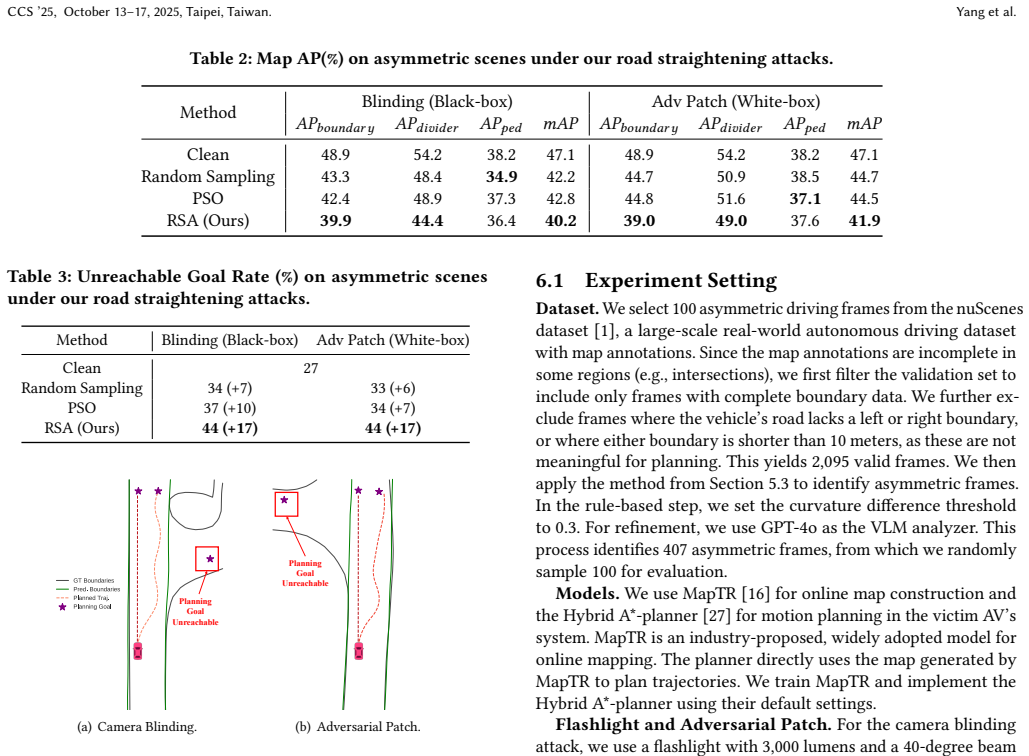
- Road straightening attacks create concrete denial-of-service outcomes: 44% of evaluated asymmetric scenes become partially unreachable, meaning entrances and turns can be effectively blocked without touching the road.
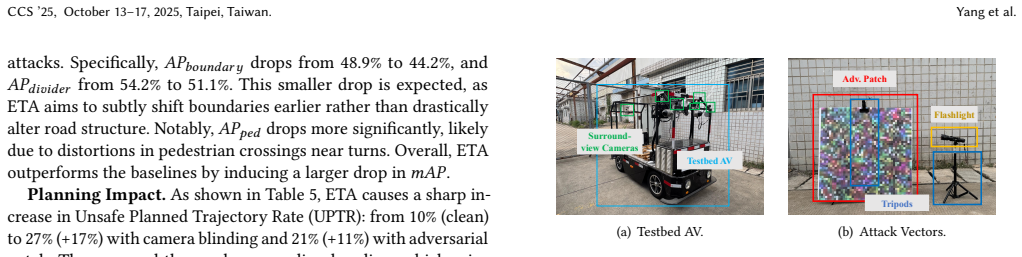
- Early-turn attacks create collision outcomes: unsafe planned trajectory rates rise to 27% with camera blinding and 21% with adversarial patches, and even small map-accuracy drops translate into large planning shifts.
- The vulnerability transfers beyond the exact victim model: configurations optimized on MapTR degrade VectorMapNet, and GeMap, MapQR, and a LiDAR-camera fusion variant remain partially vulnerable, so architecture changes alone do not remove the bias.
- Fine-tuning on asymmetric data improves robustness—road-boundary AP rises 5.2 points in clean conditions and unreachable-goal rate drops 11 points under the blinding road-straightening attack—giving model owners a practical partial defense.
Reading between the lines
- A defensive use of the same pipeline is implied but not developed: the curvature-plus-VLM scene detector could serve as a continuous safety monitor that flags predicted maps in asymmetric scenes for extra planner conservatism or human review.
- Because the bias is attributed to data imbalance and cross-element attention, it likely affects any query-based vectorized map learner trained mostly on symmetric roads; the vulnerability may be a general property of the task rather than of MapTR specifically.
- The 35/100 clean misclassification rate suggests a passive threat: even without active interference, a nontrivial fraction of asymmetric scenes may already be misread by such models, so AVs approaching forks could be making decisions on distorted maps before any attacker acts.
- A testable extension would make the effect persist beyond a single frame: the paper lists continuous, tracking flashlights and cross-frame patch optimization as future work, and combined with its finding that temporary occlusion alone can trigger the bias, such persistent interference could attack an entire turn maneuver.
Editorial analysis
A structured set of objections, weighed in public.
Referee Report
Summary. The paper reports a systematic vulnerability analysis of online HD map construction models (MapTR, VectorMapNet, and others), claiming that these models exhibit an inherent bias toward predicting symmetric road structures in asymmetric scenes (forks, merges, turns). The authors propose a two-stage attack framework: first, asymmetric scenes are identified using a rule-based curvature classifier plus GPT-4o VLM refinement; second, attack configurations (flashlight position or adversarial patch position/pattern) are optimized for either road straightening or early-turn objectives. Evaluation on the nuScenes dataset reports clean-condition misclassification of asymmetric scenes, AP degradation, unreachable route rates, and unsafe trajectory rates, with real-world validation on a testbed vehicle for eight asymmetric scenes. The paper also analyzes root causes and proposes asymmetric-data fine-tuning as a defense.
Significance. If the central claim holds, this is a useful and timely contribution: it is the first vulnerability assessment of online map construction models and demonstrates a physically realizable attack with real-world validation. The paper's strengths include the two-stage attack design, black-box and white-box optimization, transferability to several modern models (GeMap, MapQR, VAD), and a testbed evaluation with both flashlight and adversarial patch attacks. The proposed defense and root-cause analysis, while preliminary, are reasonable additions. However, the validity of the quantitative claims hinges on the scene-selection procedure and on the consistency of the reported numbers, both of which have issues that need to be addressed.
major comments (3)
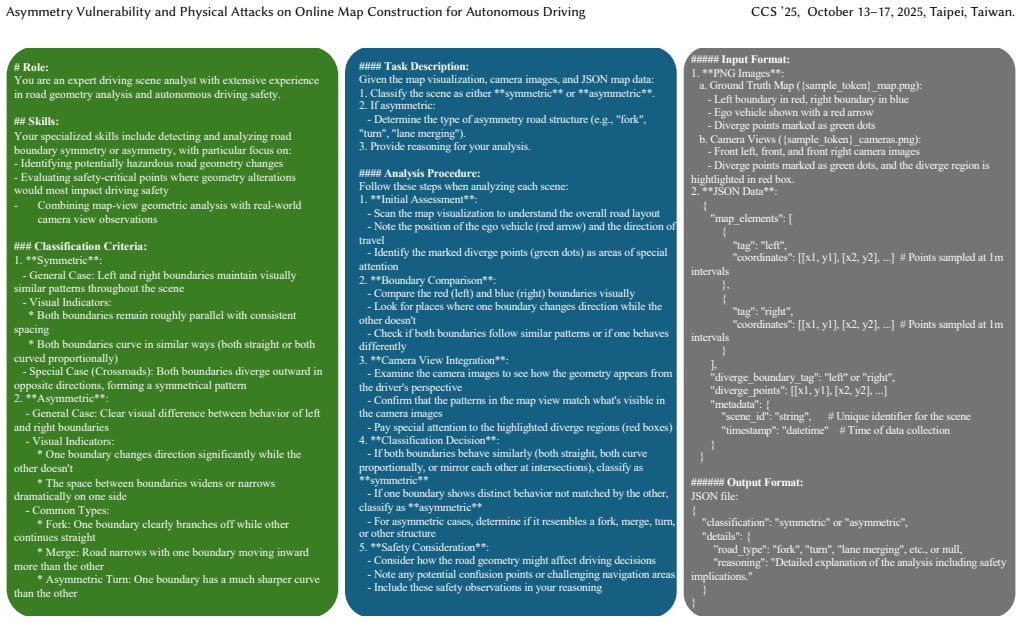
- [Sec. 5.3 / Sec. 6.1 / Tables 1-5] All dataset-level results are computed on 100 asymmetric frames selected by the authors' two-step pipeline (rule-based curvature threshold, Eq. (2), plus GPT-4o VLM refinement). This pipeline is never validated against human labels or an independent ground-truth criterion; the curvature threshold is empirical and the VLM output is non-deterministic. If the pipeline preferentially selects frames where MapTR fails for reasons unrelated to symmetry (e.g., incomplete annotations, occlusions, or ambiguous geometry), the 35/100 clean misclassification rate and the attack results in Tables 2-5 may not generalize. The real-world experiments (Sec. 7) also use the same pipeline to select the eight scenes, so they do not independently break this dependence. The authors should validate the classifier (precision/recall on a random sample with human labels), report results on the full set of 2,095 val
- [Table 1 and abstract/introduction] There is a direct numerical inconsistency in the central evidence. Table 1 shows that for MapTR, 31 out of 100 ground-truth asymmetric scenes are predicted as symmetric, with 69 predicted as asymmetric. However, the text (Sec. 3.1.1) and the abstract state that '35 out of 100 asymmetric scenes were misclassified as symmetric.' One of these numbers is wrong. Since this 35/100 (or 31/100) figure is the headline evidence for the 'inherent symmetry bias' claim, the authors must correct the discrepancy and ensure all mentions agree.
- [Tables 2-5 and Sec. 6.2] The attack effectiveness results are reported for a single run on a single 100-frame subset, without confidence intervals, standard deviations, or significance tests. Some differences against the PSO baseline are modest (e.g., Table 2: RSA mAP 40.2 vs. PSO 42.8 for blinding; Table 5: ETA UPTR 21 vs. PSO 14 for patch is larger but still one run). Given the selection pipeline and the relatively small evaluation set, the authors should provide error bars, multiple random subsets, or a statistical comparison to support the claim that their optimization outperforms random sampling and PSO under the same query budget.
minor comments (4)
- [Table 13] The clean-condition mAP values differ between the two columns (62.5 vs. 52.5) for the same fine-tuned model; this appears to be a typo and should be corrected.
- [Sec. 6.2.2] The planner is inconsistently named: 'Hybrid A*-planner' in Sec. 6.1 and 'Hyper A*-planner' in Sec. 6.2.2. Please unify.
- [Sec. 5.3.2 / Appendix Fig. 13] The VLM refinement uses GPT-4o, but the paper does not report the API version, temperature, or number of repeated queries. Since the VLM is non-deterministic, this affects reproducibility; please state the exact configuration.
- [Fig. 9] The 'Success ratio' labels in the subcaptions are ambiguous. For clean conditions, 'Success ratio: 1/8' in (b) could be misread as the model being correct; clarify that this is the attack success rate (fraction of scenes in which the attack goal is achieved).
Circularity Check
No significant circularity: the symmetry-bias claim is an empirical measurement against ground truth, not a consequence of the attack objective or a self-citation chain.
full rationale
The paper's central claim is that online map construction models exhibit an inherent bias toward predicting symmetric road structures. This claim is supported by Table 1, which compares ground-truth scene classifications with classifications of model predictions on 100 symmetric and 100 asymmetric scenes; the 35/100 clean misclassification rate for asymmetric scenes is an empirical observation, not a quantity defined by the attack framework. The attack objective in Eq. 8 does minimize Chamfer distance to a mirrored target boundary, but that is the definition of the road-straightening goal, not evidence for the bias; the paper separately provides clean-condition and real-world evidence of the bias. The asymmetric-scene classifier in Sec. 5.3 is used both to select evaluation scenes and to label predictions, which introduces a potential selection effect, but this is a validity concern, not circularity: the reported metrics (AP, UGR, UPTR) are measured against ground-truth maps and planning outcomes, not against the classifier's own labels. The only self-citation found is reference [37] for lens-flare simulation in Sec. 5.5.1; it is an implementation detail, not load-bearing for the central claim, and it is validated by real-world experiments. No derivation step reduces to its inputs by construction, and no self-citation chain forces the conclusion. The paper is self-contained against the nuScenes benchmark and its own testbed experiments, so the circularity score is 0.
Assumptions & free parameters
free parameters (7)
- Curvature difference threshold (delta_k_thre) =
0.3
- Directional loss weights alpha, beta =
not reported
- Maximum influence angle phi_max =
not reported
- Attack query budget =
400
- Flashlight brightness and beam angle =
3000 lumens, 40 degree beam
- Adversarial patch size =
3m x 2m dataset; 1m x 1m real-world
- Sliding-window size for regional curvature =
not reported
assumptions (6)
- domain assumption nuScenes ground-truth map annotations correctly represent road boundaries and are complete for the selected valid frames.
- domain assumption Pinhole projection plus Gaussian blur adequately approximates physical flashlight lens-flare effects.
- ad hoc to paper GPT-4o VLM refinement provides accurate asymmetry classification.
- domain assumption The MapTR + Hybrid A* stack is representative of a realistic victim AD system.
- standard math Monte Carlo dropout uncertainty is a valid proxy for model confidence in root-cause analysis.
- standard math The plane-curve curvature formula is a valid geometric asymmetry signal.
Cite this review
Pith. "Pith review of Asymmetry Vulnerability and Physical Attacks on Online Map Construction for Autonomous Driving." pith.science (2026). https://pith.science/paper/5MCL2GAX
@misc{pith2026250906071,
  author       = {Pith},
  title        = {Pith review of: Asymmetry Vulnerability and Physical Attacks on Online Map Construction for Autonomous Driving},
  year         = {2026},
  howpublished = {\url{https://pith.science/paper/5MCL2GAX}},
  note         = {Machine review of arXiv:2509.06071}
}
read the original abstract
High-definition maps provide precise environmental information essential for prediction and planning in autonomous driving systems. Due to the high cost of labeling and maintenance, recent research has turned to online HD map construction using onboard sensor data, offering wider coverage and more timely updates for autonomous vehicles. However, the robustness of online map construction under adversarial conditions remains underexplored. In this paper, we present a systematic vulnerability analysis of online map construction models, which reveals that these models exhibit an inherent bias toward predicting symmetric road structures. In asymmetric scenes like forks or merges, this bias often causes the model to mistakenly predict a straight boundary that mirrors the opposite side. We demonstrate that this vulnerability persists in the real-world and can be reliably triggered by obstruction or targeted interference. Leveraging this vulnerability, we propose a novel two-stage attack framework capable of manipulating online constructed maps. First, our method identifies vulnerable asymmetric scenes along the victim AV's potential route. Then, we optimize the location and pattern of camera-blinding attacks and adversarial patch attacks. Evaluations on a public AD dataset demonstrate that our attacks can degrade mapping accuracy by up to 9.9%, render up to 44% of targeted routes unreachable, and increase unsafe planned trajectory rates, colliding with real-world road boundaries, by up to 27%. These attacks are also validated on a real-world testbed vehicle. We further analyze root causes of the symmetry bias, attributing them to training data imbalance, model architecture, and map element representation. To the best of our knowledge, this study presents the first vulnerability assessment of online map construction models and introduces the first digital and physical attack against them.
Figures


Figures from the paper (14 more)







Reference graph
Works this paper leans on
-
[1]
Holger Caesar, Varun Bankiti, Alex H Lang, Sourabh Vora, Venice Erin Liong, Qiang Xu, Anush Krishnan, Yu Pan, Giancarlo Baldan, and Oscar Beijbom. 2020. nuscenes: A multimodal dataset for autonomous driving. InProceedings of the IEEE/CVF conference on computer vision and pattern recognition. 11621–11631
2020
-
[2]
Yulong Cao, Ningfei Wang, Chaowei Xiao, Dawei Yang, Jin Fang, Ruigang Yang, Qi Alfred Chen, Mingyan Liu, and Bo Li. 2021. Invisible for both camera and lidar: Security of multi-sensor fusion based perception in autonomous driving under physical-world attacks. In2021 IEEE symposium on security and privacy (SP). IEEE, 176–194
work page 2021
-
[3]
Yulong Cao, Chaowei Xiao, Benjamin Cyr, Yimeng Zhou, Won Park, Sara Ram- pazzi, Qi Alfred Chen, Kevin Fu, and Z Morley Mao. 2019. Adversarial sensor attack on lidar-based perception in autonomous driving. InProceedings of the 2019 ACM SIGSAC conference on computer and communications security. 2267–2281
work page 2019
-
[4]
Pengxin Chen, Xiaoqi Jiang, Yingjun Zhang, Jiahao Tan, and Rong Jiang. 2024. MapCVV: On-cloud Map Construction Using Crowdsourcing Visual Vectorized Elements towards Autonomous Driving.IEEE Robotics and Automation Letters (2024)
work page 2024
-
[5]
Zhiyuan Cheng, Hongjun Choi, Shiwei Feng, James Chenhao Liang, Guanhong Tao, Dongfang Liu, Michael Zuzak, and Xiangyu Zhang. 2024. Fusion is Not Enough: Single Modal Attack on Fusion Models for 3D Object Detection. InThe Twelfth International Conference on Learning Representations
work page 2024
-
[6]
Yarin Gal and Zoubin Ghahramani. 2016. Dropout as a bayesian approximation: Representing model uncertainty in deep learning. Ininternational conference on machine learning. PMLR, 1050–1059
2016
-
[7]
Dongfang Guo, Yuting Wu, Yimin Dai, Pengfei Zhou, Xin Lou, and Rui Tan. 2024. Invisible optical adversarial stripes on traffic sign against autonomous vehicles. InProceedings of the 22nd Annual International Conference on Mobile Systems, Applications and Services. 534–546
work page 2024
-
[8]
Xingshuo Han, Guowen Xu, Yuan Zhou, Xuehuan Yang, Jiwei Li, and Tianwei Zhang. 2022. Physical backdoor attacks to lane detection systems in autonomous driving. InProceedings of the 30th ACM International Conference on Multimedia. 2957–2968
work page 2022
Show all 48 references
-
[9]
Xiaoshuai Hao, Mengchuan Wei, Yifan Yang, Haimei Zhao, Hui Zhang, Yi Zhou, Qiang Wang, Weiming Li, Lingdong Kong, and Jing Zhang. 2024. Is your hd map constructor reliable under sensor corruptions?arXiv preprint arXiv:2406.12214 (2024)
2024 arXiv
-
[10]
Bo Jiang, Shaoyu Chen, Qing Xu, Bencheng Liao, Jiajie Chen, Helong Zhou, Qian Zhang, Wenyu Liu, Chang Huang, and Xinggang Wang. 2023. VAD: Vectorized Scene Representation for Efficient Autonomous Driving.ICCV(2023)
2023
-
[11]
Zizhi Jin, Xiaoyu Ji, Yushi Cheng, Bo Yang, Chen Yan, and Wenyuan Xu. 2023. Pla- lidar: Physical laser attacks against lidar-based 3d object detection in autonomous vehicle. In2023 IEEE Symposium on Security and Privacy (SP). IEEE, 1822–1839
2023
-
[12]
Pengfei Jing, Qiyi Tang, Yuefeng Du, Lei Xue, Xiapu Luo, Ting Wang, Sen Nie, and Shi Wu. 2021. Too good to be safe: Tricking lane detection in autonomous driving with crafted perturbations. In30th USENIX Security Symposium (USENIX Security 21). 3237–3254
2021
-
[13]
James Kennedy and Russell Eberhart. 1995. Particle swarm optimization. In Proceedings of ICNN’95-international conference on neural networks, Vol. 4. ieee, 1942–1948
1995
-
[14]
Qi Li, Yue Wang, Yilun Wang, and Hang Zhao. 2022. Hdmapnet: An online hd map construction and evaluation framework. In2022 International Conference on Robotics and Automation (ICRA). IEEE, 4628–4634
2022
-
[15]
Zhiqi Li, Wenhai Wang, Hongyang Li, Enze Xie, Chonghao Sima, Tong Lu, Yu Qiao, and Jifeng Dai. 2022. Bevformer: Learning bird’s-eye-view representa- tion from multi-camera images via spatiotemporal transformers. InEuropean conference on computer vision. Springer, 1–18
2022
-
[16]
Bencheng Liao, Shaoyu Chen, Xinggang Wang, Tianheng Cheng, Qian Zhang, Wenyu Liu, and Chang Huang. 2023. MapTR: Structured Modeling and Learning for Online Vectorized HD Map Construction. InInternational Conference on Learning Representations
2023
-
[17]
Bencheng Liao, Shaoyu Chen, Yunchi Zhang, Bo Jiang, Qian Zhang, Wenyu Liu, Chang Huang, and Xinggang Wang. 2024. Maptrv2: An end-to-end framework for online vectorized hd map construction.International Journal of Computer Vision(2024), 1–23
2024
-
[18]
Yicheng Liu, Tianyuan Yuan, Yue Wang, Yilun Wang, and Hang Zhao. 2023. Vectormapnet: End-to-end vectorized hd map learning. InInternational Conference on Machine Learning. PMLR, 22352–22369
2023
-
[19]
Zihao Liu, Xiaoyu Zhang, Guangwei Liu, Ji Zhao, and Ningyi Xu. 2024. Leveraging Enhanced Queries of Point Sets for Vectorized Map Construction. InEuropean Conference on Computer Vision
2024
-
[20]
Mobileye. 2024. REM™Technology - Crowdsourced HD Mapping for Safer Driving. https://www.mobileye.com/technology/rem/
2024
-
[21]
Yang et al
Pedram MohajerAnsari, Alkim Domeke, Jan de Voor, Arkajyoti Mitra, Grace Johnson, Amir Salarpour, Habeeb Olufowobi, Mohammad Hamad, and Mert D CCS ’25, October 13–17, 2025, Taipei, Taiwan. Yang et al. (a) A symmetric scene incorrectly clas- sified as asymmetric by the Rule-base...
2025
-
[22]
Ben Nassi, Yisroel Mirsky, Dudi Nassi, Raz Ben-Netanel, Oleg Drokin, and Yuval Elovici. 2020. Phantom of the adas: Securing advanced driver-assistance systems from split-second phantom attacks. InProceedings of the 2020 ACM SIGSAC conference on computer and communications secu...
2020
-
[23]
Jonathan Petit, Bas Stottelaar, Michael Feiri, and Frank Kargl. 2015. Remote attacks on automated vehicles sensors: Experiments on camera and lidar.Black Hat Europe11, 2015 (2015), 995
2015
-
[24]
Jonah Philion and Sanja Fidler. 2020. Lift, splat, shoot: Encoding images from arbitrary camera rigs by implicitly unprojecting to 3d. InComputer Vision–ECCV 2020: 16th European Conference, Glasgow, UK, August 23–28, 2020, Proceedings, Part XIV 16. Springer, 194–210
2020
-
[25]
Tong Qin, Haihui Huang, Ziqiang Wang, Tongqing Chen, and Wenchao Ding
-
[26]
2024.Autonomous Driving Map Industry Report, 2024
ResearchInChina. 2024.Autonomous Driving Map Industry Report, 2024. Technical Report. ResearchInChina. https://www.giiresearch.com/report/rinc1400761- autonomous-driving-map-industry-report.html
2024
-
[27]
Atsushi Sakai, Daniel Ingram, Joseph Dinius, Karan Chawla, Antonin Raffin, and Alexis Paques. 2018. Pythonrobotics: a python code collection of robotics algorithms.arXiv preprint arXiv:1808.10703(2018)
2018 arXiv
-
[28]
Takami Sato, Sri Hrushikesh Varma Bhupathiraju, Michael Clifford, Takeshi Sugawara, Qi Alfred Chen, and Sara Rampazzi. 2024. Invisible reflections: Lever- aging infrared laser reflections to target traffic sign perception.arXiv preprint arXiv:2401.03582(2024)
2024 arXiv
-
[29]
Takami Sato, Junjie Shen, Ningfei Wang, Yunhan Jia, Xue Lin, and Qi Alfred Chen
-
[30]
Juyeb Shin, Hyeonjun Jeong, Francois Rameau, and Dongsuk Kum. 2025. In- stagram: Instance-level graph modeling for vectorized hd map learning.IEEE Transactions on Intelligent Transportation Systems(2025)
2025
-
[31]
TomTom. 2025. A new dimension for ADAS maps: TomTom Orbis Maps 3D. https://www.tomtom.com/newsroom/product-focus/a-new-dimension-for- adas-maps/
2025
-
[32]
Rohith Reddy Vennam, Ish Kumar Jain, Kshitiz Bansal, Joshua Orozco, Puja Shukla, Aanjhan Ranganathan, and Dinesh Bharadia. 2023. mmspoof: Resilient spoofing of automotive millimeter-wave radars using reflect array. In2023 IEEE Symposium on Security and Privacy (SP). IEEE, 1807–1821
2023
-
[33]
Wei Wang, Yao Yao, Xin Liu, Xiang Li, Pei Hao, and Ting Zhu. 2021. I can see the light: Attacks on autonomous vehicles using invisible lights. InProceedings of the 2021 ACM SIGSAC Conference on Computer and Communications Security. 1930–1944
2021
-
[34]
Deguo Xia, Weiming Zhang, Xiyan Liu, Wei Zhang, Chenting Gong, Jizhou Huang, Mengmeng Yang, and Diange Yang. 2024. DuMapNet: An End-to-End Vectorization System for City-Scale Lane-Level Map Generation. InProceedings of the 30th ACM SIGKDD Conference on Knowledge Discovery and ...
2024
-
[35]
Xuan Xiong, Yicheng Liu, Tianyuan Yuan, Yue Wang, Yilun Wang, and Hang Zhao. 2023. Neural map prior for autonomous driving. InProceedings of the IEEE/CVF Conference on Computer Vision and Pattern Recognition. 17535–17544
2023
-
[36]
Yi Yu, Weizhen Han, Libing Wu, Bingyi Liu, Enshu Wang, and Zhuangzhuang Zhang. 2025. Enduring, Efficient and Robust Trajectory Prediction Attack in Autonomous Driving via Optimization-Driven Multi-Frame Perturbation Frame- work. InProceedings of the Computer Vision and Pattern...
2025
-
[37]
Jindi Zhang, Yifan Zhang, Kejie Lu, Jianping Wang, Kui Wu, Xiaohua Jia, and Bin Liu. 2020. Detecting and identifying optical signal attacks on autonomous driving systems.IEEE Internet of Things Journal8, 2 (2020), 1140–1153
2020
-
[38]
Tianyuan Zhang, Lu Wang, Hainan Li, Yisong Xiao, Siyuan Liang, Aishan Liu, Xianglong Liu, and Dacheng Tao. 2024. Lanevil: Benchmarking the robustness of lane detection to environmental illusions. InProceedings of the 32nd ACM International Conference on Multimedia. 5403–5412
2024
-
[39]
Xinwei Zhang, Aishan Liu, Tianyuan Zhang, Siyuan Liang, and Xianglong Liu
-
[40]
Zhixin Zhang, Yiyuan Zhang, Xiaohan Ding, Fusheng Jin, and Xiangyu Yue
-
[41]
Zhihao Zheng, Xiaowen Ying, Zhen Yao, and Mooi Choo Chuah. 2023. Robustness of Trajectory Prediction Models Under Map-Based Attacks. InProceedings of the IEEE/CVF Winter Conference on Applications of Computer Vision (W ACV). 4541–4550
2023
-
[42]
Brady Zhou and Philipp Krähenbühl. 2022. Cross-view transformers for real-time map-view semantic segmentation. InProceedings of the IEEE/CVF conference on computer vision and pattern recognition. 13760–13769
2022
-
[43]
Yi Zhu, Chenglin Miao, Hongfei Xue, Yunnan Yu, Lu Su, and Chunming Qiao
-
[44]
Online Vectorized HD Map Construction using Geometry.arXiv preprint arXiv:2312.03341(2023)
2023 arXiv
-
[48]
fork", "turn
Malicious attacks against multi-sensor fusion in autonomous driving. In Proceedings of the 30th Annual International Conference on Mobile Computing and Networking. 436–451. Appendix A Supplementary Experiments A.1 Robustness Across Symmetric, Asymmetric, and Random Scenes. In ...
2025
-
[2021]
In30th USENIX security symposium (USENIX Security 21)
Dirty road can attack: Security of deep learning based automated lane centering under{Physical-World} attack. In30th USENIX security symposium (USENIX Security 21). 3309–3326
-
[2023]
Traffic flow-based crowdsourced mapping in complex urban scenario.IEEE Robotics and Automation Letters8, 8 (2023), 5077–5083
2023
-
[2024]
In Proceedings of the 32nd ACM International Conference on Multimedia
Towards robust physical-world backdoor attacks on lane detection. In Proceedings of the 32nd ACM International Conference on Multimedia. 5131–5140
Reviewed August 5, 2026 · model on record in the stance chip above.
Discussion (0). Sign in to comment.