REVIEW 5 major objections 5 minor 44 references
High-Quality Tomographic Image Reconstruction Integrating Neural Networks and Mathematical Optimization
T0 review · 5 major / 5 minor · reviewed 2026-08-05 · deepseek-v4-flash
Pith's one-line read Neural edge prior halves sparse-scan tomography error
desk verdict Solid engineering story with real phantom gains, but the paper never isolates the learned edge model from the hand-crafted binarization prior—an ablation is needed before the central claim holds. read the letter →
The pith
A machine-rendered reading of the paper's core claim, the machinery that carries it, and where it could break.
The reading
What carries the argument
The load-bearing object is the DNN-as-MIP block: a trained ReLU network that approximates the Sobel edge response on a 3x3 patch, converted into linear constraints plus binary variables by the standard Fischetti–Jo formulation, so the optimizer can reason about edges exactly. Around it sits the MIP RO window objective: for each patch, a binary edge variable e_a selects max(y_a, T - y_a), with α and β weights balancing material-density deviation against fidelity to the base CSHM image. Setting α=β makes the objective affine in the pixels, so each small window is a binary linear program solvable to global optimality; the sliding-window algorithm averages overlapping patch solutions.
What would settle it
Measure the trained DNN's output against the exact Sobel response on 3×3 patches sampled from the real zeolite and copper projection data; if the mean absolute error is of the same order as the difference between the threshold T=800 and the Sobel values it separates, the edge decisions are not trustworthy. Then re-run MIP RO with T and ω re-estimated on each dataset: if the RME/BMS superiority over CSHM disappears, much of the reported gain is parameter transfer rather than the method itself.
Extended reading notes
Core claim
The central claim is that MIP RO — a DNN-guided mixed-integer re-optimization of an already good CSHM reconstruction — systematically improves reconstruction fidelity for homogeneous materials with sharp edges. Each 3x3 subregion is re-solved independently: a binary variable decides whether the region is an edge or a uniform area, with threshold T controlling the decision; the objective rewards approximated Sobel values either above T or below T, while a quadratic loss keeps the new pixels close to the rescaled CSHM image and a deviation term pushes values toward 0 or the known material density ω. Because the DNN is encoded as linear MIP constraints, the whole decision can be solved to globa
Load-bearing premise
The whole method assumes that a small DNN trained on one flower photograph approximates the Sobel edge response well enough on tomography subregions, and that the threshold T=800 and the known density ω carry over from one dataset to all others; if the network mislabels edges on real tomographic patches, the sharper interfaces it produces are artifacts.
Editorial extensions
If this is right
- For simulated sparse-view data, MIP RO beats SIRT, CS, TVR-DART, and CSHM on relative mean error and bimodal contrast in every tested setting, including a 60° missing wedge.
- On experimental zeolite and copper datasets, the method yields sharper interfaces and more uniform material intensity than all benchmarks, at the price of higher raw-data-coverage values and longer runtimes.
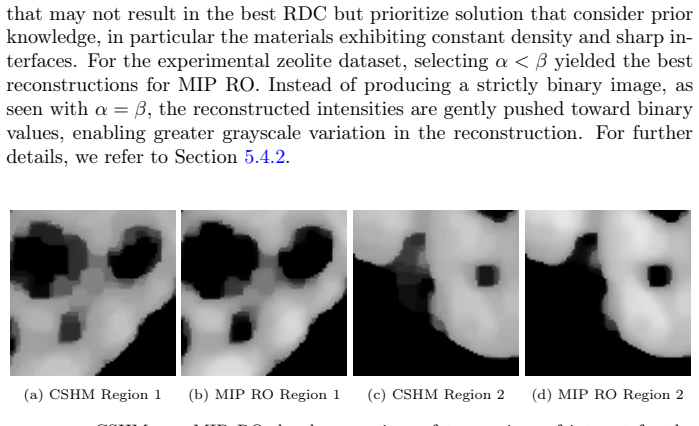
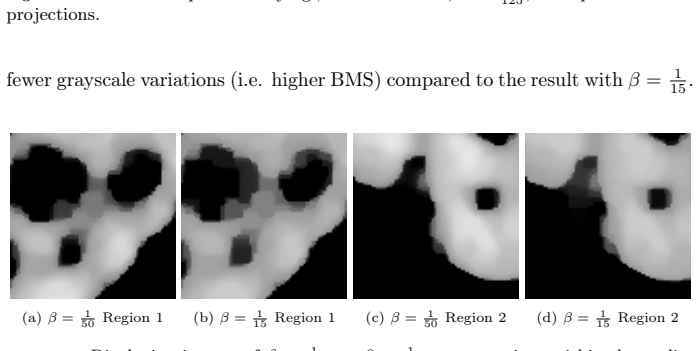
- Choosing α=β makes each subproblem a linear binary program, restoring computational tractability and a nearly binary image; choosing α<β preserves grayscale variation needed when raw data contain inconsistencies.
- Because each 3×3 subproblem is independent, the entire re-optimization can be parallelized, so the practical runtime gap versus CSHM could shrink substantially.
- The scheme is not limited to tomography: any data-learned knowledge expressible as a ReLU network can be inserted into a mathematical optimization model this way.
Reading between the lines
- The most direct test the paper leaves open is measuring the trained network's approximation error against the exact Sobel operator on the actual tomography patches; if the DNN is not faithful where it matters, the threshold T=800 may be silently misclassifying edges.
- The same encoding could be applied to other imaging priors — Hessian, structure tensor, learned segmentation scores — turning them into constraints for any discrete ill-posed inverse problem, not just homogeneous-material tomography.
- Because the threshold T was tuned on the zeolite data and reused elsewhere, the method's apparent generality may be optimistic; re-estimating T per dataset would show how much of the gain depends on that hand-set value.
- The RME improvements on the phantom are large enough that end-to-end learning methods could benchmark against this exact-optimization hybrid; conversely, replacing Sobel with a learned edge detector trained on tomographic data might transfer better to multi-material specimens.
Signed reviews
Editorial analysis
A structured set of objections, weighed in public.
Referee Report
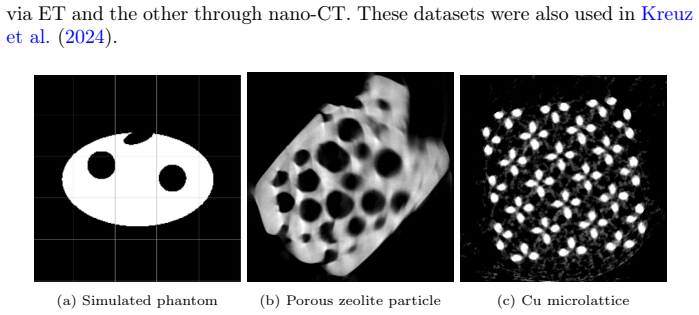
Summary. The paper proposes a post-processing reconstruction framework for tomographic images of homogeneous materials with sharp edges. A ReLU neural network is trained to approximate the Sobel edge intensity on 3×3 subregions, and the trained network is encoded as mixed-integer linear constraints following Fischetti and Jo (2018). This DNN-MIP block is then combined with the CSHM reconstruction model in two ways: a joint integrated model and a cheaper per-subregion 'MIP RO' re-optimization that balances the learned Sobel prediction, a hand-crafted binary material-prior term, and a pixel-loss term relative to the CSHM solution. Experiments compare MIP RO against SIRT, CS, TVR-DART, and CSHM on a simulated phantom (with and without missing wedge), a zeolite ET dataset, and a copper nano-CT dataset. The paper reports lower RME and higher BMS on the phantom, and sharper interfaces/higher BMS on the experimental datasets, at the cost of longer runtimes and worse raw-data coverage.
Significance. If the central claim is valid, the approach is a useful contribution to model-based/learning hybrid tomography: it embeds a learned edge operator into an exact MIP framework, and it is openly implemented with code and data made public. The phantom results are self-consistent and show a substantial reduction in RME (0.042→0.017 at 5 projections, 0.060→0.008 at 20 projections) over CSHM. However, the novelty claim specifically rests on the learned DNN edge term, and the current evidence does not isolate that term from the hand-crafted binarization prior. Moreover, the ReLU encoding shown in Eqs. (7)–(8) is incomplete, and the experimental quality metrics for the no-ground-truth datasets are partly circular. These issues are load-bearing, so the manuscript needs substantial revision before the central claim can be accepted.
major comments (5)
- [Section 3.4, Eqs. (7)–(8)] The claimed ReLU MIP encoding is incomplete. The implications z=1⇒x≥0 and z=0⇒s≥0 are already consequences of x,s≥0 and do not enforce the complementarity x·s=0 that defines ReLU(y)=x for y=x−s. Without additional big-M bounds such as x≤U(1−z) and s≤Uz, the feasible set contains non-ReLU solutions, so (DNN) does not represent the trained network. Since every subsequent model inherits (DNN), the formulation must be corrected or the implicit finite bounds must be stated.
- [Section 3.7.2, Eq. (14)] The simplification of αDev+βL for α=β=1 uses the maximum DNN/Sobel value \bar u from Section 3.7.1 instead of the material density ω from Eq. (12). With Dev(f)=(ω−f)f, the affine coefficient is (ω−2f*), not (\bar u−2f*). This appears to be a typo, but since the linearity claim for the α=β case is used to explain runtimes and parameter behavior, the displayed identity should be corrected.
- [Section 5, Eq. (14)] No ablation isolates the learned DNN contribution. The MIP RO objective combines the DNN edge term MIPa, the hand-crafted binarization term Dev(a), and the pixel-fidelity term L(a). A variant optimizing only −αDev(a)−βL(a) should be compared against full MIP RO; otherwise the reported RME/BMS gains could be entirely due to the hand-crafted binary prior rather than to 'integrating neural networks' as claimed in the abstract and title. This is load-bearing for the paper's central claim.
- [Sections 5.4–5.5] For the experimental datasets there is no ground truth, and the principal quantitative metric BMS (Eq. 18) is directly encouraged by the Dev term (Eq. 12), making the sharpness/homogeneity gains partly circular. Meanwhile RDC for MIP RO is worse than CSHM in both experimental cases (zeolite: 0.090 vs 0.028; Cu: 0.126 vs 0.058). Please add an independent metric (e.g., edge localization error, segmentation agreement, or comparison against a high-projection reference) to support the claim of superior experimental reconstructions.
- [Sections 4.3 and 3.7.1] The method assumes the DNN approximates the Sobel operator sufficiently well on tomography subregions and that the threshold T=800 transfers across datasets. No test-set approximation error of the DNN against the true Sobel operator is reported, and T is tuned on the zeolite dataset (Figure 12) but applied to the phantom and Cu datasets. Please report DNN accuracy on a held-out tomography-like set and provide per-dataset threshold sensitivity.
minor comments (5)
- [Figure 7 caption] '642 pixels' should read '64² pixels'.
- [Figure 17 caption] The caption lists results as (a)–(d) for the simulated dataset and (e)–(h) for the zeolite dataset, but the figure contains panels (a)–(j). The caption needs to be aligned with the figure panels.
- [Section 5.4.1] The discussion of threshold T is internally inconsistent: low T is first said to make subregions more likely to be classified as edges, but then said to 'suppress weaker edges', and higher T is said to detect weaker edges. This is likely a wording error and should be clarified.
- [Algorithm 1] The subregion spacing s∈{1,3} is never reported in the computational experiments. The results may depend on whether overlapping or non-overlapping subregions are used; please state the value of s for every experiment.
- [Section 5.2] The integrated model is stopped at 15% optimality gap, but the caption does not state whether the displayed image corresponds to the incumbent or the best proven solution; this should be clarified.
Circularity Check
Partial self-referentiality in the sharpness/homogeneity metric, but the core RME result against the phantom ground truth is independent.
-
self definitional
[Section 3.1 and Eq. (9a)/(14); Section 5.1 Eq. (18); Section 5.4]
"We aim to reconstruct an image with enhanced edge sharpness by optimizing pixel values so that the edge intensity within each subregion is either near its upper bound (denoting an edge) or zero (denoting homogeneity). ... As an indicator for the strength of binarization and contrast in the reconstruction, we introduce the bimodal contrast score (BMS) ... BMS(f) := 1/n Σ (1_{[0,ε]}(fi) + 1_{[fmax−ε,fmax]}(fi))"
MIP RO's objective (14) explicitly rewards the exact pattern that BMS measures: Dev(fa)=|ω−fa||fa| forces pixel values toward 0 or ω, and MIPa forces the DNN edge estimate toward extremes relative to T. BMS then counts pixels near 0 or fmax. Consequently, the reported BMS improvements on experimental data (zeolite 0.810 to 0.833; Cu 0.521 to 0.763) are partly a restatement of the objective, not independent evidence of reconstruction fidelity. The paper itself notes 'neither RDC, BMS or MC are as reliable as RME,' and the phantom RME comparison is independent of this loop, so the circularity is partial.
full rationale
The central quantitative claim for the simulated phantom is not circular: RME is computed against a noise-free ground truth (Eq. 16), and MIP RO's improvement (e.g., 0.042 to 0.017 in Fig. 8; 0.060 to 0.008 in Fig. 9) is an external, objective measure. CSHM is re-specified in Eq. (4), so the self-citation to Kreuz et al. (2024) is not load-bearing. The DNN/MIP formulation follows Fischetti and Jo (2018) as external support. The main circularity concern is that the 'sharpness/homogeneity' gains on experimental datasets are gauged by BMS, a metric almost directly aligned with the Dev and MIPa terms of the optimization objective; this makes those qualitative claims partially self-confirming. The paper's own caveat that BMS/RDC/MC are not as reliable as RME mitigates the issue. Separately, the lack of a no-DNN ablation means the contribution of the learned edge term is not isolated from the hand-crafted binarization prior; this is an attribution gap, not a derivation collapse. Hyperparameter T is selected on the same zeolite data, another non-circular but notable evaluation weakness. Overall, no full reduction of the central result to its inputs occurs.
Assumptions & free parameters
free parameters (8)
- threshold T =
800
- weight alpha =
1/50 or 1/125
- weight beta =
1/50, 1/25, 1/15, 1/125
- material density omega
- TV weight lambda (in CSHM/CS) =
20000 (phantom), 4000 (zeolite), 3 (Cu)
- weight phi (integrated model) =
1e8
- subregion spacing s =
not reported
- DNN weights and biases
assumptions (5)
- domain assumption The Sobel operator is a sufficient measure of edge sharpness for homogeneous-phase tomograms.
- domain assumption A DNN trained on a natural image of flowers approximates the Sobel operator accurately on tomographic subregions in [0, omega]^9.
- standard math The mixed-integer encoding of the ReLU network is complete and correct.
- domain assumption For a homogeneous sample, pixel values should be near 0 or near the material density omega.
- ad hoc to paper The weighted objective in (14) with tuned T, alpha, beta yields improved reconstructions.
Cite this review
Pith. "Pith review of High-Quality Tomographic Image Reconstruction Integrating Neural Networks and Mathematical Optimization." pith.science (2026). https://pith.science/paper/2CZ2KESH
@misc{pith2026250906082,
  author       = {Pith},
  title        = {Pith review of: High-Quality Tomographic Image Reconstruction Integrating Neural Networks and Mathematical Optimization},
  year         = {2026},
  howpublished = {\url{https://pith.science/paper/2CZ2KESH}},
  note         = {Machine review of arXiv:2509.06082}
}
read the original abstract
In this work, we develop a novel technique for reconstructing images from projection-based nano- and microtomography. Our contribution focuses on enhancing reconstruction quality, particularly for specimen composed of homogeneous material phases connected by sharp edges. This is accomplished by training a neural network to identify edges within subpictures. The trained network is then integrated into a mathematical optimization model, to reduce artifacts from previous reconstructions. To this end, the optimization approach favors solutions according to the learned predictions, however may also determine alternative solutions if these are strongly supported by the raw data. Hence, our technique successfully incorporates knowledge about the homogeneity and presence of sharp edges in the sample and thereby eliminates blurriness. Our results on experimental datasets show significant enhancements in interface sharpness and material homogeneity compared to benchmark algorithms. Thus, our technique produces high-quality reconstructions, showcasing its potential for advancing tomographic imaging techniques.
Figures


Figures from the paper (14 more)






Reference graph
Works this paper leans on
-
[1]
author Adler, J. , author Öktem, O. , year 2018 . title Learned primal-dual reconstruction . journal IEEE Transactions on Medical Imaging volume 37 , pages 1322--1332 . :10.1109/TMI.2018.2799231
-
[2]
author Baguer, D.O. , author Leuschner, J. , author Schmidt, M. , year 2020 . title Computed tomography reconstruction using deep image prior and learned reconstruction methods . journal Inverse Problems volume 36 , pages 094004 . :10.1088/1361-6420/aba415
-
[3]
author Burnett, T. , author Withers, P. , year 2019 . title Completing the picture through correlative characterization . journal Nature materials volume 18 , pages 1041--1049
work page 2019
-
[4]
author Cand \`e s, E.J. , author Romberg, J.K. , author Tao, T. , year 2006 . title Stable signal recovery from incomplete and inaccurate measurements . journal Communications on Pure and Applied Mathematics: A Journal Issued by the Courant Institute of Mathematical Sciences volume 59 , pages 1207--1223
work page 2006
-
[5]
author Canny, J. , year 1986 . title A computational approach to edge detection . journal IEEE Transactions on Pattern Analysis and Machine Intelligence volume PAMI-8 , pages 679--698 . :10.1109/TPAMI.1986.4767851
-
[6]
author Chen, G. , author Hong, X. , author Ding, Q. , author Zhang, Y. , author Chen, H. , author Fu, S. , author Zhao, Y. , author Zhang, X. , author Ji, H. , author Wang, G. , author Huang, Q. , author Gao, H. , year 2020 . title Airnet: Fused analytical and iterative reconstruction with deep neural network regularization for sparse-data ct . journal Me...
-
[7]
author Chen, H. , author Zhang, Y. , author Chen, Y. , author Zhang, J. , author Zhang, W. , author Sun, H. , author Lv, Y. , author Liao, P. , author Zhou, J. , author Wang, G. , year 2018 . title LEARN: Learned Experts' Assessment-Based Reconstruction Network for Sparse-Data CT . journal IEEE Transactions on Medical Imaging volume 37 , pages 1333--1347 ...
arXiv 2018
-
[8]
author Christiansen, E.M. , author Yang, S.J. , author Ando, D.M. , author Javaherian, A. , author Skibinski, G. , author Lipnick, S. , author Mount, E. , author O'Neil, A. , author Shah, K. , author Lee, A.K. , author Goyal, P. , author Fedus, W. , author Poplin, R. , author Esteva, A. , author Berndl, M. , author Rubin, L.L. , author Nelson, P. , author...
work page 2018
Show all 44 references
-
[9]
, year 2015
author Dharampal, V.M. , year 2015 . title Methods of image edge detection: A review . journal J. Electr. Electron. Syst volume 4 , pages 2332--0796
2015
-
[10]
, author Jo, J
author Fischetti, M. , author Jo, J. , year 2018 . title Deep neural networks and mixed integer linear optimization . journal Constraints volume 23 . :10.1007/s10601-018-9285-6
2018 doi
-
[11]
, year 1972
author Gilbert, P. , year 1972 . title Iterative methods for the three-dimensional reconstruction of an object from projections . journal Journal of theoretical biology volume 36 , pages 105--117
1972
-
[12]
, author Woods, R
author Gonzalez, R. , author Woods, R. , year 2017 . title Digital Image Processing Global Edition . publisher Pearson Deutschland
2017
-
[13]
, author Bengio, Y
author Goodfellow, I. , author Bengio, Y. , author Courville, A. , year 2016 . title Deep Learning . publisher MIT Press
2016
-
[14]
title Gurobi Optimizer Reference Manual
author Gurobi Optimization, LLC , year 2023 . title Gurobi Optimizer Reference Manual . https://www.gurobi.com
2023
-
[15]
, author Lutter, F
author Götz, A. , author Lutter, F. , author Possart, D.S. , author Augsburger, D. , author Arslan, U. , author Pechmann, S. , author Rubach, C. , author Buwen, M. , author Sultan, U. , author Kichigin, A. , author Böhmer, J. , author Vorlaufer, N. , author Suter, P. , author ...
2025
-
[16]
, author Ye, J.C
author Han, Y. , author Ye, J.C. , year 2018 . title Framing u-net via deep convolutional framelets: Application to sparse-view ct . journal IEEE Transactions on Medical Imaging volume 37 , pages 1418--1429 . :10.1109/TMI.2018.2823768
2018
-
[17]
, author Slaney, M
author Kak, A.C. , author Slaney, M. , year 2001 . title Principles of computerized tomographic imaging . publisher SIAM
2001
-
[18]
, author Min, J
author Kang, E.Y. , author Min, J. , author Ye, J.C. , year 2017 . title A deep convolutional neural network using directional wavelets for low-dose x-ray ct reconstruction . journal Medical Physics volume 44 , pages e360--e375 . :10.1002/mp.12344
2017 doi
-
[19]
, author Bellon, B
author Kang, S.G. , author Bellon, B. , author Bhaskar, L. , author Zhang, S. , author Gotz, A. , author Wirth, J. , author Apeleo Zubiri, B. , author Kalacska, S. , author Jain, M. , author Sharma, A. , et al., year 2023 . title Fabrication and extreme micromechanics of addit...
2023 arXiv
-
[20]
, author Bredies, K
author Knoll, F. , author Bredies, K. , author Pock, T. , author Stollberger, R. , year 2011 . title Second order total generalized variation (tgv) for mri . journal Magnetic resonance in medicine volume 65 , pages 480--491
2011
-
[21]
, author Apeleo Zubiri, B
author Kreuz, S. , author Apeleo Zubiri, B. , author Englisch, S. , author Buwen, M. , author Kang, S.G. , author Ramachandramoorthy, R. , author Spiecker, E. , author Liers, F. , author Rolfes, J. , year 2024 . title Improving reconstructions in nanotomography for homogeneous...
2024 doi
-
[22]
, author Saghi, Z
author Leary, R. , author Saghi, Z. , author Midgley, P.A. , author Holland, D.J. , year 2013 . title Compressed sensing electron tomography . journal Ultramicroscopy volume 131 , pages 70--91
2013
-
[23]
, author Midgley, P.A
author Leary, R.K. , author Midgley, P.A. , year 2019 . title Electron Tomography in Materials Science . publisher Springer International Publishing , address Cham . pp. pages 1279--1329 . :10.1007/978-3-030-00069-1_26
2019 doi
-
[24]
, author Bottou, L
author LeCun, Y. , author Bottou, L. , author Bengio, Y. , author Haffner, P. , year 1998 . title Gradient-based learning applied to document recognition , in: booktitle Proceedings of the IEEE , pp. pages 2278--2324
1998
-
[25]
, author Lee, M.S
author Lee, S. , author Lee, M.S. , author Kang, M.G. , year 2018 . title Poisson–gaussian noise analysis and estimation for low-dose x-ray images in the nsct domain . journal Sensors volume 18 . :10.3390/s18041019
2018 doi
-
[26]
, author Donoho, D
author Lustig, M. , author Donoho, D. , author Pauly, J.M. , year 2007 . title Sparse mri: The application of compressed sensing for rapid mr imaging . journal Magnetic Resonance in Medicine: An Official Journal of the International Society for Magnetic Resonance in Medicine v...
2007
-
[27]
, author Beltr \'a n, A.M
author Machoke, A.G. , author Beltr \'a n, A.M. , author Inayat, A. , author Winter, B. , author Weissenberger, T. , author Kruse, N. , author G \"u ttel, R. , author Spiecker, E. , author Schwieger, W. , year 2015 . title Micro/macroporous system: Mfi-type zeolite crystals wi...
2015
-
[28]
, year 1979
author Otsu, N. , year 1979 . title A threshold selection method from gray-level histograms . journal IEEE Transactions on Systems, Man, and Cybernetics volume 9 , pages 62--66 . :10.1109/TSMC.1979.4310076
1979
-
[29]
, author Zubiri, B.A
author Przybilla, T. , author Zubiri, B.A. , author Beltr \'a n, A.M. , author Butz, B. , author Machoke, A.G. , author Inayat, A. , author Distaso, M. , author Peukert, W. , author Schwieger, W. , author Spiecker, E. , year 2018 . title Transfer of individual micro-and nanopa...
2018
-
[30]
, author Bilal, R.M
author Qaisar, S. , author Bilal, R.M. , author Iqbal, W. , author Naureen, M. , author Lee, S. , year 2013 . title Compressive sensing: From theory to applications, a survey . journal Journal of Communications and Networks volume 15 , pages 443--456
2013
-
[31]
, author Kal \'a cska, S
author Ramachandramoorthy, R. , author Kal \'a cska, S. , author Poras, G. , author Schwiedrzik, J. , author Edwards, T.E. , author Maeder, X. , author Merle, T. , author Ercolano, G. , author Koelmans, W.W. , author Michler, J. , year 2022 . title Anomalous high strain rate c...
2022
-
[32]
, author Ye, J.C
author Ravishankar, S. , author Ye, J.C. , author Fessler, J.A. , year 2020 . title Image reconstruction: From sparsity to data-adaptive methods and machine learning . journal Proceedings of the IEEE volume 108 , pages 86--109 . :10.1109/JPROC.2019.2936204
2020
-
[33]
, author Kak, A
author Slaney, M. , author Kak, A. , year 1988 . title Principles of computerized tomographic imaging . publisher IEEE press
1988
-
[34]
, author Lei, T
author Sun, R. , author Lei, T. , author Chen, Q. , author Wang, Z. , author Du, X. , author Zhao, W. , author Nandi, A.K. , year 2022 . title Survey of image edge detection . journal Frontiers in Signal Processing volume 2 . :10.3389/frsip.2022.826967
2022
-
[35]
, year 2011
author Szeliski, R. , year 2011 . title Computer Vision: Algorithms and Applications . publisher Springer , address London
2011
-
[36]
, author Xiao, K.Y
author Tjeng, V. , author Xiao, K.Y. , author Tedrake, R. , year 2019 . title Evaluating robustness of neural networks with mixed integer programming , in: booktitle International Conference on Learning Representations . https://openreview.net/forum?id=HyGIdiRqtm
2019
-
[37]
, author Drummy, L.F
author Venkatakrishnan, S.V. , author Drummy, L.F. , author Jackson, M. , author De Graef, M. , author Simmons, J. , author Bouman, C.A. , year 2014 . title Model-based iterative reconstruction for bright-field electron tomography . journal IEEE Transactions on Computational I...
2014
-
[38]
, author Ye, J.C
author Wang, G. , author Ye, J.C. , author De Man, B. , year 2020 . title Deep learning for tomographic image reconstruction . journal Nature Machine Intelligence volume 2 , pages 737--748 . :10.1038/s42256-020-00273-z
2020 doi
-
[39]
, author Chen, Y.c.K
author Wang, J. , author Chen, Y.c.K. , author Yuan, Q. , author Tkachuk, A. , author Erdonmez, C. , author Hornberger, B. , author Feser, M. , year 2012 . title Automated markerless full field hard x-ray microscopic tomography at sub-50 nm 3-dimension spatial resolution . jou...
2012 doi
-
[40]
, author Bouman, C
author Withers, P.J. , author Bouman, C. , author Carmignato, S. , author Cnudde, V. , author Grimaldi, D. , author Hagen, C.K. , author Maire, E. , author Manley, M. , author Du Plessis, A. , author Stock, S.R. , year 2021 . title X-ray computed tomography . journal Nature Re...
2021
-
[41]
, author Qiao, Z
author Xi, Y. , author Qiao, Z. , author Wang, W. , author Niu, L. , year 2020 . title Study of ct image reconstruction algorithm based on high order total variation . journal Optik volume 204 , pages 163814
2020
-
[42]
, author Buzzard, G.T
author Ye, D.H. , author Buzzard, G.T. , author Ruby, M. , author Bouman, C.A. , year 2018 . title Deep back projection for sparse-view ct reconstruction , in: booktitle 2018 IEEE Global Conference on Signal and Information Processing (GlobalSIP) , pp. pages 1--5 . :10.1109/Gl...
2018
-
[43]
, author Liu, J.Z
author Zhu, B. , author Liu, J.Z. , author Cauley, S.F. , author Rosen, B.R. , author Rosen, M.S. , year 2018 . title Image reconstruction by domain-transform manifold learning . journal Nature volume 555 , pages 487--492 . :10.1038/nature25988
2018 doi
-
[44]
, author Palenstijn, W.J
author Zhuge, X. , author Palenstijn, W.J. , author Batenburg, K.J. , year 2015 . title Tvr-dart: A more robust algorithm for discrete tomography from limited projection data with automated gray value estimation . journal IEEE Transactions on Image Processing volume 25 , pages...
2015
Reviewed August 5, 2026 · model on record in the stance chip above.
Discussion (0). Continue with ORCID to comment.