REVIEW 4 major objections 5 minor 38 references
SLiNT: Structure-aware Language Model with Injection and Contrastive Training for Knowledge Graph Completion
T0 review · 4 major / 5 minor · reviewed 2026-08-04 · deepseek-v4-flash
Pith's one-line read SLiNT claims that injecting pseudo-neighbor-enhanced structural embeddings and contrastive interpolation into a frozen LLM with LoRA yields superior link prediction on WN18RR and FB15k-237.
desk verdict Credible but incremental KGC paper: the gains over DIFT are tiny and unproven, but the framework is coherent and the ablations honest; send it to review with a request for code and variance. read the letter →
The pith
A machine-rendered reading of the paper's core claim, the machinery that carries it, and where it could break.
The reading
What carries the argument
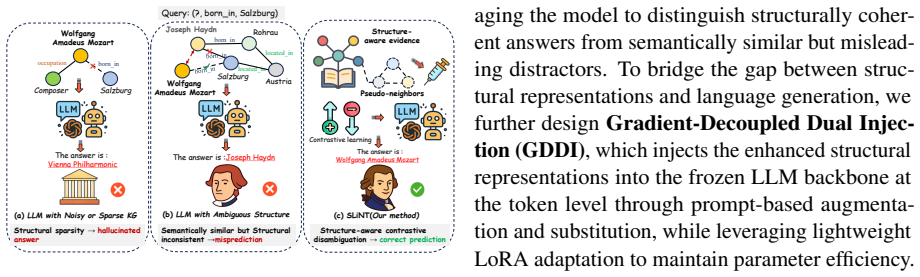
The central mechanism is the three-module pipeline: SGNE (pseudo-neighbor retrieval plus attention fusion), DHCL (interpolated hard-sample contrastive loss), and GDDI (token-level injection into a frozen LLM with LoRA). What does the work is the alignment: SGNE-enhanced structural vectors are placed into specific token slots so the LLM's autoregressive generation conditions on graph structure, while DHCL pushes the query representation away from interpolated negatives and toward interpolated positives to sharpen entity decision boundaries.
What would settle it
Take the test queries, delete the gold entity from the top-20 candidate list, and measure Hits@1. A large Hits@1 means the frozen LLM can answer from parametric memory alone and the structure injection is not the binding constraint; a near-zero Hits@1 confirms SLiNT inherits the base embedding's recall ceiling.
Extended reading notes
Core claim
SLiNT is a modular generative framework for link prediction that combines three mechanisms around a frozen LLaMA-2-7B backbone: Structure-Guided Neighborhood Enhancement (SGNE), which takes the top-k nearest entities in the pretrained KG embedding space and fuses them with the query via multi-head attention to produce structure-rich query and entity embeddings; Dynamic Hard Contrastive Learning (DHCL), which samples entities, selects the most and least similar ones, forms weighted prototype centers, interpolates them with the query to create boundary-level positives and negatives, and optimizes a margin-based contrastive loss; and Gradient-Decoupled Dual Injection (GDDI), which writes the SG
Load-bearing premise
The whole pipeline depends on the pretrained KG embedding already ranking the correct answer inside its top-m candidate list; if the gold entity is missing there, SLiNT has no way to recover it.
Editorial extensions
If this is right
- A frozen LLM plus structure-injected token embeddings can match or beat full-generation KGC systems without updating the LLM weights, so KGC improves by reusing existing KG embeddings rather than retraining.
- The plug-and-play design means any pretrained KG embedding can be dropped into SLiNT; better encoders (CoLE over TransE) raise MRR, so gains scale with the quality of the structural prior.
- Removing DHCL cuts Hits@1 the most (0.368 to 0.329 on FB15k-237), so contrastive boundary learning is what disambiguates close structural candidates.
- Retrieving 5 pseudo-neighbors is a robust default; fewer loses structure and more (10) introduces noise, especially for weaker encoders.
- SLiNT's accuracy is capped by the base embedding's recall: if the gold entity is not among the top-20 candidates, the model cannot produce it.
Reading between the lines
- Editorial: SGNE retrieves neighbors by raw embedding similarity, which is relation-agnostic; relation-conditioned neighbor retrieval would likely reduce the noise that appears at ks=10 and could push low-degree entity Hits@1 higher.
- Editorial: the interpolation coefficients in DHCL are sampled from a fixed uniform range; making them depend on local degree or relation could produce harder, more informative boundaries on FB15k-237, where the paper finds the optimal contrastive weight is lower.
- Editorial: GDDI's token-slot injection is a general interface; the same mechanism could inject multimodal or temporal entity representations into a frozen LLM, which the paper's limitations section also points toward.
Editorial analysis
A structured set of objections, weighed in public.
Referee Report
Summary. The paper proposes SLiNT, a modular framework for knowledge graph completion that injects structural context from pretrained KG embeddings into a frozen LLaMA-2-7B backbone with LoRA adaptation. Three components are introduced: SGNE retrieves pseudo-neighbors in the pretrained embedding space to enrich sparse entities; DHCL constructs interpolated hard positives/negatives and applies a margin-based contrastive loss; GDDI injects enhanced embeddings into token positions and uses a combined LM-plus-contrastive objective. Experiments on WN18RR and FB15k-237 compare SLiNT with embedding-based and generation-based baselines, with variants built on TransE, SimKGC, and CoLE. The paper reports the best MRR on FB15k-237 (0.443) and WN18RR (0.691) among generative baselines, plus ablations, robustness checks under data/edge removal, low-degree analysis, and theoretical appendices.
Significance. If the empirical claims are reliable, SLiNT would be a useful contribution: it is modular, keeps the LLM frozen, uses lightweight LoRA, and appears to improve over direct LLM+KGE baselines across two standard benchmarks. The paper also includes a genuinely informative failure case (Appendix D.3), which is good practice. However, the central empirical claim of 'superior' performance rests on very small differences over the strongest direct baselines, and the contrastive supervision as described is not anchored to true positives. The theoretical support in Appendix A.3 is also flawed as written. With controlled re-runs, per-seed statistics, and a clarified contrastive objective, the framework would be credible; in its current form the significance is not yet established.
major comments (4)
- [§4.3, Table 1 and Appendix C] The main claim of 'superior' performance is not supported by the reported numbers. On FB15k-237, SLiNT+CoLE achieves MRR 0.443 vs. DIFT+CoLE 0.439, and on WN18RR, SLiNT+SimKGC achieves 0.691 vs. DIFT+SimKGC 0.686: a difference of 0.004–0.005. The table footnote states that DIFT and other baselines are taken from their original papers, not re-run under the same implementation, hardware, or hyperparameters. Appendix C says results are averaged over three runs with fixed seeds, but no standard deviations, per-seed values, or significance tests are reported anywhere in the paper. A difference of this size, against a non-re-run baseline, is within plausible run-to-run noise. At minimum, the word 'superior' should be softened; the authors should re-run DIFT under identical conditions and report variance and significance tests for the reported margins.
- [§3.2, Algorithm 1 and Eq. (7)] DHCL defines positives as the top-kc most cosine-similar entities among Nc=50 randomly sampled entities from the global entity pool. With 40,943 entities in WN18RR, the gold entity is almost never in a random sample of 50, so the 'hard positives' are essentially nearest neighbors in the pretrained space, not true positives. The contrastive loss is therefore not a supervised objective for distinguishing correct answers; it is a self-referential clustering objective that reinforces the pretrained embedding geometry. This may still be useful, but it should be presented as such and its noisy-supervision effect should be analyzed. Furthermore, Appendix C mentions a 'confusion-aware scoring function' and 'pseudo-neighbor overlap' selection that do not appear in Algorithm 1 or in any equation, making the method unreproducible.
- [§3.2, Eqs. (9)–(10) and Algorithm 1] There is a dimensional/space inconsistency in the contrastive formulation. Eq. (9) builds interpolated samples from the un-enhanced query q, while Eq. (10) compares them against the enhanced query \tilde{q}. If q and \tilde{q} live in different spaces, the interpolation is not well-defined. Algorithm 1 also lists the entity pool as E∈R^{N×d'}, but the text in §3.2 computes cosine similarity between the enhanced query and raw entity embeddings e_j∈R^d. The role of SGNE in the contrastive loss is therefore unclear. The authors should specify whether entity embeddings are also passed through SGNE, and use a single consistent enhanced space throughout DHCL.
- [Appendix A.3] The theoretical justification of the contrastive loss is mathematically incorrect. The text claims that under unit-norm embeddings Z_j = ||\tilde{q} - \tilde{n}_j||^2 - ||\tilde{q} - \tilde{p}_j||^2 satisfies Z_j ∈ [-2,2]. For unit-norm vectors the squared Euclidean distance lies in [0,4], so the difference lies in [-4,4]. Consequently the per-term loss bound ℓ(Z_j) ∈ [log(1+e^{-2}), log(1+e^2)] ≈ [0.13, 2.13] is wrong. The subsequent PAC-Bayes bound depends on this boundedness assumption. The authors should either correct the interval and re-derive the bound, or remove this theoretical appendix and state the stability argument heuristically.
minor comments (5)
- [§3.2, Eq. (7)] The symbol N_c is overloaded: it denotes both the sample size in Algorithm 1 and the negative set N_c in Eq. (7). This makes the algorithm difficult to read; please use distinct notation, e.g., m for sample size and \mathcal{N}^c for the negative set.
- [§3.2, Eq. (8)] The prototype weights w_j^+, w_j^- are said to be sampled from a uniform distribution, but the support is not specified. Please state the distribution explicitly or explain how these weights are set.
- [§3.3 / Appendix A.4] Eq. (23) introduces an alignment loss L_align and says 'In practice, we approximate this by...', but this loss does not appear in the training objective Eq. (13). If it is not used, it should be removed or labeled as a conceptual motivation only; if it is used, the total loss should include it with a coefficient.
- [§4.1 and Appendix C] The paper refers to the backbone as 'frozen LLaMA-7B' in Section 4.2 but then specifies LLaMA-2-7B-chat in the footnote and Appendix C. Please use one consistent name.
- [Table 6 / Appendix A.2] The reported overhead percentages (≈3% training, <4% inference) are not accompanied by variance measures or the number of runs. Given that the headline empirical claim already suffers from missing variance, the efficiency claim should also be reported with run-to-run spread or acknowledged as approximate.
Circularity Check
No significant circularity: SLiNT's pipeline is a self-contained reranking/contrastive framework over external KG embeddings; reported gains are empirical, not constructionally forced.
full rationale
The paper's derivation chain is not circular. The pretrained KG embeddings (TransE, SimKGC, CoLE) are external inputs used to generate the top-m candidate list (Eq. 1) and pseudo-neighbors (Eq. 2); SLiNT then learns a LoRA-adapted LLM reranker with a contrastive auxiliary loss. No reported test metric is fitted from the test set, and no equation reduces to a fitted parameter by construction. The contrastive positives/negatives (Eq. 7) are selected by cosine similarity in the same embedding space, which is self-referential clustering but not circular reasoning, because the final evaluation is against external KG completion benchmarks and the loss does not encode the gold answer. The acknowledged limitation that the method depends on structure-derived signals from pretrained KG embeddings (Limitations section) is an honest scope restriction, not a circular step. The claimed superiority over DIFT is weakened by missing variance and by not re-running DIFT, but this is a statistical/reproducibility concern, not an instance of prediction reducing to input. There are no load-bearing self-citations; DIFT, SimKGC, and CoLE are external prior works with no author overlap. The theoretical appendices (A.3, A.4) are loose, but they are justifications, not derivations of the empirical results. Overall, the method is self-contained against external benchmarks and no circular step can be exhibited.
Assumptions & free parameters
free parameters (8)
- k_s (pseudo-neighbor count) =
5
- k_c (contrastive sample count) =
10
- N_c (sampled entity count) =
50
- m (candidate list size) =
20
- k_r (injected entity markers) =
1
- lambda (contrastive weight) =
0.5
- LoRA rank r, alpha, dropout =
r=128, alpha=64, dropout=0.1
- Interpolation coefficient bounds =
U(0.3,0.7)
assumptions (5)
- domain assumption Pretrained KG embeddings provide a reliable candidate ranking and meaningful pseudo-neighbors
- ad hoc to paper Hard positives selected by cosine similarity are structurally consistent with the query
- ad hoc to paper Interpolated samples in Eq. (9) approximate decision boundaries
- domain assumption A frozen LLaMA-2-7B with LoRA can integrate injected structural token embeddings
- ad hoc to paper A 'confusion-aware scoring function' exists and weights the contrastive loss
Cite this review
Pith. "Pith review of SLiNT: Structure-aware Language Model with Injection and Contrastive Training for Knowledge Graph Completion." pith.science (2026). https://pith.science/paper/GAIPKFQ4
@misc{pith2026250906531,
  author       = {Pith},
  title        = {Pith review of: SLiNT: Structure-aware Language Model with Injection and Contrastive Training for Knowledge Graph Completion},
  year         = {2026},
  howpublished = {\url{https://pith.science/paper/GAIPKFQ4}},
  note         = {Machine review of arXiv:2509.06531}
}
read the original abstract
Link prediction in knowledge graphs requires integrating structural information and semantic context to infer missing entities. While large language models offer strong generative reasoning capabilities, their limited exploitation of structural signals often results in structural sparsity and semantic ambiguity, especially under incomplete or zero-shot settings. To address these challenges, we propose SLiNT (Structure-aware Language model with Injection and coNtrastive Training), a modular framework that injects knowledge-graph-derived structural context into a frozen LLM backbone with lightweight LoRA-based adaptation for robust link prediction. Specifically, Structure-Guided Neighborhood Enhancement (SGNE) retrieves pseudo-neighbors to enrich sparse entities and mitigate missing context; Dynamic Hard Contrastive Learning (DHCL) introduces fine-grained supervision by interpolating hard positives and negatives to resolve entity-level ambiguity; and Gradient-Decoupled Dual Injection (GDDI) performs token-level structure-aware intervention while preserving the core LLM parameters. Experiments on WN18RR and FB15k-237 show that SLiNT achieves superior or competitive performance compared with both embedding-based and generation-based baselines, demonstrating the effectiveness of structure-aware representation learning for scalable knowledge graph completion.
Figures


Figures from the paper (1 more)

Reference graph
Works this paper leans on
-
[1]
online" 'onlinestring :=
ENTRY address archivePrefix author booktitle chapter edition editor eid eprint eprinttype howpublished institution journal key month note number organization pages publisher school series title type volume year doi pubmed url lastchecked label extra.label sort.label short.list INTEGERS output.state before.all mid.sentence after.sentence after.block STRING...
-
[2]
write newline
" write newline "" before.all 'output.state := FUNCTION n.dashify 't := "" t empty not t #1 #1 substring "-" = t #1 #2 substring "--" = not "--" * t #2 global.max substring 't := t #1 #1 substring "-" = "-" * t #2 global.max substring 't := while if t #1 #1 substring * t #2 global.max substring 't := if while FUNCTION word.in bbl.in capitalize " " * FUNCT...
-
[3]
Ivana Balazevic, Carl Allen, and Timothy M. Hospedales. 2019. https://doi.org/10.18653/V1/D19-1522 Tucker: Tensor factorization for knowledge graph completion . In Proceedings of the 2019 Conference on Empirical Methods in Natural Language Processing and the 9th International Joint Conference on Natural Language Processing, EMNLP-IJCNLP 2019, Hong Kong, C...
-
[4]
Antoine Bordes, Nicolas Usunier, Alberto Garc \' a - Dur \' a n, Jason Weston, and Oksana Yakhnenko. 2013. https://proceedings.neurips.cc/paper/2013/hash/1cecc7a77928ca8133fa24680a88d2f9-Abstract.html Translating embeddings for modeling multi-relational data . In Advances in Neural Information Processing Systems 26: 27th Annual Conference on Neural Inform...
work page 2013
-
[5]
Chen Chen, Yufei Wang, Bing Li, and Kwok - Yan Lam. 2022. https://aclanthology.org/2022.coling-1.352 Knowledge is flat: A seq2seq generative framework for various knowledge graph completion . In Proceedings of the 29th International Conference on Computational Linguistics, COLING 2022, Gyeongju, Republic of Korea, October 12-17, 2022 , pages 4005--4017. I...
work page 2022
-
[6]
Sanxing Chen, Xiaodong Liu, Jianfeng Gao, Jian Jiao, Ruofei Zhang, and Yangfeng Ji. 2021. https://doi.org/10.18653/V1/2021.EMNLP-MAIN.812 Hitter: Hierarchical transformers for knowledge graph embeddings . In Proceedings of the 2021 Conference on Empirical Methods in Natural Language Processing, EMNLP 2021, Virtual Event / Punta Cana, Dominican Republic, 7...
-
[7]
Kewei Cheng, Nesreen K. Ahmed, and Yizhou Sun. 2023. https://openreview.net/forum?id=F8VKQyDgRVj Neural compositional rule learning for knowledge graph reasoning . In The Eleventh International Conference on Learning Representations, ICLR 2023, Kigali, Rwanda, May 1-5, 2023 . OpenReview.net
work page 2023
- [8]
Show all 38 references
-
[9]
Tim Dettmers, Pasquale Minervini, Pontus Stenetorp, and Sebastian Riedel. 2018. https://doi.org/10.1609/AAAI.V32I1.11573 Convolutional 2d knowledge graph embeddings . In Proceedings of the Thirty-Second AAAI Conference on Artificial Intelligence, (AAAI-18), the 30th innovative...
2018 doi
-
[10]
Stefan Elfwing, Eiji Uchibe, and Kenji Doya. 2018. https://doi.org/10.1016/J.NEUNET.2017.12.012 Sigmoid-weighted linear units for neural network function approximation in reinforcement learning . Neural Networks, 107:3--11
2018 doi
-
[11]
Hu, Yelong Shen, Phillip Wallis, Zeyuan Allen - Zhu, Yuanzhi Li, Shean Wang, Lu Wang, and Weizhu Chen
Edward J. Hu, Yelong Shen, Phillip Wallis, Zeyuan Allen - Zhu, Yuanzhi Li, Shean Wang, Lu Wang, and Weizhu Chen. 2022. https://openreview.net/forum?id=nZeVKeeFYf9 Lora: Low-rank adaptation of large language models . In The Tenth International Conference on Learning Representat...
2022
-
[12]
Jeff Johnson, Matthijs Douze, and Herv \' e J \' e gou. 2021. https://doi.org/10.1109/TBDATA.2019.2921572 Billion-scale similarity search with gpus . IEEE Trans. Big Data , 7(3):535--547
2021
-
[13]
Mike Lewis, Yinhan Liu, Naman Goyal, Marjan Ghazvininejad, Abdelrahman Mohamed, Omer Levy, Veselin Stoyanov, and Luke Zettlemoyer. 2020. https://doi.org/10.18653/V1/2020.ACL-MAIN.703 BART: denoising sequence-to-sequence pre-training for natural language generation, translation...
2020 doi
-
[14]
Bill Yuchen Lin, Xinyue Chen, Jamin Chen, and Xiang Ren. 2019. https://doi.org/10.18653/V1/D19-1282 Kagnet: Knowledge-aware graph networks for commonsense reasoning . In Proceedings of the 2019 Conference on Empirical Methods in Natural Language Processing and the 9th Internat...
2019 doi
-
[15]
Ben Liu, Jihai Zhang, Fangquan Lin, Cheng Yang, and Min Peng. 2025. https://aclanthology.org/2025.coling-main.740/ Filter-then-generate: Large language models with structure-text adapter for knowledge graph completion . In Proceedings of the 31st International Conference on Co...
2025
-
[16]
Yang Liu, Zequn Sun, Guangyao Li, and Wei Hu. 2022. https://doi.org/10.1145/3511808.3557355 I know what you do not know: Knowledge graph embedding via co-distillation learning . In Proceedings of the 31st ACM International Conference on Information & Knowledge Management, Atla...
2022
-
[17]
Yang Liu, Xiaobin Tian, Zequn Sun, and Wei Hu. 2024. https://doi.org/10.1007/978-3-031-77844-5\_11 Finetuning generative large language models with discrimination instructions for knowledge graph completion . In The Semantic Web - ISWC 2024 - 23rd International Semantic Web Co...
2024 doi
-
[18]
McAllester
David A. McAllester. 1999. https://doi.org/10.1145/307400.307435 Pac-bayesian model averaging . In Proceedings of the Twelfth Annual Conference on Computational Learning Theory, COLT 1999, Santa Cruz, CA, USA, July 7-9, 1999 , pages 164--170. ACM
1999
-
[19]
OpenAI. 2023. Chatgpt: Optimizing language models for dialogue. https://openai.com/blog/chatgpt. https://openai.com/blog/chatgpt
2023
-
[20]
Colin Raffel, Noam Shazeer, Adam Roberts, Katherine Lee, Sharan Narang, Michael Matena, Yanqi Zhou, Wei Li, and Peter J. Liu. 2020. https://jmlr.org/papers/v21/20-074.html Exploring the limits of transfer learning with a unified text-to-text transformer . J. Mach. Learn. Res.,...
2020
-
[21]
Nikunj Saunshi, Orestis Plevrakis, Sanjeev Arora, Mikhail Khodak, and Hrishikesh Khandeparkar. 2019. http://proceedings.mlr.press/v97/saunshi19a.html A theoretical analysis of contrastive unsupervised representation learning . In Proceedings of the 36th International Conferenc...
2019
-
[22]
Apoorv Saxena, Adrian Kochsiek, and Rainer Gemulla. 2022. https://doi.org/10.18653/V1/2022.ACL-LONG.201 Sequence-to-sequence knowledge graph completion and question answering . In Proceedings of the 60th Annual Meeting of the Association for Computational Linguistics (Volume 1...
2022 doi
-
[23]
Talukdar
Apoorv Saxena, Aditay Tripathi, and Partha P. Talukdar. 2020. https://doi.org/10.18653/V1/2020.ACL-MAIN.412 Improving multi-hop question answering over knowledge graphs using knowledge base embeddings . In Proceedings of the 58th Annual Meeting of the Association for Computati...
2020 doi
-
[24]
Zhiqing Sun, Zhi - Hong Deng, Jian - Yun Nie, and Jian Tang. 2019. https://openreview.net/forum?id=HkgEQnRqYQ Rotate: Knowledge graph embedding by relational rotation in complex space . In 7th International Conference on Learning Representations, ICLR 2019, New Orleans, LA, US...
2019
-
[25]
Naftali Tishby and Noga Zaslavsky. 2015. https://doi.org/10.1109/ITW.2015.7133169 Deep learning and the information bottleneck principle . In 2015 IEEE Information Theory Workshop, ITW 2015, Jerusalem, Israel, April 26 - May 1, 2015 , pages 1--5. IEEE
2015
-
[26]
Kristina Toutanova, Danqi Chen, Patrick Pantel, Hoifung Poon, Pallavi Choudhury, and Michael Gamon. 2015. https://doi.org/10.18653/V1/D15-1174 Representing text for joint embedding of text and knowledge bases . In Proceedings of the 2015 Conference on Empirical Methods in Natu...
2015 doi
-
[27]
Talukdar
Shikhar Vashishth, Soumya Sanyal, Vikram Nitin, and Partha P. Talukdar. 2020. https://openreview.net/forum?id=BylA\_C4tPr Composition-based multi-relational graph convolutional networks . In 8th International Conference on Learning Representations, ICLR 2020, Addis Ababa, Ethi...
2020
-
[28]
Bo Wang, Tao Shen, Guodong Long, Tianyi Zhou, Ying Wang, and Yi Chang. 2021 a . https://doi.org/10.1145/3442381.3450043 Structure-augmented text representation learning for efficient knowledge graph completion . In WWW '21: The Web Conference 2021, Virtual Event / Ljubljana, S...
2021
-
[29]
Liang Wang, Wei Zhao, Zhuoyu Wei, and Jingming Liu. 2022. https://doi.org/10.18653/V1/2022.ACL-LONG.295 Simkgc: Simple contrastive knowledge graph completion with pre-trained language models . In Proceedings of the 60th Annual Meeting of the Association for Computational Lingu...
2022 doi
-
[30]
Xiang Wang, Xiangnan He, Yixin Cao, Meng Liu, and Tat - Seng Chua. 2019. https://doi.org/10.1145/3292500.3330989 KGAT: knowledge graph attention network for recommendation . In Proceedings of the 25th ACM SIGKDD International Conference on Knowledge Discovery & Data Mining, KD...
2019
-
[31]
Xiaozhi Wang, Tianyu Gao, Zhaocheng Zhu, Zhengyan Zhang, Zhiyuan Liu, Juanzi Li, and Jian Tang. 2021 b . https://doi.org/10.1162/TACL\_A\_00360 KEPLER: A unified model for knowledge embedding and pre-trained language representation . Trans. Assoc. Comput. Linguistics, 9:176--194
2021 doi
- [32]
-
[33]
Xin Xie, Ningyu Zhang, Zhoubo Li, Shumin Deng, Hui Chen, Feiyu Xiong, Mosha Chen, and Huajun Chen. 2022. https://doi.org/10.1145/3487553.3524238 From discrimination to generation: Knowledge graph completion with generative transformer . In Companion of The Web Conference 2022,...
2022
-
[34]
Bishan Yang, Wen - tau Yih, Xiaodong He, Jianfeng Gao, and Li Deng. 2015. http://arxiv.org/abs/1412.6575 Embedding entities and relations for learning and inference in knowledge bases . In 3rd International Conference on Learning Representations, ICLR 2015, San Diego, CA, USA,...
2015 arXiv
-
[35]
Fan Yang, Zhilin Yang, and William W. Cohen. 2017. https://proceedings.neurips.cc/paper/2017/hash/0e55666a4ad822e0e34299df3591d979-Abstract.html Differentiable learning of logical rules for knowledge base reasoning . In Advances in Neural Information Processing Systems 30: Ann...
2017
-
[36]
Rui Yang, Jiahao Zhu, Jianping Man, Hongze Liu, Li Fang, and Yi Zhou. 2025. https://doi.org/10.1016/J.INFFUS.2024.102868 GS-KGC: A generative subgraph-based framework for knowledge graph completion with large language models . Inf. Fusion, 117:102868
2025
-
[37]
Liang Yao, Chengsheng Mao, and Yuan Luo. 2019. https://arxiv.org/abs/1909.03193 KG-BERT: BERT for knowledge graph completion . CoRR, abs/1909.03193
2019 arXiv
-
[38]
Zhaocheng Zhu, Zuobai Zhang, Louis - Pascal A. C. Xhonneux, and Jian Tang. 2021. https://proceedings.neurips.cc/paper/2021/hash/f6a673f09493afcd8b129a0bcf1cd5bc-Abstract.html Neural bellman-ford networks: A general graph neural network framework for link prediction . In Advanc...
2021
Reviewed August 4, 2026 · model on record in the stance chip above.
Discussion (0). Sign in to comment.