REVIEW 4 major objections 5 minor 34 references
The paper claims MoLER—domain continual pre-training plus RL-tuned query and passage generation—lets a 1.7B model beat a 32B model on coarse-ranking retrieval benchmarks while keeping training cheap via MSLF and inference scalable via MMLF.
Reviewed by Pith at T0; open to challenge. T0 means a machine referee read the full paper against a public rubric. the ladder, T0–T4 →
A two-stage RAG training pipeline, MoL continual pre-training plus GRPO reinforcement learning with single-passage training and multi-passage inference, reports state-of-the-art retrieval recall on NFCORPUS and SCIFACT using small Qwen3 models.
T0 review reviewed 2026-08-04 challenge →
load-bearing objection A modest but real training-efficiency trick (MSLF) wrapped in a pipeline of existing components, with headline gains that are plausible but sloppily evidenced—worth refereeing, not desk-rejecting. the 4 major comments →
Domain-Aware RAG: MoL-Enhanced RL for Efficient Training and Scalable Retrieval
The pith
A machine-rendered reading of the paper's core claim, the machinery that carries it, and where it could break.
The reading
Core claim
On its own terms, the paper's discovery is that retrieval performance in a specialized domain can be optimized end-to-end by treating query generation and passage generation as a reinforcement-learned policy rewarded by recall, provided the model first absorbs domain knowledge through a dual-loss continual pre-training. The key named mechanism is the pair MSLF/MMLF: during RL training, the policy generates several sub-queries but collapses them into one synthetic passage before retrieval, cutting policy rollouts from n+1 model interactions to 2; at inference, the same policy generates a separate passage per sub-query and merges the ranked lists with reciprocal rank fusion. The paper reports
What carries the argument
Three building blocks carry the argument: MoL (Mixture of Losses), a continual pre-training objective that applies cross-entropy loss to domain corpora and KL-divergence loss to general corpora; GRPO (Group Relative Policy Optimization), an RL algorithm whose reward is the recall of the fused retrieval result; and the MSLF/MMLF pair, where MSLF generates one passage from many queries during training and MMLF generates one passage per query during inference, with reciprocal rank fusion combining the ranked lists. MoL supplies domain knowledge, GRPO tunes generation toward recall, MSLF keeps RL cheap, and MMLF keeps inference scalable.
Load-bearing premise
The efficiency claim rests on the assumption that training with one fused passage preserves the retrieval gains from generating many separate passages at inference time—a trend read from a few data points, not established by a fitted relationship or significance test.
What would settle it
Fix the embedding model, train the same base model with and without MSLF, then evaluate MMLF inference at expansion counts 1, 2, 4, 8, 16, and 32 on NFCORPUS and SCIFACT; fit the recall-versus-log-count slope with confidence intervals. The scalability-transfer claim stands only if the post-MSLF slope is positive and statistically indistinguishable from the base model's; if the curve flattens past the training count of 3, the central efficiency claim fails.
If this is right
- RL-tuned query and passage generation can lift coarse-ranking recall on specialized corpora beyond prompt-only augmentation with a much larger model.
- Training with MSLF keeps RL rollouts cheap—two model interactions instead of n+1—while preserving the inference-time benefit of MMLF.
- Recall improves approximately logarithmically with the number of generated queries, so more expansions at inference buy predictable but diminishing returns.
- MoL continual pre-training reaches higher and more stable RL rewards than CE-only domain training in the reported convergence curves.
- Nonthinking mode gives nearly the same retrieval performance as thinking mode, so deployment can skip chain-of-thought latency.
Where Pith is reading between the lines
- A direct consequence the paper leaves implicit: the log-linear recall-versus-query-count curve is a budget rule—deployers could pick the number of generated queries from latency or cost targets rather than the fixed n=3 used in training.
- The same train-cheap/infer-expensive split could transfer to other retrieval-oriented generation tasks, such as reranking or entity linking, by using a single fused rollout as the RL reward surrogate and deploying fully diverse rollouts only at inference.
- Because the paper fixes one embedding model, a natural test is whether the gains transfer across embedding spaces; if they shrink or vanish, much of the benefit may lie in the retriever rather than the trained generation policy.
- Applying the same two-stage pipeline to the 32B baseline would show whether MoL+GRPO gains stack with scale or saturate; the current comparison leaves that question open.
Editorial analysis
A structured set of objections, weighed in public.
Referee Report
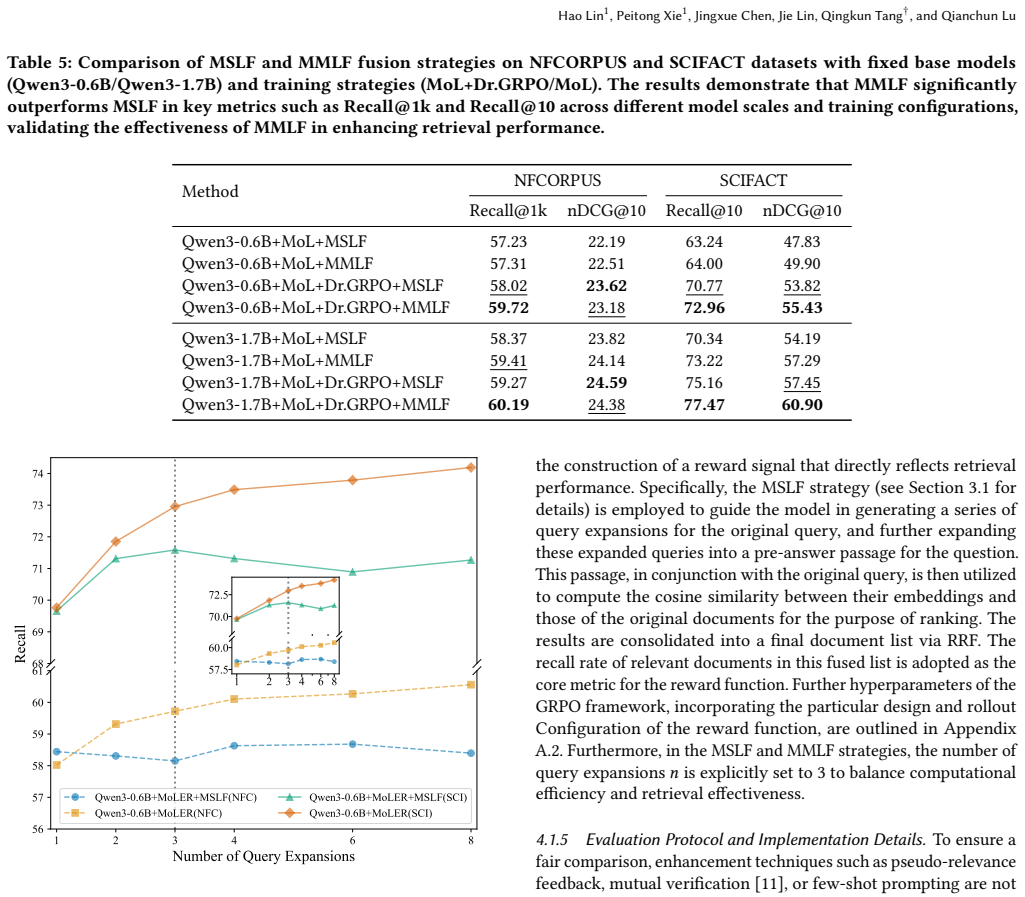
Summary. The paper proposes MoLER, a two-stage method for improving coarse-ranking recall in RAG. In stage one, continuous pre-training (CPT) applies a Mixture of Losses (MoL) dual-loss objective: cross-entropy on a domain corpus and KL divergence on a general corpus, with a 1:1 ratio imported from reference [2]. In stage two, GRPO or Dr.GRPO reinforcement learning optimizes query and pseudo-passage generation, using the Multi-query Single-passage Late Fusion (MSLF) strategy during training to reduce LLM interactions, and Multi-query Multi-passage Late Fusion (MMLF) at inference for effectiveness. Experiments on NFCORPUS and SCIFACT report that Qwen3-1.7B+MoL+GRPO outperforms all baselines, including Qwen3-32B+MMLF, and that MMLF retains a log-linear relationship between retrieval performance and number of generated queries even after MSLF-based training. The paper interprets these results as demonstrating efficient training and scalable retrieval for domain-adaptive RAG.
Significance. If the empirical claims hold, the paper makes a practically valuable contribution: a 1.7B parameter model with domain CPT and RL-tuned query generation surpassing a 32B model on standard BEIR subsets, together with a training/inference asymmetry (MSLF/MMLF) that promises reduced RL cost without losing query-expansion scalability. The manuscript's strengths include an explicit two-stage design, a clear ablation structure (Tables 4-7), and a public code repository. However, the two headline claims are not yet established: the 'significantly outperforming' statement rests on single-run point estimates with no error bars or significance tests, and the central scalability-preservation claim is asserted from visual inspection of small-N curves without fitted models, confidence intervals, or repeated-seed variance. The contribution is plausible and interesting, but the current evidence is insufficient for the strength of the claims made.
major comments (4)
- [§4.2.3, Figures 4–6] The load-bearing claim that MMLF's log-linear scalability is 'preserved' after MSLF training is not quantitatively supported. The text in §4.2.3 infers 'approximately linear growth' and 'near-linear relationships' from five expansion counts (n=3,5,7,9,11) by eye, with no fitted log-linear or power-law model, no R², no confidence intervals, and no repeated-seed variance. Furthermore, 'preserved' requires a before/after comparison for MMLF (base, +MoL, +MoL+RL). Figure 5 compares MMLF vs MSLF only after training, and Figure 4 compares base vs MoLER; neither quantifies the slope or its uncertainty. Without this, the title's 'Scalable Retrieval' and the efficiency justification of MSLF are unsupported. Please fit the scaling law, provide CIs, and report variance.
- [Abstract, §1, §4.2.1, Table 3] The words 'significantly outperforming' and 'statistically significant improvements' are used without any supporting statistical evidence. Table 3 shows single point estimates with no error bars, no repeated runs, and no significance tests. The margins over the closest baseline are tiny: e.g., NFCORPUS Recall@1k 61.42 vs 60.87 (+0.55 pp), and SCIFACT nDCG@10 62.59 vs 62.55 (+0.04 pp). These are within plausible decoding noise for LLM-based query expansion. Please add per-instance bootstrap or paired tests, or soften the claims.
- [§4.1.4, §3.3] The claim that MSLF 'reduces computational overhead' is only supported structurally (reducing LLM interactions from n+1 to 2 per rollout). No wall-clock time, FLOPs, GPU-hours, or comparative training convergence data are reported. Since 'Efficient Training' is part of the paper's title and contribution, the efficiency benefit needs empirical demonstration. Without it, the reader cannot assess whether the reduced interaction count translates into practical savings after the full RL pipeline.
- [§3.2, Table 7] The 'optimal 1:1 corpus ratio' for MoL is imported from the self-cited reference [2] and treated as a fixed hyperparameter. Table 7 abandons only the ratio (comparing CE vs MoL at fixed 4 epochs), not the ratio itself, so the optimality of 1:1 for these Qwen3 models and NFCORPUS/SCIFACT is not established. This is a correctness-risk concern: if the 1:1 ratio is not optimal for the new setting, the MoL advantage could be under- or over-stated. Please add a sensitivity analysis or explicitly frame the ratio as a transferred hyperparameter.
minor comments (5)
- [Throughout] Several typos reduce readability: 'enhencement', 'agunent', 'ambigous', 'nothinking' (in Table 4 caption, inconsistent with 'nonthinking' elsewhere), and reference [30] title 'Quary Expansion'. Please proofread.
- [Figure 4] The caption refers to 'logarithmic scaling subplots (shown as insets)', but in the provided PDF the inset text and axis labels are illegible. Ensure insets are large enough and axes are clearly labeled in the revised version.
- [References] References [10] and [11] appear to be the same MILL paper with duplicated entries. Please consolidate.
- [§4.1.5] 'Unless specified' should be capitalized and punctuated as a sentence ('Unless otherwise specified, MMLF is used...').
- [§4.2.1] 'an average improvement of 0.49% over its closest competitor' is ambiguous: please specify which metrics and across which datasets this average is computed.
Circularity Check
Only minor self-citation for the MoL component; central retrieval claims are evaluated on external test data and do not reduce to inputs.
specific steps
-
self citation load bearing
[Section 3.2 (Continual Pre-training)]
"Following [2], we employ an optimal 1:1 corpus ratio in LoRA fine-tuning to avoid degradation of generalization ability due to excessive domain data, thereby ensuring balanced performance."
The MoL dual-loss architecture and the 'optimal 1:1 corpus ratio' are imported from reference [2], which is authored by current paper authors Jingxue Chen, Qingkun Tang, and Qianchun Lu. The paper does not re-derive this ratio or test alternative ratios; the ablation studies vary training epochs, not the corpus ratio. Thus the specific ratio choice is justified by self-citation. However, this is a component-level adoption rather than a derived prediction: the paper independently evaluates MoL vs. CE in Table 7 and Figure 6 on held-out test queries, so the central retrieval result does not reduce to the cited claim. The self-citation is therefore present but not load-bearing for the paper's main performance conclusions.
full rationale
MoLER's main results are benchmarked on held-out BEIR test splits (NFCORPUS and SCIFACT) against external baselines, and the RL reward (recall on MSLF rollouts) is a training signal, not the reported test metric. The reported test-set improvements therefore do not reduce by construction to the training objective. The MSLF/MMLF distinction is a genuine algorithmic asymmetry (one fused passage during training vs. n passages at inference), and the scalability claim—while statistically under-supported (no fitted slopes, confidence intervals, or repeated-seed variance)—is an empirical assertion about measured recall curves, not a definitional consequence. The only circularity-adjacent item is the adoption of the MoL dual-loss and its 1:1 general/domain ratio from the authors' own prior work [2]. That self-citation is not load-bearing because the paper supplies independent ablation evidence (Table 7, Figure 6) comparing MoL with CE on the same external benchmarks. The weakness of the scaling-law evidence is better characterized as a correctness/evidence concern than as circularity.
Axiom & Free-Parameter Ledger
free parameters (4)
- n (query expansion count) =
3
- RRF constant K =
60
- MoL domain:general corpus ratio =
1:1
- MoL training epochs =
4
axioms (4)
- domain assumption MoL dual-loss (CE for domain, KL for general) enhances domain expertise while preserving general capabilities
- domain assumption Recall computed via ada-002 embeddings and RRF is a valid reward signal for optimizing retrieval
- ad hoc to paper MMLF retrieval performance scales log-linearly with query count and this scaling is preserved after MSLF training
- standard math GRPO/Dr.GRPO objectives as written in Eq. 4-5 correctly describe the training updates
Cite this review
Pith. "Pith review of Domain-Aware RAG: MoL-Enhanced RL for Efficient Training and Scalable Retrieval." pith.science (2026). https://pith.science/paper/4BOMORNF
@misc{pith2026250906650,
  author       = {Pith},
  title        = {Pith review of: Domain-Aware RAG: MoL-Enhanced RL for Efficient Training and Scalable Retrieval},
  year         = {2026},
  howpublished = {\url{https://pith.science/paper/4BOMORNF}},
  note         = {Machine review of arXiv:2509.06650}
}
read the original abstract
Retrieval-Augmented Generation (RAG) systems rely heavily on the retrieval stage, particularly the coarse-ranking process. Existing coarse-ranking optimization approaches often struggle to balance domain-specific knowledge learning with query enhencement, resulting in suboptimal retrieval performance. To address this challenge, we propose MoLER, a domain-aware RAG method that uses MoL-Enhanced Reinforcement Learning to optimize retrieval. MoLER has a two-stage pipeline: a continual pre-training (CPT) phase using a Mixture of Losses (MoL) to balance domain-specific knowledge with general language capabilities, and a reinforcement learning (RL) phase leveraging Group Relative Policy Optimization (GRPO) to optimize query and passage generation for maximizing document recall. A key innovation is our Multi-query Single-passage Late Fusion (MSLF) strategy, which reduces computational overhead during RL training while maintaining scalable inference via Multi-query Multi-passage Late Fusion (MMLF). Extensive experiments on benchmark datasets show that MoLER achieves state-of-the-art performance, significantly outperforming baseline methods. MoLER bridges the knowledge gap in RAG systems, enabling robust and scalable retrieval in specialized domains.
Figures




Reference graph
Works this paper leans on
-
[1]
J. Bhogal, A. Macfarlane, and P. Smith. 2007. A review of ontology based query expansion.Information Processing & Management43, 4 (2007), 866–886. https: //doi.org/10.1016/j.ipm.2006.09.003
-
[2]
Jingxue Chen, Qingkun Tang, Qianchun Lu, and Siyuan Fang. 2025. MoL for LLMs: Dual-Loss Optimization to Enhance Domain Expertise While Preserving General Capabilities. arXiv:2505.12043 [cs.CL] https://arxiv.org/abs/2505.12043 Table 9: Training Setup for GRPO Hyperparameter Value global batch size 64 gradient learning rate 1e-4 LoRA rank 64 weight decay 0....
Pith/arXiv arXiv 2025
-
[3]
Shufan Chen, He Zheng, and Lei Cui. 2025. When and How to Augment Your Input: Question Routing Helps Balance the Accuracy and Efficiency of Large Language Models. InFindings of the Association for Computational Linguistics: NAACL 2025, Luis Chiruzzo, Alan Ritter, and Lu Wang (Eds.). Association for Computational Linguistics, Albuquerque, New Mexico, 3621–...
-
[4]
Cormack, Charles L A Clarke, and Stefan Buettcher
Gordon V. Cormack, Charles L A Clarke, and Stefan Buettcher. 2009. Reciprocal rank fusion outperforms condorcet and individual rank learning methods. In Proceedings of the 32nd International ACM SIGIR Conference on Research and Development in Information Retrieval(Boston, MA, USA)(SIGIR ’09). Association for Computing Machinery, New York, NY, USA, 758–759...
arXiv 2009
-
[5]
Andrea Cossu, Tinne Tuytelaars, Antonio Carta, Lucia Passaro, Vincenzo Lomonaco, and Davide Bacciu. 2022. Continual Pre-Training Mitigates For- getting in Language and Vision. arXiv:2205.09357 [cs.LG] https://arxiv.org/abs/ 2205.09357
work page internal anchor Pith review Pith/arXiv arXiv 2022
-
[6]
Daya Guo, Dejian Yang, Haowei Zhang, Junxiao Song, Ruoyu Zhang, Runxin Xu, Qihao Zhu, Shirong Ma, Peiyi Wang, Xiao Bi, and et al. 2025. DeepSeek- R1: Incentivizing Reasoning Capability in LLMs via Reinforcement Learning. arXiv preprint arXiv:2501.12948(2025). https://arxiv.org/abs/2501.12948 Code: https://github.com/deepseek-ai/DeepSeek-R1
Pith/arXiv arXiv 2025
-
[7]
Edward J Hu, Yelong Shen, Phillip Wallis, Zeyuan Allen-Zhu, Yuanzhi Li, Shean Wang, Lu Wang, Weizhu Chen, et al. 2022. Lora: Low-rank adaptation of large language models.ICLR1, 2 (2022), 3
2022
-
[8]
Kexin Huang, Jaan Altosaar, and Rajesh Ranganath. 2019. ClinicalBERT: Model- ing Clinical Notes and Predicting Hospital Readmission.ArXivabs/1904.05342 (2019). https://api.semanticscholar.org/CorpusID:119308351
Pith/arXiv arXiv 2019
-
[9]
Rolf Jagerman, Honglei Zhuang, Zhen Qin, Xuanhui Wang, and Michael Bender- sky. 2023. Query expansion by prompting large language models.arXiv preprint (2023). arXiv:2305.03653 https://arxiv.org/abs/2305.03653
Pith/arXiv arXiv 2023
-
[10]
Pengyue Jia, Yiding Liu, Xiangyu Zhao, Xiaopeng Li, Changying Hao, Shuaiqiang Wang, and Dawei Yin. 2024. MILL: Mutual Verification with Large Language Models for Zero-Shot Query Expansion. InProceedings of the 2024 Conference of the North American Chapter of the Association for Computational Linguistics: Hu- man Language Technologies (Volume 1: Long Paper...
2024
-
[11]
Pengyue Jia, Yiding Liu, Xiangyu Zhao, Xiaopeng Li, Changying Hao, Shuaiqiang Wang, and Dawei Yin. 2024. MILL: Mutual Verification with Large Language Models for Zero-Shot Query Expansion. InProceedings of the 2024 Conference of the North American Chapter of the Association for Computational Linguistics: Human Language Technologies. 2498–2518. https://arx...
Pith/arXiv arXiv 2024
-
[12]
Pengcheng Jiang, Jiacheng Lin, Lang Cao, Runchu Tian, SeongKu Kang, Zifeng Wang, Jimeng Sun, and Jiawei Han. 2025. DeepRetrieval: Hacking Real Search Engines and Retrievers with Large Language Models via Reinforcement Learning. arXiv:2503.00223 [cs.IR] https://arxiv.org/abs/2503.00223
Pith/arXiv arXiv 2025
-
[13]
Vladimir Karpukhin, Barlas Oguz, Sewon Min, Patrick SH Lewis, Ledell Wu, Sergey Edunov, Danqi Chen, and Wen-tau Yih. 2020. Dense Passage Retrieval for Open-Domain Question Answering.. InEMNLP (1). 6769–6781. Domain-Aware RAG: MoL-Enhanced RL for Efficient Training and Scalable Retrieval
work page 2020
-
[14]
Yuan-Ching Kuo, Yi Yu, Chih-Ming Chen, and Chuan-Ju Wang. 2025. MMLF: Multi-query Multi-passage Late Fusion Retrieval. InFindings of the Association for Computational Linguistics: NAACL 2025. 6587–6598
2025
-
[15]
Patrick Lewis, Ethan Perez, Aleksandra Piktus, Fabio Petroni, Vladimir Karpukhin, Naman Goyal, Heinrich Küttler, Mike Lewis, Wen-tau Yih, Tim Rocktäschel, Sebastian Riedel, and Douwe Kiela. 2020. Retrieval-Augmented Generation for Knowledge-Intensive NLP Tasks.CoRRabs/2005.11401 (2020). arXiv:2005.11401 https://arxiv.org/abs/2005.11401
Pith/arXiv arXiv 2020
-
[16]
Zichen Liu, Chen Chen, Wenhan Li, Tianyu Pang, Chengzhe Du, and Min Lin
-
[17]
2022.PEFT: State-of-the-art Parameter-Efficient Fine-Tuning Methods
Sourab Mangrulkar, Sylvain Gugger, Lysandre Debut, Younes Belkada, Sayak Paul, and Benjamin Bossan. 2022.PEFT: State-of-the-art Parameter-Efficient Fine-Tuning Methods. Technical Report. Hugging Face. https://github.com/ huggingface/peft
work page 2022
-
[18]
Rodrigo Nogueira and Kyunghyun Cho. 2020. Passage Re-ranking with BERT. arXiv:1901.04085 [cs.IR] https://arxiv.org/abs/1901.04085
Pith/arXiv arXiv 2020
-
[19]
2022.New and improved embedding model
OpenAI. 2022.New and improved embedding model. https://openai.com/blog/ new-and-improved-embedding-model
work page 2022
-
[20]
Dipasree Pal, Mandar Mitra, and Kalyankumar Datta. 2013. Improving Query Expansion Using WordNet.CoRRabs/1309.4938 (2013). arXiv:1309.4938 http: //arxiv.org/abs/1309.4938
work page internal anchor Pith review Pith/arXiv arXiv 2013
-
[21]
John Schulman, Filip Wolski, Prafulla Dhariwal, Alec Radford, and Oleg Klimov
-
[22]
Rulin Shao, Rui Qiao, Varsha Kishore, Niklas Muennighoff, Xi Victoria Lin, Daniela Rus, Bryan Kian Hsiang Low, Sewon Min, Wen-tau Yih, Pang Wei Koh, et al. 2025. ReasonIR: Training Retrievers for Reasoning Tasks.arXiv preprint arXiv:2504.20595(2025)
Pith/arXiv arXiv 2025
-
[23]
Shezheng Song, Hao Xu, Jun Ma, Shasha Li, Long Peng, Qian Wan, Xiaodong Liu, and Jie Yu. 2025. How to Complete Domain Tuning while Keeping General Ability in LLM: Adaptive Layer-wise and Element-wise Regularization. https: //doi.org/10.48550/arXiv.2501.13669
-
[24]
Nandan Thakur, Nils Reimers, Andreas Rücklé, Abhishek Srivastava, and Iryna Gurevych. 2021. Beir: A heterogenous benchmark for zero-shot evaluation of information retrieval models.arXiv preprint arXiv:2104.08663(2021)
Pith/arXiv arXiv 2021
-
[25]
Liang Wang, Nan Yang, and Furu Wei. 2023. Query2doc: Query expansion with large language models.arXiv preprint arXiv:2303.07678(2023)
Pith/arXiv arXiv 2023
-
[26]
Liang Wen, Fenrui Xiao, Xin He, Yunke Cai, Qi An, Zhenyu Duan, Yimin Du, Junchen Liu, Lifu Tang, Xiaowei Lv, Haosheng Zou, Yongchao Deng, Shousheng Jia, and Xiangzheng Zhang. 2025. Light-R1: Curriculum SFT, DPO and RL for Long COT from Scratch and Beyond. arXiv:2503.10460 https://github.com/ Qihoo360/Light-R1
Pith/arXiv arXiv 2025
-
[27]
Rossi, Haoliang Wang, and Julian McAuley
Yu Xia, Junda Wu, Sungchul Kim, Tong Yu, Ryan A. Rossi, Haoliang Wang, and Julian McAuley. 2025. Knowledge-Aware Query Expansion with Large Language Models for Textual and Relational Retrieval. arXiv:2410.13765 [cs.CL] https://arxiv.org/abs/2410.13765
Pith/arXiv arXiv 2025
-
[28]
Shitao Xiao, Zheng Liu, Peitian Zhang, and Niklas Muennighoff. 2023. C-Pack: Packaged Resources To Advance General Chinese Embedding. arXiv:2309.07597 [cs.CL]
Pith/arXiv arXiv 2023
-
[29]
Bennett, Junaid Ahmed, and Arnold Overwijk
Lee Xiong, Chenyan Xiong, Ye Li, Kwok-Fung Tang, Jialin Liu, Paul N. Bennett, Junaid Ahmed, and Arnold Overwijk. 2020. Approximate Nearest Neighbor Negative Contrastive Learning for Dense Text Retrieval.CoRRabs/2007.00808 (2020). arXiv:2007.00808 https://arxiv.org/abs/2007.00808
Pith/arXiv arXiv 2020
-
[30]
Jinxi Xu and W. Bruce Croft. 2017. Quary Expansion Using Local and Global Document Analysis.SIGIR Forum51, 2 (Aug. 2017), 168–175. https://doi.org/10. 1145/3130348.3130364
-
[31]
An Yang, Anfeng Li, Baosong Yang, Beichen Zhang, Binyuan Hui, Bo Zheng, Bowen Yu, Chang Gao, Chengen Huang, Chenxu Lv, et al. 2025. Qwen3 technical report.arXiv preprint arXiv:2505.09388(2025)
Pith/arXiv arXiv 2025
-
[32]
Hansi Zeng, Hamed Zamani, and Vishwa Vinay. 2022. Curriculum Learning for Dense Retrieval Distillation. InProceedings of the 45th International ACM SIGIR Conference on Research and Development in Information Retrieval(Madrid, Spain)(SIGIR ’22). Association for Computing Machinery, New York, NY, USA, 1979–1983. https://doi.org/10.1145/3477495.3531791
arXiv 2022
-
[2017]
Proximal policy optimization algorithms.arXiv preprint arXiv:1707.06347 (2017)
Pith/arXiv arXiv 2017
-
[2025]
Understanding R1-Zero-Like Training: A Critical Perspective.arXiv preprint(2025). https://github.com/sail-sg/understand-r1-zero/blob/main/ understand-r1-zero.pdf Code: https://github.com/sail-sg/understand-r1-zero
work page 2025
This paper was first reviewed by deepseek-v4-flash on August 4, 2026.
discussion (0)
Sign in with ORCID, Apple, or X to comment. Anyone can read and Pith papers without signing in.