REVIEW 3 major objections 5 minor 1 cited by
Evolution of spin excitations in superconducting La$_{2-x}$Ca$_{x}$CuO$_{4-\delta}$ from the underdoped to the heavily overdoped regime
T0 review · 3 major / 5 minor · reviewed 2026-08-04 · deepseek-v4-flash
Pith's one-line read Spin waves persist to 50% doping in cuprate superconductor
desk verdict Solid new RIXS data on LCCO across the full doping range, but the title claim of persistent paramagnons to x=0.50 is softer in the body than in the abstract. read the letter →
The pith
A machine-rendered reading of the paper's core claim, the machinery that carries it, and where it could break.
The reading
What carries the argument
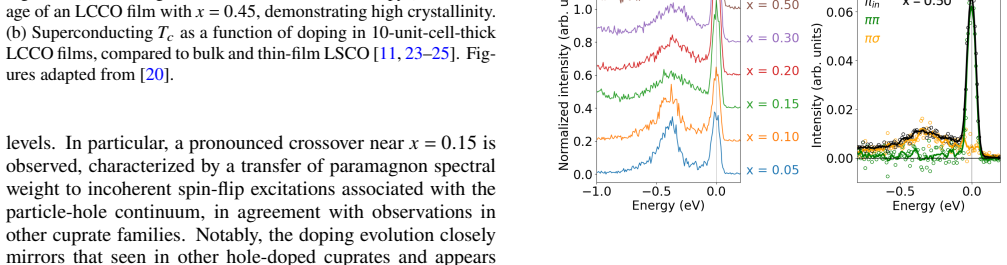
The central object is the spin-flip excitation feature near 0.35–0.40 eV in Cu L3-edge RIXS spectra, isolated by polarization analysis into the cross-polarized channel. Its nature is classified by incident-photon-energy detuning: a Raman-like collective paramagnon keeps a fixed peak energy, whereas an incoherent particle-hole continuum shifts toward higher energy. A damped harmonic oscillator lineshape is used to extract the peak, and the ratio R=I(0.7 eV)/I(0.4 eV) functions as a proxy for the fraction of incoherent spectral weight. The crossover near x=0.15 is identified as the doping at which R starts to rise with detuning.
What would settle it
A RIXS experiment at x=0.50 with improved energy resolution and a wider detuning range that resolves two distinct components, one with constant peak energy and one that shifts, would test the claim directly; if on-detuning data alone the entire spin-flip feature shifts linearly with incident energy and the R ratio reaches the fluorescence value, the collective component is absent at that doping.
Extended reading notes
Core claim
The paper's central claim is that the spin-flip signal seen by RIXS in the mid-infrared range is composed of a collective paramagnon component plus incoherent particle-hole excitations, and that the collective component, while losing weight around x≈0.15, never disappears up to x=0.50. The evidence is the detuning behavior: at x=0.05 and 0.10 the peak energy is independent of incident photon energy (Raman-like), while for x=0.15–0.50 the peak shifts but remains offset from the purely fluorescent trajectory, and the ratio R of intensity at 0.7 eV to that at 0.4 eV stays below the fluorescence value. The authors interpret this as a residual collective mode coexisting with a growing continuum.
Load-bearing premise
That a collective paramagnon persists at x=0.50 depends on interpreting detuning and R-ratio behavior from spectra that are fit with a single damped harmonic oscillator, even though the paper states that the collective mode and incoherent spin-flip excitations cannot be cleanly separated for x=0.15–0.50.
Editorial extensions
If this is right
- High-energy spin excitations (paramagnons) can be removed from the shortlist of pairing glue candidates for cuprate superconductivity.
- The crossover near x=0.15, where paramagnon weight transfers to the continuum, is a universal feature of hole-doped cuprates rather than a consequence of the specific superconducting dome.
- LCCO's extended superconductivity up to x=0.50 shows no corresponding extension of the paramagnon crossover, meaning the magnetic spectrum and the pairing strength are decoupled in this doping range.
- Theories that attribute the entire mid-infrared RIXS weight to incoherent particle-hole excitations are contradicted by the persistence of a Raman-like component.
- The relevant magnetic fluctuations for overdoped superconductivity lie at low energies near the zone center, as previously seen by neutron scattering, not in the high-energy RIXS range.
Reading between the lines
- The same logic would predict that in electron-doped cuprates, where the superconducting dome is also asymmetric, high-energy spin excitations should also be insensitive to Tc; a direct RIXS comparison would test this.
- The residual collective mode at x=0.50 implies that short-range antiferromagnetic correlations survive far beyond hole doping levels where long-range order disappears; this could be examined with momentum-resolved RIXS at higher Q.
- The coincidence of the x≈0.15 crossover with Fermi-surface reconstruction suggests the incoherent continuum is the spectroscopic signature of emergent hole carriers; combined RIXS and transport studies on the same films could test this link.
- If high-energy magnons are not involved in pairing, theories of pairing must rely on low-energy spin fluctuations or charge fluctuations, which strengthens the case for focusing neutron scattering and low-energy probes on the overdoped side.
Editorial analysis
A structured set of objections, weighed in public.
Referee Report
Summary. The paper reports Cu L3-edge RIXS measurements on La_{2-x}Ca_xCuO_{4-delta} films (x = 0.05-0.50), using polarization analysis and incident-photon-energy detuning to study the evolution of high-energy spin excitations. The authors find that the mid-infrared spin-flip feature persists across the doping range, with a crossover near x = 0.15 where spectral weight transfers from collective paramagnon-like excitations to incoherent particle-hole continuum excitations. They interpret the detuning dependence and the intensity ratio R as evidence that a collective paramagnon component survives up to x = 0.50, and they argue that the doping evolution is insensitive to the unusually extended superconducting dome in LCCO, supporting the view that high-energy RIXS magnetic excitations are not a major contributor to superconducting pairing.
Significance. If the central claim holds, the paper provides a systematic doping-dependent RIXS dataset for a cuprate family with an extended superconducting dome, strengthening the case that high-energy paramagnons are largely decoupled from the pairing mechanism. The strengths include polarization-resolved measurements, a broad doping range, high-quality films, and detuning series that go beyond simple peak-position tracking. The comparison of LCCO with Bi2201, Tl2201, and YBCO is valuable. However, the manuscript's strongest interpretation—persistence of a collective paramagnon up to x=0.50—is not uniquely established by the presented analysis, and the authors themselves acknowledge that collective and incoherent components cannot be cleanly separated for x=0.15-0.50. The paper would be more persuasive with a quantitative discrimination between single-DHO-plus-continuum and pure-continuum models.
major comments (3)
- [Section III, paragraph after Fig. 6] The abstract's claim that the data 'confirm the persistence of collective paramagnon excitations up to x=0.50' is stronger than the evidence. The manuscript explicitly states that 'the collective mode and incoherent spin-flip excitations cannot be cleanly separated in the RIXS spectra for x=0.15–0.50' and that a single resolution-convoluted DHO is used to model the mid-infrared spin-flip feature. Therefore the fitted DHO parameters describe the total spin-flip feature, not an isolated collective component. The detuning dependence in Fig. 4 and the R ratio in Fig. 5 are indirect; a purely incoherent particle-hole continuum with an energy-dependent matrix element and resolution broadening can also produce a sub-linear peak shift and R<1. No quantitative criterion is given to distinguish these scenarios. This point is load-bearing because the 'persistence' conclusion and the subsequent pair
- [Section III, Eq. (1)] The single-DHO line shape presupposes a collective damped harmonic excitation. Since the same functional form is used to fit both the low-doping (collective-dominated) and high-doping (continuum-dominated) spectra, the apparent persistence of a Raman-like component is partly built into the fitting model. The paper does not provide a falsifiable alternative: what spectral signature would demonstrate that no collective component remains at x=0.50? A two-component fit (DHO + incoherent continuum) or a comparison with determinant quantum Monte Carlo or other model calculations for the pure-continuum case would be needed to support the claim.
- [Section III, Fig. 5] The interpretation of the R ratio—intensity at 0.7 eV divided by intensity at 0.4 eV—as a proxy for 'integrity of the collective spin excitation' is not quantitatively calibrated. The manuscript states that R remains small when spectral weight is concentrated in a well-defined collective mode, but a broad incoherent continuum with a matrix element decreasing with energy transfer could also yield small R with a weak doping dependence. Without a calculation of R for the incoherent-only scenario, the crossover near x=0.15 and the conclusion that a residual collective component persists are not uniquely established. Please provide model R values or an alternative discriminator.
minor comments (5)
- [Abstract and Section IV] The word 'confirm' in the abstract is too strong relative to the caveats in Sections III and IV. Suggest 'indicate' or 'provide evidence for' to avoid overclaiming.
- [Author affiliation] Typo: 'Bo ˆıte' should be 'Boîte' in the European Synchrotron Radiation Facility address.
- [Section III, paragraph after Fig. 5] The definition of the R ratio could be more precise: specify whether the averaged intensities are background-subtracted, normalized to incident flux, and how the 25 meV window is centered.
- [Figure 4] No error bars or uncertainties are shown for the peak maxima. Adding error estimates would help assess the significance of the detuning-dependent shifts, especially for x=0.15-0.50 where the peak is broad.
- [Section IV, discussion of spinon continuum] Reference [36] is cited as 'private communication.' For a public claim about the spinon continuum, a preprint or published reference would be more appropriate.
Circularity Check
No significant circularity: the persistence claim is an empirical interpretation of new RIXS data, and the self-cited detuning/R-ratio framework is supported by independent prior Hubbard-model calculations and measurements on other cuprate families.
full rationale
The paper's central claim—that collective paramagnon excitations persist up to x=0.50 in LCCO—is not obtained by construction from a fitted parameter or by definitional equivalence. The evidence comes from new experimental RIXS data: polarization-resolved cross-polarized intensity, detuning dependence of the peak energy, and the R ratio. The DHO fit in Eq. (1) is a standard line-shape model used to extract peak positions and widths; the conclusion is not a fit parameter renamed as a prediction. The interpretive framework (Raman-like vs fluorescent detuning behavior, R ratio as a proxy for collective-mode integrity) is adopted from refs. [14] and [17], which include numerical Hubbard-model calculations and experimental validation on other cuprates; these are external benchmarks rather than purely self-referential assertions. The paper explicitly acknowledges the main limitation in Section III: "the collective mode and incoherent spin-flip excitations cannot be cleanly separated in the RIXS spectra for x=0.15–0.50, as for these dopings, the mid-infrared spin-flip excitation peak can be modeled using a single resolution-convoluted DHO function," and later states that overlapping incoherent excitations "preclude fully unambiguous conclusions." This is a model-identifiability and interpretation caveat, not a circular derivation: the data could in principle have shown fully fluorescent behavior (R=1 and peak shifting with the dashed line), which would have contradicted the persistence claim. No equation in the paper reduces to another by construction, and no fitted value is relabeled as a prediction. The self-citations are load-bearing for the interpretive language but are supported by prior published numerical and experimental work, so they do not constitute circularity.
Assumptions & free parameters
free parameters (2)
- DHO line-shape parameters (amplitude A, undamped frequency omega0, damping Gamma) =
fitted per spectrum, values not tabulated
- R ratio energy windows (0.4 eV and 0.7 eV, 25 meV averaging) =
chosen by hand
assumptions (5)
- domain assumption The cross-polarized (pi sigma') RIXS channel is dominated by spin-flip excitations.
- domain assumption Detuning dependence distinguishes Raman-like collective modes from fluorescent particle-hole continuum excitations.
- domain assumption Ca doping x equals the hole doping p of the CuO2 planes.
- domain assumption Superconductivity persists up to x=0.50 in these LCCO films as reported in prior work.
- ad hoc to paper The single-DHO model is an adequate description of the spin-flip peak even when incoherent continuum contributions overlap.
Cite this review
Pith. "Pith review of Evolution of spin excitations in superconducting La$_{2-x}$Ca$_{x}$CuO$_{4-\delta}$ from the underdoped to the heavily overdoped regime." pith.science (2026). https://pith.science/paper/GNCP7M65
@misc{pith2026250906680,
  author       = {Pith},
  title        = {Pith review of: Evolution of spin excitations in superconducting La$_2-x$Ca$_x$CuO$_4-\delta$ from the underdoped to the heavily overdoped regime},
  year         = {2026},
  howpublished = {\url{https://pith.science/paper/GNCP7M65}},
  note         = {Machine review of arXiv:2509.06680}
}
abstract
We investigate high-energy spin excitations in hole-doped La$_{2-x}$Ca$_{x}$CuO$_{4-\delta}$ films across a broad Ca doping range $x = 0.05-0.50$ using resonant inelastic x-ray scattering (RIXS). Polarization analysis and incident-photon energy detuning measurements confirm the persistence of collective paramagnon excitations up to $x = 0.50$. Consistent with previous studies on other cuprate families, we observe a pronounced crossover near $x = 0.15$, where paramagnon spectral weight is transferred to incoherent spin-flip excitations associated with the particle-hole continuum. The overall behavior of paramagnons in LCCO resembles that in other hole-doped cuprates and appears insensitive to the persistence of superconductivity at high doping levels in LCCO - up to at least $x = 0.50$, as demonstrated in prior work. These findings support the view that high-energy magnetic excitations probed by RIXS are not a major contributor to superconducting pairing, in line with theories of spin-fluctuation mediated superconductivity.
Figures


Figures from the paper (2 more)


Forward citations
Cited by 1 Pith paper
-
Emergence of Fermi-liquid and BCS physics in overdoped cuprates
Overdoped cuprates, which currently look exotic, may be ordinary Fermi-liquid/BCS superconductors once alloy disorder is accounted for, with clean-material tests proposed.
Reference graph
Works this paper leans on
-
[1]
Keimer, S
B. Keimer, S. A. Kivelson, M. R. Norman, S. Uchida, and J. Zaanen, Nature518, 179 (2015)
2015
-
[2]
C. Proust and L. Taillefer, Annual Review of Condensed Matter Physics10, 409 (2019). 5
work page 2019
-
[3]
R. Nicholls, R. Hinlopen, J. Ayres, T. Kotte, T. Forster, J. Park, J. Sourd, A. Carrington, and N. Hussey, Doping dependence of the low temperature planar carrier density in overdoped YBa2Cu3O7−𝛿 (2025), arXiv:2506.14342
work page Pith review arXiv 2025
- [4]
-
[5]
R. Zhou, I. Vinograd, M. Hirata, T. Wu, H. Mayaffre, S. Kr¨amer, W. N. Hardy, R. Liang, D. A. Bonn, T. Loew, J. Porras, B. Keimer, and M.-H. Julien, Nature Physics21, 97 (2025)
work page 2025
- [6]
-
[7]
R. Arpaia, L. Martinelli, M. M. Sala, S. Caprara, A. Nag, N. B. Brookes, P. Camisa, Q. Li, Q. Gao, X. Zhou, M. Garcia- Fernandez, K.-J. Zhou, E. Schierle, T. Bauch, Y. Y. Peng, C. D. Castro, M. Grilli, F. Lombardi, L. Braicovich, and G. Ghir- inghelli, Nature Communications14, 7198 (2023)
work page 2023
-
[8]
M. Frachet, I. Vinograd, R. Zhou, S. Benhabib, S. Wu, H. Mayaf- fre, S. Kr ¨amer, S. K. Ramakrishna, A. P. Reyes, J. Debray, T. Kurosawa, N. Momono, M. Oda, S. Komiya, S. Ono, M. Ho- rio, J. Chang, C. Proust, D. LeBoeuf, and M.-H. Julien, Nature Physics16, 1064 (2020)
work page 2020
Show all 36 references
-
[9]
Missiaen, H
A. Missiaen, H. Mayaffre, S. Kr¨amer, D. Zhao, Y. Zhou, T. Wu, X. Chen, S. Pyon, T. Takayama, H. Takagi, D. LeBoeuf, and M.-H. Julien, Phys. Rev. X15, 021010 (2025)
2025
-
[10]
Le Tacon, G
M. Le Tacon, G. Ghiringhelli, J. Chaloupka, M. M. Sala, V. Hinkov, M. W. Haverkort, M. Minola, M. Bakr, K. J. Zhou, S. Blanco-Canosa, C. Monney, Y. T. Song, G. L. Sun, C. T. Lin, G. M. De Luca, M. Salluzzo, G. Khaliullin, T. Schmitt, L. Braicovich, and B. Keimer, Nature Physic...
2011
-
[11]
M. P. M. Dean, G. Dellea, R. S. Springell, F. Yakhou-Harris, K. Kummer, N. B. Brookes, X. Liu, Y.-J. Sun, J. Strle, T. Schmitt, L. Braicovich, G. Ghiringhelli, I. Boˇ zovi´c, and J. P. Hill, Nature Materials12, 1019 (2013)
2013
-
[12]
Le Tacon, M
M. Le Tacon, M. Minola, D. C. Peets, M. Moretti Sala, S. Blanco-Canosa, V. Hinkov, R. Liang, D. A. Bonn, W. N. Hardy, C. T. Lin, T. Schmitt, L. Braicovich, G. Ghiringhelli, and B. Keimer, Phys. Rev. B88, 020501 (2013)
2013
-
[13]
Wakimoto, K
S. Wakimoto, K. Ishii, H. Kimura, M. Fujita, G. Dellea, K. Kum- mer, L. Braicovich, G. Ghiringhelli, L. M. Debeer-Schmitt, and G. E. Granroth, Phys. Rev. B91, 184513 (2015)
2015
-
[14]
Minola, G
M. Minola, G. Dellea, H. Gretarsson, Y. Y. Peng, Y. Lu, J. Por- ras, T. Loew, F. Yakhou, N. B. Brookes, Y. B. Huang, J. Pelli- ciari, T. Schmitt, G. Ghiringhelli, B. Keimer, L. Braicovich, and M. Le Tacon, Phys. Rev. Lett.114, 217003 (2015)
2015
-
[15]
Monney, T
C. Monney, T. Schmitt, C. E. Matt, J. Mesot, V. N. Strocov, O. J. Lipscombe, S. M. Hayden, and J. Chang, Phys. Rev. B93, 075103 (2016)
2016
-
[16]
Meyers, H
D. Meyers, H. Miao, A. C. Walters, V. Bisogni, R. S. Springell, M. d’ Astuto, M. Dantz, J. Pelliciari, H. Y. Huang, J. Okamoto, D. J. Huang, J. P. Hill, X. He, I. Boˇ zovi´c, T. Schmitt, and M. P. M. Dean, Phys. Rev. B95, 075139 (2017)
2017
-
[17]
Minola, Y
M. Minola, Y. Lu, Y. Y. Peng, G. Dellea, H. Gretarsson, M. W. Haverkort, Y. Ding, X. Sun, X. J. Zhou, D. C. Peets, L. Chauviere, P. Dosanjh, D. A. Bonn, R. Liang, A. Damascelli, M. Dantz, X. Lu, T. Schmitt, L. Braicovich, G. Ghiringhelli, B. Keimer, and M. Le Tacon, Phys. Rev....
2017
-
[18]
Y. Y. Peng, E. W. Huang, R. Fumagalli, M. Minola, Y. Wang, X. Sun, Y. Ding, K. Kummer, X. J. Zhou, N. B. Brookes, B. Moritz, L. Braicovich, T. P. Devereaux, and G. Ghiringhelli, Phys. Rev. B98, 144507 (2018)
2018
-
[19]
Zhang, C
W. Zhang, C. E. Agrapidis, Y. Tseng, T. C. Asmara, E. Paris, V. N. Strocov, E. Giannini, S. Nishimoto, K. Wohlfeld, and T. Schmitt, npj Quantum Materials7, 123 (2022)
2022
-
[20]
G. Kim, K. S. Rabinovich, A. V. Boris, A. N. Yaresko, Y. E. Suy- olcu, Y.-M. Wu, P. A. van Aken, G. Christiani, G. Logvenov, and B. Keimer, Proceedings of the National Academy of Sciences of the United States of America118, e2106170118 (2021)
2021
-
[21]
Hameed, Y
S. Hameed, Y. Liu, K. S. Rabinovich, G. Kim, P. Wochner, G. Christiani, G. Logvenov, K. Higuchi, N. B. Brookes, E. Weschke, F. Yakhou-Harris, A. V. Boris, B. Keimer, and M. Minola, Interplay between electronic and lattice superstruc- tures in La2−𝑥 Ca𝑥CuO4 (2024), arXiv:2408.06774
2024 arXiv
-
[22]
E. W. Huang, D. J. Scalapino, T. A. Maier, B. Moritz, and T. P. Devereaux, Phys. Rev. B96, 020503 (2017)
2017
-
[23]
J. L. Tallon, C. Bernhard, H. Shaked, R. L. Hitterman, and J. D. Jorgensen, Phys. Rev. B51, 12911 (1995)
1995
-
[24]
H. Sato, A. Tsukada, M. Naito, and A. Matsuda, Phys. Rev. B 61, 12447 (2000)
2000
-
[25]
G. Kim, G. Christiani, G. Logvenov, S. Choi, H.-H. Kim, M. Mi- nola, and B. Keimer, Phys. Rev. Mater.1, 054801 (2017)
2017
-
[26]
Benjamin, I
D. Benjamin, I. Klich, and E. Demler, Phys. Rev. Lett.112, 247002 (2014)
2014
-
[27]
Kan ´asz-Nagy, Y
M. Kan ´asz-Nagy, Y. Shi, I. Klich, and E. A. Demler, Phys. Rev. B94, 165127 (2016)
2016
-
[28]
C. J. Jia, E. A. Nowadnick, K. Wohlfeld, Y. F. Kung, C.-C. Chen, S. Johnston, T. Tohyama, B. Moritz, and T. P. Devereaux, Nature Communications5, 3314 (2014)
2014
-
[29]
Wakimoto, H
S. Wakimoto, H. Zhang, K. Yamada, I. Swainson, H. Kim, and R. J. Birgeneau, Phys. Rev. Lett.92, 217004 (2004)
2004
-
[30]
Wakimoto, K
S. Wakimoto, K. Yamada, J. M. Tranquada, C. D. Frost, R. J. Birgeneau, and H. Zhang, Phys. Rev. Lett.98, 247003 (2007)
2007
-
[31]
O. J. Lipscombe, S. M. Hayden, B. Vignolle, D. F. McMorrow, and T. G. Perring, Phys. Rev. Lett.99, 067002 (2007)
2007
-
[32]
Fournier, G
D. Fournier, G. Levy, Y. Pennec, J. L. McChesney, A. Bostwick, E. Rotenberg, R. Liang, W. N. Hardy, D. A. Bonn, I. S. Elfimov, and A. Damascelli, Nature Physics6, 905 (2010)
2010
-
[33]
Badoux, W
S. Badoux, W. Tabis, F. Lalibert ´e, G. Grissonnanche, B. Vig- nolle, D. Vignolles, J. B´eard, D. A. Bonn, W. N. Hardy, R. Liang, N. Doiron-Leyraud, L. Taillefer, and C. Proust, Nature531, 210 (2016)
2016
-
[34]
Putzke, S
C. Putzke, S. Benhabib, W. Tabis, J. Ayres, Z. Wang, L. Malone, S. Licciardello, J. Lu, T. Kondo, T. Takeuchi, N. E. Hussey, J. R. Cooper, and A. Carrington, Nature Physics17, 826 (2021)
2021
-
[35]
P. M. Bonetti, M. Christos, and S. Sachdev, Proceedings of the National Academy of Sciences121, e2418633121 (2024)
2024
-
[36]
P. M. Bonetti, A. Nikolaenko, and S. Sachdev, (2025), private communication. 6
2025
Reviewed August 4, 2026 · model on record in the stance chip above.
Discussion (0). Continue with ORCID to comment.