REVIEW 5 major objections 5 minor 1 cited by
This Perspective argues that an ideal disorder-free overdoped cuprate would be a Fermi liquid in the normal state and a weak-coupling BCS d-wave superconductor below T_c.
Reviewed by Pith at T0; open to challenge. T0 means a machine referee read the full paper against a public rubric. the ladder, T0–T4 →
T0 review · deepseek-v4-flash
2026-08-04 07:28 UTC pith:XAOHQJ2S
load-bearing objection A candid, well-argued Perspective making the case that overdoped cuprates are FL/BCS once alloy disorder is accounted for, with the disorder attribution as the main unresolved pillar. the 5 major comments →
Emergence of Fermi-liquid and BCS physics in overdoped cuprates
The pith
A machine-rendered reading of the paper's core claim, the machinery that carries it, and where it could break.
Core claim
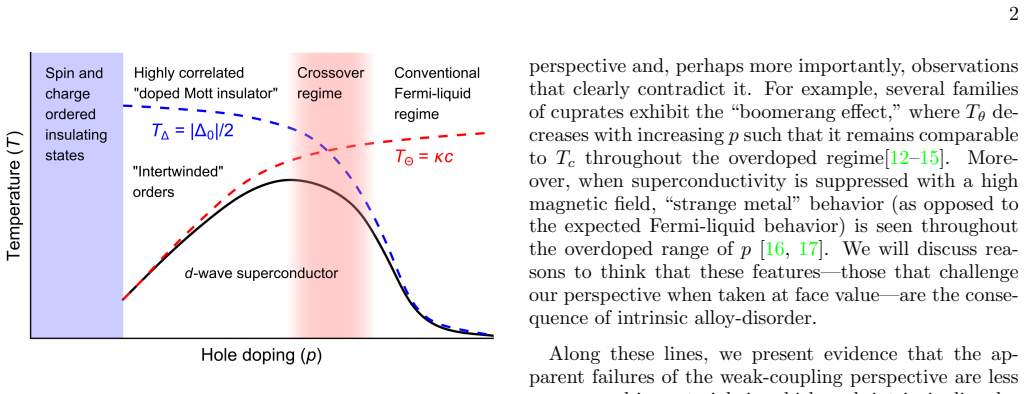
The paper proposes a doping-controlled crossover inside the cuprate phase diagram: underdoped materials have the strong-coupling hierarchy |Δ0|/2 ≫ T_c ≈ T_θ, so T_c is set by phase fluctuations; overdoped materials have the BCS hierarchy T_θ ≫ T_c ≈ |Δ0|/2, so the normal state is a Fermi liquid and superconductivity is weak-coupling BCS mean-field below the gap scale. Every apparently contradictory observation in real overdoped samples—T-linear resistivity in a magnetic field, the boomerang drop of superfluid stiffness, gaps persisting well above T_c, large residual specific heat—is attributed to intrinsic alloy disorder, amplified because d-wave pairing with a two-lattice-constant coherenc
What carries the argument
The argument rests on three pieces: the two-scale hierarchy between the phase-ordering temperature T_θ (from the superfluid stiffness κ, k_B T_θ ≡ κc per plane) and the pairing scale |Δ0|/2, with BCS applying only when T_θ ≫ T_c ≈ |Δ0|/2; the real-space BCS gap equation Δ̃(r) = −Ṽ(r)φ̃(r), which makes the gap's momentum dependence image the interaction's range—so the measured purely d-wave gap Δ(k) = Δ0[cos k_x − cos k_y]/2 implies short-ranged (nearest-neighbor) pairing with strength Ṽ ≈ 0.6 eV; and the disorder amplifier: with coherence length ξ0 ≈ 2–3 lattice constants, comparable to the dopant spacing, alloy disorder creates mesoscopic superconducting puddles that explain the non-BCS a
Load-bearing premise
The load-bearing premise (announced in Section I, argued rather than modeled in Section IV) is that the anomalous overdoped features—T-linear resistivity in a field, the boomerang stiffness drop, gaps above T_c, residual uncondensed carriers—are caused by randomly placed dopant atoms and would vanish in an ideal crystal. If any one of them is intrinsic, the central claim fails; the authors themselves concede (Section V) that their extracted pairing interaction at optimal dopi
What would settle it
Follow the paper's own recipe: measure the low-energy properties of a genuinely low-disorder overdoped cuprate, most directly stoichiometric YBa2Cu3O7 driven further overdoped by pressure. If the T-linear resistivity persists when superconductivity is quenched by a magnetic field, if the superfluid stiffness still 'boomerangs' downward, or if the dome edge stays sharp rather than rounding, the claim fails. Likewise, any measurable deviation from the single-mass Lifshitz-Kosevich form in quantum oscillations of the cleanest overdoped material would falsify the Fermi-liquid premise. A quantitati
If this is right
- An ideal disorder-free overdoped cuprate would have T_θ ≫ T_c ≈ |Δ0|/2, so T_c is set by pair-breaking and the normal state is a Fermi liquid; the deviations seen in real samples should shrink as disorder is reduced.
- The overdoped edge of the dome should be a rounded, convex tail with T_c ~ exp(−α/(p_max − p)) as the effective pairing interaction Ṽ passes through zero—not a sharp cutoff—and p_max should move to higher doping in cleaner materials.
- The T-linear resistivity observed in overdoped LSCO and Tl2201 when superconductivity is killed by a magnetic field is predicted to vanish in less disordered materials, most directly in pressure-doped stoichiometric YBa2Cu3O7.
- Because the gap retains the pure d-wave form f(k) ≈ 1 from slightly underdoped to the highest overdoping measured, the pairing interaction is short-ranged, which rules out the exchange of a quantum-critical collective mode as the primary pairing mechanism at optimal doping.
- The search for new high-temperature superconductors should aim for the cuprate band-structure motif—a large density of states near (0,π) and (π,0) connected by wavevector (π,π) with short-range antiferromagnetic correlations—rather than trying to reproduce the local chemistry.
Where Pith is reading between the lines
- Beyond the paper: if the disorder attribution is right, the anomalies should track a disorder proxy such as the NQR linewidth, not the superconducting T_c—a quantitative dome-shape-versus-linewidth correlation across cuprate families would be a cheap, sharp test of the whole framework.
- Beyond the paper: the puddle picture implies that the 'clean enough' threshold is set by the coherence length itself, so even state-of-the-art overdoped samples sit in the granular regime near the dome edge; the deciding experiments require synthesis of stoichiometric overdoped crystals or pressure-tuned fully ordered compounds.
- Beyond the paper: the same logic applied to electron-doped cuprates—where antiferromagnetic correlations persist to optimal doping and the gap shows hints of non-monotonic structure—would classify those as genuine strong-correlation physics, since the disorder mechanism alone has no reason to be weaker there.
- Beyond the paper: the inverted-gap-equation analysis gives a reusable recipe: measure Δ(k) and the dispersion, invert the BCS self-consistency condition, and read off the range and sign of the pairing interaction—importable directly to other unconventional superconductors with short coherence lengths.
Editorial analysis
A structured set of objections, weighed in public.
Referee Report
Summary. This Perspective argues that in overdoped cuprates, below an intermediate energy scale of order 0.1 eV, the normal state is a Fermi liquid and superconductivity is d-wave BCS mean-field, with the observed non-FL/non-BCS phenomena (T-linear resistivity in field, the boomerang superfluid stiffness, persistent gaps above Tc, and residual specific heat) attributed to intrinsic alloy disorder and nanoscale superconducting puddles. The paper defines BCS as a weak-coupling instability from a Fermi liquid independent of the pairing glue, reviews quantum oscillations, superfluid stiffness and gap-ratio data across YBCO, LSCO, Tl2201 and Bi2212, inverts the BCS gap equation to infer the effective pairing interaction V(p), and lists falsifiable predictions for cleaner materials. The argument is explicitly conditional: the authors acknowledge that key observed features contradict the framework if taken at face value, and they assign those contradictions to disorder.
Significance. If correct, the paper would reframe overdoped cuprates as conventional at low energy, with the exotic physics located in disorder-induced puddles rather than in intrinsic strong-correlation physics. This is a significant counterpoint to quantum-critical and non-Fermi-liquid narratives. The paper's strengths are its unusually candid treatment of contradictory evidence, its reliance on high-quality experimental probes such as quantum oscillations and Lifshitz-Kosevich analysis, and its explicit falsifiable predictions. Its current weakness is that the disorder attribution is largely qualitative: no quantitative model with a single set of disorder parameters is shown to reproduce the boomerang Tθ(p), the T-linear resistivity in field, the residual C/T, and the persistent gaps. The paper is therefore a thoughtful and potentially influential Perspective, but the central claim is not yet backed by a demonstrated microscopic mechanism for the anomalies.
major comments (5)
- [Section IV, 'Reconciling a Fermi liquid ground state'] The T-linear resistivity observed when superconductivity is suppressed by magnetic field is the strongest evidence against a Fermi-liquid normal state. The only mechanism offered here is scattering from quantum phase fluctuations of superconducting puddles, citing Ref. [49] (arXiv:2502.08699), a preprint co-authored by one of the present authors. No calculation or quantitative comparison is shown to demonstrate that this mechanism reproduces the magnitude, doping range, or temperature/field dependence of the data of Cooper et al. [16] or Proust et al. [17]. Because the abstract's central claim requires reconciling this anomaly, this is currently a promissory note rather than an established result.
- [Section IV, 'Evidence that the large phase fluctuations are extrinsic'] The boomerang effect—Tθ decreasing with doping on the overdoped side—is one of the principal apparent violations of the BCS picture. The paper argues that mesoscopic inhomogeneity is dominant, citing NQR broadening, STM puddles, and the YBCO comparison. However, no quantitative disorder model is fit to the measured Tθ(p) of LSCO or Tl2201, nor to the residual C/T and √H specific-heat data of Wang et al. [83]. Without a quantitative calculation showing that realistic dopant disorder produces the observed magnitude and doping dependence, the attribution of the boomerang to extrinsic disorder remains an assertion rather than a demonstrated mechanism.
- [Section V, Fig. 3 and Eqs. (7)–(8)] The inference of the pairing interaction V from measured gap values by inverting Eq. (7), followed by a linear fit to V as a function of doping (Eq. (8)), and then the use of that fitted line to 'predict' Δ0 at higher doping, is an in-sample fit-and-extrapolate construction. The purple 'predicted' Δ points inherit the same data and the same assumed linear form. The extrapolated pmax is sensitive to the choice of fitting function and to the free parameters V0 and pmax. The paper should provide error bands that propagate uncertainties in the ARPES gap, the tight-binding parameters in Eq. (10), and the choice F(ε)=1, and should discuss sensitivity to excluding near-optimal points from the fit.
- [Section V, 'Additional Considerations'; Section II] The paper defines a BCS superconductor as a weak-coupling instability from a Fermi liquid, but the inferred coupling at optimal doping is Vρ(E_F) ~ 1. This is not weak coupling in the usual BCS sense. The comparison to Pb with λ~1 in Migdal-Eliashberg theory does not fully resolve the tension, because in Pb the Migdal parameter is controlled by the small ratio of phonon to Fermi energies, whereas the present effective interaction is a static electronic interaction with no such control parameter. The authors should clarify what 'weak-coupling' means in this context and why a mean-field treatment is quantitatively justified despite Vρ ~ 1.
- [Section VI, falsifiable predictions] The predictions are qualitatively useful, but they lack an operational metric for disorder. Statements such as 'the T-linear term should become increasingly small with decreasing disorder' require a quantitative definition of disorder strength—for example, RMS local doping variation or a distribution of local Tc values—and a predicted scaling. The NQR linewidth comparison and the stoichiometric YBCO example provide a start, but they do not yet make the central claim quantitatively falsifiable.
minor comments (5)
- [Section III] Typo: 'emersed' should be 'immersed'.
- [Section IV heading] Typo: 'Tl1201' should be 'Tl2201'.
- [Section IV, 'Absence of intertwined orders'] Typo: 'inlelastic' should be 'inelastic'.
- [Fig. 3] The label 'Δextrap.' is used without defining the fitting procedure or the uncertainty in the extrapolation; consider adding a figure caption explanation and error bands.
- [Throughout] The paper repeatedly invokes 'the expected effects of material disorder' without a precise definition of what 'expected' means; a short subsection formalizing the disorder parameter and the relevant length scales would improve readability.
Circularity Check
No significant circularity: the FL/BCS claim is supported by independent data, and the disorder attribution is a falsifiable hypothesis; the Fig. 3 extrapolation and Ref [49] self-citation are transparent caveats rather than reductions.
full rationale
This is a perspective paper, not a derivation: it proposes that overdoped cuprates can be described by Fermi-liquid plus BCS physics once alloy disorder is accounted for, and it makes falsifiable predictions for cleaner materials. The main supporting evidence is independent of the proposal: quantum oscillations fitting the Lifshitz-Kosevich form, ARPES Fermi-surface and mass-renormalization data, the measured gap ratio approaching 2.14 k_B T_c, and the contrasting doping dependence of the superfluid stiffness in stoichiometric YBCO versus more disordered LSCO/Tl2201. The disorder attribution is not built into the definitions; it is defended by separate observations (NQR linewidth inhomogeneity, STM-visible puddles, irradiation studies, the YBCO comparison) and is explicitly couched as a testable hypothesis. The Fig. 3 construction is the closest thing to a fit-and-extrapolate: the pairing interaction is inferred by inverting Eq. 7 from measured gaps, a line is fit, and the purple dots are the gaps that would follow from that fitted line. But the paper labels these as 'simple fits' and 'smoothly extrapolated' values, and the central falsifiable claim in that context is the independent BCS relation Delta0 ≈ 2T_c, not the purple-dot extrapolation. The resolution of the T-linear resistivity anomaly does cite a non-peer-reviewed preprint coauthored by one of the present authors (Ref. [49]), which is a legitimate verification caveat; however, the paper also cites independent alternative mechanisms (Refs. [50-54]) and makes a specific falsifiable prediction that the T-linear term should vanish in cleaner overdoped materials. The argument therefore does not reduce by construction to its own inputs, and no circular step meets the standard required by the review rules.
Axiom & Free-Parameter Ledger
free parameters (4)
- Effective nearest-neighbor pairing interaction V(p) =
about -0.6 eV near optimal doping, decreasing in magnitude with overdoping (Fig. 3)
- Linear-fit parameters V0 and p_max in Eq. (8) =
Red/grey fit lines in Fig. 3; p_max near where extrapolated V changes sign, roughly p ~ 0.28-0.30
- Tight-binding parameters t, t', t'', t_perp in Eq. (10) =
t = 166 meV, t' = -0.33t, t'' = 0, t_perp = 0.21t
- Intermediate energy scale defining the low-energy regime =
about 0.1 eV, i.e. of order J
axioms (5)
- domain assumption Existence of a low-energy effective description with well-defined quasiparticles and short-ranged residual interactions below an intermediate scale (of order J) in overdoped cuprates.
- domain assumption Effective parameters are analytic functions of doping, leading to V = -V0(p_max - p) near the edge of the dome.
- domain assumption The BCS gap-equation inversion can be done with no additional high-energy cutoff, F(epsilon) = 1.
- domain assumption Intrinsic alloy disorder produces mesoscopic electronic inhomogeneity on the coherence-length scale in all doped cuprates, and this inhomogeneity is responsible for the non-BCS anomalies in overdoped materials.
- standard math Abrikosov-Gor'kov pair-breaking and the phase-fluctuation criterion T_theta/Tc apply as stated to d-wave superconductors with short coherence length.
read the original abstract
Cuprates are the paradigmatic `unconventional' superconductors: their critical temperature is much higher than can be expected from phonon-mediated pairing; the superconducting gap has $d$-wave symmetry; and the normal-metallic state appears to be far from a conventional Fermi liquid. These and numerous other experimental facts have led to a consensus that the conventional theory --- the Fermi-liquid-based Bardeen--Cooper--Schrieffer (BCS) theory --- is the wrong starting point for understanding superconductivity in the cuprates. In this Perspective, we propose that, although underdoped cuprates do indeed require a different theoretical framework, there is a crossover with increasing doping to an overdoped regime in which a BCS-like approach is warranted (at energy scales of the order of the superconducting gap and below), provided that the various forms of disorder are accounted for. We summarize key experimental studies of the low-energy properties of overdoped cuprates, identify properties that are and are not compatible with this proposal --- and argue that features that are inconsistent with this approach can in fact be attributed to the expected effects of material disorder. Finally, we provide falsifiable predictions for the behaviour of an `ideal' (disorder-free) overdoped cuprate through which our approach can be tested.
Figures


Forward citations
Cited by 1 Pith paper
-
Disorder effect on the superfluid density and the origin of the pseudogap end point in the cuprate superconductors
Variational calculation on the disordered t-J model finds superfluid density robust to disorder, monotonically increasing with doping, and linear with optical weight, supporting a Mott transition at the pseudogap end point.
Reference graph
Works this paper leans on
-
[1]
V. J. Emery and S. A. Kivelson. Importance of phase fluctuations in superconductors with small superfluid density. Nature, 374(6521):434–437, March 1995. ISSN 1476-4687. doi:10.1038/374434a0. URLhttps://www. nature.com/articles/374434a0. Publisher: Nature Publishing Group
doi:10.1038/374434a0 1995
-
[2]
From quantum matter to high-temperature superconductivity in copper oxides
Keimer B, Kivelson SA, Norman MR, Uchida S, and Zaanen J. From quantum matter to high-temperature superconductivity in copper oxides. Nature, 518:179–86,
-
[3]
low energy
We restrict our attention to “low energy” properties, that is to say those that reflect excitations with ener- gies less than an intermediate scale which we take some- what arbitrarily to be∼0.1 eV, or in other words a scale of order the exchange energyJin the undoped parent materials. 4) We focus on a subset of mate- rials: YBa 2Cu3O6+δ (YBCO), the elect...
-
[4]
hidden order,
0.05 0.1 0.15 0.2 0.250 100 200 300 400 p Tθ (K) 1+p p Tc YBa2Cu3O6+x Ca-YBa2Cu3O6+x FIG. 2. Doping dependence ofT θ (defined in Eq. 2 withL=c) in YBa 2Cu3O6+x (teal points) and Ca doped YBa2Cu3O6+x (orange points). WhileT c (shown in purple for YBa2Cu3O6+x) at fixed doping is only weakly affected by Ca substitution, the Ca-doped materials exhibit a clear...
-
[5]
Mainak Pal, Andreas Kreisel, W. A. Atkinson, and P. J. Hirschfeld. Simulating superconducting proper- ties of overdoped cuprates: The role of inhomogene- ity. Phys. Rev. B, 107(14):144501, April 2023. doi: 10.1103/PhysRevB.107.144501
-
[6]
Miguel Antonio Sulangi, Willem Farmilo, An- dreas Kreisel, Mainak Pal, W. A. Atkinson, and P. J. Hirschfeld. Inhomogeneity, Fluctuations, and Gap Filling in Overdoped Cuprates. arXiv e-prints, art. arXiv:2503.20861, March 2025. doi: 10.48550/arXiv.2503.20861
-
[7]
D. J. Scalapino. A common thread: The pair- ing interaction for unconventional superconductors. Rev. Mod. Phys., 84:1383–1417, Oct 2012. doi: 10.1103/RevModPhys.84.1383. URLhttps://link.a ps.org/doi/10.1103/RevModPhys.84.1383
-
[8]
Sudip Chakravarty, R. B. Laughlin, Dirk K. Morr, and Chetan Nayak. Hidden order in the cuprates. Physical Review B, 63(9):094503, January 2001. doi: 10.1103/PhysRevB.63.094503. URLhttps://link.aps .org/doi/10.1103/PhysRevB.63.094503. Publisher: American Physical Society
-
[9]
R. B. Laughlin. Hartree-Fock computation of the high-${T} {c}$cuprate phase diagram. Physical Review B, 89(3):035134, January 2014. doi: 10.1103/PhysRevB.89.035134. URLhttps://link.a ps.org/doi/10.1103/PhysRevB.89.035134. Publisher: American Physical Society
-
[10]
J. C. Seamus Davis and Dung-Hai Lee. Concepts relat- ing magnetic interactions, intertwined electronic orders, and strongly correlated superconductivity. Proceedings of the National Academy of Sciences, 110(44):17623– 17630, 2013. doi:10.1073/pnas.1316512110. URLhttp s://www.pnas.org/doi/abs/10.1073/pnas.13165121 10
-
[11]
Utpal Chatterjee, Dingfei Ai, Junjing Zhao, Stephan Rosenkranz, Adam Kaminski, Helene Raffy, Zhizhong Li, Kazuo Kadowaki, Mohit Randeria, Michael R. Nor- man, and J. C. Campuzano. Electronic phase dia- gram of high-temperature copper oxide superconduc- tors. Proceedings of the National Academy of Sciences, 108(23):9346–9349, 2011. doi:10.1073/pnas.1101008...
-
[12]
Y. J. Uemura, G. M. Luke, B. J. Sternlieb, J. H. Brewer, J. F. Carolan, W. N. Hardy, R. Kadono, J. R. Kempton, R. F. Kiefl, S. R. Kreitzman, P. Mulhern, T. M. Rise- man, D. Ll. Williams, B. X. Yang, S. Uchida, H. Takagi, J. Gopalakrishnan, A. W. Sleight, M. A. Subramanian, C. L. Chien, M. Z. Cieplak, Gang Xiao, V. Y. Lee, B. W. Statt, C. E. Stronach, W. J...
-
[13]
T. A. Maier, D. Poilblanc, and D. J. Scalapino. Dynamics of the pairing interaction in the hubbard andt−jmodels of high-temperature superconduc- tors. Phys. Rev. Lett., 100:237001, Jun 2008. doi: 10.1103/PhysRevLett.100.237001. URLhttps://link .aps.org/doi/10.1103/PhysRevLett.100.237001
-
[14]
Thomas A. Maier, M. Jarrell, and D. J. Scalapino. Pair- ing interaction in the two-dimensional hubbard model studied with a dynamic cluster quantum monte carlo approximation. Phys. Rev. B, 74:094513, Sep 2006. doi: 10.1103/PhysRevB.74.094513. URLhttps://link.aps .org/doi/10.1103/PhysRevB.74.094513
-
[15]
T. R. Lemberger, I. Hetel, A. Tsukada, M. Naito, and M. Randeria. Superconductor-to-metal quantum phase transition in overdoped la 2−xsrxcuo4. Phys. Rev. B, 83:140507, Apr 2011. doi:10.1103/PhysRevB.83.140507. URLhttps://link.aps.org/doi/10.1103/PhysRevB. 83.140507
-
[16]
R. A. Cooper, Y. Wang, B. Vignolle, O. J. Lipscombe, S. M. Hayden, Y. Tanabe, T. Adachi, Y. Koike, M. No- hara, H. Takagi, Cyril Proust, and N. E. Hussey. Anomalous Criticality in the Electrical Resistivity of La2–xSrxCuO4. Science, 323(5914):603–607, January
-
[17]
Cyril Proust, Etienne Boaknin, R. W. Hill, Louis Taille- fer, and A. P. Mackenzie. Heat Transport in a Strongly Overdoped Cuprate: Fermi Liquid and a Pure d -Wave BCS Superconductor. Physical Review Letters, 89(14): 147003, September 2002. ISSN 0031-9007, 1079-7114. doi:10.1103/PhysRevLett.89.147003. URLhttps://li nk.aps.org/doi/10.1103/PhysRevLett.89.147003
-
[18]
Quantum-critical pairing in electron-doped cuprates
Yuxuan Wang and Andrey Chubukov. Quantum-critical pairing in electron-doped cuprates. Phys. Rev. B, 88: 024516, Jul 2013. doi:10.1103/PhysRevB.88.024516. URLhttps://link.aps.org/doi/10.1103/PhysRev B.88.024516
-
[20]
I. Bozovic, X. He, J. Wu, and A. T. Bollinger. De- pendence of the critical temperature in overdoped copper oxides on superfluid density. Nature, 536 (7616):309–311, August 2016. ISSN 1476-4687. doi: 10.1038/nature19061. URLhttps://www.nature.com /articles/nature19061. Publisher: Nature Publishing Group
-
[21]
Richard E. Prange and Leo P. Kadanoff. Transport Theory for Electron-Phonon Interactions in Metals. Physical Review, 134(3A):A566–A580, May 1964. doi: 10.1103/PhysRev.134.A566. URLhttps://link.aps.o rg/doi/10.1103/PhysRev.134.A566. Publisher: Amer- ican Physical Society
-
[22]
Effective Field Theory and the Fermi Surface
Joseph Polchinski. Effective Field Theory and the Fermi Surface. arXiv e-prints, art. hep-th/9210046, October
-
[23]
R. Shankar. Renormalization-group approach to inter- acting fermions. Rev. Mod. Phys., 66:129–192, Jan
-
[24]
E. W. Carlson, V. J. Emery, S. A. Kivelson, and D. Or- gad. Concepts in High Temperature Superconductivity. arXiv e-prints, art. cond-mat/0206217, June 2002. doi: 10.48550/arXiv.cond-mat/0206217
work page internal anchor Pith review Pith/arXiv arXiv doi:10.48550/arxiv.cond-mat/0206217 2002
-
[25]
G. Blatter, M. V. Feigel’man, V. B. Geshken- bein, A. I. Larkin, and V. M. Vinokur. Vortices in high-temperature superconductors. Reviews of Modern Physics, 66(4):1125–1388, October 1994. doi: 10.1103/RevModPhys.66.1125. URLhttps://link.a ps.org/doi/10.1103/RevModPhys.66.1125. Publisher: American Physical Society
-
[26]
L. Taillefer. Scattering and pairing in cuprate supercon- ductors. Annual Review of Condensed Matter Physics, 1:51–70, 2010. doi:https://doi.org/10.1146/annurev- conmatphys-070909-104117. 14
doi:10.1146/annurev- 2010
-
[27]
S. Sachdev. Where is the quantum critical point in the cuprate superconductors. Phys. Status Solidi B, 247: 537–543, 210. doi:DOI 10.1002/pssb.200983037
-
[28]
N. R. Lee-Hone, H. U. ¨Ozdemir, V. Mishra, D. M. Broun, and P. J. Hirschfeld. Low energy phenomenol- ogy of the overdoped cuprates: Viability of the landau- bcs paradigm. Phys. Rev. Res., 2:013228, Feb 2020. doi:10.1103/PhysRevResearch.2.013228. URLhttps: //link.aps.org/doi/10.1103/PhysRevResearch.2.0 13228
-
[29]
H. U. ¨Ozdemir, Vivek Mishra, N. R. Lee-Hone, Xi- angru Kong, T. Berlijn, D. M. Broun, and P. J. Hirschfeld. Effect of realistic out-of-plane dopant potentials on the superfluid density of overdoped cuprates. Phys. Rev. B, 106:184510, Nov 2022. doi: 10.1103/PhysRevB.106.184510. URLhttps://link.a ps.org/doi/10.1103/PhysRevB.106.184510
-
[30]
A. P. Mackenzie, R. K. W. Haselwimmer, A. W. Tyler, G. G. Lonzarich, Y. Mori, S. Nishizaki, and Y. Maeno. Extremely strong dependence of superconductivity on disorder in sr 2ruo4. Phys. Rev. Lett., 80:161–164, Jan
-
[31]
J. M. Tranquada, P. M. Lozano, Juntao Yao, G. D. Gu, and Qiang Li. From nonmetal to strange metal at the stripe-percolation transition in la2−xsrxcuo4. Phys. Rev. B, 109:184510, May 2024. doi: 10.1103/PhysRevB.109.184510. URLhttps://link.a ps.org/doi/10.1103/PhysRevB.109.184510
-
[32]
Kivelson, and Dung-Hai Lee
Zi-Xiang Li, Steven A. Kivelson, and Dung-Hai Lee. Superconductor-to-metal transition in overdoped cuprates. npj Quantum Materials, 6(1):36, December
-
[33]
Miguel Antonio Sulangi. Low-temperature phenomenol- ogy of gap inhomogeneity in cuprate superconductors: High-energy granularity, low-energy homogeneity, and spectral kinks. Phys. Rev. B, 112:134511, Oct 2025. doi:10.1103/dsbb-jhnc. URLhttps://link.aps.org/d oi/10.1103/dsbb-jhnc
-
[34]
N. P. Armitage, P. Fournier, and R. L. Greene. Progress and perspectives on electron-doped cuprates. Rev. Mod. Phys., 82:2421–2487, Sep 2010. doi: 10.1103/RevModPhys.82.2421. URLhttps://link.a ps.org/doi/10.1103/RevModPhys.82.2421
-
[35]
Birgeneau, Chris Stock, John M
Robert J. Birgeneau, Chris Stock, John M. Tranquada, and Kazuyoshi Yamada. Magnetic Neutron Scattering in Hole-Doped Cuprate Superconductors. Journal of the Physical Society of Japan, 75(11):111003, Novem- ber 2006. ISSN 0031-9015. doi:10.1143/JPSJ.75.111003. URLhttps://journals.jps.jp/doi/abs/10.1143/ JPSJ.75.111003. Publisher: The Physical Society of Japan
-
[36]
N. R. Lee-Hone, V. Mishra, D. M. Broun, and P. J. Hirschfeld. Optical conductivity of over- doped cuprate superconductors: Application to la2−xsrxcuo4. Phys. Rev. B, 98:054506, Aug 2018. doi: 10.1103/PhysRevB.98.054506. URLhttps://link.aps .org/doi/10.1103/PhysRevB.98.054506
-
[37]
C. C. Tam, M. Zhu, J. Ayres, K. Kummer, F. Yakhou- Harris, J. R. Cooper, A. Carrington, and S. M. Hayden. Charge density waves and Fermi surface reconstruc- tion in the clean overdoped cuprate superconductor Tl2Ba2CuO6+δ. Nature Communications, 13(1):570, January 2022. ISSN 2041-1723. doi:10.1038/s41467- 022-28124-y. URLhttps://www.nature.com/article s/s4...
doi:10.1038/s41467- 2022
-
[38]
Yuval Gannot, B. J. Ramshaw, and Steven A. Kivelson. Fermi surface reconstruction by a charge density wave with finite correlation length. Physical Review B, 100(4):045128, July 2019. doi: 10.1103/PhysRevB.100.045128. URLhttps://link.a ps.org/doi/10.1103/PhysRevB.100.045128. Pub- lisher: American Physical Society
-
[39]
N. E. Hussey, M. Abdel-Jawad, A. Carrington, A. P. Mackenzie, and L. Balicas. A coherent three-dimensional Fermi surface in a high-transition- temperature superconductor. Nature, 425(6960): 814–817, October 2003. ISSN 1476-4687. doi: 10.1038/nature01981. URLhttps://www.nature.com /articles/nature01981. Publisher: Nature Publishing Group
-
[40]
M. Plat´ e, J. D. F. Mottershead, I. S. Elfimov, D. C. Peets, Ruixing Liang, D. A. Bonn, W. N. Hardy, S. Chiuzbaian, M. Falub, M. Shi, L. Patthey, and A. Damascelli. Fermi Surface and Quasiparti- cle Excitations of Overdoped tl 2ba2cuo6+δ. Physical Review Letters, 95(7):077001, August 2005. doi: 10.1103/PhysRevLett.95.077001. URLhttps://link.a 15 ps.org/d...
-
[41]
B. J. Ramshaw, Baptiste Vignolle, James Day, Ruix- ing Liang, W. N. Hardy, Cyril Proust, and D. A. Bonn. Angle dependence of quantum oscillations in YBa2Cu3O6.59 shows free-spin behaviour of quasipar- ticles. Nature Physics, 7(3):234–238, March 2011. ISSN 1745-2481. doi:10.1038/nphys1873. URLhttps://www. nature.com/articles/nphys1873. Publisher: Nature Pu...
-
[42]
David J. Singh and Warren E. Pickett. Elec- tronic characteristics of Tl2Ba2CuO6. Physica C: Superconductivity, 203(1):193–202, December 1992. ISSN 0921-4534. doi:10.1016/0921-4534(92)90526-I. URLhttps://www.sciencedirect.com/science/ar ticle/pii/092145349290526I
arXiv 1992
-
[43]
Bergemann, Mackenzie , A
C. Bergemann, Mackenzie , A. P., Julian , S. R., Forsythe , D., , and E. Ohmichi. Quasi-two- dimensional Fermi liquid properties of the uncon- ventional superconductor Sr2RuO4. Advances in Physics, 52(7):639–725, November 2003. ISSN 0001-
2003
-
[45]
Shoenberg
D. Shoenberg. Magnetic Oscillations in Metals. Cam- bridge University Press, January 1984. ISBN 978-0-521- 22480-2. Google-Books-ID: GO7cNJl2juAC
1984
-
[46]
A detailed de Haas–van Alphen effect study of the over- doped cuprate Tl2Ba2CuO6+$\delta$
P M C Rourke, A F Bangura, T M Benseman, M Ma- tusiak, J R Cooper, A Carrington, and N E Hussey. A detailed de Haas–van Alphen effect study of the over- doped cuprate Tl2Ba2CuO6+$\delta$. New Journal of Physics, 12(10):105009, October 2010. ISSN 1367-2630. doi:10.1088/1367-2630/12/10/105009. URLhttps:// dx.doi.org/10.1088/1367-2630/12/10/105009
-
[47]
B. Vignolle, A. Carrington, R. A. Cooper, M. M. J. French, A. P. Mackenzie, C. Jaudet, D. Vignolles, Cyril Proust, and N. E. Hussey. Quantum oscillations in an overdoped high-Tc superconductor. Nature, 455 (7215):952–955, October 2008. ISSN 1476-4687. doi: 10.1038/nature07323. URLhttps://www.nature.com /articles/nature07323. Publisher: Nature Publishing Group
-
[48]
J. Ayres, M. Berben, M. ˇCulo, Y.-T. Hsu, E. van Heumen, Y. Huang, J. Zaanen, T. Kondo, T. Takeuchi, J. R. Cooper, C. Putzke, S. Friedemann, A. Carring- ton, and N. E. Hussey. Incoherent transport across the strange-metal regime of overdoped cuprates. Nature, 595(7869):661–666, July 2021. ISSN 1476-4687. doi: 10.1038/s41586-021-03622-z. URLhttps://www.nat...
-
[49]
Kivelson, J¨ org Schmalian, and Erez Berg
Noga Bashan, Evyatar Tulipman, Steven A. Kivelson, J¨ org Schmalian, and Erez Berg. Extended strange metal regime from superconducting puddles, February
-
[50]
Patel, Peter Lunts, and Subir Sachdev
Aavishkar A. Patel, Peter Lunts, and Subir Sachdev. Localization of overdamped bosonic modes and trans- port in strange metals. Proceedings of the National Academy of Science, 121(14):e2402052121, March 2024. doi:10.1073/pnas.2402052121
-
[51]
Patel, Haoyu Guo, Ilya Esterlis, and Subir Sachdev
Aavishkar A. Patel, Haoyu Guo, Ilya Esterlis, and Subir Sachdev. Universal theory of strange metals from spa- tially random interactions. Science, 381(6659):790–793, August 2023. doi:10.1126/science.abq6011
-
[52]
Cooper pair- ing of incoherent electrons: An electron-phonon version of the Sachdev-Ye-Kitaev model
Ilya Esterlis and J¨ org Schmalian. Cooper pair- ing of incoherent electrons: An electron-phonon version of the Sachdev-Ye-Kitaev model. Phys. Rev. B, 100(11):115132, September 2019. doi: 10.1103/PhysRevB.100.115132
-
[53]
M.A. Metlitski and Sachdev S. Instabilities near the onset of spin density wave order in metals. New Journal of Physics, 12:105007, 2010. doi:10.1088/1367- 2630/12/10/105007
doi:10.1088/1367- 2010
-
[54]
Tunable non-fermi liquid phase from cou- pling to two-level systems.Phys
Noga Bashan, Evyatar Tulipman, J¨ org Schmalian, and Erez Berg. Tunable non-fermi liquid phase from cou- pling to two-level systems.Phys. Rev. Lett., 132:236501, Jun 2024. doi:10.1103/PhysRevLett.132.236501. URL https://link.aps.org/doi/10.1103/PhysRevLett.1 32.236501
-
[55]
P. L. Alireza, G. H. Zhang, W. Guo, J. Porras, T. Loew, Y.-T. Hsu, G. G. Lonzarich, M. Le Tacon, B. Keimer, and Suchitra E. Sebastian. Accessing the entire over- doped regime in pristine yba 2cu3o6+x by application of pressure. Physical Review B, 95(10):100505, March
-
[56]
T. Pereg-Barnea, P. J. Turner, R. Harris, G. K. Mullins, J. S. Bobowski, M. Raudsepp, Ruixing Liang, D. A. Bonn, and W. N. Hardy. Absolute values of the London penetration depth in YBa 2 Cu 3 O 6 + y measured by zero field ESR spectroscopy on Gd doped single crystals. Physical Review B, 69(18): 184513, May 2004. ISSN 1098-0121, 1550-235X. doi: 10.1103/Phy...
-
[57]
A detailed doping survey of the low-energy electrodynamics of YBa2Cu3O6+x
Jordan Carl Baglo. A detailed doping survey of the low-energy electrodynamics of YBa2Cu3O6+x. PhD thesis, University of British Columbia, 2014. URL https://open.library.ubc.ca/soa/cIRcle/colle ctions/ubctheses/24/items/1.0167590
2014
-
[58]
Arkady Shekhter, K. A. Modic, R. D. McDon- ald, and B. J. Ramshaw. Thermodynamic con- straints on the amplitude of quantum oscillations. Physical Review B, 95(12):121106, March 2017. doi: 10.1103/PhysRevB.95.121106. URLhttps://link.aps .org/doi/10.1103/PhysRevB.95.121106. Publisher: American Physical Society
-
[59]
P. Giraldo-Gallo, J. A. Galvis, Z. Stegen, K. A. Modic, F. F. Balakirev, J. B. Betts, X. Lian, C. Moir, S. C. Riggs, J. Wu, A. T. Bollinger, X. He, Bozovic I., B. J. Ramshaw, R. D. McDonald, G. S. Boebinger, and A. Shekhter. Scale-invariant magnetoresistance in a cuprate superconductor. Science, 361(6401):479– 481, August 2018. doi:10.1126/science.aan3178...
-
[60]
URLhttps://www.nature .com/articles/nature12165
Bounding the pseudogap with a line of phase transitions in YBa2Cu3O6+δ|Nature. URLhttps://www.nature .com/articles/nature12165
-
[61]
S. Kamal, D. A. Bonn, Nigel Goldenfeld, P. J. Hirschfeld, Ruixing Liang, and W. N. Hardy. Penetra- tion Depth Measurements of 3D yba 2cu3o6.95. Physical Review Letters, 73(13):1845–1848, September 1994. doi: 10.1103/PhysRevLett.73.1845. URLhttps://link.aps .org/doi/10.1103/PhysRevLett.73.1845. Publisher: American Physical Society
-
[62]
Y. J. Uemura, A. Keren, L. P. Le, G. M. Luke, W. D. Wu, Y. Kubo, T. Manako, Y. Shimakawa, M. Subra- manian, J. L. Cobb, and J. T. Markert. Magnetic- field penetration depth in TI2Ba2CuO6+δin the over- doped regime. Nature, 364(6438):605–607, August 1993. ISSN 1476-4687. doi:10.1038/364605a0. URLhttps: //www.nature.com/articles/364605a0. Publisher: Nature ...
-
[63]
I. Bozovic, X. He, and J. Wu abd A. T. Bollinger. The vanishing superfluid density in cuprates—and why it matters. Journal of Superconductivity and Novel Magnetism, 31:2683–2690, 2018. doi: https://doi.org/10.1007/s10948-018-4792-7
-
[64]
J. M. Wade, J. W. Loram, K. A. Mirza, J. R. Cooper, and J. L. Tallon. Electronic specific heat of Tl2Ba2CuO6+δfrom 2 K to 300 K for 0≤δ≤0.1. Journal of Superconductivity, 7(1):261–264, February
-
[65]
Yayu Wang, Z. A. Xu, T. Kakeshita, S. Uchida, S. Ono, Yoichi Ando, and N. P. Ong. Onset of the vortex- like Nernst signal above T c in La 2-x Sr x CuO 4 and Bi 2 Sr 2-y La y CuO 6. Physical Review B, 64 (22):224519, November 2001. ISSN 0163-1829, 1095-
2001
-
[66]
Yayu Wang, Lu Li, and N. P. Ong. Nernst effect in high- T c superconductors. Physical Review B, 73(2): 024510, January 2006. ISSN 1098-0121, 1550-235X. doi: 10.1103/PhysRevB.73.024510. URLhttps://link.aps .org/doi/10.1103/PhysRevB.73.024510
-
[67]
Yoichi Tanabe, Tadashi Adachi, Takashi Noji, and Yoji Koike. Superconducting volume fraction in overdoped regime of la2-xsrxcuo4: Implication for phase separation from magnetic-susceptibility measurement. Journal of The Physical Society of Japan - J PHYS SOC JPN, 74: 2893–2896, 11 2005. doi:10.1143/JPSJ.74.2893
-
[68]
B. Nachumi, A. Keren, K. Kojima, M. Larkin, G. M. Luke, J. Merrin, O. Tchernysh¨ ov, Y. J. Uemura, N. Ichikawa, M. Goto, and S. Uchida. Muon spin re- laxation studies of zn-substitution effects in high-T c cuprate superconductors. Phys. Rev. Lett., 77:5421– 5424, Dec 1996. doi:10.1103/PhysRevLett.77.5421. URLhttps://link.aps.org/doi/10.1103/PhysRev Lett.77.5421
-
[69]
V. B. Geshkenbein, L. B. Ioffe, and A. J. Mil- lis. Theory of the resistive transition in overdoped Tl2Ba2CuO6+δ: Implications for the vortex viscosity and the quasiparticle scattering rate in high-T c su- perconductors. Phys. Rev. Lett., 80:5778–5781, Jun
-
[70]
M. Jurkutat, J. Kohlrautz, S. Reichardt, A. Erb, G. V.M. Williams, and J. Haase. NMR of Cuprate Superconductors: Recent Developments. Springer Series in Materials Science 255, 2017. doi:DOI 10.1007/978-3-319-52675-1˙8
-
[71]
P. M. Singer, A. W. Hunt, and T. Imai. ${}ˆ{63}\mathrm{Cu}$NQR Evidence for Spa- tial Variation of Hole Concentration in La 2−xSrxCuO4. Physical Review Letters, 88(4):047602, January 2002. doi:10.1103/PhysRevLett.88.047602. URLhttps://li nk.aps.org/doi/10.1103/PhysRevLett.88.047602. Publisher: American Physical Society
-
[72]
V. Breit, P. Schweiss, R. Hauff, H. W¨ uhl, H. Claus, H. Rietschel, A. Erb, and G. M¨ uller-Vogt. Evidence for chain superconductivity in near-stoichiometric yba2cu3o6+x single crystals. Physical Review B, 52(22):R15727–R15730, December 1995. doi: 10.1103/PhysRevB.52.R15727. URLh t t p s : //link.aps.org/doi/10.1103/PhysRevB.52.R15727. Publisher: American...
-
[73]
Turning to direct evidence of an inhomogeneous su- perconducting gap: superconducting puddles have been visualized by STM in overdoped BSCCO [74–78]
and stoichiometric YBCO-248, which have roughly one order of magnitude sharper lines, and stoichiometric YBa2Cu3O7 which is closer to two orders of magnitude sharper. Turning to direct evidence of an inhomogeneous su- perconducting gap: superconducting puddles have been visualized by STM in overdoped BSCCO [74–78]. At p= 0.19, superconducting gaps persist...
-
[74]
Volker Pasler, Peter Schweiss, Christoph Meingast, Bernhard Obst, Helmut W¨ uhl, Alexandre Rykov, and Setsuko Tajima. 3D-XY Critical Fluctuations of the Thermal Expansivity in Detwinned YBa2Cu3O7-δSin- gle Crystals Near Optimal Doping. Physical Review Letters, 81(5):1094–1097, August 1998. ISSN 0031- 9007, 1079-7114. doi:10.1103/PhysRevLett.81.1094. 16 UR...
-
[75]
A. C. Fang, L. Capriotti, D. J. Scalapino, S. A. Kivelson, N. Kaneko, M. Greven, and A. Ka- pitulnik. Gap-Inhomogeneity-Induced Electronic States in Superconducting Bi 2Sr2CaCu2O8+δ. Phys. Rev. Lett., 96(1):017007, January 2006. doi: 10.1103/PhysRevLett.96.017007
-
[76]
Pasupathy, Aakash Pushp, Kenjiro K
Abhay N. Pasupathy, Aakash Pushp, Kenjiro K. Gomes, Colin V. Parker, Jinsheng Wen, Zhijun Xu, Genda Gu, Shimpei Ono, Yoichi Ando, and Ali Yazdani. Electronic Origin of the Inhomogeneous Pairing Interaction in the High-Tc Superconductor Bi 2Sr2CaCu2O8+δ. Science, 320(5873):196, April 2008. doi:10.1126/science.1154700
-
[77]
Colin V. Parker, Aakash Pushp, Abhay N. Pasupathy, Kenjiro K. Gomes, Jinsheng Wen, Zhijun Xu, Shim- pei Ono, Genda Gu, and Ali Yazdani. Nanoscale Prox- imity Effect in the High-Temperature Superconductor Bi2Sr2CaCu2O8+δ Using a Scanning Tunneling Micro- scope. Phys. Rev. Lett., 104(11):117001, March 2010. doi:10.1103/PhysRevLett.104.117001
-
[78]
Tromp, Tjerk Benschop, Jian-Feng Ge, Irene Battisti, Koen M
Willem O. Tromp, Tjerk Benschop, Jian-Feng Ge, Irene Battisti, Koen M. Bastiaans, Damianos Chat- zopoulos, Amber H. M. Vervloet, Steef Smit, Erik van Heumen, Mark S. Golden, Yinkai Huang, Takeshi Kondo, Tsunehiro Takeuchi, Yi Yin, Jennifer E. Hoff- man, Miguel Antonio Sulangi, Jan Zaanen, and Milan P. Allan. Puddle formation and persistent gaps across the...
doi:10.1038/s 2023
-
[79]
ISSN 1572-9605. doi:10.1007/BF00730408. URL https://doi.org/10.1007/BF00730408
-
[80]
Yu He, Su-Di Chen, Zi-Xiang Li, Dan Zhao, Dongjoon Song, Yoshiyuki Yoshida, Hiroshi Eisaki, Tao Wu, Xian-Hui Chen, Dong-Hui Lu, Christoph Meingast, Thomas P. Devereaux, Robert J. Birge- neau, Makoto Hashimoto, Dung-Hai Lee, and Zhi- Xun Shen. Superconducting fluctuations in overdoped bi2sr2cacu2o8+δ. Phys. Rev. X, 11:031068, Sep 2021. doi:10.1103/PhysRevX...
-
[81]
High-tc superconductivity alive and well
Yu He. High-tc superconductivity alive and well. Nature Materials, 20:1470–1471, 2021. doi:10.1038/s41563-021- 01115-4
-
[82]
Y. He, M. Hashimoto, D. Song, S.-D. Chen, J. He, I. M. Vishik, B. Moritz, D.-H. Lee, N. Nagaosa, J. Za- anen, T. P. Devereaux, Y. Yoshida, H. Eisaki, D. H. Lu, and Z.-X. Shen. Rapid change of superconductivity and electron-phonon coupling through critical doping in Bi-2212. Science, 362(6410):62–65, October 2018. doi: 10.1126/science.aar3394. URLhttps://w...
discussion (0)
Sign in with ORCID, Apple, or X to comment. Anyone can read and Pith papers without signing in.