REVIEW 4 major objections 7 minor 42 references
A frequency-filtering state-space model wins both tracks of the new high-FPS motion deblurring challenge.
Reviewed by Pith at T0; open to challenge. T0 means a machine referee read the full paper against a public rubric. the ladder, T0–T4 →
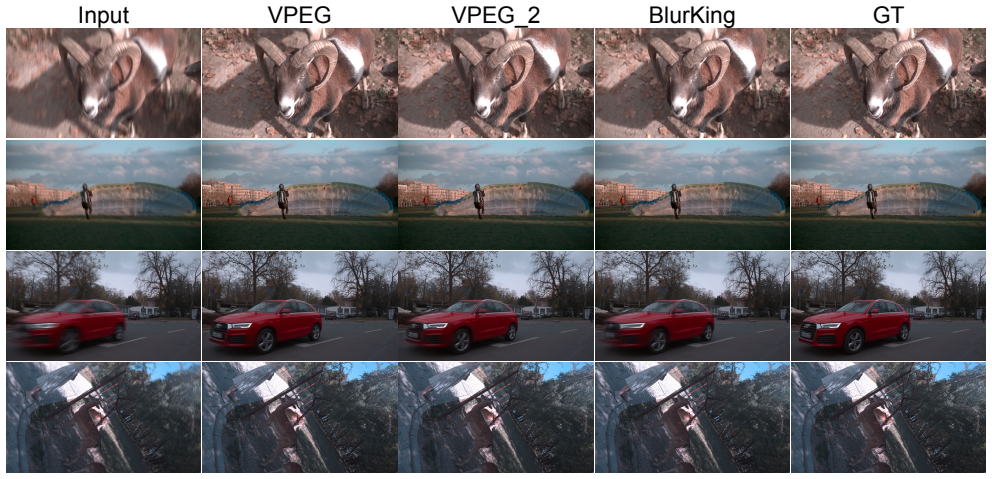
The AIM 2025 challenge ranks 9 deblurring solutions on new high-FPS motion blur datasets, with VPEG placing first in both moderate and extreme tracks.
T0 review reviewed 2026-08-04 challenge →
load-bearing objection A solid challenge report with transparent rankings; the main caveat is that the 'significant progress' claim rests on synthetic blur realism that this paper never actually argues for. the 4 major comments →
AIM 2025 Challenge on High FPS Motion Deblurring: Methods and Results
The pith
A machine-rendered reading of the paper's core claim, the machinery that carries it, and where it could break.
The reading
Core claim
The central claim of the paper is that a shared, controlled evaluation—moderate blur in MIORe and extreme blur in VAR-MIORe—can rank single-image motion deblurring systems across difficulty levels, and that the winner of both tracks is a frequency-filtering visual state-space model (EVSSM) trained in stages with increasing patch size. The reported numbers anchor the claim: the winning method reaches 34.484 dB PSNR / 0.9026 SSIM on Track 1 and 30.287 dB / 0.8434 on Track 2, ahead of the second place by roughly 0.3–1.7 dB. The paper also documents the solution space: frequency-domain attention, prompt-guided two-stage restoration, progressive multiscale training, pretrained model fusion, and d
What carries the argument
The load-bearing objects are the MIORe and VAR-MIORe datasets and the evaluation protocol itself. MIORe supplies 7,860 full-HD synthetic blur/sharp pairs with mild to moderate blur and occasional defocus; VAR-MIORe supplies 1,299 pairs with blur severity scaled up to four times. Rankings are computed by averaging each team's rank on PSNR, SSIM, and LPIPS (with ImageNet-pretrained deep features), which makes the composite final rank the operational definition of success in the challenge. On the method side, the winning pipeline is EVSSM, a visual state-space architecture whose core blocks alternate transposition and flipping to preserve spatial structure while filtering frequencies in the Fou
Load-bearing premise
The rankings stand on the assumption that blur generated synthetically from high-FPS frames behaves like real motion blur, including the up-to-4x severity used in Track 2; if that generation misses real-world effects such as camera shake, rolling shutter, or occlusion, the benchmark results may not transfer.
What would settle it
Measure optical-flow magnitude and blur-kernel statistics of real blurred videos captured with the same high-speed camera in natural scenes and compare them to MIORe and VAR-MIORe. If the synthetic data's flow distribution or blur length differs markedly from the real captures, or if method rankings on a small real-blur test set diverge from the challenge rankings, the central claim is falsified.
If this is right
- The MIORe and VAR-MIORe splits give future work a fixed ground for comparing deblurring methods under moderate and 4x-severe blur, with public training data and a common scoring rule.
- The roughly 4.2 dB PSNR drop between the winning Track 1 and Track 2 scores quantifies how much harder the extreme regime is, so new methods can be judged by how much of this gap they close.
- Progressive training with growing patch size is shared by the two top-scoring entries, suggesting it is a transferable recipe for high-resolution deblurring.
- Frequency-domain attention and state-space models currently lead the fidelity metrics, while a diffusion-based generative approach leads LPIPS, so a combined or application-specific objective would choose different winners.
- Participants who transferred weights from existing real-world deblurring datasets and then fine-tuned on the challenge data reached the high ranks, supporting the transfer-then-finetune recipe on synthetic benchmarks.
Where Pith is reading between the lines
- Because the final rank averages PSNR, SSIM, and LPIPS with no runtime or parameter-count term, a deployment-oriented ranking could reorder the field: the winning 17M-parameter model takes about 52 seconds per image on one GPU, while several lower-ranked entries run in under a second.
- The diffusion entry's best-in-class LPIPS with low PSNR suggests the composite metric is mission-dependent; a challenge aimed at visually compelling output might weight perceptual distance more heavily, which would change the winner.
- The synthetic blur-generation pipeline, if it tracks real high-FPS capture, could be extended to generate arbitrarily long blur trajectories on demand, turning the fixed 4x ceiling into a continuous stress test of deblurring robustness.
Editorial analysis
A structured set of objections, weighed in public.
Referee Report
Summary. The paper reports the AIM 2025 High FPS Non-Uniform Motion Deblurring Challenge. Two tracks are organized around the new synthetic datasets MIORe (moderate blur, 7,860 training pairs) and VAR-MIORe (severe blur, 1,299 training pairs). Nine teams submitted valid entries; results are evaluated on held-out test splits using PSNR, SSIM, and LPIPS. The organizers report VPEG as the top-ranked method in both tracks (Track 1 PSNR 34.484, SSIM 0.9026; Track 2 PSNR 30.287, SSIM 0.8434). Section 7 summarizes each team's architecture and training procedure, and the conclusion states that the challenge showcases significant progress in high-FPS single-image motion deblurring.
Significance. If the results are taken at face value, the paper provides a useful archival record of the challenge and identifies a strong practical solution (EVSSM-based VPEG) on the MIORe/VAR-MIORe benchmarks. The public benchmark, the Codabench evaluation server, and the per-team method descriptions are concrete strengths. However, the scientific significance is limited by the absence of external baselines (so the 'state-of-the-art' claim is not demonstrated against prior methods), the lack of detail on the synthetic blur generation process, an ambiguity about test-set fine-tuning by one team, and an underspecified composite ranking formula. These issues are fixable, but they currently weaken the paper's central claims of 'significant progress' and generalizable deblurring performance.
major comments (4)
- [Sec. 2 and Sec. 8] The datasets are introduced as 'synthetically generated from sharp ground-truth frames recorded with a high-frame-rate CHRONOS 2.1-HD camera', with details deferred to reference [5]. The paper never describes the synthesis model: is blur produced by temporal averaging of the high-FPS burst, by warping/averaging with optical flow, or by learned/new synthetic kernels? Nor is 'up to four times stronger' blur in VAR-MIORe defined. Since the abstract and conclusion claim that the challenge identifies networks for 'diverse and challenging conditions' and shows 'significant progress' in high-FPS motion deblurring, the realism of the synthetic distribution is load-bearing. Please specify the generation procedure or explicitly restrict the claims to the synthetic benchmark.
- [Sec. 6, Tables 1 and 2] The final ranking compares only the nine submitted methods. There is no evaluation of standard non-participant baselines (e.g., Restormer, NAFNet, EVSSM, or a simple prior method) under the same test protocol. Consequently, the abstract's 'state-of-the-art advances' and the conclusion's 'significant progress' are not supported: the tables only rank the challenge participants. Adding a few reference baselines, or tempering the claims, is necessary for the paper's central message.
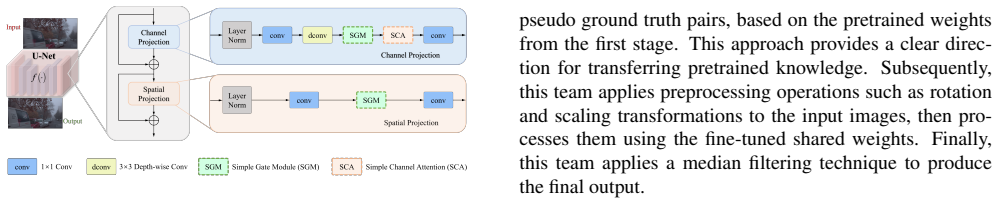
- [Sec. 7.9 vs. Sec. 5] MagicBlur's method description says the team fine-tunes the model on test-set inputs using pseudo ground-truth images produced by the same model pre-trained on the training set. Section 5, however, states only that 'the fine-tuning of the test set was restricted by limiting user submissions', which is vague and appears inconsistent with allowing test-input fine-tuning. Please clarify the official rule: was test-input adaptation explicitly permitted for all teams? If so, state it in the evaluation protocol. If not, MagicBlur's result should be flagged as non-comparable or excluded. Even though MagicBlur ranks last, the ambiguity affects the integrity of the comparison protocol.
- [Sec. 4, Tables 1 and 2] The 'Final Rank' is described only as 'a composite metric, derived from the average ranking'. The reader can infer that the three per-metric rank positions are averaged, but the exact formula, tie-breaking rule, and whether the average is computed before or after standard competition ranking are not specified. Since the final ranking is the paper's primary output, this should be defined precisely in Section 4 (e.g., final score = (r_PSNR + r_SSIM + r_LPIPS)/3, with ties assigned by competition ranking).
minor comments (7)
- [Sec. 4] Typo: 'Structured Similarity Index' should be 'Structural Similarity Index Measure'.
- [Sec. 2 and throughout] The dataset name is inconsistently typeset as 'V AR-MIORe' with a space; use a consistent form, e.g., 'VAR-MIORe'.
- [Sec. 7.1] Typo: 'the the employed EVSSM' should read 'the employed EVSSM'.
- [Tables 1 and 2 captions] Define 'rk.' and 'Final Rank' in the captions, since the table is not self-contained without Section 4's formula.
- [Sec. 7.5] The heading 'BlurKing Sharper' is confusing because Table 1 uses 'BlurKing' and Table 2 uses 'Sharper'. Please clarify that these are the same team's two track submissions.
- [Sec. 5] The sentence 'The fine-tuning of the test set was restricted by limiting user submissions' is unclear. It should state whether fine-tuning on test inputs was allowed, and what 'limited submissions' means operationally.
- [Tables 1 and 2] The test sets are small (75 and 63 images), and the PSNR gap between the top two teams (Track 1: 0.329 dB) is small. Reporting confidence intervals or a bootstrap significance test would help the reader judge whether the ranking differences are meaningful.
Circularity Check
No significant circularity; empirical challenge rankings are measured, not derived from fitted inputs.
full rationale
The paper is a challenge report rather than a derivation. The central claim — VPEG ranked first on the MIORe and VAR-MIORe test splits — is an empirical measurement obtained by evaluating submitted images against private test ground truths using fixed metrics (Section 4, Tables 1–2). The organizers did not fit the test labels or the ranking criteria to any participant's method, and participants were not given test ground truths during development or validation. The only self-referential element is that the benchmark datasets MIORe and VAR-MIORe are introduced by the same research group and cited as [5] in Section 2. This is a normal dataset citation and is not load-bearing for the ranking outcome: the dataset provides the testbed, but the scores are measured, not derived from the dataset definition or from any fitted parameter. The abstract's claim of 'significant progress' depends on the synthetic blur being representative of real high-FPS motion blur, but representativeness is a generalization/validity concern, not a circularity of the reported measurements. No equation in the paper reduces a prediction to its input by construction, no fitted parameter is renamed as a prediction, and no self-citation is invoked to force the choice of the winning method. Therefore no circular step is identified; the score reflects only the minor self-referential dataset citation.
Axiom & Free-Parameter Ledger
free parameters (1)
- Composite final rank aggregation =
unweighted average of per-metric ranks
axioms (4)
- domain assumption Synthetic blur in MIORe and VAR-MIORe is representative of real high-FPS motion blur.
- domain assumption PSNR, SSIM, and LPIPS are adequate and sufficient metrics to rank deblurring quality.
- domain assumption The Codabench evaluation protocol correctly compares submitted images to private ground truths without data leaks or exploits.
- domain assumption The composite Final Rank, derived from an unweighted average of per-metric ranks, is a meaningful way to determine winners.
Cite this review
Pith. "Pith review of AIM 2025 Challenge on High FPS Motion Deblurring: Methods and Results." pith.science (2026). https://pith.science/paper/LJ5X46QB
@misc{pith2026250906793,
  author       = {Pith},
  title        = {Pith review of: AIM 2025 Challenge on High FPS Motion Deblurring: Methods and Results},
  year         = {2026},
  howpublished = {\url{https://pith.science/paper/LJ5X46QB}},
  note         = {Machine review of arXiv:2509.06793}
}
read the original abstract
This paper presents a comprehensive review of the AIM 2025 High FPS Non-Uniform Motion Deblurring Challenge, highlighting the proposed solutions and final results. The objective of this challenge is to identify effective networks capable of producing clearer and visually compelling images in diverse and challenging conditions, by learning representative visual cues for complex aggregations of motion types. A total of 68 participants registered for the competition, and 9 teams ultimately submitted valid entries. This paper thoroughly evaluates the state-of-the-art advances in high-FPS single image motion deblurring, showcasing the significant progress in the field, while leveraging samples of the novel dataset, MIORe, that introduces challenging examples of movement patterns.
Figures



Reference graph
Works this paper leans on
-
[1]
Simple baselines for image restoration
Liangyu Chen, Xiaojie Chu, Xiangyu Zhang, and Jian Sun. Simple baselines for image restoration. In Shai Avi- dan, Gabriel J. Brostow, Moustapha Ciss ´e, Giovanni Maria Farinella, and Tal Hassner, editors,Computer Vision - ECCV 2022 - 17th European Conference, Tel Aviv, Israel, Octo- ber 23-27, 2022, Proceedings, Part VII, volume 13667 of Lecture Notes in ...
work page 2022
-
[2]
Simple baselines for image restoration
Liangyu Chen, Xiaojie Chu, Xiangyu Zhang, and Jian Sun. Simple baselines for image restoration. InEuropean confer- ence on computer vision, pages 17–33. Springer, 2022. 6
2022
-
[3]
Hierarchical integration diffusion model for realistic image deblurring.NeurIPS, 2024
Zheng Chen, Yulun Zhang, Ding Liu, Jinjin Gu, Linghe Kong, Xin Yuan, et al. Hierarchical integration diffusion model for realistic image deblurring.NeurIPS, 2024. 6
work page 2024
-
[4]
AIM 2025 high FPS non-uniform motion deblurring challenge report
George Ciubotariu, Florin-Alexandru Vasluianu, Zhuyun Zhou, Nancy Mehta, Radu Timofte, et al. AIM 2025 high FPS non-uniform motion deblurring challenge report. In Proceedings of the IEEE/CVF International Conference on Computer Vision (ICCV) Workshops, 2025. 1
work page 2025
-
[5]
MIORe & V AR-MIORe: Benchmarks to push the boundaries of restoration
George Ciubotariu, Zhuyun Zhou, Zongwei Wu, and Radu Timofte. MIORe & V AR-MIORe: Benchmarks to push the boundaries of restoration. InProceedings of the IEEE In- ternational Conference on Computer Vision (ICCV). IEEE Computer Society, 2025. 1, 3, 6, 8
work page 2025
-
[6]
AIM 2025 rip current segmentation (RipSeg) challenge report
Andrei Dumitriu, Florin Miron, Florin Tatui, Radu Tudor Ionescu, Radu Timofte, Aakash Ralhan, Florin-Alexandru Vasluianu, et al. AIM 2025 rip current segmentation (RipSeg) challenge report. InProceedings of the IEEE/CVF International Conference on Computer Vision (ICCV) Work- shops, 2025. 1
work page 2025
-
[7]
Efficient real-world deblurring using single images: AIM 2025 chal- lenge report
Daniel Feijoo, Paula Garrido, Marcos Conde, Jaesung Rim, Alvaro Garcia, Sunghyun Cho, Radu Timofte, et al. Efficient real-world deblurring using single images: AIM 2025 chal- lenge report. InProceedings of the IEEE/CVF International Conference on Computer Vision (ICCV) Workshops, 2025. 1
work page 2025
-
[8]
4K image super-resolution on mobile NPUs: Mobile AI & AIM 2025 challenge report
Andrey Ignatov, Georgy Perevozchikov, Radu Timofte, et al. 4K image super-resolution on mobile NPUs: Mobile AI & AIM 2025 challenge report. InProceedings of the IEEE/CVF International Conference on Computer Vision (ICCV) Work- shops, 2025. 1
work page 2025
-
[9]
Adapting stable diffusion for on-device inference: Mobile AI & AIM 2025 challenge report
Andrey Ignatov, Georgy Perevozchikov, Radu Timofte, et al. Adapting stable diffusion for on-device inference: Mobile AI & AIM 2025 challenge report. InProceedings of the IEEE/CVF International Conference on Computer Vision (ICCV) Workshops, 2025. 1
work page 2025
-
[10]
Efficient image denoising on smartphone GPUs: Mobile AI & AIM 2025 challenge report
Andrey Ignatov, Georgy Perevozchikov, Radu Timofte, et al. Efficient image denoising on smartphone GPUs: Mobile AI & AIM 2025 challenge report. InProceedings of the IEEE/CVF International Conference on Computer Vision (ICCV) Workshops, 2025. 1
work page 2025
-
[11]
Efficient learned smartphone ISP on mobile GPUs: Mo- bile AI & AIM 2025 challenge report
Andrey Ignatov, Georgy Perevozchikov, Radu Timofte, et al. Efficient learned smartphone ISP on mobile GPUs: Mo- bile AI & AIM 2025 challenge report. InProceedings of the IEEE/CVF International Conference on Computer Vision (ICCV) Workshops, 2025. 1
work page 2025
-
[12]
AIM 2025 challenge on robust offline video super-resolution: Dataset, methods and results
Nikolai Karetin, Ivan Molodetskikh, Dmitry Vatolin, Radu Timofte, et al. AIM 2025 challenge on robust offline video super-resolution: Dataset, methods and results. InProceed- ings of the IEEE/CVF International Conference on Com- puter Vision (ICCV) Workshops, 2025. 1
work page 2025
-
[13]
Efficient frequency domain-based trans- formers for high-quality image deblurring
Lingshun Kong, Jiangxin Dong, Jianjun Ge, Mingqiang Li, and Jinshan Pan. Efficient frequency domain-based trans- formers for high-quality image deblurring. InCVPR, 2023. 3
work page 2023
-
[14]
Efficient visual state space model for image deblurring
Lingshun Kong, Jiangxin Dong, Jinhui Tang, Ming-Hsuan Yang, and Jinshan Pan. Efficient visual state space model for image deblurring. InCVPR, 2025. 2, 3, 6
work page 2025
-
[15]
Alex Krizhevsky, Ilya Sutskever, and Geoffrey E. Hinton. Imagenet classification with deep convolutional neural net- works.Commun. ACM, 60(6):84–90, may 2017. 2
work page 2017
-
[16]
Flux.1 kontext: Flow matching for in-context image generation and editing in latent space,
Black Forest Labs, Stephen Batifol, Andreas Blattmann, Frederic Boesel, Saksham Consul, Cyril Diagne, Tim Dock- horn, Jack English, Zion English, Patrick Esser, Sumith Ku- lal, Kyle Lacey, Yam Levi, Cheng Li, Dominik Lorenz, Jonas M¨uller, Dustin Podell, Robin Rombach, Harry Saini, Axel Sauer, and Luke Smith. Flux.1 kontext: Flow matching for in-context i...
-
[17]
Real-world raw de- noising using diverse cameras: AIM 2025 challenge report
Feiran Li, Jiacheng Li, Marcos Conde, Beril Besbinar, Vlad Hosu, Daisuke Iso, Radu Timofte, et al. Real-world raw de- noising using diverse cameras: AIM 2025 challenge report. InProceedings of the IEEE/CVF International Conference on Computer Vision (ICCV) Workshops, 2025. 1
work page 2025
-
[18]
Swin transformer: Hierarchical vision transformer using shifted windows
Ze Liu, Yutong Lin, Yue Cao, Han Hu, Yixuan Wei, Zheng Zhang, Stephen Lin, and Baining Guo. Swin transformer: Hierarchical vision transformer using shifted windows. In ICCV, 2021. 6
2021
-
[19]
AIM 2025 perceptual image super-resolution chal- lenge
Bruno Longarela, Marcos Conde, ´Alvaro Garc´ıa, Radu Tim- ofte, et al. AIM 2025 perceptual image super-resolution chal- lenge. InProceedings of the IEEE/CVF International Con- ference on Computer Vision (ICCV) Workshops, 2025. 1
work page 2025
-
[20]
SGDR: stochastic gradient descent with warm restarts
Ilya Loshchilov and Frank Hutter. SGDR: stochastic gradient descent with warm restarts. InICLR, 2017. 3
2017
-
[21]
Evenformer: Dynamic even transformer for real-world image restoration
Xin Lu, Yuanfei Bao, Jiarong Yang, Anya Hu, Jie Xiao, Kunyu Wang, Dong Li, Senyan Xu, Kean Liu, Xueyang Fu, and Zheng-Jun Zha. Evenformer: Dynamic even transformer for real-world image restoration. InProceedings of the Com- puter Vision and Pattern Recognition Conference (CVPR) Workshops, pages 1081–1091, June 2025. 6
work page 2025
-
[22]
Elucidating and Endowing the Diffusion Training Paradigm for General Image Restoration
Xin Lu, Xueyang Fu, Jie Xiao, Zihao Fan, Yurui Zhu, and Zheng-Jun Zha. Elucidating and endowing the diffu- sion training paradigm for general image restoration.arXiv preprint arXiv:2506.21722, 2025. 6
work page internal anchor Pith review Pith/arXiv arXiv 2025
-
[23]
Boosting inverse tone mapping via diffusion regularization
Xin Lu, Yufeng Peng, Chengjie Ge, Zhijing Sun, Ziang Zhou, Zihao Li, Zishun Liao, Dong Li, Qiyu Kang, Xueyang Fu, and Zheng-Jun Zha. Boosting inverse tone mapping via diffusion regularization. In2025 IEEE/CVF International Conference on Computer Vision (ICCV) Workshops. IEEE Computer Society, 2025. 6
work page 2025
-
[24]
Efficient high fps non-uniform mo- tion deblurring via progressive learning
Xin Lu, Zhijing Sun, Chengjie Ge, Yufeng Peng, Ziang Zhou, Zihao Li, Zishun Liao, Dong Li, Qiyu Kang, Xueyang Fu, and Zheng-Jun Zha. Efficient high fps non-uniform mo- tion deblurring via progressive learning. In2025 IEEE/CVF International Conference on Computer Vision (ICCV) Work- shops. IEEE Computer Society, 2025. 6
work page 2025
-
[25]
Continuous adverse weather removal via degradation-aware distillation
Xin Lu, Jie Xiao, Yurui Zhu, and Xueyang Fu. Continuous adverse weather removal via degradation-aware distillation. InProceedings of the Computer Vision and Pattern Recog- nition Conference (CVPR), pages 28113–28123, June 2025. 6
work page 2025
-
[26]
Advancing ambient lighting nor- malization via diffusion shadow generation
Xin Lu, Jiarong Yang, Yuanfei Bao, Zihao Fan, Anya Hu, Kunyu Wang, Jie Xiao, Xi Wang, Hongjian Liu, Xueyang Fu, and Zheng-Jun Zha. Advancing ambient lighting nor- malization via diffusion shadow generation. InProceedings of the Computer Vision and Pattern Recognition Conference (CVPR) Workshops, pages 1070–1080, June 2025. 6
work page 2025
-
[27]
Hirformer: Dynamic high resolution transformer for large-scale image shadow removal
Xin Lu, Yurui Zhu, Xi Wang, Dong Li, Jie Xiao, Yun- peng Zhang, Xueyang Fu, and Zheng-Jun Zha. Hirformer: Dynamic high resolution transformer for large-scale image shadow removal. InProceedings of the IEEE/CVF Confer- ence on Computer Vision and Pattern Recognition (CVPR) Workshops, pages 6513–6523, June 2024. 6
work page 2024
-
[28]
Loformer: Local frequency transformer for im- age deblurring
Xintian Mao, Jiansheng Wang, Xingran Xie, Qingli Li, and Yan Wang. Loformer: Local frequency transformer for im- age deblurring. In Jianfei Cai, Mohan S. Kankanhalli, Bal- akrishnan Prabhakaran, Susanne Boll, Ramanathan Subra- manian, Liang Zheng, Vivek K. Singh, Pablo C ´esar, Lexing Xie, and Dong Xu, editors,Proceedings of the 32nd ACM International Con...
work page 2024
-
[29]
Deep multi-scale convolutional neural network for dynamic scene deblurring
Seungjun Nah, Tae Hyun Kim, and Kyoung Mu Lee. Deep multi-scale convolutional neural network for dynamic scene deblurring. InProceedings of the IEEE conference on computer vision and pattern recognition, pages 3883–3891,
-
[30]
Deep multi-scale convolutional neural network for dynamic scene deblurring
Seungjun Nah, Tae Hyun Kim, and Kyoung Mu Lee. Deep multi-scale convolutional neural network for dynamic scene deblurring. In2017 IEEE Conference on Computer Vision and Pattern Recognition, CVPR 2017, Honolulu, HI, USA, July 21-26, 2017, pages 257–265. IEEE Computer Society,
work page 2017
-
[31]
Real-world blur dataset for learning and benchmarking deblurring algorithms
Jaesung Rim, Haeyun Lee, Jucheol Won, and Sunghyun Cho. Real-world blur dataset for learning and benchmarking deblurring algorithms. In Andrea Vedaldi, Horst Bischof, Thomas Brox, and Jan-Michael Frahm, editors,Computer Vision - ECCV 2020 - 16th European Conference, Glasgow, UK, August 23-28, 2020, Proceedings, Part XXV, volume 12370 ofLecture Notes in Co...
work page 2020
-
[32]
AIM 2025 challenge on screen-content video quality assessment: Methods and results
Nickolay Safonov, Mikhail Rakhmanov, Dmitriy Vatolin, Radu Timofte, et al. AIM 2025 challenge on screen-content video quality assessment: Methods and results. InProceed- ings of the IEEE/CVF International Conference on Com- puter Vision (ICCV) Workshops, 2025. 1
work page 2025
-
[33]
Chronos 2.1-hd high-speed camera
Kron Technologies. Chronos 2.1-hd high-speed camera. https://www.krontech.ca/product/chronos- 2- 1- hd- high- speed- camera/, 2024. Accessed: 2024-11-11. 2
work page 2024
-
[34]
AIM 2025 challenge on inverse tone mapping report: Methods and results
Chao Wang, Francesco Banterle, Bin Ren, Radu Timofte, et al. AIM 2025 challenge on inverse tone mapping report: Methods and results. InProceedings of the IEEE/CVF Inter- national Conference on Computer Vision (ICCV) Workshops,
work page 2025
-
[35]
Image quality assessment: from error visibility to structural similarity.IEEE transactions on image processing, 13(4):600–612, 2004
Zhou Wang, Alan C Bovik, Hamid R Sheikh, and Eero P Si- moncelli. Image quality assessment: from error visibility to structural similarity.IEEE transactions on image processing, 13(4):600–612, 2004. 2
2004
-
[36]
Zhen Xu, Sergio Escalera, Adrien Pav ˜ao, Magali Richard, Wei-Wei Tu, Quanming Yao, Huan Zhao, and Isabelle Guyon. Codabench: Flexible, easy-to-use, and reproducible meta-benchmark platform.Patterns, 3(7):100543, 2022. 1, 2
work page 2022
-
[37]
AIM 2025 low-light raw video denoising challenge: Dataset, methods and results
Alexander Yakovenko, George Chakvetadze, Ilya Khrapov, Maksim Zhelezov, Dmitry Vatolin, Radu Timofte, et al. AIM 2025 low-light raw video denoising challenge: Dataset, methods and results. InProceedings of the IEEE/CVF Inter- national Conference on Computer Vision (ICCV) Workshops,
work page 2025
-
[38]
Towards efficient and scale-robust ultra- high-definition image demoir´eing
Xin Yu, Peng Dai, Wenbo Li, Lan Ma, Jiajun Shen, Jia Li, and Xiaojuan Qi. Towards efficient and scale-robust ultra- high-definition image demoir´eing. In Shai Avidan, Gabriel J. Brostow, Moustapha Ciss ´e, Giovanni Maria Farinella, and Tal Hassner, editors,Computer Vision - ECCV 2022 - 17th European Conference, Tel Aviv, Israel, October 23-27, 2022, Proce...
work page 2022
-
[39]
Restormer: Efficient transformer for high-resolution image restoration
Syed Waqas Zamir, Aditya Arora, Salman Khan, Mu- nawar Hayat, Fahad Shahbaz Khan, and Ming-Hsuan Yang. Restormer: Efficient transformer for high-resolution image restoration. InCVPR, 2022. 3
2022
-
[40]
Restormer: Efficient transformer for high-resolution image restoration
Syed Waqas Zamir, Aditya Arora, Salman Khan, Mu- nawar Hayat, Fahad Shahbaz Khan, and Ming-Hsuan Yang. Restormer: Efficient transformer for high-resolution image restoration. InProceedings of the IEEE/CVF Conference on Computer Vision and Pattern Recognition (CVPR), pages 5728–5739, 2022. 8
work page 2022
-
[41]
The unreasonable effectiveness of deep features as a perceptual metric
Richard Zhang, Phillip Isola, Alexei A Efros, Eli Shechtman, and Oliver Wang. The unreasonable effectiveness of deep features as a perceptual metric. InCVPR, 2018. 2
2018
-
[42]
Yuxuan Zhang, Yirui Yuan, Yiren Song, Haofan Wang, and Jiaming Liu. Easycontrol: Adding efficient and flexible control for diffusion transformer.arXiv preprint arXiv:2503.07027, 2025. 6 A. Teams and Affiliations AIM 2025 Team Title:AIM 2025 High FPS Motion Deblurring Challenge Members: George Ciubotariu 1 (george.ciubotariu@uni- wuerzburg.de), Florin Vasl...
Pith/arXiv arXiv 2025
This paper was first reviewed by deepseek-v4-flash on August 4, 2026.
discussion (0)
Sign in with ORCID, Apple, or X to comment. Anyone can read and Pith papers without signing in.