REVIEW 3 major objections 4 minor 2 cited by
The paper argues that the large effective nearest-neighbor attraction (V≈−t) recently inferred from RIXS data on cuprate ladders is not uniquely required: a bare t–J ladder with intrinsic rung pairing reproduces the same dynamical spin stru
Reviewed by Pith at T0; open to challenge. T0 means a machine referee read the full paper against a public rubric. the ladder, T0–T4 →
Bare t-J models reproduce the experimentally observed ladder DSF without an explicit attraction, and phonon downfolding yields attraction while three-band downfolding mostly does not.
T0 review reviewed 2026-08-04 challenge →
load-bearing objection Shows bare t-J ladders reproduce the RIXS data that motivated attractive Hubbard terms, with a useful qualitative phonon-vs-three-band contrast; the quantitative reconstructed parameters are the weak link. the 3 major comments →
Towards effective models for low-dimensional cuprates: From ground state Hamiltonian reconstruction to spectral functions
The pith
A machine-rendered reading of the paper's core claim, the machinery that carries it, and where it could break.
The reading
Core claim
We show that both the Fermi-Hubbard model with nearest-neighbor attraction (FH+V) and the t–J model, with or without attraction, are suitable effective single-band descriptions of cuprate ladders: the bare t–J ladder's intrinsic rung-pairing gives a binding energy (E_B/t≈0.17) close to that of FH+V (≈0.23), and both produce the experimentally observed suppression of spin-flip excitations. Reconstructing effective couplings from ground states shows that phonons can induce attraction—V/t≈−0.64 in the Fermi-Hubbard model and −0.44 in the t–J model after infinite-size extrapolation—whereas reconstruction from the three-band model yields essentially no density-density attraction (V/t≈0.07 in FH,
What carries the argument
Ground-state Hamiltonian reconstruction: given the ground state of a parent model (Hubbard-Holstein or three-band Emery), one builds a correlation matrix M_ij = ½⟨{L_i, L_j}⟩ − ⟨L_i⟩⟨L_j⟩ over a chosen basis of effective operators; the eigenvector with smallest eigenvalue gives the best effective single-band Hamiltonian, and the eigenvalue measures the reconstruction error. The load-bearing physical mechanism is the intrinsic rung-pairing of the t–J ladder, which binds holes on opposite legs even at V=0 and suppresses spin-flip weight in the dynamical spin structure factor. For the three-band parent, Wannier downfolding centered on copper sites provides the single-particle basis before the r
Load-bearing premise
The couplings reconstructed at one doping (16.7% holes) and at finite chain lengths are assumed to transfer unchanged to other dopings and to the infinite chain, even though the fitted attraction changes by roughly a factor of two across the accessible system sizes.
What would settle it
Take the ladder DSF at δ=6% using the thermodynamic-limit t–J parameters (J/t≈0.5, no V) on a long ladder and compare the spin-flip weight below the two-triplon continuum to the RIXS data of [8]; because the fitted V drifts with system size, a size-converged bare t–J calculation either reproduces the suppression (supporting the paper) or does not (falsifying it).
If this is right
- RIXS spin-flip suppression in ladders is not decisive evidence for a phonon-induced V≈−t; the bare t–J ladder already produces comparable suppression.
- Phonon-induced attraction is real but smaller than previously quoted: extrapolated |V|≈0.64t in the Fermi-Hubbard model and 0.44t in the t–J model, not the fitted 1.25t.
- Three-band-derived single-band models should carry a sizeable density-assisted hopping term (t_n/t≈0.65) rather than a density-density attraction.
- In two-dimensional cylinders, FH+V and bare t–J both remove the stripe signal seen in the bare Fermi-Hubbard model, with comparable binding energies.
- The effective single-band description is not unique: distinct parent models yield different additional terms yet similar spin spectra.
Where Pith is reading between the lines
- The quantitative results inherit a transferability assumption: parameters fitted from 16.7%-doped finite chains are used at 29% doping and extrapolated to infinite length, while the raw reconstructed V drifts from about −1.08t (L=12) to −0.64t (L=36), so the agreement at 29% is a weaker test than it appears.
- A more discriminating observable would be charge dynamics—for example, two-hole binding energy as a function of doping, or the intensity of the holon-folding branch in ARPES—where FH+V and bare t–J are expected to differ more than in the spin channel.
- The underdetermination result generalizes: any downfolding that matches only a low-energy spin observable will leave the pairing mechanism (phononic versus magnetic) ambiguous; tests should target observables that couple to pair size or density-assisted hopping.
- One could test the three-band parent with larger U/Δ or with finite t_pp to see whether attraction emerges there as well; if it never does, the ladder RIXS fit would preferentially favor phonon-coupled or intrinsic-pairing models.
Editorial analysis
A structured set of objections, weighed in public.
Referee Report
Summary. The paper addresses the ambiguity in choosing an effective single-band model for cuprates by comparing Fermi-Hubbard (FH) and t-J descriptions, with and without additional attractive density-density terms. The authors argue that recent RIXS evidence for a large nearest-neighbor attraction (V ≈ -t) in cuprate ladders is not unique: a bare t-J ladder, with its intrinsic rung pairing, reproduces the experimentally observed suppression of spin-flip excitations. They then use ground-state Hamiltonian reconstruction to downfold from two parent models—an extended Hubbard-Holstein model with electron-phonon coupling and a three-band Emery model—into single-band FH and t-J models. They report that phonons generate an effective nearest-neighbor attraction, while the three-band reconstruction yields essentially no attractive V (and a repulsive V in the FH case). The reconstructed models are validated by computing the dynamical spin structure factor (DSF) at 29% hole doping, where the t-J model with V/t=-0.44 gives a gap at k=π close to that of an FH model with V=-t. A brief two-dimensional extension compares hole and spin correlations on a cylinder for two holes. The central claim is that both extended single-band descriptions can capture the relevant spectral features, and that the microscopic origin of attraction depends on the parent model.
Significance. If the conclusions hold, the paper makes an important contribution to the long-standing problem of choosing an effective single-band Hamiltonian for cuprates. The demonstration that the bare t-J ladder reproduces the RIXS spin-flip suppression weakens the uniqueness of the recently proposed large attractive V in ladder materials, and the systematic ground-state reconstruction from two different parent models provides a useful framework for identifying which additional terms are physically required. A notable strength is that the reconstructed models are tested against a dynamical observable, the DSF, that was not used in the reconstruction fit; this is an independent benchmark rather than a mere circular validation. The comparison with a Lang-Firsov transformation in the Supplemental Material also grounds the reconstruction in an analytically controlled limit for weak coupling. However, the quantitative support for the central claims is weakened by finite-size and doping-transferability issues discussed below; with those addressed, the qualitative sign difference between phonon-induced and three-band-induced V would still constitute a valuable result.
major comments (3)
- [SM A1a; Tables II/III; Fig. 3] The reconstructed single-band parameters are obtained from parent ground states at a fixed doping of 16.7% (2, 4, and 6 holes on L=12, 24, and 36 sites) and then used without further testing to compute DSFs at δ=29% in Fig. 3. The SM statement that 'the reconstructed parameters do not strongly depend on L' is contradicted by the tables: for the extended t-J reconstruction from Hubbard-Holstein, V/t = -1.08 (L=12), -0.78 (L=24), -0.64 (L=36), extrapolated to -0.44; for extended FH, V/t = -1.01, -0.85, -0.75, extrapolated to -0.64. This is a 30–40% drift over the available system sizes. No test of doping transferability is provided, so the close agreement between the t-J(V/t=-0.44) curve and the FH(V/t=-1.0) curve in Fig. 3b could be coincidental at the 29% doping where the comparison with RIXS is made. The authors should compute the DSF at the reconstruction doping, repeat the reconstruct
- [SM A1; Tables II–V] All reconstructed parameters are quoted as L→∞ extrapolations, but the extrapolation scheme, the fit function, and the uncertainty of the extrapolated values are not reported. The 'error' column in Tables II–V is the reconstruction variance ε of Eq. (A2), not a statistical error on the parameter estimate. Given the strong L-dependence of V documented in the tables, the extrapolated values such as V/t=-0.44 and V/t=-0.64 cannot be regarded as precise. The authors should describe the extrapolation procedure explicitly and report error bars on the extrapolated parameters, or at least display the raw finite-size values in the main text so the reader can judge the reliability of the extrapolation.
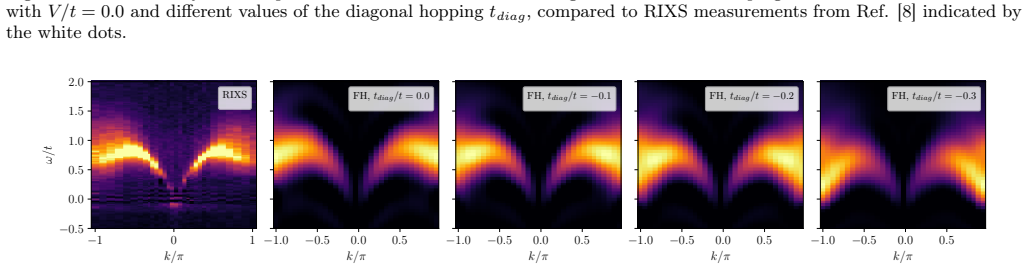
- [Ladder compounds; Fig. 1 and Appendix D] The central ladder comparison uses fixed model parameters: FH+V with U/t=8+V, t⊥/t=0.84, t_diag/t=-0.3, and bare t-J with J∥/t=0.5, J⊥/t=0.35, Jdiag=t_diag=0. The conclusion that the bare t-J model reproduces the RIXS suppression of spin-flip weight rests on this single parameter choice. Because the t-J model lives in a different Hilbert space (no charge fluctuations), the mapping between U and J is not unique, and a robustness scan over J∥, J⊥, and t3 would be needed to establish that the agreement is not accidental. The authors themselves note in Appendix D that for the doped FH ladder other parameter combinations may yield a smaller required attraction, underscoring the sensitivity of the effective pairing interpretation to Hamiltonian details.
minor comments (4)
- [Table I caption] Typos in the caption: 'since tit is one order' should read 'since it is one order'; 'here , since' has a misplaced comma; 'For all parameters are extrapolated' is ungrammatical. The caption should also define what 'extended' means in the table columns.
- [Fig. 1a text] The text has a duplicated phrase: 'see see Fig. 1a(right)'. Also, the exact parameters used for the t-J DSF in Fig. 1a (e.g., whether t_diag=0 as in the binding-energy comparison or t_diag=-0.3 as for the FH+V model) are not specified in the main text; please state them explicitly.
- [Tables II–V] The column labeled 'error' should be renamed or described as the variance ε/t² from Eq. (A2), not a 'fitting error' or 'uncertainty'. The current labeling is misleading.
- [Two-dimensional systems; Fig. 4] The 2D extension is limited to two holes on a 12×6 cylinder. A brief comment on the possible finite-size effects and on the sensitivity of the stripe signal to cylinder width would help the reader calibrate the 2D conclusions.
Circularity Check
No significant circularity: the DSF validation is an independent dynamical test at a different doping, not a refit of the reconstructed parameters.
full rationale
The paper's derivation chain does not reduce to its inputs. The ladder comparison (Fig. 1) computes DSFs for bare FH, FH+V, bare t-J, and t-J+V and compares them directly to RIXS; the bare t-J result is not fitted to the RIXS data. The ground-state reconstruction (SM A) minimizes the variance of an effective Hamiltonian on a parent ground state; the resulting parameters are fits to ground-state correlations, but the subsequent DSF at δ=29% (Fig. 3) is a dynamical observable at a different doping that was not used in the reconstruction, so the validation is non-circular. The HH→V result is consistent with the Lang-Firsov transformation (SM B), but the paper presents this as a cross-check rather than a new derivation, and the three-band reconstruction yields a contrasting near-zero V, showing the outcome is not forced by the method. The only self-citation (Ref. [37]) is a technical doublon-correction scheme in the 2D section, not load-bearing. The manuscript does contain external-validity weaknesses: the SM statement that 'the reconstructed parameters do not strongly depend on L' is difficult to reconcile with the 30–40% drift in V/t in Tables II–III, and Appendix D concedes that other t_diag values might reduce the required attraction. These are correctness/robustness concerns about the doping-transfer and parameter-choice extrapolations, not circularity.
Axiom & Free-Parameter Ledger
free parameters (9)
- FH+V ladder parameters =
V/t=-1.25, U/t=8+V=6.75, t_diag/t=-0.3, t_perp/t=0.84
- t-J ladder parameters =
J_parallel/t=0.5, J_perp/t=0.35, J_diag=0, t_diag=0
- Reconstructed FH from Hubbard-Holstein (L to infinity) =
U/t=8.05, V/t=-0.64, V'/t=-0.34
- Reconstructed t-J from Hubbard-Holstein (L to infinity) =
J/t=0.52, t3/t=0.05, V/t=-0.44
- Reconstructed FH from three-band (L to infinity) =
U/t=11.41, t_n/t=0.65, V/t=0.07
- Reconstructed t-J from three-band (L to infinity) =
J/t=0.66, t3/t=0.08, V/t=-0.02
- Reconstructed t-J from FH+V ladder =
J_parallel/t=0.36-0.38, t3/t=0.08, J_perp/t=0.17-0.20, V/t=-0.98 to -1.07, t_diag/t=-0.13 to -0.15
- Hubbard-Holstein parent parameters =
omega0/t=0.2, g0/t=0.3, g1/t=0.15
- Three-band Emery parent parameters =
tpp/tpd=0.5, Ud/tpd=6.0, Up/tpd=3.0, Delta_pd/tpd=3.5
axioms (7)
- domain assumption Single-band Hubbard and t-J models with nearest-neighbor density interactions span the relevant effective-model space
- standard math The Qi-Ranard ground-state reconstruction yields a unique effective Hamiltonian when the lowest eigenvalue of the correlation matrix is zero and the second is positive
- domain assumption Wannier downfolding following Jiang et al. [6] gives a valid single-band representation of the three-band model
- domain assumption The parent model parameters are appropriate for the cuprate compounds studied
- domain assumption Reconstructed couplings are transferable from 16.7% doping to 29% doping
- domain assumption Zero-temperature DSF is comparable to 260 K RIXS data
- domain assumption t-J ladder parameters J_parallel/t=0.5, J_perp/t=0.35 represent the natural t-J description of the copper-oxide ladder
Cite this review
Pith. "Pith review of Towards effective models for low-dimensional cuprates: From ground state Hamiltonian reconstruction to spectral functions." pith.science (2026). https://pith.science/paper/V3HTTMGY
@misc{pith2026250906947,
  author       = {Pith},
  title        = {Pith review of: Towards effective models for low-dimensional cuprates: From ground state Hamiltonian reconstruction to spectral functions},
  year         = {2026},
  howpublished = {\url{https://pith.science/paper/V3HTTMGY}},
  note         = {Machine review of arXiv:2509.06947}
}
abstract
Understanding which minimal effective model captures the essential physics of cuprates is a key step towards unraveling the mechanism behind high-$T_c$ superconductivity. Recent measurements of the dynamical spin structure factor (DSF) in cuprate ladder compounds have indicated the presence of a large effective attraction in the single-band Hubbard model, possibly mediated by phonons. Here, we demonstrate that similar DSF features can also be captured by $t$-$J$ descriptions with or even without any attractive term. Motivated by this observation, we systematically investigate the strength and origin of different contributions to the single-band Hamiltonians by downfolding either from the three-band Emery model or the electron-phonon coupled Hubbard-Holstein model. For one-dimensional systems, we find that the extended versions of both single-band descriptions can reproduce the experimentally observed DSF signatures. Finally, we extend our analysis to two dimensions by comparing two-hole correlation functions for the different single-band models. Our results provide new insights into the long-standing question of which single-band Hamiltonian can capture the essential physics of cuprates.
Figures



Forward citations
Cited by 2 Pith papers
-
Realizing multi-orbital Emery models with ultracold atoms
An optical superlattice architecture is proposed to implement the three-band Emery model with ultracold fermions, allowing simulation of cuprate-like band structure, interactions, and thermodynamics.
-
Hubbard vs. Emery model: spectra, transport and relevance for cuprates
Hubbard and Emery models produce similar physics for cuprates but differ quantitatively in spectra, transport, and doping-dependent features, with good experimental agreement when using stronger coupling in the Hubbard model.
Reference graph
Works this paper leans on
-
[1]
J. G. Bednorz and K. A. Müller, Zeitschrift für Physik B Condensed Matter64, 189 (1986)
work page 1986
-
[2]
V. J. Emery, Phys. Rev. Lett.58, 2794 (1987). 6
work page 1987
- [3]
- [4]
-
[5]
Georges, G
A. Georges, G. Kotliar, W. Krauth, and M. J. Rozen- berg, Rev. Mod. Phys.68, 13 (1996)
1996
-
[6]
Jiang, D
S. Jiang, D. J. Scalapino, and S. R. White, Phys. Rev. B108, L161111 (2023)
2023
-
[7]
H. Xu, C.-M. Chung, M. Qin, U. Schollwöck, S. R. White, and S. Zhang, Science384, eadh7691 (2024), https://www.science.org/doi/pdf/10.1126/science.adh7691
-
[8]
H. Padma, J. Thomas, S. F. TenHuisen, W. He, Z. Guan, J. Li, B. Lee, Y. Wang, S. H. Lee, Z. Mao, H. Jang, V. Bisogni, J. Pelliciari, M. P. Dean, S. Johnston, and M. Mitrano, Physical Review X15(2025), 10.1103/phys- revx.15.021049
doi:10.1103/phys- 2025
-
[9]
Cooper-pair localization in the magnetic dynamics of a cuprate ladder,
A. Scheie, P. Laurell, J. Thomas, V. Sharma, A. I. Kolesnikov, G. E. Granroth, Q. Zhang, B. Lake, M. M. Jr., R. I. Bewley, R. S. Eccleston, J. Akimitsu, E. Dagotto, C. D. Batista, G. Alvarez, S. Johnston, and D. A. Tennant, “Cooper-pair localization in the magnetic dynamics of a cuprate ladder,” (2025), arXiv:2501.10296 [cond-mat.str-el]
Pith/arXiv arXiv 2025
-
[10]
J. Li, D. Jost, T. Tang, R. Wang, Y. Zhong, Z. Chen, M. Garcia-Fernandez, J. Pelliciari, V. Bisogni, B. Moritz, K. Zhou, Y. Wang, T. P. Devereaux, W.-S. Lee, and Z.- X. Shen, Phys. Rev. Lett.134, 146501 (2025)
work page 2025
-
[11]
F. C. Zhang and T. M. Rice, Phys. Rev. B37, 3759 (1988)
work page 1988
-
[12]
C. Ye, P. Cai, R. Yu, X. Zhou, W. Ruan, Q. Liu, C. Jin, and Y. Wang, Nature Communications4, 1365 (2013)
work page 2013
-
[13]
Visualizing the zhang-rice singlet,molecularorbitalsandpairformationincuprate,
S. Ye, J. Zhao, Z. Yao, S. Chen, Z. Dong, X. Li, L. Shi, Q. Liu, C. Jin, and Y. Wang, “Visualizing the zhang-rice singlet,molecularorbitalsandpairformationincuprate,” (2023), arXiv:2309.09260 [cond-mat.supr-con]
Pith/arXiv arXiv 2023
-
[14]
L. H. Tjeng, B. Sinkovic, N. B. Brookes, J. B. Goedkoop, R. Hesper, E. Pellegrin, F. M. F. de Groot, S. Altieri, S. L. Hulbert, E. Shekel, and G. A. Sawatzky, Phys. Rev. Lett.78, 1126 (1997)
work page 1997
- [15]
-
[16]
S. Li, A. Nocera, U. Kumar, and S. Johnston, Commu- nications Physics4, 217 (2021)
work page 2021
- [17]
-
[18]
J. H. Jefferson, H. Eskes, and L. F. Feiner, Phys. Rev. B45, 7959 (1992)
work page 1992
-
[19]
V. I. Belinicher and A. L. Chernyshev, Phys. Rev. B47, 390 (1993)
work page 1993
-
[20]
V. I. Belinicher, A. L. Chernyshev, and L. V. Popovich, Phys. Rev. B50, 13768 (1994)
work page 1994
-
[21]
L. F. Feiner, J. H. Jefferson, and R. Raimondi, Phys. Rev. B53, 8751 (1996)
work page 1996
-
[22]
A. E. Feiguin, C. Helman, and A. A. Aligia, Phys. Rev. B108, 075125 (2023)
work page 2023
-
[23]
T. Tohyama, H. Maeda, K. Tsutsui, S. Sota, and S. Yunoki, Phys. Rev. B110, 125106 (2024)
work page 2024
-
[24]
T. Tang, D. Jost, B. Moritz, and T. P. Devereaux, Phys. Rev. B110, 165118 (2024)
work page 2024
-
[25]
Z. Shen, J. Liu, H.-X. Wang, and Y. Wang, Phys. Rev. Res.6, L032068 (2024)
work page 2024
-
[26]
Z. Chen, Y. Wang, S. N. Rebec, T. Jia, M. Hashimoto, D. Lu, B. Moritz, R. G. Moore, T. P. Dev- ereaux, and Z.-X. Shen, Science373, 1235 (2021), https://www.science.org/doi/pdf/10.1126/science.abf5174
-
[27]
Y. Wang, Z. Chen, T. Shi, B. Moritz, Z.-X. Shen, and T. P. Devereaux, Phys. Rev. Lett.127, 197003 (2021)
work page 2021
- [28]
-
[29]
Z. Zhou, W. Ye, H.-G. Luo, J. Zhao, and J. Chang, Phys. Rev. B108, 195136 (2023)
work page 2023
- [30]
-
[31]
S. R. White and D. J. Scalapino, Phys. Rev. B55, 6504 (1997)
work page 1997
-
[32]
Supplementary material,
“Supplementary material,”
-
[33]
B. K. Chakraverty, J. Ranninger, and D. Feinberg, Phys. Rev. Lett.81, 433 (1998)
work page 1998
-
[34]
Qi and D
X.-L. Qi and D. Ranard, Quantum3, 159 (2019)
2019
-
[35]
des Cloizeaux and J
J. des Cloizeaux and J. J. Pearson, Phys. Rev.128, 2131 (1962)
1962
-
[36]
T. Tang, B. Moritz, C. Peng, Z.-X. Shen, and T. P. Devereaux, Nature Communications14, 3129 (2023)
work page 2023
- [37]
-
[38]
R. C. Sawaya and S. R. White, Phys. Rev. B105, 045145 (2022)
work page 2022
-
[39]
C. Hubig, F. Lachenmaier, N.-O. Linden, T. Reinhard, L. Stenzel, A. Swoboda, M. Grundner, S. Mardazad, and S. Paeckel, “TheSyTentoolkit,”
-
[40]
Hubig,Symmetry-Protected Tensor Networks, Ph.D
C. Hubig,Symmetry-Protected Tensor Networks, Ph.D. thesis, LMU München (2017)
work page 2017
- [41]
-
[42]
Singh, R
S. Singh, R. N. C. Pfeifer, and G. Vidal, Phys. Rev. B 83, 115125 (2011)
2011
- [43]
-
[44]
Paeckel, T
S. Paeckel, T. Köhler, A. Swoboda, S. R. Manmana, U. Schollwöck, and C. Hubig, Annals of Physics411, 167998 (2019)
2019
-
[45]
T. Barthel, U. Schollwöck, and S. R. White, Phys. Rev. B79, 245101 (2009). 7 Supplemental Material Appendix A: Reconstruction Schemes for Effective Hamiltonians In this section, we describe the reconstruction procedures used to derive effective Hamiltonians from the Hub- bard–Holstein chains, three-band Hubbard models and the Fermi-Hubbard ladder consider...
work page 2009
-
[46]
Reconstruction from the Hubbard–Holstein Model a. Reconstruction scheme To reconstruct effective single-band Fermi–Hubbard andt–JHamiltonians, we follow the ground-state reconstruc- tion approach outlined in Ref. [34]. This method involves reconstructing the effective Hamiltonian using measurements performed on the ground statev. Here, we closely follow t...
-
[47]
Reconstruction from the three-band model a. Reconstruction scheme In order to reconstruct a single-band model from the three-band Fermi-Hubbard model, we use the reconstruction schemes from Refs. [6, 38]. Here, we closely follow Ref. [6]. We start from the three-band model with two oxygenpx andp y sites and one copperdsite. The goal is to define Wannier f...
-
[48]
a NN hopping defined by tαβ X i Ai,αAi+1,β ˆc† i,σˆci+1,σ,(A9)
-
[49]
on-site repulsion defined by Uα X i A4 i,α ˆn† i,↑ ˆni↓,(A10) 10
-
[50]
a NN density assisted tunneling Uα X i Ai,αAi+1,αAi+1,αAi+1,αˆc† i,σˆci+1,σ ˆni+1,¯σ,(A11)
-
[51]
These terms are not considered in Ref
a NN density interaction Uα X i Ai,αAi,αAi+1,αAi+1,α ˆni,σ ˆni+1,¯σ,(A12) and the terms with the same amplitude, corresponding to correlated hopping processesˆc† i,σˆci+1,σˆc† i,¯σˆci+1,¯σand ˆc† i,σˆci+1,σˆc† i+1,¯σˆci,¯σ. These terms are not considered in Ref. [6], but partly in Ref. [38]. In analogy to Ref. [38], in most cases we would like to obtain a...
-
[52]
using the Wannier downfolding in Sec
We downfold from the three-band model to the single-band Fermi Hubbard model including terms 2a 1.-4. using the Wannier downfolding in Sec. A2. The respective parameters are labelled Jiang et al. [6] in the table
-
[53]
As explained in the previous section, we would like to obtain an effective Hubbard model with a density interaction termVfrom the Hamiltonian including terms 1.-4.. However, none of 1.-4. gives rise to a full Vterm. Since 4. contains density interactions for opposite spins as well as correlated hopping terms that potentially give rise to pairing, we apply...
-
[54]
A1 to the extended Fermi-Hubbard ladder from Ref
Reconstruction from the Fermi-Hubbard ladder To derive an effectivet-Jladder model from the extended Fermi-Hubbard ladder, we apply the reconstruction scheme from Sec. A1 to the extended Fermi-Hubbard ladder from Ref. [8], H=−t X i,l,σ ˆc† i,l,σ ˆci+1,l,σ +h.c. −t ⊥ X i,σ ˆc† i,1,σˆci,2,σ +h.c. −t diag X i,σ ˆc† i,1,σˆci+1,2,σ + ˆc† i,2,σˆci+1,1,σ +h.c. +...
-
[55]
In this regime, the reconstruction and Lang- Firsov effective model parameters agree well
Note that we assumeteff = 1for the Lang-Firsov transformation results, which is only approximately valid for smallg0 ω , g1 ω ≪1. In this regime, the reconstruction and Lang- Firsov effective model parameters agree well. since[S, ˆbi] =λ 0[ˆni(ˆb† i − ˆbi), ˆbi] +λ 1[ˆni(ˆb† i±1 − ˆbi±1), ˆbi] =λ 0 ˆni[(ˆb† i − ˆbi), ˆbi] + ˆniλ1[(ˆb† i±1 − ˆbi±1), ˆbi] =...
work page 2048
This paper was first reviewed by deepseek-v4-flash on August 4, 2026.
discussion (0)
Sign in with ORCID, Apple, or X to comment. Anyone can read and Pith papers without signing in.