REVIEW 3 major objections 4 minor 92 references
The paper shows that consistent uncertainty quantification for cluster-expansion alloy models requires restricting the Bayesian posterior to a single ground-state cone in coefficient space.
Reviewed by Pith at T0; open to challenge. T0 means a machine referee read the full paper against a public rubric. the ladder, T0–T4 →
Bayesian hyperparameter selection and ground-state-enforcing priors are compared for cluster expansions; standard posteriors rarely reproduce DFT ground states, and cone-restricted priors fix this.
T0 review reviewed 2026-08-04 challenge →
load-bearing objection A genuinely useful Bayesian cluster-expansion practice paper; the cone-restricted prior is the real contribution, but the cone-search algorithm's zero-ECI failure mode needs stricter handling. the 3 major comments →
Bayesian Prior Construction for Uncertainty Quantification in First-Principles Statistical Mechanics
The pith
A machine-rendered reading of the paper's core claim, the machinery that carries it, and where it could break.
The reading
Core claim
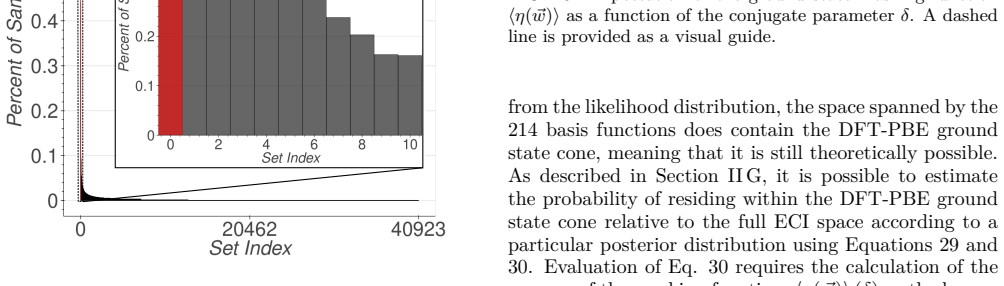
The central discovery is that ground-state replication can be enforced as a prior rather than left to chance. ECI space divides into ray-bounded cones, one per ground-state set, and the masking function η(w)=∫[f(w,x)−g(w,x)]dx measures the area between the target and predicted ground-state hulls. The prior P(w)∝exp(−γη(w)), with γ→∞, restricts the posterior to the target cone. For BCC Li-Al, the RVM and least-squares models fail to reproduce the DFT-PBE ground states and their voltage curves gain spurious or missing steps; the cone-restricted MAP reproduces every DFT step. Sampling 500,000 unrestricted ECI vectors yielded 40,923 different ground-state sets, none the DFT set, and the estimate
What carries the argument
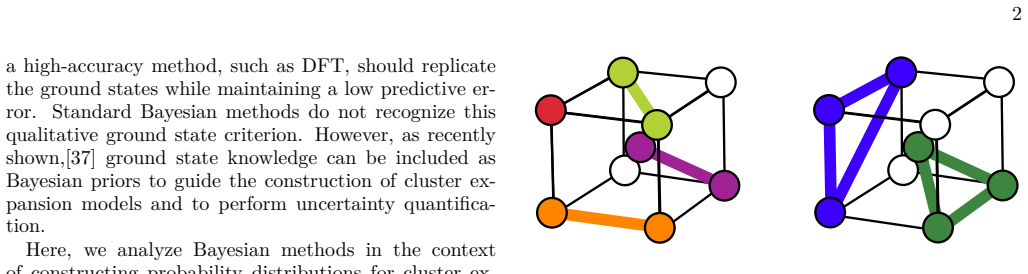
The central object is a ground-state cone in ECI space: the set of coefficient vectors w that predict the same set of lowest-energy configurations (ground states). The carrying mechanism is the masking function η(w), defined as the integral over composition of the area between the target hull f(w,x) and the hull g(w,x) predicted by w. Zero inside the target cone and monotonically increasing outside it, η is inserted into the prior as exp(−γη), so γ→∞ gives zero probability to models outside the cone. A gradient-descent cone finder, using the gradient of η, locates a starting ECI vector in the target cone and also tests whether a given truncation can realize the target ground states at all.
Load-bearing premise
The load-bearing premise is that the DFT-PBE ground-state set is the true set every acceptable model must reproduce; if that set is wrong or functional-dependent, the entire cone-restricted posterior is biased, and the gradient-descent cone search that must find a point in that cone is presented without a convergence proof.
What would settle it
Take 100 ECI vectors sampled from the cone-restricted posterior for Li-Al, build each model's zero-temperature convex hull, and compare the predicted ground states with the DFT-PBE set. If any sample predicts a spurious or missing ground state, the claim that the γ→∞ prior guarantees a single ground-state set fails. Alternatively, re-estimate the reported 3.20×10⁻¹²% probability of the PBE cone with a longer free-energy integration; if the value is not negligibly small, the paper's characterization of the unrestricted posterior is contradicted.
If this is right
- A cone-restricted posterior guarantees that every sampled cluster expansion predicts the same target ground states, so downstream free-energy and voltage uncertainties reflect quantitative spread rather than qualitative disagreement.
- For Li-Al, unrestricted sampling essentially never lands in the DFT-PBE ground-state cone, so reliable uncertainty quantification for ordered alloys requires an explicit ground-state prior.
- The relevance vector machine is a practical hyperparameter scheme for Bayesian cluster expansions: it sparsifies the basis automatically, keeps the posterior Gaussian and analytical, and produces physically reasonable short-range few-body interactions.
- Uncertainty across DFT approximations is larger than the cluster-expansion surrogate uncertainty, so honest uncertainty quantification for first-principles thermodynamics should span multiple exchange-correlation functionals as well as surrogate models.
- The same cone-and-masking construction transfers to other linear surrogate models, including atomic cluster expansions, to enforce qualitative stability predictions.
Where Pith is reading between the lines
- Beyond the paper: cone restriction makes posterior uncertainty conditional on the target ground-state set being true; total uncertainty should therefore also include the choice of DFT functional, which the paper shows moves predictions more than surrogate noise.
- The free-energy integration used to estimate the probability of one cone could be reused as a hypothesis test to rank competing candidate ground-state sets, not just to estimate a single cone's probability.
- A soft, finite-γ version of the masking prior could serve as a diagnostic: increasing the conjugate parameter δ and watching the mean masking function ⟨η⟩ decline shows how strongly the data pull the posterior away from the imposed ground states.
- The same cone construction could be extended beyond exact ground-state matching, for example to enforce relative stability rankings among a handful of competing phases, which is the qualitative constraint most relevant for machine-learned interatomic potentials.
Editorial analysis
A structured set of objections, weighed in public.
Referee Report
Summary. The paper develops Bayesian strategies for cluster expansion (CE) surrogate models in first-principles statistical mechanics, focusing on hyperparameter selection and ground-state preservation. The authors compare cross-validation, Bayesian ridge, and the relevance vector machine for fitting BCC Li_xMg_1-x formation energies using LDA, PBE, and SCAN, and propagate posterior ECI samples to free energies and voltage curves. For Li_xAl_1-x, they introduce a masking function η(w) (Eq. 23) that measures deviation from a target ground-state cone, use gradient descent on η to locate points in the cone, and construct a γ→∞ cone-restricted posterior that by construction predicts the target ground states. They show that unconstrained likelihood and RVM posteriors populate many different ground-state cones (40,923 hulls in 500,000 samples), and they estimate the likelihood probability of the PBE cone as at most 3.2×10^-12%.
Significance. If the methods hold, the paper provides a practical framework for a recognized weakness in Bayesian CEs: standard posteriors assign weight to models with qualitatively different ground states, making downstream thermodynamic UQ ill-defined. The quantitative comparison of CV, Bayesian ridge, and RVM is useful, and the cone-restricted prior is a principled way to encode expert structural knowledge. Strengths include transparent reporting of the finite-δ upper bound and explicit acknowledgment of the trivial-origin failure in cone search. However, the cone-search algorithm of Sec. II F is load-bearing for basis certification and pruning, and it currently has an inconsistent descent-direction formula and no post-hoc verification excluding the zero-ECI minimizer. These issues are fixable and do not invalidate the conceptual framework, but they require revision before the practical workflow can be relied upon.
major comments (3)
- [II F, Eq. (27) and Appendix A (A2)] Eq. (27) as written gives +∇_w η(w), not the negative gradient stated in Eq. (24): the first sum is ∇_w∫f (from Eq. 26) and the second is ∇_w∫g, so the expression equals ∇_w(∫f − ∫g). The parenthetical 'primed (unprimed) quantities come from the integral of f (g)' is ambiguous and inconsistent with the notation of Eqs. (25)-(26). The same sign problem appears in Eq. (A2). Because the descent direction is central to the cone-search algorithm, please correct the signs and define primed/unprimed consistently.
- [II F and III E] The masking function η in Eq. (23) is positively homogeneous of degree one, so η(0)=0 for every target set: at w=0 both f and g vanish. The zero-ECI vector is therefore a global minimizer of η that does not reside in the non-degenerate target cone. The text acknowledges that descent can 'go directly through the origin' but provides no convergence proof or post-hoc criterion to distinguish a valid cone point from this trivial solution. Since the same algorithm is used in Sec. III E to certify that the 505-function basis can replicate the PBE ground states and to assign ∞ removal penalties during pruning to 214 functions, a false positive would directly corrupt the reported basis-selection workflow. Please add a verification step (e.g., check η(w)=0 and enumerate the convex hull predicted by the returned w) and report its outcome.
- [III E / II G] The value 3.2×10^-12% for the probability of the target cone is an upper bound because the δ-integration in Eq. (30) is truncated, as the authors note. This is sufficient for the qualitative conclusion, but the number should be explicitly labeled 'upper bound' wherever it appears, and the truncation point should be stated. If feasible, provide a rough estimate of the neglected tail of ⟨η⟩(δ) to show that the upper bound is non-vacuous.
minor comments (4)
- [III E / Fig. 13(a)] The voltage-curve match of the cone-restricted model is built in by construction (γ→∞ prior forces the PBE cone); the real empirical content is that the OLS and RVM MAP models fail. Please state this explicitly to avoid overclaiming the agreement as independent validation.
- [Abstract / II F] The abstract states that the paper 'provides methods to find and enforce ground-state-preserving models.' Given the heuristic nature of the cone search and the lack of convergence guarantee, consider softening 'find' or adding a caveat.
- [II D] There is a typo: 'fails to predict a the correct set' should read 'fails to predict the correct set.'
- [II G] Equations (28)-(30): define the hypothesis M and clarify that P(M) is with respect to a particular posterior distribution (fixed β and λ). The notation is understandable but could be sharper.
Circularity Check
Cone-restricted posterior's ground-state match is built into Eq. 17 with γ→∞; independent content remains in RVM/ML comparisons, probability estimates, and finite-T predictions.
specific steps
-
self definitional
[Section III E, Eq. (17) and the paragraph defining the cone-restricted posterior; Fig. 13(a)]
"A posterior distribution was then constructed for the ECI of the 505 cluster basis functions using a prior distribution of the form of Eq. 17 in which γ → ∞. This prior distribution restricts the posterior distribution of the ECI vectors w to the DFT-PBE ground state set cone. We refer to this posterior distribution as the cone-restricted distribution. By construction, any ECI vector w sampled from the cone-restricted distribution predicts the correct ground states."
The prior (Eq. 17) is defined through the masking function η(w) of Eq. 23, which is built from f(w,x), the piecewise-linear envelope of the targeted DFT-PBE ground states. Sending γ to ∞ makes the prior vanish outside the cone of ECI vectors that reproduce that target set, so every posterior sample reproduces the input ground states by definition rather than by inference. The zero-K voltage steps in Fig. 13(a) are determined by the ground state set, so the cone-restricted curve matching the DFT-PBE steps is an enforced consequence, not an independent prediction. The paper states 'By construction' explicitly, so this is a transparent definitional loop, but it is still a loop: the demonstrated ground-state replication is equivalent to the constraint imposed.
full rationale
The core method is transparent: the cone-restricted posterior is designed to force the target ground-state set, so the matching voltage-step positions in Fig. 13(a) reduce by construction to the input DFT-PBE ground states. This is the main circular element and warrants a partial-circularity score. However, the paper contains substantial non-circular content: the RVM and maximum-likelihood models are shown to miss the target cone (Figs. 13-14), the probability of the cone under the likelihood is estimated via free-energy integration (Eqs. 28-30), the RMSE trade-off of cone restriction is quantified, and the 300 K Monte Carlo voltage curve (Fig. 13(b)) is a genuine prediction in which entropic effects can alter step positions. The self-citation to Ref. [37] for the cone/masking-function construction is not load-bearing in a circular way because the defining equations are restated in the present paper. The cone-search algorithm's acknowledged trivial-zero failure (Section II F) is a correctness risk for basis certification and pruning, but it is not a circularity; it is a heuristic limitation and is weighed as such. Overall, one central 'prediction' is built in, but independent content remains, so the score is 6 rather than 8-10.
Axiom & Free-Parameter Ledger
free parameters (5)
- Prior precision alpha (BR: common; RVM: per-ECI) =
RVM selects 95 of 754 (Li-Mg) and 97 of 505 (Li-Al) nonzero ECIs; BR curves in Figs. 8-10, no tabulated values
- Likelihood precision beta =
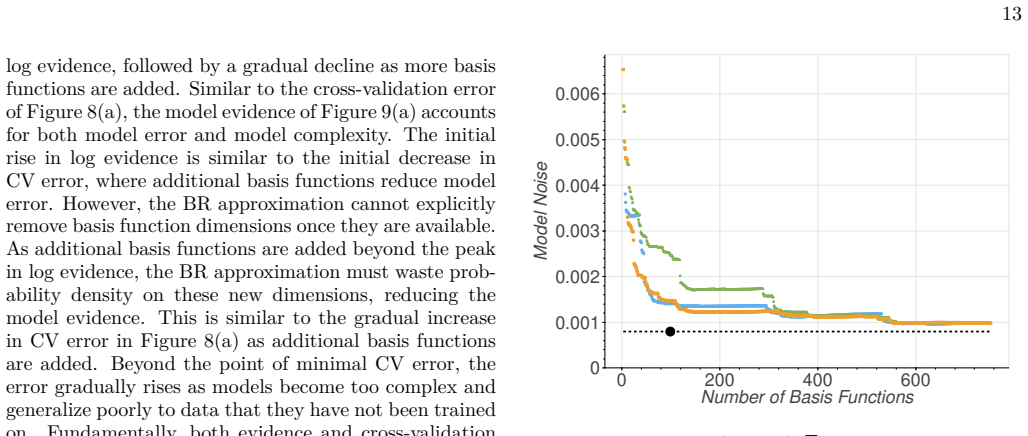
Model noise 1/sqrt(beta) approaches about 1 meV/atom; curves in Fig. 10
- Regularizer lambda = alpha/beta =
Varies with basis size per sequence; curves in Fig. 8(c) and 9(c)
- Ground-state bias gamma (or delta) =
gamma to infinity for enforcement; delta integrated 0 to 0.6
- Basis-pruning RMSE threshold for removing non-RVM basis functions =
3.6 meV/atom
axioms (7)
- standard math Cluster expansion basis functions form a complete orthonormal set in configuration space
- domain assumption Numerical errors in DFT training energies are iid zero-mean Gaussian with precision beta
- domain assumption ECI space partitions into ray-bounded ground-state cones and the masking function eta(w) is zero exactly in the target cone
- domain assumption The DFT-PBE ground state set is the correct target qualitative behavior
- domain assumption The evidence approximation with uniform hyperpriors on alpha and beta is valid
- ad hoc to paper Cone-search gradient descent from multiple axis starts finds the target cone when it exists
- ad hoc to paper Truncating the delta integration at 0.6 gives a valid upper bound for the cone probability
Cite this review
Pith. "Pith review of Bayesian Prior Construction for Uncertainty Quantification in First-Principles Statistical Mechanics." pith.science (2026). https://pith.science/paper/QIBUARZB
@misc{pith2026250907326,
  author       = {Pith},
  title        = {Pith review of: Bayesian Prior Construction for Uncertainty Quantification in First-Principles Statistical Mechanics},
  year         = {2026},
  howpublished = {\url{https://pith.science/paper/QIBUARZB}},
  note         = {Machine review of arXiv:2509.07326}
}
abstract
First-principles statistical mechanics enables the prediction of thermodynamic and kinetic properties of materials, but is computationally expensive. Many approaches require surrogate models to calculate energies within Monte Carlo or molecular dynamics simulations. Inexpensive surrogates such as cluster expansions enable otherwise intractable calculations by interpolating data from higher accuracy methods, such as Density Functional Theory (DFT). Surrogate models introduce uncertainty into downstream calculations, in addition to any uncertainty inherent to DFT calculations. Bayesian frameworks address this by quantifying uncertainty and incorporating expert knowledge through priors. However, constructing effective priors remains challenging. This work introduces and describes practical strategies for building Bayesian cluster expansions, focusing on basis truncation, hyperparameter selection, and ground state replication. We analyze multiple basis truncation schemes, compare cross-validation to the evidence-approximation for hyperparameter optimization, and provide methods to find and enforce ground-state-preserving models through priors. Additionally, we compare the uncertainties between different approximations to DFT (LDA, PBE, SCAN) against the uncertainty introduced with the use of cluster expansion surrogate models. These approaches are demonstrated on the BCC Li$_x$Mg$_{1-x}$ and Li$_x$Al$_{1-x}$ alloys, which are both of interest for solid-state Li batteries. Our results provide guidelines for constructing and utilizing Bayesian cluster expansions, thereby improving the transparency of materials modeling. The approaches and insights developed in this work can be transferred to a wide range of cluster expansion surrogate models, including the atomic cluster expansion and related machine-learned interatomic potential architectures.
Figures




Reference graph
Works this paper leans on
-
[1]
To this end, the DFT data is divided into k equally sized folds with one fold serving as a test set and the remaining k-1 folds used in the likelihood function
Minimization of the cross-validation score A subset of hyperparameters can be estimated by min- imizing a k-fold cross-validation score. To this end, the DFT data is divided into k equally sized folds with one fold serving as a test set and the remaining k-1 folds used in the likelihood function. The cross-validation (CV) er- ror is defined as the root-me...
-
[2]
It does this by maximizing P (⃗ α, β|⃗t), the poste- rior distribution for ⃗ αand β, conditioned on the training data, ⃗t
Evidence approximation The evidence approximation enables an independent estimate of the prior and likelihood hyperparameters, ⃗ α and β. It does this by maximizing P (⃗ α, β|⃗t), the poste- rior distribution for ⃗ αand β, conditioned on the training data, ⃗t. Using Bayes’ theorem, this distribution can be written as [ 36] P (⃗ α, β|⃗t) ∼ P (⃗t|⃗ α, β)P (...
-
[3]
A. R. Allnatt and A. B. Lidiard, Atomic transport in solids (Cambridge University Press, 2003)
2003
-
[4]
A. Van der Ven, J. C. Thomas, B. Puchala, and A. R. Natarajan, First-principles statistical mechanics of mul- ticomponent crystals, Annual Review of Materials Re- search 48, 27 (2018)
work page 2018
-
[5]
J. M. Sanchez, F. Ducastelle, and D. Gratias, Generalized cluster description of multicomponent systems, Physica A: Statistical Mechanics and its Applications 128, 334 (1984)
1984
-
[6]
D. B. Laks, L. Ferreira, S. Froyen, and A. Zunger, Effi- cient cluster expansion for substitutional systems, Phys- ical Review B 46, 12587 (1992)
work page 1992
-
[7]
D. De Fontaine, Cluster approach to order-disorder trans- formations in alloys, in Solid state physics , Vol. 47 (Else- vier, 1994) pp. 33–176
work page 1994
-
[8]
R. Drautz and M. Fähnle, Spin-cluster expansion: Parametrization of the general adiabatic magnetic en- ergy surface with ab initio accuracy, Physical Review B 69, 104404 (2004)
work page 2004
-
[9]
J. C. Thomas and A. Van der Ven, Finite-temperature properties of strongly anharmonic and mechanically un- stable crystal phases from first principles, Physical Re- view B 88, 214111 (2013)
work page 2013
-
[10]
etc.). We focused on the alloy cluster expansion [ 5] due its importance for modeling configurational disor- der in multi-component crystals and its relative simplic- ity when compared to other cluster expansion surrogate models. Many of the conclusions of this study can be generalized to other classes of cluster expansion surro- gate models. Bayesian app...
-
[11]
E. T. Jaynes, Information theory and statistical mechan- ics, Physical review 106, 620 (1957)
1957
-
[12]
T. L. Hill, Statistical mechanics: principles and selected applications (Courier Corporation, 2013)
2013
-
[13]
J. C. Thomas, J. S. Bechtel, A. R. Natarajan, and A. Van der Ven, Machine learning the density functional theory potential energy surface for the inorganic halide perovskite cspbbr 3, Physical Review B 100, 134101 (2019)
work page 2019
-
[14]
B. Puchala, J. C. Thomas, A. R. Natarajan, J. G. Goiri, S. S. Behara, J. L. Kaufman, and A. Van der Ven, Casm—a software package for first-principles based study of multicomponent crystalline solids, Computa- tional Materials Science 217, 111897 (2023)
work page 2023
-
[15]
S. S. Behara, J. C. Thomas, B. Puchala, and A. Van der Ven, Chemomechanics in alloy phase stability, Physical Review Materials 8, 033801 (2024)
work page 2024
-
[16]
K. Schütt, P.-J. Kindermans, H. E. Sauceda Felix, S. Chmiela, A. Tkatchenko, and K.-R. Müller, Schnet: A continuous-filter convolutional neural network for mod- eling quantum interactions, Advances in neural informa- tion processing systems 30 (2017)
work page 2017
-
[17]
O. T. Unke and M. Meuwly, Physnet: A neural network for predicting energies, forces, dipole moments, and par- tial charges, Journal of chemical theory and computation 15, 3678 (2019)
2019
-
[18]
J. Gasteiger, J. Groß, and S. Günnemann, Directional message passing for molecular graphs, arXiv preprint arXiv:2003.03123 (2020)
Pith/arXiv arXiv 2003
-
[19]
J. C. Thomas, J. S. Bechtel, and A. Van der Ven, Hamil- tonians and order parameters for crystals of orientable molecules, Physical Review B 98, 094105 (2018)
work page 2018
-
[20]
A. R. Natarajan and A. Van der Ven, Machine-learning the configurational energy of multicomponent crystalline solids, npj Computational Materials 4, 56 (2018)
work page 2018
-
[21]
Drautz, Atomic cluster expansion for accurate and transferable interatomic potentials, Physical Review B 99, 014104 (2019)
R. Drautz, Atomic cluster expansion for accurate and transferable interatomic potentials, Physical Review B 99, 014104 (2019)
2019
-
[22]
V. G. Satorras, E. Hoogeboom, and M. Welling, E (n) equivariant graph neural networks, in International con- ference on machine learning (PMLR, 2021) pp. 9323– 9332
work page 2021
- [23]
-
[24]
M. Haghighatlari, J. Li, X. Guan, O. Zhang, A. Das, C. J. Stein, F. Heidar-Zadeh, M. Liu, M. Head-Gordon, L. Bertels, et al., Newtonnet: A newtonian message pass- ing network for deep learning of interatomic potentials and forces, Digital Discovery 1, 333 (2022)
work page 2022
-
[25]
softened
can be generalized to high-dimensional composition spaces. The integral of the piecewise linear function con- necting the energies of the target ground states in high- dimensional composition spaces can be written as ∫ f ( ⃗ w, ⃗ x)dx = 1 d + 1 ∑ s∈S (∑ i∈s ⃗ξi ⃗ w ) 1 d! |det(Xs)| (A1) where d is the dimension of the composition space and s indexes simpl...
-
[26]
P. Thölke and G. De Fabritiis, Torchmd-net: equivariant transformers for neural network based molecular poten- tials, arXiv preprint arXiv:2202.02541 (2022)
Pith/arXiv arXiv 2022
-
[27]
To minimize the risk of this occurring, gradient descent can be performed from multiple start- ing points, e.g
This procedure can fail if the negative gradient points directly through the origin, resulting in the zero vector as a trivial solution. To minimize the risk of this occurring, gradient descent can be performed from multiple start- ing points, e.g. each axis in ECI space (the positive and negative unit vectors of each axis). If the truncated clus- ter exp...
-
[28]
B. Anderson, T. S. Hy, and R. Kondor, Cormorant: Co- variant molecular neural networks, Advances in neural information processing systems 32 (2019)
work page 2019
-
[29]
N. Thomas, T. Smidt, S. Kearnes, L. Yang, L. Li, K. Kohlhoff, and P. Riley, Tensor field networks: Rotation-and translation-equivariant neural networks for 3d point clouds, arXiv preprint arXiv:1802.08219 (2018)
Pith/arXiv arXiv 2018
-
[30]
30 requires the calculation of the average of the masking function, ⟨η( ⃗ w)⟩ (δ) as the hyper- parameter δ is varied from 0 to ∞
Evaluation of Eq. 30 requires the calculation of the average of the masking function, ⟨η( ⃗ w)⟩ (δ) as the hyper- parameter δ is varied from 0 to ∞. This average was estimated with Monte Carlo simulations using the likeli- hood distribution (which corresponds to a posterior dis- tribution in which all αc = 0 ) over a range of δ (Figure 15). The integratio...
- [31]
-
[32]
L. Cao, C. Li, and T. Mueller, The use of cluster expan- sions to predict the structures and properties of surfaces and nanostructured materials, Journal of Chemical In- formation and Modeling 58, 2401 (2018)
work page 2018
-
[33]
A. Van der Ven, Z. Deng, S. Banerjee, and S. P. Ong, Rechargeable alkali-ion battery materials: theory and 22 computation, Chemical reviews 120, 6977 (2020)
work page 2020
-
[34]
J. Klicpera, F. Becker, and S. Günnemann, Gemnet: Uni- versal directional graph neural networks for molecules, in Proceedings of the 35th International Conference on Neural Information Processing Systems (2021) pp. 6790– 6802
work page 2021
-
[35]
D. Jung, S. S. Behara, and A. Van der Ven, Phase sta- bility and chemomechanics in the ge–sn alloy, Acta Ma- terialia , 121369 (2025)
work page 2025
-
[36]
J. Brandstetter, R. Hesselink, E. van der Pol, E. J. Bekkers, and M. Welling, Geometric and physical quan- tities improve e (3) equivariant message passing, arXiv preprint arXiv:2110.02905 (2021)
Pith/arXiv arXiv 2021
-
[37]
S. Batzner, A. Musaelian, L. Sun, M. Geiger, J. P. Mailoa, M. Kornbluth, N. Molinari, T. E. Smidt, and B. Kozinsky, E (3)-equivariant graph neural networks for data-efficient and accurate interatomic potentials, Na- ture communications 13, 2453 (2022)
work page 2022
-
[38]
A. Duval, S. V. Mathis, C. K. Joshi, V. Schmidt, S. Miret, F. D. Malliaros, T. Cohen, P. Liò, Y. Bengio, and M. Bronstein, A hitchhiker’s guide to geometric gnns for 3d atomic systems, arXiv preprint arXiv:2312.07511 (2023)
Pith/arXiv arXiv 2023
-
[39]
I. Batatia, S. Batzner, D. P. Kovács, A. Musaelian, G. N. Simm, R. Drautz, C. Ortner, B. Kozinsky, and G. Csányi, The design space of e (3)-equivariant atom-centred inter- atomic potentials, Nature Machine Intelligence , 1 (2025)
work page 2025
-
[40]
A. R. Natarajan, J. C. Thomas, B. Puchala, and A. Van der Ven, Symmetry-adapted order parameters and free energies for solids undergoing order-disorder phase transitions, Physical Review B 96, 134204 (2017)
work page 2017
-
[41]
M. Aldegunde, N. Zabaras, and J. Kristensen, Quantify- ing uncertainties in first-principles alloy thermodynam- ics using cluster expansions, Journal of Computational Physics 323, 17 (2016)
work page 2016
-
[42]
J. Sanchez and D. De Fontaine, The fcc ising model in the cluster variation approximation, Physical Review B 17, 2926 (1978)
work page 1978
-
[43]
S. Kadkhodaei and J. A. Muñoz, Cluster expansion of al- loy theory: a review of historical development and mod- ern innovations, JOM 73, 3326 (2021)
work page 2021
-
[44]
J. P. Perdew, P. Ziesche, and H. Eschrig, Electronic structure of solids’ 91 (1991)
work page 1991
-
[45]
Bayesian- Ridge
and the SCAN meta-Generalized Gradient Approxi- mation functional [46]. The calculated formation energies are shown in Figure 6(a). The energies of BCC Li and HCP Mg were used as reference states when calculating the formation energies. Figure 6(b) shows the forma- tion energies of 444 Li-Al configurations over the sites of the BCC crystal structure as ca...
-
[46]
C. M. Bishop, Pattern Recognition and Machine Learn- ing, 1st ed. (Springer Science+Business Media, LLC, 2006)
work page 2006
-
[47]
D. E. Ober and A. Van der Ven, Thermodynamically informed priors for uncertainty propagation in first- principles statistical mechanics, Physical Review Mate- rials 8, 103803 (2024)
work page 2024
-
[48]
A. van de Walle and G. Ceder, Automating first- principles phase diagram calculations, Journal of Phase Equilibria 23, 348 (2002)
work page 2002
-
[49]
D. J. MacKay, Bayesian interpolation, Neural computa- tion 4, 415 (1992)
work page 1992
-
[50]
M. E. Tipping, Sparse bayesian learning and the rele- vance vector machine, Journal of machine learning re- search 1, 211 (2001)
work page 2001
-
[51]
C. Wolverton, V. Ozolins, and A. Zunger, Short-range- order types in binary alloys: a reflection of coherent phase stability, Journal of Physics: Condensed Matter 12, 2749 (2000)
work page 2000
-
[52]
Kohn and L
W. Kohn and L. J. Sham, Self-consistent equations in- cluding exchange and correlation effects, Physical review 140, A1133 (1965)
1965
-
[53]
C. B. Gopal and A. van de Walle, Ab initio thermody- namics of intrinsic oxygen vacancies in ceria, Physical Review B—Condensed Matter and Materials Physics 86, 134117 (2012)
work page 2012
-
[54]
J. P. Perdew, K. Burke, and M. Ernzerhof, Generalized gradient approximation made simple, Physical review let- ters 77, 3865 (1996)
1996
-
[55]
J. Sun, A. Ruzsinszky, and J. P. Perdew, Strongly constrained and appropriately normed semilocal density functional, Physical review letters 115, 036402 (2015)
work page 2015
-
[56]
17 to a specific ground state cone, it also offers a way of finding ECI vectors ⃗ wthat replicate the targeted ground states
and Monte Carlo annealing simulations to determine the ground states for the ECI vector ⃗ w.[55] While the masking function η( ⃗ w) is designed to bias the prior probability distribution Eq. 17 to a specific ground state cone, it also offers a way of finding ECI vectors ⃗ wthat replicate the targeted ground states. This is important to determine whether a...
-
[57]
K. Lejaeghere, G. Bihlmayer, T. Björkman, P. Blaha, S. Blügel, V. Blum, D. Caliste, I. E. Castelli, S. J. Clark, A. Dal Corso, et al. , Reproducibility in density func- tional theory calculations of solids, Science 351, aad3000 (2016)
work page 2016
-
[58]
T. Mueller and G. Ceder, Bayesian approach to cluster expansions, Phys. Rev. B 80, 024103 (2009)
work page 2009
-
[59]
J. Kristensen and N. J. Zabaras, Bayesian uncertainty quantification in the evaluation of alloy properties with the cluster expansion method, Computer Physics Com- munications 185, 2885 (2014)
work page 2014
-
[60]
C. Wolverton, First-principles theory of 250 000-atom co- herent alloy microstructure, Modelling and Simulation in Materials Science and Engineering 8, 323 (2000)
work page 2000
-
[61]
K. Wang, D. Cheng, and B.-C. Zhou, Generalization of the mixed-space cluster expansion method for arbitrary lattices, npj Computational Materials 9, 75 (2023)
work page 2023
-
[62]
P. E. Blöchl, Projector augmented-wave method, Physi- cal review B 50, 17953 (1994)
work page 1994
-
[63]
to obtain accurate total energies. III. RESUL TS To analyze the concepts and methods of Section II, we construct cluster expansions and their posterior proba- bility distributions for the BCC forms of Li xMg1−x and LixAl1−x. Both alloys are currently of interest due to their beneficial role in moderating morphological evolu- tion during lithium plating an...
-
[64]
Inden, Atomic ordering, Phase transformations in ma- terials , 519 (2001)
G. Inden, Atomic ordering, Phase transformations in ma- terials , 519 (2001)
work page 2001
-
[65]
B. Puchala, J. C. Thomas, and A. Van der Ven, Casm monte carlo: Calculations of the thermodynamic and kinetic properties of complex multicomponent crystals, Computational Materials Science 260, 114091 (2025)
work page 2025
-
[66]
G. L. Hart and R. W. Forcade, Algorithm for generat- ing derivative structures, Physical Review B—Condensed Matter and Materials Physics 77, 224115 (2008)
work page 2008
-
[67]
F. Pedregosa, G. Varoquaux, A. Gramfort, V. Michel, B. Thirion, O. Grisel, M. Blondel, P. Prettenhofer, R. Weiss, V. Dubourg, J. Vanderplas, A. Passos, D. Cour- napeau, M. Brucher, M. Perrot, and E. Duchesnay, Scikit-learn: Machine learning in Python, Journal of Ma- chine Learning Research 12, 2825 (2011)
work page 2011
-
[68]
A. Vehtari and J. Lampinen, Bayesian model assessment and comparison using cross-validation predictive densi- ties, Neural computation 14, 2439 (2002)
work page 2002
-
[69]
Kresse and J
G. Kresse and J. Hafner, Ab initio molecular dynamics for liquid metals, Physical review B 47, 558 (1993)
1993
-
[70]
G. Kresse and J. Furthmüller, Efficiency of ab-initio total energy calculations for metals and semiconductors using a plane-wave basis set, Computational materials science 6, 15 (1996)
work page 1996
-
[71]
G. Kresse and J. Furthmüller, Efficient iterative schemes for ab initio total-energy calculations using a plane-wave basis set, Physical review B 54, 11169 (1996)
work page 1996
-
[72]
P. E. Blöchl, O. Jepsen, and O. K. Andersen, Improved tetrahedron method for brillouin-zone integrations, Phys- ical Review B 49, 16223 (1994)
work page 1994
-
[73]
C. Yang, H. Xie, W. Ping, K. Fu, B. Liu, J. Rao, J. Dai, C. Wang, G. Pastel, and L. Hu, An electron/ion dual-conductive alloy framework for high-rate and high- capacity solid-state lithium-metal batteries, Advanced Materials 31, 1804815 (2019)
work page 2019
-
[74]
T. Krauskopf, B. Mogwitz, C. Rosenbach, W. G. Zeier, and J. Janek, Diffusion limitation of lithium metal and Li–Mg alloy anodes on LLZO type solid electrolytes as a function of temperature and pressure, Advanced Energy Materials 9, 1902568 (2019)
work page 2019
-
[75]
Y. Liu, C. Wang, S. G. Yoon, S. Y. Han, J. A. Lewis, D. Prakash, E. J. Klein, T. Chen, D. H. Kang, D. Ma- jumdar, et al. , Aluminum foil negative electrodes with multiphase microstructure for all-solid-state Li-ion bat- teries, Nature Communications 14, 3975 (2023)
work page 2023
-
[76]
Y.-G. Lee, S. Fujiki, C. Jung, N. Suzuki, N. Yashiro, R. Omoda, D.-S. Ko, T. Shiratsuchi, T. Sugimoto, S. Ryu, et al. , High-energy long-cycling all-solid-state lithium metal batteries enabled by silver–carbon com- posite anodes, Nature Energy 5, 299 (2020)
work page 2020
-
[77]
S. S. Behara, J. Thomas, and A. Van der Ven, Fundamen- tal thermodynamic, kinetic, and mechanical properties of lithium and its alloys, Chemistry of Materials 36, 7370 (2024)
work page 2024
-
[78]
S. S. Behara and A. Van der Ven, Role of short-range or- der on diffusion coefficients in the li–mg alloy, Chemistry of Materials 36, 11236 (2024)
work page 2024
-
[79]
J. C. Thomas, A. R. Natarajan, and A. Van der Ven, Comparing crystal structures with symmetry and geom- etry, npj Computational Materials 7, 164 (2021)
work page 2021
-
[80]
N. A. Zarkevich and D. D. Johnson, Reliable first- 23 principles alloy thermodynamics via truncated cluster ex- pansions, Physical review letters 92, 255702 (2004)
work page 2004
This paper was first reviewed by deepseek-v4-flash on August 4, 2026.
discussion (0)
Sign in with ORCID, Apple, or X to comment. Anyone can read and Pith papers without signing in.