REVIEW 4 major objections 4 minor 35 references
SBS: Enhancing Parameter-Efficiency of Neural Representations for Neural Networks via Spectral Bias Suppression
T0 review · 4 major / 4 minor · reviewed 2026-08-04 · deepseek-v4-flash
Pith's one-line read A small MLP can regenerate a pretrained CNN's weights with 2–3x better parameter efficiency if its spectral bias is suppressed in both output and input space.
desk verdict A plausible incremental win over NeRN with a garbled theory section and a sigma-selection rule that is weaker than the authors claim. read the letter →
The pith
A machine-rendered reading of the paper's core claim, the machinery that carries it, and where it could break.
The reading
What carries the argument
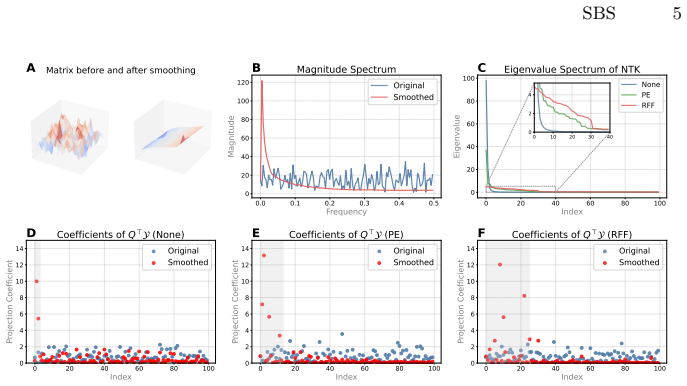
The two load-bearing mechanisms are the UOS permutation and the UOS-RFF encoding. UOS is a greedy reordering of CNN kernels within each layer along a single axis, the filter index, minimizing Euclidean distance between neighboring kernels; this reshapes the target weight signal so its energy sits in the low-frequency eigenmodes that a ReLU-MLP learns fastest, as measured by the neural tangent kernel (NTK), the Gram matrix governing frequency-wise convergence under gradient descent. UOS-RFF is a random Fourier feature input encoding whose Gaussian bandwidth sigma is reduced as layer-wise parameter count grows, preventing the input coordinates from collapsing into too narrow a frequency band a
What would settle it
Take a CNN with larger layers than ResNet18 (for instance, ResNet50) on ImageNet, fix UOS and the SBS training objective, and sweep the RFF bandwidth sigma. The paper's rule predicts the optimal sigma should drop below the value used for ResNet18 (100); finding that the best sigma is set by dataset or architecture in a way uncorrelated with layer count would undercut the UOS-RFF contribution.
Extended reading notes
Core claim
The paper's claim is that the limiting factor in NeRN-style MLPs that generate CNN weights is spectral bias: the ReLU-MLP acts as a low-pass filter, so it reconstructs smooth, low-frequency weight arrangements well but loses high-frequency kernel detail. SBS attacks this on both sides of the MLP. In output space, UOS greedily reorders kernels within each layer along one direction (filter-wise) using Euclidean distance, concentrating energy at low frequencies so the target signal is easier for the MLP to fit. In input space, UOS-RFF maps coordinates through random Fourier features and sets the bandwidth sigma inversely to layer-wise parameter count, rebalancing the frequency content the MLP s
Load-bearing premise
The method's central premise is that the ideal frequency bandwidth of the input encoding depends mainly on how many parameters the CNN layer has, so the rule 'wider layers need smaller bandwidth' carries over to new networks rather than being a per-dataset hyperparameter choice.
Editorial extensions
If this is right
- NeRN-style weight reconstruction can reach a given accuracy with roughly one-third to one-half of the MLP parameters previously needed, making weight-representation compression more practical for mobile and edge deployment.
- The same ReLU-MLP backbone no longer needs a stronger teacher or extra distillation signal: at equal MLP size, SBS outperforms the stronger-teacher variant while using no external supervision.
- The bandwidth rule makes the method transfer across CNN widths: wider layers automatically receive smaller RFF bandwidth, reducing per-dataset frequency hyperparameter search.
- The gains grow as the MLP shrinks, so the method is most effective exactly in the low-parameter regime where compression matters.
Reading between the lines
- A natural extension is per-layer or per-block bandwidth selection instead of one global sigma; the paper's inverse-relationship rule suggests such adaptivity could remove the remaining hyperparameter tuning.
- Because UOS concentrates kernel energy at low frequencies, the reconstructed weights may also compress better under standard quantization or sparsification downstream — the paper does not test this.
- The unidirectional-over-multidirectional insight may transfer to other INR tasks where the target signal has a natural axis ordering (e.g., video frames along time, volumetric slices), not just CNN kernels.
- The paper's comparison against a distillation-augmented baseline suggests a fairer protocol for weight-space INRs: measure gains over unaugmented baselines before importing external supervision.
Editorial analysis
A structured set of objections, weighed in public.
Referee Report
Summary. The paper proposes SBS, a parameter-efficiency enhancement to NeRN (neural representation for neural networks). SBS augments a coordinate-based ReLU-MLP that generates CNN weights with two mechanisms: (1) Unidirectional Ordering-based Smoothing (UOS), a greedy permutation that reorders CNN kernels along one direction using Euclidean distance to increase low-frequency energy in the output space; and (2) UOS-RFF, a Random Fourier Feature input encoding whose bandwidth σ² is reduced for wider CNNs, based on the authors' observation that larger models exhibit stronger low-frequency bias under UOS. The method is evaluated on ResNet20/ResNet56 for CIFAR-10, ResNet56 for CIFAR-100, and ResNet18 for ImageNet, comparing against NeRN and a stronger-teacher variant. The central claim is a 2–3× improvement in parameter efficiency, e.g., reaching NeRN's 46%-parameter-usage accuracy with about 15% of the MLP parameters on ImageNet.
Significance. If the empirical claims hold, the paper makes a useful practical contribution: it improves NeRN's parameter efficiency without external supervision, with consistent gains across CIFAR-10, CIFAR-100, and ImageNet. The experimental tables are the main strength: SBS consistently outperforms NeRN at the same MLP hidden sizes, the ImageNet result (Table 3) is competitive even against a stronger-teacher variant, and the UOS ablation (Table 4) supports the ordering strategy. However, the paper's theoretical scaffolding is substantially weaker than claimed. Equations (5) and (7) are asserted without derivations, the UOS-RFF bandwidth rule rests on a confounded two-point comparison, and the claim of a proof for RFF's advantage is unsupported. These gaps do not invalidate the empirical comparison, but they prevent the paper from supporting its advertised principled design rules.
major comments (4)
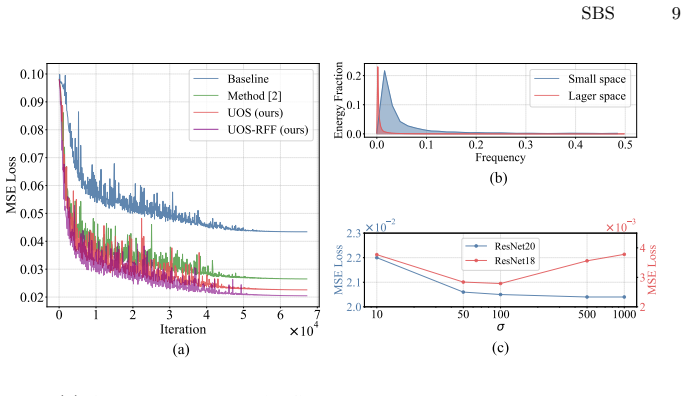
- [§4.3, Table 5, Fig. 4(c)] The UOS-RFF design rule ('for wider CNNs, reduce RFF bandwidth σ²') is supported only by two configurations that change architecture, dataset, and input resolution simultaneously (ResNet20/CIFAR-10 vs ResNet18/ImageNet), so the inverse relationship is confounded. Moreover, Table 5 is internally inconsistent with the main CIFAR setup: for ResNet20, accuracy increases monotonically from 91.05 at σ=10 to 91.44 at σ=1000, with no peak reached, yet the main CIFAR experiments fix σ=400. On the paper's own grid, σ=400 is suboptimal. The reported CIFAR gains are therefore not at SBS's best configuration, and the claimed adaptivity of UOS-RFF is not validated as a causal layer-count law. Controlled experiments (e.g., same dataset/architecture with varying layer widths) are needed.
- [§4.1, Eq. (5)] The bound in Eq. (5) is stated without derivation and with several undefined quantities. What exactly are Δf_i, n_k, δ, and ε, and how does the first inequality follow from the linear-region argument? The step from this bound to the regularization term S(w) in Eq. (6) is the theoretical basis for UOS, but as written Eq. (5) is not checkable. Please provide a complete derivation or explicitly label the statement as heuristic motivation.
- [§4.2, Eq. (7)] The claim that unidirectional smoothing yields faster convergence than multi-directional smoothing is asserted as Eq. (7) without derivation. The coefficients c1, c2, c3 are not defined, and the approximation ‖ft(X)-Y‖² ≈ |c1| e^{-ηλ1t} does not follow from Eqs. (2) and (4) as written: replacing the full eigenvalue sum by a single term requires an error bound. Since UOS is one of the paper's two main contributions, this step needs either a rigorous justification or an explicit statement that it is an empirical observation.
- [§4.3, Eqs. (10)–(12)] The RFF kernel approximation contains a factor error. With B∼N(0,σ²I) and φ(x)=[cos(πBx), sin(πBx)], the expected inner product is exp(-π²σ²‖x-y‖²/2), not exp(-σ²‖x-y‖²/2) as written in Eq. (12). Additionally, the sentence in §4.3 claiming RFF's advantage is 'theoretically proven' is not backed by any theorem or proof in the paper; please correct the formula and soften or substantiate the claim.
minor comments (4)
- [Tables 1–2] Typos: 'Achitecture' and 'Smothness' in the table headers. Also, the asterisk in Table 3 is not explained in the caption.
- [§5.3] The phrase 'reaches the performance of NeRN at 46% parameter usage with only about 15% of the MLP parameters' is imprecise: in Table 3, SBS at 15% gives 68.57 while NeRN at 46% gives 68.74, a 0.17 accuracy gap. State the tolerance or compare within variance.
- [§5] Training details are missing: values of α and β in the loss, learning-rate schedule, number of epochs, RFF feature dimension, number of random seeds, and standard deviations. These are needed to assess whether reported differences of 0.1–0.3% are significant.
- [Fig. 4] The caption of Fig. 4 appears garbled in the reviewed version (e.g., '/uni00000013/...' tokens). Please ensure the final figure is legible and the caption renders correctly.
Circularity Check
No significant circularity; the UOS-RFF bandwidth heuristic is under-validated but not self-referential.
full rationale
The paper's central derivation chain is not circular. The low-pass property (Eqs. 1–4) is imported from external NTK literature (Basri et al., Arora et al., Rahaman et al.), not from the authors' own results. The output-space UOS smoothing is an empirical algorithm whose effectiveness is measured against NeRN at matched MLP sizes on CIFAR-10/100 and ImageNet (Tables 1–3); these external head-to-head comparisons are independent of any internal design rule. The only arguably self-referential element is the UOS-RFF bandwidth rule in Sec. 4.3: the statement 'for wider CNNs ... reduce RFF bandwidth' is inferred from Fig. 4(b,c)/Table 5 and then used to set σ=400 for CIFAR and σ=100 for ImageNet. However, this is an empirical heuristic, not a fitted parameter renamed as a prediction: the paper does not estimate σ from the target accuracy, and the main efficiency claims do not mathematically reduce to the heuristic. In fact, Table 5 shows ResNet20 accuracy still increasing at σ=1000, so the chosen σ=400 is not even the paper's best observed setting; this is a validity/rigor issue, not circularity. There are no self-citations, no imported uniqueness theorems, and no ansatz smuggled via citation. The phrase 'theoretically proven' in Sec. 4.3 is an overstatement—the argument is heuristic—but it is not circular. Therefore the derivation chain is self-contained against external benchmarks and the circularity score is 0.
Assumptions & free parameters
free parameters (3)
- RFF bandwidth sigma =
400 (CIFAR-10/100), 100 (ImageNet)
- Loss weights alpha and beta =
not reported
- MLP hidden size =
140 to 1372 depending on experiment
assumptions (4)
- standard math ReLU MLPs in the NTK regime act as low-pass filters with exponentially decaying eigenvalue spectra for high-frequency components
- domain assumption CNN kernels can be reordered along a single dimension so that the resulting sequence is locally smooth and easier for an MLP to fit
- domain assumption The number of linear regions K of the ReLU-MLP is much smaller than the number of weight samples n (K << n), so local linear-region behavior dominates approximation error
- standard math Random Fourier Features with high enough dimensionality approximate a Gaussian kernel that preserves sensitivity to high frequencies
Cite this review
Pith. "Pith review of SBS: Enhancing Parameter-Efficiency of Neural Representations for Neural Networks via Spectral Bias Suppression." pith.science (2026). https://pith.science/paper/YXWJGXKX
@misc{pith2026250907373,
  author       = {Pith},
  title        = {Pith review of: SBS: Enhancing Parameter-Efficiency of Neural Representations for Neural Networks via Spectral Bias Suppression},
  year         = {2026},
  howpublished = {\url{https://pith.science/paper/YXWJGXKX}},
  note         = {Machine review of arXiv:2509.07373}
}
read the original abstract
Implicit neural representations have recently been extended to represent convolutional neural network weights via neural representation for neural networks, offering promising parameter compression benefits. However, standard multi-layer perceptrons used in neural representation for neural networks exhibit a pronounced spectral bias, hampering their ability to reconstruct high-frequency details effectively. In this paper, we propose SBS, a parameter-efficient enhancement to neural representation for neural networks that suppresses spectral bias using two techniques: (1) a unidirectional ordering-based smoothing that improves kernel smoothness in the output space, and (2) unidirectional ordering-based smoothing aware random fourier features that adaptively modulate the frequency bandwidth of input encodings based on layer-wise parameter count. Extensive evaluations on various ResNet models with datasets CIFAR-10, CIFAR-100, and ImageNet, demonstrate that SBS achieves significantly better reconstruction accuracy with less parameters compared to SOTA.
Figures


Figures from the paper (2 more)

Reference graph
Works this paper leans on
-
[1]
In: Pro- ceedings of the 36th International Conference on Machine Learning
Arora, S., Du, S.S., Hu, W., Li, Z., Wang, R.: Fine-grained analysis of optimiza- tion and generalization for overparameterized two-layer neural networks. In: Pro- ceedings of the 36th International Conference on Machine Learning. pp. 322–332. PMLR (2019)
work page 2019
-
[2]
In: The Eleventh International Conference on Learning Representations (2023) 14 Q
Ashkenazi, M., Rimon, Z., Vainshtein, R., Levi, S., Richardson, E., Mintz, P., Treister, E.: Nern: Learning neural representations for neural networks. In: The Eleventh International Conference on Learning Representations (2023) 14 Q. Xie et al
work page 2023
-
[3]
In: Advances in Neural Information Processing Systems
Ashkenazi, M., Treister, E.: Towards croppable implicit neural representations. In: Advances in Neural Information Processing Systems. vol. 37 (2024)
work page 2024
-
[4]
In: Advances in Neural Information Processing Systems
Basri, R., Jacobs, D., Kasten, Y., Kritchman, S.: The convergence rate of neural networks for learned functions of different frequencies. In: Advances in Neural Information Processing Systems. vol. 32 (2019)
work page 2019
-
[5]
ACM Transactions on Graph- ics (Proc
Bemana, M., Myszkowski, K., Seidel, H.P., Ritschel, T.: X-fields: Implicit neu- ral view-, light- and time-image interpolation. ACM Transactions on Graph- ics (Proc. SIGGRAPH Asia 2020)39(6), 1–15 (2020). https://doi.org/10.1145/ 3414685.3417827
arXiv 2020
-
[6]
In: Advances in Neural Information Processing Systems
Chen, H., He, B., Wang, H., Ren, Y., Lim, S.N., Shrivastava, A.: Nerv: Neural representations for videos. In: Advances in Neural Information Processing Systems. vol. 34, pp. 21557–21568 (2021)
work page 2021
-
[7]
In: Proceedings of the IEEE/CVF Conference on Com- puter Vision and Pattern Recognition
Chen, Y., Liu, S., Wang, X.: Learning continuous image representation with local implicit image function. In: Proceedings of the IEEE/CVF Conference on Com- puter Vision and Pattern Recognition. pp. 8628–8638 (2021)
work page 2021
-
[8]
Learning Implicit Fields for Generative Shape Modeling
Chen, Z., Zhang, H.: Learning implicit fields for generative shape modeling. arXiv preprint arXiv:1812.02822 (2018)
work page Pith review arXiv 2018
Show all 35 references
-
[9]
arXiv preprint arXiv:2407.00356 (2024)
Choi, H., Thiagarajan, J.J., Glatt, R., Liu, S.: Enhancing accuracy and parameter- efficiency of neural representations for network parameterization. arXiv preprint arXiv:2407.00356 (2024)
2024 arXiv
-
[10]
Mathe- matics of Control, Signals and Systems2(4), 303–314 (1989)
Cybenko, G.: Approximation by superpositions of a sigmoidal function. Mathe- matics of Control, Signals and Systems2(4), 303–314 (1989)
1989
-
[11]
In: Proceedings of the IEEE Conference on Computer Vision and Pattern Recognition (CVPR)
Deng, J., Dong, W., Socher, R., Li, L.J., Li, K., Fei-Fei, L.: Imagenet: A large-scale hierarchical image database. In: Proceedings of the IEEE Conference on Computer Vision and Pattern Recognition (CVPR). pp. 248–255 (2009)
2009
-
[12]
arXiv preprint arXiv:1801.01952 (2018)
Deutsch, L.: Generating neural networks with neural networks. arXiv preprint arXiv:1801.01952 (2018)
2018 arXiv
-
[13]
arXiv preprint arXiv:2103.03123 (2021)
Dupont, E., Goliński, A., Alizadeh, M., Teh, Y.W., Doucet, A.: Coin: Compression with implicit neural representations. arXiv preprint arXiv:2103.03123 (2021)
2021 arXiv
-
[14]
arXiv preprint arXiv:1609.09106 (2016)
Ha, D., Dai, A., Le, Q.V.: Hypernetworks. arXiv preprint arXiv:1609.09106 (2016)
2016 arXiv
-
[15]
He,K.,Zhang,X.,Ren,S.,Sun,J.:Deepresiduallearningforimagerecognition.In: Proceedings of the IEEE Conference on Computer Vision and Pattern Recognition (CVPR). pp. 770–778 (2016)
2016
-
[16]
Neural Networks2(5), 359–366 (1989)
Hornik, K., Stinchcombe, M., White, H.: Multilayer feedforward networks are uni- versal approximators. Neural Networks2(5), 359–366 (1989)
1989
-
[17]
In: Proceedings of the IEEE/CVF Conference on Computer Vision and Pattern Recognition
Jiang, C.M., Sud, A., Makadia, A., Huang, J., Nießner, M., Funkhouser, T.: Lo- cal implicit grid representations for 3d scenes. In: Proceedings of the IEEE/CVF Conference on Computer Vision and Pattern Recognition. pp. 6001–6010 (2020)
2020
-
[18]
arXiv preprint arXiv:2204.02405 (2022)
Kim, C., Lee, J., Shin, J.: Zero-shot blind image denoising via implicit neural representations. arXiv preprint arXiv:2204.02405 (2022)
2022 arXiv
-
[19]
In: 2024 IEEE International Solid-State Circuits Conference (ISSCC)
Kim, S., Kim, S., Jo, W., Kim, S., Hong, S., Yoo, H.J.: C-transformer: A 2.6- 18.1µj/token homogeneous dnn-transformer/spiking-transformer processor with big-little network and implicit weight generation for large language models. In: 2024 IEEE International Solid-State Circui...
2024
-
[20]
In: Advances in Neural Information Processing Systems
Knyazev, B., Drozdzal, M., Taylor, G.W., Romero Soriano, A.: Parameter predic- tion for unseen deep architectures. In: Advances in Neural Information Processing Systems. vol. 34, pp. 29433–29448 (2021)
2021
-
[21]
Krizhevsky, A.: Learning multiple layers of features from tiny images. Tech. rep., University of Toronto (2009) SBS 15
2009
-
[22]
In: 2021 IEEE/RSJ Interna- tionalConferenceonIntelligentRobotsandSystems(IROS).pp.1323–1330(2021)
Lin, Y.C., Florence, P., Barron, J.T., Rodriguez, A., Isola, P., Lin, T.Y.: inerf: Inverting neural radiance fields for pose estimation. In: 2021 IEEE/RSJ Interna- tionalConferenceonIntelligentRobotsandSystems(IROS).pp.1323–1330(2021). https://doi.org/10.1109/IROS51168.2021.9636708
2021
-
[23]
In: Proceedings of the IEEE/CVF Conference on Computer Vision and Pattern Recognition
Mescheder, L., Oechsle, M., Niemeyer, M., Nowozin, S., Geiger, A.: Occupancy networks: Learning 3d reconstruction in function space. In: Proceedings of the IEEE/CVF Conference on Computer Vision and Pattern Recognition. pp. 4460– 4470 (2019). https://doi.org/10.1109/CVPR.2019.00459
2019
-
[24]
In: Eu- ropean Conference on Computer Vision
Mildenhall, B., Srinivasan, P.P., Tancik, M., Barron, J.T., Ramamoorthi, R., Ng, R.: Nerf: Representing scenes as neural radiance fields for view synthesis. In: Eu- ropean Conference on Computer Vision. pp. 405–421 (2020)
2020
-
[25]
In: Proceedings of the IEEE/CVF Winter Conference on Applications of Computer Vision
Nguyen, Q.H., Beksi, W.J.: Single image super-resolution via a dual interactive implicit neural network. In: Proceedings of the IEEE/CVF Winter Conference on Applications of Computer Vision. pp. 4936–4945 (2023)
2023
-
[26]
In: Proceedings of the IEEE/CVF Conference on Computer Vision and Pattern Recognition
Park,J.J.,Florence,P.,Straub,J.,Newcombe,R.,Lovegrove,S.:Deepsdf:Learning continuous signed distance functions for shape representation. In: Proceedings of the IEEE/CVF Conference on Computer Vision and Pattern Recognition. pp. 165– 174 (2019)
2019
-
[27]
In: European Conference on Computer Vision
Peng, S., Niemeyer, M., Mescheder, L., Pollefeys, M., Geiger, A.: Convolutional occupancy networks. In: European Conference on Computer Vision. pp. 523–540. Springer (2020)
2020
-
[28]
In: Proceedings of the 36th International Conference on Machine Learning
Rahaman, N., Baratin, A., Arpit, D., Draxler, F., Lin, M., Hamprecht, F.A., Ben- gio, Y., Courville, A.: On the spectral bias of neural networks. In: Proceedings of the 36th International Conference on Machine Learning. pp. 5301–5310. PMLR (2019)
2019
-
[29]
Advances in Neural In- formation Processing Systems33, 7462–7473 (2020)
Sitzmann, V., Martel, J.N., Bergman, A., Lindell, D.B., Wetzstein, G.: Implicit neural representations with periodic activation functions. Advances in Neural In- formation Processing Systems33, 7462–7473 (2020)
2020
-
[30]
In: Advances in Neural Information Processing Systems
Sitzmann, V., Zollhöfer, M., Wetzstein, G.: Scene representation networks: Con- tinuous 3d-structure-aware neural scene representations. In: Advances in Neural Information Processing Systems. vol. 32 (2019)
2019
-
[31]
arXiv preprint arXiv:2402.18153 (2024)
Soro, B., Andreis, B., Lee, H., Chong, S., Hutter, F., Hwang, S.J.: Diffusion-based neural network weights generation. arXiv preprint arXiv:2402.18153 (2024)
2024 arXiv
-
[32]
Advances in Neural Infor- mation Processing Systems33(2020)
Tancik, M., Srinivasan, P.P., Mildenhall, B., Fridovich-Keil, S., Raghavan, N., Sing- hal, U., Ramamoorthi, R., Barron, J.T., Ng, R.: Fourier features let networks learn high frequency functions in low dimensional domains. Advances in Neural Infor- mation Processing Systems33(2020)
2020
-
[33]
In: Computer Vision – ECCV 2024
Yang, X., Wang, X.: Neural metamorphosis. In: Computer Vision – ECCV 2024. Lecture Notes in Computer Science, vol. 15092, pp. 1–19. Springer, Cham (2025)
2024
-
[34]
arXiv preprint arXiv:1810.05749 (2018)
Zhang, C., Ren, M., Urtasun, R.: Graph hypernetworks for neural architecture search. arXiv preprint arXiv:1810.05749 (2018)
2018 arXiv
-
[35]
In: Proceedings of the International Conference on Learning Representations (ICLR) (2020)
Zhong, E.D., Bepler, T., Davis, J.H., Berger, B.: Reconstructing continuous dis- tributions of 3d protein structure from cryo-em images. In: Proceedings of the International Conference on Learning Representations (ICLR) (2020)
2020
Reviewed August 4, 2026 · model on record in the stance chip above.
Discussion (0). Sign in to comment.