REVIEW 4 major objections 6 minor 44 references
Prompt-only multimodal AI can generate spreadsheet layouts from scratch
Reviewed by Pith at T0; open to challenge. T0 means a machine referee read the full paper against a public rubric. the ladder, T0–T4 →
T0 review · deepseek-v4-flash
2026-08-04 22:08 UTC pith:OK2S5KIL
load-bearing objection A useful new task, dataset, and framework for spreadsheet layout generation, but the headline 22.6% gain is measured on a rubric the system itself optimizes, so treat the margin as provisional. the 4 major comments →
SheetDesigner: MLLM-Powered Spreadsheet Layout Generation with Rule-Based and Vision-Based Reflection
The pith
A machine-rendered reading of the paper's core claim, the machinery that carries it, and where it could break.
Core claim
The paper claims that spreadsheet layout generation—assigning titles, main tables, summary tables, metadata, and charts to discrete grid cells—is ill-served by existing pixel-oriented layout generators, and that a zero-shot, training-free MLLM pipeline can generate high-scoring layouts. SheetDesigner works in two stages: first it places components in R1C1 grid coordinates, guided by type-aware and relation-aware instructions plus a topic-matched exemplar image; then it scores multiple candidate layouts with a seven-criterion protocol (fullness, compatibility, component alignment, type-aware alignment, relation-aware alignment, balance, overlap), refines the best candidate through a Dual Refl
What carries the argument
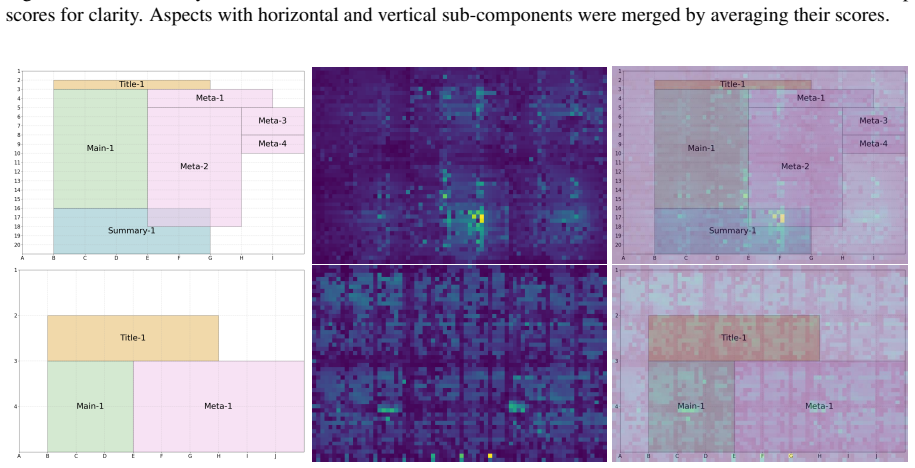
The central mechanism is a generate–score–revise loop powered by SheetRanker, a seven-criterion scoring function that both selects the best layout candidate among repeated MLLM runs and decides which aspects to revise. All criteria are weighted equally; when an aspect score falls below a threshold, the system appends a targeted textual instruction (rule-based reflection), and it further feeds the MLLM a color-coded sketch image of the layout (vision-based reflection). The two-stage design—structure placement with reflection, then content population—keeps the MLLM focused on one task at a time and uses discrete grid coordinates rather than continuous pixels.
Load-bearing premise
The load-bearing premise is that the seven-criterion formula with hand-set constants captures what makes a spreadsheet layout useful; since the system selects and revises layouts using that same formula, the reported 22.6% improvement is measured on the protocol itself rather than against an independent standard of quality.
What would settle it
A blind user study in which spreadsheet users rank SheetDesigner layouts against the baselines without knowing which is which; if users do not prefer the higher-scoring SheetDesigner layouts, the protocol is not tracking perceived usability. Alternatively, score SheetDesigner's outputs on a separate human-derived rubric that excludes the seven criteria and show no advantage.
If this is right
- Spreadsheet layout becomes a benchmarkable task: the dataset and seven-criterion protocol give future systems a common evaluation target.
- Training-free MLLM pipelines can replace trained graphic-layout models for grid-based documents, lowering the barrier to automated spreadsheet formatting.
- Hybrid reflection is necessary because each modality has complementary strengths: vision feedback handles overlap and balance, while rule-based textual feedback handles alignment.
- Small open-weights models (13B) can match or surpass a GPT-4o-backed pipeline when embedded in the generate–score–revise structure.
- Explicitly setting row heights, column widths, and line breaks in the content-population stage beats Excel's AutoFit on the paper's compatibility metric.
Where Pith is reading between the lines
- Because SheetRanker is both the selector and the refiner, the 22.6% headline gain is partly the system optimizing its own metric; a blinded human-preference study would reveal whether the score gap corresponds to layouts people actually prefer.
- The seven criteria and their equal weights are hand-set; a version trained on human ratings of spreadsheet quality could change which layouts win, and might alter the ablation conclusions.
- The attention analysis suggests a general weakness of current vision encoders for fine-grained structural boundaries (alignment) versus salient local defects (overlap); improving that could benefit layout tasks beyond spreadsheets.
- The framework's token cost (about $0.07 per instance with GPT-4o) is non-trivial; distilling the reflection loop into a small trained model is a natural follow-up.
Editorial analysis
A structured set of objections, weighed in public.
Referee Report
Summary. The paper formalizes spreadsheet layout generation as a layout problem over grid-based components and proposes SheetDesigner, a zero-shot, training-free MLLM pipeline. SheetDesigner first performs type- and relation-aware structure placement over multiple candidates, selects candidates with a learned-free scoring function called SheetRanker, and then applies dual reflection (rule-based textual feedback and vision-based sketch feedback) before populating content and setting row heights/column widths. The authors introduce a dataset of 3,326 spreadsheets and a seven-criterion evaluation protocol (fullness, compatibility, component/type/relation alignment, balance, overlap). They report that SheetDesigner with GPT-4o outperforms five baselines by at least 22.6%, with a 13B LLaVA variant competitive with LayoutPrompter using GPT-4o. Ablations analyze the contribution of topic images, reflection, SheetRanker, and vision, and an attention analysis argues that MLLMs handle overlap and balance better than alignment.
Significance. If the central claim were independently validated, this would be a useful contribution: it provides a first task formulation, a dataset, and a practical MLLM-based pipeline that substantially outperforms adapted general-purpose layout models on the proposed protocol. Strengths include the concrete task definition, the detailed prompt-level methodology, the SheetLayout dataset, and systematic ablations including a tail analysis. The paper is also refreshingly explicit about the absence of a definitive ground truth in Appendix C and includes extensive implementation details in the appendices. However, the load-bearing quantitative claim is weakened by a metric-independence problem: the seven-criterion protocol is used both as the in-loop optimizer (SheetRanker selection and reflection thresholds) and as the final evaluation metric, and no human study, external benchmark, or perceptual utility validation is provided. The reported 22.6% margin is therefore an optimization result on the proposed metric, not a demonstrated advantage on an independently grounded notion of layout quality.
major comments (4)
- [§3.3, §4.3, Appendix C] The headline claim 'outperforms five baselines by at least 22.6%' is measured with the same seven-criterion protocol that SheetDesigner actively optimizes. Section 3.1.1 generates N1=3 candidates and selects by SheetRanker; §3.1.2 triggers targeted revision instructions whenever a criterion falls below Table 5 thresholds; §3.2 repeats selection with N2=3. Baselines receive no equivalent metric-driven selection or reflection. Thus the margin in Table 1 is partly an in-loop optimization result on the evaluation protocol. Appendix C acknowledges that 'there is no definitive ground truth' and that a well-scoring layout 'can still be effective,' but no human study, user study, or independent benchmark is supplied, and the Limitations section does not mention this validity gap. To support the abstract's quantitative claim, the paper needs external validation (e.g., human preference ratings or
- [Appendix C, Eq. (1)–(5)] The evaluation protocol depends on several hand-set constants and modeling choices: θ_full=0.8, W_text=12, H_text=15, P_h=40, P_v=10, S_h=7, uniform criterion weights, the top-k choice in alignment, and the reciprocal normalization. No sensitivity analysis is reported for these constants, except for the reflection thresholds in §4.5. Because the reported 22.6% gap is computed on this protocol, it is important to show that the margin is robust to reasonable reparameterizations (e.g., θ_full∈[0.7,0.9], W_text and H_text scaled by ±20%, or non-uniform weights). Without such analysis, the reader cannot tell whether the advantage is a property of the generated layouts or of the specific hand-selected metric.
- [§4.2, Appendix H.2] The baseline comparison may not be fully controlled. Traditional baselines are adapted to spreadsheets through a pixel-to-grid mapping with B_x=1000, C_x=50, B_y=500, C_y=25 and snapping, while LLM baselines such as LayoutPrompter are evaluated in their native coordinate form. Appendix H.2 shows that equipping LayoutPrompter with R1C1 coordinates improves its total score (from 3.789 to 3.861) but does not apply this adaptation to all baselines. More importantly, baselines are not given an equivalent candidate-selection or reflection loop. The paper should either provide a controlled comparison in which all methods receive the same number of samples and the same scoring-based selection, or report the SheetDesigner variants without selection/reflection as the primary comparison. As noted above, the latter is partially available in Table 2 and would strengthen the fairness argument.
- [Table 14, §4.3] The experimental section does not report statistical significance or multiple-seed intervals for the compared methods. Table 14 gives standard deviations only for SheetDesigner (total score 4.885±0.28), not for the five baselines, and no significance tests are provided. Since the central claim is a quantitative margin, the authors should report means and standard deviations over at least three runs for all methods and, where possible, paired tests on the test set. This is especially important because MLLM outputs with temperature 0.7 are stochastic and the reported margin may vary.
minor comments (6)
- [Abstract] Typo: 'necessitates hybrid rule and visual reflection strategies' should be 'necessitating' or 'requires hybrid rule- and vision-based reflection strategies.'
- [§4.4] The term 'ContentPopulator' appears in the text before being defined; earlier sections refer to 'content population with global arrangements.' Please align terminology or introduce the name when the stage is first described.
- [Table 3 caption] The caption is garbled: 'Specified dimensions with line wraps than the AutoFit of Excel.' Please clarify the comparison and the meaning of the 'Deg. Ratio' column.
- [Appendix I] The sentence 'The threshold values for Dual LoRA are selected based on a balance...' should read 'Dual Reflection,' not 'Dual LoRA.'
- [Appendix C, Eq. (5)] The definition of Soverlap says each pair of collision increases the overlap count by 2, then applies a quadratic term C^2_overlap/N. The factor of 2 is not used in the formula; please reconcile the counting convention and formula to avoid ambiguity.
- [§2, Related Work] The paper says 'we first formalize' the spreadsheet layout generation task; since this is a claim of priority, it is safer to phrase as 'to our knowledge, we present the first formalization.'
Circularity Check
The reported 22.6% improvement is measured by a seven-criterion protocol that SheetDesigner itself optimizes through SheetRanker candidate selection and score-triggered reflection; the evaluator and the optimizer are the same function.
specific steps
-
self definitional
[Section 3.3 (SheetRanker); Section 3.1.2 and Appendix D.3 (reflection thresholds); Section 4.3 / Table 1 (headline result); Appendix C (metric definition and no-ground-truth caveat)]
"SheetRanker assigns a score to each based on the protocol in subsection 2.2 and selects the one with the highest score. ... SheetRanker serves two key functions: (i) guiding selection toward the candidate with the highest overall performance, and (ii) providing a quantitative foundation for reflecting on and refining structural placement."
The reported dependent variable (Table 1's weighted total) is the same weighted seven-criterion function used to (a) choose the best of N1/N2 candidate layouts and (b) trigger Dual Reflection whenever any sub-score falls below Table 5 thresholds. Concretely, the final output is L* = argmax SheetRanker(L) over candidates, and the paper then reports SheetRanker(L*) as the improvement. The 22.63% margin is therefore an in-loop optimization result on the evaluator, not an independent measurement. Baselines receive no equivalent metric-driven selection/refinement. Since Appendix C states 'There is no definitive ground truth for what a layout should be' and no user or external benchmark validates the metric, the central quantitative claim reduces to 'our method scores higher on the exact functio
full rationale
The paper is self-contained in its method description: no load-bearing argument depends on self-citation or an imported uniqueness theorem. The main circularity is structural: the authors propose a seven-criterion protocol (Appendix C), build SheetRanker from the same protocol (§3.3), use SheetRanker to select candidates and to decide when to issue reflection instructions (§3.1.2 and Table 5/6), and then report Table 1's '22.63%' margin as the headline result. Selection and evaluation are the same function, so the reported margin is partly a tautology. This is not the common situation where a model is trained on one loss and tested on an externally established benchmark; here the test-time generator itself optimizes the evaluator. If the protocol were independently validated by, say, a human study, the comparison would be legitimate; but the paper explicitly concedes there is no definitive ground truth and provides no such validation. The score is 6 rather than higher because the MLLM still performs non-trivial generation and all baselines are evaluated on the same metric; the flaw is that the metric is simultaneously the objective and the yardstick.
Axiom & Free-Parameter Ledger
free parameters (8)
- theta_full =
0.8
- W_text =
12 pixels per character
- H_text =
15 pixels per line
- Ph =
40
- Pv =
10
- Sh =
7
- Reflection thresholds =
0.5 for all aspects except overlap (0.0)
- Baseline grid mapping parameters =
Bx=1000, By=500, Cx=50, Cy=25
axioms (5)
- domain assumption The seven hand-defined criteria are a valid measure of spreadsheet layout quality.
- domain assumption Automated preprocessing, including LLM-based type assignment, descriptions, relation extraction, and object detection, correctly captures the user's intended components and relationships.
- domain assumption There is no single ground truth layout; any layout scoring well on the proposed criteria is acceptable.
- domain assumption Topic exemplar images and type/relation prompts provide sufficient inductive bias for MLLMs to generate good layouts.
- domain assumption Snapping pixel coordinates to the nearest grid cell is a fair adaptation for rectangle-based baseline models.
Cite this review
Pith. "Pith review of SheetDesigner: MLLM-Powered Spreadsheet Layout Generation with Rule-Based and Vision-Based Reflection." pith.science (2026). https://pith.science/paper/OK2S5KIL
@misc{pith2026250907473,
  author       = {Pith},
  title        = {Pith review of: SheetDesigner: MLLM-Powered Spreadsheet Layout Generation with Rule-Based and Vision-Based Reflection},
  year         = {2026},
  howpublished = {\url{https://pith.science/paper/OK2S5KIL}},
  note         = {Machine review of arXiv:2509.07473}
}
read the original abstract
Spreadsheets are critical to data-centric tasks, with rich, structured layouts that enable efficient information transmission. Given the time and expertise required for manual spreadsheet layout design, there is an urgent need for automated solutions. However, existing automated layout models are ill-suited to spreadsheets, as they often (1) treat components as axis-aligned rectangles with continuous coordinates, overlooking the inherently discrete, grid-based structure of spreadsheets; and (2) neglect interrelated semantics, such as data dependencies and contextual links, unique to spreadsheets. In this paper, we first formalize the spreadsheet layout generation task, supported by a seven-criterion evaluation protocol and a dataset of 3,326 spreadsheets. We then introduce SheetDesigner, a zero-shot and training-free framework using Multimodal Large Language Models (MLLMs) that combines rule and vision reflection for component placement and content population. SheetDesigner outperforms five baselines by at least 22.6\%. We further find that through vision modality, MLLMs handle overlap and balance well but struggle with alignment, necessitates hybrid rule and visual reflection strategies. Our codes and data is available at Github.
Figures




Reference graph
Works this paper leans on
-
[1]
Diego Martin Arroyo, Janis Postels, and Federico Tombari. 2021. Variational transformer networks for layout generation. In Proceedings of the IEEE/CVF Conference on Computer Vision and Pattern Recognition, pages 13642--13652
work page 2021
-
[2]
Yolande E Chan and Veda C Storey. 1996. The use of spreadsheets in organizations: Determinants and consequences. Information & Management, 31(3):119--134
work page 1996
-
[3]
Qin Chen, Yuanyi Ren, Xiaojun Ma, and Yuyang Shi. 2025 a . Large language models for predictive analysis: How far are they? arXiv preprint arXiv:2505.17149
work page internal anchor Pith review Pith/arXiv arXiv 2025
-
[4]
Qin Chen and Guojie Song. 2025. Adaptive heterogeneous graph neural networks: Bridging heterophily and heterogeneity. arXiv preprint arXiv:2508.06034
Pith/arXiv arXiv 2025
-
[5]
Qin Chen, Liang Wang, Bo Zheng, and Guojie Song. 2025 b . Dagprompt: Pushing the limits of graph prompting with a distribution-aware graph prompt tuning approach. In Proceedings of the ACM on Web Conference 2025, pages 4346--4358
work page 2025
-
[6]
Chin-Yi Cheng, Ruiqi Gao, Forrest Huang, and Yang Li. 2024. Colay: Controllable layout generation through multi-conditional latent diffusion. arXiv preprint arXiv:2405.13045
work page internal anchor Pith review Pith/arXiv arXiv 2024
-
[7]
Yutao Cheng, Zhao Zhang, Maoke Yang, Hui Nie, Chunyuan Li, Xinglong Wu, and Jie Shao. 2025. Graphic design with large multimodal model. In Proceedings of the AAAI Conference on Artificial Intelligence, volume 39, pages 2473--2481
work page 2025
-
[8]
Kamal Gupta, Justin Lazarow, Alessandro Achille, Larry S Davis, Vijay Mahadevan, and Abhinav Shrivastava. 2021. Layouttransformer: Layout generation and completion with self-attention. In Proceedings of the IEEE/CVF International Conference on Computer Vision, pages 1004--1014
work page 2021
-
[9]
Joachim H \"a cker and Dietmar Ernst. 2017. Financial Modeling: An Introductory Guide to Excel and VBA Applications in Finance. Springer
work page 2017
-
[10]
Hsiao Yuan Hsu, Xiangteng He, Yuxin Peng, Hao Kong, and Qing Zhang. 2023. Posterlayout: A new benchmark and approach for content-aware visual-textual presentation layout. In Proceedings of the IEEE/CVF Conference on Computer Vision and Pattern Recognition, pages 6018--6026
work page 2023
-
[11]
HsiaoYuan Hsu and Yuxin Peng. 2025. Postero: Structuring layout trees to enable language models in generalized content-aware layout generation. arXiv preprint arXiv:2505.07843
work page internal anchor Pith review Pith/arXiv arXiv 2025
-
[12]
Forrest Huang, Gang Li, Xin Zhou, John F Canny, and Yang Li. 2021. Creating user interface mock-ups from high-level text descriptions with deep-learning models. arXiv preprint arXiv:2110.07775
work page internal anchor Pith review Pith/arXiv arXiv 2021
-
[13]
Zhaoyun Jiang, Jiaqi Guo, Shizhao Sun, Huayu Deng, Zhongkai Wu, Vuksan Mijovic, Zijiang James Yang, Jian-Guang Lou, and Dongmei Zhang. 2023. Layoutformer++: Conditional graphic layout generation via constraint serialization and decoding space restriction. In Proceedings of the IEEE/CVF Conference on Computer Vision and Pattern Recognition, pages 18403--18412
work page 2023
-
[14]
Zhaoyun Jiang, Shizhao Sun, Jihua Zhu, Jian-Guang Lou, and Dongmei Zhang. 2022. Coarse-to-fine generative modeling for graphic layouts. In Proceedings of the AAAI conference on artificial intelligence, volume 36, pages 1096--1103
work page 2022
-
[15]
Kotaro Kikuchi, Edgar Simo-Serra, Mayu Otani, and Kota Yamaguchi. 2021. Constrained graphic layout generation via latent optimization. In Proceedings of the 29th ACM International Conference on Multimedia, pages 88--96
work page 2021
-
[16]
Xiang Kong, Lu Jiang, Huiwen Chang, Han Zhang, Yuan Hao, Haifeng Gong, and Irfan Essa. 2022. Blt: bidirectional layout transformer for controllable layout generation. In European Conference on Computer Vision, pages 474--490. Springer
work page 2022
-
[17]
Talia Lavie and Noam Tractinsky. 2004. Assessing dimensions of perceived visual aesthetics of web sites. International journal of human-computer studies, 60(3):269--298
work page 2004
-
[18]
Hsin-Ying Lee, Lu Jiang, Irfan Essa, Phuong B Le, Haifeng Gong, Ming-Hsuan Yang, and Weilong Yang. 2020. Neural design network: Graphic layout generation with constraints. In Computer Vision--ECCV 2020: 16th European Conference, Glasgow, UK, August 23--28, 2020, Proceedings, Part III 16, pages 491--506. Springer
work page 2020
-
[19]
Jianan Li, Jimei Yang, Jianming Zhang, Chang Liu, Christina Wang, and Tingfa Xu. 2020. Attribute-conditioned layout gan for automatic graphic design. IEEE Transactions on Visualization and Computer Graphics, 27(10):4039--4048
work page 2020
-
[20]
Tao Li, Chin-Yi Cheng, Amber Xie, Gang Li, and Yang Li. 2024. Revision matters: Generative design guided by revision edits. arXiv preprint arXiv:2406.18559
Pith/arXiv arXiv 2024
-
[21]
Jiawei Lin, Jiaqi Guo, Shizhao Sun, Weijiang Xu, Ting Liu, Jian-Guang Lou, and Dongmei Zhang. 2023 a . A parse-then-place approach for generating graphic layouts from textual descriptions. In Proceedings of the IEEE/CVF International Conference on Computer Vision, pages 23622--23631
work page 2023
-
[22]
Jiawei Lin, Jiaqi Guo, Shizhao Sun, Zijiang Yang, Jian-Guang Lou, and Dongmei Zhang. 2023 b . Layoutprompter: awaken the design ability of large language models. Advances in Neural Information Processing Systems, 36:43852--43879
work page 2023
-
[23]
Haotian Liu, Chunyuan Li, Qingyang Wu, and Yong Jae Lee. 2023. Visual instruction tuning. Advances in neural information processing systems, 36:34892--34916
2023
-
[24]
Wei Liu, Liuan Wang, and Jun Sun. 2025 a . Efficient object placement via llm and diffusion model. In ICASSP 2025-2025 IEEE International Conference on Acoustics, Speech and Signal Processing (ICASSP), pages 1--5. IEEE
work page 2025
-
[25]
Xuyuan Liu, Yinghao Cai, Qihui Yang, and Yujun Yan. 2024. http://papers.nips.cc/paper\_files/paper/2024/hash/f631e778fd3c1b871e9e3a94369335e9-Abstract-Conference.html Exploring consistency in graph representations: from graph kernels to graph neural networks . In Advances in Neural Information Processing Systems 38: Annual Conference on Neural Information...
work page 2024
-
[26]
Xuyuan Liu, Lei Hsiung, Yaoqing Yang, and Yujun Yan. 2025 b . https://aclanthology.org/2025.findings-acl.251/ Spectral insights into data-oblivious critical layers in large language models . In Findings of the Association for Computational Linguistics, ACL 2025, Vienna, Austria, July 27 - August 1, 2025 , pages 4860--4877. Association for Computational Li...
work page 2025
-
[27]
OpenAI. 2024. https://arxiv.org/abs/2410.21276 Gpt-4o system card . Preprint, arXiv:2410.21276
Pith/arXiv arXiv 2024
-
[28]
Stephen G Powell and Kenneth R Baker. 2019. Business analytics: The art of modeling with spreadsheets. John Wiley & Sons
work page 2019
-
[29]
Soliha Rahman, Vinoth Pandian Sermuga Pandian, and Matthias Jarke. 2021. Ruite: Refining ui layout aesthetics using transformer encoder. In Companion Proceedings of the 26th International Conference on Intelligent User Interfaces, pages 81--83
work page 2021
-
[30]
Yuanyi Ren, Haoran Ye, Hanjun Fang, Xin Zhang, and Guojie Song. 2024. https://doi.org/10.18653/v1/2024.acl-long.111 V alue B ench: Towards comprehensively evaluating value orientations and understanding of large language models . In Proceedings of the 62nd Annual Meeting of the Association for Computational Linguistics (Volume 1: Long Papers), pages 2015-...
-
[31]
Jaejung Seol, Seojun Kim, and Jaejun Yoo. 2024. Posterllama: Bridging design ability of language model to content-aware layout generation. In European Conference on Computer Vision, pages 451--468. Springer
work page 2024
- [32]
-
[33]
Yiliu Sun, Yanfang Zhang, Zicheng Zhao, Sheng Wan, Dacheng Tao, and Chen Gong. 2025. Fast-slow-thinking: Complex task solving with large language models. arXiv preprint arXiv:2504.08690
Pith/arXiv arXiv 2025
-
[34]
Hongbo Tang, Shuai Zhao, Jing Luo, Yihang Su, and Jinjian Yang. 2024. Layoutkag: Enhancing layout generation in large language models through knowledge-augmented generation. In 2024 3rd International Conference on Artificial Intelligence, Human-Computer Interaction and Robotics (AIHCIR), pages 292--299. IEEE
work page 2024
-
[35]
Zecheng Tang, Chenfei Wu, Juntao Li, and Nan Duan. 2023. Layoutnuwa: Revealing the hidden layout expertise of large language models. arXiv preprint arXiv:2309.09506
Pith/arXiv arXiv 2023
-
[36]
Yiqi Wang, Wentao Chen, Xiaotian Han, Xudong Lin, Haiteng Zhao, Yongfei Liu, Bohan Zhai, Jianbo Yuan, Quanzeng You, and Hongxia Yang. 2024. Exploring the reasoning abilities of multimodal large language models (mllms): A comprehensive survey on emerging trends in multimodal reasoning. arXiv preprint arXiv:2401.06805
Pith/arXiv arXiv 2024
-
[37]
Tao Yang, Yingmin Luo, Zhongang Qi, Yang Wu, Ying Shan, and Chang Wen Chen. 2024. Posterllava: Constructing a unified multi-modal layout generator with llm. arXiv preprint arXiv:2406.02884
Pith/arXiv arXiv 2024
-
[38]
Jiahao Zhang, Ryota Yoshihashi, Shunsuke Kitada, Atsuki Osanai, and Yuta Nakashima. 2024. Vascar: Content-aware layout generation via visual-aware self-correction. arXiv preprint arXiv:2412.04237
Pith/arXiv arXiv 2024
-
[39]
Jiarui Zhang, Mahyar Khayatkhoei, Prateek Chhikara, and Filip Ilievski. 2025 a . Mllms know where to look: Training-free perception of small visual details with multimodal llms. arXiv preprint arXiv:2502.17422
Pith/arXiv arXiv 2025
-
[40]
Peirong Zhang, Jiaxin Zhang, Jiahuan Cao, Hongliang Li, and Lianwen Jin. 2025 b . Smaller but better: Unifying layout generation with smaller large language models. International Journal of Computer Vision, pages 1--27
work page 2025
-
[41]
Lianmin Zheng, Wei-Lin Chiang, Ying Sheng, Siyuan Zhuang, Zhanghao Wu, Yonghao Zhuang, Zi Lin, Zhuohan Li, Dacheng Li, Eric Xing, and 1 others. 2023. Judging llm-as-a-judge with mt-bench and chatbot arena. Advances in Neural Information Processing Systems, 36:46595--46623
work page 2023
-
[42]
Xinru Zheng, Xiaotian Qiao, Ying Cao, and Rynson WH Lau. 2019. Content-aware generative modeling of graphic design layouts. ACM Transactions on Graphics (TOG), 38(4):1--15
work page 2019
-
[43]
online" 'onlinestring :=
ENTRY address archivePrefix author booktitle chapter edition editor eid eprint eprinttype howpublished institution journal key month note number organization pages publisher school series title type volume year doi pubmed url lastchecked label extra.label sort.label short.list INTEGERS output.state before.all mid.sentence after.sentence after.block STRING...
-
[44]
write newline
" write newline "" before.all 'output.state := FUNCTION n.dashify 't := "" t empty not t #1 #1 substring "-" = t #1 #2 substring "--" = not "--" * t #2 global.max substring 't := t #1 #1 substring "-" = "-" * t #2 global.max substring 't := while if t #1 #1 substring * t #2 global.max substring 't := if while FUNCTION word.in bbl.in capitalize " " * FUNCT...
discussion (0)
Sign in with ORCID, Apple, or X to comment. Anyone can read and Pith papers without signing in.