REVIEW 5 major objections 5 minor 18 references
Fine-Tuning Vision-Language Models for Visual Navigation Assistance
T0 review · 5 major / 5 minor · reviewed 2026-08-04 · deepseek-v4-flash
Pith's one-line read Fine-tuning only the language side of BLIP-2 with LoRA—0.24% of its weights—raises its navigation-instruction score (BERT F1) from 0.63 to 0.76, while tuning vision alone collapses it to 0.04.
desk verdict Useful incremental demo of BLIP-2+LoRA for navigation instruction generation, but the homebrew metric and missing statistics undercut the main claim. read the letter →
The pith
A machine-rendered reading of the paper's core claim, the machinery that carries it, and where it could break.
The reading
What carries the argument
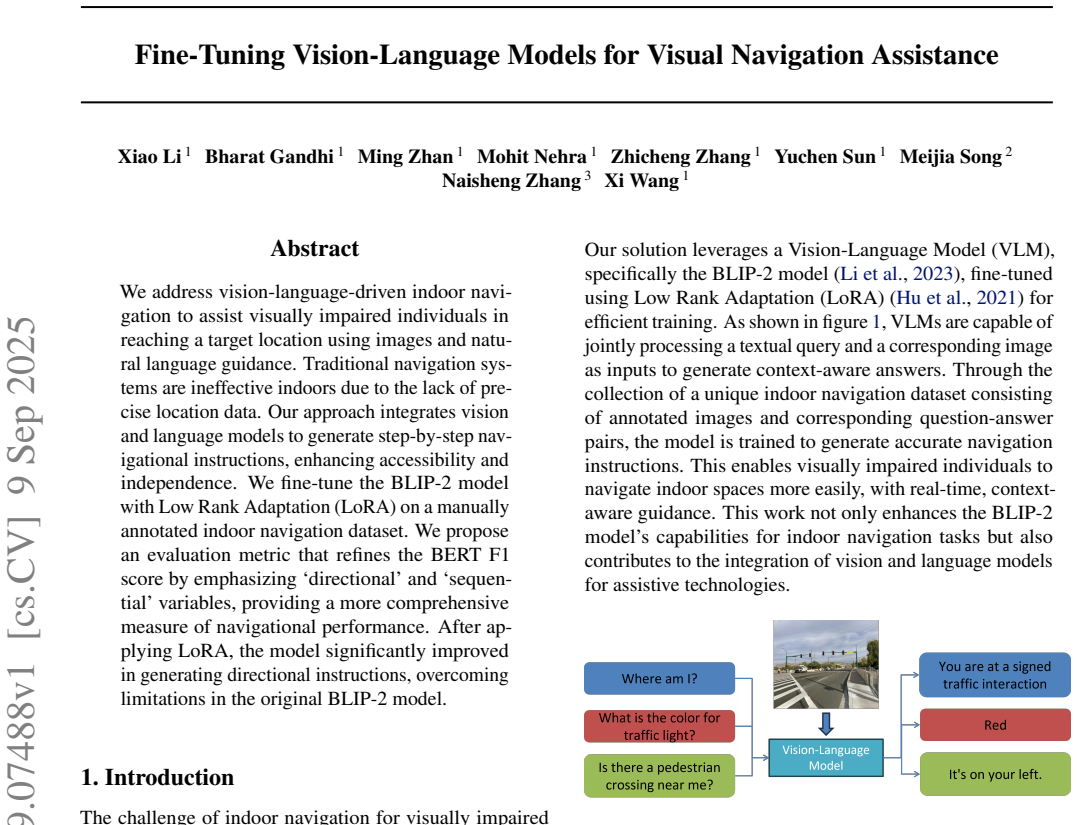
Two mechanisms carry the argument. The first is Low-Rank Adaptation (LoRA), which injects small trainable low-rank matrices into the transformer layers of the frozen BLIP-2 model so that only 9M parameters (0.24% of the model) are updated during fine-tuning. The second is the paper's proposed Enhanced BERTScore, a composite metric Final Score = (1−w)·BERT F1 + w·Enhanced Score, where the Enhanced Score sums a weighted semantic similarity, a directional flow bonus, an overall text similarity, and a special-case boost for functionally equivalent instructions. The metric is designed to detect directional conflicts (opposing terms in reference vs. prediction), penalize discrepancies in the numbe
What would settle it
Collect human ratings of the generated instructions from the five configurations and compare them with the Enhanced BERTScore ordering. If fluent speakers, blindfolded as to configuration, do not rank the language-model-tuned outputs above the untuned baseline in the direction the metric predicts—or if the metric's zeroing of reversed action order disagrees with humans on which of 'walk forward then turn left' and 'turn left then walk forward' is correct for a given image—then the central improvement claim collapses. A second decisive check: run the same five configurations on a VLN benchmark
Extended reading notes
Core claim
The paper claims that fine-tuning the language model of BLIP-2 with Low-Rank Adaptation (LoRA) on a small manually annotated indoor-navigation dataset substantially improves the model's ability to produce directional navigation instructions, while fine-tuning the vision encoder alone collapses performance. The best configuration—language-model LoRA trained on augmented data, 9M parameters (0.24% of the model)—reached BERT F1 0.76 and the paper's Enhanced BERTScore 0.54, against 0.63 and 0.46 for the untuned baseline. To make evaluation sensitive to what matters in navigation, the paper proposes a weighted metric that penalizes contradictory directions, mismatched step counts, and reversed ac
Load-bearing premise
The load-bearing premise is that the paper's new scoring metric truly reflects whether a navigation instruction is good; the metric was tuned by hand on a small set of examples and never validated against human judgments, so if it is wrong the reported improvements are not established.
Editorial extensions
If this is right
- If the central claim holds, assistive indoor navigation can be bootstrapped from a frozen vision encoder plus a small language-side adapter, without training a purpose-built navigation model.
- The reported asymmetry—language-only tuning works, vision-only tuning fails—implies that for this task most of the domain gap is linguistic phrasing rather than visual perception.
- The 21% relative BERT F1 gain from 0.63 to 0.76 suggests that data augmentation through rephrased question-answer pairs is a cheap lever for improving instruction generation.
- The proposed Enhanced BERTScore, if adopted, would give navigation-instruction researchers a metric that penalizes wrong direction words and reversed action order instead of rewarding surface similarity.
- Joint vision-language tuning's slight F1 drop suggests a two-stage or lower-learning-rate schedule might be needed to keep both streams aligned.
Reading between the lines
- Because the dataset contains only about 1,000 manually annotated samples from a static-image dataset, a natural test of the paper's claim is whether the same LoRA recipe transfers to video-based or egocentric navigation inputs; the paper itself flags single-frame inputs as a limitation.
- The metric's weights and components (FlowBonus, SpecialCaseBoost, conflict set D) are tuned on a small set of navigation cases without external validation; if the metric were calibrated against human ratings of instruction quality, the reported ranking of the five configurations could shift.
- The paper's asymmetry finding suggests that for partially-observable navigation, effort spent on linguistic adaptation of a frozen VLM may deliver more per parameter than visual fine-tuning; this ordering could generalize to other instruction-following assistive tasks.
- Since the paper reports no comparison to path-following outcomes (whether a user following the generated instructions actually reaches the target), an obvious extension is to couple the metric with a waypoint-level success measure.
Editorial analysis
A structured set of objections, weighed in public.
Referee Report
Summary. The paper addresses vision-language-driven indoor navigation for visually impaired users by fine-tuning BLIP-2 with LoRA on a manually annotated dataset derived from the MIT Indoor Scene Recognition dataset. It introduces an 'Enhanced BERTScore' intended to weight directional and sequential correctness, and reports four fine-tuning configurations. The central empirical claim is that the best configuration, language-model fine-tuning with augmented data (0.24% of parameters), improves BERT F1 from 0.63 to 0.76 and Enhanced BERTScore from 0.46 to 0.54 relative to the un-tuned baseline. The paper also reports that vision-only fine-tuning collapses to BERT F1 0.04.
Significance. If the reported improvements were statistically and semantically validated, the paper would make a useful contribution: it demonstrates that a very small parameter update (0.24%) can adapt a VLM to a narrow navigation-instruction task, and the four-way ablation of language/vision fine-tuning and data augmentation is a reasonable experimental structure. The use of a public image dataset and standard BLIP-2/LoRA components is also a strength. However, the evidence as presented is not sufficient to establish the central claim. The proposed Enhanced BERTScore is incompletely specified, the weights were tuned on the authors' own test cases, no uncertainty quantification or test-set description is provided, and the dataset grounding of 'directional instructions' is unclear. The paper is better viewed as a preliminary workshop-style report; as a journal submission it needs substantial additional validation and transparency.
major comments (5)
- [§3.4, Eq. (6)-(7)] The Enhanced BERTScore is the primary evaluation metric, but it is not fully defined. The conflicting-direction set D in Eq. (6), the FlowBonus, SemanticSimilarity, and SpecialCaseBoost terms in Eq. (7), and the weights α, β, γ, w are never given explicit definitions or values. The text states that the weights were 'determined through iterative experimentation on a diverse set of navigation instruction test cases' and adjusted to match human intuition, but no such set, protocol, or resulting values are reported. This makes the 0.46→0.54 Enhanced BERTScore improvements impossible for an independent reader to reproduce or interpret. The metric must be specified completely, the weights fixed and disclosed, and the metric validated against human judgments or an existing VLN benchmark before it can support the paper's conclusions.
- [§4.4, Table 3] The central comparison lacks basic statistical support. The paper reports averages such as BERT F1 0.63 vs. 0.76, but gives no test-set size, no confidence intervals, no standard deviations, no repeated runs with different seeds, and no significance tests. With roughly 1,000 manually annotated examples and four configurations, a 0.13 F1 gain could be affected by evaluation noise, seed variation, or selection of the best checkpoint on the test set. The paper must describe the train/test split explicitly, state the number of evaluation examples, and report uncertainty and significance for each configuration.
- [§4.1 and §3.4] There is a mismatch between the claimed task—'step-by-step navigational instructions'—and the dataset construction. The dataset is built from the MIT Indoor Scene Recognition images with manually written question-answer pairs about obstacles and exits, but no navigation trajectories, maps, or sequential route information are described. It is therefore unclear how the 'directional and sequential' ground truth in the metric is anchored, or what exactly the model is being evaluated on. The annotation protocol, the definition of a 'directional term,' and example model outputs versus reference outputs should be provided so that the reader can assess whether the metric measures navigation quality rather than superficial phrasing.
- [§5.2] The claims that 'LM-only tuning is highly effective' and 'data augmentation is useful' are presented as established findings, but they rest solely on the unsupported point estimates in Table 3. In particular, the comparison between v1 (BERT F1 0.69) and v2 (0.76) is a single run with no error bars, and no evidence is given that the augmented dataset is the cause rather than random variation or checkpoint selection. These interpretive statements need to be tempered or backed by the statistical analysis requested above.
- [§6] The limitations section appropriately acknowledges path ambiguity, dataset scale, and lack of temporal context. However, these limitations directly undermine the generalizability claim in the abstract and conclusion. The paper should either restrict its claims to the specific dataset and settings or provide external evaluation evidence, such as testing on unseen building layouts or a separate navigation benchmark, before claiming that it improves accessibility and independence for visually impaired users.
minor comments (5)
- [Figure 1] There is a typo in the caption: 'applicatioon' should be 'application'.
- [§4.2] The text says 'the model was trained for 30 epochs, with early stopping implemented' and later refers to 'high accuracy on the test set,' but no test set is described in the data section. Please define the split and how early stopping was applied.
- [§3.4, Eq. (7)] Equation (7) has underbrace labels that make the expression difficult to read; the terms 'Semantic' and 'Directional' are not defined in the text. Clarify the notation and define all terms explicitly.
- [§4.3 and Table 3] The use of '–' in Table 3 is ambiguous (no fine-tuning vs. not applicable). Use explicit 'No'/'Yes' entries and add footnotes where values are not applicable.
- [General] No code, data, or configuration files are released. For reproducibility, the authors should provide the augmented dataset, the exact training/evaluation script, and the final metric weights.
Circularity Check
No circularity: the LoRA fine-tuning improvement is an empirical result, not a consequence of the metric definition.
full rationale
The paper’s central claim—that LoRA fine-tuning of BLIP-2 improves directional instruction generation—rests on a direct before/after comparison of the same base model, with gains reported on BERT F1, a standard lexical-overlap metric, as well as on the authors’ proposed Enhanced BERTScore. The proposed metric is not an input to the model, nor is it fitted to predict the improvement; its weights are set by iterative qualitative tuning, which is a validity concern (and Section 6 concedes the narrow dataset and limited generalization), but it does not make the BERT F1 gain (0.63→0.76) a tautology. The cited foundations (BLIP-2, LoRA) are external works, not self-citations, and no uniqueness theorem or ansatz is imported from the authors’ prior publications. Section 3.4 under-specifies components such as D, FlowBonus, and SpecialCaseBoost, and Section 4.4 reports no error bars or train/test split; these are rigor/validity issues, not circularity. Under the stated rules, the derivation is self-contained and the score is 0.
Assumptions & free parameters
free parameters (3)
- LoRA rank and alpha scaling =
not reported
- alpha, beta, gamma (Enhanced BERTScore weights) =
not reported
- w (final score blend weight) =
not reported
assumptions (4)
- domain assumption BLIP-2 pretrained weights provide transferable visual-linguistic representations sufficient for indoor navigation assistance.
- domain assumption The manually annotated QA pairs for roughly 1,000 Indoor Scene Recognition images are correct and unambiguous navigation ground truth.
- ad hoc to paper The Enhanced BERTScore weights can be set by qualitative iterative experimentation to match human intuition.
- domain assumption Indoor Scene Recognition images are suitable proxies for navigation-relevant scenes.
Cite this review
Pith. "Pith review of Fine-Tuning Vision-Language Models for Visual Navigation Assistance." pith.science (2026). https://pith.science/paper/DC3JW5BV
@misc{pith2026250907488,
  author       = {Pith},
  title        = {Pith review of: Fine-Tuning Vision-Language Models for Visual Navigation Assistance},
  year         = {2026},
  howpublished = {\url{https://pith.science/paper/DC3JW5BV}},
  note         = {Machine review of arXiv:2509.07488}
}
read the original abstract
We address vision-language-driven indoor navigation to assist visually impaired individuals in reaching a target location using images and natural language guidance. Traditional navigation systems are ineffective indoors due to the lack of precise location data. Our approach integrates vision and language models to generate step-by-step navigational instructions, enhancing accessibility and independence. We fine-tune the BLIP-2 model with Low Rank Adaptation (LoRA) on a manually annotated indoor navigation dataset. We propose an evaluation metric that refines the BERT F1 score by emphasizing directional and sequential variables, providing a more comprehensive measure of navigational performance. After applying LoRA, the model significantly improved in generating directional instructions, overcoming limitations in the original BLIP-2 model.
Figures
Reference graph
Works this paper leans on
-
[1]
write newline
" write newline "" before.all 'output.state := FUNCTION n.dashify 't := "" t empty not t #1 #1 substring "-" = t #1 #2 substring "--" = not "--" * t #2 global.max substring 't := t #1 #1 substring "-" = "-" * t #2 global.max substring 't := while if t #1 #1 substring * t #2 global.max substring 't := if while FUNCTION format.date year duplicate empty "emp...
-
[2]
Navcog: A navigational cognitive assistant for the blind
Ahmetovic, D., Gleason, C., Ruan, C., Kitani, K., and Asakawa, C. Navcog: A navigational cognitive assistant for the blind. In ASSETS, 2016
work page 2016
-
[3]
Flamingo: A visual language model for few-shot learning
Alayrac, J.-B., Donahue, J., Minderer, M., and et al. Flamingo: A visual language model for few-shot learning. arXiv preprint arXiv:2204.14198, 2022
arXiv 2022
-
[4]
Anderson, P., Wu, Q., Teney, D., Bruce, J., Johnson, M., Gould, S., and van den Hengel, A. Vision-and-language navigation: Interpreting visually-grounded navigation instructions in real environments. In Proceedings of the IEEE Conference on Computer Vision and Pattern Recognition, pp.\ 3674--3683. IEEE, 2018
work page 2018
-
[5]
Parameter-efficient transfer learning for nlp
Houlsby, N., Giurgiu, A., Jastrzebski, S., Morrone, B., De Laroussilhe, Q., Gesmundo, A., Attariyan, M., and Gelly, S. Parameter-efficient transfer learning for nlp. In Proceedings of the 36th International Conference on Machine Learning, volume 97, pp.\ 2790--2799. PMLR, 2019
work page 2019
-
[6]
J., Shen, Y., Wallis, P., Allen-Zhu, Z., Li, Y., Wang, S., Wang, L., and Chen, W
Hu, E. J., Shen, Y., Wallis, P., Allen-Zhu, Z., Li, Y., Wang, S., Wang, L., and Chen, W. Lora: Low-rank adaptation of large language models. arXiv preprint arXiv:2106.09685, 2021
arXiv 2021
-
[7]
V., Sung, Y., Li, Z., and Duerig, T
Jia, C., Yang, Y., Xia, Y., Chen, Y.-T., Parekh, Z., Pham, H., Le, Q. V., Sung, Y., Li, Z., and Duerig, T. Scaling up visual and vision-language representation learning with noisy text supervision. In Proceedings of the 38th International Conference on Machine Learning, volume 139, pp.\ 4904--4916. PMLR, 2021
work page 2021
-
[8]
Li, J., Li, D., Savarese, S., and Hoi, S. C. H. Blip: Bootstrapping language-image pre-training. In Proceedings of the IEEE/CVF Conference on Computer Vision and Pattern Recognition, pp.\ 318--328. IEEE, 2022
work page 2022
Show all 18 references
-
[9]
Li, J., Li, D., Savarese, S., and Hoi, S. C. H. Blip-2: Bootstrapping language-image pre-training with frozen image encoders and large language models. In Proceedings of the 40th International Conference on Machine Learning, volume 202, pp.\ 16684--16697. PMLR, 2023
2023
-
[10]
and Liang, P
Li, X. and Liang, P. Prefix-tuning: Optimizing continuous prompts for generation. In Proceedings of the 59th Annual Meeting of the Association for Computational Linguistics, pp.\ 4582--4597. ACL, 2021
2021
-
[11]
Visual instruction tuning
Liu, H., Li, C., Chen, Q., Zhou, P., Yang, J., and Gao, J. Visual instruction tuning. arXiv preprint arXiv:2304.08485, 2023
2023 arXiv
-
[12]
ViLBERT : Pretraining task-agnostic visiolinguistic representations for vision-and-language tasks
Lu, J., Batra, D., Parikh, D., and Lee, S. ViLBERT : Pretraining task-agnostic visiolinguistic representations for vision-and-language tasks. In Advances in Neural Information Processing Systems, 2019
2019
-
[13]
Navcog3: An evaluation of a smartphone-based blind indoor navigation assistant with ble beacons
Miyazaki, Y., Gleason, C., Asakawa, C., and Kitani, K. Navcog3: An evaluation of a smartphone-based blind indoor navigation assistant with ble beacons. In CHI, 2019
2019
-
[14]
and Torralba, A
Quattoni, A. and Torralba, A. Recognizing indoor scenes. In 2009 IEEE conference on computer vision and pattern recognition, pp.\ 413--420. IEEE, 2009
2009
-
[15]
W., Hallacy, C., Ramesh, A., Goh, G., Agarwal, S., Sastry, G., Mishkin, P., Clark, J., Krueger, G., and Sutskever, I
Radford, A., Kim, J. W., Hallacy, C., Ramesh, A., Goh, G., Agarwal, S., Sastry, G., Mishkin, P., Clark, J., Krueger, G., and Sutskever, I. Learning transferable visual models from natural language supervision. In Proceedings of the 38th International Conference on Machine Lear...
2021
-
[16]
Coca: Contrastive captioners are image-text foundation models
Yu, J., Wang, Z., Vasudevan, V., Yeung, L., Seyedhosseini, M., and Wu, Y. Coca: Contrastive captioners are image-text foundation models. arXiv preprint arXiv:2205.01917, 2022
2022 arXiv
-
[17]
Florence: A new computer vision foundation model for visual understanding
Yuan, L., Chen, D., Shi, Y., Liu, C., Liu, M., Huang, X., Li, B., Codella, N., Chau, M., Zeng, M., Zhou, L., and Gao, J. Florence: A new computer vision foundation model for visual understanding. arXiv preprint arXiv:2111.11432, 2021. Accessed: 2025-04-22
2021 arXiv
-
[18]
A fine-grained evaluation of vision–language navigation
Yubo, W., Cao, Y., and Tan, M. A fine-grained evaluation of vision–language navigation. In Findings of EMNLP, 2024
2024
Reviewed August 4, 2026 · model on record in the stance chip above.
Discussion (0). Continue with ORCID to comment.