REVIEW 4 major objections 5 minor 52 references
Flexible Morphing Aerial Robot with Inflatable Structure for Perching-based Human-Robot Interaction
T0 review · 4 major / 5 minor · reviewed 2026-08-04 · deepseek-v4-flash
Pith's one-line read This paper claims the first aerial robot that can perch on a human arm to interact: arms rigid in flight, inflatable-soft when grasping, with a free-fall perch and powered takeoff demonstrated end to end.
desk verdict A plausible first demonstration of a quadrotor perching on a human arm, with a clever hybrid mechanism; the theoretical 'conditions' are weaker than they look, and the human-perching claim needs scoping, but the core feasibility result stands. read the letter →
The pith
A machine-rendered reading of the paper's core claim, the machinery that carries it, and where it could break.
The reading
What carries the argument
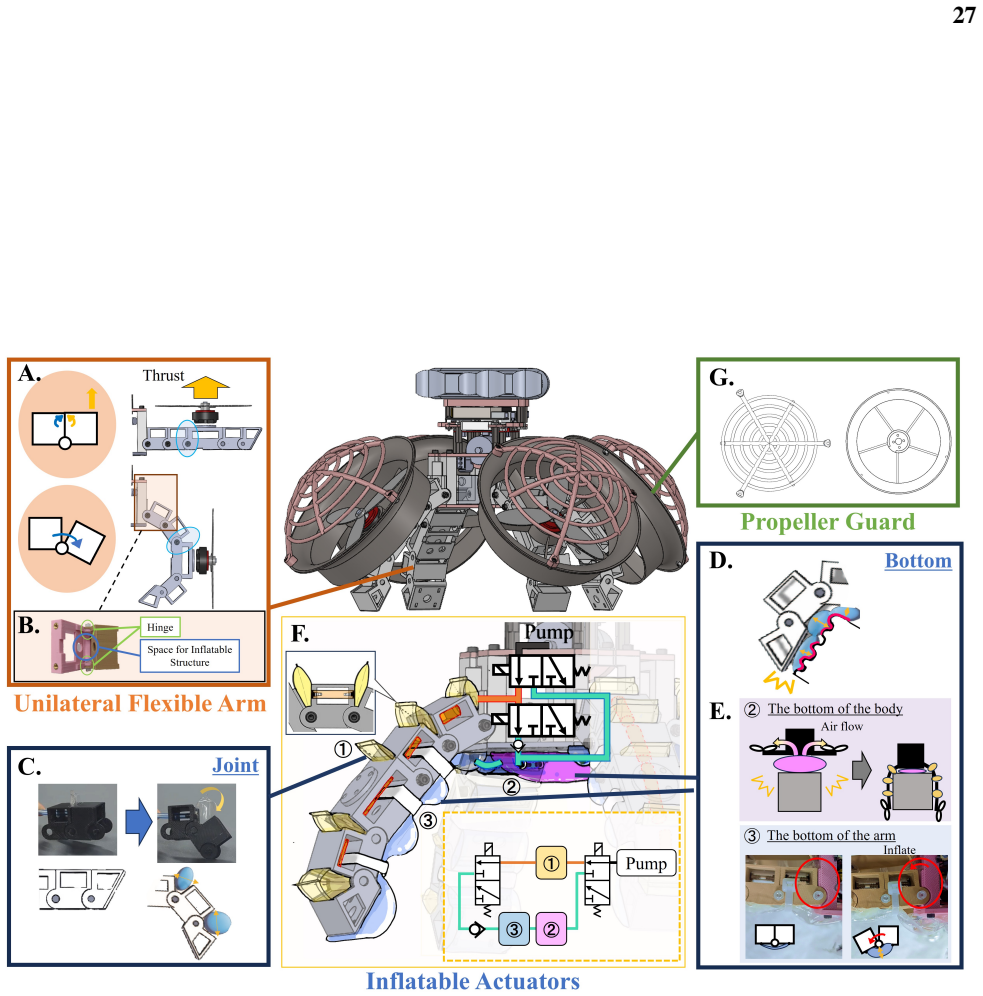
The central mechanism is the unilateral flexible arm with inflatable joint actuators: a chain of hollow hinge segments that lock into a rigid beam when propeller thrust pulls them taut and hang limp when it drops. Joint airbags (folded TPU pockets in the hinge gaps) generate torque M(θ,P0) ≈ ½(k0−k1θ)P0 l_link(y1²−y0²) − ⅓ k2 θ l_link(y1³−y0³), bending the arm around the grasped limb. The bottom inflatable actuator is triple-duty—air reservoir (cutting joint-inflation time ~1 s), landing shock absorber, and root bending torque via axial contraction. A Boyle's-law model sets reservoir pre-pressure P0 ≈ 38.2 kPa to yield stabilized joint pressure P1 ≈ 21 kPa, and the arm-base equilibrium λ_hov
What would settle it
A concrete test: repeat the perching sequence with a force-measuring sleeve on the forearm across several subjects, with the arm held still as in the paper, and then with the arm displaced a few centimeters during the free fall. If impact forces exceed a safe threshold, or success collapses with small displacements, the human-perching claim holds only for scripted poses. A second test: in tethered flight, reduce thrust below the paper's threshold λ_hover ≥ m_arm g/2 + m_rotor g and check whether the arms curl and the robot descends—confirming the rigidity threshold is real.
Extended reading notes
Core claim
On the paper's own terms, the discovery is that a 1.444 kg quadrotor with four rotor-embedded, hinge-segmented arms and joint airbags can perch on a human arm. Provided hover thrust satisfies λ_hover ≥ m_arm g/2 + m_rotor g, the unidirectional arms brace into a rigid chain, so standard quadrotor dynamics and an LQI attitude controller stay valid without modeling the flexible arms. For perching, the bottom airbag is pre-pressurized to about 40 kPa and dumped through a valve into the joint airbags, deforming the arms in about 0.3 s during free fall; the grip then holds a human arm at roughly 47 kPa average joint pressure with the pump off, surviving 6.6 m/s² shaking and about ±1 rad roll. The
Load-bearing premise
The human perching demonstration assumes a cooperative person: the robot does not recognize the arm and free-falls onto a limb the person must hold still and deliberately extend into its path; if the arm moves or is misaligned, the perch fails or could strike the person.
Editorial extensions
If this is right
- Perching-based human-robot interaction becomes practical: the robot can approach a person, cling to an outstretched arm, and keep holding through shaking and rolling with the pump and valves off, so close-range sensing or guidance costs almost no energy.
- Morphing arms do not force complex flight control: above the derived thrust threshold the arms behave as rigid beams, so standard quadrotor dynamics with the onboard LQI controller suffice, and the robot recovers automatically after disturbance-induced arm deformation.
- The reservoir function is what makes the free-fall perch work: pre-pressurized bottom airbags cut arm-deformation time by about 1 s versus pump-only inflation, letting the arms wrap the limb within the roughly 0.3 s fall.
- Compactness while perched matters for human partners: folded to 110×110 mm above the arm, the robot leaves the elbow free to bend, unlike larger gripper-equipped drones that restrict natural arm movement.
Reading between the lines
- The cooperative-pose premise caps the claimed capability: the robot never visually recognizes the arm and free-falls onto a limb the person must hold still and deliberately extend; perching on moving or unaware people remains untested, as the paper's own future-work section concedes.
- Safety is asserted but not yet a measurement: the paper reports no injury and credits guards and soft parts, yet records no impact force on the human; an instrumented-arm trial that bounds contact force would convert the safety claim into a specification.
- The bistability argument likely generalizes: if the thrust threshold λ_hover ≥ m_arm g/2 + m_rotor g is the real rigidity condition, other hinge-based morphing quadrotors could adopt standard quadrotor control without per-arm nonlinear models, a testable hypothesis beyond this platform.
- Fatigue, not capability, may bound deployment: at the 50 kPa operating pressure the airbags survive roughly 289 inflation cycles in fatigue tests versus about 2144 at 40 kPa, suggesting field use trades grasping force for bag lifetime.
Signed reviews
Editorial analysis
A structured set of objections, weighed in public.
Referee Report
Summary. The paper presents a 1.444 kg quadrotor with four unilateral flexible arms, each embedding a rotor, and a pneumatic system of joint and bottom inflatable actuators. The arms are designed to lock rigid during flight under sufficient thrust and to deform compliantly for perching. The authors derive a pressure/volume model to choose the initial bottom-actuator pressure, propose that standard quadrotor modeling and control are valid near hover when thrust keeps the arms rigid, and demonstrate grasping forces up to about 45 N, robustness to a disturbance-induced arm deformation, and an in-flight perching sequence on a human arm. The central claim is that this is the first aerial robot capable of perching on humans for interaction.
Significance. If the result holds, the paper offers a useful hardware contribution: an integrated morphing design that combines rigid flight behavior with soft, controllable grasping, and a pneumatic system that doubles as both an air reservoir and a shock absorber. The detailed fabrication descriptions, thrust measurements, pressure/volume model, and energy comparison tables are valuable for replication. The demonstrated perching on a human arm, even under cooperative conditions, is a notable feasibility data point for human-drone physical interaction. However, the evidence for the strongest claims is limited: the human perching rests on a single cooperative trial, the optimal-pressure derivation is partly circular, and the flight-robustness argument is supported by one disturbance experiment. These issues affect the paper's central novelty claim and need to be addressed before the contribution can be assessed at its face value.
major comments (4)
- [Sec. 5.4.2, Appendix E] The human-perching demonstration is a single sequence performed under the explicit assumption in Appendix E that 'the human user must proactively align their arm with the robot, as the robot does not actively recognize the arm.' No impact force, contact pressure, or misalignment tolerance is reported. The abstract's claim of 'the first to achieve an aerial robot capable of perching on humans' is therefore stronger than the evidence supports. Please add repeated trials with varied arm positions/poses and report impact loads, or qualify the claim to 'perching on a stationary, cooperative, pre-aligned human arm.' This is load-bearing because human perching is the paper's core novelty.
- [Sec. 3.1, Eqs. (18)-(19); Sec. 5.2.2] The derivation of P0≈38.20 kPa is circular: the target P1=21 kPa is itself chosen from the approximation line of the measured grasping force described in Sec. 5.2.2. Equation (19) is therefore an empirical calibration, not an independent prediction. The paper should state this explicitly and provide uncertainty on the fitted line. Moreover, the executed human-perching experiment uses P0=40 kPa and obtains P1≈19-22 kPa, not the nominal 38.2/21 kPa from Eq. (19); the relationship between the derived 'optimal' pressure and the experimental condition needs clarification.
- [Sec. 4.1, Eqs. (21)-(25)] The claimed sufficient condition for arm rigidity reduces to m_body + 2m_arm ≥ 0, which is always true for positive masses. This provides no practical design constraint and does not, by itself, establish that standard quadrotor control remains effective during transient thrust reductions (e.g., during yaw maneuvers, as depicted in Fig. 4D). The disturbance-rejection experiment in Sec. 5.3 is a single push test with no repeated trials and no quantitative measurement of arm deformation during the transient. Please present repeated trials and, if possible, arm-angle/deformation data to support the 'robust flight' claim.
- [Sec. 5.2, Fig. 6] Grasping-force results are reported without error bars, standard deviations, or trial counts. The maximum forces (45.17 N for the H50 box, 41.65 N for the arm model) and the location of the optimum bottom pressure (≈20-21 kPa) are central to the pneumatic design and to the P0 derivation. Single measurements are insufficient. Please report means and spreads for at least the arm-model and H50-box conditions, including the number of repetitions.
minor comments (5)
- [Sec. 3.2] Typo: 'thought of the solenoid valve' should be 'through the solenoid valve.' Also, 'PTE tubes' in Sec. 2.2/Fig. 3 should be 'PTFE tubes.'
- [Fig. 2 caption] 'thrust forces cause the arm to beam upward' should likely be 'bend upward'; the current phrasing is confusing.
- [Sec. 5.4.2 / Table 6] The text states that the joint actuator reaches 19 kPa as 'the maximum pressure needed to maintain the arm rigidity,' while Sec. 3.1 states the joint actuator should be 40-50 kPa during perching. Clarify the distinction between the pre-perch rigidity pressure and the final grasping pressure.
- [Eq. (20)] Define K_p and PWM_min and state their units/values. Also clarify whether the same controller is used for both actuator types.
- [Sec. 2.2, Eq. (2)] The approximation x ≈ yθ is introduced as a small-angle assumption but is applied up to θ = π/3 in Appendix A. Please state the intended validity range or justify the approximation at larger angles.
Circularity Check
No significant circularity: the pressure-optimization chain is calibration, not prediction; the human-perching caveat is a limitation, not a circular step.
full rationale
The nearest-to-circular step is the choice of P1 = 21 kPa from measured grasping-force data (Sec. 3.1, citing Sec. 5.2.2) and then solving Eq. (18) for P0 ≈ 38.20 kPa. This is not circular: Eq. (18) is an independent mass-conservation/Boyle's-law relation, and P1 is an empirically chosen target, not the output being predicted. The optimality of P1 is imported from measurements, but the paper does not claim to derive maximum grasping force from the pneumatic model; it uses the model to back-calculate the initial bottom pressure needed to reach that target. The torque coefficients (Appendix A) and volume parameters (Appendix C) are fitted or measured calibrations used to make the model track data, not predictions derived from the conclusions. The flight-stability condition (Sec. 4.1) is derived from static moment equilibrium and holds trivially at hover; it does not assume the conclusion that standard quadrotor control is valid. The standard quadrotor modeling is independently tested by flight-disturbance experiments (Sec. 5.3), and the cited LQI controller from prior work by the same authors is a standard control tool, not a self-citation used to forbid alternatives. The human-perching experiment depends on the cooperative, pre-aligned arm assumption stated in Appendix E ('the human user must proactively align their arm with the robot, as the robot does not actively recognize the arm'), and future work acknowledges that arm recognition is still to be integrated. That is an honest limitation that weakens the strength of the 'first to perch on humans' claim, but it is a correctness/generality concern, not a circular derivation. No load-bearing step reduces, by the paper's own equations or by self-citation, to its own input.
Assumptions & free parameters
free parameters (8)
- k0 =
0.2206
- k1 =
0.1745
- k2 =
-1.457
- Pmax =
80 kPa
- Vj,res =
1587 mm^3
- Vb,res =
0 mm^3
- P1 target =
21 kPa
- Airbag geometric parameters =
x_j=30 mm, y_j=20 mm, x_b and y_b per design, n_j=20, n_b=4
assumptions (5)
- domain assumption The unilateral flexible arm can be treated as a rigid beam near hover; base bending moment M_A >= 0 and thrust satisfies Eq (24)
- ad hoc to paper Joint airbag internal pressure distribution is linear: P(y) = k0 P0 - k1 P0 theta - k2 x (Eq 1)
- ad hoc to paper Airbag volume follows elliptical-cylinder deformation with linear pressure dependence of parameter d (Eqs 10-13)
- standard math Isothermal conditions and mass conservation (Boyle's law) for air transfer between bottom and joint actuators (Eq 8)
- domain assumption In near-hover flight, Euler angle derivatives equal body angular velocities and allocation matrix Q is constant (Appendix H, I)
Cite this review
Pith. "Pith review of Flexible Morphing Aerial Robot with Inflatable Structure for Perching-based Human-Robot Interaction." pith.science (2026). https://pith.science/paper/KCYQHTL4
@misc{pith2026250907496,
  author       = {Pith},
  title        = {Pith review of: Flexible Morphing Aerial Robot with Inflatable Structure for Perching-based Human-Robot Interaction},
  year         = {2026},
  howpublished = {\url{https://pith.science/paper/KCYQHTL4}},
  note         = {Machine review of arXiv:2509.07496}
}
read the original abstract
Birds in nature perform perching not only for rest but also for interaction with human such as the relationship with falconers. Recently, researchers achieve perching-capable aerial robots as a way to save energy, and deformable structure demonstrate significant advantages in efficiency of perching and compactness of configuration. However, ensuring flight stability remains challenging for deformable aerial robots due to the difficulty of controlling flexible arms. Furthermore, perching for human interaction requires high compliance along with safety. Thus, this study aims to develop a deformable aerial robot capable of perching on humans with high flexibility and grasping ability. To overcome the challenges of stability of both flight and perching, we propose a hybrid morphing structure that combines a unilateral flexible arm and a pneumatic inflatable actuators. This design allows the robot's arms to remain rigid during flight and soft while perching for more effective grasping. We also develop a pneumatic control system that optimizes pressure regulation while integrating shock absorption and adjustable grasping forces, enhancing interaction capabilities and energy efficiency. Besides, we focus on the structural characteristics of the unilateral flexible arm and identify sufficient conditions under which standard quadrotor modeling and control remain effective in terms of flight stability. Finally, the developed prototype demonstrates the feasibility of compliant perching maneuvers on humans, as well as the robust recovery even after arm deformation caused by thrust reductions during flight. To the best of our knowledge, this work is the first to achieve an aerial robot capable of perching on humans for interaction.
Figures


Figures from the paper (11 more)


Reference graph
Works this paper leans on
-
[1]
R. Bonatti, Y. Zhang, S. Choudhury, W. Wang, and S. Scherer, ``Autonomous drone cinematographer: Using artistic principles to create smooth, safe, occlusion-free trajectories for aerial filming,'' in Proceedings of the 2018 international symposium on experimental robotics , pp. 119--129, Springer, 2020
work page 2018
-
[2]
F. Chataigner, ``Arsi: an aerial robot for sewer inspection.,'' Advances in Robotics Research: From Lab to Market. Springer, Cham, 2020 , pp. 249--274, 2020
work page 2020
-
[3]
N. Michael, S. Shen, K. Mohta, Y. Mulgaonkar, V. Kumar, K. Nagatani, Y. Okada, S. Kiribayashi, K. Otake, K. Yoshida, K. Ohno, E. Takeuchi, and S. Tadokoro, ``Collaborative mapping of an earthquake-damaged building via ground and aerial robots,'' Journal of Field Robotics , vol. 29, no. 5, pp. 832--841, 2012
work page 2012
-
[4]
D. Floreano and R. J. Wood, ``Science, technology and the future of small autonomous drones,'' Nature , vol. 521, pp. 460--466, 2015
work page 2015
-
[5]
V. Kumar and N. Michael, ``Opportunities and challenges with autonomous micro aerial vehicles,'' The International Journal of Robotics Research , vol. 31, no. 11, pp. 1279--1291, 2012
work page 2012
-
[6]
K. Hang, X. Lyu, H. Song, J. A. Stork, A. M. Dollar, D. Kragic, and F. Zhang, ``Perching and resting—a paradigm for uav maneuvering with modularized landing gears,'' Science Robotics , vol. 4, no. 28, p. eaau6637, 2019
work page 2019
-
[7]
T. W. Danko, A. Kellas, and P. Y. Oh, ``Robotic rotorcraft and perch-and-stare: Sensing landing zones and handling obscurants,'' in ICAR'05. Proceedings., 12th International Conference on Advanced Robotics, 2005. , pp. 296--302, IEEE, 2005
work page 2005
-
[8]
M. Allenspach, Y. Vyas, M. Rubio, R. Siegwart, and M. Tognon, ``Human-state-aware controller for a tethered aerial robot guiding a human by physical interaction,'' IEEE Robotics and Automation Letters , vol. 7, no. 2, pp. 2827--2834, 2022
work page 2022
Show all 52 references
-
[9]
Z. Liao, J. Salazar, and Y. Hirata, ``Robotic guidance system for visually impaired users running outdoors using haptic feedback,'' in 2021 IEEE/RSJ International Conference on Intelligent Robots and Systems (IROS) , pp. 8325--8331, IEEE, 2021
2021
-
[10]
T. Jain, A. Sibley, H. Stryhn, and I. Hubloue, ``Comparison of unmanned aerial vehicle technology-assisted triage versus standard practice in triaging casualties by paramedic students in a mass-casualty incident scenario,'' Prehospital and disaster medicine , vol. 33, no. 4, p...
2018
-
[11]
Sanz-Martos, M
S. Sanz-Martos, M. D. Lopez-Franco, C. \'A lvarez-Garc \' a, N. Granero-Moya, J. M. Lopez-Hens, S. C \'a mara-Anguita, P. L. Pancorbo-Hidalgo, and I. M. Comino-Sanz, ``Drone applications for emergency and urgent care: a systematic review,'' Prehospital and disaster medicine , ...
2022
-
[12]
Anderson, ``A bird in the house: An anthropological perspective on companion parrots,'' Society & Animals , vol
P. Anderson, ``A bird in the house: An anthropological perspective on companion parrots,'' Society & Animals , vol. 11, no. 4, pp. 393--418, 2003
2003
-
[13]
P. K. Anderson, ``Social dimensions of the human--avian bond: parrots and their persons,'' Anthrozo \"o s , vol. 27, no. 3, pp. 371--387, 2014
2014
-
[14]
Tezza and M
D. Tezza and M. Andujar, ``The state-of-the-art of human--drone interaction: A survey,'' IEEE access , vol. 7, pp. 167438--167454, 2019
2019
-
[15]
McLaren, Z
A. McLaren, Z. Fitzgerald, G. Gao, and M. Liarokapis, ``A passive closing, tendon driven, adaptive robot hand for ultra-fast, aerial grasping and perching,'' in 2019 IEEE/RSJ International Conference on Intelligent Robots and Systems (IROS) , pp. 5602--5607, IEEE, 2019
2019
-
[16]
P. E. I. Pounds, D. R. Bersak, and A. M. Dollar, ``Grasping from the air: Hovering capture and load stability,'' in 2011 IEEE International Conference on Robotics and Automation , pp. 2491--2498, 2011
2011
-
[17]
S. Lin, A. Lynch, and M. Liarokapis, ``An ultra-light, ultra-fast, passive closing aerial gripping system capable of grasping, perching, and aerial manipulation,'' in 2024 IEEE International Symposium on Safety Security Rescue Robotics (SSRR) , pp. 12--17, IEEE, 2024
2024
-
[18]
Zhang, J
H. Zhang, J. Sun, and J. Zhao, ``Compliant bistable gripper for aerial perching and grasping,'' in 2019 International Conference on Robotics and Automation (ICRA) , pp. 1248--1253, 2019
2019
-
[19]
Y. Zhao, R. Xiang, H. Li, C. Wang, J. Zhang, X. Liu, and Y. Hao, ``Design and validation of a biomimetic leg-claw mechanism capable of perching and grasping for multirotor drones,'' Biomimetics , vol. 10, no. 1, p. 10, 2024
2024
-
[20]
W. R. Roderick, M. R. Cutkosky, and D. Lentink, ``Bird-inspired dynamic grasping and perching in arboreal environments,'' Science Robotics , vol. 6, no. 61, p. eabj7562, 2021
2021
-
[21]
Ubellacker, A
S. Ubellacker, A. Ray, J. M. Bern, J. Strader, and L. Carlone, ``High-speed aerial grasping using a soft drone with onboard perception,'' npj Robotics , vol. 2, no. 1, p. 5, 2024
2024
-
[22]
C. E. Doyle, J. J. Bird, T. A. Isom, J. C. Kallman, D. F. Bareiss, D. J. Dunlop, R. J. King, J. J. Abbott, and M. A. Minor, ``An avian-inspired passive mechanism for quadrotor perching,'' IEEE/ASME Transactions On Mechatronics , vol. 18, no. 2, pp. 506--517, 2012
2012
-
[23]
P. H. Nguyen, K. Patnaik, S. Mishra, P. Polygerinos, and W. Zhang, ``A soft-bodied aerial robot for collision resilience and contact-reactive perching,'' Soft Robotics , 2023
2023
-
[24]
Sarkar, A
D. Sarkar, A. Arora, S. Sen, S. S. S. Katta, D. Shashank, M. Rohan, and S. K. Saha, ``Development of an autonomous uav integrated with a manipulator and a soft gripper,'' in 2022 13th Asian Control Conference (ASCC) , pp. 2212--2217, 2022
2022
-
[25]
J. T. Ping, B. H. Khoo, O. A. Syadiqeen, N. Khoo, C. P. Tan, and S. G. Nurzaman, ``Aerial grasping by a quadrotor uav with a soft material gripper,''
-
[26]
H. C. Cheung, C.-W. Chang, B. Jiang, C.-Y. Wen, and H. K. Chu, ``A modular pneumatic soft gripper design for aerial grasping and landing,'' in 2024 IEEE 7th International Conference on Soft Robotics (RoboSoft) , pp. 82--88, 2024
2024
-
[27]
Bucki, J
N. Bucki, J. Tang, and M. W. Mueller, ``Design and control of a midair-reconfigurable quadcopter using unactuated hinges,'' IEEE Transactions on Robotics , vol. 39, no. 1, pp. 539--557, 2022
2022
-
[28]
W. Tao, K. Patnaik, F. Chen, Y. Kumar, and W. Zhang, ``Design, characterization and control of a whole-body grasping and perching (whopper) drone,'' in 2023 IEEE/RSJ International Conference on Intelligent Robots and Systems (IROS) , pp. 1--7, IEEE, 2023
2023
-
[29]
F. Ruiz, B. C. Arrue, and A. Ollero, ``Sophie: Soft and flexible aerial vehicle for physical interaction with the environment,'' IEEE Robotics and Automation Letters , vol. 7, no. 4, pp. 11086--11093, 2022
2022
-
[30]
Zheng, F
P. Zheng, F. Xiao, P. H. Nguyen, A. Farinha, and M. Kovac, ``Metamorphic aerial robot capable of mid-air shape morphing for rapid perching,'' Scientific Reports , vol. 13, no. 1, p. 1297, 2023
2023
-
[31]
Sakaguchi, T
A. Sakaguchi, T. Takimoto, and T. Ushio, ``A novel quadcopter with a tilting frame using parallel link mechanism,'' in 2019 International Conference on Unmanned Aircraft Systems (ICUAS) , pp. 674--683, 2019
2019
-
[32]
figure-8
Y. Bai and S. Gururajan, ``Evaluation of a baseline controller for autonomous “figure-8” flights of a morphing geometry quadcopter: Flight performance,'' Drones , 2019
2019
-
[33]
Falanga, K
D. Falanga, K. Kleber, S. Mintchev, D. Floreano, and D. Scaramuzza, ``The foldable drone: A morphing quadrotor that can squeeze and fly,'' IEEE Robotics and Automation Letters , vol. 4, no. 2, pp. 209--216, 2019
2019
-
[34]
N. Zhao, Y. Luo, H. Deng, and Y. Shen, ``The deformable quad-rotor: Design, kinematics and dynamics characterization, and flight performance validation,'' in 2017 IEEE/RSJ International Conference on Intelligent Robots and Systems (IROS) , pp. 2391--2396, 2017
2017
-
[35]
D. Yang, S. Mishra, D. M. Aukes, and W. Zhang, ``Design, planning, and control of an origami-inspired foldable quadrotor,'' in 2019 American Control Conference (ACC) , pp. 2551--2556, 2019
2019
-
[36]
Bucki, J
N. Bucki, J. Tang, and M. W. Mueller, ``Design and control of a midair-reconfigurable quadcopter using unactuated hinges,'' IEEE Transactions on Robotics , vol. 39, no. 1, pp. 539--557, 2023
2023
-
[37]
M. Zhao, K. Kawasaki, K. Okada, and M. Inaba, ``Transformable multirotor with two-dimensional multilinks: modeling, control, and motion planning for aerial transformation,'' Advanced Robotics , vol. 30, no. 13, pp. 825--845, 2016
2016
-
[38]
H. Yang, S. Park, J. Lee, J. Ahn, D. Son, and D. Lee, ``Lasdra: Large-size aerial skeleton system with distributed rotor actuation,'' in 2018 IEEE International Conference on Robotics and Automation (ICRA) , pp. 7017--7023, 2018
2018
-
[39]
Cawthorne, ``Development of a multirotor drone airbag,'' Flexible Master, University of Southern Denmark , 2016
D. Cawthorne, ``Development of a multirotor drone airbag,'' Flexible Master, University of Southern Denmark , 2016
2016
-
[40]
K. I. Ansari, A. Shendge, K. Pakhrani, and R. Singh, ``Design and development of an auto-inflatable airbag as the failsafe system of unmanned aerial vehicle,'' Materials Today: Proceedings , vol. 77, pp. 983--990, 2023
2023
-
[41]
Ryll and R
M. Ryll and R. K. Katzschmann, ``Smors: A soft multirotor uav for multimodal locomotion and robust interaction,'' in 2022 International Conference on Robotics and Automation (ICRA) , pp. 2010--2016, IEEE, 2022
2022
-
[42]
X. Zhou, S. Zhou, D. Li, and A. Zhou, ``Direct folding method of cylindrical airbag and its application in landing buffer,'' Journal of Aerospace Engineering , vol. 35, no. 6, p. 04022083, 2022
2022
-
[43]
J. T. Bruton, T. G. Nelson, T. K. Zimmerman, J. D. Fernelius, S. P. Magleby, and L. L. Howell, ``Packing and deploying soft origami to and from cylindrical volumes with application to automotive airbags,'' Royal Society open science , vol. 3, no. 9, p. 160429, 2016
2016
-
[44]
Abtahi, D
P. Abtahi, D. Y. Zhao, J. L. E, and J. A. Landay, ``Drone near me: Exploring touch-based human-drone interaction,'' Proceedings of the ACM on Interactive, Mobile, Wearable and Ubiquitous Technologies , vol. 1, no. 3, pp. 1--8, 2017
2017
-
[45]
T. Lee, M. Leok, and N. H. McClamroch, ``Geometric tracking control of a quadrotor uav on se(3),'' in 49th IEEE Conference on Decision and Control (CDC) , pp. 5420--5425, 2010
2010
-
[46]
M. Zhao, T. Anzai, F. Shi, T. Maki, T. Nishio, K. Ito, N. Kuromiya, K. Okada, and M. Inaba, ``Versatile multilinked aerial robot with tilted propellers: Design, modeling, control, and state estimation for autonomous flight and manipulation,'' Journal of Field Robotics , vol. 3...
2021
-
[47]
A. G. Howard, ``Mobilenets: Efficient convolutional neural networks for mobile vision applications,'' arXiv preprint arXiv:1704.04861 , 2017
2017 arXiv
-
[48]
M. Tan, R. Pang, and Q. V. Le, ``Efficientdet: Scalable and efficient object detection,'' in Proceedings of the IEEE/CVF conference on computer vision and pattern recognition , pp. 10781--10790, 2020
2020
-
[49]
, `` AIST Anthropometric Database 1991-1992 .'' https://www.airc.aist.go.jp/dhrt/91-92/data/list.html, 2005
Digital Human Research Team, Artificial Intelligence Research Center, AIST. , `` AIST Anthropometric Database 1991-1992 .'' https://www.airc.aist.go.jp/dhrt/91-92/data/list.html, 2005. Accessed: 2025-01-03
1991
-
[50]
Accessed: 2025-01-03
Ministry of Economy, Trade and Industry (METI) , `` Human Body Size Database: size-JPN 2004-2006 .'' https://warp.ndl.go.jp/info:ndljp/pid/286890/www.meti.go.jp/press/20071001007/20071001007.html, 2007. Accessed: 2025-01-03
2004
-
[51]
Accessed: 2025-01-03
NC State University , `` Anthropometric Data .'' https://multisite.eos.ncsu.edu/www-ergocenter-ncsu-edu/wp-content/uploads/sites/18/2016/06/Anthropometric-Detailed-Data-Tables.pdf, 2016. Accessed: 2025-01-03
2016
-
[52]
P. C. Young and J. Willems, ``An approach to the linear multivariable servomechanism problem,'' International journal of control , vol. 15, no. 5, pp. 961--979, 1972
1972
Reviewed August 4, 2026 · model on record in the stance chip above.
Discussion (0). Continue with ORCID to comment.