REVIEW 3 major objections 5 minor 61 references
OmniMap: A General Mapping Framework Integrating Optics, Geometry, and Semantics
T0 review · 3 major / 5 minor · reviewed 2026-08-04 · deepseek-v4-flash
Pith's one-line read One online RGB-D framework can simultaneously deliver photorealistic rendering, dense geometry, and open-vocabulary semantics in real time.
desk verdict A well-engineered integration of 3DGS and voxel mapping with strong benchmark results, but the rendering claim is weakened by an unstated evaluation protocol for the per-keyframe camera parameters. read the letter →
The pith
A machine-rendered reading of the paper's core claim, the machinery that carries it, and where it could break.
The reading
What carries the argument
The load-bearing object is the hybrid 3DGS–voxel map. Voxels from TSDF-Fusion are the stable scaffold: they hold probabilistic instance-ID tuples and an embedding codebook, provide the keyframe-selection signal through the ratio of unregistered voxels, and decide where to place new Gaussians. The Gaussian field is the fine-grained surface: it renders RGB, depth, and normals and carries photometric detail beyond voxel resolution. The two are coupled by initializing Gaussians only at newly allocated voxels, and by a four-parameter differentiable camera model that corrects per-frame blur and exposure during optimization.
What would settle it
Perturb ground-truth ScanNet poses with drift typical of a real SLAM trajectory and stream the sequence through OmniMap; if PSNR or mesh F-score collapses below the compared baseline under that noise, the practical online-mapping claim fails. Alternatively, move a person through a static indoor scene and test whether the probabilistic instance tuples fragment or merge the moving object.
Extended reading notes
Core claim
One online framework can hold the three scene attributes prior work separates—photorealistic appearance, dense geometry, open-vocabulary semantics—if the representations are coupled the right way. Voxels store probabilistic instance-ID tuples with Dirichlet pseudo-counts, giving semantic fusion an explicit uncertainty model; new Gaussians are initialized only from newly allocated voxels, so growth follows observed structure. A four-parameter differentiable camera model approximates blur and exposure during optimization, and RGB, depth, and normal losses supervise the field. The paper positions this as the first general online mapping framework to combine all three. Reported results with grou
Load-bearing premise
The framework does not track itself: it consumes external camera poses, and the benchmark scenes are static, so all reported map quality is conditioned on a noise-free pose stream and a non-dynamic world.
Editorial extensions
If this is right
- A robot with an RGB-D camera and any external pose source can maintain a map that is simultaneously renderable, meshable, and queryable by natural-language object descriptions.
- Because Gaussian growth is driven by newly allocated voxels, model size is tied to observed structure rather than frame count; the reported 6.2 MB model at coarser voxel resolution makes the accuracy-efficiency trade-off explicit.
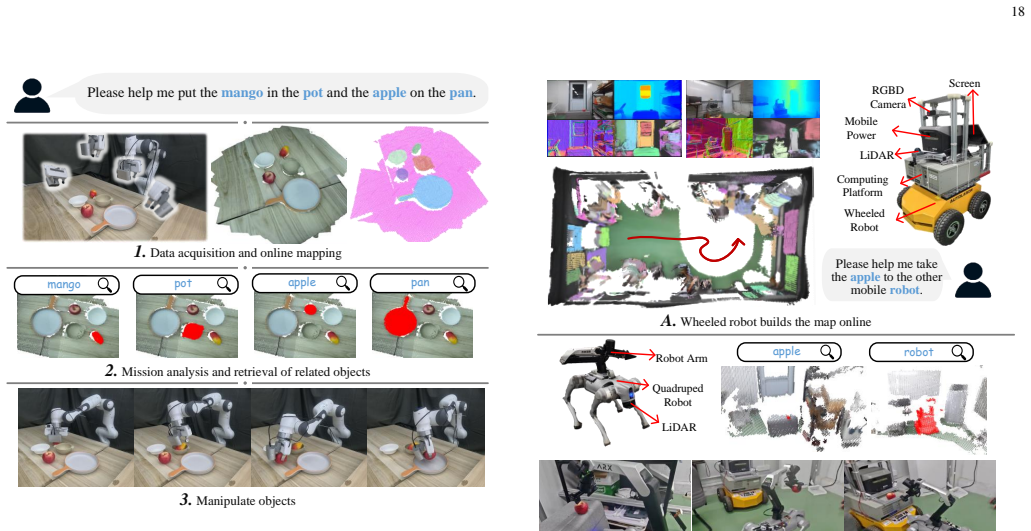
- Downstream tasks such as scene question answering, object editing, pick-and-place, and navigation can read from the same unified map instead of separate representations.
- If the central claim holds, the perceived trade-off between online 3DGS mapping and open-vocabulary mapping is not fundamental; both can be maintained simultaneously.
Reading between the lines
- The four optimized camera parameters could serve as a per-frame quality signal: large translation or brightness weights would flag motion-blurred or badly exposed frames for re-capture before they contaminate the map.
- Because the framework accepts poses from any external source, the next natural stress test is a trajectory with realistic SLAM drift; the paper's results bracket only the perfect-pose regime.
- The Dirichlet pseudo-counts on each voxel provide an uncertainty estimate the paper does not exploit; this could drive next-best-view selection or tell a robot when to re-observe an instance.
- The modular front end implies that swapping the detection and segmentation models should change semantic accuracy and frame rate nearly independently, making the semantic pipeline tunable without touching the reconstruction core.
Editorial analysis
A structured set of objections, weighed in public.
Referee Report
Summary. OmniMap proposes an online RGB-D mapping framework that couples a 3D Gaussian Splatting (3DGS) field with a probabilistic voxel map to jointly represent appearance, geometry, and open-vocabulary semantics. The method introduces: (i) a hybrid representation in which newly allocated TSDF voxels initialize Gaussian primitives; (ii) a per-keyframe four-parameter camera model to compensate for motion blur and exposure; (iii) normal supervision from rendered depth; and (iv) an instance-level probabilistic fusion formulated as MLE/MAP over Dirichlet-Categorical updates with an embedding codebook. Experiments on Replica and ScanNet compare against 3DGS-based SLAM and open-vocabulary mapping baselines, reporting state-of-the-art PSNR/SSIM/LPIPS, mesh F-score, zero-shot semantic mIoU, 5.55 FPS, and 14.2 MB model size. The paper also demonstrates downstream applications: scene Q&A, interactive editing, manipulation, and navigation.
Significance. If the empirical claims hold, the paper makes a substantial contribution: it demonstrates a single online pipeline that simultaneously maintains photorealistic rendering, accurate geometry, and open-vocabulary instance understanding, with real-time operation and a compact model. The benchmark coverage is unusually broad for a mapping paper: eight 3DGS baselines on rendering/reconstruction, seven semantic baselines, ablations, parameter-sensitivity plots, and real-robot demos. The probabilistic instance-fusion formulation is a principled alternative to heuristic IoU association, and the voxel-guided Gaussian initialization is a clean mechanism for incremental densification. However, the central claims rest on the optical evaluation protocol: the paper does not explicitly state that evaluated frames are held out from the per-keyframe camera-parameter optimization, and no error bars or multi-seed statistics are reported. The framework also relies on externally provided poses and is limited to static scenes, as acknowledged in the Conclusion. These issues affect the strength of the 'first general online mapping framework' and 'SOTA' claims, but they appear fixable with additional clari
major comments (3)
- [Sec. VI-D and Sec. VII-B, Eq. (29)-(33), Tables II-III] The optical evaluation protocol is underspecified in a load-bearing way. The four camera parameters [ω_raw, ω_trans, x_trans, y_trans] are optimized per keyframe with the same RGB and SSIM losses (Eqs. 30-31) that are later used to report rendering quality. The text says 'rendered novel views using camera trajectories P' but does not state whether the evaluated frames are disjoint from the keyframes used during optimization, nor what camera parameters are used at evaluation time. If the evaluated frames are the same keyframes whose parameters were fitted, the camera model can absorb per-frame brightness and translation residuals, inflating PSNR/SSIM/LPIPS without improving true novel-view synthesis. The Fig. 6 'validation' is also only a correlation on the optimized frames. Please specify the train/test split, report held-out-frame metrics with camera parameters frozen or handled by a co
- [Sec. VII-A, Tables II-VII] All benchmark numbers are single-run point estimates. The pipeline uses stochastic 3DGS optimization and random selection of 19 keyframes per input frame (Sec. VII-A), so the reported differences—especially the smaller margins over HI-SLAM2 and GS-ICP-SLAM—may not be statistically robust. The paper repeatedly claims OmniMap 'consistently outperforms' and is 'superior' across metrics; supporting this requires mean±std over at least 3 seeds (or equivalent significance testing) for the headline tables. Without this, the SOTA claim is not yet quantitatively grounded.
- [Sec. VII-A and Sec. IX] The framework does not estimate camera poses; all experiments use ground-truth poses, and the Conclusion explicitly states that mapping quality depends on external positioning systems and that dynamic scenes are not handled. This is an honest limitation, but it directly bounds the 'general online mapping framework' claim in the Abstract and Sec. I. The claimed online performance is only demonstrated for externally localized, static environments. To support the broader claim, please either add experiments with realistic pose noise (or an integrated tracker) and dynamic-object sequences, or qualify the abstract and contribution statements accordingly.
minor comments (5)
- [Eq. (21)] The Gaussian exponent should use the inverse covariance Σ_i^{-1}; the current Σ_i^T is incorrect as written.
- [Eq. (27) and Fig. 6] The text states ω_raw and ω_trans are in [0,1], but Fig. 6 reports optimized values such as 1.408 and -8.820. Please clarify the actual parameter bounds or state that they are unconstrained post-initialization.
- [Sec. VII-D] The sentence 'Tab. V and Tab. VI summarize the qualitative results' should say 'quantitative results'; the figures provide the qualitative results.
- [Sec. VII-A] The keyframe discrimination thresholds—the unregistered-region ratio τ_t and the maximum number N of consecutive non-keyframes—are never given numerical values. Please report them in the implementation details.
- [Sec. V-C] The Dirichlet closed-form expectation in Eq. (16) cites reference [14]; a standard Bayesian statistics reference would be more appropriate for the conjugate prior update.
Circularity Check
Camera-model 'validation' in Fig. 6 is a fitting artifact, but the main SOTA claims rest on external benchmarks and ablations.
-
fitted input called prediction
[Sec. VI-C Eq. (29), Sec. VI-D Eqs. (30)-(31), Fig. 6]
"The numbers under images correspond to the optimized parameter set [ωraw, ωtrans, xtrans, ytrans]. Quantitative analysis reveals: (1) high-brightness images show elevated ωraw+ωtrans (blue bar) relative to low-brightness conditions, and (2) blurred images exhibit consistently higher |xtrans|+|ytrans| (green bar) compared to sharp counterparts. These correlations validate OmniMap’s effectiveness in camera modeling."
The four camera parameters are optimized per keyframe against the very same observed frames via Eq. (29) supervised by Lrgb (Eq. 30). Therefore ωraw+ωtrans and |xtrans|+|ytrans| are free variables chosen to minimize the photometric residual for each frame. A bright frame forces the optimizer to raise ωraw+ωtrans, and a blurred frame with motion forces a nonzero translation mixture; the reported correlation is a property of the fitted parameters, not an independent validation. No held-out blur/exposure prediction is made, so Fig. 6's 'validate' is circular. The central rendering claim remains partly supported by the external ablation and benchmarks.
full rationale
The paper's core derivations are not circular: rendering, mesh, and semantic metrics are external benchmarks (Replica, ScanNet), baseline methods are reproduced, and ablations (Table VIII) show the proposed components matter. The only genuine circular step is Fig. 6, where per-frame camera parameters optimized to minimize photometric loss are then used to 'validate' the camera model by showing correlations with brightness and blur; this correlation is a direct consequence of the fitting procedure, not a predictive test. Self-citations, including the OpenVox-derived probabilistic voxel formulation, are background and not load-bearing because the Dirichlet update and association equations are derived in the paper. The evaluation protocol does not explicitly state that rendered 'novel views' are held out from camera-parameter optimization, but that is an ambiguity/risk rather than a demonstrated reduction, so it is not counted as circularity. Overall score 3 reflects this partial, non-central circularity while the main SOTA claims retain independent support.
Assumptions & free parameters
free parameters (6)
- Per-keyframe camera model parameters (omega_raw, omega_trans, x_trans, y_trans) =
Initialized [0.5, 0.5, 0, 0]; fitted per keyframe, examples in Fig. 6
- Instance fusion threshold xi =
Not reported
- Voxel resolution =
0.03 m default; 0.06 m in ablation (6.2 MB model)
- Keyframe insertion thresholds (unregistered ratio tau_t and N consecutive frames) =
Not reported
- Fusion weights between geometric and embedding similarity =
Not reported
- Loss balancing weights for L_rgb, L_ssim, L_depth, L_normal =
Not reported
assumptions (6)
- domain assumption 3DGS differentiable rendering (Eqs. 21-23) correctly models the scene appearance and depth.
- domain assumption TSDF-Fusion provides a stable voxel grid with reliable color and surface information for Gaussian initialization.
- domain assumption YOLO-World and TAP produce masks and captions accurate enough that probabilistic fusion can recover from their noise.
- domain assumption Scene is static and camera poses are externally accurate.
- ad hoc to paper Motion blur and exposure can be represented as a weighted combination of a sharp render and a globally shifted sharp render (Eq. 29).
- domain assumption Dirichlet-Categorical conjugate updating (Eqs. 12-16) is a valid sensor model for instance segmentation observations.
Cite this review
Pith. "Pith review of OmniMap: A General Mapping Framework Integrating Optics, Geometry, and Semantics." pith.science (2026). https://pith.science/paper/WPRDKFX5
@misc{pith2026250907500,
  author       = {Pith},
  title        = {Pith review of: OmniMap: A General Mapping Framework Integrating Optics, Geometry, and Semantics},
  year         = {2026},
  howpublished = {\url{https://pith.science/paper/WPRDKFX5}},
  note         = {Machine review of arXiv:2509.07500}
}
read the original abstract
Robotic systems demand accurate and comprehensive 3D environment perception, requiring simultaneous capture of photo-realistic appearance (optical), precise layout shape (geometric), and open-vocabulary scene understanding (semantic). Existing methods typically achieve only partial fulfillment of these requirements while exhibiting optical blurring, geometric irregularities, and semantic ambiguities. To address these challenges, we propose OmniMap. Overall, OmniMap represents the first online mapping framework that simultaneously captures optical, geometric, and semantic scene attributes while maintaining real-time performance and model compactness. At the architectural level, OmniMap employs a tightly coupled 3DGS-Voxel hybrid representation that combines fine-grained modeling with structural stability. At the implementation level, OmniMap identifies key challenges across different modalities and introduces several innovations: adaptive camera modeling for motion blur and exposure compensation, hybrid incremental representation with normal constraints, and probabilistic fusion for robust instance-level understanding. Extensive experiments show OmniMap's superior performance in rendering fidelity, geometric accuracy, and zero-shot semantic segmentation compared to state-of-the-art methods across diverse scenes. The framework's versatility is further evidenced through a variety of downstream applications, including multi-domain scene Q&A, interactive editing, perception-guided manipulation, and map-assisted navigation.
Figures


Figures from the paper (11 more)


Reference graph
Works this paper leans on
-
[1]
Octomap: An efficient probabilistic 3d mapping framework based on octrees,
A. Hornung, K. M. Wurm, M. Bennewitz, et al., “Octomap: An efficient probabilistic 3d mapping framework based on octrees,”Autonomous robots, vol. 34, no. 3, pp. 189–206, 2013
work page 2013
-
[2]
V oxblox: Incremental 3d euclidean signed distance fields for on-board mav planning,
H. Oleynikova, Z. Taylor, M. Fehr, et al., “V oxblox: Incremental 3d euclidean signed distance fields for on-board mav planning,” in2017 IEEE/RSJ International Conference on Intelligent Robots and Systems (IROS), pp. 1366–1373. IEEE, 2017
work page 2017
-
[3]
Kinectfusion: Real-time dense surface mapping and tracking,
R. A. Newcombe, S. Izadi, O. Hilliges, et al., “Kinectfusion: Real-time dense surface mapping and tracking,” in2011 10th IEEE international symposium on mixed and augmented reality, pp. 127–136. Ieee, 2011
work page 2011
-
[4]
A. Dai, M. Nießner, M. Zollh ¨ofer, et al., “Bundlefusion: Real-time glob- ally consistent 3d reconstruction using on-the-fly surface reintegration,” ACM Transactions on Graphics (ToG), vol. 36, no. 4, p. 1, 2017
work page 2017
-
[5]
Nerf: Representing scenes as neural radiance fields for view synthesis,
B. Mildenhall, P. P. Srinivasan, M. Tancik, et al., “Nerf: Representing scenes as neural radiance fields for view synthesis,”Communications of the ACM, vol. 65, no. 1, pp. 99–106, 2021. 19
work page 2021
-
[6]
3d gaussian splatting for real-time radiance field rendering,
B. Kerbl, G. Kopanas, T. Leimk ¨uhler, et al., “3d gaussian splatting for real-time radiance field rendering,”ACM Transactions on Graphics, vol. 42, no. 4, pp. 1–14, 2023
work page 2023
-
[7]
Conceptgraphs: Open- vocabulary 3d scene graphs for perception and planning,
Q. Gu, A. Kuwajerwala, S. Morin, et al., “Conceptgraphs: Open- vocabulary 3d scene graphs for perception and planning,” in2016 IEEE international conference on robotics and automation (ICRA). IEEE, 2024
work page 2024
-
[8]
Hierarchical Open-V ocabulary 3D Scene Graphs for Language-Grounded Robot Navigation,
A. Werby, C. Huang, M. B ¨uchner, et al., “Hierarchical Open-V ocabulary 3D Scene Graphs for Language-Grounded Robot Navigation,” inPro- ceedings of Robotics: Science and Systems, Delft, Netherlands, Jul. 2024
work page 2024
Show all 61 references
-
[9]
Lerf: Language embedded radi- ance fields,
J. Kerr, C. M. Kim, K. Goldberg, et al., “Lerf: Language embedded radi- ance fields,” inProceedings of the IEEE/CVF International Conference on Computer Vision, pp. 19 729–19 739, 2023
2023
-
[10]
Langsplat: 3d language gaussian splatting,
M. Qin, W. Li, J. Zhou, et al., “Langsplat: 3d language gaussian splatting,” inIEEE/CVF Conference on Computer Vision and Pattern Recognition (CVPR), 2024
2024
-
[11]
Occupancy grid mapping without ray-casting for high-resolution lidar sensors,
Y . Cai, F. Kong, Y . Ren, et al., “Occupancy grid mapping without ray-casting for high-resolution lidar sensors,”IEEE Transactions on Robotics, vol. 40, pp. 172–192, 2023
2023
-
[12]
Continuous occupancy mapping in dynamic environments using particles,
G. Chen, W. Dong, P. Peng, et al., “Continuous occupancy mapping in dynamic environments using particles,”IEEE Transactions on Robotics, vol. 40, pp. 64–84, 2023
2023
-
[13]
Uni-fusion: Universal continuous mapping,
Y . Yuan and A. N ¨uchter, “Uni-fusion: Universal continuous mapping,” IEEE Transactions on Robotics, vol. 40, pp. 1373–1392, 2024
2024
-
[14]
See-csom: Sharp-edged and efficient continuous semantic occupancy mapping for mobile robots,
Y . Deng, M. Wang, Y . Yang, et al., “See-csom: Sharp-edged and efficient continuous semantic occupancy mapping for mobile robots,” IEEE Transactions on Industrial Electronics, 2023
2023
-
[15]
Semantic octree mapping and shannon mutual information computation for robot exploration,
A. Asgharivaskasi and N. Atanasov, “Semantic octree mapping and shannon mutual information computation for robot exploration,”IEEE Transactions on Robotics, vol. 39, no. 3, pp. 1910–1928, 2023
1910
-
[16]
Hd-ccsom: Hierarchical and dense collaborative continuous semantic occupancy mapping through label diffusion,
Y . Deng, M. Wang, Y . Yang, et al., “Hd-ccsom: Hierarchical and dense collaborative continuous semantic occupancy mapping through label diffusion,” in2022 IEEE/RSJ International Conference on Intelligent Robots and Systems (IROS), pp. 2417–2422. IEEE, 2022
2022
-
[17]
Gaussian-slam: Photo-realistic dense slam with gaussian splatting,
V . Yugay, Y . Li, T. Gevers, et al., “Gaussian-slam: Photo-realistic dense slam with gaussian splatting,”arXiv preprint arXiv:2312.10070, 2023
2023 arXiv
-
[18]
Splatam: Splat track & map 3d gaussians for dense rgb-d slam,
N. Keetha, J. Karhade, K. M. Jatavallabhula, et al., “Splatam: Splat track & map 3d gaussians for dense rgb-d slam,” inProceedings of the IEEE/CVF Conference on Computer Vision and Pattern Recognition, pp. 21 357–21 366, 2024
2024
-
[19]
Gaussian splatting slam,
H. Matsuki, R. Murai, P. H. Kelly, et al., “Gaussian splatting slam,” inProceedings of the IEEE/CVF Conference on Computer Vision and Pattern Recognition, pp. 18 039–18 048, 2024
2024
-
[20]
Conceptfusion: Open- set multimodal 3d mapping,
K. Jatavallabhula, A. Kuwajerwala, Q. Gu, et al., “Conceptfusion: Open- set multimodal 3d mapping,”Robotics: Science and Systems (RSS), 2023
2023
-
[21]
Opengraph: Open-vocabulary hier- archical 3d graph representation in large-scale outdoor environments,
Y . Deng, J. Wang, J. Zhao, et al., “Opengraph: Open-vocabulary hier- archical 3d graph representation in large-scale outdoor environments,” IEEE Robotics and Automation Letters, vol. 9, no. 10, pp. 8402–8409, 2024
2024
-
[22]
Openin: Open-vocabulary instance- oriented navigation in dynamic domestic environments,
Y . Tang, M. Wang, Y . Deng, et al., “Openin: Open-vocabulary instance- oriented navigation in dynamic domestic environments,”IEEE Robotics and Automation Letters, no. 99, pp. 1–8, 2025
2025
-
[23]
Gsfusion: Online rgb-d mapping where gaussian splatting meets tsdf fusion,
J. Wei and S. Leutenegger, “Gsfusion: Online rgb-d mapping where gaussian splatting meets tsdf fusion,”IEEE Robotics and Automation Letters, 2024
2024
-
[24]
Nice-slam: Neural implicit scalable encoding for slam,
Z. Zhu, S. Peng, V . Larsson, et al., “Nice-slam: Neural implicit scalable encoding for slam,” inProceedings of the IEEE/CVF conference on computer vision and pattern recognition, pp. 12 786–12 796, 2022
2022
-
[25]
Activegs: Active scene reconstruction using gaussian splatting,
L. Jin, X. Zhong, Y . Pan, et al., “Activegs: Active scene reconstruction using gaussian splatting,”IEEE Robotics and Automation Letters, 2025
2025
-
[26]
Deblur-nerf: Neural radiance fields from blurry images,
L. Ma, X. Li, J. Liao, et al., “Deblur-nerf: Neural radiance fields from blurry images,” inProceedings of the IEEE/CVF conference on computer vision and pattern recognition, pp. 12 861–12 870, 2022
2022
-
[27]
Deblurring 3d gaussian splatting,
B. Lee, H. Lee, X. Sun, et al., “Deblurring 3d gaussian splatting,” in European Conference on Computer Vision, pp. 127–143. Springer, 2024
2024
-
[28]
Bad-gaussians: Bundle adjusted deblur gaussian splatting,
L. Zhao, P. Wang, and P. Liu, “Bad-gaussians: Bundle adjusted deblur gaussian splatting,” inEuropean Conference on Computer Vision, pp. 233–250. Springer, 2024
2024
-
[29]
Open-fusion: Real-time open- vocabulary 3d mapping and queryable scene representation,
K. Yamazaki, T. Hanyu, K. V o, et al., “Open-fusion: Real-time open- vocabulary 3d mapping and queryable scene representation,” in2024 IEEE International Conference on Robotics and Automation (ICRA), pp. 9411–9417. IEEE, 2024
2024
-
[30]
Occupancy grid models for robot mapping in changing environments,
D. Meyer-Delius, M. Beinhofer, and W. Burgard, “Occupancy grid models for robot mapping in changing environments,” inTwenty-Sixth AAAI Conference on Artificial Intelligence, 2012
2012
-
[31]
Ssgm: Spatial semantic graph matching for loop closure detection in indoor environments,
Y . Tang, M. Wang, Y . Deng, et al., “Ssgm: Spatial semantic graph matching for loop closure detection in indoor environments,” in2023 IEEE/RSJ International Conference on Intelligent Robots and Systems (IROS), pp. 9163–9168. IEEE, 2023
2023
-
[32]
Multi-view robust collaborative localization in high outlier ratio scenes based on semantic features,
Y . Tang, M. Wang, Y . Deng, et al., “Multi-view robust collaborative localization in high outlier ratio scenes based on semantic features,” in2023 IEEE/RSJ International Conference on Intelligent Robots and Systems (IROS), pp. 11 042–11 047. IEEE, 2023
2023
-
[33]
Robust large-scale collabora- tive localization based on semantic submaps with extreme outliers,
Y . Tang, M. Wang, Y . Yang, et al., “Robust large-scale collabora- tive localization based on semantic submaps with extreme outliers,” IEEE/ASME Transactions on Mechatronics, vol. 29, no. 4, pp. 2649– 2660, 2023
2023
-
[34]
Semanticfusion: Dense 3d semantic mapping with convolutional neural networks,
J. McCormac, A. Handa, A. Davison, et al., “Semanticfusion: Dense 3d semantic mapping with convolutional neural networks,” in2017 IEEE International Conference on Robotics and automation (ICRA), pp. 4628–
-
[35]
Gpmap: A unified framework for robotic mapping based on sparse gaussian processes,
S. Kim and J. Kim, “Gpmap: A unified framework for robotic mapping based on sparse gaussian processes,” inField and Service Robotics: Results of the 9th International Conference, pp. 319–332. Springer, 2015
2015
-
[36]
Hilbert maps: Scalable continuous occupancy mapping with stochastic gradient descent,
F. Ramos and L. Ott, “Hilbert maps: Scalable continuous occupancy mapping with stochastic gradient descent,”The International Journal of Robotics Research, vol. 35, no. 14, pp. 1717–1730, 2016
2016
-
[37]
Bayesian generalized kernel inference for terrain traversability mapping,
T. Shan, J. Wang, B. Englot, et al., “Bayesian generalized kernel inference for terrain traversability mapping,” inConference on Robot Learning, pp. 829–838. PMLR, 2018
2018
-
[38]
S-mki: Incremental dense semantic occupancy reconstruction through multi-entropy kernel inference,
Y . Deng, M. Wang, D. Wang, et al., “S-mki: Incremental dense semantic occupancy reconstruction through multi-entropy kernel inference,” in 2022 IEEE/RSJ International Conference on Intelligent Robots and Systems (IROS), pp. 3824–3829. IEEE, 2022
2022
-
[39]
Lgsdf: Continual global learning of signed distance fields aided by local updating,
Y . Yue, Y . Deng, Y . Tang, et al., “Lgsdf: Continual global learning of signed distance fields aided by local updating,”IEEE Robotics and Automation Letters, 2025
2025
-
[40]
Macim: Multi-agent collaborative implicit mapping,
Y . Deng, Y . Tang, Y . Yang, et al., “Macim: Multi-agent collaborative implicit mapping,”IEEE Robotics and Automation Letters, 2024
2024
-
[41]
imap: Implicit mapping and positioning in real-time,
E. Sucar, S. Liu, J. Ortiz, et al., “imap: Implicit mapping and positioning in real-time,” inProceedings of the IEEE/CVF international conference on computer vision, pp. 6229–6238, 2021
2021
-
[42]
Gs-slam: Dense visual slam with 3d gaussian splatting,
C. Yan, D. Qu, D. Xu, et al., “Gs-slam: Dense visual slam with 3d gaussian splatting,” inProceedings of the IEEE/CVF Conference on Computer Vision and Pattern Recognition, pp. 19 595–19 604, 2024
2024
-
[43]
Rtg-slam: Real-time 3d reconstruction at scale using gaussian splatting,
Z. Peng, T. Shao, Y . Liu, et al., “Rtg-slam: Real-time 3d reconstruction at scale using gaussian splatting,” inACM SIGGRAPH 2024 Conference Papers, pp. 1–11, 2024
2024
-
[44]
Splat-slam: Globally optimized rgb-only slam with 3d gaussians,
E. Sandstr ¨om, G. Zhang, K. Tateno, et al., “Splat-slam: Globally optimized rgb-only slam with 3d gaussians,” inProceedings of the Computer Vision and Pattern Recognition Conference, pp. 1680–1691, 2025
2025
-
[45]
Rgbd gs-icp slam,
S. Ha, J. Yeon, and H. Yu, “Rgbd gs-icp slam,” inEuropean Conference on Computer Vision, pp. 180–197. Springer, 2024
2024
-
[46]
Cartgs: Computational alignment for real-time gaussian splatting slam,
D. Feng, Z. Chen, Y . Yin, et al., “Cartgs: Computational alignment for real-time gaussian splatting slam,”IEEE Robotics and Automation Letters, 2025
2025
-
[47]
Hi-slam2: Geometry-aware gaussian slam for fast monocular scene reconstruction,
W. Zhang, Q. Cheng, D. Skuddis, et al., “Hi-slam2: Geometry-aware gaussian slam for fast monocular scene reconstruction,”arXiv preprint arXiv:2411.17982, 2024
2024
-
[48]
Decomposing nerf for editing via feature field distillation,
S. Kobayashi, E. Matsumoto, and V . Sitzmann, “Decomposing nerf for editing via feature field distillation,”Advances in Neural Information Processing Systems, vol. 35, pp. 23 311–23 330, 2022
2022
-
[49]
Openobj: Open-vocabulary object- level neural radiance fields with fine-grained understanding,
Y . Deng, J. Wang, J. Zhao, et al., “Openobj: Open-vocabulary object- level neural radiance fields with fine-grained understanding,”IEEE Robotics and Automation Letters, 2024
2024
-
[50]
Openmulti: Open-vocabulary instance- level multi-agent distributed implicit mapping,
J. Dou, Y . Deng, J. Wang, et al., “Openmulti: Open-vocabulary instance- level multi-agent distributed implicit mapping,”IEEE Robotics and Automation Letters, 2025
2025
-
[51]
Gaussian grouping: Segment and edit anything in 3d scenes,
M. Ye, M. Danelljan, F. Yu, et al., “Gaussian grouping: Segment and edit anything in 3d scenes,” inEuropean Conference on Computer Vision, pp. 162–179. Springer, 2024
2024
-
[52]
Opengaussian: Towards point-level 3d gaussian-based open vocabulary understanding,
Y . Wu, J. Meng, H. Li, et al., “Opengaussian: Towards point-level 3d gaussian-based open vocabulary understanding,”Advances in Neural Information Processing Systems, vol. 37, pp. 19 114–19 138, 2024
2024
-
[53]
Openvox: Real-time instance-level open-vocabulary probabilistic voxel representation,
Y . Deng, B. Yao, Y . Tang, et al., “Openvox: Real-time instance-level open-vocabulary probabilistic voxel representation,” in2025 IEEE/RSJ International Conference on Intelligent Robots and Systems (IROS). IEEE, 2025. 20
2025
-
[54]
Yolo-world: Real-time open- vocabulary object detection,
T. Cheng, L. Song, Y . Ge, et al., “Yolo-world: Real-time open- vocabulary object detection,” inProceedings of the IEEE/CVF Confer- ence on Computer Vision and Pattern Recognition, pp. 16 901–16 911, 2024
2024
-
[55]
Tokenize anything via prompting,
T. Pan, L. Tang, X. Wang, et al., “Tokenize anything via prompting,” in Proceedings of the European conference on computer vision (ECCV), 2024
2024
-
[56]
Sentence-bert: Sentence embeddings using siamese bert-networks,
N. Reimers and I. Gurevych, “Sentence-bert: Sentence embeddings using siamese bert-networks,” inProceedings of the 2019 Conference on Empirical Methods in Natural Language Processing, 11 2019
2019
-
[57]
A volumetric method for building complex models from range images,
B. Curless and M. Levoy, “A volumetric method for building complex models from range images,” inProceedings of the 23rd annual confer- ence on Computer graphics and interactive techniques, pp. 303–312, 1996
1996
-
[58]
Bayesian spatial kernel smoothing for scalable dense semantic mapping,
L. Gan, R. Zhang, J. W. Grizzle, et al., “Bayesian spatial kernel smoothing for scalable dense semantic mapping,”IEEE Robotics and Automation Letters, vol. 5, no. 2, pp. 790–797, 2020
2020
-
[59]
Graspsplats: Efficient manipulation with 3d feature splatting,
M. Ji, R.-Z. Qiu, X. Zou, et al., “Graspsplats: Efficient manipulation with 3d feature splatting,” inConference on Robot Learning, 2024
2024
-
[60]
The replica dataset: A digital replica of indoor spaces,
J. Straub, T. Whelan, L. Ma, et al., “The replica dataset: A digital replica of indoor spaces,”arXiv preprint arXiv:1906.05797, 2019
1906 arXiv
-
[61]
Scannet: Richly-annotated 3d reconstructions of indoor scenes,
A. Dai, A. X. Chang, M. Savva, et al., “Scannet: Richly-annotated 3d reconstructions of indoor scenes,” inProceedings of the IEEE conference on computer vision and pattern recognition, pp. 5828–5839, 2017. Yinan Deng(Student Member, IEEE) received the B.S. degree from Beijing ...
2017
Reviewed August 4, 2026 · model on record in the stance chip above.
Discussion (0). Sign in to comment.