REVIEW 3 major objections 5 minor 35 references
Avoiding Knowledge Edit Skipping in Multi-hop Question Answering with Guided Decomposition
T0 review · 3 major / 5 minor · reviewed 2026-08-04 · deepseek-v4-flash
Pith's one-line read The paper argues that multi-hop knowledge edits are skipped when subquestions are written at a finer or coarser granularity than the edited fact, and that pre-retrieving the edit and using its atomic question to guide decomposition fixes th
desk verdict Solid retrieve-then-decompose advance for RAG-based knowledge editing; deserves a serious referee, though the causal mechanism needs a conditional analysis to fully land. read the letter →
The pith
A machine-rendered reading of the paper's core claim, the machinery that carries it, and where it could break.
The reading
What carries the argument
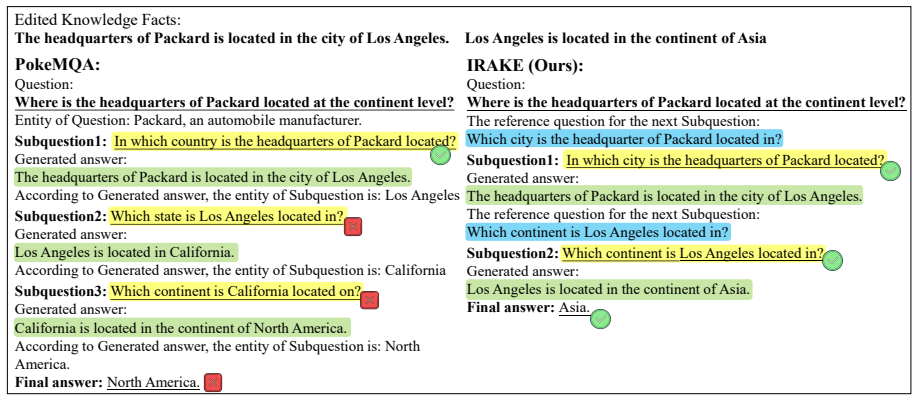
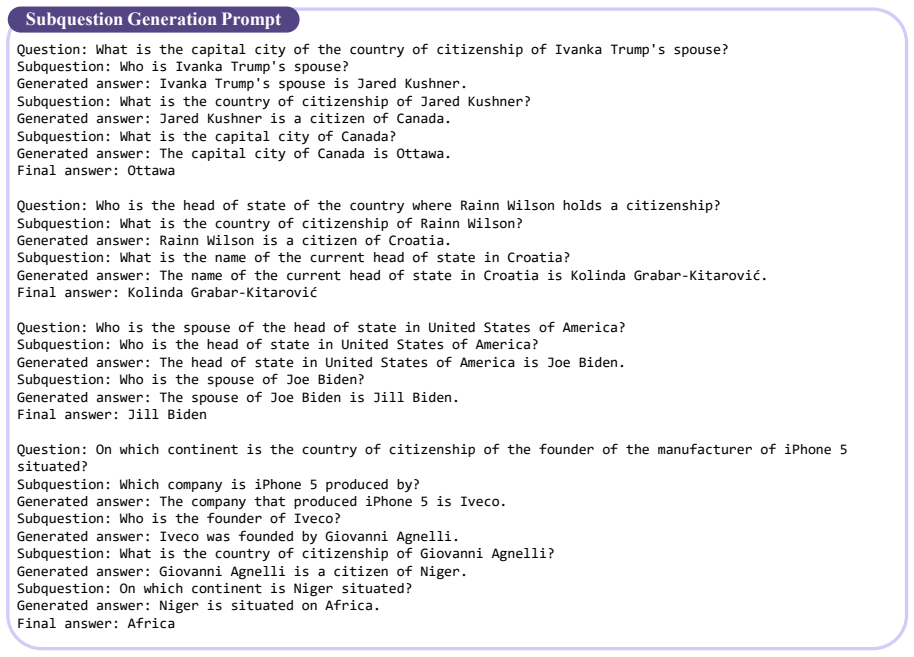
The load-bearing mechanism is edit-guided decomposition, built from three parts: (1) edited-fact guidance, where a pre-retrieved edit's atomic question—the natural question corresponding to the edited triplet, e.g., "Who is the president of the USA?" for the edit "president: Biden -> Trump"—is used as a reference subquestion during decomposition; (2) edited-case guidance, where the full decomposition record of the most similar solved case is used as a dynamic prompt; and (3) a backtracking stack that saves the last non-guided decomposition and restores it if guidance leads to no edit retrieval. The atomic question is key: the paper argues that using the edited factual answer directly provoke
What would settle it
Take the subset of MQuAKE-2002 cases in which the required edited fact is absent from the top-3 pre-retrieval results (roughly 42% of cases given the paper's reported 58.17% pre-retrieval recall at k=3). If IRAKE's accuracy on that subset is not substantially worse than its accuracy on cases where the edit is retrieved, the paper's claim that pre-retrieval is the mechanism would be undercut; conversely, supplying an oracle pre-retriever that always returns the gold edit should push accuracy near the ceiling. Both comparisons are directly measurable on a held-out split.
Extended reading notes
Core claim
The central claim is that "edit skipping" in multi-hop knowledge editing is caused by a mismatch between the granularity of the decomposed subquestion and the granularity of the relevant edited fact, and that this can be corrected by a retrieve-then-decompose pipeline. Given a complex question Q, IRAKE first pre-retrieves the top-k edited facts most similar to Q, or to a rewritten version of Q, then asks an LLM judge to identify the single most helpful edit, and uses the atomic question associated with that edit as a reference subquestion to guide decomposition. The same decomposition is further guided by retrieving the most similar previously solved edited case and injecting its full soluti
Load-bearing premise
The pre-retrieval step must bring the relevant edited fact into the top-k candidates even when the question does not share its exact words; otherwise the fact-level guidance never fires and edit skipping can persist.
Editorial extensions
If this is right
- The decompose-then-retrieve order used by earlier multi-hop editing methods is itself a correctable source of edit skipping, not a fixed limitation.
- Edited memories should store atomic questions alongside edits, because counterfactual answer statements trigger doubt, while question-form guidance improves subquestion alignment.
- Retrieving a similar previously solved case strengthens decomposition, especially on harder 4-hop cases, and adding more solved cases to the library yields further gains.
- Edit recall during reasoning is a useful diagnostic metric: measured improvements in retrieving required edited facts correspond to improvements in final accuracy.
- The guidance pattern transfers across base LLMs with different reasoning strengths and shows the smallest degradation on the harder MQuAKE-hard set.
Reading between the lines
- The same retrieve-before-decompose principle could generalize beyond knowledge editing to any retrieval-augmented reasoning task where a sparse, precise store of facts or constraints must be honored during planning.
- The reported pre-retrieval recall of 58.17% at k=3 means roughly two-fifths of cases reach the LLM judge without the needed edit, so a stronger retriever or query rewriting before pre-retrieval would likely improve IRAKE more than further prompt engineering.
- Because the method relies on atomic questions that must exist for each edit, automatically generating or paraphrasing those questions for new edits would make the approach deployable outside benchmark data.
- A confidence signal on the LLM judge could let the system avoid entering a bad guided path in the first place, rather than relying on backtracking to recover from it afterwards; this is a cheap, testable extension.
Editorial analysis
A structured set of objections, weighed in public.
Referee Report
Summary. The paper addresses knowledge editing (KE) for multi-hop question answering. It identifies 'edit skipping,' where RAG-based KE methods fail because the granularity of the LLM's question decomposition does not match the granularity of the edited facts, so the relevant edit is never retrieved or applied. The proposed method, IRAKE, reverses the usual order: before decomposing the multi-hop question, it pre-retrieves candidate edited facts and uses the atomic question of the selected fact to guide subquestion generation; it also retrieves similar previously solved edited cases to provide a dynamic decomposition prompt, and includes a state backtracking mechanism. Experiments on MQuAKE-2002 and MQuAKE-hard with LLaMa-3-8B, DeepSeek-V2-Lite-16B, and GPT-4o-Mini show large gains in both multi-hop accuracy and hop-wise accuracy over MeLLo, DeepEdit, and PokeMQA. Ablations indicate that all three components contribute, with fact-level guidance having the largest effect.
Significance. If the results hold, IRAKE is a valuable and practical contribution: it reframes multi-hop KE as 'retrieve-then-decompose' rather than 'decompose-then-retrieve,' provides a concrete mechanism for aligning subquestions with the wording of edited facts, and demonstrates consistent gains across three base LLMs and two datasets, with especially strong Hop-Acc improvements. The paper is also commendably transparent: it includes full prompts, runtime and token-cost comparisons, an ablation study, sensitivity analyses in the appendices, and a clear statement of limitations. The main reservations are statistical and evidential: the central causal mechanism is not isolated by a conditional analysis of pre-retrieval success, and the main comparisons lack repeated-run or significance evidence.
major comments (3)
- [§4.2, Table 12, Table 2] The causal claim that fact-level guidance mitigates edit skipping rests on the pre-retrieval step surfacing the relevant edited fact. At the default k=3, Table 12 reports pre-retrieval recall of only 58.17% on MQuAKE-2002, so for roughly 42% of the required edited facts the correct candidate is absent. The reported 'Acc in judgment' of 83.28% includes the large number of cases where the correct fact is absent and the model should output 0; it does not establish that the LLM judge reliably selects the correct fact when it is present. The paper never reports accuracy conditioned on whether the required edit was pre-retrieved. Because Table 2 shows that removing fact-level guidance causes the largest performance drop, this omission is load-bearing: the drop could come from helpful guidance when present, from active misleading when a wrong fact is selected, or from some other interaction. Pl
- [§5.3, Figure 4, Appendix K, Table 12] Key hyperparameters appear to be selected on the evaluation sets. Figure 4 sweeps the similarity threshold θ and reports test-set Acc; Table 12 selects the default k=3 based on MQuAKE-2002 Acc. Using evaluation-set performance to choose θ and k can inflate reported gains and makes the comparison with baselines unfair if baselines do not receive the same tuning. Please either use a held-out validation split for hyperparameter selection, report cross-validation, or explicitly state in the main text that θ and k were chosen on the test sets and quantify the sensitivity over reasonable ranges. The current appendix presentation understates this issue.
- [§5.1, Table 1] The central 'outperforms state-of-the-art' claim is supported only by single-run point estimates. No variance, confidence intervals, or significance tests are reported. Some margins are modest (e.g., Table 1, DeepSeek-V2-Lite-16B 1-edited Acc: IRAKE 56.30 vs. PokeMQA 51.40), and the case-level Acc uses the lenient 'any of three generated questions correct' criterion inherited from prior work. Please report means and standard deviations over multiple runs (or bootstrap CIs), and additionally report per-question accuracy and the stricter all-three-questions-correct accuracy so readers can calibrate the effect size.
minor comments (5)
- [§3, notation] The edited fact memory is written as E={e1, e1, ..., en}; the duplicate 'e1' appears to be a typo for e2.
- [Table 8 vs. Table 2] The label 'w/o guided' in Table 8 is ambiguous: its reported all-edited Acc (42.10) matches the no-fact-guidance row in Table 2, but the caption says 'without guidance.' Clarify whether case-level guidance is present in this ablation.
- [§4.4, state backtracking] The state backtracking mechanism is described only in prose. A short algorithm or pseudocode specifying exactly when a non-guided state is pushed, when the stack is cleared, and when backtracking is triggered would materially aid reproducibility.
- [Figure 3] The 'Recall of edited facts' metric is computed from the retrieval process that includes pre-retrieval and question rewriting, so it is partly a by-construction outcome of the method rather than an independent measurement. The positive correlation is suggestive, but the text should acknowledge that the metric is not fully independent.
- [Figure 4] The y-axis 'Number' is not clearly labeled (number of guided test cases?); please provide exact counts or a secondary axis, and indicate whether the curve is on the same evaluation set used for the main results.
Circularity Check
No significant circularity: IRAKE's gains are measured against external baselines; pre-retrieval guidance is the method's intended mechanism, not a relabeled target.
full rationale
The central claim—that pre-retrieval of edited facts before decomposition mitigates edit skipping—is a legitimate pipeline design and is evaluated against external baselines (MeLLo, DeepEdit, PokeMQA) on MQuAKE-2002 and MQuAKE-hard. No parameter is fitted to the test set to force the reported results; the pre-retrieval encoder is borrowed from PokeMQA, and hyperparameters (k=3, θ=0.80, 500 sampled cases) are set as design choices, not optimized on the test data. The 'recall of edited facts' metric measures a mechanism (whether required edits are retrieved during reasoning) and is used for analysis, not as a training objective; it correlates with accuracy but is not the thing being predicted. The paper contains no load-bearing self-citations: references to Gu et al. (2024) for atomic-question definitions and retrieval methods are external prior work. The acknowledged limitations (e.g., pre-retrieval recall only 58.17% at k=3, cold-start problem for the case library) are robustness concerns, not circularity. The derivation chain—pre-retrieve, judge, guide decomposition, fine-grained retrieve, backtrack—does not reduce to its inputs by construction; the final answer is produced by the base LLM after guided reasoning. Thus no circular step exists.
Assumptions & free parameters
free parameters (3)
- similarity threshold theta =
0.80
- pre-retrieval top-k =
3
- edited case library size =
500 sampled training cases
assumptions (4)
- domain assumption Edit skipping is primarily caused by a mismatch between decomposition granularity and edited-fact granularity.
- domain assumption Semantically similar complex questions share analogous decomposition structures and overlapping edit points.
- domain assumption The LLM judge can reliably select the most relevant edited fact among pre-retrieved candidates, or correctly output 0 when none is relevant.
- domain assumption The embedding similarity metric (mxbai-embed-large-v1) is a reliable proxy for question-to-edit relevance despite paraphrase mismatches.
Cite this review
Pith. "Pith review of Avoiding Knowledge Edit Skipping in Multi-hop Question Answering with Guided Decomposition." pith.science (2026). https://pith.science/paper/M4UK4WS4
@misc{pith2026250907555,
  author       = {Pith},
  title        = {Pith review of: Avoiding Knowledge Edit Skipping in Multi-hop Question Answering with Guided Decomposition},
  year         = {2026},
  howpublished = {\url{https://pith.science/paper/M4UK4WS4}},
  note         = {Machine review of arXiv:2509.07555}
}
read the original abstract
In a rapidly evolving world where information updates swiftly, knowledge in large language models (LLMs) becomes outdated quickly. Retraining LLMs is not a cost-effective option, making knowledge editing (KE) without modifying parameters particularly necessary. We find that although existing retrieval-augmented generation (RAG)-based KE methods excel at editing simple knowledge, they struggle with KE in multi-hop question answering due to the issue of "edit skipping", which refers to skipping the relevant edited fact in inference. In addition to the diversity of natural language expressions of knowledge, edit skipping also arises from the mismatch between the granularity of LLMs in problem-solving and the facts in the edited memory. To address this issue, we propose a novel Iterative Retrieval-Augmented Knowledge Editing method with guided decomposition (IRAKE) through the guidance from single edited facts and entire edited cases. Experimental results demonstrate that IRAKE mitigates the failure of editing caused by edit skipping and outperforms state-of-the-art methods for KE in multi-hop question answering.
Figures


Figures from the paper (6 more)




Reference graph
Works this paper leans on
-
[1]
online" 'onlinestring :=
ENTRY address archivePrefix author booktitle chapter edition editor eid eprint eprinttype howpublished institution journal key month note number organization pages publisher school series title type volume year doi pubmed url lastchecked label extra.label sort.label short.list INTEGERS output.state before.all mid.sentence after.sentence after.block STRING...
-
[2]
write newline
" write newline "" before.all 'output.state := FUNCTION n.dashify 't := "" t empty not t #1 #1 substring "-" = t #1 #2 substring "--" = not "--" * t #2 global.max substring 't := t #1 #1 substring "-" = "-" * t #2 global.max substring 't := while if t #1 #1 substring * t #2 global.max substring 't := if while FUNCTION word.in bbl.in capitalize " " * FUNCT...
-
[3]
Roi Cohen, Eden Biran, Ori Yoran, Amir Globerson, and Mor Geva. 2024. Evaluating the ripple effects of knowledge editing in language models. TACL, 12:283--298
work page 2024
-
[4]
DeepSeek - AI, Aixin Liu, Bei Feng, Bin Wang, Bingxuan Wang, Bo Liu, Chenggang Zhao, Chengqi Deng, Chong Ruan, Damai Dai, Daya Guo, Dejian Yang, Deli Chen, Dongjie Ji, Erhang Li, Fangyun Lin, Fuli Luo, Guangbo Hao, Guanting Chen, Guowei Li, Hao Zhang, Hanwei Xu, Hao Yang, Haowei Zhang, Honghui Ding, Huajian Xin, Huazuo Gao, Hui Li, Hui Qu, J. L. Cai, Jian...
work page 2024
-
[5]
Ning Ding, Yujia Qin, Guang Yang, Fuchao Wei, Zonghan Yang, Yusheng Su, Shengding Hu, Yulin Chen, Chi - Min Chan, Weize Chen, Jing Yi, Weilin Zhao, Xiaozhi Wang, Zhiyuan Liu, Hai - Tao Zheng, Jianfei Chen, Yang Liu, Jie Tang, Juanzi Li, and Maosong Sun. 2023. Parameter-efficient fine-tuning of large-scale pre-trained language models. Nat. Mac. Intell., 5(...
work page 2023
-
[6]
Abhimanyu Dubey, Abhinav Jauhri, Abhinav Pandey, Abhishek Kadian, Ahmad Al - Dahle, Aiesha Letman, Akhil Mathur, Alan Schelten, Amy Yang, Angela Fan, Anirudh Goyal, Anthony Hartshorn, Aobo Yang, Archi Mitra, Archie Sravankumar, Artem Korenev, Arthur Hinsvark, Arun Rao, Aston Zhang, Aur \' e lien Rodriguez, Austen Gregerson, Ava Spataru, Baptiste Rozi \` e...
work page 2024
-
[7]
Hengrui Gu, Kaixiong Zhou, Xiaotian Han, Ninghao Liu, Ruobing Wang, and Xin Wang. 2024. PokeMQA : Programmable knowledge editing for multi-hop question answering. In ACL, pages 8069--8083
work page 2024
-
[8]
David Ha and J \" u rgen Schmidhuber. 2018. Recurrent world models facilitate policy evolution. In NeurIPS, pages 2455--2467
work page 2018
Show all 35 references
-
[9]
Shibo Hao, Yi Gu, Haodi Ma, Joshua Jiahua Hong, Zhen Wang, Daisy Zhe Wang, and Zhiting Hu. 2023. Reasoning with language model is planning with world model. In EMNLP, pages 8154--8173
2023
-
[10]
Peter Hase, Mohit Bansal, Been Kim, and Asma Ghandeharioun. 2023. Does localization inform editing? surprising differences in causality-based localization vs. knowledge editing in language models. In NeurIPS
2023
-
[11]
Hu, Yelong Shen, Phillip Wallis, Zeyuan Allen - Zhu, Yuanzhi Li, Shean Wang, Lu Wang, and Weizhu Chen
Edward J. Hu, Yelong Shen, Phillip Wallis, Zeyuan Allen - Zhu, Yuanzhi Li, Shean Wang, Lu Wang, and Weizhu Chen. 2022. LoRA : Low-rank adaptation of large language models. In ICLR
2022
-
[12]
Aaron Hurst, Adam Lerer, Adam P. Goucher, Adam Perelman, Aditya Ramesh, Aidan Clark, AJ Ostrow, Akila Welihinda, Alan Hayes, Alec Radford, Aleksander Madry, Alex Baker - Whitcomb, Alex Beutel, Alex Borzunov, Alex Carney, Alex Chow, Alex Kirillov, Alex Nichol, Alex Paino, Alex ...
2024
-
[13]
Maurice Jakesch, Advait Bhat, Daniel Buschek, Lior Zalmanson, and Mor Naaman. 2023. Co-writing with opinionated language models affects users' views. In CHI, pages 111:1--111:15
2023
-
[14]
Ehsan Kamalloo, Nouha Dziri, Charles L. A. Clarke, and Davood Rafiei. 2023. Evaluating open-domain question answering in the era of large language models. In ACL, pages 5591--5606
2023
-
[15]
Bangzheng Li, Ben Zhou, Fei Wang, Xingyu Fu, Dan Roth, and Muhao Chen. 2024. Deceptive semantic shortcuts on reasoning chains: How far can models go without hallucination? In NAACL-HLT , pages 7675--7688
2024
-
[16]
Xianming Li and Jing Li. 2023. Angle-optimized text embeddings. CoRR
2023
-
[17]
Jiawei Liu, Chunqiu Steven Xia, Yuyao Wang, and Lingming Zhang. 2023. Is your code generated by ChatGPT really correct? rigorous evaluation of large language models for code generation. In NeurIPS
2023
-
[18]
Yifan Lu, Yigeng Zhou, Jing Li, Yequan Wang, Xuebo Liu, Daojing He, Fangming Liu, and Min Zhang. 2024. Knowledge editing with dynamic knowledge graphs for multi-hop question answering. CoRR
2024
-
[19]
Vittorio Mazzia, Alessandro Pedrani, Andrea Caciolai, Kay Rottmann, and Davide Bernardi. 2023. A survey on knowledge editing of neural networks. CoRR
2023
-
[20]
Kevin Meng, David Bau, Alex Andonian, and Yonatan Belinkov. 2022. Locating and editing factual associations in GPT . In NeurIPS
2022
-
[21]
Andonian, Yonatan Belinkov, and David Bau
Kevin Meng, Arnab Sen Sharma, Alex J. Andonian, Yonatan Belinkov, and David Bau. 2023. Mass-editing memory in a transformer. In ICLR
2023
-
[22]
Eric Mitchell, Charles Lin, Antoine Bosselut, Chelsea Finn, and Christopher D. Manning. 2022 a . Fast model editing at scale. In ICLR
2022
-
[23]
Manning, and Chelsea Finn
Eric Mitchell, Charles Lin, Antoine Bosselut, Christopher D. Manning, and Chelsea Finn. 2022 b . Memory-based model editing at scale. In ICML, volume 162, pages 15817--15831
2022
-
[24]
Yucheng Shi, Qiaoyu Tan, Xuansheng Wu, Shaochen Zhong, Kaixiong Zhou, and Ninghao Liu. 2024. Retrieval-enhanced knowledge editing in language models for multi-hop question answering. In CIKM , pages 2056--2066
2024
-
[25]
Karan Singhal, Tao Tu, Juraj Gottweis, Rory Sayres, Ellery Wulczyn, Mohamed Amin, Le Hou, Kevin Clark, Stephen R Pfohl, Heather Cole-Lewis, et al. 2025. Toward expert-level medical question answering with large language models. Nature Medicine, pages 1--8
2025
-
[26]
Changyue Wang, Weihang Su, Qingyao Ai, and Yiqun Liu. 2024 a . Knowledge editing through chain-of-thought. CoRR
2024
-
[27]
Pan, Wen Zhang, and Huajun Chen
Junjie Wang, Mingyang Chen, Binbin Hu, Dan Yang, Ziqi Liu, Yue Shen, Peng Wei, Zhiqiang Zhang, Jinjie Gu, Jun Zhou, Jeff Z. Pan, Wen Zhang, and Huajun Chen. 2024 b . Learning to plan for retrieval-augmented large language models from knowledge graphs. In EMNLP (Findings) , pag...
2024
-
[28]
Peng Wang, Ningyu Zhang, Xin Xie, Yunzhi Yao, Bozhong Tian, Mengru Wang, Zekun Xi, Siyuan Cheng, Kangwei Liu, Guozhou Zheng, et al. 2023. Easyedit: An easy-to-use knowledge editing framework for large language models. CoRR
2023
-
[29]
Song Wang, Yaochen Zhu, Haochen Liu, Zaiyi Zheng, Chen Chen, and Jundong Li. 2025. Knowledge editing for large language models: A survey. ACM Comput. Surv., 57(3):59:1--59:37
2025
-
[30]
Yiwei Wang, Muhao Chen, Nanyun Peng, and Kai - Wei Chang. 2024 c . DeepEdit : Knowledge editing as decoding with constraints. CoRR
2024
-
[31]
Ann Yuan, Andy Coenen, Emily Reif, and Daphne Ippolito. 2022. Wordcraft: Story writing with large language models. In IUI, pages 841--852
2022
-
[32]
Ningyu Zhang, Yunzhi Yao, Bozhong Tian, Peng Wang, Shumin Deng, Mengru Wang, Zekun Xi, Shengyu Mao, Jintian Zhang, Yuansheng Ni, Siyuan Cheng, Ziwen Xu, Xin Xu, Jia - Chen Gu, Yong Jiang, Pengjun Xie, Fei Huang, Lei Liang, Zhiqiang Zhang, Xiaowei Zhu, Jun Zhou, and Huajun Chen...
2024
-
[33]
Tenenbaum, and Chuang Gan
Shun Zhang, Zhenfang Chen, Yikang Shen, Mingyu Ding, Joshua B. Tenenbaum, and Chuang Gan. 2023. Planning with large language models for code generation. In ICLR
2023
-
[34]
Ce Zheng, Lei Li, Qingxiu Dong, Yuxuan Fan, Zhiyong Wu, Jingjing Xu, and Baobao Chang. 2023. Can we edit factual knowledge by in-context learning? In EMNLP, pages 4862--4876
2023
-
[35]
Manning, Christopher Potts, and Danqi Chen
Zexuan Zhong, Zhengxuan Wu, Christopher D. Manning, Christopher Potts, and Danqi Chen. 2023. MQuAKE : Assessing knowledge editing in language models via multi-hop questions. In EMNLP, pages 15686--15702
2023
Reviewed August 4, 2026 · model on record in the stance chip above.
Discussion (0). Continue with ORCID to comment.