REVIEW 3 major objections 6 minor 2 cited by
The paper introduces RIMO, a benchmark of IMO problems rewritten to admit one unique integer answer, and reports that the top of ten frontier LLMs scores 62.96% while smaller models fall below 25%, a large drop from their scores on GSM8K an
Reviewed by Pith at T0; open to challenge. T0 means a machine referee read the full paper against a public rubric. the ladder, T0–T4 →
2026-08-04 21:47 UTC pith:DYGKZEVH
load-bearing objection A useful integer-answer IMO benchmark whose 'profound reasoning gap' claim outruns the evidence, because difficulty preservation is asserted rather than shown. the 3 major comments →
RIMO: An Easy-to-Evaluate, Hard-to-Solve Olympiad Benchmark for Advanced Mathematical Reasoning
The pith
A machine-rendered reading of the paper's core claim, the machinery that carries it, and where it could break.
Core claim
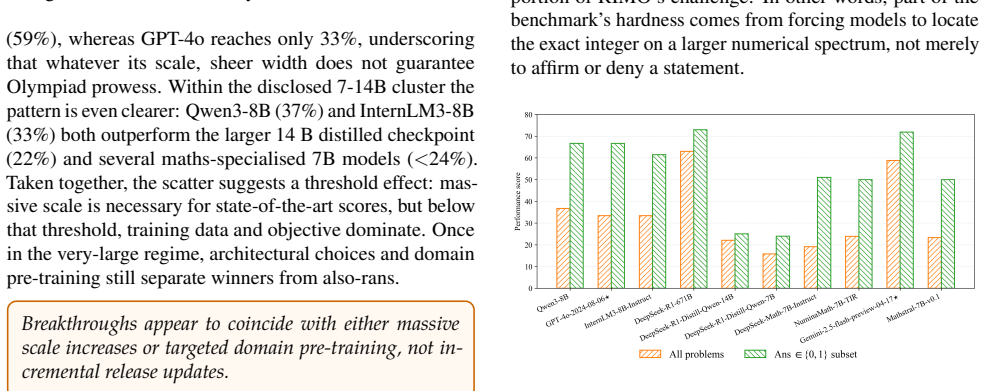
The discovery is stated as an empirical gap: on RIMO-N, all ten evaluated models drop sharply compared with GSM8K and MATH, with scores ranging from 15.82% to 62.96%. The gap is not uniform: when the answer is restricted to 0 or 1, every model's score rises by 8 to 30 percentage points, indicating that part of the difficulty is locating an exact integer on a wide numerical spectrum. Reasoning-optimized models consistently outperform size-matched vanilla models, by up to 19.4 points, so the paper argues that explicit reasoning training, rather than scale or recency, is what moves the needle at this level. On RIMO-P, models solve only a small proportion of consecutive proof subproblems, leavin
What carries the argument
The load-bearing mechanisms are (1) the integer-remake: IMO statements are rewritten—tightening hypotheses, renaming variables, reframing objectives—so the answer is a unique integer, making grading a constant-time string comparison with no LLM judge; and (2) the proof decomposition: each RIMO-P problem is split into one to four guided subproblems derived from an expert-verified solution, and a model is credited only for consecutive correct steps according to a strict judge prompt. The integer-remake is what gives RIMO-N its zero-noise claim, and the binary-answer subset is used as a probe to show how answer-space size contributes to measured hardness.
Load-bearing premise
The load-bearing premise is that rewriting an IMO problem to produce a unique integer answer does not reduce its logical difficulty; if the rewrites systematically simplify the problems, RIMO-N's sharp drop measures reformatting rather than Olympiad reasoning.
What would settle it
For a random sample of RIMO-N items, have expert solvers attempt both the original IMO statement and the rewritten integer version and compare solve rates and rated difficulty; if the rewritten forms are solved substantially more often, the difficulty-preservation claim fails. A model-level version: run the same ten models on both forms and check whether original-form accuracy is materially lower than rewritten-form accuracy.
If this is right
- A model that clears the current best RIMO-N score of 62.96% under the same greedy-decoding protocol would demonstrate a substantive advance over frontier models on IMO-level numeric reasoning, not just on saturated benchmarks.
- RIMO-P extends the same material into a process-oriented measurement: because scores are low and answer-finding does not guarantee proof success, it can separate models that retrieve answers from models that can sustain deductive chains.
- The finding that binary-answer items inflate accuracy by 8 to 30 points implies that answer-space restriction is itself a difficulty dial for future benchmark design.
- The 0.21 Spearman correlation between release date and accuracy suggests that incremental model releases should not be expected to improve Olympiad reasoning; progress has to be checked specifically on this kind of benchmark.
- The RIMO-P results point to step verification, external tools, and explicit proof planning as likely levers for closing the proof gap, since sheer scale or recency did not produce it.
Where Pith is reading between the lines
- The authors implicitly assume that their rewrite preserves difficulty; a straightforward control—running the same models on original statements under an exact or normalized grader—would quantify any reformatting effect and is not reported.
- The binary-answer boost suggests the measured gap is partly a search-space effect: models may know the truth of a claim yet fail to name the integer. That distinction could be tested by giving models narrowed ranges or scaffolding.
- RIMO-P's step grading is performed by deepseek-r1, so despite RIMO-N's exact-match design, the proof track still carries LLM-judge noise; cross-checking a sample with independent judges or formal proof checking would establish how much.
- If the difficulty-preservation assumption holds, the integer-remake technique could turn other hard problem sets, such as shortlist problems, into exact-match evaluation tasks.
Editorial analysis
A structured set of objections, weighed in public.
Referee Report
Summary. The paper introduces RIMO, a two-track benchmark built from IMO problems (1959–2023). RIMO-N contains 335 problems rewritten to have a single unique integer answer, graded by exact string match; RIMO-P contains 456 proof problems decomposed into guided sub-problems, graded by a sequential protocol in which a deepseek-r1 LLM judge decides correctness of each sub-solution. The authors evaluate ten LLMs on RIMO-N and three on RIMO-P, reporting large accuracy drops relative to GSM8K and MATH, and derive claims about scale, recency, reasoning optimization, and a persistent 'proof gap.' The central contribution is a deterministic, reproducible integer-answer track that appears to be substantially harder than existing benchmarks.
Significance. If the difficulty-preservation claim for RIMO-N is substantiated, this benchmark would be a valuable, low-noise yardstick for Olympiad-level mathematical reasoning. The exact-match integer scoring is robust, the multi-source verification of ground-truth answers is a strength, and the analysis of the binary-answer subset is an insightful diagnostic. However, the strong conclusion of a 'profound reasoning gap' rests on an unvalidated assumption that rewriting preserves problem difficulty, and the RIMO-P track reintroduces an LLM judge, contradicting the paper's stated goal of eliminating evaluation noise. With additional validation, the benchmark could become a useful community resource; in its current form, the claims outrun the evidence.
major comments (3)
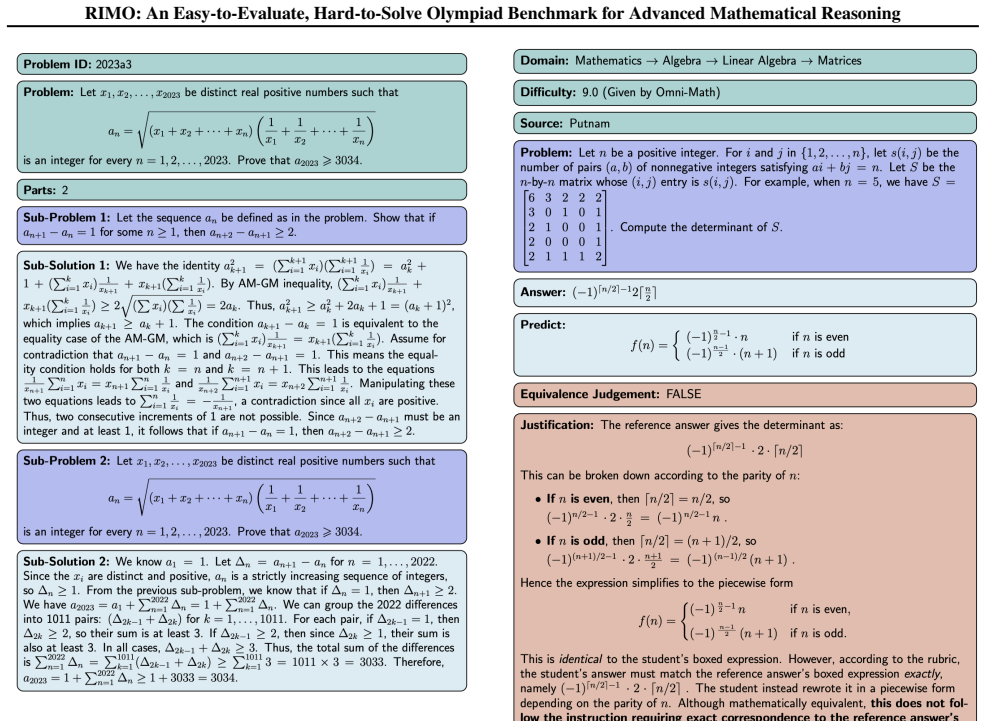
- [§3.1, Figure 3] The central claim that rewriting IMO problems into single-integer form preserves 'the logical core and difficulty' is asserted without evidence. The examples are not merely cosmetic: a concurrency proof becomes a counting question, and a classification of triples becomes a single numerical computation. These transformations can change the nature of the task (from proof construction to finite search/computation) and impose all-or-nothing exact-match grading. The paper's own §4.1.1 (Figure 9) shows that restricting to binary answers improves accuracy by 8–30 points across models, demonstrating that output-space size materially affects measured performance. Without a difficulty-equivalence check—e.g., human solvers on original vs. rewritten problems, or an independent expert rating of the rewritten items—the observed drop from MATH/GSM8K cannot be cleanly attributed to 'Olympiad-level reaso
- [§4.1.2, Eq. (1), Figure 11] RIMO-P grading is performed by deepseek-r1, which is itself one of the ten benchmarked models and the strongest on RIMO-N. This reintroduces exactly the type of model-based evaluation noise the paper promises to eliminate. No validation of the judge is provided (e.g., agreement with human expert graders on a sample), and the sequential rubric is prompt-based, so the reported 'step-by-step reasoning' scores are not noise-free. The claim that current models have a 'profound deficit in deductive ability' is therefore only as strong as the unvalidated judge. The authors should either validate the judge, use a judge that is not among the evaluated models, or present RIMO-P as a preliminary model-judged track rather than as part of a noise-free benchmark.
- [§4.1.2, §5] Only three models (Qwen3-8B, InternLM3-8B-instruct, Mathstral-7B) are evaluated on RIMO-P. The conclusions about domain-specific fine-tuning, recency versus training type, and the 'proof gap' relative to 'advanced human students' are drawn from this very small sample, and no human data are actually reported. The statement in §5 that 'advanced human students, all of whom used the same rubric' exhibit better performance is unsupported because no human-baseline results are given. The authors should either include human baseline scores or soften the corresponding claims to reflect the lack of direct comparison.
minor comments (6)
- [Abstract] The abstract says the benchmark 'eliminates evaluation noise' but RIMO-P uses an LLM judge; the wording should be qualified to refer only to RIMO-N, or the RIMO-P grading should be described as 'reduced-noise' rather than noise-free.
- [Table 2] For RIMO-P, the '# Unif.' column is marked with a dash; it would be helpful to clarify that the sub-problem outputs are not uniform in format, and that the 'Noise' value 'LLM' indicates the intended contrast with RIMO-N.
- [A.1] The prompt header says 'eavluate' (typo). Also, the Omni-MATH judge prompt is excessively long for an appendix example; consider trimming.
- [§4.1.1] The phrase 'Scores jump by 8 to 30 percentage points across in every baseline' has a grammatical issue ('across in'). Also, the Spearman correlation of 0.21 is reported without a p-value or confidence interval; given only ten data points, its interpretation is limited.
- [§3.1] The sentence 'Each shortlist problem retains the jury’s official integer' is unclear: if a shortlist problem is rewritten, it is not the original official integer but a new derived integer. Clarify the relationship between the rewriting and the official answer.
- [§3.2] The phrase 'expert-verified proofs' is not operationalized; specify the expertise of the verifiers and whether inter-rater agreement was measured.
Circularity Check
RIMO-N is independent and non-circular; RIMO-P's proof-gap conclusion is partially self-referential because the judge (deepseek-r1) is one of the evaluated models and the human-level comparison is asserted, not measured.
specific steps
-
self definitional
[Section 4.1.2, Equation (1); Section 5, 'A Persistent Proof Gap']
"A proof attempt is graded based on the number of consecutive sub-problems solved correctly, judged by deepseek-r1 (the top RIMO-N model). ... The low scores on RIMO-P highlight a profound deficit in deductive ability. This represents a large gap in the performance of advanced human students, all of whom used the same rubric."
Equation (1) defines the RIMO-P score P as the average share of sub-problems that deepseek-r1—itself one of the ten LLMs being benchmarked—marks 'correct'. The paper then interprets low P as a 'profound deficit in deductive ability' and a gap versus 'advanced human students', but no human scores are reported and deepseek-r1's reliability as an expert proof verifier is not validated. The measured quantity is, by construction, an LLM-judge acceptance rate; the conclusion about human-level proof ability is a renaming of that rate into a broader construct, making the 'proof gap' partly a restatement of the definition of P rather than an independent, externally anchored measurement.
full rationale
RIMO-N, which carries the paper's headline claim, is not circular: the 335 integer answers are grounded in official IMO jury keys or in agreement among three independent community sources (Section 3.1), and grading is deterministic string-match, so the observed accuracy drop relative to GSM8K/MATH is an external, reproducible fact, not a by-construction consequence of the benchmark's definition. The paper's own binary-subset analysis (96 problems with answers 0/1, accuracy rising 8–30 points) provides an honest internal control showing that answer-space size materially affects measured performance; this means the Section 3.1 assertion that 'the logical core and difficulty of the source problem remain intact' is an unvalidated construct-validity assumption—a real weakness, but not a circular reduction. The only meaningful circularity is in RIMO-P: the score P (Eq. 1) is the proportion of steps accepted by deepseek-r1, an LLM from the same evaluated model population; the paper then presents low P as evidence of a 'profound deficit in deductive ability' relative to 'advanced human students', without human control scores or any verification that deepseek-r1's judgments coincide with human expert judgments. The official reference solution is an external anchor, so the circularity is partial, but the human-level 'gap' is asserted rather than derived, and the 'proof gap' conclusion is in part a restatement of the choice of an LLM judge. The OlymMATH self-citation (a co-author of this paper is also an author of OlymMATH) is merely motivational comparison in Section 2.2 and is not load-bearing for RIMO's results. Overall, the core RIMO-N result stands independently; only the RIMO-P proof-gap inference is partially self-referential, yielding a moderate circularity score of 3.
Axiom & Free-Parameter Ledger
axioms (4)
- ad hoc to paper Rewriting IMO problems into single-integer form preserves original difficulty
- domain assumption Community sources (AoPS Wiki, YouTube, ParSe) provide trustworthy ground truth for contest problems
- ad hoc to paper deepseek-r1 is a reliable strict judge for RIMO-P sub-problems
- domain assumption The 1959-2023 IMO corpus is representative of olympiad-level reasoning
Cite this review
Pith. "Pith review of RIMO: An Easy-to-Evaluate, Hard-to-Solve Olympiad Benchmark for Advanced Mathematical Reasoning." pith.science (2026). https://pith.science/paper/DYGKZEVH
@misc{pith2026250907711,
  author       = {Pith},
  title        = {Pith review of: RIMO: An Easy-to-Evaluate, Hard-to-Solve Olympiad Benchmark for Advanced Mathematical Reasoning},
  year         = {2026},
  howpublished = {\url{https://pith.science/paper/DYGKZEVH}},
  note         = {Machine review of arXiv:2509.07711}
}
read the original abstract
As large language models (LLMs) reach high scores on established mathematical benchmarks, such as GSM8K and MATH, the research community has turned to International Mathematical Olympiad (IMO) problems to push the evaluation frontier. However, existing Olympiad-level benchmarks suffer from practical constraints that introduce grading noise and potential bias, such as heterogeneous answer formats requiring model-based judges and a reliance on potentially flawed solutions. We introduce RIMO, a two-track benchmark designed to preserve peak Olympiad difficulty while eliminating this evaluation noise. The first track, RIMO-N, rewrites 335 IMO problems to admit a single, unique integer answer, allowing for deterministic correctness checking. The second track, RIMO-P, features 456 proof problems with expert-checked solutions, which are decomposed into a sequence of sub-problems to evaluate the step-by-step reasoning process via an automated grading system. Our benchmarking of ten frontier LLMs, including GPT-4o and Gemini 2.5 Flash, reveals that while these systems excel on older benchmarks, their performance drops sharply on RIMO. These results highlight a substantial gap between current LLM capabilities and actual Olympiad-level reasoning. By providing a challenging yet easy-to-evaluate suite, RIMO offers a high-resolution yardstick for future research, presenting a clear target for closing the profound reasoning gap our findings expose.
Figures





Forward citations
Cited by 2 Pith papers
-
AdvancedMathBench: A Benchmark Suite for Advanced Mathematical Proof Generation and Verification
A 245-problem advanced proof benchmark plus 888 expert-labeled trajectories shows frontier LLMs remain far from reliable advanced proof generation and verification.
-
Prefix-Safe Bayesian Belief Tracking for LLM Reasoning Reliability:Separating Calibration from Ranking
SBBT separates Brier-score calibration gains from AUROC ranking gains in prefix-conditioned success estimation for LLM math reasoning, with structure-aware signals yielding up to +0.110 AUROC over baselines.
Reference graph
Works this paper leans on
-
[1]
write newline
" write newline "" before.all 'output.state := FUNCTION n.dashify 't := "" t empty not t #1 #1 substring "-" = t #1 #2 substring "--" = not "--" * t #2 global.max substring 't := t #1 #1 substring "-" = "-" * t #2 global.max substring 't := while if t #1 #1 substring * t #2 global.max substring 't := if while FUNCTION format.date year duplicate empty "emp...
-
[2]
Arora, D., Singh, H. G., and Mausam. Have llms advanced enough? a challenging problem solving benchmark for large language models, 2023. URL https://arxiv.org/abs/2305.15074
Pith/arXiv arXiv 2023
-
[3]
Training verifiers to solve math word problems, 2021
Cobbe, K., Kosaraju, V., Bavarian, M., Chen, M., Jun, H., Kaiser, L., Plappert, M., Tworek, J., Hilton, J., Nakano, R., Hesse, C., and Schulman, J. Training verifiers to solve math word problems, 2021. URL https://arxiv.org/abs/2110.14168
Pith/arXiv arXiv 2021
-
[4]
Fang, M., Wan, X., Lu, F., Xing, F., and Zou, K. Mathodyssey: Benchmarking mathematical problem-solving skills in large language models using odyssey math data, 2024. URL https://arxiv.org/abs/2406.18321
Pith/arXiv arXiv 2024
-
[5]
C., Buzzard, K., Gowers, T., Liu, P
Frieder, S., Bealing, S., Nikolaiev, A., Smith, G. C., Buzzard, K., Gowers, T., Liu, P. J., Loh, P.-S., Mackey, L., de Moura, L., Roberts, D., Sculley, D., Tao, T., Balduzzi, D., Coyle, S., Gerko, A., Holbrook, R., Howard, A., and Markets, X., 2025
work page 2025
-
[6]
Omni-math: A universal olympiad level mathematic benchmark for large language models, 2024
Gao, B., Song, F., Yang, Z., Cai, Z., Miao, Y., Dong, Q., Li, L., Ma, C., Chen, L., Xu, R., Tang, Z., Wang, B., Zan, D., Quan, S., Zhang, G., Sha, L., Zhang, Y., Ren, X., Liu, T., and Chang, B. Omni-math: A universal olympiad level mathematic benchmark for large language models, 2024. URL https://arxiv.org/abs/2410.07985
Pith/arXiv arXiv 2024
-
[7]
L., Shen, J., Hu, J., Han, X., Huang, Y., Zhang, Y., Liu, J., Qi, L., Liu, Z., and Sun, M
He, C., Luo, R., Bai, Y., Hu, S., Thai, Z. L., Shen, J., Hu, J., Han, X., Huang, Y., Zhang, Y., Liu, J., Qi, L., Liu, Z., and Sun, M. Olympiadbench: A challenging benchmark for promoting agi with olympiad-level bilingual multimodal scientific problems, 2024. URL https://arxiv.org/abs/2402.14008
Pith/arXiv arXiv 2024
-
[8]
Measuring mathematical problem solving with the math dataset, 2021
Hendrycks, D., Burns, C., Kadavath, S., Arora, A., Basart, S., Tang, E., Song, D., and Steinhardt, J. Measuring mathematical problem solving with the math dataset, 2021. URL https://arxiv.org/abs/2103.03874
Pith/arXiv arXiv 2021
-
[9]
Olympicarena: Benchmarking multi-discipline cognitive reasoning for superintelligent ai, 2025
Huang, Z., Wang, Z., Xia, S., Li, X., Zou, H., Xu, R., Fan, R.-Z., Ye, L., Chern, E., Ye, Y., Zhang, Y., Yang, Y., Wu, T., Wang, B., Sun, S., Xiao, Y., Li, Y., Zhou, F., Chern, S., Qin, Y., Ma, Y., Su, J., Liu, Y., Zheng, Y., Zhang, S., Lin, D., Qiao, Y., and Liu, P. Olympicarena: Benchmarking multi-discipline cognitive reasoning for superintelligent ai, ...
Pith/arXiv arXiv 2025
-
[10]
Solving quantitative reasoning problems with language models, 2022
Lewkowycz, A., Andreassen, A., Dohan, D., Dyer, E., Michalewski, H., Ramasesh, V., Slone, A., Anil, C., Schlag, I., Gutman-Solo, T., Wu, Y., Neyshabur, B., Gur-Ari, G., and Misra, V. Solving quantitative reasoning problems with language models, 2022. URL https://arxiv.org/abs/2206.14858
Pith/arXiv arXiv 2022
-
[11]
Mao, Y., Kim, Y., and Zhou, Y. Champ: A competition-level dataset for fine-grained analyses of llms' mathematical reasoning capabilities, 2024. URL https://arxiv.org/abs/2401.06961
Pith/arXiv arXiv 2024
-
[12]
X., Liu, Z., Wang, Z., Fang, L., and Wen, J.-R
Sun, H., Min, Y., Chen, Z., Zhao, W. X., Liu, Z., Wang, Z., Fang, L., and Wen, J.-R. Challenging the boundaries of reasoning: An olympiad-level math benchmark for large language models, 2025. URL https://arxiv.org/abs/2503.21380
Pith/arXiv arXiv 2025
-
[13]
Solving olympiad geometry without human demonstrations
Trinh, T., Wu, Y., Le, Q., He, H., and Thắng, L. Solving olympiad geometry without human demonstrations. Nature, 625: 0 476--482, 01 2024. doi:10.1038/s41586-023-06747-5
This paper was first reviewed by deepseek-v4-flash on August 4, 2026.
discussion (0)
Sign in with ORCID, Apple, or X to comment. Anyone can read and Pith papers without signing in.