REVIEW 4 major objections 5 minor 31 references
Testing the problem of time with cold atoms
T0 review · 4 major / 5 minor · reviewed 2026-08-04 · deepseek-v4-flash
Pith's one-line read This paper reports a cold-atom experiment that orders the dynamics of a partitioned Bose-Einstein condensate using an internal entropic time, and derives an entropic-time Schrödinger equation that reproduces the measured expansion and recol
desk verdict A genuinely useful cold-atom platform, but Eq. (3) makes monotonicity trivial and the Schrödinger equation derivation is a hand-wave; the paper overclaims its test of relational time. read the letter →
The pith
A machine-rendered reading of the paper's core claim, the machinery that carries it, and where it could break.
The reading
What carries the argument
The load-bearing object is the entropic time τ defined in Eq. (3): an integral of entropy change along the trajectory of the analogue clock field ϕ, normalized by the Boltzmann constant and an arbitrary time unit σ. It converts non-monotonic motion of the clock coordinate into a monotonic ordering by using entropy exchange between the bright and dark sectors, and it stops when no entropy flows. The derivation of the entropic-time Schrödinger equation is carried by the linear approximation M(ϕ)=αϕ, a two-component decomposition that retains only the positive-energy branch, and the measured entropy flow encoded in the pump factor Λ(τ); the time derivative of Λ controls whether energy flows int
What would settle it
Measure M in the bright sector as a function of ϕ with high resolution across a full barrier-crossing cycle. If M(ϕ) deviates systematically from a straight line—expected near ϕ=0 where the barrier divides the cloud—then Eqs. (5)-(6) no longer follow from the stated Hamiltonian. A second check: use Eq. (6) to predict the dynamics at a barrier height that was not used to fix the entropy pump Λ, and compare with independent data.
Extended reading notes
Core claim
Central claim: the bright sector of a partitioned, isolated Bose-Einstein condensate can be ordered from within, using only internal degrees of freedom. An entropic time τ = (σ/kB)∫ dS/dϕ |dϕ|, built from measured coarse-grained entropy S and the analogue clock field ϕ, stays monotonic across repeated 'big bang' to 'big crunch' cycles even though ϕ reverses. From the time-independent bright-sector Hamiltonian, the approximation M(ϕ)=αϕ, and a two-component decomposition keeping only positive-energy solutions, the author derives an entropic-time Schrödinger equation whose numerical solutions reproduce the measured width evolution. This is presented as experimental evidence that time in quantu
Load-bearing premise
The derivation of the entropic-time Schrödinger equation assumes the bright-sector atom number M is proportional to the clock coordinate ϕ (M=αϕ), described as 'well justified' without proof; near ϕ=0, where the barrier divides the cloud, this proportionality cannot hold exactly, and if it fails the derivation of Eqs. (5)-(6) loses its foundation.
Editorial extensions
If this is right
- If entropic time is the correct internal clock, the standard Schrödinger equation becomes a local-in-time approximation of the more general Eq. (6), valid when the entropy pump Λ is nearly stationary.
- Barrier height controls the rate of entropy production and therefore the speed of emergent time, allowing one to move from cyclic big-bang/big-crunch dynamics to a stationary 'heat death' in which entropic time stops.
- The construction gives an operationally defined, experimentally testable counterpart to thermal time, and the paper explicitly raises the question of whether the two notions coincide in some limit.
- The same platform can be extended to study multiple clock choices, singularity behavior, reversibility via Loschmidt echo, analogue black holes in the bright sector, and tunnelling scenarios.
Reading between the lines
- One implication the paper leaves implicit: if a second candidate clock field were monitored alongside ϕ, the entropic-time ordering might differ between clocks, and the experiment could measure relative clock shifts—a test listed as future but not performed here.
- The reproduction of the data uses the measured entropy in the pump factor Λ(τ), so the agreement is not a fully independent prediction; predicting dynamics at a barrier height not used to determine Λ would be a stronger test.
- Because the linear relation M(ϕ)=αϕ is asserted rather than demonstrated, a direct measurement of atom number versus center-of-mass position across a full barrier crossing would show how far the entropic-time Schrödinger equation generalizes.
- If entropic time is a genuine relational time, its ordering property should not depend on the specific entropy functional; replacing the measured entropy with another functional of the density profile could separate the thermodynamic arrow from the particular definition.
Editorial analysis
A structured set of objections, weighed in public.
Referee Report
Summary. The manuscript reports a cold-atom experiment with a 87Rb Bose-Einstein condensate in a conservative trap divided by a thin optical barrier into 'dark' and 'bright' sectors. The bright sector is modeled as a minisuperspace analogue whose center-of-mass coordinate phi plays the role of a clock field and whose width Sigma plays the role of a scale factor. The author defines an entropic time in Eq. (3), tau = (sigma/k_B) integral (dS/dphi)|dphi|, and claims that this time 'robustly orders' the bright-sector dynamics across repeated big-bang/big-crunch cycles. A Feshbach-Villars decomposition with the approximation M(phi)=alpha phi is then used to derive an entropic-time Schroedinger equation, Eq. (5), which after a Taylor expansion becomes Eq. (6). Numerical solution of Eq. (6), with alpha and the entropy-dependent pump Lambda inferred from the same data, is reported to reproduce the measured evolution of Sigma. The paper claims this constitutes an experimental validation of relational-time constructions.
Significance. If the central claims were correct, this would be a notable tabletop test of relational-time ideas in quantum cosmology. The experiment itself is interesting: a well-isolated condensate, a controlled partition into sectors, repeated expansion/recollapse cycles, and measurement of a coarse-grained entropy. However, the central validation claims are not supported as presented. The monotonicity of tau is essentially built into Eq. (3) once S is proportional to the atom number (footnote [28]); the derivation of Eqs. (5)-(6) is an asserted step with an unjustified linear approximation; and the numerical 'reproduction' uses parameters taken from the same dataset, making it a post-diction rather than an independent test. The remaining value is as a proof-of-principle of an experimental platform, not as a quantitative test of the problem of time.
major comments (4)
- [Eq. (3) and footnote [28]; Fig. 2] With S = N s and s of order unity (footnote [28]), Eq. (3) reduces to tau proportional to the total variation of S, tau ~ sum |Delta S_i|. Total variation is nondecreasing by construction for any sequence of data, and it is invariant under reversing the order of the frames. Therefore the central observation that tau is 'robustly monotonic' and 'orders events' is a mathematical property of the definition, not an empirical result about the dynamics. The arrow is inserted by the absolute value |dphi|, not emergent from entropy production. This undercuts the claimed experimental validation of relational time.
- [Eqs. (4)-(6), derivation of the entropic-time Schroedinger equation] The step from Eq. (4) to Eq. (5) is presented as a single asserted 'we obtain' with no derivation. The approximation M(phi)=alpha phi is stated to be 'well justified' but no supporting argument is given; this linear relation between atom number and center-of-mass position is load-bearing because it combines the kinetic and potential terms. The Feshbach-Villars decomposition and the restriction to 'positive' onward-in-time solutions are also not justified for this analogue system, especially since phi is non-monotonic in a cycle. Without a derivation, Eq. (6) cannot be considered a consequence of the minisuperspace Hamiltonian.
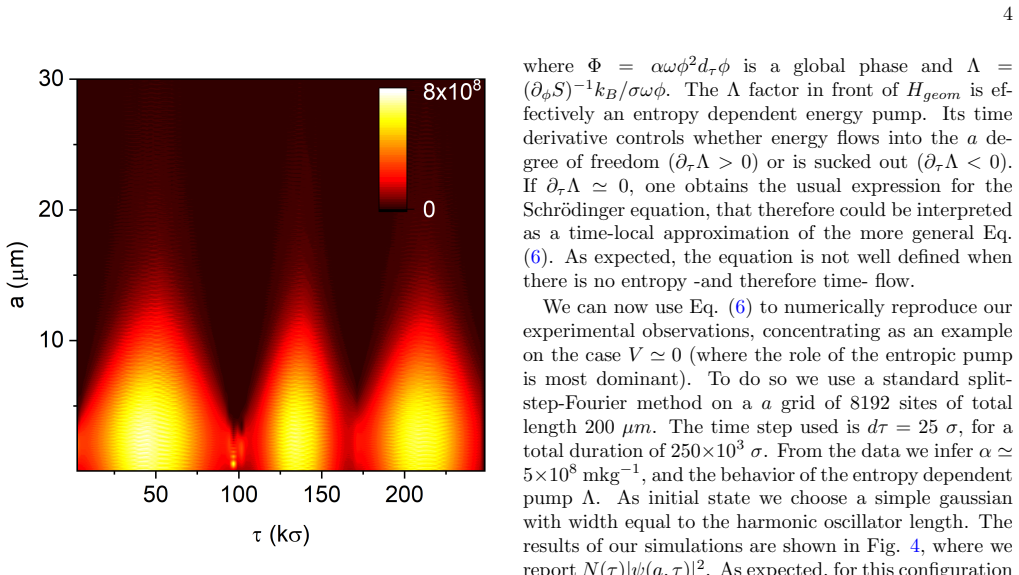
- [Numerical simulation, Fig. 3(b)] The numerical 'reproduction' is not an independent test: alpha is inferred from the same data, Lambda is obtained from the measured entropy of the same dataset, and the result is compared with the measured Sigma for the same V~0 run. This is a consistency check, not a falsifiable prediction. The claim that the equation 'is able to reproduce the measured evolution' would require, at minimum, a prediction for a different barrier height or a reversal protocol not used in the fit.
- [Eq. (2) and minisuperspace analogy] The mapping of the bright-sector Hamiltonian to a minisuperspace form relies on spherical coordinates and replacing the density by its average value, stated as 'without affecting the physical content'. This reduction is not demonstrated quantitatively. Since the subsequent quantization and the identification of phi and Sigma as clock and scale factor depend on this reduction, a comparison with the full 3D Gross-Pitaevskii dynamics or an estimate of the correction terms is needed before the analogue claim is credible.
minor comments (5)
- [Abstract] 'Schroedinger' should be 'Schroedinger' consistently; the main text uses 'Schr\"odinger' in one place and 'Schr¨odinger' elsewhere.
- [Section on high V] 'heath death' should read 'heat death'.
- [Eqs. (5)-(6)] The notation 'd\tau \phi' is undefined. Clarify whether this means d(phi)/d(tau), (dphi/dtau), or something else. Similarly, the expressions for Phi and Lambda should be written with explicit parentheses and stated as functions of tau or phi.
- [Fig. 2] The arbitrary unit sigma and the normalization of tau should be stated explicitly; otherwise the reader cannot compare the absolute values of tau across different barrier heights.
- [Fig. 3(b) caption] 'The dotted curve is the results' should be 'is the result'.
Circularity Check
Entropic-time monotonicity is built into Eq. (3) via |dφ|; the Schrödinger-equation 'reproduction' is a refit of data-derived α and Λ, so the central validation is largely definitional/post-dictive.
-
self definitional
[Eq. (3), Section 'Entropic internal time' (p. 3)]
"τ(λ) = σ kB ∫λ dS dϕ |dϕ|, (3) ... This definition ensures that, as long as dS and dϕ have the same sign, the arrow of time does not change direction. ... Crucially, τ grows monotonically almost everywhere."
Discretely, the definition gives Δτ_i = sign(Δφ_i) ΔS_i. The paper's headline result that τ is 'robustly monotonic' is therefore equivalent to the same-sign condition sign(ΔS_i)=sign(Δφ_i) holding almost everywhere—a condition the absolute value was inserted to exploit. With S∝N (footnote [28]) and N=N(φ), τ accumulates the magnitude of atom-number change; any such cumulative variation is nondecreasing by construction (up to the few sign-changing wiggles the paper attributes to coarse sampling). Reversing lab time leaves the sequence of |ΔS_i| unchanged, so no intrinsic arrow is derived. The monotonicity is an artifact of the definition, not an emergent thermodynamic arrow.
-
fitted input called prediction
[Section 'We can now use Eq. (6)...' (p. 4)]
"From the data we infer α≃5×10^8 m kg−1, and the behavior of the entropy dependent pump Λ. ... We then fit the density profiles with a gaussian function and we plot in Fig. 3 b) the values obtained for the standard deviation Σ as a function of τ (dotted line), finding excellent agreement with our data."
The numerical solution of Eq. (6) is not an independent prediction: α is inferred from the same dataset, Λ is taken from the measured entropy, and the resulting curve is then fitted to the measured Σ. The 'excellent agreement' therefore confirms the fitting procedure, not the derived entropic-time Schrödinger equation. Moreover, Eq. (6) is parameterized by the τ defined in Eq. (3), so the reproduction uses the same constructed time whose monotonicity is already definitional. The M(φ)=αφ approximation, stated as 'well justified' without independent support, is another data-dependent input.
full rationale
The paper's central validation claim—that entropic time 'robustly orders' the bright-sector dynamics—reduces to the construction in Eq. (3): τ is defined by accumulating |dφ| weighted by dS/dφ, so whenever dS and dφ share a sign, τ advances. The absolute value inserts the orientation by hand; the empirical content is only that the measured entropy happens to move with the clock coordinate φ almost everywhere. That is a property of the chosen clock and entropy, not a derivation of an arrow from a time-independent WDW system. The subsequent Schrödinger-equation derivation is also not independently tested: the numerical solution uses the measured entropy (through Λ) and a fitted α from the same data to reproduce the measured evolution, making the agreement post-dictive. No load-bearing self-citation chain or uniqueness theorem is invoked, so the circularity is internal rather than imported from prior work. Scores 6–8 apply because the strongest claims are definitional or fitted; I assign 7.
Assumptions & free parameters
free parameters (1)
- α =
5×10^8 m kg^-1
assumptions (6)
- domain assumption The system is well isolated with negligible dissipation on the 100 ms timescale.
- domain assumption The entropy per atom measured by the method of Ref. [27] is a valid coarse-grained entropy for the bright sector.
- ad hoc to paper Eq. (2) is a faithful minisuperspace representation of the bright sector; the use of spherical coordinates and average density does not affect physical content.
- ad hoc to paper M(φ)=αφ is well justified.
- ad hoc to paper The Feshbach-Villars decomposition with only positive-frequency solutions is applicable to this analogue.
- domain assumption The Taylor expansion of Eq. (5) is valid because the first term under the square root is ≈ N times the second.
Cite this review
Pith. "Pith review of Testing the problem of time with cold atoms." pith.science (2026). https://pith.science/paper/DQ732VZI
@misc{pith2026250907745,
  author       = {Pith},
  title        = {Pith review of: Testing the problem of time with cold atoms},
  year         = {2026},
  howpublished = {\url{https://pith.science/paper/DQ732VZI}},
  note         = {Machine review of arXiv:2509.07745}
}
read the original abstract
We realize a cold-atom system to quantitatively test relational constructions of time. A well-isolated atomic Bose-Einstein condensate evolves in a conservative trap that is partitioned by a thin optical barrier into an observed and unobserved sector, with negligible dissipation on the experimental timescale. Motivated by relational-time approaches discussed in the Wheeler-DeWitt framework, we ask whether the dynamics of the observed sector can be ordered using only internal degrees of freedom. To this end, we construct an entropic time from an experimentally defined coarse-grained entropy, and demonstrate that it can robustly order the events in the observed sector across repeated cycles of expansion and recollapse. We finally derive an effective Schroedinger equation parameterized by this internal time and show that it is able to reproduce the measured evolution. These results establish a controlled experimental setting in which relational-time constructions can be quantitatively tested.
Figures


Reference graph
Works this paper leans on
-
[28]
Thus, entropy flow is directly linked to atom num- ber dynamics
Since the entropy per particlesremains of order unity throughout the evolution, the total entropySis effec- tively proportional to the number of atoms in the bright 6 sector. Thus, entropy flow is directly linked to atom num- ber dynamics
-
[1]
B. S. DeWitt, Quantum theory of gravity. i. the canonical theory, Phys. Rev.160, 1113 (1967)
1967
-
[2]
J. B. Hartle and S. W. Hawking, Wave function of the universe, Phys. Rev. D28, 2960 (1983)
1983
-
[3]
J. J. Halliwell and S. W. Hawking, Origin of structure in the universe, Phys. Rev. D31, 1777 (1985)
work page 1985
- [4]
-
[5]
K. V. Kuchar, Time and interpretations of quantum grav- ity, Int. J. Mod. Phys. D20, 3 (2011)
work page 2011
-
[6]
C. Kiefer and B. Sandh¨ ofer, Quantum cosmology, Zeitschrift f¨ ur Naturforschung A77, 543 (2022)
work page 2022
- [7]
Show all 31 references
-
[8]
Connes and C
A. Connes and C. Rovelli, Von neumann algebra auto- morphisms and time-thermodynamics relation in gener- ally covariant quantum theories, Classical and Quantum Gravity11, 2899 (1994)
1994
-
[9]
D. N. Page and W. K. Wootters, Evolution without evo- lution: Dynamics described by stationary observables, Phys. Rev. D27, 2885 (1983)
1983
-
[10]
Vilenkin, Approaches to quantum cosmology, Phys
A. Vilenkin, Approaches to quantum cosmology, Phys. Rev. D50, 2581 (1994)
1994
-
[11]
J. J. Halliwell, Introductory lectures on quantum cos- mology, in7th Jerusalem Winter School for Theoreti- cal Physics: Quantum Cosmology and Baby Universes (1989) arXiv:0909.2566 [gr-qc]
1989 arXiv
-
[12]
W. F. Blyth and C. J. Isham, Quantization of a fried- mann universe filled with a scalar field, Phys. Rev. D11, 768 (1975)
1975
-
[14]
Kiefer and H
C. Kiefer and H. D. Zeh, Arrow of time in a recollapsing quantum universe, Phys. Rev. D51, 4145 (1995)
1995
-
[15]
Steinhauer, Observation of quantum hawking radiation and its entanglement in an analogue black hole, Nature Physics12, 959 (2016)
J. Steinhauer, Observation of quantum hawking radiation and its entanglement in an analogue black hole, Nature Physics12, 959 (2016)
2016
-
[16]
J. R. Mu˜ noz de Nova, K. Golubkov, V. I. Kolobov, and J. Steinhauer, Observation of thermal hawking radiation and its temperature in an analogue black hole, Nature 569, 688 (2019)
2019
-
[17]
Eckel, A
S. Eckel, A. Kumar, T. Jacobson, I. B. Spielman, and G. K. Campbell, A rapidly expanding bose-einstein con- densate: An expanding universe in the lab, Phys. Rev. X 8, 021021 (2018)
2018
-
[18]
Gonz´ alez-Cuadra, M
D. Gonz´ alez-Cuadra, M. Hamdan, T. V. Zache, B. Braverman, M. Kornjaˇ ca, A. Lukin, S. H. Cant´ u, F. Liu, S.-T. Wang, A. Keesling,et al., Observation of string breaking on a (2+ 1) d rydberg quantum simula- tor, Nature , 1 (2025)
2025
-
[19]
A. De, A. Lerose, D. Luo, F. M. Surace, A. Schuckert, E. R. Bennewitz, B. Ware, W. Morong, K. S. Collins, Z. Davoudi, A. V. Gorshkov, O. Katz, and C. Monroe, Observation of string-breaking dynamics in a quantum simulator (2024), arXiv:2410.13815 [quant-ph]
2024 arXiv
-
[20]
Zenesini, A
A. Zenesini, A. Berti, R. Cominotti, C. Rogora, I. G. Moss, T. P. Billam, I. Carusotto, G. Lamporesi, A. Re- cati, and G. Ferrari, False vacuum decay via bubble for- mation in ferromagnetic superfluids, Nature Physics20, 558 (2024)
2024
-
[21]
Z.-H. Zhu, Y. Liu, G. Lagnese, F. M. Surace, W.- Y. Zhang, M.-G. He, J. C. Halimeh, M. Dalmonte, S. C. Morampudi, F. Wilczek, Z.-S. Yuan, and J.-W. Pan, Probing false vacuum decay on a cold-atom gauge- theory quantum simulator (2024), arXiv:2411.12565 [cond-mat.quant-gas]
2024 arXiv
-
[22]
Fabre de la Ripelle, The potential harmonic expansion method, Annals of Physics147, 281 (1983)
M. Fabre de la Ripelle, The potential harmonic expansion method, Annals of Physics147, 281 (1983)
1983
-
[23]
Barontini, R
G. Barontini, R. Labouvie, F. Stubenrauch, A. Vogler, V. Guarrera, and H. Ott, Controlling the dynamics of an open many-body quantum system with localized dissipa- tion, Phys. Rev. Lett.110, 035302 (2013)
2013
-
[24]
Wang, Dust and radiation quantum perfect fluid cosmology: selection of time variable, General Relativity and Gravitation37, 971 (2005)
I.-C. Wang, Dust and radiation quantum perfect fluid cosmology: selection of time variable, General Relativity and Gravitation37, 971 (2005)
2005
-
[25]
A. Mostafazadeh, Two-component formula- tion of the wheeler–dewitt equation, Jour- nal of Mathematical Physics39, 4499 (1998), https://pubs.aip.org/aip/jmp/article- pdf/39/9/4499/19324815/4499 1 online.pdf
1998
-
[26]
Pigolotti, I
S. Pigolotti, I. Neri, E. Rold´ an, and F. J¨ ulicher, Generic properties of stochastic entropy production, Phys. Rev. Lett.119, 140604 (2017)
2017
-
[27]
Madeira, A
L. Madeira, A. D. Garc ´ ıa-Orozco, F. E. A. dos Santos, and V. S. Bagnato, Entropy of a turbulent bose-einstein condensate, Entropy22, 10.3390/e22090956 (2020)
2020 doi
-
[29]
J. D. Brown and K. V. Kuchaˇ r, Dust as a standard of space and time in canonical quantum gravity, Phys. Rev. D51, 5600 (1995)
1995
-
[30]
by controlling the sign and strength of the inter- actions to determine whether the system experiences a true singularity or a quantum bounce; iii) to perform ac- curate tests of reversibility [14] through Loschmidt echo, iv) to engineer analogue black holes in the bright sec-...
-
[31]
Bojowald, Absence of a singularity in loop quantum cosmology, Phys
M. Bojowald, Absence of a singularity in loop quantum cosmology, Phys. Rev. Lett.86, 5227 (2001)
2001
-
[32]
J. F. Barbero G and E. J. Villase˜ nor, Quantization of midisuperspace models, Living Reviews in Relativity13, 6 (2010)
2010
Reviewed August 4, 2026 · model on record in the stance chip above.
Discussion (0). Continue with ORCID to comment.