REVIEW 4 major objections 5 minor 117 references
Modeling Low-Temperature Plasmas Simulating Titan's Atmosphere
T0 review · 4 major / 5 minor · reviewed 2026-08-04 · deepseek-v4-flash
Pith's one-line read Updated plasma model traces Titan haze precursors to acetylene-driven cation growth.
desk verdict Solid incremental model update, but the gas-solid C/N comparison is not controlled and the reaction table has duplicate rates; worth reviewing after fixes. read the letter →
The pith
A machine-rendered reading of the paper's core claim, the machinery that carries it, and where it could break.
The reading
What carries the argument
The mechanism is the acetylene-driven cationic addition chain, generalized as C2nH2m+ + C2H2 → C2n+2H2m+2+ + xH2, with the specific bottleneck C4H3+ + C2H2 → C6H5+ yielding the first benzene-family cations. The apparatus is CO-PRISM, a 1D multi-fluid discharge model that solves electron and heavy-species mass balance along the anode-to-cathode channel and converts computed mole fractions into synthetic mass spectra.
What would settle it
Run the COSmIC discharge with isotopically labeled acetylene (13C2H2) and inspect the m/z 76–77 peaks: if the C2H2-addition cation chain is the dominant route to C6 precursors, those peaks should shift by two mass units per added acetylene, whereas a neutral-radical mechanism would give a different shift pattern; even a single measured peak shift would discriminate the pathways.
Extended reading notes
Core claim
The paper claims that, with the updated CO-PRISM reaction network, the modeled gas-phase chemistry of a 150 K N2–CH4 discharge reproduces the key observed features of COSmIC mass spectra: when 5% acetylene is present, C6H4+ and C6H5+ (benzene-family fragments at m/z 76–77) appear and match the experiment, methanimine and protonated methanimine form in small concentrations, and intermediate C5 ions such as C5H5+ become abundant. The authors attribute this growth to cationic pathways in which acetylene adds to hydrocarbon ions—notably C4H3+ + C2H2 → C6H5+—forming nitrogen-rich, intermediate-sized precursors that feed tholin production. They further show that the calculated gas-phase C/N ratio
Load-bearing premise
The results depend on the estimated reaction-rate constants and electron-collision cross-sections being accurate at 150 K in a non-equilibrium plasma, and on the modeled gas mixtures being close enough to the mixtures that produced the solid tholins for the C/N comparison to be meaningful.
Editorial extensions
If this is right
- If the cationic chain is the dominant growth route, the C2H2 + C4H3+ and C2H2 + C4H2+ steps, rather than neutral radical growth, explain the m/z 76–77 benzene fragments seen in experiments, making these reactions the key targets for future kinetic measurements.
- Methanimine, produced via N(2D) + CH4 and NH + CH3, becomes a trace but detectable product at m/z 29–30, so future experiments using isotopically labeled methane could quantify it and test the model.
- The modeled gas-phase C/N trend (5.3 to 8.6 with acetylene versus 1.3 to 2.4 in solids) predicts that acetylene-rich Titan-like plasmas produce solids with more nitrile-bearing aromatic structures and less nitrogen overall.
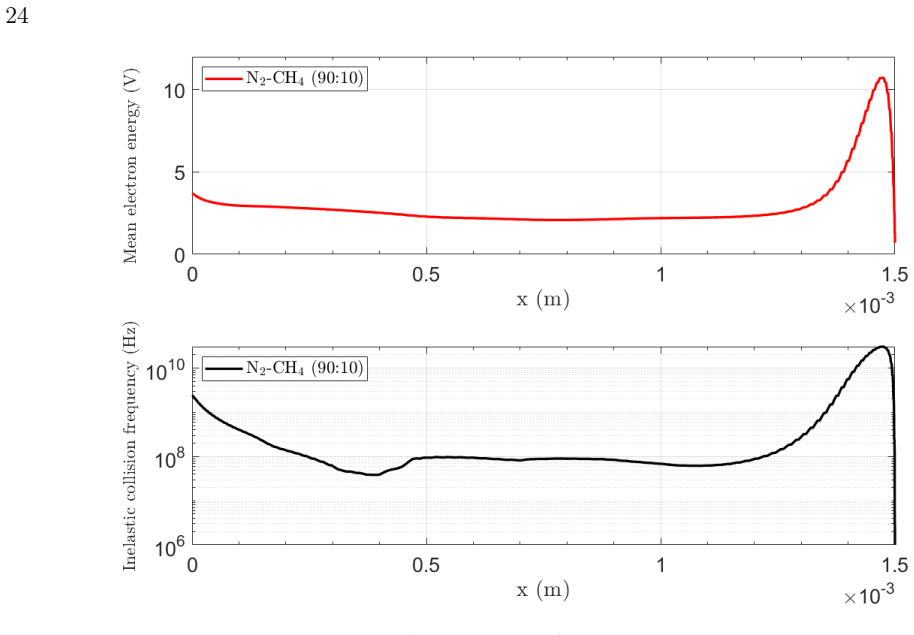
- Higher electron densities in C2H2-containing plasmas produce an intense ionization region near the cathode, so spatial position within the discharge materially changes the predicted product distribution; experiments should compare spectra taken at different channel positions.
Reading between the lines
- Editorial inference: labeling acetylene with 13C would make each acetylene addition shift the m/z ladder by two units, providing a clean experimental test of the cationic chain versus neutral-radical growth.
- Editorial inference: because the model sets wall sticking to 1 and neglects diffusion, predicted abundances of larger cations near the electrodes may be biased; a finite sticking coefficient and 2D transport could change the inferred C/N balance.
- Editorial inference: the gas-solid C/N comparison currently pairs modeled 90:10 and 95:5:0.5 mixtures with solid samples from 95:5 and 94.5:5:0.5 mixtures; running the model at the exact solid-production ratios would test whether the trend persists.
- Editorial inference: excluding negative ions and particle formation means the gas-phase products are not depleted by condensation; including anion chemistry (e.g., CN−, C2H−) could alter the nitrogen-incorporation routes to tholins.
Signed reviews
Editorial analysis
A structured set of objections, weighed in public.
Referee Report
Summary. The paper presents an updated version of the CO-PRISM 1D multi-fluid plasma model, used to simulate the low-temperature (150 K) discharge in the COSmIC chamber for N2–CH4-based gas mixtures relevant to Titan's atmosphere. The model incorporates 45 new reactions and updated rate coefficients, including electron-impact dissociative ionization of C2H2, C2H4, and C2H6, reactions involving N(2D), NH, NH2, and methanimine, and a set of C2H2-addition pathways growing C4/C6 cations. The authors compare synthetic positive-ion mass spectra with earlier COSmIC ReTOF-MS data for N2–CH4 (90:10), N2–CH4–C2H2 (85:10:5), and N2–CH4–C2H4 (85:10:5) plasmas, finding improved agreement for several C3/C4/C5 and C6 features, and they report modeled gas-phase C/N ratios alongside solid-tholin C/N values from a previous XANES study, claiming a similar trend when C2H2 is added. The central scientific claim is that C2H2 drives cation-mediated growth toward C6 and nitrogen-bearing intermediates, which act as tholin precursors.
Significance. If the central claim holds, the work is a useful step in connecting laboratory plasma experiments to Titan aerosol precursor chemistry. The main strengths are the public presentation of the full reaction network (Table 4), the explicit sensitivity analysis along the plasma channel, the use of literature rate coefficients rather than fitting to the COSmIC data, and the transparent enumeration of remaining model limitations (wall sticking gamma=1, no particle formation, no negative ions, no isotopologues). The comparison with independent XANES solid-phase data is a valuable cross-check in principle. However, the paper's headline consistency claims are weakened by several concrete internal inconsistencies: the gas-phase/solid-phase C/N comparison in Table 3 is not made at the stated 'same initial gas mixtures'; duplicate reactions are listed with different rate constants; at least one reaction in the new network violates elementary conservation laws; and the mass-spectrum agreement is qualitative, with several observed peaks still missing or overpredicted. These issues need to be resolved before the claims of consistency and trend agreement can be accepted.
major comments (4)
- [§3.4.4, Table 3] The text states that the gas-phase plasmas were modeled with 'the same initial gas mixtures as the XANES study,' but Table 3 contradicts this: the gas-phase control is N2–CH4 (90:10) while the XANES tholin control is N2–CH4 (95:5), and the gas-phase acetylene case is N2–CH4–C2H2 (95:5:0.5) while the tholin case is N2–CH4–C2H2 (94.5:5:0.5). Because §3.2 demonstrates that the CH4 fraction materially changes the ion chemistry (e.g., CH3+ and CH5+ abundances in the 99:1 vs 90:10 mixtures), the modeled gas-phase C/N increase from 5.3 to 8.6 cannot be cleanly attributed to C2H2 addition; it may partly be a mixture-composition effect. The claimed 'similar trend' is therefore not demonstrated as presented. The authors should rerun the gas-phase models at the exact XANES mixture ratios (95:5 and 94.5:5:0.5) or explicitly qualify the comparison as approximate with different N2/CH4 ratios.
- [Table 2 vs Appendix Table 4 (R9/R134, R10/R150)] The same reactions are listed with inconsistent rate constants in the main text and the appendix. Specifically, Table 2 gives R9 as C2H2 + C4H2+ → C6H4+ with k = 5.0×10⁻¹¹ cm³ s⁻¹, while Appendix R134 (and R258) gives the same reaction with k = 2.7×10⁻¹⁰ cm³ s⁻¹; Table 2 R10 gives C2H2 + C4H3+ → C6H5+ with k = 2.9×10⁻¹¹ cm³ s⁻¹, while Appendix R150 (and R259) gives k = 2.2×10⁻¹⁰ cm³ s⁻¹. If both entries are active in the network, the effective rate is ambiguous by factors of 5–8, directly affecting the C6H4+/C6H5+ abundances that underpin the paper's main cationic-growth claim. The authors must state which rate is actually used, remove duplicates, and verify that no other duplicated entries differ.
- [Table 2, Reaction R3] Reaction R3 is written as C2H6 + e⁻ → C6H2+ + 2e⁻. This violates atom conservation (two carbon atoms in the reactant, six in the product) and is physically impossible as stated. This reaction is among the '45 new reactions' claimed to improve the network, so the error is load-bearing for the model's internal consistency. Please correct the stoichiometry or the intended product (e.g., C2H2+ or C2H5+ + H + 2e⁻), and check the corresponding cross-section reference.
- [§3.1, Figure 4; Abstract] The abstract states that modeling results are 'consistent with experimental measurements ... showing the production of C6Hx intermediates and precursors of larger organics, as well as methanimine in small concentration.' The paper's own text in §3.1 documents substantial remaining disagreements: m/z 27 is observed in the N2–CH4 experiment but not predicted; m/z 38 is underpredicted; m/z 52 is absent; and in the C2H4 case the C4–C5 block contains predicted peaks (m/z 50, 51, 65, 77, 79) that are not observed experimentally. The improved agreement is real for a subset of peaks, but the abstract's blanket statement is stronger than the evidence. The authors should qualify the consistency claim, e.g., by restricting it to the specific peaks where agreement is achieved, or by providing a quantitative metric (intensity residuals, detection threshold) for the comparison.
minor comments (5)
- [Table 3] The row labels are misleading: the first row lists the gas-phase mixture as N2–CH4 (90:10%) and the tholin mixture as N2–CH4 (95:5) under a single column. Please make the mixture ratios explicit for each column, and note in the caption that the gas-phase and solid-phase mixtures are not identical in the current table.
- [Figure 12 caption] The caption states the plasma is N2–CH4–C2H2 (85-5-5), while the text in §3.4.3 and Table 1 use N2–CH4–C2H2 (85-10-5) or (95:5:0.5). Please check which mixture was actually simulated and correct the caption.
- [Eq. (7)] The mixture-average diffusion coefficient Dk is set to zero with the justification that the supersonic expansion dominates. Given the model's sensitivity to wall processes (sticking coefficient gamma=1) and the 1D approximation, a brief discussion or sensitivity test of the Dk = 0 assumption would strengthen the interpretation of the spatial profiles in §3.3.
- [General] Several typographical errors should be corrected: 'respecitvely' (§3.4.4), 'atm/z' (§3.4.1), 'precusors' (§3.4.4), and the reference to 'S. N. Raymond & A. Izidoro (2017)' in §2.2.2 appears to be an unrelated citation and should be replaced with the intended experimental reference.
- [§3.2] The statement that the four additional mixtures (C2H6, NH3, HCN, CH2NH) produce mass spectra 'identical' to N2–CH4 (90:10) is important and potentially informative, but it would be useful to quantify 'identical' (e.g., maximum relative difference across m/z) so that readers can judge whether the lack of response is a model limitation or a robust chemical result.
Circularity Check
C6 peaks are partly by construction via added reactions, but rate constants are external; gas/solid C/N comparison has a separate mixture-mismatch flaw.
-
other
[Section 3.1 and Table 2 (R9/R10)]
"An improvement now observed in the model outputs, compared to the original model, is the predicted production of molecules at masses m/z 76 and 77 in the N2 – CH4 – C2H2 plasma, as observed experimentally. These peaks correspond to the benzene fragments C6H4+ and C6H5+."
The updated CO-PRISM network was extended with R9 (C2H2 + C4H2+ -> C6H4+) and R10 (C2H2 + C4H3+ -> C6H5+), whose products are exactly m/z 76 and 77. The paper then presents the appearance of m/z 76/77 as a predicted improvement consistent with experiment. This appearance is largely a mass-balance consequence of inserting these product-forming reactions; the original model without them had no C6 ions. The prediction is therefore partly by construction. However, the rate constants are taken from external literature, not fitted to COSmIC data, so the intensity comparison retains some independent content. Hence the circularity is partial, not complete.
full rationale
The only genuine partial-circularity element is the C6 prediction described above: the model was given reactions whose products are the very m/z 76/77 peaks later reported as consistent with experiment. This is offset by the fact that the rate coefficients come from external literature (e.g., De Bleecker et al. 2006, Angelova et al. 2004, Janalizadeh et al. 2023) and are not adjusted to fit the COSmIC mass spectra, so the comparison has independent content. No load-bearing self-citation chain is present: Raymond et al. (2018) is prior model work, but the governing equations (5)-(11) are restated in this paper. There is no uniqueness theorem or ansatz imported solely from the authors' own work. A separate, non-circular flaw is the gas-tholin C/N comparison in Section 3.4.4 and Table 3: the text claims 'same initial gas mixtures as the XANES study', but Table 3 lists gas-phase N2-CH4 (90:10) versus tholin N2-CH4 (95:5), and gas-phase N2-CH4-C2H2 (95:5:0.5) versus tholin (94.5:5:0.5). This undermines the claimed 'similar trends' comparison as presented and should be corrected, but it is an internal-consistency/missing-support issue, not a circular reduction. Duplicate rate entries R9/R134 and R10/R150 also create ambiguity in the C6 rates, adding uncertainty without being circular. Overall score 4 reflects one partially by-construction prediction with substantial independent grounding.
Assumptions & free parameters
free parameters (4)
- seed_electron_density =
1e7 cm^-3
- sticking_coefficient_gamma =
1
- secondary_emission_coefficient =
0.025
- physical_mole_fraction_threshold =
1e-20
assumptions (4)
- domain assumption Diffusion is negligible (Dk=0) in Eq. 7.
- domain assumption Rate constants measured near 300 K remain valid at 150 K in the COSmIC plasma.
- domain assumption Chemical network truncated at C12 species and omits negative ions, isotopologues, and particle formation.
- ad hoc to paper Gamma = 1 for all wall sticking coefficients.
Cite this review
Pith. "Pith review of Modeling Low-Temperature Plasmas Simulating Titan's Atmosphere." pith.science (2026). https://pith.science/paper/FGLOJV6P
@misc{pith2026250908063,
  author       = {Pith},
  title        = {Pith review of: Modeling Low-Temperature Plasmas Simulating Titan's Atmosphere},
  year         = {2026},
  howpublished = {\url{https://pith.science/paper/FGLOJV6P}},
  note         = {Machine review of arXiv:2509.08063}
}
read the original abstract
In the study presented here, we model the gas phase chemistry induced by plasma discharge at low temperature (150 K) in the NASA Ames COSmIC Simulation Chamber (COSmIC) using a 1-dimensional multi-fluid plasma model named CO-PRISM (COSmIC Plasma Reactivity and Ionization Simulation Model). Our model incorporates an extensive chemical reaction network to simulate the neutral-neutral and ion-neutral reactions occurring in the COSmIC experiments when using N2-CH4-based gas mixtures relevant to Titan's atmosphere. Our reaction network now includes crucial reactions involving the first electronically-excited state of atomic nitrogen, recent electron collision cross-sections, and radical chemistry. In particular, we have investigated the influence of C2H2 on the gas phase polymeric growth and the elemental composition of the chemical products, and we have compared our findings to recently published solid phase analyses. The modeling results are consistent with experimental measurements of N2-CH4-C2H2 plasmas on COSmIC, showing the production of C6Hx intermediates and precursors of larger organics, as well as methanimine in small concentration. Our numerical results point to cationic pathways enabling efficient intermediate-sized and nitrogen-rich \ce{C2H2}-driven chemistry driving tholin production. Comparison of the modeled gas phase elemental composition with elemental composition of the solid phase samples produced in COSmIC reveal similar trends, with C/N increasing when C2H2 is present in the gas mixture. Finally, our results demonstrate the importance of such synergistic studies using low-temperature plasma chemistry experiments combined with modeling efforts to improve our understanding of cold planetary environments.
Figures


Figures from the paper (10 more)





Reference graph
Works this paper leans on
-
[1]
, " * write output.state after.block = add.period write newline
ENTRY address archivePrefix author booktitle chapter doi edition editor eprint howpublished institution journal key month number organization pages publisher school series title misctitle type volume year version url label extra.label sort.label short.list INTEGERS output.state before.all mid.sentence after.sentence after.block FUNCTION init.state.consts ...
-
[2]
write newline
" write newline "" before.all 'output.state := FUNCTION format.url url empty "" new.block "" url * "" * if FUNCTION format.eprint eprint empty "" archivePrefix empty "" archivePrefix "arXiv" = new.block " " eprint * " " * new.block " " eprint * " " * if if if FUNCTION format.doi doi empty "" " " doi * " " * if FUNCTION format.pid doi empty eprint empty ur...
-
[3]
[ y ZOzԆDZ [ Q 9ik <XB QkdE pB/ݗ)37F Ed=UJR*TDV yd#TeGH9 x Ij
thebibliography [1] 20pt to REFERENCES 6pt =0pt \@twocolumntrue 12pt -12pt 10pt plus 3pt =0pt =0pt =1pt plus 1pt =0pt =0pt -12pt =13pt plus 1pt =20pt =13pt plus 1pt \@M =10000 =-1.0em =0pt =0pt 0pt =0pt =1.0em @enumiv\@empty 10000 10000 `\.\@m \@noitemerr \@latex@warning Empty `thebibliography' environment \@ifnextchar \@reference \@latexerr Missing key o...
arXiv 2017
-
[4]
Angelova, G., Novotny, O., Mitchell, J., et al. 2004, title Branching ratios for the dissociative recombination of hydrocarbon ions , International Journal of Mass Spectrometry, 235, 7, 10.1016/j.ijms.2004.03.002
-
[5]
Anicich, V. G. 2003, title An index of the literature for bimolecular gas phase cation-molecule reaction kinetics , JPL Publications 03-19, 1-1194
2003
-
[6]
T., Williams, S., Dotan, I., et al
Arnold, S. T., Williams, S., Dotan, I., et al. 1999, title Flow tube studies of benzene charge transfer reactions from 250 to 1400 K , Journal of Physical Chemistry A, 103, 8421, 10.1021/jp991928k
-
[7]
Barone, V., & Puzzarini, C. 2022, title Toward Accurate Formation Routes of Complex Organic Molecules in the Interstellar Medium: The Paradigmatic Cases of Acrylonitrile and Cyanomethanimine , Frontiers in Astronomy and Space Sciences, 8, 10.3389/fspas.2021.814384
arXiv 2022
-
[8]
Bejaoui, S., Bera, P. P., Salama, F., & Lee, T. 2023, title Cavity Ring-Down Spectroscopy of Anthracene, 9-Methylanthracene, and 2-Methylanthracene in Supersonic Expansion , Journal of Physical Chemistry A, 127, 2717, 10.1021/acs.jpca.2c08994
Show all 117 references
-
[9]
2019, title Cavity ring down spectroscopy of cold neutral phenanthrene and phenanthridine in supersonic jets , AIP Advances, 9, 085021, 10.1063/1.5100152
Bejaoui, S., & Salama, F. 2019, title Cavity ring down spectroscopy of cold neutral phenanthrene and phenanthridine in supersonic jets , AIP Advances, 9, 085021, 10.1063/1.5100152
2019 doi
-
[10]
2010, title Plasma-chemical reactions: Low pressure acetylene plasmas , Journal of Physics D: Applied Physics, 43, 10.1088/0022-3727/43/4/043001
Benedikt, J. 2010, title Plasma-chemical reactions: Low pressure acetylene plasmas , Journal of Physics D: Applied Physics, 43, 10.1088/0022-3727/43/4/043001
2010 doi
-
[11]
P., Peverati, R., Head-Gordon, M., & Lee, T
Bera, P. P., Peverati, R., Head-Gordon, M., & Lee, T. J. 2015, title Hydrocarbon growth via ion-molecule reactions: Computational studies of the isomers of C4H2+, C6H2+and C6H4+and their formation paths from acetylene and its fragments , Physical Chemistry Chemical Physics, 17...
2015 doi
-
[12]
L., Ugelow, M
Berry, J. L., Ugelow, M. S., Tolbert, M. A., & Browne, E. C. 2019, title Chemical Composition of Gas-Phase Positive Ions during Laboratory Simulations of Titan’s Haze Formation , ACS Earth and Space Chemistry, 3, 202, 10.1021/acsearthspacechem.8b00139
2019 doi
-
[13]
Biennier, L., Alsayed-ali, M., Foutel-richard, A., et al. 2006 a , title Laboratory measurements of the recombination of PAH ions with electrons : Implications for the PAH charge state in interstellar clouds Laboratory measurements of the recombination of PAH ions with electro...
2006
-
[14]
2006 b , title Flow dynamics of a pulsed planar expansion , Chemical Physics, 326, 445, 10.1016/j.chemphys.2006.03.016
Biennier, L., Benidar, A., & Salama, F. 2006 b , title Flow dynamics of a pulsed planar expansion , Chemical Physics, 326, 445, 10.1016/j.chemphys.2006.03.016
2006 doi
-
[15]
Bourgalais, J., Carrasco, N., Vettier, L., & Pernot, P. 2019, title Low-Pressure EUV Photochemical Experiments: Insight on the Ion Chemistry Occurring in Titan's Atmosphere , Journal of Geophysical Research: Space Physics, 1, 10.1029/2019JA026953
2019 doi
-
[16]
2020, title On an EUV Atmospheric Simulation Chamber to Study the Photochemical Processes of Titan’s Atmosphere , Scientific Reports, 10, 10.1038/s41598-020-66950-6
Bourgalais, J., Carrasco, N., Vettier, L., et al. 2020, title On an EUV Atmospheric Simulation Chamber to Study the Photochemical Processes of Titan’s Atmosphere , Scientific Reports, 10, 10.1038/s41598-020-66950-6
2020 doi
-
[17]
Bourgalais, J., Carrasco, N., Vettier, L., et al. 2021, title Aromatic Formation Promoted by Ion-Driven Radical Pathways in EUV Photochemical Experiments Simulating Titan's Atmospheric Chemistry , Journal of Physical Chemistry A, 125, 3159, 10.1021/acs.jpca.1c00324
2021 doi
-
[18]
H., Brok, W
Broks, B. H., Brok, W. J., Remy, J., et al. 2005, title Modeling the influence of anode-cathode spacing in a pulsed discharge nozzle , Spectrochimica Acta - Part B Atomic Spectroscopy, 60, 1442, 10.1016/j.sab.2005.08.012
2005 doi
-
[19]
Broks, B. H. P., Brok, W. J. M., Remy, J., & Mullen, J. J. A. M. V. D. 2005, title Numerical investigation of the discharge characteristics of the pulsed discharge nozzle , Physical Reviews, E71, 1, 10.1103/PhysRevE.71.036409
2005 doi
-
[20]
L., H \" o rst, S
Cable, M. L., H \" o rst, S. M., Hodyss, R., et al. 2012, title Titan tholins: Simulating Titan organic chemistry in the Cassini-Huygens era , Chemical Reviews, 112, 1882, 10.1021/cr200221x
2012 doi
-
[21]
2008, title Sensitivity of a Titan ionospheric model to the ion-molecule reaction parameters , Planetary and Space Science, 56, 1644, 10.1016/j.pss.2008.04.007
Carrasco, N., Alcaraz, C., Dutuit, O., et al. 2008, title Sensitivity of a Titan ionospheric model to the ion-molecule reaction parameters , Planetary and Space Science, 56, 1644, 10.1016/j.pss.2008.04.007
2008 doi
-
[22]
2022, title A missing link in the nitrogen-rich organic chain on Titan , , 1
Carrasco, N., Bourgalais, J., Vettier, L., et al. 2022, title A missing link in the nitrogen-rich organic chain on Titan , , 1
2022
-
[23]
t., Pernot, P., & Cernogora, G
Carrasco, N., Gautier, T., Es-sebbar, E. t., Pernot, P., & Cernogora, G. 2012, title Volatile products controlling Titan's tholins production , Icarus, 219, 230, 10.1016/j.icarus.2012.02.034
2012 doi
-
[24]
M., Tielens, A
Cernicharo, J., Heras, A. M., Tielens, A. G. G. M., et al. 2001, title Infrared Space Observatory's Discovery of C4H2, C6H2, and Benzene in CRL 618 , The Astrophysical Journal, 546, L123, 10.1086/318871
2001 doi
-
[25]
S., & Salama, F
Contreras, C. S., & Salama, F. 2013, title Laboratory investigations of polycyclic aromatic hydrocarbon formation and destruction in the circumstellar outflows of carbon stars , Astrophysical Journal, Supplement Series, 208:6
2013
-
[26]
K., & Trotta, F
Coustenis, A., Schmitt, B., Khanna, R. K., & Trotta, F. 1999, title Plausible condensates in Titan's stratosphere from Voyager infrared spectra , Planetary and Space Science, 47, 1305, 10.1016/s0032-0633(99)00053-7
1999 doi
-
[27]
S., Lignell, A., Jacovi, R., & Pi \' e tri, N
Couturier-Tamburelli, I., Gudipati, M. S., Lignell, A., Jacovi, R., & Pi \' e tri, N. 2014, title Spectroscopic studies of non-volatile residue formed by photochemistry of solid C4N2: A model of condensed aerosol formation on Titan , Icarus, 234, 81, 10.1016/j.icarus.2014.02.016
2014 doi
-
[28]
J., Magee, B
Crary, F. J., Magee, B. A., Mandt, K., et al. 2009, title Heavy ions, temperatures and winds in Titan's ionosphere: Combined Cassini CAPS and INMS observations , Planetary and Space Science, 57, 1847, 10.1016/j.pss.2009.09.006
2009 doi
-
[29]
V., et al
Cui, J., Galand, M., Yelle, R. V., et al. 2009 a , title Diurnal variations of Titan’s ionosphere , Journal of Geophysical Research, 114, 1, 10.1029/2009JA014228
2009 doi
-
[30]
V., Vuitton, V., et al
Cui, J., Yelle, R. V., Vuitton, V., et al. 2009 b , title Analysis of Titan's neutral upper atmosphere from Cassini Ion Neutral Mass Spectrometer measurements , Icarus, 200, 581, 10.1016/j.icarus.2008.12.005
2009 doi
-
[31]
De Bleecker, K., Bogaerts, A., & Goedheer, W. 2006 a , title Detailed modeling of hydrocarbon nanoparticle nucleation in acetylene discharges , Physical Review E - Statistical, Nonlinear, and Soft Matter Physics, 73, 1, 10.1103/PhysRevE.73.026405
2006 doi
-
[32]
2006 b , title Aromatic ring generation as a dust precursor in acetylene discharges , Applied Physics Letters, 88, 10.1063/1.2193796
De Bleecker, K., Bogaerts, A., & Goedheer, W. 2006 b , title Aromatic ring generation as a dust precursor in acetylene discharges , Applied Physics Letters, 88, 10.1063/1.2193796
2006 doi
-
[33]
M., Adriani, A., Moriconi, M
Dinelli, B. M., Adriani, A., Moriconi, M. L., Funke, B., & Aversa, E. D. 2013, title An unidentified emission in Titan’s upper atmosphere , 40, 1489, 10.1002/grl.50332
2013 doi
-
[34]
C., Hickson, K
Dobrijevic, M., Loison, J. C., Hickson, K. M., & Gronoff, G. 2016, title 1D-coupled photochemical model of neutrals, cations and anions in the atmosphere of Titan , Icarus, 268, 313, 10.1016/j.icarus.2015.12.045
2016 doi
-
[35]
2025, title Photochemical Haze Formation on Titan and Uranus: A Comparative Review , International Journal of Molecular Sciences, 26, 7531, 10.3390/ijms26157531
Dubois, D. 2025, title Photochemical Haze Formation on Titan and Uranus: A Comparative Review , International Journal of Molecular Sciences, 26, 7531, 10.3390/ijms26157531
2025 doi
-
[36]
Dubois, D., Carrasco, N., Bourgalais, J., et al. 2019 a , title Nitrogen-containing Anions and Tholin Growth in Titan's Ionosphere: Implications for Cassini CAPS-ELS Observations , Astrophysical Journal Letters, 872, 10.3847/2041-8213/ab05e5
2019 doi
-
[37]
2020, title Positive ion chemistry in an N2-CH4 plasma discharge: Key precursors to the growth of Titan tholins , Icarus, 338, 113437, 10.1016/j.icarus.2019.113437
Dubois, D., Carrasco, N., Jovanovic, L., et al. 2020, title Positive ion chemistry in an N2-CH4 plasma discharge: Key precursors to the growth of Titan tholins , Icarus, 338, 113437, 10.1016/j.icarus.2019.113437
2020
-
[38]
2019 b , title In situ investigation of neutrals involved in the formation of Titan tholins , Icarus, 317, 182
Dubois, D., Carrasco, N., Petrucciani, M., et al. 2019 b , title In situ investigation of neutrals involved in the formation of Titan tholins , Icarus, 317, 182
2019
-
[39]
Dutuit, O., Carrasco, N., Thissen, R., et al. 2013, title Critical Rreview of N, N+ , N2+, N++ , And N++2 Main Production Processes and Reactions of Relevance to Titan's Atmosphere , The Astrophysical Journal Supplement Series, 204, 20, 10.1088/0067-0049/204/2/20
2013 doi
-
[40]
Endstrasser, N., Zappa, F., Mauracher, A., et al. 2009, title Absolute partial cross sections and kinetic energy analysis for the electron impact ionization of ethylene , International Journal of Mass Spectrometry, 280, 65, 10.1016/j.ijms.2008.08.004
2009 doi
-
[41]
Esposito, V., Alessandrini, S., Dubois, D., & Fortenberry, R. 2025, title A Catalytic Pathway for the Formation of Cyanobenzene in Nitrogen-rich Environments and the Spectroscopy of the Reactive Intermediates , The Planetary Science Journal, in press, 10.3847/PSJ/adcf17
2025 doi
-
[42]
2017, title High Energy Radical Chemistry Formation of HCN-rich Atmospheres on early Earth , Scientific Reports, 7, 1, 10.1038/s41598-017-06489-1
Ferus, M., Kubel \' i k, P., Kn \' i z ek, A., et al. 2017, title High Energy Radical Chemistry Formation of HCN-rich Atmospheres on early Earth , Scientific Reports, 7, 1, 10.1038/s41598-017-06489-1
2017 doi
-
[43]
C., & Esposito, V
Fortenberry, R. C., & Esposito, V. J. 2024, title On the Formation and Detectability of H 2 CNCN and Its Progenitors , The Astrophysical Journal, 972, 35, 10.3847/1538-4357/ad685c
2024 doi
-
[44]
1978, title The interstellar synthesis of HC3N and HC5N , Astrophysical Letters, 19, 133
Freeman, C., Harland, P., & McEwan, M. 1978, title The interstellar synthesis of HC3N and HC5N , Astrophysical Letters, 19, 133. http://adsabs.harvard.edu/abs/1978ApL....19..133F
1978
-
[45]
D., Thomas, R., Semaniak, J., et al
Geppert, W. D., Thomas, R., Semaniak, J., et al. 2004, title Dissociative Recombination of N <sub>2</sub> H <sup>+</sup> : Evidence for Fracture of the N—N Bond , The Astrophysical Journal, 609, 459, 10.1086/420733
2004 doi
-
[46]
I., Mebel, A
Gu, X., Kaiser, R. I., Mebel, A. M., et al. 2009, title A crossed molecular beams study on the formation of the exotic cyanoethynyl radical in titan's atmosphere , Astrophysical Journal, 701, 1797, 10.1088/0004-637X/701/2/1797
2009 doi
-
[47]
J., & Pitchford, L
Hagelaar, G. J., & Pitchford, L. C. 2005, title Solving the Boltzmann equation to obtain electron transport coefficients and rate coefficients for fluid models , Plasma Sources Science and Technology, 14, 722, 10.1088/0963-0252/14/4/011
2005 doi
-
[48]
2010, title A NEW NETWORK FOR HIGHER-TEMPERATURE GAS-PHASE CHEMISTRY
Harada, N., Herbst, E., & Wakelam, V. 2010, title A NEW NETWORK FOR HIGHER-TEMPERATURE GAS-PHASE CHEMISTRY. I. A PRELIMINARY STUDY OF ACCRETION DISKS IN ACTIVE GALACTIC NUCLEI , The Astrophysical Journal, 721, 1570, 10.1088/0004-637X/721/2/1570
2010 doi
-
[49]
G., & Tammet, H
Harrison, R. G., & Tammet, H. 2008, title Ions in the Terrestrial Atmospheres and Other Solar System Atmospheres , in Planetary Atmospheric Electricity, Space scie edn. (Springer)
2008
-
[50]
H \' e brard, E., Dobrijevic, M., Pernot, P., et al. 2009, title How measurements of rate coefficients at low temperature increase the predictivity of photochemical models of titan's atmosphere , Journal of Physical Chemistry A, 113, 11227, 10.1021/jp905524e
2009 doi
-
[51]
M., Yoon, Y
H \" o rst, S. M., Yoon, Y. H., Ugelow, M. S., et al. 2018, title Laboratory investigations of Titan haze formation: In situ measurement of gas and particle composition , Icarus, 301, 136, 10.1016/j.icarus.2017.09.039
2018 doi
-
[52]
Huntress, W. T. 1977, title Ion-molecule reactions in the evolution of simple organic molecules in interstellar clouds and planetary atmospheres , Chemical Society Reviews, 6, 295, 10.1039/CS9770600295
1977 doi
-
[53]
M., Liu, Y., Panesi, M., et al
Huo, W. M., Liu, Y., Panesi, M., et al. 2015, title Electron-impact excitation cross sections for modeling non-equilibrium gas , 53rd AIAA Aerospace Sciences Meeting, 1, 10.2514/6.2015-1896
2015 doi
-
[54]
N., Elsila, J
Imanaka, H., Khare, B. N., Elsila, J. E., et al. 2004, title Laboratory experiments of Titan tholin formed in cold plasma at various pressures: Implications for nitrogen-containing polycyclic aromatic compounds in Titan haze , Icarus, 168, 344, 10.1016/j.icarus.2003.12.014
2004 doi
-
[55]
Janalizadeh, S., Foroutan, G., & Foroutan, V. 2023, title Nucleation of Carbonaceous Nanoparticles in a Low Pressure Ar/C <sub>2</sub> H <sub>2</sub> Plasma with C <sub>2</sub> H <sub>4</sub> Impurity , The Journal of Physical Chemistry A, 127, 6999, 10.1021/acs.jpca.3c02510
2023 doi
-
[56]
Jose, J., Zamir, A., & Stein, T. 2021, title Molecular dynamics reveals formation path of benzonitrile and other molecules in conditions relevant to the interstellar medium , Proceedings of the National Academy of Sciences of the United States of America, 118, 1, 10.1073/pnas....
2021 doi
-
[57]
Krasnopolsky, V. a. 2014, title Chemical composition of Titan’s atmosphere and ionosphere: Observations and the photochemical model , Icarus, 236, 83, 10.1016/j.pss.2006.04.019
2014 doi
-
[58]
D., & Nyman, G
Larsson, M., Geppert, W. D., & Nyman, G. 2012, title Ion chemistry in space , Reports on Progress in Physics, 75
2012
-
[59]
V., Koskinen, T., et al
Lavvas, P., Yelle, R. V., Koskinen, T., et al. 2013, title Aerosol growth in Titan's ionosphere , Proceedings of the National Academy of Sciences, 110, 2729. http://www.pnas.org/cgi/doi/10.1073/pnas.1217059110
2013 doi
-
[60]
C., Dobrijevic, M., Hickson, K
Loison, J. C., Dobrijevic, M., Hickson, K. M., & Heays, A. N. 2017, title The photochemical fractionation of oxygen isotopologues in Titan's atmosphere , Icarus, 291, 17, 10.1016/j.icarus.2017.02.032
2017 doi
-
[61]
M., Adriani, A., et al
L \' o pez-Puertas, M., Dinelli, B. M., Adriani, A., et al. 2013, title Large Abundances of Polycyclic Aromatic Hydrocarbons in Titan's Upper Atmosphere , The Astrophysical Journal, 770, 132. http://stacks.iop.org/0004-637X/770/i=2/a=132?key=crossref.f6b5878728ebc9dcb8330e83d4dd1ff6
2013
-
[62]
Mao, M., Benedikt, J., Consoli, A., & Bogaerts, A. 2008, title New pathways for nanoparticle formation in acetylene dusty plasmas: A modelling investigation and comparison with experiments , Journal of Physics D: Applied Physics, 41, 10.1088/0022-3727/41/22/225201
2008 doi
-
[63]
G., Bejaoui, S., Haggmark, M., et al
Marin, L. G., Bejaoui, S., Haggmark, M., et al. 2020, title Low-temperature Formation of Carbonaceous Dust Grains from PAHs , The Astrophysical Journal, 889, 101, 10.3847/1538-4357/ab62b7
2020 doi
-
[64]
J., & Anicich, V
McEwan, M. J., & Anicich, V. G. 2007, title Titan's ion chemistry: A laboratory perspective , Mass Spectrometry Reviews, 26, 281, 10.1002/mas.20117
2007 doi
-
[65]
1960, Diffusion and heterogeneous reaction
Motz, H., & Wise, H. 1960, Diffusion and heterogeneous reaction. III. Atom recombination at a catalytic boundary , 10.1063/1.1731060
1960 doi
-
[66]
2018, title A Model for Negative Ion Chemistry in Titan’s Ionosphere , The Astrophysical Journal, 856, 168, 10.3847/1538-4357/aab1f5
Mukundan, V., & Bhardwaj, A. 2018, title A Model for Negative Ion Chemistry in Titan’s Ionosphere , The Astrophysical Journal, 856, 168, 10.3847/1538-4357/aab1f5
2018 doi
-
[67]
Mullen, C., & Smith, M. A. 2005, title Low temperature NH(X 3 -) radical reactions with NO, saturated, and unsaturated hydrocarbons studied in a pulsed supersonic Laval nozzle flow reactor between 53 and 188 K , Journal of Physical Chemistry A, 109, 1391, 10.1021/jp045541f
2005 doi
-
[68]
Nixon, C. A. 2024, title The Composition and Chemistry of Titan’s Atmosphere , ACS Earth and Space Chemistry, 8, 406, 10.1021/acsearthspacechem.2c00041
2024 doi
-
[69]
A., Theule, P., Borget, F., et al
Noble, J. A., Theule, P., Borget, F., et al. 2013, title The thermal reactivity of HCN and NH3in interstellar ice analogues , Monthly Notices of the Royal Astronomical Society, 428, 3262, 10.1093/mnras/sts272
2013 doi
-
[70]
A., et al
Nuevo, M., Sciamma-O'Brien, E., Sandford, S. A., et al. 2022, title The Titan Haze Simulation (THS) experiment on COSmIC. Part III. XANES study of laboratory analogs of Titan tholins , Icarus, 376, 114841, 10.1016/j.icarus.2021.114841
2022
-
[72]
Orgel, L. E. 2002, title Is cyanoacetylene prebiotic? , Origins of Life and Evolution of the Biosphere, 32, 279, 10.1023/A:1016509009433
2002 doi
-
[73]
O., Murga, M
Pentsak, E. O., Murga, M. S., & Ananikov, V. P. 2024, title Role of Acetylene in the Chemical Evolution of Carbon Complexity , ACS Earth and Space Chemistry, 8, 798, 10.1021/acsearthspacechem.3c00223
2024 doi
-
[74]
P., Lee, T
Peverati, R., Bera, P. P., Lee, T. J., & Head-Gordon, M. 2016, title INSIGHTS INTO HYDROCARBON CHAIN AND AROMATIC RING FORMATION IN THE INTERSTELLAR MEDIUM: COMPUTATIONAL STUDY OF THE ISOMERS OF AND AND THEIR FORMATION PATHWAYS , The Astrophysical Journal, 830, 128, 10.3847/00...
2016 doi
-
[75]
V., & Petrovic, Z
Phelps, A. V., & Petrovic, Z. L. 1999, title Cold-cathode discharges and breakdown in argon: surface and gas phase production of secondary electrons , Plasma Sources Science and Technology, 8, R21, 10.1088/0963-0252/8/3/201
1999 doi
-
[76]
P., Neto, A
Pilling, S., Andrade, D. P., Neto, A. C., Rittner, R., & De Brito, A. N. 2009, title DNA nucleobase synthesis at Titan atmosphere analog by soft X-rays , Journal of Physical Chemistry A, 113, 11161, 10.1021/jp902824v
2009 doi
-
[77]
D., Loureiro, J., Cernogora, G., & Touzeau, M
Pintassilgo, C. D., Loureiro, J., Cernogora, G., & Touzeau, M. 1999, title Methane decomposition and active nitrogen in a N2-CH4 glow discharge at low pressures , Plasma Sources Science and Technology, 8, 463, 10.1088/0963-0252/8/3/317
1999 doi
-
[78]
Plessis, S., Carrasco, N., & Pernot, P. 2010, title Knowledge-based probabilistic representations of branching ratios in chemical networks: The case of dissociative recombinations , Journal of Chemical Physics, 133, 10.1063/1.3479907
2010 doi
-
[79]
2012, title Prebiotic-like chemistry on Titan , Chemical Society Reviews, 41, 5380, 10.1039/c2cs35014a
Raulin, F., Brass \' e , C., Poch, O., & Coll, P. 2012, title Prebiotic-like chemistry on Titan , Chemical Society Reviews, 41, 5380, 10.1039/c2cs35014a
2012 doi
-
[80]
W., Sciamma-O’Brien, E., Salama, F., & Mazur, E
Raymond, A. W., Sciamma-O’Brien, E., Salama, F., & Mazur, E. 2018, title A Model of Titan-like Chemistry to Connect Experiments and <i>Cassini</i> Observations , The Astrophysical Journal, 853, 107, 10.3847/1538-4357/aaa12c
2018 doi
-
[81]
N., & Izidoro, A
Raymond, S. N., & Izidoro, A. 2017, title Origin of water in the inner Solar System: planetesimals scattered inward during Jupiter and Saturn's rapid gas accretion ACCEPTED MANUSCRIPT Origin of water in the inner Solar System: planetesimals scattered inward during Jupiter and ...
2017 doi
-
[82]
Remy, J. r. m., Biennier, L., & Salama, F. 2003, title Plasma structure in a pulsed discharge environment , Plasma Sources Science and Technology, 12, 295, 10.1088/0963-0252/12/3/301
2003 doi
-
[83]
L., Contreras, C
Ricketts, C. L., Contreras, C. S., Walker, R. L., & Salama, F. 2011, title The coupling of a reflectron time-of-flight mass spectrometer with a cosmic simulation chamber : A powerful new tool for laboratory astrophysics , Intern. Journal of Mass Spectrometry, 300, 26, 10.1016/...
2011 doi
-
[84]
B., Majumdar, L., Priyadarshi, A., Wright, S., & Yurchenko, S
Rimmer, P. B., Majumdar, L., Priyadarshi, A., Wright, S., & Yurchenko, S. N. 2021, title Detectable Abundance of Cyanoacetylene (HC 3 N) Predicted on Reduced Nitrogen-rich Super-Earth Atmospheres , The Astrophysical Journal Letters, 921, L28, 10.3847/2041-8213/ac2f3a
2021 doi
-
[85]
J., Poplawski, M
Ritson, D. J., Poplawski, M. W., Bond, A. D., & Sutherland, J. D. 2022, title Azoles as Auxiliaries and Intermediates in Prebiotic Nucleoside Synthesis , Journal of the American Chemical Society, 144, 19447, 10.1021/jacs.2c07774
2022 doi
-
[86]
Rosi, M., Skouteris, D., Casavecchia, P., et al. 2018, title Formation of Nitrogen-Bearing Organic Molecules in the Reaction NH + C2H5: A Theoretical Investigation and Main Implications for Prebiotic Chemistry in Space , , 773 10.1007/978-3-319-95165-2 \_ 54
2018 doi
-
[87]
R., & Khare, B
Sagan, C., Thompson, W. R., & Khare, B. N. 1992, title Titan: a laboratory for prebiological organic chemistry , Accounts of Chemical Research, 25, 286, 10.1021/ar00019a003
1992 doi
-
[88]
2017, title Recent Progresses in Laboratory Astrophysics with Ames’ COSmIC Facility , Proceedings of the IAU, 364, 10.1017/S1743921317011619
Salama, F., Contreras, C., Sciamma-O'Brien, E., & Bejaoui, S. 2017, title Recent Progresses in Laboratory Astrophysics with Ames’ COSmIC Facility , Proceedings of the IAU, 364, 10.1017/S1743921317011619
2017 doi
-
[89]
M., Colzi, L., et al
San Andr \' e s, D., Rivilla, V. M., Colzi, L., et al. 2024, title First Detection in Space of the High-energy Isomer of Cyanomethanimine: H 2 CNCN , The Astrophysical Journal, 967, 39, 10.3847/1538-4357/ad3af3
2024 doi
-
[90]
W., McKay, C
Scattergood, T. W., McKay, C. P., Borucki, W. J., et al. 1989, title Production of organic compounds in plasmas: A comparison among electric sparks, laser-induced plasmas, and UV light , Icarus, 81, 413, 10.1016/0019-1035(89)90061-4
1989 doi
-
[91]
2020, The Titan haze simulation experiment: Investigating Titan's low-temperature atmospheric chemistry in a pulsed plasma jet expansion , 10.1017/S1743921319009748
Sciamma-O'Brien, E., Raymond, A., Dubois, D., Mazur, E., & Salama, F. 2020, The Titan haze simulation experiment: Investigating Titan's low-temperature atmospheric chemistry in a pulsed plasma jet expansion , 10.1017/S1743921319009748
2020 doi
-
[92]
L., & Salama, F
Sciamma-O'Brien, E., Ricketts, C. L., & Salama, F. 2014, title The Titan haze simulation experiment on cOsmic: Probing titan's atmospheric chemistry at low temperature , Icarus, 243, 325, 10.1016/j.icarus.2014.08.004
2014 doi
-
[93]
T., & Salama, F
Sciamma-O'Brien, E., Upton, K. T., & Salama, F. 2017, title The Titan Haze Simulation (THS) experiment on COSmIC. Part II. Ex-situ analysis of aerosols produced at low temperature , Icarus, 289, 214, 10.1016/j.icarus.2017.02.004
2017 doi
-
[94]
L., Rannou, P., Dubois, D., & Salama, F
Sciamma-O’Brien, E., Roush, T. L., Rannou, P., Dubois, D., & Salama, F. 2023 a , title First optical constants of laboratory-generated organic refractory materials (Tholins) produced in the NASA Ames COSmIC Facility from the visible to the near infrared (0.4-1.6um): Applicatio...
2023
-
[95]
L., Rannou, P., Dubois, D., & Salama, F
Sciamma-O’Brien, E., Roush, T. L., Rannou, P., Dubois, D., & Salama, F. 2023 b , title First Optical Constants of Laboratory-generated Organic Refractory Materials (Tholins) Produced in the NASA Ames COSmIC Facility from the Visible to the Near Infrared (0.4-1.6 m): Applicatio...
2023 doi
-
[96]
Shapiro, R. 1999, title Prebiotic cytosine synthesis: A critical analysis and implications for the origin of life , Proceedings of the National Academy of Sciences of the United States of America, 96, 4396, 10.1073/pnas.96.8.4396
1999 doi
-
[97]
C., Shen, L., Zhou, J., Schlegel, H
Singh, P. C., Shen, L., Zhou, J., Schlegel, H. B., & Suits, A. G. 2010, title Photodissociation Dynamics of Methylamine Cation and Its Relevance To Titan'S Ionosphere , The Astrophysical Journal, 710, 112, 10.1088/0004-637X/710/1/112
2010 doi
-
[98]
L., Schloerb, F
Snell, R. L., Schloerb, F. P., Young, J. S., Hjalmarson, A., & Friberg, P. 1980, title OBSERVATIONS OF HC3N, HC5N, AND HC7N IN MOLECULAR CLOUDS ,
1980
-
[99]
P., Lee, T
Stein, T., Bera, P. P., Lee, T. J., & Head-Gordon, M. 2020, title Molecular growth upon ionization of van der Waals clusters containing HCCH and HCN is a pathway to prebiotic molecules , Physical chemistry chemical physics : PCCP, 22, 20337, 10.1039/d0cp03350b
2020 doi
-
[100]
2001, Plasma chemistry and growth of nanosized particles in a C 2 H 2 RF discharge , Tech
Stoykov, S., Eggs, C., & Kortshagen, U. 2001, Plasma chemistry and growth of nanosized particles in a C 2 H 2 RF discharge , Tech. rep
2001
-
[101]
J., & Coll, P
Szopa, C., Cernogora, G., Boufendi, L., Correia, J. J., & Coll, P. 2006, title PAMPRE: A dusty plasma experiment for Titan's tholins production and study , Planetary and Space Science, 54, 394, 10.1016/j.pss.2005.12.012
2006 doi
-
[102]
Tan, X., & Salama, F. 2005, title Cavity ring-down spectroscopy and theoretical calculations of the S 1( 1B 3u)←S 0( 1A g) transition of jet-cooled perylene , Journal of Chemical Physics, 122, 10.1063/1.1851502
2005 doi
-
[103]
J., Islyaikin, A
Tanarro, I., Herrero, V. J., Islyaikin, A. M., et al. 2007, title Ion chemistry in cold plasmas of H2 with CH4 and N2 , Journal of Physical Chemistry A, 111, 9003, 10.1021/jp073569w
2007 doi
-
[104]
A., Irwin, P
Teanby, N. A., Irwin, P. G. J., de Kok, R., et al. 2006, title Latitudinal variations of HCN, HC3N, and C2 N2 in Titan's stratosphere derived from Cassini CIRS data , Icarus, 181, 243, 10.1016/j.icarus.2005.11.008
2006 doi
-
[105]
2011, title Hydrogenation of solid hydrogen cyanide HCN and methanimine CH2NH at low temperature , Astronomy & Astrophysics, 534, A64, 10.1051/0004-6361/201117494
Theule, P., Borget, F., Mispelaer, F., et al. 2011, title Hydrogenation of solid hydrogen cyanide HCN and methanimine CH2NH at low temperature , Astronomy & Astrophysics, 534, A64, 10.1051/0004-6361/201117494
2011 doi
-
[106]
Tian, C., & Vidal, C. R. 1998, title Cross sections of the electron impact dissociative ionization of CO, CH4 and C2H2 , Journal of Physics B: Atomic, Molecular and Optical Physics, 31, 895, 10.1088/0953-4075/31/4/031
1998 doi
-
[107]
Vazart, F., Latouche, C., Skouteris, D., Balucani, N., & Barone, V. 2015, title CYANOMETHANIMINE ISOMERS in COLD INTERSTELLAR CLOUDS: INSIGHTS from ELECTRONIC STRUCTURE and KINETIC CALCULATIONS , Astrophysical Journal, 810, 10.1088/0004-637X/810/2/111
2015 doi
-
[108]
2018, title Study of Titan's fall southern stratospheric polar cloud composition with Cassini/CIRS: Detection of benzene ice , Icarus, 1, 10.1016/j.icarus.2017.12.040
Vinatier, S., Schmitt, B., B \' e zard, B., et al. 2018, title Study of Titan's fall southern stratospheric polar cloud composition with Cassini/CIRS: Detection of benzene ice , Icarus, 1, 10.1016/j.icarus.2017.12.040
2018 doi
-
[109]
V., & Cui, J
Vuitton, V., Yelle, R. V., & Cui, J. 2008, title Formation and distribution of benzene on Titan , Journal of Geophysical Research E: Planets, 113, 1, 10.1029/2007JE002997
2008 doi
-
[110]
V., & Klippenstein, S
Vuitton, V., Yelle, R. V., & Klippenstein, S. J. 2018, title Simulating the density of organic species in the atmosphere of Titan with a coupled ion-neutral photochemical model , Icarus
2018
-
[111]
V., Klippenstein, S
Vuitton, V., Yelle, R. V., Klippenstein, S. J., H \" o rst, S. M., & Lavvas, P. 2019, title Simulating the density of organic species in the atmosphere of Titan with a coupled ion-neutral photochemical model , Icarus, 324, 120, 10.1016/j.icarus.2018.06.013
2019 doi
-
[112]
V., & McEwan, M
Vuitton, V., Yelle, R. V., & McEwan, M. J. 2007, title Ion chemistry and N-containing molecules in Titan's upper atmosphere , Icarus, 191, 722, 10.1016/j.icarus.2007.06.023
2007 doi
-
[113]
H., Young, D., Cravens, T
Waite, J. H., Young, D., Cravens, T. E., et al. 2007, title The Process of Tholin Formation in Titan's Upper Atmosphere , Science, 870, 10.1126/science.1139727
2007 doi
-
[114]
C., et al
Wakelam, V., Herbst, E., Loison, J. C., et al. 2012, title A kinetic database for astrochemistry (KIDA) , Astrophysical Journal, Supplement Series, 199, 10.1088/0067-0049/199/1/21
2012 doi
-
[115]
L., Prabhu, A., Williams, J., Morrison, S
Wong, M. L., Prabhu, A., Williams, J., Morrison, S. M., & Hazen, R. M. 2023, title Toward Network‐Based Planetary Biosignatures: Atmospheric Chemistry as Unipartite, Unweighted, Undirected Networks , Journal of Geophysical Research: Planets, 128, 10.1029/2022je007658
2023 doi
-
[116]
V., Vuitton, V., Lavvas, P., et al
Yelle, R. V., Vuitton, V., Lavvas, P., et al. 2010, title Formation of NH3 and CH2NH in Titan's upper atmosphere , Faraday Discussions, 147, 31, 10.1039/c004787m
2010 doi
-
[117]
Z abka, J., Pola, M., Ascenzi, D., Tosi, P., & Roithova, J. 2009, title Reactivity of C 2 H 5 + with Benzene : Formation of Ethylbenzenium Ions and Implications for Titan ’ s Ionospheric Chemistry † ´ s , Journal of Physical Chemistry, 2005, 11153
2009
-
[118]
2012, title Anion chemistry on Titan: A possible route to large N-bearing hydrocarbons , Icarus, 219, 161, 10.1016/j.icarus.2012.02.031
Z abka, J., Romanzin, C., Alcaraz, C., & Pol \' a s ek, M. 2012, title Anion chemistry on Titan: A possible route to large N-bearing hydrocarbons , Icarus, 219, 161, 10.1016/j.icarus.2012.02.031
2012 doi
Reviewed August 4, 2026 · model on record in the stance chip above.
Discussion (0). Continue with ORCID to comment.