REVIEW 4 major objections 5 minor 55 references
This paper claims that a structured refactoring prompt template lets developers reach a concise, accurate, and satisfactory ChatGPT response in about one turn, versus a median of three and a mean above thirteen turns for unguided prompts.
Reviewed by Pith at T0; open to challenge. T0 means a machine referee read the full paper against a public rubric. the ladder, T0–T4 →
2026-08-04 21:17 UTC pith:LVWB577C
load-bearing objection Useful taxonomy and prompt template, but the headline claim about accuracy and satisfaction isn't supported by the metrics; the evaluation is in-sample and the stats table is garbled. the 4 major comments →
ChatGPT for Code Refactoring: Analyzing Topics, Interaction, and Effective Prompts
The pith
A machine-rendered reading of the paper's core claim, the machinery that carries it, and where it could break.
Core claim
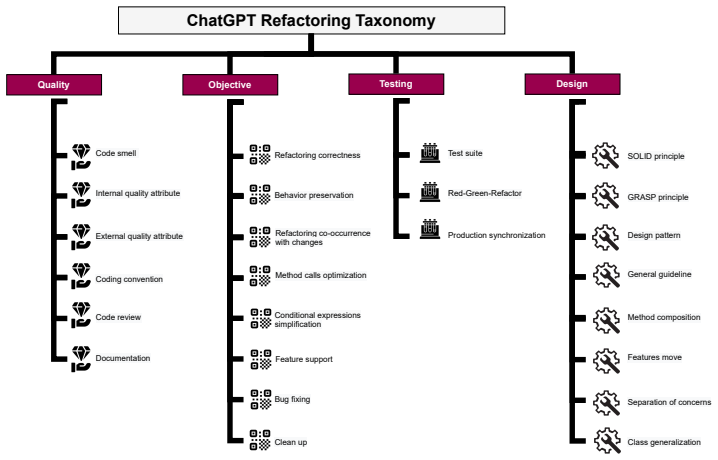
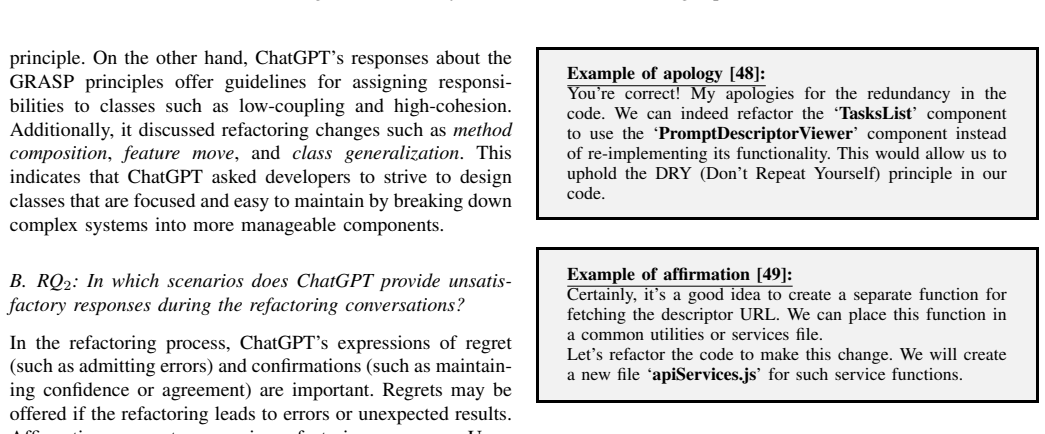
The paper's discovery is that refactoring conversations with ChatGPT are patterned enough to be classified and engineered. From 715 interactions it derives a two-tier taxonomy with four root categories—Quality, Objective, Testing, and Design—and 25 sub-themes. It then observes that ChatGPT's refactoring responses contain systematic apologetic phrases for introduced bugs, misunderstood code, missed updates, and bad practices, as well as affirmative phrases such as 'certainly' and 'absolutely' marking quality improvements or refactoring extensions. Finally, it constructs a refactoring prompt template whose role, working set, context, task, steps, output format, example, and clarification field
What carries the argument
The central object is the refactoring prompt template: a structured, fill-in-the-blank instruction block that assigns ChatGPT a role, supplies the working set, context, and constraints, specifies the refactoring task and intent, lists steps to analyze, apply strategies, give multiple solutions, validate behavior, and comment/document, and demands a specific output format with test cases. It carries the argument by turning unstructured developer requests into the exact information the paper hypothesizes ChatGPT needs, which is why it can reach the same refactoring result in one turn. The 25-theme taxonomy is the supporting classification machinery that identifies what topics those prompts mus
Load-bearing premise
The load-bearing premise is that fewer turns and shorter prompts or responses equal accurate and satisfactory refactoring; the paper assumes this equivalence without comparing template output to the developer's final code or collecting satisfaction ratings, and it designs and tests the template on the same 715 conversations.
What would settle it
Run the template on a held-out sample of refactoring requests, compile and test the generated code, diff it against the developers' merged refactorings, and collect developer satisfaction judgments; if the one-turn output is not at least as correct and satisfactory as the original multi-turn conversation, the central claim fails.
If this is right
- Using the template should let a developer obtain an acceptable refactoring in a single ChatGPT turn, cutting the average interaction cost from roughly 13.6 turns to 1.45.
- The 25-theme taxonomy gives researchers and tool builders a standard vocabulary for labeling refactoring requests and for auditing whether an LLM response stays on the requested topic.
- Apology phrases in ChatGPT output can serve as a practical red flag: they cluster around introduced bugs, misunderstood intent, missed updates, and bad practices, telling developers where to re-prompt.
- Even with the template, ChatGPT frequently skips required test cases and multiple solution versions and mishandles markdown and commit-message formatting, so one-shot success is not uniform across refactoring tasks.
Where Pith is reading between the lines
- Because the template was designed and evaluated on the same 715 conversations, the one-turn advantage is likely optimistic; a held-out set of refactoring conversations would be needed to rule out overfitting to those examples.
- The evaluation never executes or diffs the generated code, so the words 'accurate and satisfactory' are an extrapolation; comparing one-shot template output against the developer's merged refactoring with test execution and developer ratings would directly test the claim.
- If turn count is a proxy for quality, the large effect size justifies treating prompt design as a first-class software-engineering artifact; a cross-LLM replication would show whether the gain comes from the template or from ChatGPT's particular behavior.
- The taxonomy's Objective and Design themes align with refactoring types that static-analysis-backed tools handle well, suggesting a hybrid workflow: use the template for exploration and use IDE-integrated refactoring tools for validation.
Editorial analysis
A structured set of objections, weighed in public.
Referee Report
Summary. The paper analyzes 715 developer-ChatGPT refactoring interactions drawn from the DevGPT dataset. It makes three contributions: (1) a thematic taxonomy of 25 refactoring-related conversation topics organized under four root themes (Quality, Objective, Testing, Design), produced through manual coding with a reported disagreement rate of 6%; (2) a qualitative analysis of ChatGPT's apology and affirmation phrases, categorized by scenarios such as bug introduction, misunderstanding, and best-practice violations; and (3) a structured refactoring prompt template, evaluated on the same DevGPT conversations by comparing the number of turns, prompt length, and response length against the original developer prompts. The abstract claims that the prompt template enables 'concise, accurate, and satisfactory responses with minimal interactions.' The paper includes a replication package and a discussion of LLM-generated code unreliability.
Significance. If the main claims were fully supported, the paper would be a useful addition to the growing literature on LLM-assisted refactoring: the taxonomy could inform future studies of developer-AI refactoring dialogue, and a validated prompt template would have practical value. The authors are also transparent about the limitations of ChatGPT's output, and they provide a replication artifact, which is a strength. However, the central quantitative claim about the prompt template's effectiveness is not supported by the evidence presented: the evaluation measures only interaction effort, not correctness or user satisfaction, and the evaluation is performed on the same conversations used to design the template. The taxonomy and RQ2 analysis are plausible qualitative contributions, but the lack of reported frequencies for apology/affirmation categories weakens their evidentiary value. Thus the paper's significance is contingent on either substantially revising the claims or adding missing validation.
major comments (4)
- [Abstract and Section III-C (RQ3)] The claim that the prompt template yields 'concise, accurate, and satisfactory responses' is not supported by the metrics in Table II. RQ3 measures only number of turns, prompt length, and response length; it does not compare the generated code against the developer's final code, check behavior preservation, or collect satisfaction ratings. The paper's own Discussion (Takeaway #3) states that ChatGPT 'often fails to follow the entire prompt,' skips test cases, produces hallucinations, and generates invalid Git commit messages. These admissions directly contradict 'accurate and satisfactory.' Please either temper the claim to 'fewer interactions' or add a correctness/satisfaction evaluation (e.g., diff-based comparison with the DevGPT ground truth, human ratings, or automated tests).
- [Section II-C (Prompt Construction and Evaluation)] The prompt template is constructed by manually reviewing the DevGPT conversations (Section II-C, Step #1) and then evaluated by 'reproducing the corresponding developer's prompt from DevGPT' on the same conversations (Step #2). This is an in-sample evaluation: the template is tested on the very data used to design it. The observed reduction in turns could partly reflect overfitting to the test conversations. Please validate the template on a held-out set of refactoring requests or an external benchmark, or explicitly frame the result as a proof-of-concept on the training distribution.
- [Section III-C / Table II] Table II is critically hard to interpret: the row and column alignments are corrupted (e.g., the values for 'Prompt length' and 'Response length' appear to merge with adjacent columns), making the p-values and Cliff's delta values unverifiable. Since the statistical comparison in RQ3 is one of the paper's main quantitative results, the table must be corrected and the reported effect sizes should be reconciled with the displayed distributions (e.g., the number-of-turns mean of 13.58 vs. median 3 suggests a heavily skewed distribution; please clarify how 'large (0.56)' is computed and whether it is consistent with the reported medians).
- [Section III-B (RQ2)] RQ2 identifies apology and affirmation categories but reports no counts, percentages, or inter-rater reliability for these classifications. The reader cannot tell how prevalent each scenario is (e.g., how often ChatGPT apologizes for bug introduction vs. lack of understanding) or whether the proposed subcategories are comprehensive. Please report the distribution of categories and, ideally, a measure of annotation agreement, as is standard for qualitative coding studies.
minor comments (5)
- [Abstract and Section I] The abstract says 'text mining 715 refactoring-related interactions,' but the methodology is primarily manual thematic analysis. Please clarify the role of automated text mining versus manual coding.
- [Section II-B] The conflict resolution rate of 6% is reported, but no Cohen's kappa or equivalent agreement coefficient is given. Adding one would strengthen confidence in the taxonomy's reliability.
- [Figure 2] The taxonomy figure is difficult to read because the sub-themes under each root category are not visually distinguished. Please format the figure so that the 25 sub-themes are clearly associated with their four root themes.
- [Section IV (Discussion)] Takeaway #1 calls the prompt template a 'successful prompt' and a 'guideline,' but Takeaway #3 documents several frequent failures. Please align these statements and indicate explicitly what 'successful' means in light of the observed limitations.
- [References] Some references are incomplete (e.g., [3] lacks a publication venue; [10] is a bare URL). Please ensure all citations follow the journal's style.
Circularity Check
RQ3's 'fewer turns' result is built into the one-shot evaluation protocol and the template was fitted to the same DevGPT conversations used for evaluation, so the abstract's 'accurate and satisfactory' claim is not independently supported.
specific steps
-
self definitional
[Section III-C (RQ 3), Table II; abstract]
"We evaluate the efficiency of the template by assessing its ability to reproduce in one shot the exact refactored code that took developers several rounds of prompts to reach it. ... Looking at Table II, we found that our prompts differ (i.e., fewer turns (µ=1.45), shorter prompt (µ=4855.52), and shorter response (µ=6975.71)) from original developer’s prompts."
The template is run as a single one-shot prompt, so its number of turns is 1 (or about 1.45 when clarification is requested) by experimental construction. Comparing this fixed one-turn condition to DevGPT's multi-turn developer prompts and then reporting 'fewer turns' with a large effect size is not an empirical finding about prompt effectiveness; the outcome is embedded in the definition of the test. The abstract's 'minimal interactions' claim restates the one-shot setup rather than measuring it.
-
fitted input called prediction
[Section II-C Step #1-#2 and Section III-C]
"Then, we started by manually reviewing the unique set of prompts in which developers initiated a conversation with ChatGPT about refactoring. Based on our observations, we recognized that there is a certain format that leads to a shorter interaction between ChatGPT and developers. ... Consequently, we construct our first prompt. ... After constructing the prompt, we evaluated it by reproducing the corresponding developer's prompt from DevGPT, which serves as our ground truth."
The template is manually fitted to the same DevGPT conversations that later serve as the ground truth for RQ3. The designers explicitly looked for a format that leads to shorter interactions, refined the prompt on these examples, and then 'evaluated' it on those same examples. No held-out or external set is used, so the reported reductions in turns and lengths are an in-sample fit, not an independent prediction. The paper's own limitation statement that effectiveness still needs to be assessed using other LLMs does not address this in-sample evaluation.
full rationale
The primary circularity is in RQ3. The template's 'fewer turns' is guaranteed by the one-shot evaluation protocol (the authors run the template once and count that as one turn), so the comparison to multi-turn DevGPT conversations reports a difference that is built into the experimental setup. Compounding this, the template was manually constructed from the same DevGPT conversations used for evaluation, so the measured reductions are in-sample rather than predictive. The abstract's 'accurate and satisfactory' wording goes beyond the three metrics actually tested (turns, prompt length, response length); no correctness or satisfaction measure is reported, and Discussion Takeaway #3 concedes the model often fails to follow the prompt, skips tests, and hallucinates. I treat that as a validity/overclaim issue rather than an additional circularity. The RQ1 taxonomy and RQ2 apology/affirmation analysis are descriptive and independent; citation [14] to the authors' prior study is used only as design motivation and is not the basis for the effectiveness claim. Overall, the central template-effectiveness result is partially circular due to the one-shot construction and in-sample fitting, so the score is 6.
Axiom & Free-Parameter Ledger
axioms (4)
- domain assumption DevGPT snapshot provides a representative sample of developer-ChatGPT refactoring interactions.
- domain assumption Prompts containing the keyword 'refactor' are a valid and sufficient filter for refactoring-related interactions.
- domain assumption Manual thematic coding by two authors is a reliable measure of topics and of ChatGPT's behavior.
- domain assumption The developer's eventual resolved code in each DevGPT conversation is a valid ground truth for evaluating the prompt template.
Cite this review
Pith. "Pith review of ChatGPT for Code Refactoring: Analyzing Topics, Interaction, and Effective Prompts." pith.science (2026). https://pith.science/paper/LVWB577C
@misc{pith2026250908090,
  author       = {Pith},
  title        = {Pith review of: ChatGPT for Code Refactoring: Analyzing Topics, Interaction, and Effective Prompts},
  year         = {2026},
  howpublished = {\url{https://pith.science/paper/LVWB577C}},
  note         = {Machine review of arXiv:2509.08090}
}
read the original abstract
Large Language Models (LLMs), such as ChatGPT, have become widely popular and widely used in various software engineering tasks such as refactoring, testing, code review, and program comprehension. Although recent studies have examined the effectiveness of LLMs in recommending and suggesting refactoring, there is a limited understanding of how developers express their refactoring needs when interacting with ChatGPT. In this paper, our goal is to explore interactions related to refactoring between developers and ChatGPT to better understand how developers identify areas for improvement in code, and how ChatGPT addresses developers' needs. Our approach involves text mining 715 refactoring-related interactions from 29,778 ChatGPT prompts and responses, as well as the analysis of developers' explicit refactoring intentions.
Figures


Reference graph
Works this paper leans on
-
[1]
N. Nathalia, A. Paulo, and C. Donald, “Artificial intelligence vs. software engineers: An empirical study on performance and efficiency using chatgpt,” inProceedings of the 33rd Annual International Conference on Computer Science and Software Engineering, pp. 24–33, 2023
work page 2023
-
[2]
Towards human-bot collaborative software architecting with chatgpt,
A. Ahmad, M. Waseem, P. Liang, M. Fahmideh, M. S. Aktar, and T. Mikkonen, “Towards human-bot collaborative software architecting with chatgpt,” inProceedings of the 27th International Conference on Evaluation and Assessment in Software Engineering, pp. 279–285, 2023
work page 2023
-
[3]
You augment me: Exploring chatgpt-based data augmentation for semantic code search,
Y . Wanga, L. G. E. Shic, W. C. J. Chena, W. Z. M. W. H. Lie, and H. Z. Z. L. Z. Zhenga, “You augment me: Exploring chatgpt-based data augmentation for semantic code search,”
-
[4]
A prompt pattern catalog to enhance prompt engineering with chatgpt,
J. White, Q. Fu, S. Hays, M. Sandborn, C. Olea, H. Gilbert, A. El- nashar, J. Spencer-Smith, and D. C. Schmidt, “A prompt pattern catalog to enhance prompt engineering with chatgpt,”arXiv preprint arXiv:2302.11382, 2023
Pith/arXiv arXiv 2023
-
[5]
The potential use of chatgpt for debugging and bug fixing,
M. A. Haque and S. Li, “The potential use of chatgpt for debugging and bug fixing,”EAI Endorsed Transactions on AI and Robotics, vol. 2, no. 1, pp. e4–e4, 2023
work page 2023
-
[6]
The scope of chatgpt in software engineering: A thorough investigation,
W. Ma, S. Liu, W. Wang, Q. Hu, Y . Liu, C. Zhang, L. Nie, and Y . Liu, “The scope of chatgpt in software engineering: A thorough investigation,”arXiv preprint arXiv:2305.12138, 2023
Pith/arXiv arXiv 2023
-
[7]
Investigating code generation performance of chat-gpt with crowd- sourcing social data,
Y . Feng, S. Vanam, M. Cherukupally, W. Zheng, M. Qiu, and H. Chen, “Investigating code generation performance of chat-gpt with crowd- sourcing social data,” inProceedings of the 47th IEEE Computer Software and Applications Conference, pp. 1–10, 2023
work page 2023
-
[8]
From copilot to pilot: Towards ai supported software development,
R. Pudari and N. A. Ernst, “From copilot to pilot: Towards ai supported software development,”arXiv preprint arXiv:2303.04142, 2023
Pith/arXiv arXiv 2023
-
[9]
Is chatgpt a good translator? a preliminary study,
W. Jiao, W. Wang, J.-t. Huang, X. Wang, and Z. Tu, “Is chatgpt a good translator? a preliminary study,”arXiv preprint arXiv:2301.08745, 2023. 9
Pith/arXiv arXiv 2023
-
[10]
https://futurism.com/the-byte/github-92-percent-programmers-using-ai
-
[11]
Automatic code summarization via chatgpt: How far are we?,
W. Sun, C. Fang, Y . You, Y . Miao, Y . Liu, Y . Li, G. Deng, S. Huang, Y . Chen, Q. Zhang,et al., “Automatic code summarization via chatgpt: How far are we?,”arXiv preprint arXiv:2305.12865, 2023
Pith/arXiv arXiv 2023
-
[12]
https://github.com/UIUC-Chatbot/ai-ta-backend/issues/57
-
[13]
H. Hao, K. A. Hasan, H. Qin, M. Macedo, Y . Tian, S. H. Ding, and A. E. Hassan, “An empirical study on developers shared conversa- tions with chatgpt in github pull requests and issues,”arXiv preprint arXiv:2403.10468, 2024
Pith/arXiv arXiv 2024
-
[14]
How to refactor this code? an exploratory study on developer-chatgpt refactoring conversations,
E. A. AlOmar, A. Venkatakrishnan, M. W. Mkaouer, C. Newman, and A. Ouni, “How to refactor this code? an exploratory study on developer-chatgpt refactoring conversations,” inProceedings of the 21st International Conference on Mining Software Repositories, pp. 202–206, 2024
work page 2024
- [15]
-
[16]
A survey of software refactoring,
T. Mens and T. Tourw ´e, “A survey of software refactoring,”IEEE Transactions on software engineering, vol. 30, no. 2, pp. 126–139, 2004
2004
-
[17]
Next-generation refactoring: Combining llm insights and ide capabilities for extract method,
D. Pomian, A. Bellur, M. Dilhara, Z. Kurbatova, E. Bogomolov, T. Bryksin, and D. Dig, “Next-generation refactoring: Combining llm insights and ide capabilities for extract method,” in2024 IEEE Inter- national Conference on Software Maintenance and Evolution (ICSME), pp. 275–287, IEEE, 2024
work page 2024
-
[18]
Exploring the potential of general purpose llms in automated software refactoring: an empirical study,
B. Liu, Y . Jiang, Y . Zhang, N. Niu, G. Li, and H. Liu, “Exploring the potential of general purpose llms in automated software refactoring: an empirical study,”Automated Software Engineering, vol. 32, no. 1, p. 26, 2025
2025
-
[19]
https://smilevo.github.io/self-affirmed-refactoring/
-
[20]
Devgpt: Studying developer-chatgpt conversations,
T. Xiao, C. Treude, H. Hata, and K. Matsumoto, “Devgpt: Studying developer-chatgpt conversations,” in2024 IEEE/ACM 21st International Conference on Mining Software Repositories (MSR), pp. 227–230, IEEE, 2024
work page 2024
-
[21]
Gathering refactoring data: a comparison of four methods,
E. Murphy-Hill, A. P. Black, D. Dig, and C. Parnin, “Gathering refactoring data: a comparison of four methods,” inProceedings of the 2nd Workshop on Refactoring Tools, pp. 1–5, 2008
work page 2008
-
[22]
E. A. AlOmar, M. W. Mkaouer, and A. Ouni, “Can refactoring be self-affirmed? an exploratory study on how developers document their refactoring activities in commit messages,” inInternational Workshop on Refactoring-accepted. IEEE, 2019
work page 2019
-
[23]
A preliminary investigation of self- admitted refactorings in open source software (s),
Z. Di, B. Li, Z. Li, and P. Liang, “A preliminary investigation of self- admitted refactorings in open source software (s),” inInternational Conferences on Software Engineering and Knowledge Engineering, vol. 2018, pp. 165–168, KSI Research Inc. and Knowledge Systems Institute Graduate School, 2018
work page 2018
-
[24]
On the relation of refactorings and software defect prediction,
J. Ratzinger, T. Sigmund, and H. C. Gall, “On the relation of refactorings and software defect prediction,” inProceedings of the 2008 International Working Conference on Mining Software Repositories, MSR ’08, (New York, NY , USA), pp. 35–38, ACM, 2008
work page 2008
-
[25]
Toward the automatic classification of self-affirmed refactoring,
E. A. AlOmar, M. W. Mkaouer, and A. Ouni, “Toward the automatic classification of self-affirmed refactoring,”Journal of Systems and Software, vol. 171, p. 110821, 2021
work page 2021
-
[26]
Refactoring practices in the context of modern code review: An industrial case study at xerox,
E. A. AlOmar, H. AlRubaye, M. W. Mkaouer, A. Ouni, and M. Kessen- tini, “Refactoring practices in the context of modern code review: An industrial case study at xerox,” in2021 IEEE/ACM 43rd International Conference on Software Engineering: Software Engineering in Practice (ICSE-SEIP), pp. 348–357, IEEE, 2021
work page 2021
-
[27]
Recommended steps for thematic synthesis in software engineering,
D. S. Cruzes and T. Dyba, “Recommended steps for thematic synthesis in software engineering,” in2011 international symposium on empirical software engineering and measurement, pp. 275–284, IEEE, 2011
work page 2011
-
[28]
Why we refactor? confessions of github contributors,
D. Silva, N. Tsantalis, and M. T. Valente, “Why we refactor? confessions of github contributors,” inProceedings of the 2016 24th ACM SIGSOFT International Symposium on Foundations of Software Engineering, FSE 2016, (New York, NY , USA), pp. 858–870, ACM, 2016
work page 2016
-
[29]
A Lot of Talk and a Badge: An Exploratory Analysis of Personal Achievements in GitHub
F. Calefato, L. Quaranta, and F. Lanubile, “A lot of talk and a badge: An empirical analysis of personal achievements in github,”arXiv preprint arXiv:2303.14702, 2023
work page internal anchor Pith review Pith/arXiv arXiv 2023
-
[30]
Deterministic automatic refactoring at scale,
J. Gehring, “Deterministic automatic refactoring at scale,” in2023 IEEE International Conference on Software Maintenance and Evolution (ICSME), pp. 541–546, IEEE, 2023
work page 2023
-
[31]
J. White, S. Hays, Q. Fu, J. Spencer-Smith, and D. C. Schmidt, “Chatgpt prompt patterns for improving code quality, refactoring, requirements elicitation, and software design,” inGenerative AI for Effective Software Development, pp. 71–108, Springer, 2024
work page 2024
-
[32]
Refac- toring programs using large language models with few-shot examples,
A. Shirafuji, Y . Oda, J. Suzuki, M. Morishita, and Y . Watanobe, “Refac- toring programs using large language models with few-shot examples,” arXiv preprint arXiv:2311.11690, 2023
Pith/arXiv arXiv 2023
-
[33]
Exploring chatgpt’s code refactoring capabilities: An empirical study,
K. DePalma, I. Miminoshvili, C. Henselder, K. Moss, and E. A. AlOmar, “Exploring chatgpt’s code refactoring capabilities: An empirical study,” Expert Systems with Applications, vol. 249, p. 123602, 2024
work page 2024
-
[34]
Context-enhanced llm- based framework for automatic test refactoring,
Y . Gao, X. Hu, X. Yang, and X. Xia, “Context-enhanced llm- based framework for automatic test refactoring,”arXiv preprint arXiv:2409.16739, 2024
Pith/arXiv arXiv 2024
-
[35]
Iterative refactoring of real-world open- source programs with large language models,
J. Choi, G. An, and S. Yoo, “Iterative refactoring of real-world open- source programs with large language models,” inInternational Sympo- sium on Search Based Software Engineering, pp. 49–55, Springer, 2024
work page 2024
-
[36]
ismell: Assembling llms with expert toolsets for code smell detection and refactoring,
D. Wu, F. Mu, L. Shi, Z. Guo, K. Liu, W. Zhuang, Y . Zhong, and L. Zhang, “ismell: Assembling llms with expert toolsets for code smell detection and refactoring,” inProceedings of the 39th IEEE/ACM In- ternational Conference on Automated Software Engineering, pp. 1345– 1357, 2024
work page 2024
-
[37]
Improved program repair methods using refactoring with gpt models,
R. Ishizue, K. Sakamoto, H. Washizaki, and Y . Fukazawa, “Improved program repair methods using refactoring with gpt models,” inPro- ceedings of the 55th ACM Technical Symposium on Computer Science Education V . 1, pp. 569–575, 2024
work page 2024
-
[38]
Refactorbench: Evaluating stateful reasoning in language agents through code,
D. Gautam, S. Garg, J. Jang, N. Sundaresan, and R. Z. Moghad- dam, “Refactorbench: Evaluating stateful reasoning in language agents through code,” inNeurIPS 2024 Workshop on Open-World Agents, 2024
work page 2024
-
[39]
D. Cui, Q. Wang, Y . Zhao, J. Wang, M. Wei, J. Hu, L. Wang, and Q. Li, “One-to-one or one-to-many? suggesting extract class refactoring opportunities with intra-class dependency hypergraph neural network,” inProceedings of the 33rd ACM SIGSOFT International Symposium on Software Testing and Analysis, pp. 1529–1540, 2024
work page 2024
-
[40]
D. Cui, J. Wang, Q. Wang, P. Ji, M. Qiao, Y . Zhao, J. Hu, L. Wang, and Q. Li, “Three heads are better than one: Suggesting move method refactoring opportunities with inter-class code entity dependency en- hanced hybrid hypergraph neural network,” inProceedings of the 39th IEEE/ACM International Conference on Automated Software Engineer- ing, pp. 745–757, 2024
work page 2024
-
[41]
Move method refactoring recommendation based on deep learning and llm-generated information,
Y . Zhang, Y . Li, G. Meredith, K. Zheng, and X. Li, “Move method refactoring recommendation based on deep learning and llm-generated information,”Information Sciences, vol. 697, p. 121753, 2025
work page 2025
-
[42]
Preference-guided refactored tuning for retrieval augmented code gen- eration,
X. Gao, Y . Xiong, D. Wang, Z. Guan, Z. Shi, H. Wang, and S. Li, “Preference-guided refactored tuning for retrieval augmented code gen- eration,” inProceedings of the 39th IEEE/ACM International Conference on Automated Software Engineering, pp. 65–77, 2024
work page 2024
-
[43]
Copilot-in-the-loop: Fixing code smells in copilot-generated python code using copilot,
B. Zhang, P. Liang, Q. Feng, Y . Fu, and Z. Li, “Copilot-in-the-loop: Fixing code smells in copilot-generated python code using copilot,” inProceedings of the 39th IEEE/ACM International Conference on Automated Software Engineering, pp. 2230–2234, 2024
work page 2024
-
[44]
Refactoring to pythonic idioms: A hybrid knowledge-driven approach leveraging large language models,
Z. Zhang, Z. Xing, X. Ren, Q. Lu, and X. Xu, “Refactoring to pythonic idioms: A hybrid knowledge-driven approach leveraging large language models,”Proceedings of the ACM on Software Engineering, vol. 1, no. FSE, pp. 1107–1128, 2024
work page 2024
-
[45]
W. J. Conover,Practical nonparametric statistics, vol. 350. John Wiley & Sons, 1998
work page 1998
-
[46]
Dominance statistics: Ordinal analyses to answer ordinal questions,
N. Cliff, “Dominance statistics: Ordinal analyses to answer ordinal questions,”Psychological Bulletin, vol. 114, no. 3, p. 494, 1993
work page 1993
-
[47]
Appropriate statistics for ordinal level data,
J. Romano, J. Kromrey, J. Coraggio, and J. Skowronek, “Appropriate statistics for ordinal level data,” inProceedings of the Annual Meeting of the Florida Association of Institutional Research, pp. 1–3, 2006
work page 2006
-
[48]
https://chat.openai.com/share/e9f4664e-50a5-40c1-8604-befe89a2dd36
-
[49]
https://chat.openai.com/share/dbd163f7-aa90-4351-a9a7-a2deb906120e
-
[50]
Prompt programming for large language models: Beyond the few-shot paradigm,
L. Reynolds and K. McDonell, “Prompt programming for large language models: Beyond the few-shot paradigm,” p. 10, 2021
work page 2021
-
[51]
https://chatgpt.com/share/73e56b34-fb0d-4056-bfcc-daf800b5d213
-
[52]
How is chatgpt’s behavior changing over time?,
L. Chen, M. Zaharia, and J. Zou, “How is chatgpt’s behavior changing over time?,”Harvard Data Science Review, vol. 6, no. 2, 2024
work page 2024
-
[53]
Together we go further: Llms and ide static analysis for extract method refactoring,
D. Pomian, A. Bellur, M. Dilhara, Z. Kurbatova, E. Bogomolov, T. Bryksin, and D. Dig, “Together we go further: Llms and ide static analysis for extract method refactoring,”arXiv preprint arXiv:2401.15298, 2024
Pith/arXiv arXiv 2024
-
[54]
Unveiling chatgpt’s usage in open source projects: A mining-based study,
R. Tufano, A. Mastropaolo, F. Pepe, O. Dabi ´c, M. Di Penta, and G. Bavota, “Unveiling chatgpt’s usage in open source projects: A mining-based study,”arXiv preprint arXiv:2402.16480, 2024
Pith/arXiv arXiv 2024
-
[55]
How we refactor, and how we know it,
E. Murphy-Hill, C. Parnin, and A. P. Black, “How we refactor, and how we know it,”IEEE Transactions on Software Engineering, vol. 38, pp. 5–18, Jan 2012. 10
work page 2012
This paper was first reviewed by deepseek-v4-flash on August 4, 2026.
discussion (0)
Sign in with ORCID, Apple, or X to comment. Anyone can read and Pith papers without signing in.