REVIEW 3 major objections 6 minor 39 references
Building a segment transformer that slices full songs into beat-aligned four-bar units and models their inter-relationships lets a two-stage detector identify AI-generated music with near-perfect accuracy on the SONICS benchmark.
Reviewed by Pith at T0; open to challenge. T0 means a machine referee read the full paper against a public rubric. the ladder, T0–T4 →
T0 review · deepseek-v4-flash
2026-08-04 20:50 UTC pith:I5WZL7OH
load-bearing objection Plausible two-stage architecture for AIGM detection, but the near-perfect SONICS numbers need track-disjoint splits and ablations before I'd trust them. the 3 major comments →
Segment Transformer: AI-Generated Music Detection via Music Structural Analysis
The pith
A machine-rendered reading of the paper's core claim, the machinery that carries it, and where it could break.
Core claim
The central claim is that segment-level musical features combined with long-range temporal analysis improve AIGM detection. Stage 1 pairs frozen pre-trained encoders (Wav2vec 2.0, Music2vec, MERT, or FXencoder) with transformer classifiers on short clips. Stage 2 slices full audio at detected downbeats into four-bar segments, embeds each with the Stage-1 model, and feeds the sequence to a Segment Transformer whose dual-pathway encoder concatenates content features with a self-similarity matrix of all segments. With MERT embeddings the full pipeline reports near-perfect SONICS results (accuracy 0.9992, AUC 0.9999, specificity 0.9987), above SpecTTTra-alpha (F1 0.97, AUC 0.99); the authors att
What carries the argument
The Segment Transformer: a dual-pathway transformer that consumes a fixed-length sequence (length 48) of beat-aligned four-bar audio segments. One encoder processes the segment content embeddings; the other processes a self-similarity matrix built from all segment embeddings, capturing repetition and variation across the song. The two outputs are concatenated before classification. Beat-aware segmentation is the load-bearing innovation: it preserves the musical bar structure rather than imposing arbitrary fixed windows.
Load-bearing premise
The reported full-audio numbers depend on reusing the SONICS benchmark exactly as originally set up—same 120-second clips and same train/validation/test split—and on the beat tracker reliably locating downbeats in AI-generated music; if either assumption fails, the near-perfect accuracy and the comparison to SpecTTTra collapse.
What would settle it
Train the same Segment Transformer on the same SONICS split but replace beat-aligned four-bar segmentation with fixed-length slices of equal duration; if accuracy stays near 0.9992, the claimed structural mechanism is not what drives the result. A second check: audit the SONICS train/validation/test split used here against the original benchmark to confirm no overlap between training and test tracks.
If this is right
- Full-audio AIGM detection no longer requires whole-track transformers; a fixed-length sequence of beat-aligned segments suffices, scaling to arbitrarily long songs.
- Music-specific embeddings (MERT, FXencoder) paired with the Segment Transformer dramatically outperform speech-oriented embeddings (Wav2vec 2.0, accuracy 0.7473), showing that representation choice is as important as the structural model.
- The two-stage design is encoder-agnostic, so future music self-supervised models can be plugged into both stages without architectural changes.
- Near-perfect accuracy and specificity on SONICS suggest practical use in copyright-verification and content-moderation pipelines.
- The method directly counters the idea that long-context local features alone are sufficient for AIGM detection.
Where Pith is reading between the lines
- If musical structure is the discriminative signal, generative models that learn human-level song form could erode the detector's edge; durability against future generators is untested and likely an arms race.
- A testable ablation is replacing beat-derived four-bar segments with equal-length fixed windows; if accuracy holds, the structural segmentation itself may not be the cause.
- The numbers come from a single benchmark; transferring the detector to out-of-distribution genres, unseen text-to-music models, or partially AI-collaborative songs would reveal how much of the signal is generator-specific artifacts versus general structural difference.
- The self-similarity pathway suggests the model may attend to repeated-form signatures, such as how AI models loop or fail to develop motifs; attribution methods could probe this.
Editorial analysis
A structured set of objections, weighed in public.
Referee Report
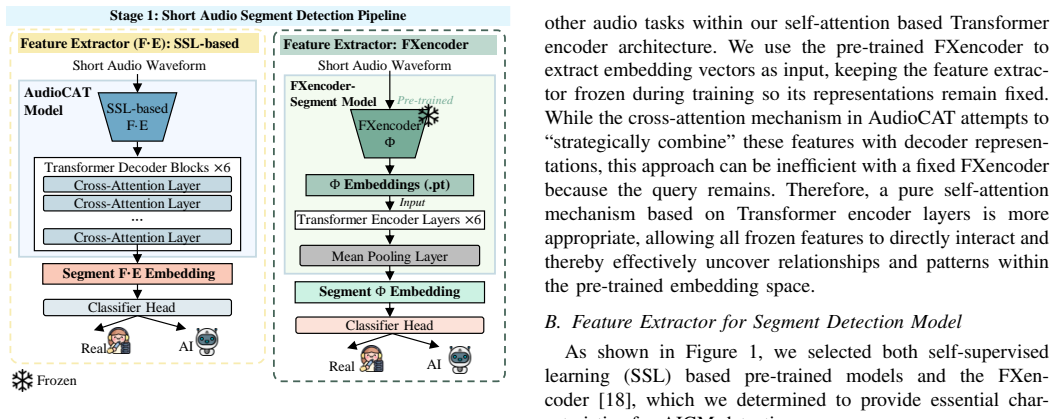
Summary. The paper proposes a two-stage framework for AI-generated music (AIGM) detection. In stage 1, short audio clips are mapped to embeddings by frozen pretrained feature extractors (Wav2vec 2.0, Music2vec, MERT, FXencoder) and classified by a cross-attention decoder (AudioCAT) or a transformer encoder (FXencoder-Segment). In stage 2, full tracks are segmented into 4-bar units using the Beat This! downbeat tracker; a Segment Transformer with two parallel transformer encoders, one over content embeddings and one over a self-similarity matrix, learns inter-segment structure for whole-track classification. Experiments on FakeMusicCaps (10 s clips) and SONICS (5 s and 120 s segments) report near-perfect performance, with the best model (MERT + Segment Transformer) reaching 0.9992 accuracy, 0.9999 AUC, and 0.9987 specificity on SONICS 120 s segments, surpassing the previously reported SpecTTTra-alpha baseline.
Significance. If the reported results are valid, the paper makes a useful contribution: it demonstrates that combining music-specific pretrained embeddings with a segment-level structural transformer can outperform previous long-context audio transformers for full-track AIGM detection. The architectural idea is clearly motivated and the use of multiple frozen encoders provides a clean comparison of feature extractor quality. The paper also has several reproducible elements: it uses public datasets (FakeMusicCaps, SONICS) and named pretrained models. However, the central quantitative claim is currently supported only by a single evaluation run with no variance estimates, no track-level split description, and no ablation isolating the structural pathway. The contribution is therefore plausible but not yet convincingly established.
major comments (3)
- [Section III.D, Table II] The most important missing information is the SONICS evaluation protocol. The text says only that the authors 'used the benchmark reported in [13]' without stating whether the train/validation/test split is track-disjoint or segment-disjoint, how many tracks/segments are in each partition, or how the 120-second segments are cropped/padded. If multiple segments from the same track appear in both training and test sets, a model can memorize track-level acoustic signatures, and the near-perfect 0.9992 accuracy and the comparison to SpecTTTra-alpha (F1 0.97) become uninterpretable. This concern applies equally to Table I's 5-second SONICS results. Please report a track-disjoint split, per-track evaluation, and the exact split configuration.
- [Section III.B/III.D, Tables I-II] All metrics are reported as point estimates with no error bars, no multiple seeds, and no statistical significance tests. The full-audio claim hinges on a four-decimal gap (0.9992 vs. 0.97 F1) that could easily be an artifact of a single lucky initialization or evaluation split. In addition, the paper's central claim that segment-level structural analysis improves detection is not tested by an ablation: there is no comparison of the dual-pathway Segment Transformer against (a) a content-embedding-only transformer, (b) a self-similarity-only transformer, or (c) simple averaging of per-segment predictions. Such an ablation is necessary to show that the proposed architecture, rather than the frozen embeddings, drives the improvement.
- [Section II.C, Music Segment Preparation] The entire stage-2 pipeline depends on the Beat This! downbeat tracker producing reliable 4-bar segments for both human and AI-generated music. The paper provides no evidence of how often beat tracking succeeds on SONICS, no analysis of failure modes (e.g., AI tracks with weak or no percussive downbeats), and no sensitivity analysis to downbeat errors. If downbeat extraction is noisy, the 'musical structure' pathway may simply be adding noise, and the reported performance could be driven by the embeddings rather than by structural segmentation. Please report downbeat-detection success rates, and, ideally, compare against fixed-length segmentation as a robustness check.
minor comments (6)
- [Section III.B] The sentence 'with a 50 % probability was performed exclusively during the training' is grammatically awkward; please revise.
- [Section III.A] The text says tracks were produced with 'SunoSuno 1 and Udio 2'—the duplicate 'Suno' appears to be a typo.
- [References] Reference [21] (Map-Music2vec) lacks publication venue and year; please complete. Some other entries are also missing page or DOI information.
- [Tables I-II] The tables report four decimal digits for some metrics but no sample sizes or confidence intervals. Please add the number of test examples per condition. Also, the notation '--' for missing baseline metrics should be explained in the caption.
- [Section II.C / Figure 2] The downbeat quantization and the padding/cropping to fixed sequence length 48 are described only verbally. A short algorithmic description or equation would make the preprocessing reproducible.
- [Section IV] The paper claims to 'establish a new benchmark' for full-audio AIGM detection, but no code, checkpoints, or public leaderboard are provided. Please state whether the code will be released.
Circularity Check
No significant circularity: the reported results are trained classifiers evaluated on an external benchmark; no fitted constant is reused as a prediction by construction.
full rationale
The paper's derivation chain is empirical rather than definitional. Stage-1 models (AudioCAT and FXencoder-Segment) use frozen pre-trained encoders (Wav2vec 2.0, Music2vec, MERT, FXencoder) and train classification heads on labeled FakeMusicCaps/SONICS segments. Stage-2 takes those segment-level embeddings and trains a Segment Transformer on SONICS 120-second segments using the benchmark protocol of Rahman et al. [13]. There is no equation in which an output quantity is defined to be an input quantity, no parameter fitted to the test set and then renamed as a prediction, and no load-bearing same-author citation chain: the authors cite no prior work of their own, and [13] is an external baseline/dataset source. The beat-aware segmentation and self-similarity path is an architectural hypothesis tested against baselines, not a tautology. The only substantive concern, whether the SONICS split is track-disjoint or whether the 5-second segment classifier was trained on segments from tracks later appearing in the 120-second test, is an evaluation-protocol or data-leakage risk, not circular reasoning: it does not make the predicted quantity identical to the training input by construction. Under the stated benchmark use, the evaluation is self-contained, so the circularity score is 0.
Axiom & Free-Parameter Ledger
free parameters (3)
- Segment transformer sequence length (48) =
48
- 4-bar segment unit =
4 bars
- Data augmentation probability (50%) =
0.5
axioms (3)
- domain assumption The SONICS full-audio benchmark in [13] is used with the same train/validation/test split and same 120-second segments
- domain assumption Beat tracking with 'Beat this!' produces reliable downbeats on both real and AI-generated music
- domain assumption Pre-trained SSL models (MERT, wav2vec, Music2vec) and FXencoder provide generalizable representations for AI vs human music
Cite this review
Pith. "Pith review of Segment Transformer: AI-Generated Music Detection via Music Structural Analysis." pith.science (2026). https://pith.science/paper/I5WZL7OH
@misc{pith2026250908283,
  author       = {Pith},
  title        = {Pith review of: Segment Transformer: AI-Generated Music Detection via Music Structural Analysis},
  year         = {2026},
  howpublished = {\url{https://pith.science/paper/I5WZL7OH}},
  note         = {Machine review of arXiv:2509.08283}
}
read the original abstract
Audio and music generation systems have been remarkably developed in the music information retrieval (MIR) research field. The advancement of these technologies raises copyright concerns, as ownership and authorship of AI-generated music (AIGM) remain unclear. Also, it can be difficult to determine whether a piece was generated by AI or composed by humans clearly. To address these challenges, we aim to improve the accuracy of AIGM detection by analyzing the structural patterns of music segments. Specifically, to extract musical features from short audio clips, we integrated various pre-trained models, including self-supervised learning (SSL) models or an audio effect encoder, each within our suggested transformer-based framework. Furthermore, for long audio, we developed a segment transformer that divides music into segments and learns inter-segment relationships. We used the FakeMusicCaps and SONICS datasets, achieving high accuracy in both the short-audio and full-audio detection experiments. These findings suggest that integrating segment-level musical features into long-range temporal analysis can effectively enhance both the performance and robustness of AIGM detection systems.
Figures

Reference graph
Works this paper leans on
-
[1]
Attributing fake images to gans: Learning and analyzing gan finger- prints,
N. Yu, L. S. Davis, and M. Fritz, “Attributing fake images to gans: Learning and analyzing gan finger- prints,” inProceedings of the IEEE/CVF international conference on computer vision, 2019, pp. 7556–7566
work page 2019
-
[2]
Make-a-video: Text-to-video generation without text-video data,
U. Singer et al., “Make-a-video: Text-to-video generation without text-video data,”arXiv preprint arXiv:2209.14792, 2022
Pith/arXiv arXiv 2022
-
[3]
Audiogen: Textually guided audio generation,
F. Kreuk et al., “Audiogen: Textually guided audio generation,”arXiv preprint arXiv:2209.15352, 2022
Pith/arXiv arXiv 2022
-
[4]
Audioldm 2: Learning holistic audio generation with self-supervised pretraining,
H. Liu et al., “Audioldm 2: Learning holistic audio generation with self-supervised pretraining,”IEEE/ACM Transactions on Audio, Speech, and Language Process- ing, 2024
work page 2024
-
[5]
Improving language understanding by generative pre-training,
A. Radford, K. Narasimhan, T. Salimans, I. Sutskever, et al., “Improving language understanding by generative pre-training,” 2018
2018
-
[6]
Pre-trained language models for text generation: A sur- vey,
J. Li, T. Tang, W. X. Zhao, J.-Y . Nie, and J.-R. Wen, “Pre-trained language models for text generation: A sur- vey,”ACM Computing Surveys, vol. 56, no. 9, pp. 1–39, 2024
work page 2024
-
[7]
Watching the generative ai hype bubble deflate,
D. G. Widder and M. Hicks, “Watching the generative ai hype bubble deflate,”arXiv preprint arXiv:2408.08778, 2024
Pith/arXiv arXiv 2024
-
[8]
Audio deepfake detection: A survey,
J. Yi, C. Wang, J. Tao, X. Zhang, C. Y . Zhang, and Y . Zhao, “Audio deepfake detection: A survey,”arXiv preprint arXiv:2308.14970, 2023
Pith/arXiv arXiv 2023
-
[9]
Asvspoof 2021: Towards spoofed and deepfake speech detection in the wild,
X. Liu et al., “Asvspoof 2021: Towards spoofed and deepfake speech detection in the wild,”IEEE/ACM Transactions on Audio, Speech, and Language Process- ing, vol. 31, pp. 2507–2522, 2023
work page 2021
-
[10]
Add 2023: The second audio deepfake detection challenge,
J. Yi et al., “Add 2023: The second audio deepfake detection challenge,”arXiv preprint arXiv:2305.13774, 2023
Pith/arXiv arXiv 2023
-
[11]
M. Masood, M. Nawaz, K. M. Malik, A. Javed, A. Irtaza, and H. Malik, “Deepfakes generation and detec- tion: State-of-the-art, open challenges, countermeasures, and way forward,”Applied intelligence, vol. 53, no. 4, pp. 3974–4026, 2023
work page 2023
-
[12]
Deepfake generation and detection: Case study and challenges,
Y . Patel et al., “Deepfake generation and detection: Case study and challenges,”IEEE Access, vol. 11, pp. 143 296–143 323, 2023
work page 2023
-
[13]
Sonics: Synthetic or not–identifying counterfeit songs,
M. A. Rahman, Z. I. A. Hakim, N. H. Sarker, B. Paul, and S. A. Fattah, “Sonics: Synthetic or not–identifying counterfeit songs,”arXiv preprint arXiv:2408.14080, 2024
Pith/arXiv arXiv 2024
-
[14]
On the Effectiveness of Speech Self-supervised Learning for Music
Y . Ma et al., “On the effectiveness of speech self-supervised learning for music,”arXiv preprint arXiv:2307.05161, 2023
work page internal anchor Pith review Pith/arXiv arXiv 2023
-
[15]
Siamese network with wav2vec feature for spoofing speech detection.,
Y . Xie, Z. Zhang, and Y . Yang, “Siamese network with wav2vec feature for spoofing speech detection.,” inInterspeech, 2021, pp. 4269–4273
work page 2021
-
[16]
H. Tak, M. Todisco, X. Wang, J.-w. Jung, J. Yamagishi, and N. Evans, “Automatic speaker verification spoofing 5 and deepfake detection using wav2vec 2.0 and data augmentation,”arXiv preprint arXiv:2202.12233, 2022
Pith/arXiv arXiv 2022
-
[17]
Codified audio language modeling learns useful representa- tions for music information retrieval,
R. Castellon, C. Donahue, and P. Liang, “Codified audio language modeling learns useful representa- tions for music information retrieval,”arXiv preprint arXiv:2107.05677, 2021
Pith/arXiv arXiv 2021
-
[18]
Music mixing style transfer: A contrastive learning approach to disentangle audio effects,
J. Koo, M. A. Mart ´ınez-Ram´ırez, W.-H. Liao, S. Uh- lich, K. Lee, and Y . Mitsufuji, “Music mixing style transfer: A contrastive learning approach to disentangle audio effects,” inICASSP 2023-2023 IEEE International Conference on Acoustics, Speech and Signal Processing (ICASSP), IEEE, 2023, pp. 1–5
work page 2023
-
[19]
Mert: Acoustic music understanding model with large-scale self-supervised training,
Y . Li et al., “Mert: Acoustic music understanding model with large-scale self-supervised training,” 2024
work page 2024
-
[20]
Wav2vec 2.0: A framework for self-supervised learning of speech representations,
A. Baevski, Y . Zhou, A. Mohamed, and M. Auli, “Wav2vec 2.0: A framework for self-supervised learning of speech representations,”Advances in neural infor- mation processing systems, vol. 33, pp. 12 449–12 460, 2020
work page 2020
-
[21]
Y . Li et al., “Map-music2vec: A simple and effective baseline for self-supervised music audio representation learning,”
-
[22]
Investigating self- supervised front ends for speech spoofing countermea- sures,
X. Wang and J. Yamagishi, “Investigating self- supervised front ends for speech spoofing countermea- sures,”arXiv preprint arXiv:2111.07725, 2021
Pith/arXiv arXiv 2021
-
[23]
Self-training and pre-training are comple- mentary for speech recognition,
Q. Xu et al., “Self-training and pre-training are comple- mentary for speech recognition,” inICASSP 2021-2021 IEEE International Conference on Acoustics, Speech and Signal Processing (ICASSP), IEEE, 2021, pp. 3030– 3034
work page 2021
-
[24]
Data2vec: A general framework for self- supervised learning in speech, vision and language,
A. Baevski, W.-N. Hsu, Q. Xu, A. Babu, J. Gu, and M. Auli, “Data2vec: A general framework for self- supervised learning in speech, vision and language,” in International conference on machine learning, PMLR, 2022, pp. 1298–1312
work page 2022
-
[25]
Similarity matrix processing for music structure analysis,
Y . Shiu, H. Jeong, and C.-C. J. Kuo, “Similarity matrix processing for music structure analysis,” inProceedings of the 1st ACM workshop on Audio and music computing multimedia, 2006, pp. 69–76
work page 2006
-
[26]
L. Comanducci, P. Bestagini, and S. Tubaro, “Fake- musiccaps: A dataset for detection and attribution of synthetic music generated via text-to-music models,” arXiv preprint arXiv:2409.10684, 2024
Pith/arXiv arXiv 2024
-
[27]
Deep residual learning for image recognition,
K. He, X. Zhang, S. Ren, and J. Sun, “Deep residual learning for image recognition,” inProceedings of the IEEE conference on computer vision and pattern recog- nition, 2016, pp. 770–778
2016
-
[28]
A convnet for the 2020s,
Z. Liu, H. Mao, C.-Y . Wu, C. Feichtenhofer, T. Darrell, and S. Xie, “A convnet for the 2020s,” inProceedings of the IEEE/CVF conference on computer vision and pattern recognition, 2022, pp. 11 976–11 986
2022
-
[29]
Squeeze-and-excitation networks,
J. Hu, L. Shen, and G. Sun, “Squeeze-and-excitation networks,” inProceedings of the IEEE conference on computer vision and pattern recognition, 2018, pp. 7132–7141
work page 2018
-
[30]
An image is worth 16x16 words: Transformers for image recognition at scale,
A. Dosovitskiy et al., “An image is worth 16x16 words: Transformers for image recognition at scale,”arXiv preprint arXiv:2010.11929, 2020
Pith/arXiv arXiv 2010
-
[31]
Mobilenets: Efficient convolu- tional neural networks for mobile vision applications,
A. G. Howard et al., “Mobilenets: Efficient convolu- tional neural networks for mobile vision applications,” arXiv preprint arXiv:1704.04861, 2017
Pith/arXiv arXiv 2017
-
[32]
Ef- ficientvit: Lightweight multi-scale attention for high- resolution dense prediction,
H. Cai, J. Li, M. Hu, C. Gan, and S. Han, “Ef- ficientvit: Lightweight multi-scale attention for high- resolution dense prediction,” inProceedings of the IEEE/CVF international conference on computer vision, 2023, pp. 17 302–17 313
work page 2023
-
[33]
Long short-term memory,
S. Hochreiter and J. Schmidhuber, “Long short-term memory,”Neural computation, vol. 9, no. 8, pp. 1735– 1780, 1997
1997
-
[34]
Detection of ai-synthesized speech using cepstral & bispectral statistics,
A. K. Singh and P. Singh, “Detection of ai-synthesized speech using cepstral & bispectral statistics,” in2021 IEEE 4th International Conference on Multimedia Infor- mation Processing and Retrieval (MIPR), IEEE, 2021, pp. 412–417
work page 2021
-
[35]
Simple and controllable music gen- eration,
J. Copet et al., “Simple and controllable music gen- eration,”Advances in Neural Information Processing Systems, vol. 36, pp. 47 704–47 720, 2023
work page 2023
-
[36]
Musicldm: Enhanc- ing novelty in text-to-music generation using beat- synchronous mixup strategies,
K. Chen, Y . Wu, H. Liu, M. Nezhurina, T. Berg- Kirkpatrick, and S. Dubnov, “Musicldm: Enhanc- ing novelty in text-to-music generation using beat- synchronous mixup strategies,” inICASSP 2024-2024 IEEE International Conference on Acoustics, Speech and Signal Processing (ICASSP), IEEE, 2024, pp. 1206– 1210
work page 2024
-
[37]
Z. Evans, J. D. Parker, C. Carr, Z. Zukowski, J. Taylor, and J. Pons, “Stable audio open,” inICASSP 2025-2025 IEEE International Conference on Acoustics, Speech and Signal Processing (ICASSP), IEEE, 2025, pp. 1–5
work page 2025
-
[38]
Mustango: Toward controllable text-to-music generation,
J. Melechovsky, Z. Guo, D. Ghosal, N. Majumder, D. Herremans, and S. Poria, “Mustango: Toward controllable text-to-music generation,”arXiv preprint arXiv:2311.08355, 2023
Pith/arXiv arXiv 2023
-
[39]
Beat this! ac- curate beat tracking without dbn postprocessing,
F. Foscarin, J. Schl ¨uter, and G. Widmer, “Beat this! ac- curate beat tracking without dbn postprocessing,”arXiv preprint arXiv:2407.21658, 2024. 6
Pith/arXiv arXiv 2024
discussion (0)
Sign in with ORCID, Apple, or X to comment. Anyone can read and Pith papers without signing in.