REVIEW 3 major objections 4 minor 54 references
Membrane Heterogeneity Driven Dynamics of Multicomponent Vesicles in Shear Flow
T0 review · 3 major / 4 minor · reviewed 2026-08-04 · deepseek-v4-flash
Pith's one-line read The paper claims that membrane surface-tension contrast alone—without viscosity mismatch or asymmetric phase placement—can drive vesicles to swing and tumble under shear, and that bending-rigidity contrast organizes a phase diagram with thr
desk verdict Solid 3D phase-field study with a genuinely new surface-tension contrast mechanism, but the unstated inextensibility relaxation parameter and single-shot phase diagrams mean the headline claims need a sensitivity pass before I'd trust them. read the letter →
The pith
A machine-rendered reading of the paper's core claim, the machinery that carries it, and where it could break.
The reading
What carries the argument
A phase-field model with two order parameters: φ marks the vesicle membrane as a diffuse interface, and c_Γ marks the lateral lo/ld composition; the diffuse-domain method extends surface equations into the bulk. The model is derived from a free energy (bending, surface, line, area-penalty) via energy variation, giving thermodynamically consistent forces and fluxes, with local inextensibility enforced by a Lagrange multiplier. The regime map is organized by dimensionless contrasts κ_B = κ_B^ld/κ_B^lo, σ_S = σ_S^ld/σ_S^lo, and the bending capillary number Ca = μ_out U L²/κ_B^lo. The surface-tension mechanism works by lowering the energetic cost of deforming ld domains, anchoring them at the ti
What would settle it
Run the same parameters but replace the symmetric tip domains with a random or single off-center ld domain, or change the reduced volume to v=0.8; if surface-tension-driven swinging/tumbling disappears or the six-regime taxonomy collapses into different states, the mechanism is not generic. Alternatively, a microfluidic experiment on a giant unilamellar vesicle with matched bending rigidities but σ_S<1 should show the predicted tumbling at Ca≈1; failure to observe it would contradict the claim.
Extended reading notes
Core claim
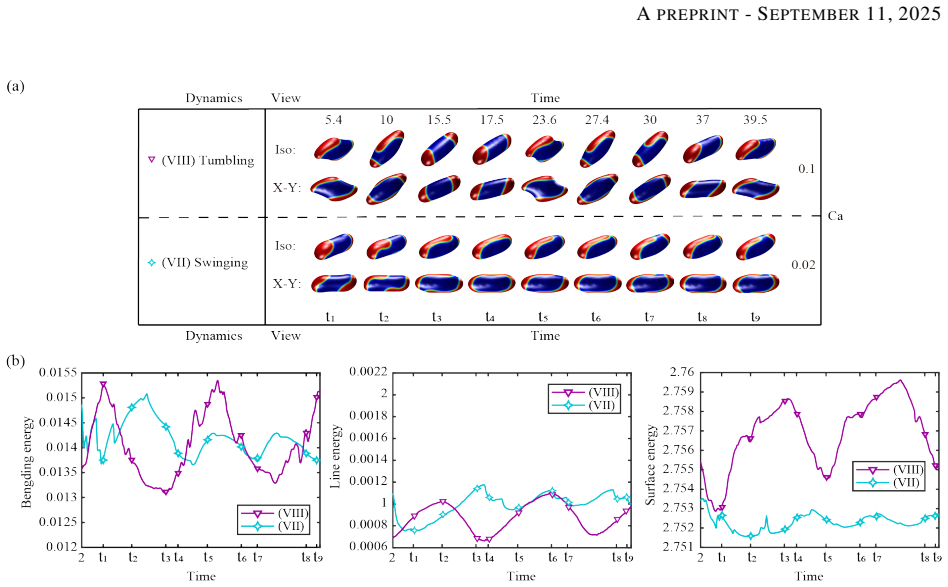
The central discovery is twofold. First, for a prolate vesicle with reduced volume v≈0.91 and two symmetric ld domains pre-placed at the tips, lowering the ld/lo surface-tension ratio σS below 1 at fixed bending contrast κ_B=0.65 causes the vesicle to enter two new regimes: small-amplitude swinging (VII) and rigid-body-like tumbling (VIII), with no viscosity contrast and no asymmetric domain placement. Second, varying the bending-rigidity contrast κ_B and the bending capillary number Ca sweeps out six banding/treading regimes, including three not previously reported: lateral ring banding (I), lateral broken-ring banding (II), and vertical broken-ring banding (IV); within vertical ring bandin
Load-bearing premise
The whole regime map—including the claim that surface tension contrast alone triggers swinging and tumbling—is computed from a single initial condition: a prolate vesicle with reduced volume v≈0.91 and two symmetric ld domains placed at the tips; if the regimes depend sensitively on that geometry or on the diffuse-interface form of the surface-tension energy, the general claim would not follow.
Editorial extensions
If this is right
- Surface-tension contrast should be treated as a first-order control parameter for vesicle motion in flow, alongside viscosity contrast and bending contrast.
- The three new banding regimes (I, II, IV) expand the known dynamical repertoire and should be observable in experiments with tunable lipid compositions.
- The identified 'Low-Rigidity Full-Dynamics Belt' and 'Low-Capillary Full-Dynamics Belt' mark parameter windows where all six regimes coexist, useful for designing vesicle-based carriers.
- Subdividing vertical ring banding into temporary, cyclic, and stable rings implies the ring is a metastable structure governed by bending contrast and shear strength.
- The model's agreement with experiments on phase separation and shear dynamics offers a validated 3D framework for predicting multicomponent vesicle behavior under flow.
Reading between the lines
- If the surface-tension-only swinging and tumbling mechanism holds generally, it suggests vesicles could be steered by locally modulating tension (e.g., via drugs, light, or other stimuli) rather than by controlling viscosity; a testable extension is to scan reduced volume v and initial domain arrangement to check the robustness of regimes VII and VIII.
- The surface-tension-driven swinging bears a formal resemblance to thermocapillary or surfactant-driven migration of droplets; the same diffuse-domain machinery might translate to droplets with heterogeneous surface tension.
- The regime taxonomy depends on the diffuse-interface representation of surface tension (through the regularized delta function and the specific surface energy); a sharp-interface benchmark or a convergence study in the interfacial thickness ε_ϕ would clarify whether the new regimes are physical or artifacts of the model's regularization.
- Because the phase diagram was computed from a single initial condition (prolate vesicle with v≈0.91 and symmetric tip domains), the regime boundaries are likely to shift with vesicle deflation and domain placement; mapping those shifts would produce a more complete design chart.
Signed reviews
Editorial analysis
A structured set of objections, weighed in public.
Referee Report
Summary. This paper proposes a thermodynamically consistent phase-field model for multicomponent vesicles in shear flow, coupling a bulk Navier–Stokes/Cahn–Hilliard system with a diffuse-domain surface Cahn–Hilliard equation for lipid phases. The membrane energy includes bending, surface tension, line tension, and surface-area penalty terms, and local inextensibility is imposed through a harmonic-relaxation Lagrange multiplier. The model is validated against GUV phase-separation experiments [5] and shear-flow experiments [33], including a quantitative comparison of inclination-angle oscillations. The authors then present phase diagrams in the (bending-rigidity contrast, capillary number) and (surface-tension contrast, capillary number) planes, reporting three new bending-driven regimes (lateral ring banding, lateral broken-ring banding, vertical broken-ring banding) and a new surface-tension-driven swinging/tumbling mechanism that operates without viscosity contrast or asymmetric phase distributions.
Significance. If the reported results are robust, the paper offers a useful 3D computational framework for multicomponent vesicles and identifies a previously unrecognized control knob—membrane surface-tension heterogeneity—for vesicle dynamics in shear. The model derivation is a genuine strength: Appendix B supplies a free-energy dissipation identity (B.25) with explicit nonnegative dissipation terms, and the validation against experiments gives nontrivial support for the model's physical content. The inclination-angle comparison in Fig. 12 is particularly valuable. However, the central new claims—the three new bending regimes and the surface-tension-driven swinging/tumbling mechanism—are supported only by simulations whose inextensibility regularization parameter is never reported and for which no mesh or ξ-convergence study is shown, and the phase diagrams are built on a single initial geometry/phase configuration. These gaps must be addressed before the paper's headline conclusions can be considered established.
major comments (3)
- [§4.2, Eq. (20), Table 1, Appendix C Step 4] The inextensibility relaxation parameter ξ is listed in Table 1 but never assigned a value in any numerical setup, including the phase-diagram runs of §4.1–4.2. Eq. (20) enforces P:∇u=0 only in the limit ξ→0; for finite ξ the membrane is extensible, and the surface-energy term ∫σ_S(c_Γ)ζ(ϕ)dV can then do mechanical work that would be forbidden for a strictly inextensible vesicle. The §3.2 validation sets σ_S=1 and therefore does not test the heterogeneous-surface-tension term. Without a reported ξ, a ξ→0 (or sufficiently small) convergence study, and a spatial-resolution check for the swinging/tumbling regimes (VII) and (VIII), the headline surface-tension mechanism cannot be distinguished from a regularization artifact. This is load-bearing for the paper's central claim.
- [§4.1, §4.2, Figs. 13 and 16] The phase diagrams and the regime taxonomy are generated from a single initial condition: a prolate vesicle with reduced volume v≈0.91, two symmetric ld domains pre-positioned at the tips, and area fraction a_ld=0.4 (§4.1; §4.2 states 'The numerical setup follows Section 4.1'). No sensitivity study is reported with respect to initial vesicle aspect ratio, initial domain placement or area fraction, or stochastic phase-field noise. Since the claim is that surface-tension heterogeneity (and bending heterogeneity) generically drives these regimes, the authors should show representative checks that the regimes and their boundaries are not artifacts of this one prepared initial state. A single 128^3 point-sampled run per parameter pair is also insufficient to establish convergence of the regime boundaries.
- [§3.1, §3.2, and Abstract] The abstract and conclusion describe the model as 'quantitatively validated,' but the validation is partly calibrated: in §3.1 the lipid mobility ratio Cn_Γ/Pe_Γ=0.12 and the interface thickness ε_c=0.02 are fitted/adjusted to the experimental data, and in §3.2 ε_c and ε_ϕ are 'fitted to experimental GUVs.' This is not a fatal flaw, but the claim of parameter-free quantitative prediction should be softened, and the fitting ranges and the sensitivity of the validation to those fitted values should be stated explicitly.
minor comments (4)
- [Eqs. (25)–(26), Table 1] Notation is inconsistent: the dimensionless surface-tension strength appears as Cs in Eq. (26) and as Cs_Γ in Table 1 and Eq. (C.29). Section 3.2 also uses 'Cs=27' without the subscript. Please unify.
- [§4.2, paragraph after Fig. 16] The text says that as σ_S decreases to 0.85, ld domains form a complete ring and its periodic rupture/reconnection 'result[s] in regime (VIII).' But regime (VIII) is later defined as tumbling with ld domains 'stably anchored at high-curvature tips.' This apparent contradiction should be clarified, since the description sounds like regime (VII) swinging.
- [§2.3 and Appendix B] The line-tension delta function is written as ζ(c_Γ) in Eq. (16), but the variational derivatives in Appendix B and the chemical potential (26) use expressions involving η_c f'(c_Γ)/ε_c − η_c ε_c Δc_Γ. The relationship between δ(c_Γ) and ζ(c_Γ) should be stated precisely, and the signs in the line-tension contributions to ω_c should be checked against the energy (13).
- [Appendix C, Step 4] The local inextensibility correction in Eq. (C.41) uses ∇·u^n in the constraint, while the velocity field has already been updated to u^{n+1} in Step 3. The temporal staggering is likely intentional, but it should be stated explicitly, along with the order of accuracy implied for the constraint.
Circularity Check
No significant circularity: the model is derived from an explicit free energy, validated against external experiments, and the new dynamical regimes are outputs of parameter sweeps rather than fitted inputs.
full rationale
The paper's central derivation chain is self-contained. The governing equations (17)-(26) are obtained from an explicit free energy functional (Eq. 13) via an energy-variation procedure (Appendix B), and the thermodynamic consistency identity (B.25) is derived rather than assumed. The new dynamical regimes, including surface-tension-driven swinging (VII) and tumbling (VIII), are computed from the PDE system by varying the stated dimensionless parameters (sigma_S, Ca, kappa_B) while holding viscosity contrast at unity and using a symmetric initial condition (two symmetric ld domains at the tips, v=0.91, a_ld=0.4). These regimes are not fitted to the target phenomenon: they appear only when sigma_S<1 in the simulations, and the phase diagrams are outputs of the numerical model, not inputs. The experimental validation in Section 3 uses fitted interfacial thicknesses and line tension values, but it is presented as reproduction/validation, not as a prediction of the new regimes, and the new regime diagrams are not constructed from those fitted quantities. Self-citations in the paper are limited to numerical methods (diffuse-domain discretization and multigrid solver) and do not carry the physical argument. No uniqueness theorem is imported from the authors' prior work, and no known result is merely renamed. The reviewer-raised concerns about the unspecified inextensibility relaxation parameter xi and the single initial condition are robustness or correctness issues, not definitional circularity: there is no equation or fitted parameter that makes the predicted swinging/tumbling equivalent to the model inputs by construction. Therefore the circularity score is 0.
Assumptions & free parameters
free parameters (6)
- epsilon_c (membrane-component interface thickness) =
0.02 (Sec 3.1), 0.05 (Sec 3.2)
- lipid mobility ratio CnGamma/PeGamma =
0.12
- line tension (Cahn number) in shear validation =
sigma_L = 0.1, 1, 4 pN, CnGamma = 0.2, 2, 8
- epsilon_phi (membrane diffuse-interface thickness) in shear runs =
0.05
- surface area penalty coefficient M_S =
2000
- surface-tension strength CsGamma and Peclet numbers in phase-diagram runs =
CsGamma = 10, PeGamma = 1, Pe = 1000, CnGamma = 0.05
assumptions (7)
- standard math The phase-field omega_phi approximates mean curvature and the regularized delta approximates the sharp membrane in the zero-thickness limit
- domain assumption Normal extension of cGamma off the membrane, n(n dot grad cGamma) = 0, and tangential flux n dot qc = 0
- domain assumption Zero spontaneous curvature and neglected Gaussian curvature in bending energy
- domain assumption Inner and outer fluids have equal density and, in the heterogeneity studies, equal viscosity
- ad hoc to paper A single initial geometry is used for the phase diagrams: prolate vesicle about v=0.91 with two symmetric ld domains at the tips, ald=0.4
- domain assumption The prescribed local surface tension energy sigma_S(cGamma) zeta(phi) is a valid representation of membrane surface-tension heterogeneity
- domain assumption Boundary conditions are no-flux for phase fields, Dirichlet shear velocity at top and bottom, and periodic in x and y
Cite this review
Pith. "Pith review of Membrane Heterogeneity Driven Dynamics of Multicomponent Vesicles in Shear Flow." pith.science (2026). https://pith.science/paper/LQBBPQ3V
@misc{pith2026250908295,
  author       = {Pith},
  title        = {Pith review of: Membrane Heterogeneity Driven Dynamics of Multicomponent Vesicles in Shear Flow},
  year         = {2026},
  howpublished = {\url{https://pith.science/paper/LQBBPQ3V}},
  note         = {Machine review of arXiv:2509.08295}
}
read the original abstract
Despite their significance in biology and materials science, the dynamics of multicomponent vesicles under shear flow remain poorly understood because of their nonlinear and strongly coupled nature, especially regarding the role of membrane heterogeneity in driving nonequilibrium behavior. Here we present a thermodynamically consistent phase-field model, which is validated against experiments, for the quantitative investigation of these dynamics. While prior research has primarily focused on viscosity or bending rigidity contrasts, we demonstrate that surface tension heterogeneity can also trigger swinging and tumbling in vesicles under shear. Additionally, our systematic phase diagram reveals three previously unreported dynamical regimes arising from the interplay between bending rigidity heterogeneity and shear flow. Overall, our model provides a robust framework for understanding multicomponent vesicle dynamics, with findings offering new physical insights and design principles for tunable vesicle-based carriers.
Figures


Figures from the paper (14 more)


Reference graph
Works this paper leans on
-
[5]
Y Wang, Y Palzhanov, A Quaini, M Olshanskii, and S Majd. Lipid domain coarsening and fluidity in multicompo- nent lipid vesicles: A continuum based model and its experimental validation.Biochim. Biophys. Acta Biomembr ., 1864(7):183898, 2022
work page 2022
-
[33]
When giant vesicles mimic red blood cell dynamics: swinging of two-phase vesicles in shear flow.Phys
Simon Tusch, Etienne Loiseau, Al-Hair Al-Halifa, Kamel Khelloufi, Emmanuèle Helfer, and Annie Viallat. When giant vesicles mimic red blood cell dynamics: swinging of two-phase vesicles in shear flow.Phys. Rev. Fluids, 3(12):123605, 2018
work page 2018
-
[1]
Tobias Baumgart, Samuel T. Hess, and Watt W. Webb. Imaging coexisting fluid domains in biomembrane models coupling curvature and line tension.Nature, 425(6960):821–824, 2003
work page 2003
-
[2]
Sarah L. Veatch and Sarah L. Keller. Separation of Liquid Phases in Giant Vesicles of Ternary Mixtures of Phospholipids and Cholesterol.Biophysical J., 85(5):3074–3083, 2003
work page 2003
-
[3]
Sarah L. Veatch and Sarah L. Keller. Miscibility Phase Diagrams of Giant Vesicles Containing Sphingomyelin. Phys. Rev. Lett., 94(14):148101, 2005
work page 2005
-
[4]
Lipid rafts as a membrane-organizing principle.Science, 327(5961):46–50, 2010
Daniel Lingwood and Kai Simons. Lipid rafts as a membrane-organizing principle.Science, 327(5961):46–50, 2010
work page 2010
-
[6]
T. Baumgart, S. Das, W.W. Webb, and J.T. Jenkins. Membrane Elasticity in Giant Vesicles with Fluid Phase Coexistence.Biophysical J., 89(2):1067–1080, 2005
work page 2005
-
[7]
Shape Deformation of Ternary Vesicles Coupled with Phase Separation.Phys
Miho Yanagisawa, Masayuki Imai, and Takashi Taniguchi. Shape Deformation of Ternary Vesicles Coupled with Phase Separation.Phys. Rev. Lett., 100(14):148102, 2008
work page 2008
Show all 54 references
-
[8]
Functional rafts in cell membranes.Nature, 387(6633):569–572, 1997
Kai Simons and Elina Ikonen. Functional rafts in cell membranes.Nature, 387(6633):569–572, 1997
1997
-
[9]
Lipid rafts and signal transduction.Nat
Kai Simons and Derek Toomre. Lipid rafts and signal transduction.Nat. Rev. Mol. Cell. Biol., 1(1):31–39, 2000
2000
-
[10]
Physics of cell adhesion: some lessons from cell-mimetic systems.Soft Matter, 10(11):1644, 2014
Erich Sackmann and Ana-Sunˇcana Smith. Physics of cell adhesion: some lessons from cell-mimetic systems.Soft Matter, 10(11):1644, 2014
2014
-
[11]
Kai Simons and Winchil L.C. Vaz. Model systems, lipid rafts, and cell membranes.Annu. Rev. Biophys. Biomol. Struct., 33(1):269–295, 2004
2004
-
[12]
Maxfield
Sushmita Mukherjee and Frederick R. Maxfield. Membrane domains.Annu. Rev. Biophys. Biomol. Struct., 20(1):839–866, 2004
2004
-
[13]
Law, and Oscar Ces
Yuval Elani, Robert V . Law, and Oscar Ces. Vesicle-based artificial cells as chemical microreactors with spatially segregated reaction pathways.Nat. Commun., 5(1):5305, 2014
2014
-
[14]
Allen and Pieter R
Theresa M. Allen and Pieter R. Cullis. Drug delivery systems: Entering the mainstream.Science, 303(5665):1818– 1822, 2004
2004
-
[15]
Extracellular vesicles as a next- generation drug delivery platform.Nat
Inge Katrin Herrmann, Matthew John Andrew Wood, and Gregor Fuhrmann. Extracellular vesicles as a next- generation drug delivery platform.Nat. Nanotechnol., 16(7):748–759, 2021
2021
-
[16]
Liposomes under shear: Structure, dynamics, and drug delivery applications
Selcan Karaz and Erkan Senses. Liposomes under shear: Structure, dynamics, and drug delivery applications. Adv. Nanobiomed Res., 3(4):2200101, 2023
2023
-
[17]
Kooijmans, Olivier G
Sander A.A. Kooijmans, Olivier G. De Jong, and Raymond M. Schiffelers. Exploring interactions between extracellular vesicles and cells for innovative drug delivery system design.Adv. Drug Deliv. Rev., 173:252–278, 2021
2021
-
[18]
Keller and Richard Skalak
Stuart R. Keller and Richard Skalak. Motion of a tank-treading ellipsoidal particle in a shear flow.J. Fluid Mech., 120:27–47, 1982
1982
-
[19]
Vacillating breathing and tumbling of vesicles under shear flow.Phys
Chaouqi Misbah. Vacillating breathing and tumbling of vesicles under shear flow.Phys. Rev. Lett., 96(2):028104, 2006
2006
-
[20]
Vlahovska and Ruben Serral Gracia
Petia M. Vlahovska and Ruben Serral Gracia. Dynamics of a viscous vesicle in linear flows.Phys. Rev. E, 75(1):016313, 2007. 23 APREPRINT- SEPTEMBER11, 2025
2007
-
[21]
Swinging and tumbling of fluid vesicles in shear flow.Phys
Hiroshi Noguchi and Gerhard Gompper. Swinging and tumbling of fluid vesicles in shear flow.Phys. Rev. Lett., 98(12):128103, 2007
2007
-
[22]
Transition to tumbling and two regimes of tumbling motion of a vesicle in shear flow.Phys
Vasiliy Kantsler and Victor Steinberg. Transition to tumbling and two regimes of tumbling motion of a vesicle in shear flow.Phys. Rev. Lett., 96(3):036001, 2006
2006
-
[23]
Abkarian and A
M. Abkarian and A. Viallat. Dynamics of vesicles in a wall-bounded shear flow.Biophysical J., 89(2):1055–1066, 2005
2005
-
[24]
Deschamps, V
J. Deschamps, V . Kantsler, and V . Steinberg. Phase diagram of single vesicle dynamical states in shear flow.Phys. Rev. Lett., 102(11):118105, 2009
2009
-
[25]
Dynamics and rheology of a dilute suspension of vesicles: higher order theory.Phys
Gerrit Danker, Thierry Biben, Thomas Podgorski, Claude Verdier, and Chaouqi Misbah. Dynamics and rheology of a dilute suspension of vesicles: higher order theory.Phys. Rev. E, 76(4):041905, 2007
2007
-
[26]
Lebedev, K.S
V .V . Lebedev, K.S. Turitsyn, and S.S. Vergeles. Nearly spherical vesicles in an external flow.New J. Phys., 10(4):043044, 2008
2008
-
[27]
Spagnolie
Prerna Gera, David Salac, and Saverio E. Spagnolie. Swinging and tumbling of multicomponent vesicles in flow. J. Fluid Mech., 935:A39, 2022
2022
-
[28]
Lowengrub, J.J
J.S. Lowengrub, J.J. Xu, and A. V oigt. Surface phase separation and flow in a simple model of multicomponent drops and vesicles.Fluid Dyn. Mater . Proc., 3(1):1–20, 2007
2007
-
[29]
Lowengrub
Jin Sun Sohn, Yu-Hau Tseng, Shuwang Li, Axel V oigt, and John S. Lowengrub. Dynamics of multicomponent vesicles in a viscous fluid.J. Comput. Phys., 229(1):119–144, 2010
2010
-
[30]
Marple, Jun Allard, Shuwang Li, Shravan Veerapaneni, and John Lowengrub
Kai Liu, Gary R. Marple, Jun Allard, Shuwang Li, Shravan Veerapaneni, and John Lowengrub. Dynamics of a multicomponent vesicle in shear flow.Soft Matter, 13(19):3521–3531, 2017
2017
-
[31]
Three-dimensional multicomponent vesicles: dynamics and influence of material properties.Soft Matter, 14(37):7690–7705, 2018
Prerna Gera and David Salac. Three-dimensional multicomponent vesicles: dynamics and influence of material properties.Soft Matter, 14(37):7690–7705, 2018
2018
-
[32]
Modeling of multicomponent three-dimensional vesicles.Comput
Prerna Gera and David Salac. Modeling of multicomponent three-dimensional vesicles.Comput. Fluids, 172:362– 383, 2018
2018
-
[34]
Shape dynamics of nearly spherical, multicomponent vesicles under shear flow
Anirudh Venkatesh and Vivek Narsimhan. Shape dynamics of nearly spherical, multicomponent vesicles under shear flow. 2024
2024
-
[35]
Two-phase fluid deformable surfaces with constant enclosed volume and phase-dependent bending and Gaussian rigidity.Comput
Jan Magnus Sischka and Axel V oigt. Two-phase fluid deformable surfaces with constant enclosed volume and phase-dependent bending and Gaussian rigidity.Comput. Methods Appl. Mech. Eng., 445:118166, 2025
2025
-
[36]
Diffuse interface models of locally inextensible vesicles in a viscous fluid.J
Sebastian Aland, Sabine Egerer, John Lowengrub, and Axel V oigt. Diffuse interface models of locally inextensible vesicles in a viscous fluid.J. Comput. Phys., 277:32–47, 2014
2014
-
[37]
Experimental validation of a phase-field model to predict coarsening dynamics of lipid domains in multicomponent membranes
Alexander Zhiliakov, Yifei Wang, Annalisa Quaini, Maxim Olshanskii, and Sheereen Majd. Experimental validation of a phase-field model to predict coarsening dynamics of lipid domains in multicomponent membranes. Biochim. Biophys. Acta Biomembr ., 1863(1):183446, 2021
2021
-
[38]
A diffuse-interface approach for modeling transport, diffusion and adsorption/desorption of material quantities on a deformable interface.Commun
Knut Erik Teigen, Xiangrong Li, John Lowengrub, Fan Wang, and Axel V oigt. A diffuse-interface approach for modeling transport, diffusion and adsorption/desorption of material quantities on a deformable interface.Commun. Math. Sci., 4(7):1009, 2009
2009
-
[39]
Solving pdes in complex geometries: a diffuse domain approach
X Li, John Lowengrub, A Rätz, and A V oigt. Solving pdes in complex geometries: a diffuse domain approach. Commun. Math. Sci., 7(1):81, 2009
2009
-
[40]
PDE’s on surfaces — a diffuse interface approach.Commun
Andreas Rätz and Axel V oigt. PDE’s on surfaces — a diffuse interface approach.Commun. Math. Sci., 4(3):575– 590, 2006
2006
-
[41]
Thornton
Hui-Chia Yu, Hsun-Yi Chen, and K. Thornton. Extended Smoothed Boundary Method for Solving Partial Differential Equations with General Boundary Conditions on Complex Boundaries.Model Simul. Mat. Sci. Eng., 20(7):075008, 2012
2012
-
[42]
A diffuse domain method for two-phase flows with large density ratio in complex geometries.J
Zhenlin Guo, Fei Yu, Ping Lin, Steven Wise, and John Lowengrub. A diffuse domain method for two-phase flows with large density ratio in complex geometries.J. Fluid Mech., 907:A38, 2021
2021
-
[43]
Nonlinear coupling effects of the thermocapillarity and insoluble surfactants to droplet migration under Poiseuille flow.Phys
Zhenlin Guo. Nonlinear coupling effects of the thermocapillarity and insoluble surfactants to droplet migration under Poiseuille flow.Phys. Rev. Fluids, 8(2):024001, 2023. 24 APREPRINT- SEPTEMBER11, 2025
2023
-
[44]
Analysis of the diffuse-domain method for solving PDEs in complex geometries.Commun
Karl Yngve Lervåg and John Lowengrub. Analysis of the diffuse-domain method for solving PDEs in complex geometries.Commun. Math. Sci., 13(6):1473–1500, 2015
2015
-
[45]
Chadwick, James A
Alexander F. Chadwick, James A. Stewart, Raúl A. Enrique, Sicen Du, and Katsuyo Thornton. Numerical Modeling of Localized Corrosion Using Phase-Field and Smoothed Boundary Methods.J. Electrochem Soc., 165(10):C633–C646, 2018
2018
-
[46]
S. O. Poulsen and P. W. V oorhees. Smoothed boundary method for diffusion-related partial differential equations in complex geometries.Int. J. Comp. Meth-Sing, 15(03):1850014, 2018
2018
-
[47]
Higher-order accurate diffuse-domain methods for partial differential equations with Dirichlet boundary conditions in complex, evolving geometries.J
Fei Yu, Zhenlin Guo, and John Lowengrub. Higher-order accurate diffuse-domain methods for partial differential equations with Dirichlet boundary conditions in complex, evolving geometries.J. Comput. Phys., 406:109174, 2020
2020
-
[48]
Z. Guo, P. Lin, J. Lowengrub, and S.M. Wise. Mass conservative and energy stable finite difference methods for the quasi-incompressible Navier–Stokes–Cahn–Hilliard system: Primitive variable and projection-type schemes. Comput. Methods Appl. Mech. Eng., 326:144–174, 2017
2017
-
[49]
R. A. Van Santen. The Ostwald step rule.J. Phys. Chem., 88(24):5768–5769, 1984
1984
-
[50]
Insights into phase transition kinetics from colloid science
Valerie J Anderson and Henk NW Lekkerkerker. Insights into phase transition kinetics from colloid science. Nature, 416(6883):811–815, 2002
2002
-
[51]
Cytoarchitecture and physical properties of cytoplasm: volume, viscosity, diffusion, intracellular surface area.Int
Katherine Luby-Phelps. Cytoarchitecture and physical properties of cytoplasm: volume, viscosity, diffusion, intracellular surface area.Int. Rev. Cytol., 192:189–221, 1999
1999
-
[52]
A diffuse-interface method for two-phase flows with soluble surfactants.J
Knut Erik Teigen, Peng Song, John Lowengrub, and Axel V oigt. A diffuse-interface method for two-phase flows with soluble surfactants.J. Comput. Phys., 230(2):375–393, 2011
2011
-
[53]
James and John Lowengrub
Ashley J. James and John Lowengrub. A surfactant-conserving volume-of-fluid method for interfacial flows with insoluble surfactant.J. Comput. Phys., 201(2):685–722, 2004
2004
-
[54]
Numerical simulation of endocytosis: Viscous flow driven by membranes with non-uniformly distributed curvature-inducing molecules.J
John Lowengrub, Jun Allard, and Sebastian Aland. Numerical simulation of endocytosis: Viscous flow driven by membranes with non-uniformly distributed curvature-inducing molecules.J. Comput. Phys., 309:112–128, 2016. 25
2016
Reviewed August 4, 2026 · model on record in the stance chip above.
Discussion (0). Continue with ORCID to comment.